


 by Tom Gurney
Tom Gurney BSc (Hons) is an art history expert with over 20 years experience
Email: tomgurney1@gmail.com / Phone: +44 7429 011000
Introduction
Picasso's sculptures are not paintings translated into solid form. A woman's head made by pressing clay into shifting planes, a guitar opened up with cardboard, a bull's head assembled from bicycle parts and a goat built around a basket ask different questions of the viewer. They share an interest in how an object can be recognised while its materials remain unmistakably present. Sculpture was an intermittent but sustained part of Picasso's career, not a short experiment between his more famous paintings.[1][2]
This guide follows several well-documented works to explain what changed when Picasso modelled, constructed, welded, cast or assembled a form. It also distinguishes the date when a sculpture was first made from the date of a particular cast. That distinction matters for anyone reading a museum label: a bronze dated “1909, cast 1959” is neither a work invented in 1959 nor necessarily a bronze poured in 1909. The material history is part of the work's meaning.[3][4]
At a Glance
- Scope: Modelled, constructed, welded, cast and assembled forms
- Materials: Clay, cardboard, metal, plaster and found objects
- Dating: Distinguish an original model from a later cast
Contents
- What counts as a Picasso sculpture
- A head that makes volume unstable
- The guitars and the opening of space
- Iron sculpture and Julio González
- Boisgeloup and the return to modelling
- Two bull heads and the art of found objects
- Vallauris and sculptures made from ordinary things
- Cut metal and sculpture in public space
- How to look and how to read a label
What counts as a Picasso sculpture
Sculpture can be made by carving material away, modelling pliable material, casting from a model, or joining components. Picasso used more than one of these routes. It is tempting to tell a simple story in which he abandoned traditional solid sculpture and invented construction, but that would miss his return to modelling and his repeated experiments with plaster, wood, iron, found objects and cut sheet metal. MoMA's survey describes his attention to sculpture as wholehearted but episodic: particular periods brought concentrated work in three dimensions.[1]
Many sculptures were kept in Picasso's studios and homes rather than sent quickly into the market. That private setting helps explain why the public knew some aspects of his work better than others for much of his lifetime. It does not mean sculpture was merely a hobby. A piece of bent cardboard could change how volume was imagined, and a large plaster head could dominate a room as surely as a painting. Photographs of studios are valuable evidence of those relationships, but they have their own makers and image rights.[1][5]
An object label can identify several different stages: an original clay or plaster model, a mould, a bronze cast, a later version in another material, or a reconstruction. The word “bronze” names the material of the object a museum owns, not automatically the substance Picasso first handled. Materials, dimensions and casting information are therefore more useful than treating a familiar title as sufficient identification.[3][4]
A head that makes volume unstable
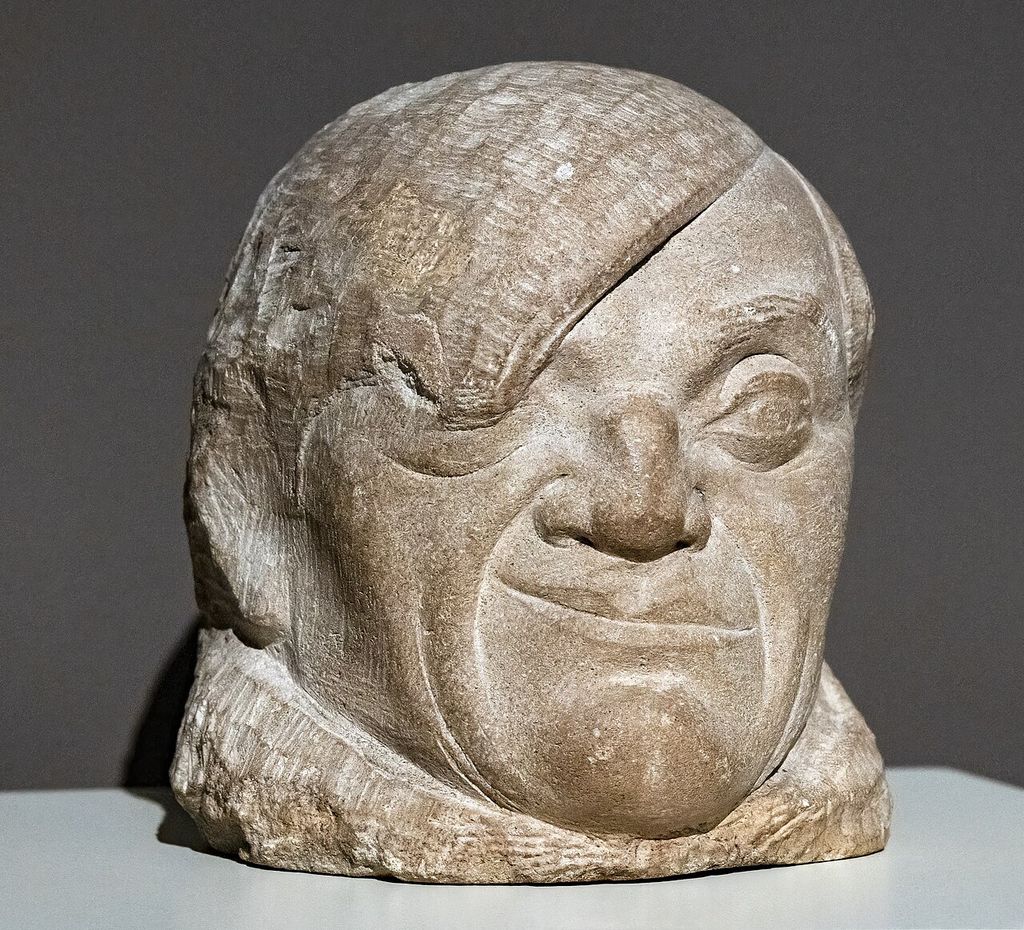
In autumn 1909 Picasso modelled Woman's Head (Fernande) in clay in Paris. MoMA relates it to portraits of Fernande Olivier made after a summer at Horta de Ebro. Its nose, cheeks and hair still form a recognisable head, but projected and recessed planes cause light to break across it differently as the viewer moves. The head is not a painting's fractured surface pasted onto a bust. It tests how a face can remain legible when its three-dimensional mass is divided into shifting parts.[3]
The original material and the museum object's material need to be kept apart. According to MoMA, Ambroise Vollard bought the clay in 1910 and arranged, with Picasso's permission, for plaster and bronze casts. A Berlin museum labels its own Frauenkopf (Fernande) as a 1909 work cast in 1959. Those records refer to related objects and moments of production, not a single instant at which every bronze existed. If a catalogue describes a 1909 sculpture, ask whether it is describing the model, the particular cast or both.[3][4]
MoMA treats this head as a significant experiment within Cubism, though its methods were still those of modelling. That matters because Cubist sculpture was not born in one instant of cardboard invention. Picasso explored faceted volume in a portrait before opening the interior of a guitar. Nor was he working alone in a vacuum: Fernande Olivier was a person in his life and a frequent subject, while dealers, plaster workers and founders affected how the clay head became a circulating bronze object. Their roles should be named rather than hidden by a single artist-and-date caption.[2][3]
Watch: Pablo Picasso
Explore Picasso through five videos from museums, broadcasters and art educators.
Picasso’s Guernica: Great Art Explained
Explore the composition and historical setting of Picasso’s best-known response to war.
Watch on YouTubeThe guitars and the opening of space
Between October and December 1912 Picasso made a Guitar from cardboard, paper, string and wire. The Museum of Modern Art describes pieces cut, folded, threaded and glued into a form that resembled an instrument without imitating its solid wooden body. The viewer recognises an outline and selected parts, yet can also look into the space where a guitar's enclosed body would be. In 1914 Picasso made a sheet-metal version. These are related constructions, not one object inexplicably described by two materials and two dates.[5][6]
The guitar's hole is particularly revealing. In an ordinary instrument it is an absence on the soundboard. In Picasso's construction, a projecting cylinder gives that absence a positive shape. Planes make volume without closing it; their shadows are real shadows, not painted shading. Looking from the side may unsettle what looked like a clear guitar from the front. A work can depend on recognition while refusing the usual way an object is built.[6][7]
This is one reason the guitars matter beyond the history of music in Picasso's pictures. A still life can depict a table, bottle and instrument on a flat surface; a construction places ordinary material and empty space in the room with us. Cardboard's fragility and sheet metal's durability are not incidental substitutes for marble. They shape what can bend, project, hang, cast a shadow and survive. The move across painting, collage and sculpture was a set of practical tests, not evidence that one medium had finally superseded the others.[5][6]
Picasso's Glass of Absinthe of spring 1914 tested another boundary. MoMA records six bronze casts made from a wax original and individually decorated by Picasso. He added a real slotted absinthe spoon to a modelled glass and sugar cube. The spoon retains its identity as a familiar utensil, even as it becomes part of a sculpture. The six versions also show that a cast need not be an identical, colourless duplicate: decisions after casting changed each object. A catalogue's phrase “one of six” should prompt comparison, not an assumption that all six look exactly alike.[8]
Iron sculpture and Julio González
Picasso returned to intense construction in metal at the end of the 1920s. The Museu Picasso Barcelona chronology records him beginning work in iron at Julio González's Paris workshop in October 1927. González, a Catalan sculptor with metalworking expertise, was a collaborator rather than an invisible technician. The Museo Reina Sofía places their work together at the centre of Picasso's exploration of welded forms around 1928–32.[9][10]
Woman in the Garden makes their contributions and the object's versions unusually clear. Reina Sofía describes an original painted-iron sculpture of 1929–30, conceived in connection with a memorial to the poet Guillaume Apollinaire. Its own object is a later, unique bronze version, welded by González at Picasso's request. The bronze is not the original iron object in another room, nor an ordinary edition of interchangeable casts. When comparing photographs or collection entries, material and institution must travel with the title.[10]
Long pointed forms, botanical shapes and open intervals make the figure seem to occupy space without filling it as a stone block would. One can look through and around it. The apparent lightness depends on difficult fabrication: joining pieces of metal so a large sculpture stands and holds its tensions. It would be inaccurate to credit the conceptual design to one artist and make the workshop labour disappear. González's own sculptural practice also developed in this exchange, as Reina Sofía's account of his work makes clear.[10][11]
Boisgeloup and the return to modelling
The story does not continue by abandoning mass. After buying the château at Boisgeloup in 1930, Picasso used a stable as a spacious sculpture studio. Large heads and other forms made there again gave weight to modelling. MoMA's Head of a Woman is a plaster object dated 1932. The Musée national Picasso-Paris records another Tête de femme, made in 1931–32, as an original in plaster and wood. Similar English titles can conceal distinct objects, so a reader should check date, inventory number and material rather than assuming every “Head of a Woman” is the same sculpture.[12][13]
Marie-Thérèse Walter is linked to several of the Boisgeloup heads, but that biographical fact is not a complete account of their forms. Eyes, nose, hair and cheeks become exaggerated volumes; a face can be monumental without behaving like a conventional likeness. The series asks what happens when parts that normally support recognition are enlarged, fused or made ambiguous. Museum interpretations of intimacy, fertility or eroticism are interpretations of specific works, not a licence to reduce every head to Picasso's private life.[12][13][14]
The German Städel Museum makes a second production-date lesson visible. It catalogues a Frauenkopf as a 1932 work with a bronze cast made in 1973. The museum describes it as one of four monumental heads, and its record includes the later casting as part of the particular object's identity. A photograph of bronze may not reveal that the original sculptural idea was explored decades earlier in a different material. Nor does the late casting turn the work into a newly conceived Picasso of 1973. The label lets us tell those histories apart.[14]
Two bull heads and the art of found objects
The Musée national Picasso-Paris holds a Tête de taureau made in spring 1942 from a bicycle saddle and handlebars. The saddle becomes a face; the handlebars become horns. The same pieces remain visibly bicycle components. The transformation works because neither identity quite cancels the other. The work is a compact example of assemblage—joining existing objects into a new visual relation—rather than a bronze modelled to look like recycled metal.[15][16]
There is a trap in the title. The same museum catalogues a different Tête de taureau, made at Boisgeloup in 1931, as bronze. “Picasso's Bull's Head” may therefore refer to more than one object. The 1942 original has a specific inventory number, MP330; the 1931 bronze is MP296. This is why identifying a sculpture requires a date and material, and ideally a collection record, not merely an image search result or an English translation of its title. For the motif beyond these two objects, see Picasso's bulls, minotaurs and bullfighting.[15][17]
Found-object construction was only one route through the war years. Picasso also modelled Man with a Lamb in occupied Paris, building clay on a metal armature. MoMA's discussion of its making emphasises the quick, visibly worked surface. Religious or wartime meanings have been proposed for the figure, but they should not be presented as a single documented intention. The important material contrast is plain: in one case Picasso found a bull already latent in two manufactured objects; in another he built a human figure by adding and pressing clay.[18]
Vallauris and sculptures made from ordinary things
In Vallauris around 1950 Picasso gave discarded and household components new jobs. The Paris museum's original La Chèvre includes plaster, a wicker basket, ceramic vessels, a palm leaf, metal, wood and cardboard. Its basket helps form the animal's body, while other objects suggest back, legs and udder. Their original functions remain partly visible. The sculpture therefore depends on the viewer moving between “basket” and “goat,” not on the illusion that it was carved from a single block.[19][20]
This method also makes the distinction between an original assembled work and a cast crucial. A bronze version of a found-object sculpture may preserve the shapes of objects that are no longer physically present in bronze as wicker, ceramic or cardboard. The Paris catalogue identifies its La Chèvre as the original mixed-material and plaster object; MoMA separately lists a She-Goat of 1950 cast in 1952. Treating those as identical material descriptions would erase the route by which the work reached a viewer.[19][21]
MoMA's account of Little Girl Jumping Rope describes a curved iron support prepared by a local ironworker, to which Picasso attached other components. The sculpture's seeming lightness is an engineered effect as well as a visual joke. It asks us to see a child in movement while noticing the precarious-seeming arrangement that makes the object stand. Across the Vallauris works, a found thing is not merely concealed inside a finished image; it can remain available for recognition and surprise.[22]
Cut metal and sculpture in public space
Later works again altered the relation between flatness and volume. The Paris museum records Femme aux bras écartés of 1961 as cut and folded metal with painted mesh, made at Cannes. Its exhibition research describes paper and cardboard models being translated into sheet metal with the help of specialist metalworker Joseph-Marius Tiola. Cutting and folding could turn a drawn silhouette into a standing form, while colour changed its appearance from different positions.[23][24]
The scale could expand beyond the studio. Research published by the Paris museum documents Picasso's collaboration with Carl Nesjar on concrete works using the Betograve process, in which the surface was blasted to expose aggregate. Picasso's designs and Nesjar's technical execution belong to the history of those works together. Their authorship cannot be responsibly described by saying Picasso alone carved every monumental surface with his hands.[25]
Chicago's Daley Plaza has a large Picasso sculpture unveiled in 1967. The city's landmark record identifies Cor-Ten steel, connecting the work materially to the surrounding civic building. Its form has invited many readings, but the official record does not settle it as one particular animal or person. In a public square, changing light, walking routes and the scale of buildings become part of how sculpture is encountered. That is a different kind of attention from the close, private looking required by a small Glass of Absinthe.[26][8]
How to look and how to read a label
Begin with the material and the action taken upon it. Was clay pressed, cardboard folded, iron welded, bronze cast or an existing object reoriented? Then walk around the work if access permits. A void between guitar planes, the open structure of Woman in the Garden, or the silhouette of a cut-metal figure may change dramatically with viewpoint. Photographs can help locate a sculpture, but a single front-facing image rarely conveys its space, back, weight or surface.[6][10][23]
Read dates carefully. “1909 (cast 1959)” records a model and a later material object; “1932 (cast 1973)” does the same in another case. Check whether a label says original plaster, bronze cast or a unique later version. Compare the inventory number when titles repeat, especially with Tête de taureau. Notice other named people—González, founders, metalworkers, Nesjar—whose skill helped move an idea into material. None of this diminishes Picasso; it makes the sculpture's actual history more visible.[4][10][14][15][17][25]
This page uses text and links to museum records, not unlicensed reproductions. A museum's online photograph is an invitation to study its object record, not permission for another site to republish the image. The sculptures themselves show why the distinction matters: an encounter with the 1942 saddle and handlebars, a later bronze cast, and a photograph of either are different kinds of object. Picasso's work in three dimensions is richest when those differences remain in view.[15][19]
Discussion
Use the evidence and your own close looking to explain your view. These are editorial prompts, not reader comments.
Reader Insights
Which component or empty space is essential to recognising the form?
How would your account change if the displayed object were a later cast?
What does a sculpture ask of a viewer moving around it that a photograph cannot show?
Join the Conversation
Which reading best fits the evidence?
References
- The Museum of Modern Art, “Picasso Sculpture,” 2015 exhibition overview. View source.
- The Museum of Modern Art, “Focus: Picasso Sculpture,” exhibition overview. View source.
- The Museum of Modern Art, “Woman's Head (Fernande),” object record. View source.
- Staatliche Museen zu Berlin, “Frauenkopf (Fernande),” object record. View source.
- The Museum of Modern Art, “Picasso: Guitars 1912–1914,” exhibition research. View source.
- The Museum of Modern Art, “Guitar,” 1914 sheet-metal object record. View source.
- The Museum of Modern Art, “Guitar,” curator and conservator discussion. View source.
- The Museum of Modern Art, “Glass of Absinthe,” 1914 object record. View source.
- Museu Picasso Barcelona, “Origen i cronologia,” Catalan chronology entry on González's workshop. View source.
- Museo Reina Sofía, “La femme au jardin,” Spanish object record and essay. View source.
- Museo Reina Sofía, “Julio González,” exhibition research. View source.
- The Museum of Modern Art, “Head of a Woman,” Boisgeloup plaster object record. View source.
- Musée national Picasso-Paris, “Tête de femme,” MP301 collection record. View source.
- Städel Museum, “Frauenkopf,” German object record for the 1932 work and 1973 cast. View source.
- Musée national Picasso-Paris, “Tête de taureau,” MP330, 1942 original. View source.
- Musée national Picasso-Paris, “L'assemblage,” thematic collection research. View source.
- Musée national Picasso-Paris, “Tête de taureau,” MP296, 1931 bronze. View source.
- The Museum of Modern Art, “Man with a Lamb,” sculpture audio discussion. View source.
- Musée national Picasso-Paris, “La Chèvre,” MP339 original object record. View source.
- Musée national Picasso-Paris, “La chèvre,” museum essay on its assembly. View source.
- The Museum of Modern Art, “2015 Museum Research Consortium Study Sessions: Picasso's sculpture,” listing the 1950 She-Goat cast in 1952. View source.
- The Museum of Modern Art, “Little Girl Jumping Rope,” curator discussion. View source.
- Musée national Picasso-Paris, “Femme aux bras écartés,” MP360 object record. View source.
- Musée national Picasso-Paris, Picasso. Sculptures, exhibition press dossier, French. View source.
- Nasher Sculpture Center, Catherine Craft, “From Steel to Concrete: Head of a Woman,” research on Picasso and Carl Nesjar's Betograve collaboration. View source.
- City of Chicago, “Daley Center” landmark record. View source.
Image Credits
- Didier Descouens. CC BY-SA 4.0. Source: Wikimedia Commons. Resized to 1024px; no crop. Source record. Licence.
