


 by Tom Gurney
Tom Gurney BSc (Hons) is an art history expert with over 20 years experience
Email: tomgurney1@gmail.com / Phone: +44 7429 011000
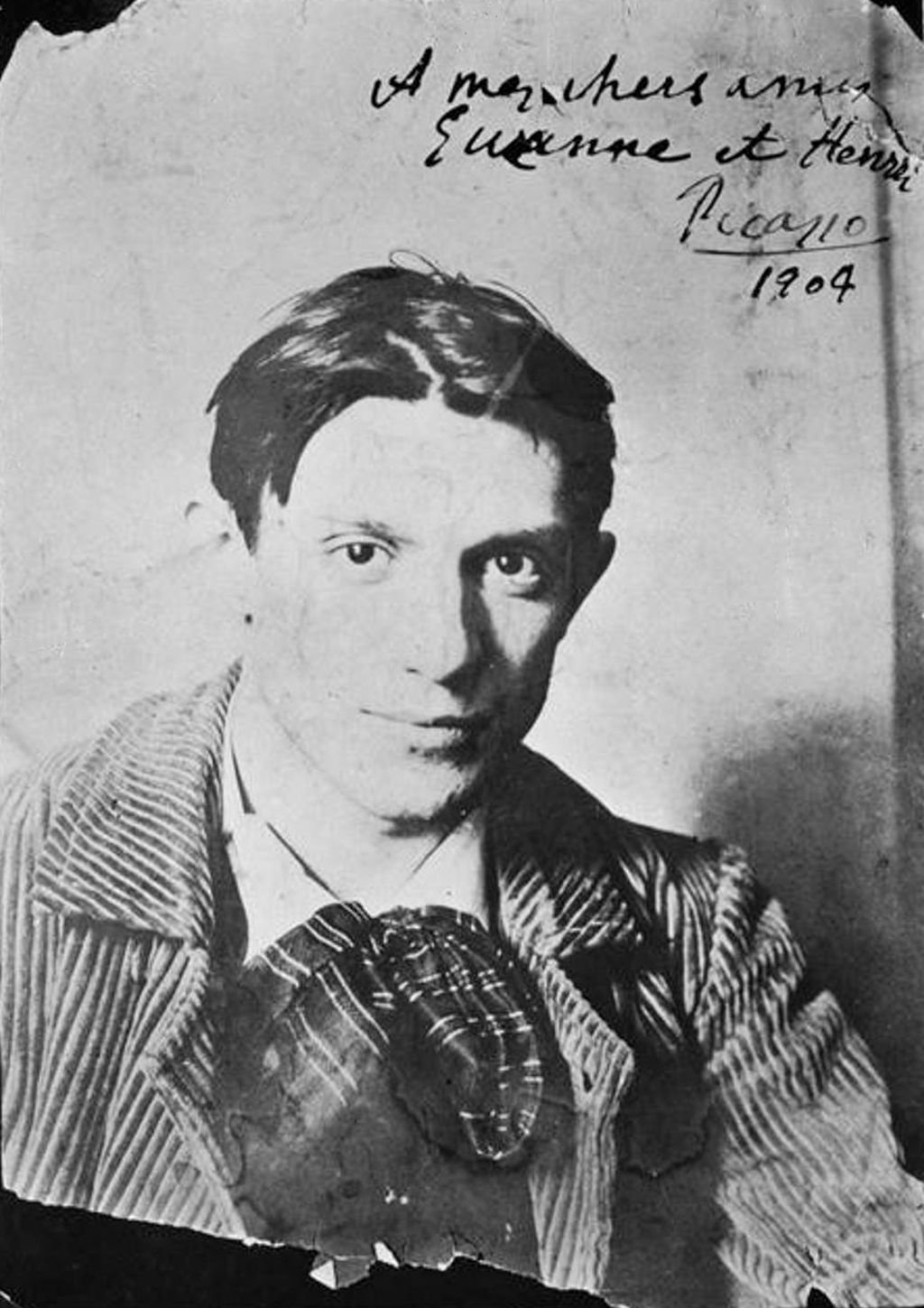
Introduction
An elderly musician bends over a guitar in The Old Guitarist. His body is narrow and angular, his head lowered, while the warm brown instrument cuts across a world of blue. Pablo Picasso made the painting in Barcelona in late 1903 or early 1904, near the end of the period now called his Blue Period. The image invites sympathy, but it does not tell us the man's name, the street where he might have played or the music he made. Its power rests in what Picasso chose to show: a person and an instrument held together in a space with almost nothing else to support them.[1][2]
The painting is in the Art Institute of Chicago, collection number 1926.253. The museum's current record describes it as oil on panel, measuring 122.9 by 82.6 centimetres. That material matters. An older Art Institute teaching guide calls it oil on canvas, but the present object catalogue and recent conservation discussions describe a wooden support. A reader trying to identify the original should follow the current holding-institution record rather than repeat an older label. The panel also holds physical evidence of earlier images beneath the guitarist, a history that makes this more than a study in blue colour alone.[1][2][3]
At a Glance
- Made: Barcelona, late 1903 or early 1904
- Period: Near the end of Picasso’s Blue Period
- Subject: An unidentified elderly musician with a guitar
The Old Guitarist in Picasso's career
First Communion
1896The Old Guitarist
1903–04Three Musicians
1921Las Meninas series
1957The highlighted work is dated with the qualifications explained in the sources on this page. The other works are selective points of comparison, not the start or end of a style.
Contents
- The figure and the guitar
- What the blue does
- The paintings beneath the guitarist
- Poverty, performance and uncertainty
- From Picasso's studio to Chicago
- What to take from the painting
The figure and the guitar
The musician is folded into a compressed pose. His legs cross low in the picture; his arms are drawn around the guitar; his head bends towards its body. The posture feels difficult to sustain, as though the figure has little room to extend. Picasso stretches limbs and sharpens joints rather than offering an anatomically neutral study. The effect is not merely that the man looks thin. The long arms and legs guide the eye around the instrument, making his body seem organised by the act of holding it.[1][2]
The Art Institute describes him as a blind musician. His eyes are closed or lowered in the painted face, and the museum has long used “sightless” in its interpretation. That does not identify a historical sitter or provide a medical history. We see a represented figure, not a case file. The label “old” is likewise part of the title and appearance, not a birth date. The painting gives enough information to suggest frailty and isolation while withholding the ordinary facts that would let us write the man's biography.[1][2]
The guitar is almost the only strong departure from the blue range. Its body is brown and rounded; its neck rises at an angle against the upright panel. The warmer colour and familiar shape help a viewer orient themselves before the dark clothes and blue setting become clear. The contrast can make the instrument feel like a source of support. It can also make the man's apparent dependence on it more painful. Neither response establishes that it was his “only hope,” that he played for food, or that music freed him from his circumstances. Those stories require evidence the picture and its catalogue do not give.[1][2]
The surrounding space is spare. Picasso provides a floor or ledge and enough tonal difference to place the body, but not the details of a recognisable café, lodging or Barcelona street. The Art Institute's older gallery guide calls the setting cramped and undecorated. With little to distract from the musician, the relation between bowed head, long hands and guitar becomes the painting's structure. A scene without a precise address can be intensely specific in its formal choices. The absence of furniture is not a licence to invent the outside world beyond the panel.[2]
At more than a metre high, the panel is also larger than a hand-held devotional image or a small sketch. The musician's downward head and the guitar's rising neck occupy a vertical field close to a viewer's own body scale. An online thumbnail tends to make the guitar the first and perhaps only obvious shape; standing before a work of this size, one can better follow the pale hands and legs that enclose it. The museum's measurements help restore that physical relation even for a reader who cannot see the original in Chicago.[1]
What the blue does
“Blue Period” can sound like a description of Picasso's private mood. It is more useful here as a name for a group of works from roughly 1901 to 1904 in which restricted blue ranges, flattened forms and figures marked by vulnerability became prominent. In The Old Guitarist, blue does not simply decorate a sad subject. It draws skin, clothing and background towards one another, while the guitar's brown interrupts the field. Colour makes the man's body seem part of the cold surrounding space and the instrument seem unusually tangible.[1][4]
The range is not one uniform pigment or one flat wash. Pale areas of the face, hair, hands and legs emerge against deeper blue and near-black passages. The guitar has its own tonal variations. Seen together, these changes make the body readable even though Picasso withholds much conventional modelling and setting. They also mean that “monochrome” is a description of the picture's dominant effect, not proof that no other colours or stages exist within the paint. Conservation work has found more varied colour in layers beneath the visible surface.[2][3]
The Art Institute relates the angular, elongated body to Picasso's interest in El Greco. The comparison is an art-historical reading, not a claim that the musician is a disguised saint or that one particular El Greco painting served as a traced model. Long forms and expressive distortion can connect artists across centuries while allowing very different subjects and meanings. Picasso's seated player has no religious attribute or sacred narrative supplied by the museum record. The Spanish precedent helps us notice how the body has been shaped; it does not solve the whole picture for us.[1]
The blue also has to be read alongside Picasso's movement between places and subjects. The Paris Picasso museum describes the early 1900s as a period of work in Barcelona and Paris, with images of people facing exclusion or precarious lives. Picasso's friend Carles Casagemas died in 1901, a loss that the museum treats as part of the wider Blue Period context. Yet The Old Guitarist was made more than two years later. One event, however important, cannot by itself explain every colour, gesture and choice in this later Barcelona panel. Picasso was working within a developing visual language, not mechanically illustrating a single episode of grief.[1][4]
Watch: Pablo Picasso
Explore Picasso through five videos from museums, broadcasters and art educators.
Picasso’s Guernica: Great Art Explained
Explore the composition and historical setting of Picasso’s best-known response to war.
Watch on YouTubeThe paintings beneath the guitarist
The surface visible now is not the first image Picasso placed on this panel. A woman's face can be discerned through parts of the blue background, and technical study has revealed earlier compositions below the finished painting. In a 2015 Barcelona conservation seminar, Art Institute conservator Allison P. Langley presented research that the Museu Picasso Barcelona later summarised in Spanish and Catalan. It identified a maternity scene beneath the guitarist and an earlier figure beneath that, related in form to a standing nude in Picasso's 1903 La Vie. The layers make the panel a record of several pictorial decisions, not a canvas with one secret portrait waiting to be named.[3]
The maternity image matters because a female face visible through the blue can otherwise look like an accidental ghost. Technical imaging gives it a context: the face belonged to another composition. The museum's report also connects that imagery with a sketch in a letter to Picasso's friend Max Jacob. Such a drawing can help researchers recognise a motif, but the letter and panel are different pieces of evidence. A sketched composition does not, on its own, date every layer of paint or prove why Picasso abandoned one picture for another.[3]
The still earlier figure, linked by the conservators to the standing nude in La Vie, places the panel within a wider set of Blue Period experiments. “Linked” does not mean that the Chicago panel contains La Vie itself. That painting belongs to the Cleveland Museum of Art and has its own history. The comparison is about a recurring form and Picasso's reuse or reworking of figure ideas. Keeping the objects separate prevents the exciting discovery of an underpainting from becoming an exaggerated claim that one famous work literally lies beneath another.[3][4]
The final guitarist changed during its own making. The Barcelona account reports evidence that the first conception of the main figure was younger and unbearded, with facial features related to male-head studies from Picasso's earlier training. The old man in the finished picture was therefore not simply placed over earlier compositions in one unaltered act. Picasso continued adjusting the protagonist who would dominate the final surface. This complicates the familiar story that he merely painted over a failed work because he lacked materials. The layers show revision and reuse; the exact practical and artistic motives are not all recoverable.[3]
Technical discoveries should sharpen our attention to the visible painting, not replace it. The hidden scenes are not clues to an inevitable meaning such as “the mother is the guitarist's memory.” Nor is there evidence that a Weeping Woman portrait of the 1930s was painted underneath a panel finished around 1904. The stronger conclusion is more interesting: Picasso used the same support for several images and altered the guitarist as he worked. The picture now known for its spare blue surface was built through a more varied and unsettled process.[1][3]
Different examination methods answer different questions. Raking light makes ridges and texture on the surface easier to notice; imaging that penetrates or distinguishes layers can reveal forms that normal light cannot separate. The Barcelona report brings these observations together rather than claiming that the visible female face alone tells the whole story. A face seen under blue paint is a clue. The maternity composition, still earlier standing figure and revised guitarist depend on comparison between the object, technical images and related drawings. Their sequence is a material finding; their emotional meaning remains a matter of interpretation.[3]
The painting's wooden support is part of this history, too. Reusing a panel does not tell us whether Picasso lacked the price of a new one at the exact moment he changed his composition. Artists reuse materials for many reasons, including practical economy and a wish to make another image over an unsatisfactory one. The Art Institute records financial hardship as background to the period, but the panel cannot distinguish those motives by itself. It is more accurate to say that Picasso painted over earlier work than to turn the support into proof of a specific day of hunger.[1][3]
Poverty, performance and uncertainty
The Art Institute interprets the musician in relation to poverty and marginalisation, and its object account notes Picasso's own financial difficulty in this period. Those are defensible historical contexts. But a picture of an apparently poor musician is not a documentary record of a specific person's earnings. We cannot tell from the panel whether he plays professionally, begs, sings on a street, or performs for someone outside the frame. To say he “must” be seeking food turns a visual cue into an unverified fact about a person we cannot identify.[1][2]
The question of dignity is similarly open. The man is shown with a task and an instrument, not simply displayed as a helpless body. His attention appears concentrated on the guitar. At the same time, the constrained pose and near-empty setting can make him seem exposed. These features allow viewers to ask how the picture balances activity and vulnerability. They do not permit a confident account of what the man himself feels, or even a claim that Picasso saw him performing at a particular site in Barcelona.[1][2]
This restraint matters because Blue Period works are often read as direct translations of Picasso's own suffering. The museum does connect his interest in such subjects with economic hardship and with social sympathy. Yet a painted guitarist remains another figure, not automatically Picasso in costume. The composition may invite a metaphor of the struggling artist, but that is a reading of the image. It should be offered as one possibility, not a discovered self-portrait or a statement Picasso is known to have made about this canvas.[1]
The instrument itself sustains more than a metaphor of income. Its strings and neck suggest performance even though the picture cannot make a sound, and the hands give the old man an action rather than leaving him wholly passive. This is why the brown body matters as much as a colour accent: it is the object to which the figure directs his remaining energy. Whether the act is consoling, laborious, habitual or necessary is left to the viewer to consider. Picasso presents an activity, not an explanatory caption for it.[1][2]
The work can also be compared with other images of the period without making them identical. La Vie places several figures in an ambiguous encounter; the Washington National Gallery's The Tragedy brings three people together at a shore. Here, one person dominates the field, and his relation to the guitar takes the place of a human exchange. Blue colour and human vulnerability connect the paintings, but their arrangements differ. A visitor learns more by comparing how each picture uses space, body and relationship than by assigning them all the same mood in one word.[3][4]
From Picasso's studio to Chicago
The Art Institute's provenance record begins with Ambroise Vollard in Paris around 1906, noting that his acquisition directly from Picasso is probable rather than certain. It then traces the painting through the American collector John Quinn in 1915, Quinn's estate, a 1926 sale involving Paul Rosenberg, and Frederic Clay Bartlett. It entered the Art Institute in 1926 as part of the Helen Birch Bartlett Memorial Collection. These documented steps explain how an early Barcelona painting became a Chicago museum work without inventing a continuous account for every year or every intermediary.[1]
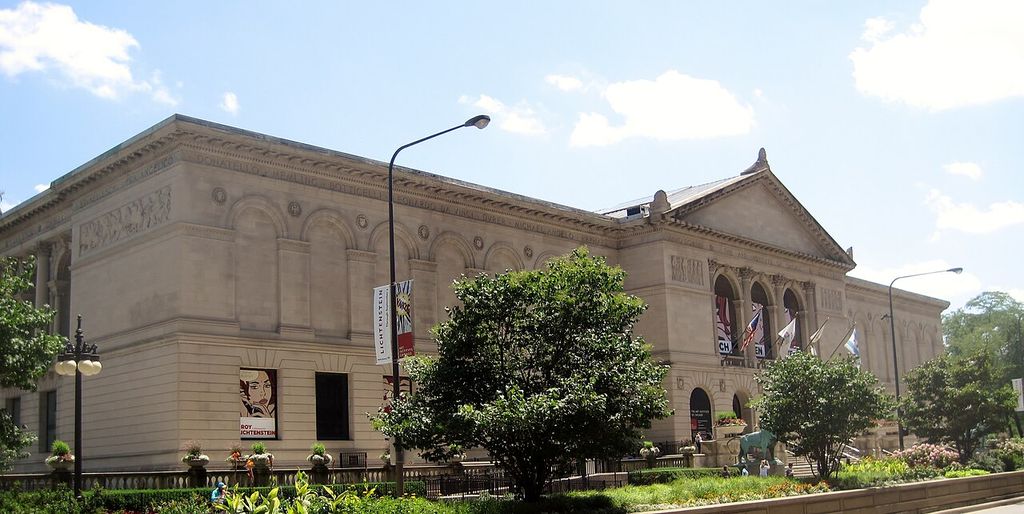
An Art Institute essay on Vollard says the painting was probably included in his 1910 retrospective of Picasso's earlier work. That word is important: the museum presents a plausible exhibition appearance, not a confirmed one. The same essay notes that Vollard's relationship with Picasso began with a 1901 Paris show and that he later bought important Blue and Rose Period pictures. The 1910 possibility, if correct, places The Old Guitarist before viewers who knew Picasso's work before his Cubist experiments became the standard lens for his career.[5]
Later reception can add another layer of confusion. The Art Institute holds David Hockney's Blue Guitar print series, made in 1976–77 in response to Wallace Stevens's 1937 poem The Man with the Blue Guitar. A sheet in Hockney's series juxtaposes the Chicago guitarist with later Picasso imagery. It is easy to reverse that chain and say Stevens wrote his poem about this precise painting. The Art Institute cautions that Stevens denied any single picture inspired the poem. Hockney's later visual response is documented; a one-to-one origin story for the poem is not.[6]
The distinction between painting and later responses is useful. A poem, a print, a museum display and an online reproduction can all make the guitarist mean something new to viewers. None changes the work's recorded date, medium or support. Nor does the popularity of the image settle the unidentified musician's life. The museum's current object record is the reliable starting point for those facts, while its conservation research opens questions about how Picasso made the painting we see today.[1][3]
What to take from the painting
The Old Guitarist rewards two kinds of looking. At the surface, follow the folded body, the pale limbs, the near-empty blue surroundings and the contrasting brown instrument. Beneath that surface, remember that the panel carries abandoned figures and changes to the musician himself. The visible simplicity was reached through a complicated history of making. Neither level alone gives the painting its force.[1][2][3]
The safest interpretation also leaves room for the viewer. The guitarist is represented as old and blind; his identity, song and exact circumstances are unknown. Picasso's Barcelona setting and Blue Period concerns are documented, while the meaning of every formal choice is not. The painting can be understood as a concentrated image of vulnerability and persistence without being reduced to a diagnosis of Picasso, a sentimental story about one street performer, or a puzzle whose answer lies entirely in an X-ray. Its held silence is part of what keeps us looking.[1][3][4]
Discussion
Use the evidence and your own close looking to explain your view. These are editorial prompts, not reader comments.
Reader Insights
How does the brown guitar change the balance of the blue figure?
What can conservation evidence tell us about revisions beneath the painting?
Why should the man’s identity remain open rather than be invented?
Join the Conversation
Which reading best fits the evidence?
References
- Art Institute of Chicago, The Old Guitarist, 1926.253; official collection API record.
- Art Institute of Chicago, historical colour and looking guide. Its “oil on canvas” label is superseded by the current object record.
- Museu Picasso Barcelona, Spanish account of Blue Period conservation research; Catalan account.
- Musée national Picasso-Paris, the Blue and Pink Periods.
- Art Institute of Chicago, Vollard exhibition essay.
- Art Institute of Chicago, Hockney's Blue Guitar title page; official collection API record.
Image Credits
- Ricard Canals i Llambí, 1904. Wikimedia Commons labels the photograph public domain; its source credits RMN-Grand Palais. Resized to 1024px; no crop. Source record. Licence.
- Teemu008, Art Institute of Chicago, 20 June 2012. Flickr / Wikimedia Commons, CC BY-SA 2.0. Proportional resize only; derivative retains CC BY-SA 2.0. Source record. Licence.

.jpg)