


 by Tom Gurney
Tom Gurney BSc (Hons) is an art history expert with over 20 years experience
Email: tomgurney1@gmail.com / Phone: +44 7429 011000
Introduction
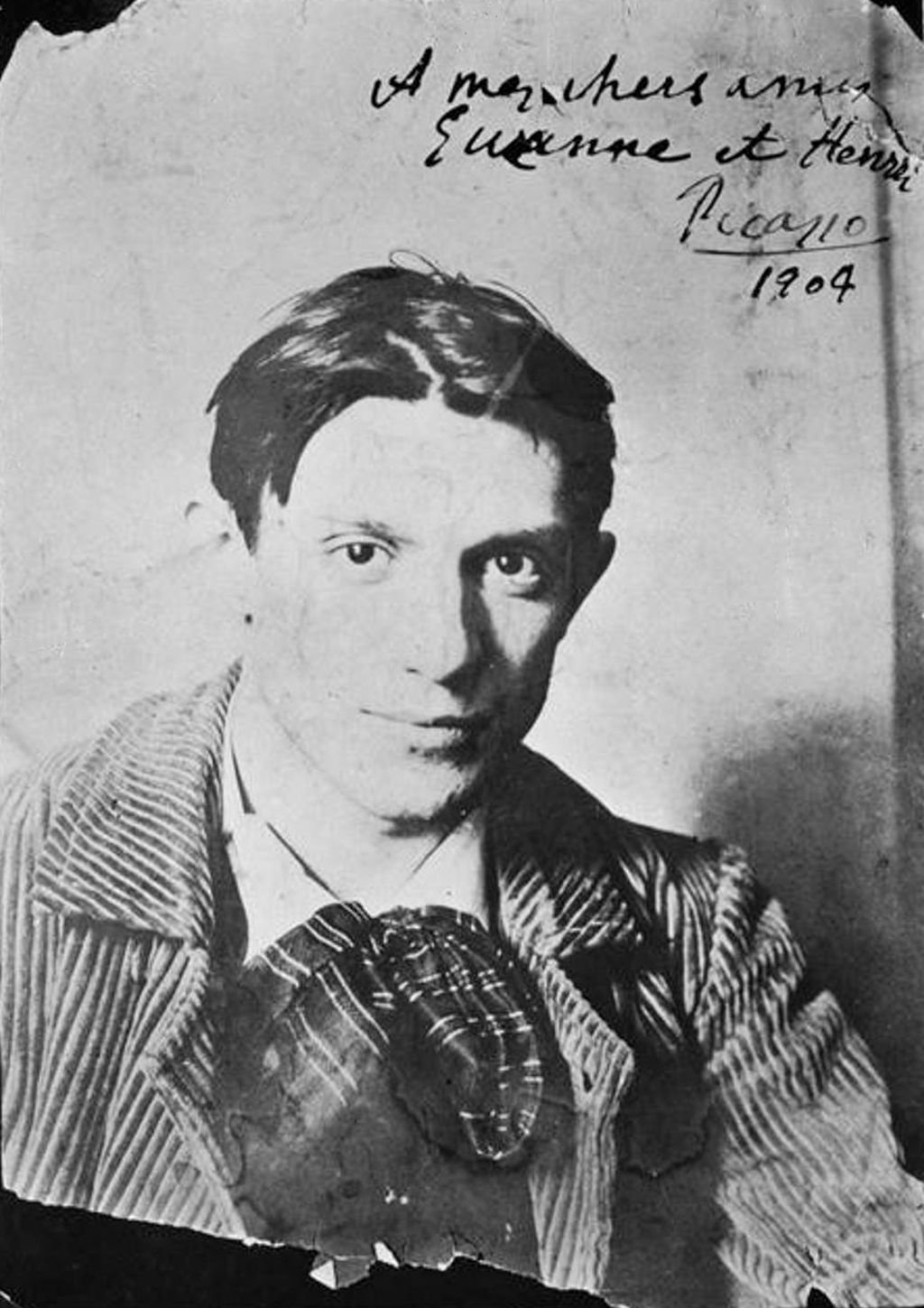
Picasso's Blue Period was not a sudden decision to paint everything blue. It developed between his journeys through Spain and Paris, beginning around autumn 1901 and giving way gradually to a warmer palette in 1904–05. During those years he made images of people alone, in pairs and in families: a man bent over a guitar, a woman sheltering a child, an old figure at the sea, a young artist presenting himself as prematurely worn. Blue binds many of these works together, but their subjects, materials and meanings differ.[1][2][3]
The period is often explained through the suicide of Picasso's friend Carles Casagemas. That loss mattered profoundly and prompted a group of paintings about him. It does not, by itself, explain the women Picasso observed at Saint-Lazare, the artistic models he studied, the Barcelona works he revised, or the formal choices by which a limited range of colours could make bodies and spaces newly expressive. A fuller view of the Blue Period holds biography, social observation and artistic experiment together.[1][4]
At a Glance
- Approximate dates: From autumn 1901 to a gradual transition in 1904–05
- Principal places: Paris and Barcelona, with the artist moving between them
- Characteristic palette: Predominantly blues and blue-greys, not an absolute ban on other colours
- Recurring subjects: Isolation, poverty, maternity, illness, labour, ageing and human relationships
- Media: Painting, drawing, pastel, sculpture and printmaking
- Important works: Self-Portrait (1901), The Blue Room (1901), Crouching Beggarwoman (1902), The Soup (1903), La Vie (1903), The Tragedy (1903), The Old Guitarist (late 1903–early 1904), La Célestine (1904) and Woman Ironing (1904)
Contents
- When the Blue Period began
- Casagemas, grief and the limits of biography
- Paris and Barcelona as connected places of work
- What blue does in the pictures
- People, poverty and the danger of easy labels
- Key works from 1901 to 1904
- Drawing, pastel, sculpture and printmaking
- What scientific study reveals
- Artistic sources and the move toward rose
- Questions about Picasso's Blue Period
When the Blue Period began
There is no dated manifesto announcing the start of Picasso's Blue Period. Its beginning is better understood as a change visible across a sequence of works. His summer 1901 exhibition at Ambroise Vollard's Paris gallery showed energetic engagement with the colour, nightlife subjects and styles of modern painters such as Van Gogh, Degas and Toulouse-Lautrec. The Musée d'Orsay describes a turn inward in the autumn, when blue became increasingly important within pictures that also recalled café scenes, harlequins and the death of Casagemas.[1]
The shift did not happen in one city alone. Picasso had travelled to Paris with Casagemas in 1900, spent time in Madrid, returned to Paris, and moved between the French capital and Barcelona over the following years. He brought ideas and works across that route. The Fondation Beyeler's German exhibition account likewise places the growing dominance of blue in late summer and autumn 1901, then follows the paintings through his alternating stays in Paris and Barcelona.[3]
Picasso returned to Barcelona at the beginning of 1902. Some museum accounts describe this as the point at which the blue idiom fully flowered, while others place its first visible emergence in Paris late in 1901.[1][3] The difference is less a factual contradiction than a question of what counts as the beginning: the first notable use of a colour, a developing group of related pictures, or a mature style. “About 1901–04” is a useful shorthand; it should not make the process seem mechanical.
Nor does the period end at the stroke of midnight in 1904. Picasso settled more permanently in Paris that year, and new circus subjects and warmer colours became increasingly prominent. The Musée d'Orsay describes a subtle passage through the last weeks of 1904 and early 1905, with some figure types continuing even as the palette widened.[1] Blue and rose are names for dominant tendencies in changing work, not sealed compartments.
Casagemas, grief and the limits of biography
Carles Casagemas, an artist and close friend of Picasso, died by suicide in Paris on 17 February 1901. Picasso was in Madrid when he learned of the death. Months later he painted Casagemas in several works. The Musée d'Orsay notes that The Death of Casagemas still uses the vigorous handling of his earlier Paris pictures, while blue becomes more pronounced in subsequent images of his friend.[1] This sequence alone shows why the story cannot be reduced to “Casagemas died, so Picasso immediately painted blue.”
The loss is inseparable from the period's history, yet a life event is not a universal caption. Many later Blue Period figures are not portraits of Casagemas, and some are not portraits of anyone whose name survives. Their bent heads, elongated limbs or withdrawn expressions may invite empathy without supplying medical evidence about Picasso's own mental health. It is reasonable to say that grief formed part of his world. It is not reasonable to diagnose every work as a direct symptom of an enduring depression.[1][4]
The point becomes clearer when looking at what else Picasso was doing. In 1901 he was exhibiting, absorbing modern French painting, drawing and making portraits. In 1902–03 he was developing compositions across several media and reworking existing supports.[1][5][18] These are signs of an active artistic practice, not merely a passive record of unhappiness. The best accounts of the period keep its emotional force while asking how that force was made visible.
Watch: Pablo Picasso
Explore Picasso through five videos from museums, broadcasters and art educators.
Picasso’s Guernica: Great Art Explained
Explore the composition and historical setting of Picasso’s best-known response to war.
Watch on YouTubeParis and Barcelona as connected places of work
Paris exposed the young Picasso to modern painting, dealers and new audiences. His Vollard exhibition opened on 25 June 1901 and closed in July. It brought him critical notice and introduced him to the poet Max Jacob.[1] The show preceded the fullest development of the blue idiom, so it is misleading to present the Blue Period as though Picasso had arrived in Paris with a finished style.
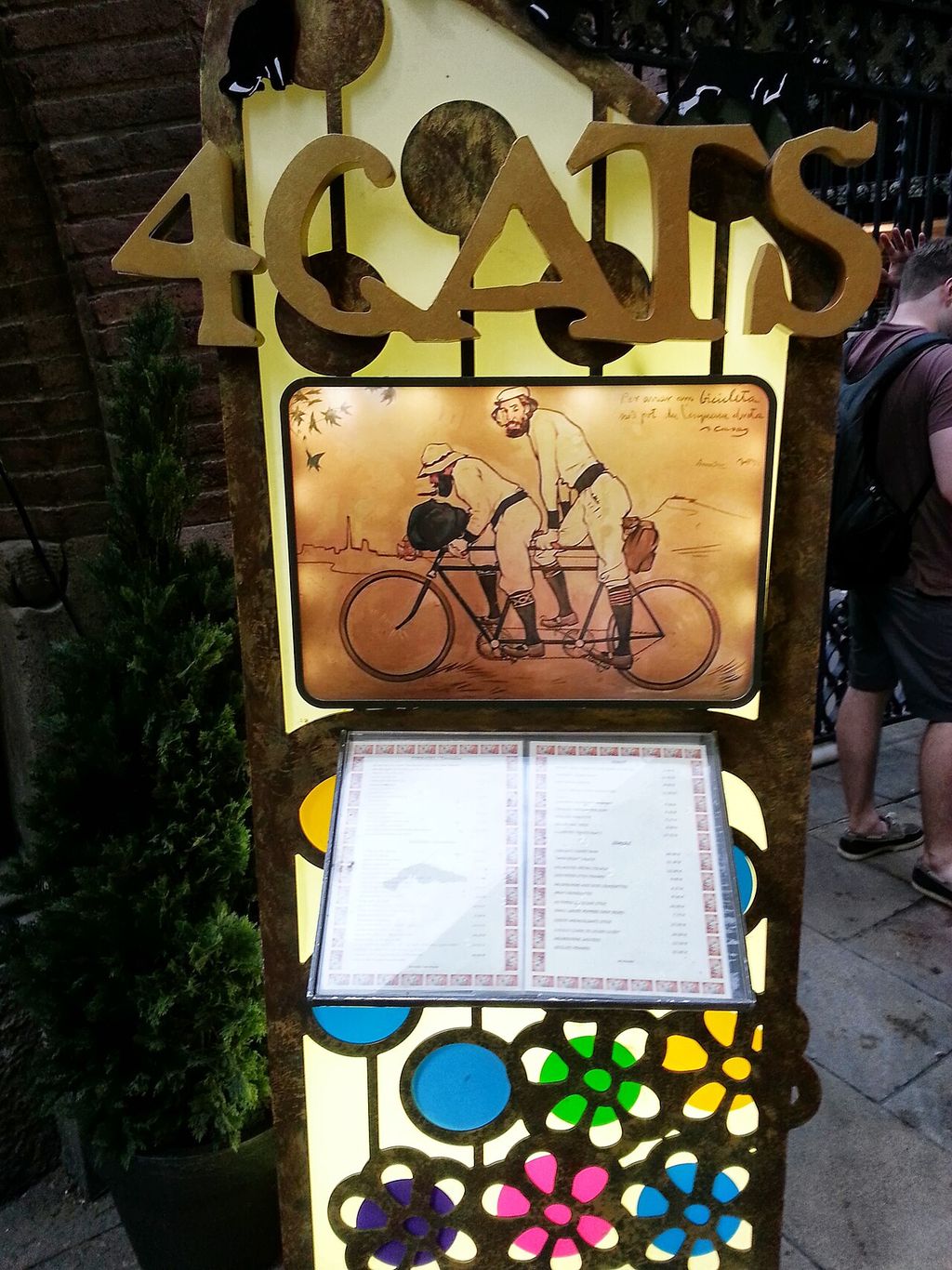
Barcelona was not simply a place to which he retreated. It had an active artistic culture around Els Quatre Gats, with painters such as Ramon Casas and Santiago Rusiñol, and it remained a site of his own studios, friendships and ambitious work. The Musée d'Orsay stresses the interaction of Catalan modernism, Spanish painting and what Picasso had encountered in Paris.[1] The Art Gallery of Ontario and the Phillips Collection likewise frame the period through movement between the two cities rather than through a one-way story of French influence.[5]
The different places matter for individual works. The Phillips Collection's Blue Room was made in Paris in 1901; the Art Gallery of Ontario's Crouching Beggarwoman and The Soup were made in Barcelona in 1902 and 1903 respectively.[5] La Vie, one of the most complex paintings of the period, was developed in Barcelona in 1903.[7] These works belong to one broad phase, but their settings, sources and material histories cannot be folded into a single Parisian legend.
The prison and hospital of Saint-Lazare are part of this geography too. The Musée d'Orsay records Picasso visiting the women's prison in Paris in autumn 1901. Some women there were held with children; clothing and head coverings from that environment entered his work, transformed into solemn, stylised figures.[1] These subjects then continued to evolve after his return to Barcelona. An artist's observation became a visual language, but the people observed should not disappear behind a sentimental label such as “the downtrodden.” They were women in a specific institution, living under coercive conditions, even when the paintings do not preserve their names. Our drawings guide's study of Two Sisters examines one related sheet and distinguishes it from another study with a similar title.
What blue does in the pictures
Blue is more than a sign that the subject is sad. It can cool flesh, join a figure to a shadowed room, reduce the distance between a body and its surrounding air, or make a small difference of light stand out sharply. The range is broader than a single pigment or a single hue. Across the period one finds turquoise, indigo, blue-green, grey and occasional warm accents. The Musée d'Orsay describes many variations within the paintings and a search for expressiveness in form as well as colour.[1]
Compare a few kinds of space. In The Blue Room, the colour belongs to an interior with a bather and visible furnishings.[5] In The Tragedy, the sea and sky surround three barefoot people who stand close together but do not seem able to comfort one another.[8] In The Old Guitarist, a thin body folds around the instrument; its warmer brown becomes conspicuous against the blue field.[9] Blue unifies each image differently. It does not supply the same narrative to all three.
Picasso also altered the human figure. Elongated hands, thin bodies and simplified forms can intensify a gesture or a posture. The Museu Picasso Barcelona's 1903 pastel Desemparats—a mother and child—uses blue to create a cold atmosphere while allowing their faces to remain luminous. Its Catalan object account points to the mother's enlarged hand and to El Greco as one formal comparison.[10] The distortions are not mistakes in anatomy. They direct attention to sheltering, touch and the weight of a body.
Where a picture approaches monochrome, a slight change becomes more meaningful. A pink face, a brown guitar, a white cloth or the difference between the sky's blue and a coat's blue can carry the eye across the work. Calling the paintings “blue” should sharpen attention to those differences, not erase them.
People, poverty and the danger of easy labels
The Blue Period includes many images of people with little visible security: beggars, prisoners, workers, solitary drinkers, old people and parents with children. Museums often speak of poverty and social alienation because those conditions are important to the period.[1][5][6] Yet one should not turn every anonymous figure into an interchangeable emblem of misery.
Some works invite a more precise account. The Guggenheim describes Woman Ironing as a 1904 image of a Parisian laundress engaged in hard physical work; her lowered head and pressing arms make labour, not simply sadness, central to the composition.[11] The women associated with Saint-Lazare belonged to a particular prison and hospital system. La Célestine was painted in Barcelona in March 1904 and is identified by the Musée Picasso Paris with Carlotta Valdivia, a brothel keeper; the title also draws on the character from Fernando de Rojas's Spanish work.[12] These subjects have different histories, and a serious account should keep them different.
The theme of maternity is equally varied. A mother may bend toward a child, shelter one, hold one, or remain separated from one by a complicated composition. In Desemparats, the Barcelonan museum sees protection in the mother's hand and clothing.[10] La Vie places a woman with a baby opposite a couple and two painted groups within the picture; the Cleveland Museum of Art records multiple interpretations rather than one authorised explanation.[7] Maternity is neither always a comforting refuge nor always a simple image of deprivation.
Picasso's own erotic and caricatural drawings from 1901–03 provide a further caution. The Musée d'Orsay presents them as a countercurrent to the solemn pictures, not as work by a different artist or a later phase.[1] The Blue Period was never a moral universe in which every image spoke in the same sorrowful tone.
Key works from 1901 to 1904
Picasso's 1901 Self-Portrait, now in the Musée national Picasso-Paris, is one familiar point of entry. He appears in dark clothing, his face pale and older-looking than his age. The picture is often read biographically, but it also shows the artist choosing how to present himself. The Musée d'Orsay sets it beside earlier self-portraits that absorb other modern painters' styles, making it part of a sequence of deliberate artistic identities.[1][2]
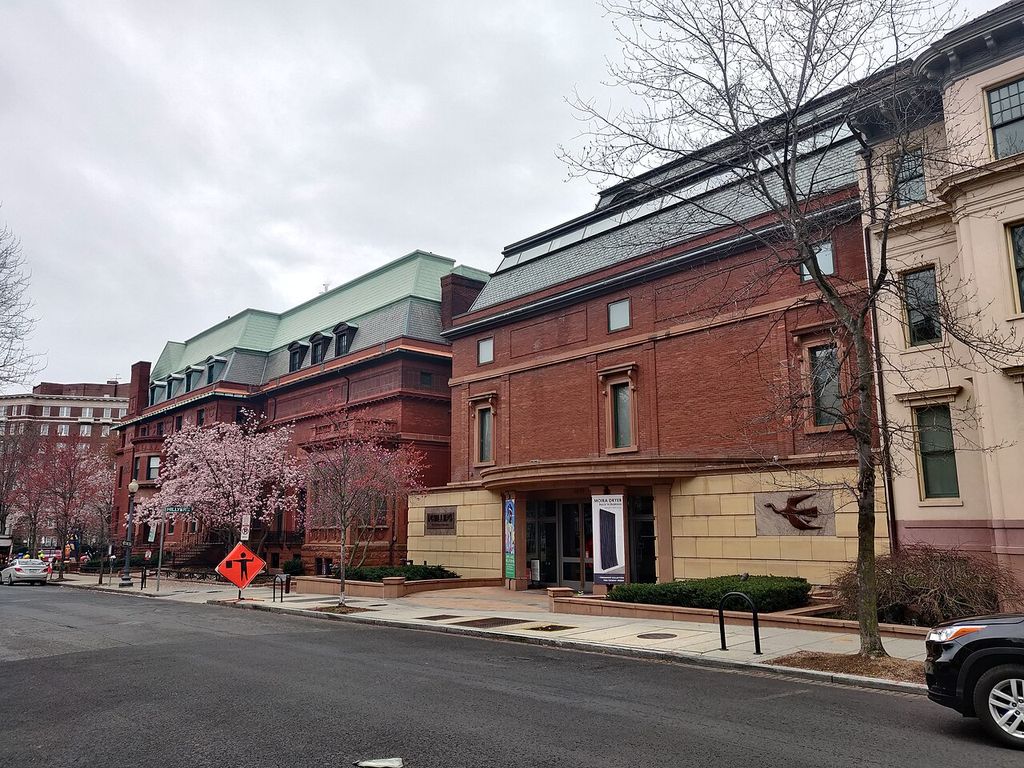
The Blue Room and Crouching Beggarwoman show the period forming across Paris and Barcelona. The former retains the life of an interior; the latter draws a lone figure inward. The Art Gallery of Ontario notes that imaging of Crouching Beggarwoman has revealed an earlier landscape whose contours Picasso used in shaping the visible figure.[5][13] Such evidence makes the painting a record of composition and alteration, not just of a fixed mood.
In 1903, The Soup makes a bowl passed between a woman and child the centre of an encounter. La Vie sets figures in a much more elaborate and disputed relationship. The Cleveland museum describes interpretations ranging from a working-class scene to a meditation on the cycle of life.[7] The Museu Picasso Barcelona's research traces studies and an earlier work beneath La Vie, showing how its meaning emerged through revisions rather than appearing fully formed.[14]
The Tragedy narrows the setting again to a shoreline and three figures. Their postures suggest distress, but the National Gallery of Art supplies no single event to explain it. Technical imaging has also found earlier compositions and drawings beneath its 1903 image.[8][15] It deserves to be read as a distinct painting, not merely as another blue illustration of Picasso's grief.
At the turn of 1903–04, The Old Guitarist presents a solitary player bent almost into the shape of his instrument. La Célestine of March 1904 confronts the viewer with a named Barcelonan woman whose identity is also transformed by literary association.[9][12] In spring 1904, Woman Ironing shows a worker whose body bears the pressure of her task. Together, these works demonstrate how many different human situations Picasso brought into a restricted palette.[11]
Drawing, pastel, sculpture and printmaking
The name “Blue Period” can suggest a line of paintings in museums, but Picasso worked in other forms throughout these years. The Musée d'Orsay explicitly includes drawing, sculpture and engraving within the period's experimentation.[1] Ink and pencil could test the fall of a body or the relation between two figures before a large painting was resolved. The Museu Picasso Barcelona preserves studies for La Vie and works such as the pastel-and-charcoal Desemparats.[10][14]
The move across media mattered because the same question could be tried at different speeds and scales. A sheet might isolate a hand or a pose; a painting could give that gesture a setting and a palette. A sculpture asked the artist to think about a figure in volume rather than only as a contour on a surface. The Musée Picasso Paris records his first sculpture in clay in 1902, close to the formative years of the blue paintings.[2]
Printmaking entered this world as well. Picasso etched The Frugal Repast in 1904, depicting a couple at a sparse table. The Museu Picasso Barcelona records that he worked on a zinc plate previously marked by Joan González and learned aspects of etching from his friend Ricard Canals. The Metropolitan Museum of Art distinguishes the etching's creation in 1904 from the larger edition published by Ambroise Vollard in 1913.[16][17] This distinction keeps the Blue Period subject in its original moment while recognising the later life of its prints.
These examples make the period more than a colour category. Picasso was studying form, changing scale, reusing materials and finding ways for graphic line, paint and sculptural volume to carry related concerns.[1][5]
What scientific study reveals
Recent conservation research has added a material history to familiar Blue Period images. The Art Gallery of Ontario and the Phillips Collection studied The Blue Room, Crouching Beggarwoman and The Soup together, using imaging and historical inquiry to understand what lies beneath their visible surfaces.[5] The Museu Picasso Barcelona's Projecte blau examined four paintings from 1901–04 and found earlier compositions under each; the hidden images are not always related to the visible subject.[18]
These findings resist an easy story of Picasso creating each blue picture in one spontaneous act. In La Vie, radiographs and related drawings document major revisions over an earlier painting, Last Moments.[14][19] Beneath The Tragedy, infrared study shows a horse, caricatures and drawing associated with the final figures.[15] The Guggenheim's study of Woman Ironing found a male portrait below the laundress.[11]
The technology also has limits. Infrared and X-ray images reveal particular materials or structures, not an artist's private motive. A false-colour reconstruction is not a photograph of how a lost painting once appeared; the Guggenheim explicitly warns that its images of the portrait under Woman Ironing do not establish that earlier picture's original palette.[11] Material evidence can change art-historical interpretation without turning every hidden layer into a secret message.
It is equally unsafe to generalise a single pigment across the period. The AGO has identified Prussian blue in specific contours of Crouching Beggarwoman.[13] That is a finding about that work and those examined areas, not proof that every Picasso blue of 1901–04 used the same material. The palette must be studied object by object.
Artistic sources and the move toward rose
Picasso's Blue Period grew from looking as well as living. The Musée d'Orsay traces his encounters with Van Gogh, Degas and Toulouse-Lautrec, alongside Catalan modernists and the long Spanish tradition. The Fondation Beyeler adds Symbolism and El Greco to the discussion of the blue pictures.[1][3] These are not names to attach mechanically to every painting. They help explain why elongated bodies, flat passages of colour, dramatic outlines and restrained settings could all become available to the young artist.
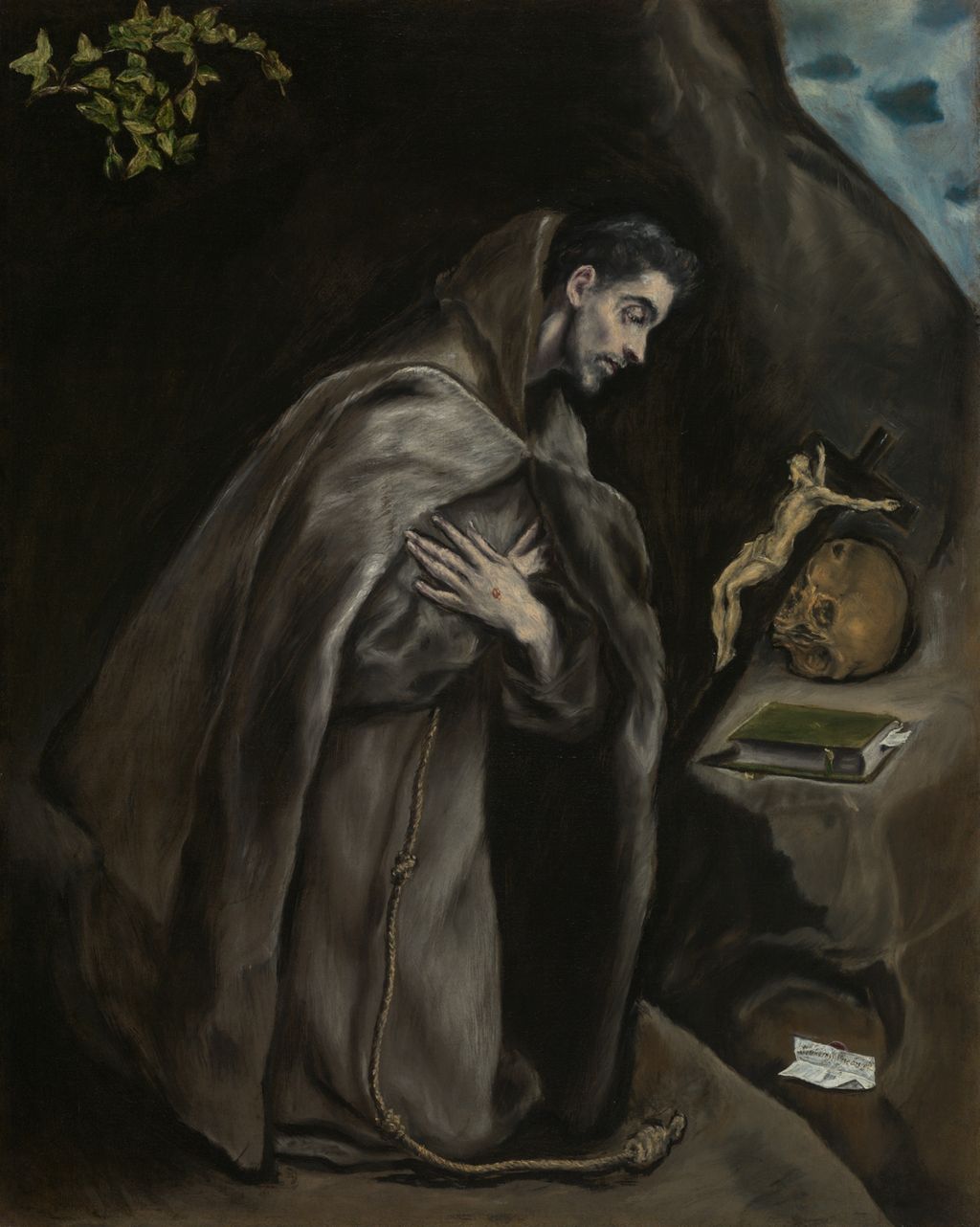
El Greco is particularly useful as a formal comparison. In Desemparats, the Barcelona museum points to the enlarged hand and a newly forceful treatment of the body.[10] The relationship is more precise than saying Picasso merely “copied El Greco.” He could take an expressive possibility from an older painter and use it for a different modern subject.
By late 1904 and early 1905, the dominant motifs and colours were changing. Circus performers, harlequins and acrobats became increasingly visible, while rose, ochre and warmer greys broadened the range. The Musée d'Orsay cautions that this was a gradual transition, with serious, sometimes melancholic figures persisting into the so-called Rose Period.[1] It is therefore wrong to make the change a cheerful ending to a medically defined episode of sadness.
The continuity is as interesting as the contrast. Picasso remained concerned with people who live together yet stand apart, with performed identities and with bodies simplified into eloquent shapes. What altered was the balance of subjects, palette and visual language. The Blue Period was not a closed prelude to Cubism; it was a substantial achievement in which he learned how much a colour, a gesture and an altered form could ask of a viewer.
Questions about Picasso's Blue Period
It began to emerge around autumn 1901 and remained dominant through about 1904. The shift toward the Rose Period was gradual across late 1904 and early 1905. Different museum accounts emphasise either the first Paris works or the fuller development after Picasso returned to Barcelona, so no single day marks its start or finish.[1][2][3]
His death was a major event and Picasso painted a group of works about him. It forms part of the Blue Period's origin, but it cannot alone explain its full range of people, places, media and artistic sources. The period developed through Picasso's continuing work in Paris and Barcelona.[1][3]
No. Blue and blue-grey dominate many important paintings, but the tonal range varies and other colours appear. Picasso also made drawings, pastels, sculpture and prints during the same phase. The label is a helpful way to follow a development, not a literal description of every object.[1][10][16]
Self-Portrait (1901), La Vie (1903), The Tragedy (1903), The Old Guitarist (late 1903–early 1904), La Célestine (1904) and Woman Ironing (1904) reveal different sides of the period. They should be compared rather than treated as versions of one sad scene: self-presentation, complex human relations, isolation, literary identity and physical labour each come forward in a different work.[2][7][8][9][11][12]
Discussion
Use the evidence and your own close looking to explain your view. These are editorial prompts, not reader comments.
Reader Insights
Which Blue Period work most challenges the idea that blue meant only grief?
Compare the palette with the painting's figures, setting and material history.
Where does Casagemas's death explain the evidence, and where does it not?
Join the Conversation
Which reading best fits the evidence?
References
- Musée d'Orsay, “Picasso. Bleu et rose,” detailed French exhibition presentation, 2018–19. View source.
- Musée national Picasso-Paris, “Frise chronologique” and “Les périodes bleue et rose.” View chronology; View period account.
- Fondation Beyeler, Der junge Picasso – Blaue und Rosa Periode, German exhibition booklet, 2019. View source.
- Musée d'Orsay, “Picasso. Blue and Rose,” English exhibition presentation, 2018–19. View source.
- Art Gallery of Ontario, “Picasso: Painting the Blue Period,” exhibition research with the Phillips Collection, 2021–22. View source.
- Museu Picasso Barcelona, “Picasso. Proyecto Azul,” Spanish exhibition research, 2022. View source.
- Cleveland Museum of Art, “La Vie,” 1903 object record and interpretive account. View source.
- National Gallery of Art, “The Tragedy,” 1903 object record. View source.
- Art Institute of Chicago, “The Old Guitarist,” collection teaching resource. View source.
- Museu Picasso Barcelona, “Desemparats,” 1903 Catalan object record. View source.
- Solomon R. Guggenheim Museum, “Picasso's Woman Ironing,” conservation study. View source.
- Musée national Picasso-Paris, “La Célestine (La femme à la taie),” object record. View source.
- Art Gallery of Ontario, “True blue,” discussion of pigment analysis of Crouching Beggarwoman. View source.
- Museu Picasso Barcelona, “Viaje a través del azul: La Vida,” Spanish exhibition study. View source.
- John K. Delaney and colleagues, “Visible and infrared imaging spectroscopy of paintings and improved reflectography,” Heritage Science 4, article 6 (2016), section on The Tragedy. View source.
- Museu Picasso Barcelona, “L'àpat frugal,” 1904 Catalan object record. View source.
- The Metropolitan Museum of Art, “The Frugal Repast,” object record distinguishing the 1904 etching and 1913 edition. View source.
- Museu Picasso Barcelona, “Picasso. Projecte blau,” Catalan technical-project and exhibition account. View source.
- Cleveland Museum of Art, Marcia Steele, “A Life Before La Vie,” conservation account, 2014. View source.
Image Credits
- Ricard Canals i Llambí, 1904. Wikimedia Commons labels the photograph public domain; its source credits RMN-Grand Palais. Resized to 1024px; no crop. Source record. Licence.
- Kurt Kaiser. CC0. Source: Wikimedia Commons. Resized to 1024px; no crop. Source record. Licence.
- Mark.thurman92. CC BY-SA 3.0. Source: Wikimedia Commons. Resized proportionally to 1024px wide; no crop. Source record. Licence.
- Domenico Theotokópoulos, called El Greco. CC0. Source: Art Institute of Chicago (Saint Francis Kneeling in Meditation). 1024px proportional sRGB JPG derivative; no crop. Source record. Licence.

