


 by Tom Gurney
Tom Gurney BSc (Hons) is an art history expert with over 20 years experience
Email: tomgurney1@gmail.com / Phone: +44 7429 011000
Introduction
A child stands alone, holding a white bird carefully against a pale dress. A coloured ball rests near the feet. Behind the figure, the ground is green and the sky or wall a deep blue. There is little to tell us where this encounter takes place, and almost nothing distracts from the small gesture of the hands. Pablo Picasso painted Child with a Dove in the autumn of 1901, when his work was moving toward the restraint and melancholy associated with his Blue Period. The painting is tender, but its simplicity is an ambitious change of direction rather than a retreat into a pleasant childhood subject. [1][2]
The work is an oil painting on canvas measuring 73 by 54 centimetres, signed “Picasso” at the centre left. It is also called Girl with a Dove, Girl with a Pigeon and, in French, L'Enfant au pigeon. The variants matter. They remind us that neither the child's gender nor the exact distinction between “dove” and “pigeon” is securely settled by the image. For decades a loan made the painting familiar to visitors to London's National Gallery; it is no longer there. The history of its making and its long public visibility in Britain are both part of why this modestly scaled painting became so important. [1][2]
At a Glance
- Made: Autumn 1901; oil on canvas
- Size: 73 × 54 centimetres
- Subject: An unidentified child holding a white bird beside a coloured ball
- Historical display: On long-term loan to London's National Gallery from 1974 until 2010
Child with a Dove in Picasso's career
The highlighted work is dated with the qualifications explained in the sources on this page. The other works are selective points of comparison, not the start or end of a style.
Contents
- What do we see in Child with a Dove?
- Why is the painting linked to the Blue Period?
- Who is the child?
- What might the dove mean?
- What lies under the painting?
- Why did it become so familiar in Britain?
- Why does Child with a Dove still matter?
What do we see in Child with a Dove?
The child faces the viewer but looks downward toward the bird, whose body is enclosed by both hands. The bird's white feathers almost merge with the light clothing. The little patch of red-brown hair, the dark contour of the face and the black outline around the arms make the quiet figure stand out against broad blue and green fields. At the lower left the ball introduces red, yellow, blue and white. Its curved surface is cropped by the edge of the canvas, as though the activity it promises has been set aside.
Picasso gives the bird more attention than the ball. The hands hold it close; the child's head bends toward it. This contrast can be read as a choice between play and care, but it does not supply a story with a beginning and an ending. We do not know whose child this is, whether the bird was a pet or where the scene occurred. The background suggests open ground and sky to some viewers, yet its large, flat areas do not define a specific landscape. That uncertainty helps the image become more than a portrait of a known child in a known place. [3]
The painting's clarity is not the same as mechanical smoothness. Strong outlines and simplified shapes make the figure easy to grasp from a distance, while the painted surface remains active. The child occupies most of the canvas, giving a small body a striking presence. The nearly frontal stance feels still and direct, but the downward gaze creates a private interval between child and bird. Viewers can notice affection or protectiveness without having to pretend that Picasso documented a precise emotion in a named sitter.
The Courtauld's study of the work draws attention to how its child stands apart from the colourful ball and from the busy city subjects Picasso had recently painted. It reads the scene as a meditation on the vulnerability of childhood innocence. That is a persuasive interpretation of the arrangement, particularly the contrast between the child's gentle hold and the empty, subdued setting. It should remain an interpretation: the painting contains no inscription explaining what the bird or ball must mean. [3]
Why is the painting linked to the Blue Period?
Picasso's Paris exhibition at Ambroise Vollard's gallery in summer 1901 showed the young artist's speed, vivid palette and appetite for metropolitan scenes. The Courtauld notes that the exhibition closed on 14 July. In the months afterward, his paintings increasingly gave individual figures a stronger contour and set them within broad, muted areas of colour. Child with a Dove belongs to this change. Its blue is conspicuous, but the green ground, pale dress, red-brown hair and many-coloured ball prevent it from becoming a uniformly blue picture. [3]
Whether this is the first work of the Blue Period or a step immediately before it depends on where a writer chooses to draw a boundary across a gradual change. The UK government's 2012 export notice calls the painting a transition into the period. The Arts Council's expert statement describes it as at the start of the Blue Period and cites Pierre Daix's placement of it on the way toward Picasso's blue paintings. The Courtauld groups it with post-Vollard works that anticipate the more sustained blue imagery of late 1901 to 1904. These descriptions differ in emphasis, not in the painting's date or its importance. “At the edge of the Blue Period” acknowledges both the new direction and the colour still present here. [1][2][3]
This context also explains why the work feels unlike The Old Guitarist, painted later. Picasso's Blue Period did not emerge as a set of fixed rules overnight. In Child with a Dove the figure is isolated and the mood subdued, but the subject remains a child engaged with a living creature, not a figure defined by destitution or a solitary musician bent around an instrument. The softened theme does not make the canvas unimportant to the transition. It shows that Picasso could test a new pictorial language through care and vulnerability as well as through suffering.
The change followed a year of extraordinary activity and personal upheaval. Picasso's friend Carles Casagemas died by suicide in February 1901; later Picasso connected the emergence of his blue painting to thoughts of that death. The Museu Picasso Barcelona's account of late-1901 work places the introspective colour shift after the bright Paris exhibition and records that later reminiscence. It is reasonable to put Child with a Dove in that emotional and artistic setting. It is not reasonable to say that Casagemas's death by itself explains every blue passage or that the child is a coded portrait of him. [3][4]
Watch: Pablo Picasso
Explore Picasso through five videos from museums, broadcasters and art educators.
Picasso’s Guernica: Great Art Explained
Explore the composition and historical setting of Picasso’s best-known response to war.
Watch on YouTubeWho is the child?
No secure sitter identification is recorded in the principal research sources. The title Girl with a Dove has encouraged many writers to call the figure a girl, but the Arts Council's expert adviser explicitly notes that we cannot be certain whether the painted child is a girl or a boy. The white dress does not resolve that question for a viewer in 2026. Nor does the name of the work prove that Picasso intended a portrait of a particular person. The most accurate description is simply “the child.” [2]
One more personal reading deserves careful treatment. Picasso's younger sister Conchita died in 1895, and the art historian Pierre Daix suggested that memories of her childhood might have contributed to the unusual tenderness of this work. The Courtauld presents this as a possibility, alongside the recent loss of Casagemas and the presence of young children in Picasso's Evocation (The Burial of Casagemas). Such a reading can deepen our understanding of why a solitary child might have mattered to him. It does not establish that Conchita posed for the painting—she could not have done so in 1901—or that the figure is intended as her likeness. [3]
The distinction between memory and identity is especially useful here. A painter may draw on remembered feelings without representing a person recognisably. The visible work gives us no photograph, documented model or artist's statement naming the child. Its emotional force is available even if we cannot settle a biography behind the face. The hands, bent head and quiet stance are enough to make an encounter between a child and a fragile bird feel significant.
What might the dove mean?
White doves can suggest innocence, tenderness or peace. In this painting the bird is first a creature being held; its small weight gives the child's arms a purpose. The closeness of white feathers and pale clothing makes bird and child appear visually connected. It would be tempting to turn that connection into a single, fixed symbol. Yet a white bird in 1901 does not necessarily carry exactly the meaning of Picasso's much later dove of peace. [2][3]
Birds, particularly pigeons and doves, were part of Picasso's visual world long before the famous peace emblem; Picasso and Animals traces the wider motif. His father José Ruiz Blasco frequently painted them, and the Museu Picasso Barcelona holds a drawing of pigeons by young Pablo dated 1890. The Museo Casa Natal in Málaga also traces the motif from the father's practice through Picasso's work. This history gives the 1901 image a plausible personal background. It does not prove that the bird in Child with a Dove was copied from one of his father's paintings. [5][6]
The distinction between paloma, pigeon and dove matters as well. In Spanish, paloma covers both words. English “dove” has become the familiar title because it sounds gentle and carries symbolic associations, while “pigeon” appears in older alternative titles and in the French pigeon. We need not identify the bird's zoological species to understand the child's careful gesture. The historical title variants are a reminder that naming can shape interpretation. [2]
Picasso's explicitly political Dove of Peace belongs to a later chapter. In 1949, his lithograph La Colombe was chosen for the poster of the World Peace Congress in Paris. The Musée national Picasso-Paris dates a related print to January of that year, and the Picasso house museum in Málaga explains how the image became a widely recognised peace symbol. The 1901 child-and-bird painting may invite a viewer to think of peace today, especially with knowledge of Picasso's later work, but that is a later association. It should not be projected backward as if the artist had already designed the 1949 emblem half a century earlier. [6][7]
What lies under the painting?
The accessible subject conceals a more complex making process. In the Courtauld's technical study, an X-radiograph of the canvas reveals an earlier composition, perhaps more than one. To the left of the visible child, the researchers discern a figure that seems to be a seated woman, possibly nude. That careful wording matters: an X-ray can show shapes and density under paint, but it does not reproduce the lost surface as a complete coloured painting or establish the figure's identity. [3]
The Courtauld also observed small traces of colour and brushwork that no longer fit the visible scene, and it examined the paint under magnification. Parts of the later image were applied when lower paint had dried, while other areas show paint working into paint that was still wet. Picasso did not cover the previous composition with an entirely fresh ground before painting the child. In material terms, he made the new image directly in relation to something already on the canvas. [3]
Why did he reuse it? A young artist's limited resources could be part of the answer. So could a wish to change subject and style as his ideas developed after the Vollard exhibition. The Courtauld raises both possibilities rather than treating one as demonstrated. We can say what the canvas preserves—a buried figure and a new image painted over it—without pretending to know exactly why Picasso decided to paint over that particular earlier work. [3]
This hidden history also complicates an easy opposition between “sweet” subject and “radical” artist. The child is plainly readable, and that directness has helped the painting become widely loved. But the finished work is a transformation of an existing surface. Picasso moved toward a different sort of figure, mood and design while literally covering older painting. The image's calmness is an achieved artistic choice, not evidence that nothing difficult happened in its making.
Why did it become so familiar in Britain?
The documented chain of ownership begins with the dealer Paul Rosenberg in Paris. The painting passed through Alexander Reid's gallery in Glasgow and was bought in 1924 by Mrs R. A. Workman. It appeared in an exhibition at the Reid gallery and then in London that year. Workman lent it to the Tate Gallery's 1926 display of modern foreign art. In 1928 she sold it to Samuel Courtauld, the collector who later helped found the Courtauld Institute of Art. When he died in 1947, he bequeathed the Picasso to Lady Aberconway; it descended in her family. [1][2]
That ownership history is distinct from public display. The Aberconway family placed the painting on long-term loan to the National Gallery in 1974. Millions of visitors could encounter it there, and its image became familiar through postcards and reproductions. It remained publicly displayed at the National Gallery until 2010; the loan subsequently moved to the Courtauld, and the painting was included in further exhibitions around 2012–13. It was never part of the National Gallery's permanent collection simply because it hung there for so long. [1][2][3]
In 2012 the work was sold privately, and the British government placed a temporary deferral on its export licence. The decision followed advice from the Reviewing Committee on the Export of Works of Art and Objects of Cultural Interest, which considered the painting important to both Picasso's artistic development and the history of British collecting. The official notice set a recommended matching price of £50 million to give a buyer in Britain an opportunity to keep the painting in the country. That figure was part of the export process; it should not be confused automatically with a publicly verified receipt for the private transaction. [1]
The effort did not result in a permanent place for the work in Britain. Contemporary reports say it went overseas after the temporary restriction ended and identify a buyer linked to Qatar. Later rights and catalogue records variously refer to Qatar Museums Authority and to a private collection. No current public display listing has been verified for this article, so the safe answer to “Where can I see it?” is not to promise a visit to either London or Doha. Readers seeking access should check current exhibition announcements and collection records rather than rely on a past loan location. [1][2][8]
Why does Child with a Dove still matter?
Its appeal begins with an uncomplicated action: a child holds a bird. Picasso then removes nearly everything that might limit the image to a passing scene. The broad planes of blue and green, the still pose, the abandoned ball and the weight of the small creature ask the viewer to attend to care, solitude and vulnerability. These are interpretive possibilities grounded in what can be seen, not a hidden narrative that has been deciphered once and for all.
The painting also lets us watch a decisive change in Picasso's work without turning a period label into a rigid border. It follows the lively exhibition pictures of summer 1901 and anticipates more sustained Blue Period imagery. It keeps traces of brighter colour while moving toward a simpler, more inward composition. Beneath its apparently direct surface is an older figure, making the shift visible in the history of the canvas itself. Its later journey from Paris through British private collections and public galleries shows another transformation: a privately owned work can become a familiar part of public visual memory, then disappear from the place where generations saw it. [1][2][3]
Discussion
Use the evidence and your own close looking to explain your view. These are editorial prompts, not reader comments.
Reader Insights
How do the child’s hands turn a simple encounter into the focus of the painting?
What does the 1901 date say about the work’s place near the Blue Period?
Why need this bird not carry the meaning of the later peace emblems?
Join the Conversation
Which reading best fits the evidence?
References
UK Department for Culture, “Culture Minister defers export of Picasso’s celebrated painting Child with a Dove”, 16 August 2012.
Arts Council England, expert adviser's statement for the 2012–13 Child with a Dove export case.
The Courtauld, Becoming Picasso: Paris 1901, teachers' resource, especially “The Secret Life of a Painting: Child with a Dove”, 2013. Accessible copy of the same resource.
Museu Picasso Barcelona, Catalan collection highlights, including the account of Picasso's late-1901 stylistic turn.
Museu Picasso Barcelona, Pigeons (1890), MPB 110.867.
Museo Casa Natal Picasso, museum section on pigeons and José Ruiz Blasco.
Musée national Picasso-Paris, La Colombe (1949), MP3414.
Bridgeman Images rights/collection record and 2013 contemporary report on the move overseas; neither is a current public-display listing.
Image Credits
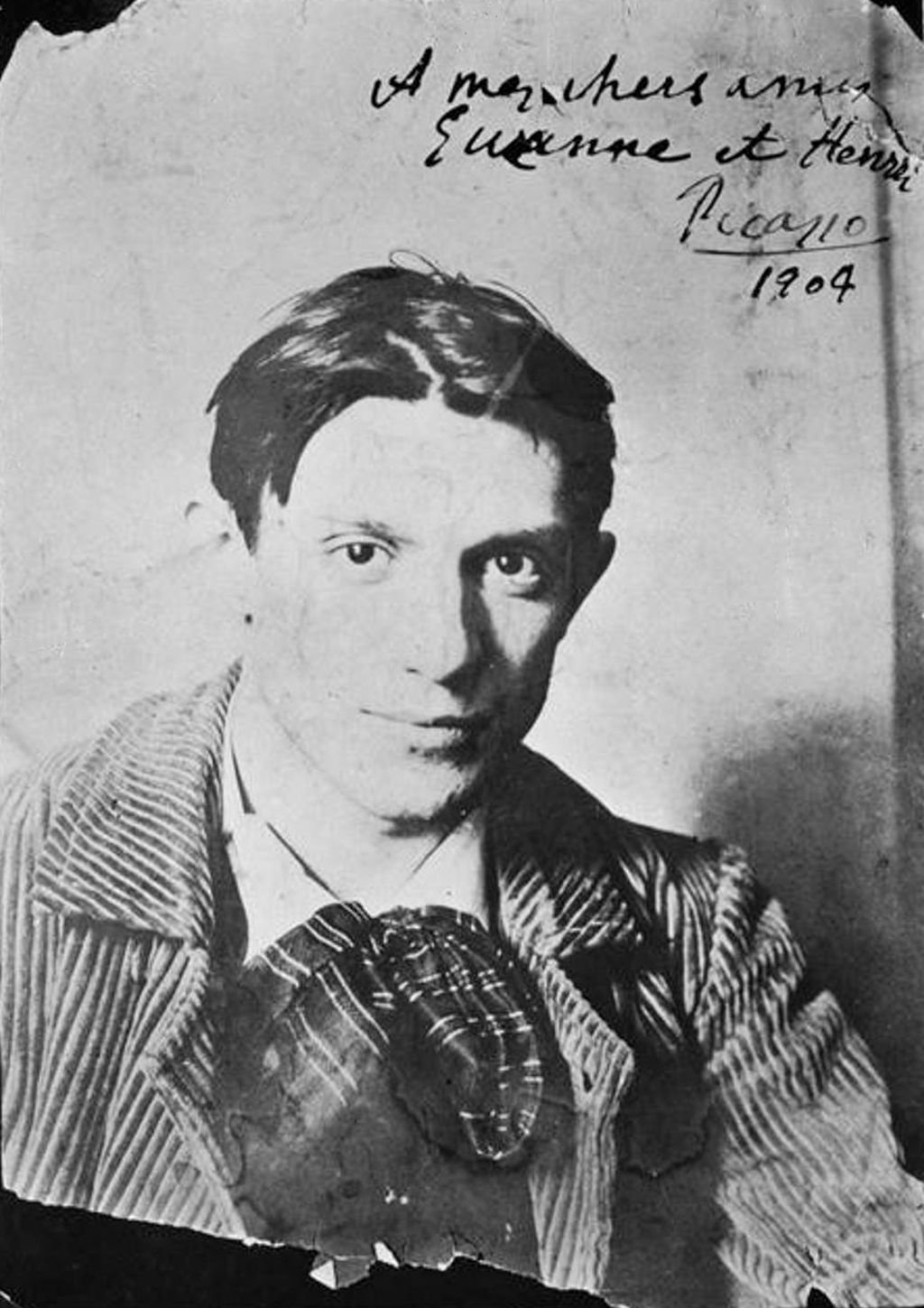
- Ricard Canals i Llambí, 1904. Wikimedia Commons labels the photograph public domain; its source credits RMN-Grand Palais. Resized to 1024px; no crop. Source record. Licence.
