


 by Tom Gurney
Tom Gurney BSc (Hons) is an art history expert with over 20 years experience
Email: tomgurney1@gmail.com / Phone: +44 7429 011000
Introduction
Picasso's neoclassicism is the name usually given to the monumental figures, clear contours and references to ancient and Renaissance art that became prominent in his work from the later 1910s into the early 1920s. It is not a period in which he stopped being a modern artist. In 1921, he worked on the sculptural, antique-looking Three Women at the Spring and the flat, Cubist Three Musicians in the same temporary studio at Fontainebleau. Two apparently opposed ways of making a picture could belong to the same summer.[1][2]
The classical turn had many sources: Picasso's study of older art, his 1917 journey through Italy while working with the Ballets Russes, the people he drew and painted, and a wider European interest in order after the First World War. None alone explains every canvas. Nor is “classical” a synonym for accurate anatomy. Picasso enlarged limbs, simplified faces and rearranged bodies even when the subject recalled a Greek robe or Roman relief. The most revealing question is not why he “went back” to tradition, but how he made it available for new experiments.[1][3][4]
At a Glance
- Prominent years: Later 1910s into the early 1920s
- Visual features: Monumental figures, clear contours and older artistic models
- Important overlap: Classical-looking and Cubist work coexisted in 1921
Contents
- What does “Picasso's Neoclassical Period” mean?
- Before and after Italy: no sudden abandonment of Cubism
- Olga's portrait: exact detail and an unfinished field
- Fontainebleau, 1921: two large pictures, two visual languages
- Mother and child: an old subject reworked
- Two Women Running on the Beach: the classical body in motion
- The Pipes of Pan and Woman in White, 1923
- Was this a retreat from modern art?
What does “Picasso's Neoclassical Period” mean?
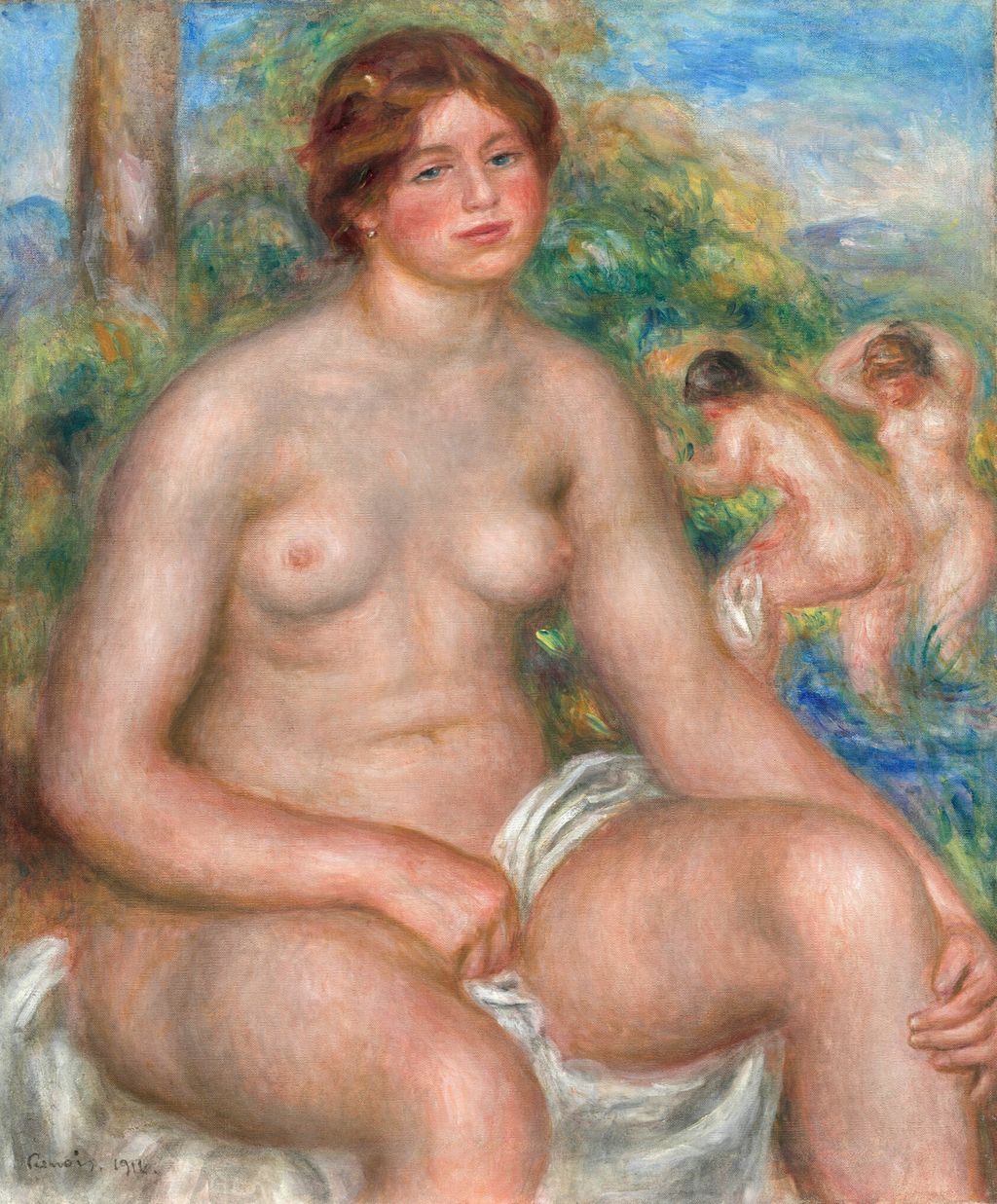
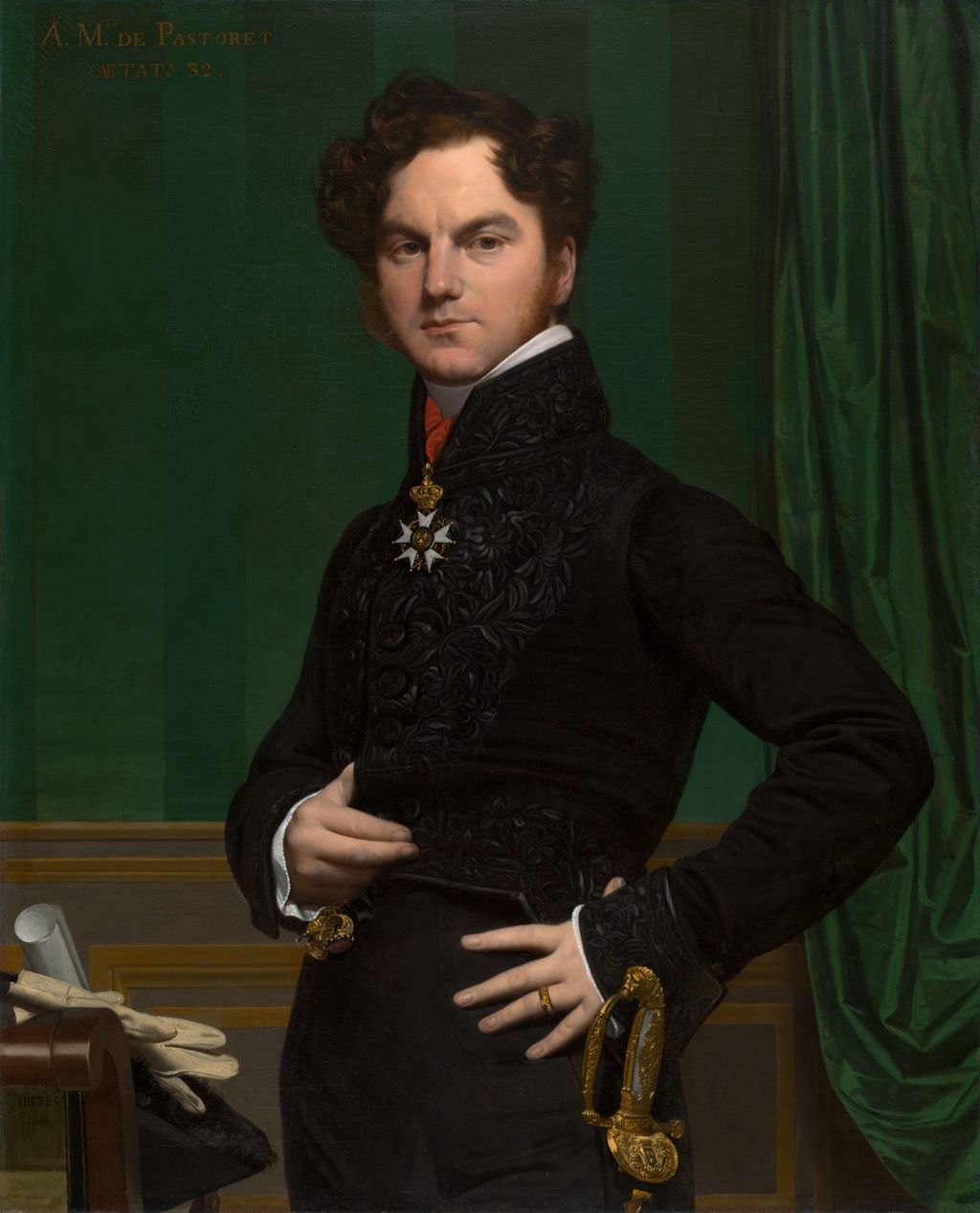
Neoclassicism in Picasso's work refers to a renewed engagement with classical subjects and forms. A figure can seem weighty as a sculpture, pose against a broad stretch of sea or sky, or wear a garment suggestive of antiquity. Drawing becomes conspicuous in a different way from a dense analytical Cubist painting: a firm contour, face or fold may be easy to follow. Picasso also looked to European artists who had reinterpreted antiquity, especially Jean-Auguste-Dominique Ingres and, in some of the large figures, Pierre-Auguste Renoir.[3][5]
Institutions use different boundaries. The Musée national Picasso-Paris calls 1918–23 the years often described as “classicising”; the Museu Picasso Barcelona finds the alternative to Cubism beginning around 1914 and strongly visible in its 1917 Barcelona works. Such dates indicate changing emphasis, not a switch flipped on the first day of a new period. The late 1910s and early 1920s are the centre of the story, with 1921–23 offering especially clear examples. A date range should never imply that everything Picasso made within it looked alike.[3][4]
“Return to order,” or retour à l'ordre, is a related but broader phrase. Following the destruction of the First World War, artists and writers across Europe re-examined older forms, stability and the value of the classical past. Picasso worked in that climate, but his use of classical imagery was neither a simple rejection of the avant-garde nor evidence that he signed up to one political or artistic programme. His simultaneous Cubist pictures are a direct caution against treating a cultural slogan as a description of an entire practice.[1][3]
Before and after Italy: no sudden abandonment of Cubism
The disruption of 1914 changed Picasso's working world. Georges Braque was mobilised, interrupting the close pre-war collaboration in which the two had developed Cubism. Picasso remained in France as a Spanish citizen. At the same time, he explored forms of drawing and figurative painting that could sit beside rather than erase Cubist work. Barcelona's museum explicitly describes the classicising manner as one he began to alternate with Cubism from around 1914.[4][6]
In 1917 Picasso went to Italy with the poet Jean Cocteau to work on Parade for Sergei Diaghilev's Ballets Russes. In Rome he designed the production's sets and costumes; he also visited Naples and Pompeii. Ancient remains and Italian art gave him direct encounters with forms he had previously known through reproductions and museum collections. The ballet was itself a collaborative modern production, not an exercise in copying antiquity. A journey can sharpen an interest, but it does not prove that every later figure was modelled on a specific fresco or sculpture.[3][4]
Picasso met the dancer Olga Khokhlova while working with the company in Rome. They travelled with the Ballets Russes to Spain; Picasso spent much of June to November 1917 in Barcelona. He married Olga in 1918. The Barcelona museum's 1917 research shows an artist moving between classical simplification and Cubist construction. Its portrait Harlequin [Léonide Massine] gives the performer a still, imposing presence, with an emphasis on line and measured colour. Yet The Columbus Promenade, made in the same city and year, uses complementary perspectives associated with Cubism. These are not “before” and “after” pictures separated by years: they are evidence of concurrent choices.[4][6]
Watch: Pablo Picasso
Explore Picasso through five videos from museums, broadcasters and art educators.
Picasso’s Guernica: Great Art Explained
Explore the composition and historical setting of Picasso’s best-known response to war.
Watch on YouTubeOlga's portrait: exact detail and an unfinished field
Picasso's Portrait of Olga in an Armchair, painted at Montrouge in spring 1918, is one of the clearest examples of his changed pictorial language. The sitter was his fiancée Olga Khokhlova. The Musée national Picasso-Paris identifies a photograph on which the painting was based. Picasso closely described her parted hair, the flowers on her dress, the upholstery and even the decoration of her fan. The figure is seated, still and recognisable rather than broken into Cubist facets.[5]
But a photograph-like likeness is only part of the work. The museum notes how the chair's lower structure and Olga's lower body disappear into raw canvas and loosely painted shadow. An exacting face and patterned fabric coexist with an unresolved surrounding space. The painting is not simply a “return to realism” after Cubism, as if nothing had changed in Picasso's awareness of the canvas. It makes a figure present through carefully chosen detail and conspicuous omission. Its elegance is also a constructed effect rather than proof that Picasso became an academic painter.[5]
Olga was a professional dancer, not merely a biographical event in Picasso's story. The Ballets Russes brought him into a world of performance, costume, movement and staged bodies. It is reasonable to connect those experiences with his art when the museum evidence does so; it is not sound to claim that marriage or a supposed change in social rank caused him to paint conservatively. The 1918 portrait has specific sources and specific formal decisions. Speculation about the couple's private psychology adds little to understanding either.[4][5]
Fontainebleau, 1921: two large pictures, two visual languages
The best evidence against a neat “Cubism, then Neoclassicism” story comes from a garage at Fontainebleau. Picasso rented a villa there in the summer of 1921 and used the adjacent garage as a studio. He worked on two monumental versions of Three Musicians and two of Three Women at the Spring within a short period. The Museum of Modern Art's 2023 exhibition reunited these works and their related drawings, prints and photographs. The pictures are comparable in scale and ambition, but strikingly different in approach.[1][2]
MoMA's oil Three Women at the Spring shows draped women around a water source. Their garments and gathering recall Greco-Roman antiquity and the tradition of French academic painting. Yet the bodies are oddly jointed, the heads can resemble masks or mannequins, and the centre woman's hand waits under a spring from which no water flows. The source is present as a motif but not as a straightforward story. Classical cues organise the picture while disquieting details keep it from settling into a calm imitation of the past.[2]
Picasso made variations of the subject. A large red-chalk work on canvas is one counterpart, and MoMA's conservators and curators have studied changes in the composition. They caution that the oil was likely made after the red-chalk version, not that every preparatory step is certain. The uncommon scale and support of the drawing also blur a convenient distinction between study and finished work. Picasso's classicising picture was the result of repeated choices about figure, medium and arrangement, not an effortless reappearance of academic rules.[1][2]
Across the studio, Three Musicians used a vocabulary associated with Synthetic Cubism. Its masked performers emerge from flat, interlocking colour shapes. It is an oil painting that can recall cut and pasted papers without actually being a collage. The two subjects share theatrical associations and a deliberately constructed surface. MoMA's comparison suggests that Picasso was testing what different inherited languages could do, not relinquishing one whenever he tried another. A viewer can look at the scale, the spaces between figures and the refusal of conventional depth in both works before deciding they are opposites.[1][2]
That simultaneity matters historically. If Three Women at the Spring is described only as a conservative retreat, the work's unsettling bodies disappear. If Three Musicians is treated as a leftover from an earlier “period,” Picasso's active return to Cubist problems in 1921 disappears too. The objects demand a less tidy account: he could stage a dialogue between old art, modern construction and the theatre on adjacent studio walls.[1][2]
Mother and child: an old subject reworked
Picasso's son Paul was born in 1921, and the mother-and-child subject became especially visible in the following years. The Art Institute of Chicago's Mother and Child, dated 1921, shows a child reaching from a mother's lap beneath a simplified expanse of sand, water and sky. Her draped body has a broad, sculptural weight. The child's gesture and the mother's lowered gaze establish a relationship without needing a detailed domestic room or a named myth.[3][7]
The Institute links this work to Picasso's new fatherhood, but it also notes that he had made mother-and-child images during the Blue Period. A familiar subject could return under very different visual conditions. The earlier figures often appear vulnerable and spare; the 1921 canvas creates mass and repose. That difference is evidence of artistic choice, not a reliable measure of the painter's private happiness. The museum does not identify the depicted mother and child as Olga and Paul. A painting can arise in a biographical moment without functioning as a literal family portrait.[7]
Picasso's “classical” women are not one standard body repeated. The Fontainebleau women have stiff, almost assembled forms; the Art Institute mother and child are closely connected through touch. Looking at the relation among hands, heads, garments and surrounding space gives a better account than calling all of them serene. The return to a motif also makes the usual period divisions porous: Picasso's Blue Period, classical years and later work can revisit related subjects for different purposes.[2][7]
Two Women Running on the Beach: the classical body in motion
In the summer of 1922, Picasso made Two Women Running on the Beach (The Race) at Dinard. The Musée national Picasso-Paris catalogues it as a small gouache on plywood, about 32.5 by 41.1 centimetres. Its scale is easy to forget because the figures seem expansive: two women surge across a narrow strip of ground under an open sky, with limbs enlarged or elongated beyond ordinary anatomy. The work makes heavy bodies feel airborne.[8]
The Paris museum relates their backward-bending movement to ancient representations of maenads, the dancing followers of Dionysus. It also points to Mannerist elongation and Picasso's observation of dancers through the Ballets Russes. These are interpretive connections, not proof that the two figures represent named ancient characters or particular performers. Their rapid motion differs sharply from the stillness of Three Women at the Spring. Antiquity supplied Picasso with more than a vocabulary of solemn, immobile poses.[8]
The 1922 gouache later had a theatrical life: it was enlarged for the curtain of the ballet Le Train Bleu in 1924. That transfer changes how to think about its small support and ambitious movement. A work made at Dinard could speak to seaside leisure and, later, to a staged performance. The same visual idea crossed places, scales and uses. Calling it simply a “classical painting” misses both the vitality of its bodies and its participation in contemporary entertainment.[8]
The Pipes of Pan and Woman in White, 1923
The Musée national Picasso-Paris catalogues La Flûte de Pan (The Pipes of Pan) as an oil painting made in Paris in autumn 1923. The museum also connects its imagined seaside setting and classical interests with Picasso's summer at Cap d'Antibes. Keeping those two facts separate avoids a common mistake: the summer experience is not the catalogue's recorded place and season of execution.[3][9]
Two large young men occupy a spare architectural setting beside the sea. One holds a pipe; the other looks out. The left figure's shifted weight recalls the classical contrapposto pose, while simple blocks of architecture can suggest both an ancient stage and modern construction. The museum reads the figures as open to several identities—shepherds, modern bathers, or people who bring to mind an ancient world. It explicitly says the painting does not depict one particular classical myth. Its power lies partly in that uncertainty: a recognisable instrument does not settle who these men are, where exactly they stand or what, if anything, they hear.[9]
The Metropolitan Museum of Art's Woman in White, also dated 1923, approaches classicism through a seated figure in a pale, toga-like dress. The Met calls it one of Picasso's best-known neoclassical pictures. Yet even its apparent likeness does not yield an uncontested sitter. Some writers have proposed the American expatriate Sara Murphy; photographs of Olga posing beside related classical heads complicate that identification. The correct account is that the sitter remains disputed. A confident name would make the object easier to narrate but less accurately understood.[10]
Together these works show why “classical” is not one mood. The Pipes of Pan is spare, architectural and enigmatic; Woman in White is intimate and richly mixed in medium, using oil, water-based paint and crayon on canvas. Neither needs to be turned into a direct confession about Picasso's marriage, and neither licenses a claim that he had permanently settled into one style by 1923.[9][10]
Was this a retreat from modern art?
The word “return” can mislead. Picasso certainly looked back—to ancient bodies, Renaissance art, Ingres and other painters—but he did so after Cubism had transformed his sense of pictorial construction. A classicising figure can still be simplified, exaggerated or placed in a shallow, artificial space. At Fontainebleau, the dramatic comparison between Three Women at the Spring and Three Musicians makes the continuity impossible to ignore.[1][2][3]
The postwar return to order was a real historical context. Yet an individual painting must be examined before a broad label can explain it. The Paris museum's research points not only to antiquity and old masters but also to photographs and popular visual material in works of these years. Picasso's sources were plural. Calling the whole sequence either “traditional” or “radical” removes the tension that makes it interesting.[3]
To read a work from this period, begin with its holding institution's title, date, medium and place rather than an assumed “period” date. Ask what is drawn with exactness and what is left unresolved. In Portrait of Olga in an Armchair[5], compare the detailed face and upholstery with the bare lower canvas. In Three Women at the Spring[2], find the classical garments, then notice the interrupted bodies and missing water. In Two Women Running on the Beach[8], ask how a tiny panel can create such a large sensation of movement. In The Pipes of Pan[9], distinguish a mythic suggestion from an illustrated myth.[5][2][8][9]
Picasso's neoclassicism matters because it is a method of reworking history, not a pause in his modernism. The very years that produced a monumental spring, a racing pair and an enigmatic seaside musician also produced new Cubist paintings. The old and the new were not securely separated in his studio; their collision was part of the work.[1][2]
Discussion
Use the evidence and your own close looking to explain your view. These are editorial prompts, not reader comments.
Reader Insights
What makes a figure feel monumental even when its setting is spare?
How can the classical Three Women at the Spring coexist with Three Musicians in 1921?
Which older artistic model is securely documented, and which is only a useful comparison?
Join the Conversation
Which reading best fits the evidence?
References
- Museum of Modern Art, Picasso in Fontainebleau exhibition; Anne Umland, exhibition introduction.
- MoMA, Three Women at the Spring; Three Musicians; curatorial and conservation discussion.
- Musée national Picasso-Paris, chronology; teaching notes on classicising years; museum collection dossier.
- Museu Picasso Barcelona, Harlequin [Léonide Massine], Catalan; 1917 Barcelona exhibition, Catalan.
- Musée national Picasso-Paris, Portrait of Olga in an Armchair, MP55.
- Museu Picasso Barcelona, El paseo de Colón, Spanish; Spanish Harlequin essay.
- Art Institute of Chicago, Mother and Child.
- Musée national Picasso-Paris, Deux Femmes courant sur la plage (La Course), MP78.
- Musée national Picasso-Paris, La Flûte de Pan, MP79; museum interpretation.
- Metropolitan Museum of Art, Woman in White.
Image Credits
- Pierre-Auguste Renoir. CC0. Source: Art Institute of Chicago (Seated Bather). 1024px proportional sRGB JPG derivative; no crop. Source record. Licence.
- Jacques-Émile Blanche, 1913, P1881. CC0 Paris Musées / Musée Carnavalet – Histoire de Paris. Painting public domain (Blanche died in 1942); reproduction released CC0. Proportional resize only. Source record. Licence.
- Jean Auguste Dominique Ingres. CC0. Source: Art Institute of Chicago (Amédée-David, the Comte de Pastoret). 1024px proportional sRGB JPG derivative; no crop. Source record. Licence.
