


 by Tom Gurney
Tom Gurney BSc (Hons) is an art history expert with over 20 years experience
Email: tomgurney1@gmail.com / Phone: +44 7429 011000
Introduction
Picasso had a close, consequential relationship with Surrealism, but he did not declare himself a Surrealist. André Breton and his circle admired his earlier innovations, defended his work, reproduced it in their journal and included him in their exhibitions. Meanwhile Picasso made bodies, objects and scenes that their audiences could read through dream, desire and metamorphosis. Those connections are real. They do not turn his entire career after 1924 into a single “Surrealist period,” or show that he adopted every Surrealist method.[1][2]
The distinction matters when looking at the art. A figure in The Three Dancers (1925) seems pulled out of bodily alignment; a 1932 pair of heads by the sea can suggest both a kiss and an attack; a 1933 drawing makes several women from spare signs for body parts. Each work asks a different question. Calling them all “chaotic” because they depart from ordinary anatomy misses the choices of composition, medium and subject that make them different.[3][4][5]
At a Glance
- Relationship: Close to Surrealist writers and exhibitions, without joining the movement
- Recurring interests: Dream, desire and transformations of the body
- Scope: A context for selected works, not a label for his entire later career
Contents
- Was Picasso a Surrealist?
- Breton, the journals and the 1925 exhibition
- The Three Dancers and the breaking of a classical body
- From Cubist construction to altered objects
- Bathers, acrobats and metamorphic bodies
- Two heads by the sea: attraction and threat
- A mirror, several possible selves
- Anatomy, myth and the limits of a period label
- How to read Picasso beside Surrealism
Was Picasso a Surrealist?
Surrealism emerged as a literary and artistic movement around Breton's 1924 manifesto. Breton proposed that art and writing should explore thought beyond the usual control of reason, drawing on dreams, desire and the unconscious. The movement was also a social and political project, not just a style of strange-looking images. Its members disagreed over methods and beliefs, and the circle changed over time. A picture's surprising appearance, by itself, is therefore not proof that its maker belonged to the group or used its theories.[1][6]
Picasso's relation to it was unusually close but not identical to membership. The Musée national Picasso-Paris records that he met Breton in 1918, made a portrait of him in 1923 and later showed work alongside the Surrealists. The museum is equally clear that Picasso did not claim the label for himself. Breton, by contrast, saw Picasso as a vital precursor and ally. It is more accurate to say Picasso participated in Surrealist exhibitions and publications, and that some of his work resonated deeply with Surrealist concerns, than to assign him a settled group identity.[1]
The relationship also ran in both directions. Picasso had developed Cubism with Georges Braque long before Breton's manifesto. When Surrealists placed earlier Picasso pictures in their own publications or exhibitions, they were reading an existing body of work through a newly articulated movement. Picasso's art did not simply begin to “look Surrealist” on a given date. Its earlier challenges to stable perspective and familiar objects gave Breton material for an argument about what modern art might do.[1][2]
Breton, the journals and the 1925 exhibition
The early public record is more revealing than an invented story of a sudden conversion. In 1924 the Surrealists published a collective tribute to Picasso when his work for the ballet Mercure was attacked. A metal Guitar construction appeared in the first issue of their journal La Révolution Surréaliste, paired with writing by Pierre Reverdy. Later issues reproduced drawings and Les Demoiselles d'Avignon, a painting from 1907. Breton also supported collector Jacques Doucet's acquisition of Demoiselles. Such acts show Breton's advocacy and the movement's attempt to place Picasso within its history.[1]
In November 1925 Picasso contributed works to La Peinture Surréaliste at the Galerie Pierre in Paris. The Paris Picasso museum identifies among them works made before 1925. Showing an older painting in a Surrealist exhibition does not change the date or original circumstances of its making. It does show that curators and artists thought the work could speak to their present concerns. The exhibition was an encounter between Picasso and a movement, not a formal initiation ceremony.[1][2]
Nor was Breton the only interpreter. Other writers close to Surrealism later disagreed with his ideas and with one another. The journal Documents, associated with Georges Bataille and published in 1929–30, challenged aspects of Breton's approach. The German critic Carl Einstein, writing around this circle, used the idea of “mythical realism” to distinguish what he saw in Picasso from a straightforward account of Surrealist image-making. These are historical interpretations, not labels Picasso was obliged to accept. They also caution against treating “Surrealist influence” as one uniform force.[6][7]
This distinction changes the way an exhibition label should be read. Breton could select a Picasso made years before his manifesto because he believed it anticipated the movement. Another writer could value an unsettling image for its material body or its conflict with ideal beauty. Neither interpretation by itself describes the steps by which Picasso made the work. The record of friendships, reproductions and exhibitions shows a productive public connection; the surfaces and objects show an artist with techniques that could not be reduced to a manifesto. The two kinds of evidence belong together, but they answer different questions.[1][6][7]
Watch: Pablo Picasso
Explore Picasso through five videos from museums, broadcasters and art educators.
Picasso’s Guernica: Great Art Explained
Explore the composition and historical setting of Picasso’s best-known response to war.
Watch on YouTubeThe Three Dancers and the breaking of a classical body
Picasso's The Three Dancers, painted in 1925 and now at Tate, is often treated as a turning point. The Contemporary Art Society's co-acquisition record identifies it as a large oil painting more than two metres high. Three bodies occupy a dance, but their limbs and faces refuse an easy description of weight, balance and shared rhythm. The central figure's thrusting shape and the harshly opened form at the left make a dance feel tense rather than graceful.[3]
The picture is not explained by saying that Picasso had discovered the irrational. He had worked with dancers, stage designs and theatrical figures for years, and in 1921 had made the very different Three Women at the Spring beside Cubist Three Musicians. The Three Dancers changes the role of the body. Here distortion can register collision, desire or alarm, while the figures remain tied together by a tightly planned composition. The departure from classical calm is forceful; it is not the absence of design.[2][3]
Later accounts have associated the painting with memories of Picasso's friends Carlos Casagemas and Ramon Pichot, and Tate's co-acquisition record describes that reading. It should be presented as an interpretation, not a list of certain identities assigned to each painted figure. The historical relationships may illuminate a work without reducing it to a coded diary. More securely, the canvas's date, scale and intense remaking of dancers help explain why contemporary Surrealists could find an affinity with it.[3]
From Cubist construction to altered objects
Picasso's constructions and sculptures complicate any claim that Surrealism replaced Cubism. His 1924 Guitar was reproduced by Surrealists, although the making of guitars from sheet and found materials had roots in his Cubist experiments of 1912–14. In 1926 he made further small Guitar assemblages using materials such as paper, cord, cardboard, textile and hardware. The Musée national Picasso-Paris describes works that could be viewed as Surrealist while still resting on a Cubist principle of construction. An object can cross interpretive boundaries without erasing its earlier technical history.[1][8]
Found materials helped Picasso change what a work could be. A piece of cloth might evoke an instrument or a body; a glove or butterfly could bring something from outside the studio's usual materials into an image. The Paris museum traces such experiments into sand reliefs around 1930 and later assemblages. Surrealists valued unexpected meetings of objects, and Breton admired Picasso's capacity to produce them. But inserting a real object is a material fact, not evidence that Picasso surrendered conscious control or used automatic procedures in every construction.[8]
This is one reason a medium label matters. A Guitar construction of metal is not the same object as a small mixed-material Guitar of 1926, and neither is interchangeable with the cardboard Guitar of 1912. The recurrence of the title can hide changes in scale, support and method. Some works appear to bring a chance encounter into art, yet the choice of what to attach, where to place it and how to hold it together remains visible as work. A reader looking only for an irrational subject may miss the inventiveness of the joints, edges and actual materials.[1][8]
He also worked with the Catalan sculptor Julio González on iron constructions around 1928–29. The Museo Reina Sofía describes their use of welded metal as a development from Picasso's earlier assemblages, now testing a new material and greater freedom from traditional sculptural mass. Some works were connected with proposals for a monument to the poet Guillaume Apollinaire. Their fabricated lines and open spaces belong to a history of sculpture and collaboration as well as to any Surrealist reading. González's technical contribution should not vanish beneath a story of Picasso's isolated imagination.[1][9]
Bathers, acrobats and metamorphic bodies
Around the end of the 1920s, Picasso repeatedly transformed the human body in paintings of bathers and performers. At Dinard, small beach scenes could show limbs enlarged beyond proportion and faces reduced to signs. The Paris museum describes L'Acrobate of 1930 as a body whose anatomical rearrangement registers the movement of a performer. It notes that Breton saw an affinity with Surrealism in these years, while Picasso did not endorse that affiliation. The work need not be treated as a literal dream or a monster; its contortion can be understood as a problem of movement and pictorial form.[4]
These bodies can also be troubling. Describing them merely as “weird” or “grotesque” turns the viewer's reaction into a historical explanation. Their distortion intersects with questions of desire, aggression, performance and looking, but the meaning changes from work to work. A specific painting should be read with its date, setting and medium, not treated as a symptom of Picasso's unconscious that a later writer can diagnose. The people Picasso depicted, especially women, should not disappear into a vocabulary of formal invention alone.[4][5]
In 1930 Picasso painted The Crucifixion, held in Paris. It combines figures associated with the Passion of Christ with startling shapes and sharp colour contrasts. The museum links its imagery to both Christian iconography and the kinds of violent, unfamiliar images circulating in contemporary journals. The work is not a simple Surrealist illustration: a recognisable sacred narrative is being disrupted, condensed and reassembled. Its source traditions reach further back than the movement around Breton.[7]
Two heads by the sea: attraction and threat
The Museo Reina Sofía's Figures by the Sea I, dated 2 January 1932, offers a particularly close encounter with the movement's interests. Two heads appear joined. Their open, toothed mouths might be about to kiss—or to devour each other. The museum's Spanish catalogue treats that ambiguity as close to Surrealist preoccupations with eroticism, and relates its bodily fragmentation to Georges Bataille's writing. It is a curator's interpretation anchored to this work, not an instruction to decode every bather Picasso made in the 1930s in the same way.[5]
The painting also reminds us that “Surrealism” was contested territory. Bataille's Documents challenged the more idealising vision associated with Breton. A menacing bodily encounter in Picasso could appeal to readers around both circles for different reasons. The surface of Figures by the Sea I is nonetheless a composed painting, oil and black chalk on canvas, not a transparent transcription of a dream. Its joined heads and seaside architecture are visual decisions, and their ambiguity is sustained by those decisions.[5][6]
The Reina Sofía catalogue notes that Picasso had considered related figures as a sculptural project for the promenade at Cannes, a project that was not realised. That information prevents a purely psychological reading of the painted forms. Their bulk and rocky contours can be considered in relation to an imagined three-dimensional setting by the sea, even as the painting leaves the heads' interaction unresolved. A proposed monument, a beach motif and an erotic threat coexist; no single one exhausts the work.[5]
A mirror, several possible selves
MoMA's Girl before a Mirror, completed in Paris on 14 March 1932, belongs to the same broad moment. A young woman reaches toward a mirror image whose colours and forms do not merely repeat her. Profile and frontal face coexist; one side is pale and smoothly painted, the other emphatically yellow and red. The reflection offers another body rather than a straightforward optical return. MoMA describes several possible oppositions—youth and age, sun and moon, light and shadow—but does not make any one of them the painting's sole key.[10]
The museum displays the painting in a gallery called “A Surreal Lens,” an apt way to describe one useful reading. Its altered body, double image and erotic visual puns invite questions about desire and identity. Yet MoMA's technical research finds a worked and reworked surface beneath the finished canvas. That is an important qualification: association with Surrealism does not mean this painting was simply made by automatic, unplanned gesture. Its symmetry and revisions are part of its meaning.[10]
The person represented is often connected with Marie-Thérèse Walter, whom Picasso met in 1927 and repeatedly depicted in the early 1930s. A biographical relationship may help date and contextualise the sequence. It should not make the pictured woman a passive sign for Picasso's inner life. In this painting she is the figure who reaches toward, confronts and touches the mirror. The act represented on the canvas deserves as much attention as the artist's private story.[1][10]
Anatomy, myth and the limits of a period label
In late February 1933 Picasso made a sequence of drawings called Une Anatomie. The Musée national Picasso-Paris counts ten drawings over four days, varying how marks for eyes, mouths, breasts and other parts could be combined into figures. One Three Women sheet, dated 27 February, is graphite on paper. The procedure is serial and deliberate: a body emerges, is rethought, and emerges again as another arrangement. These sketches may appeal to Surrealist readers because familiar anatomy becomes unstable, but the evidence is a sequence of graphic investigations, not a demonstration that Picasso abandoned method.[11]
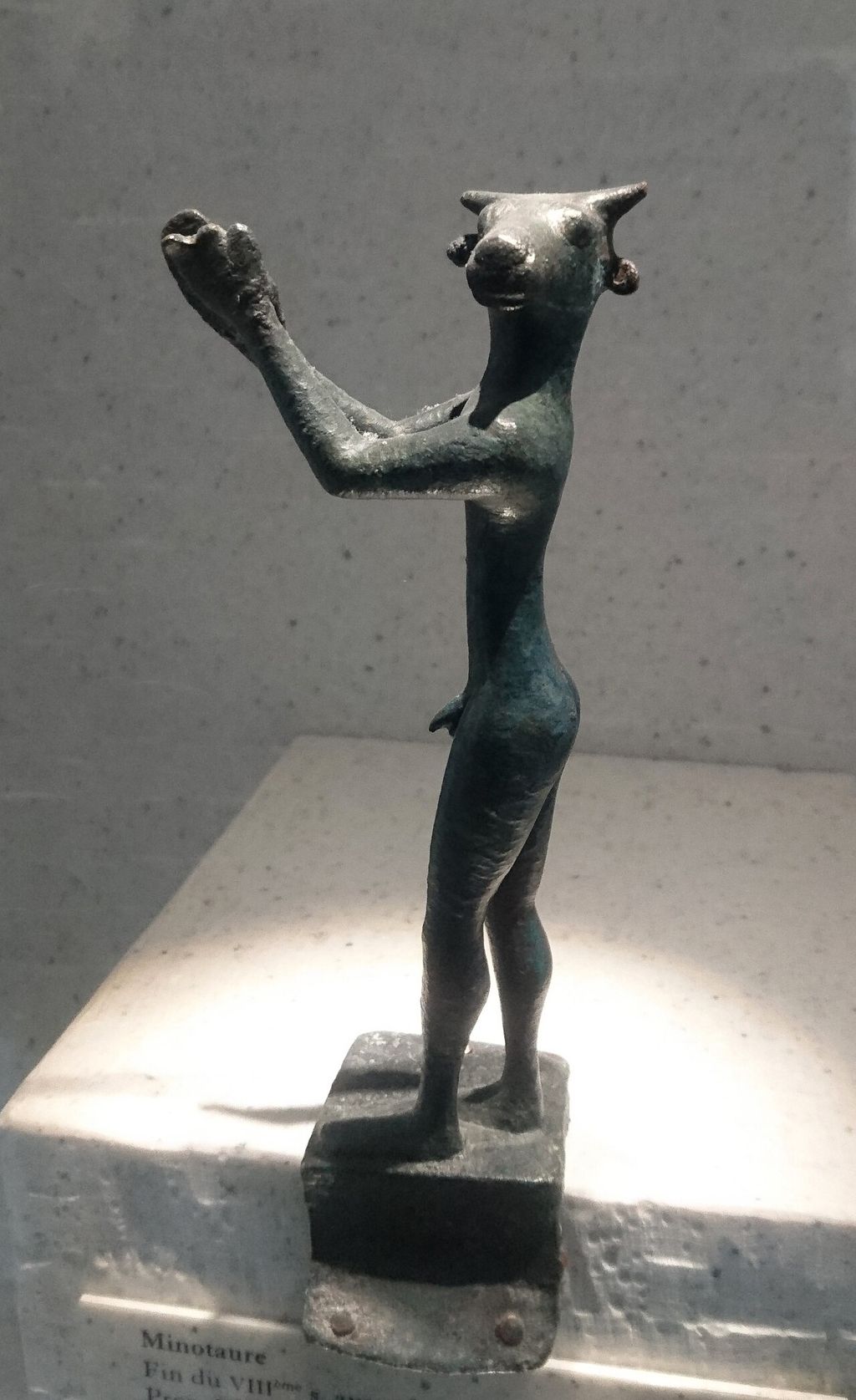
The Minotaur offered another elastic figure. It appeared in Picasso's work from around 1928 and became important in the early 1930s, when the journal Minotaure published material about him. His 1935 Minotauromachy is a large etching and engraving with a dense, enigmatic encounter among a bull-headed creature and other figures. MoMA describes it as a private mythology and notes connections with imagery later used in Guernica. Even here, “private” should not be mistaken for a code with one authorised solution: antiquity, bullfighting, printmaking and contemporary responses to the image all matter.[1][12]
The print's medium is part of the account. MoMA identifies Lacourière as its printer and Picasso as publisher, reminders that a printed image has a plate, a workshop and impressions rather than one unique painted surface. Myth could circulate in copies. Its minotaur could be read through the familiar Greek story, through Picasso's longstanding interest in bullfighting, or through the darker symbolism that interested readers of Minotaure. A later connection to Guernica does not mean the 1935 print was designed in anticipation of the 1937 commission.[12]
It is tempting to extend the Surrealist label to Guernica because that 1937 painting uses distorted figures and nightmarish violence. Those qualities alone do not explain the work. Guernica was made for the Spanish Republic's pavilion at the Paris international exposition and responds to the bombing of a Basque town during the Spanish Civil War. Its political commission and historical event must remain in view. Picasso carried some visual questions from the 1920s and 1930s into it, but a work about a specific catastrophe should not be flattened into an illustration of the unconscious.[1][12][13]
How to read Picasso beside Surrealism
Begin with the relationship, not the label. Breton's defence, journals and exhibitions document an actual exchange. Next identify what a particular work does: a dancer's impossible balance, a construction made from real materials, a bather whose mouths could kiss or bite, or a mirror that refuses ordinary reflection. Then ask what other histories are active—Cubist construction, theatre, classical myth, sculpture, printmaking or politics. Surrealism can sharpen the reading without swallowing those histories.[1][2][5][8]
The most accurate answer to “Was Picasso a Surrealist?” is therefore neither an unqualified yes nor a dismissal. He was important to the movement's artists and writers, took part in their public culture and made work that spoke powerfully to their concerns. He also retained his independence and pursued questions that did not come from Breton's manifesto. Looking at the named works in their own circumstances yields a richer account than a tidy “Surrealist period” between two other periods.[1][2]
Discussion
Use the evidence and your own close looking to explain your view. These are editorial prompts, not reader comments.
Reader Insights
Which bodily transformation invites a Surrealist reading?
What is the evidence for Picasso’s exchanges with Breton’s circle?
Where would the label Surrealist obscure another way of seeing the work?
Join the Conversation
Which reading best fits the evidence?
References
- Musée national Picasso-Paris, Picasso and Surrealism; museum chronology.
- Centre Pompidou, Picasso chronology; Museo Reina Sofía, André Breton and Surrealism exhibition.
- Contemporary Art Society, The Three Dancers, Tate co-acquisition record; Tate object record.
- Musée national Picasso-Paris, L'Acrobate; beach ball players.
- Museo Reina Sofía, Figures by the Sea I, Spanish catalogue.
- Museo Reina Sofía, Documents and Surrealism dossier; Breton and Surrealism exhibition.
- Musée national Picasso-Paris, The Crucifixion; Tableaux magiques research dossier.
- Centre d'études Picasso, assemblage research path.
- Museo Reina Sofía, Woman in the Garden, Spanish catalogue.
- Museum of Modern Art, Girl before a Mirror; technical study.
- Musée national Picasso-Paris, Une Anatomie: trois femmes; Picasso-Rodin teaching dossier.
- MoMA, Minotauromachy; Metropolitan Museum of Art record.
- Museo Reina Sofía, Guernica research project; Musée national Picasso-Paris, Guernica context.
Image Credits
- Shonagon. CC0. Source: Wikimedia Commons. Resized to 1024px; no crop. Source record. Licence.
