


 by Tom Gurney
Tom Gurney BSc (Hons) is an art history expert with over 20 years experience
Email: tomgurney1@gmail.com / Phone: +44 7429 011000
Introduction
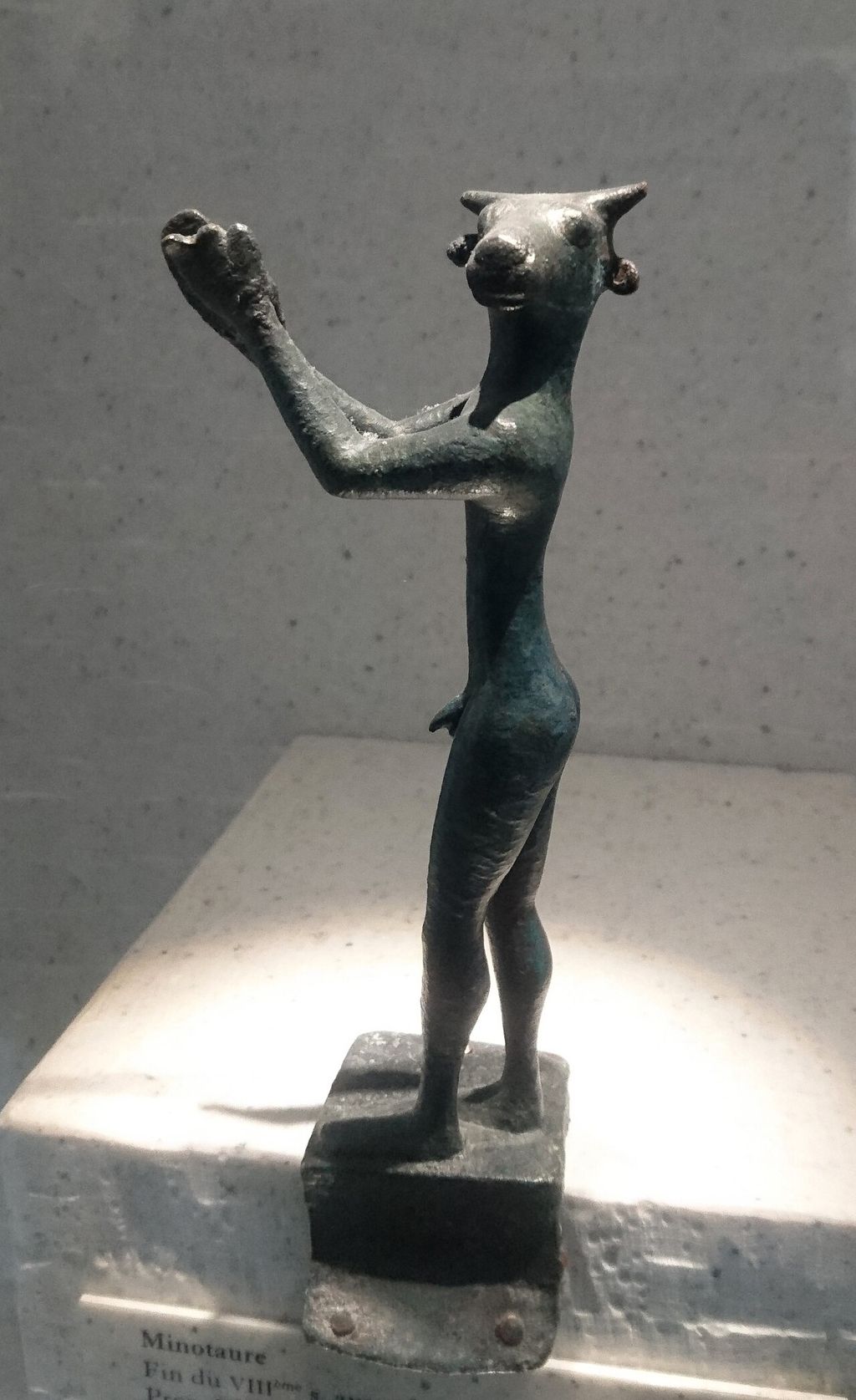
The bullring appears in Picasso’s art from his youth to his final years, but it never stays in one form. At one moment he records the movement of a horse, bull and rider; at another he reduces their struggle to dark silhouettes or bends it across the curved surface of a ceramic dish. In the 1930s he also brought a different creature into this world: the Minotaur, a human body with a bull’s head. A real bull, a bullfighter and a mythological monster can share an image, yet they are not interchangeable. Their changing relationships are what make the subject so productive in Picasso’s work. [1] [6]
Picasso’s bullfighting imagery has often been treated as a ready-made code for Spain, masculinity or the artist himself. The works resist that simplicity. Some show public spectacle; others turn the arena into a scene of injury, desire or loss of control. A single print may appear tender and threatening at once. The bull and horse in Guernica carry memories of the bullring into an anti-war painting, but neither animal has a universally agreed meaning. To follow these subjects is to see Picasso testing how familiar forms can carry very different experiences. [1] [6]
At a Glance
- Key years: 1933 Minotaur prints; 1935 Minotauromachy; 1937 Guernica
- Subjects: Bullring action and the mythological Minotaur remain distinct
- Media: Drawings, prints, painting and ceramics
Contents
- From the bullring to an artistic language
- The Minotaur enters Picasso’s work
- Bacchic Scene with Minotaur
- Minotaur Caressing a Sleeping Woman
- Blind Minotaur Led by a Girl through the Night
- From the blind Minotaur to Minotauromachy
- The bull and horse in Guernica
- Bullfighting prints after the war
- Bullfights on clay and in the late drawings
From the bullring to an artistic language
Bullfighting was part of the visual culture Picasso knew in Spain. It remained a subject across drawings, prints, paintings and ceramics, not a youthful interest that disappeared when he moved to France. The Museu Picasso in Barcelona has traced bullfighting images in his work from childhood to the matadors of the 1970s. Its collection includes both a late 1970 graphite Bullfighting Scene and detailed mid-century sequences of bullring actions. The continuity matters, but it does not mean every bull has the same role or every image records a particular corrida. [1] [6]
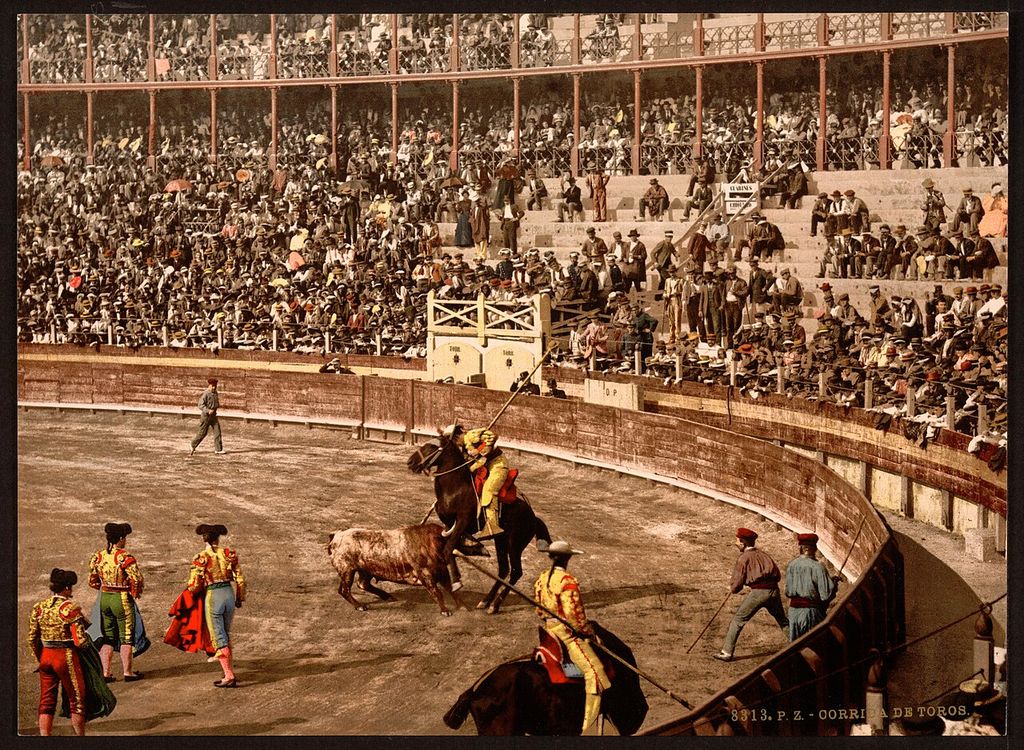
Picasso could focus on the spectacle’s recognizable participants: matador, picador, horse, bull and spectators. He could also break a contest into gestures — a charge, a turn, a raised arm, an animal’s fall. Such images put bodies under pressure. They move between the choreography of a public event and the possibility of injury beneath its ceremony. Picasso’s interest in this subject need not be mistaken for an uncomplicated celebration of it. The art can show excitement, theatricality and danger without settling a modern ethical judgment about bullfighting. [1] [6]
His methods changed as much as his viewpoint. A graphite sheet can follow motion in a few strokes. A print translates the same event into cuts, marks and contrasts that can be pulled as an edition. In Vallauris after the Second World War, a painted or incised bullfight could turn a plate’s circular rim into an arena or a serving dish into a stage. The bullring was therefore not just a topic to depict. It was a test of how line, surface and sequence work in different media. [1] [6]
The Minotaur enters Picasso’s work
The Minotaur comes from the Greek story of a creature with the head of a bull and the body of a man. Picasso did not simply illustrate that inherited myth. The Museo Reina Sofía traces his first Minotaur images to 1928, before the motif became prominent in the 1930s. Some early designs look far removed from the muscular, expressive figure familiar from later prints. Over time Picasso drew the creature into scenes of studios, feasts, erotic encounters, bullrings and blindness. [1]
The Minotaur could act like another artist or a double of the artist. That reading has strong institutional support, including the Reina Sofía’s account of Picasso’s recurring alter egos. It should still be used with care. To say that a figure can function as an alter ego is not to say that each action in a picture happened in Picasso’s life, or that one person can be identified with every woman beside it. The creature’s power lies partly in its instability: human and animal, guest and intruder, confident and helpless. [1]
Picasso’s encounter with Surrealist writers and artists made the hybrid especially resonant. He designed the cover of the first issue of the magazine Minotaure in 1933. That same year, prints for the group later known as the Vollard Suite put the monster into several different social and emotional situations. Their titles describe actions, but the images rarely close down interpretation. [1]
Watch: Pablo Picasso
Explore Picasso through five videos from museums, broadcasters and art educators.
Picasso’s Guernica: Great Art Explained
Explore the composition and historical setting of Picasso’s best-known response to war.
Watch on YouTubeBacchic Scene with Minotaur
In Bacchic Scene with Minotaur, dated 18 May 1933, the Minotaur raises a drinking vessel amid intertwined nude figures and a reclining bearded man. The group recalls a feast rather than a fight. The animal-headed figure occupies the same human space as its companions, but its bulk and horned head change the mood. The convivial gesture of a toast can suggest pleasure, excess or a loss of restraint. Picasso lets the scene move between them. [2]
This is an etching, not a painting. It is plate 85 of the Vollard Suite; the British Museum records an impression printed by Roger Lacourière in 1939. The National Gallery of Victoria identifies a different impression as the third of three states. These distinctions matter because “the print” is not a single physical sheet. Picasso made an image on a copper plate; impressions could then be printed in differing states and at later dates. A reproduction of the design is another thing again. [2]
The title’s Bacchic reference evokes wine and ancient revelry, but it is not a licence to name every figure as a mythological god. The British Museum’s object description identifies what can be seen — the Minotaur, goblets, nudes and bearded man — without proving a single dramatic story. Picasso’s modern studio mythology works precisely because classical associations sit beside the ordinary intimacy of a group gathered together. [2]
Minotaur Caressing a Sleeping Woman
The mood changes in Minotaur Caressing a Sleeping Woman, made on 18 June 1933 at Boisgeloup. Its drypoint lines place the horned figure above a woman lying in bed. Heavy dark marks gather around the Minotaur’s head while the sleeper’s form is more lightly drawn. The contrast produces an encounter that cannot be explained simply as affection or menace. Los Angeles County Museum of Art notes the gesture’s possible tenderness and the continuing threat of a powerful figure hovering over someone who is asleep. [3]
The longer title used by Museo Picasso Málaga describes the Minotaur touching the sleeping woman’s hand with its muzzle. Málaga identifies the work as the last image in an eleven-print Minotaur sequence within the Vollard Suite. The Museo Reina Sofía identifies its own impression as number 93 in that series. These are different catalogued sheets of a print, not separate paintings sharing a poetic title. [3]
Readers often link Picasso’s Minotaur to his relationships, particularly with Marie-Thérèse Walter. Such context is relevant, but it must not turn a print into a literal account of someone’s sleeping body or assume that the woman’s feelings are visible to us. The image stages an unequal encounter and leaves its emotional terms unresolved. It is more revealing to attend to the way Picasso makes the dense dark head approach the pale, quiet figure than to claim a certainty the record cannot provide. [3]
Blind Minotaur Led by a Girl through the Night
By 1934 the assertive creature of the feast and bedroom could become vulnerable. In Blind Minotaur Led by a Girl through the Night, a young guide leads it through a dark scene. The Minotaur’s size no longer gives it mastery. It depends on someone much smaller to move forward. The boat, nearby figures and sharply contrasting light make the encounter feel at once theatrical and precarious. [4]
The Metropolitan Museum of Art records its impression as a work of 1934 printed in 1939 for the Vollard Suite. It combines aquatint, etching and drypoint, not etching alone. Picasso returned to the blind-Minotaur subject in several distinct 1934 works; the Musée national Picasso-Paris archive lists variants with a girl carrying flowers, a girl with a dove and other changes in pose or setting. Their differences matter. The title of one version should not be used to identify a detail in another. [4]
The guide is sometimes associated with Marie-Thérèse Walter, but a resemblance does not establish that she is a portrait of a particular person. Nor should details from one version of the subject be imported into another. The scene’s drama can be read without fixing a biographical name to the girl: authority has shifted from a forceful hybrid to a child who can see the path. [4]
From the blind Minotaur to Minotauromachy
Picasso pushed the encounter further in Minotauromachy of 1935. The Reina Sofía dates its impression to work on the plate between 28 April and 3 May and identifies etching with scraping techniques. It is not another impression of the 1934 night scene. Its expanded confrontation brings together the Minotaur, a light-bearing girl, a wounded horse and other figures in a dense, uneasy space. Where an individual Vollard Suite image can isolate an action, Minotauromachy gathers several charged relationships into one field. [5]
The Reina Sofía presents the blind-Minotaur sequence and Minotauromachy among the important precedents to Guernica. “Precedent” here means a developing repertoire of figures and tensions, not a sketch for the exact 1937 composition. The repeated bull-like figure, horse and light can invite comparison; the prints remain works in their own right, with different dates, techniques and settings. [5]
The bull and horse in Guernica
In Guernica (1937), the bull and the suffering horse appear within Picasso’s response to the bombing of the Basque town. The Reina Sofía’s research identifies the horse attacked in the bullring as one visual source for some of the work’s preparatory studies. Picasso was drawing on imagery he had long used, but the completed painting is not a picture of a bullfight. Its broken bodies, grieving people and compressed space address violence against civilians. [5]
What the bull “means” in that painting has been debated for decades. Reina Sofía’s archive traces attempts to assign fixed allegorical roles to the bull and horse, including a 1947 symposium at New York’s Museum of Modern Art. Picasso resisted supplying a settled key. It is therefore sounder to describe the animals’ presence and their earlier visual history than to declare that the bull always equals one nation, regime or person. The separate Guernica article follows the painting, its 1937 commission and its reception in full. [5]
Bullfighting prints after the war
Picasso returned to the bullring in his post-war prints. A work catalogued as Scènes de corrida dates from 1945 and belongs to his early experiments in lithography with printer Fernand Mourlot. Phillips has recorded three separate working proofs whose printed images can combine into the larger composition. The proofs show why a title alone is not enough to identify a particular sheet: an individual trial and the composite image are related, but they are not the same physical object. [6] [7] [8]
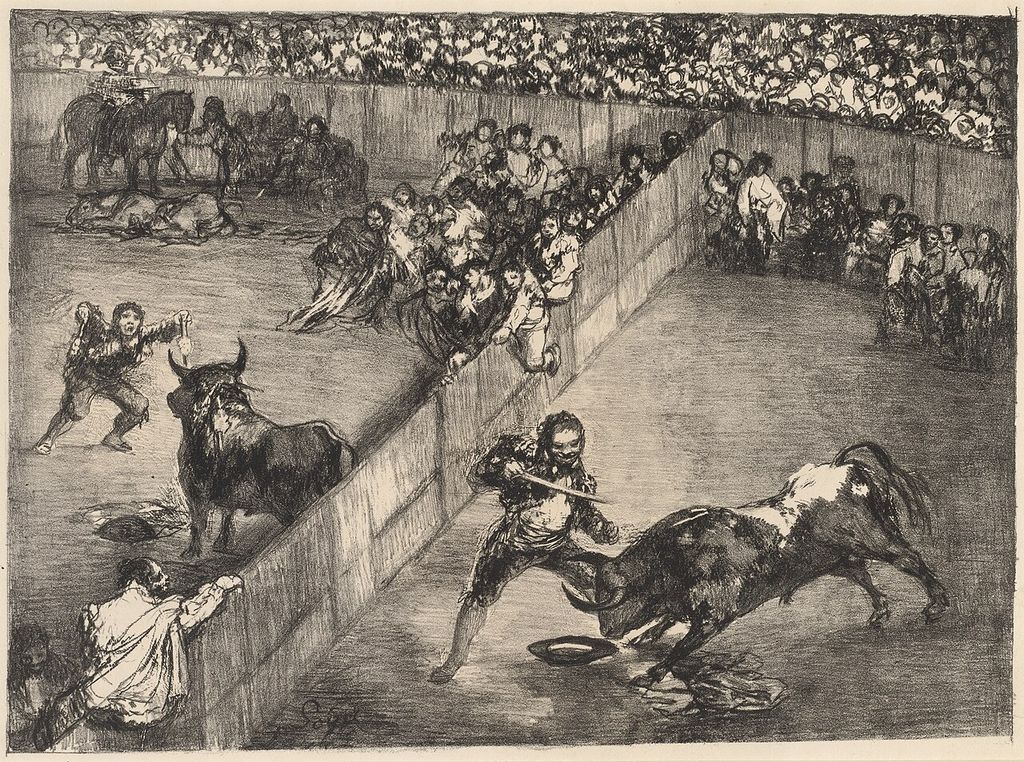
Lithography also let Picasso test how isolated figures might form a sequence. A bull, horse or matador can be simplified into a black shape and set against an expanse of paper, giving each gesture a striking immediacy. This graphic treatment differs from the crowded, psychologically charged Minotaur prints of the 1930s. It returns the viewer to recognizable actions of the corrida while leaving room for changes between working proof, printed composition and later reproduction. [6] [7] [8]
The subject did not end there. Barcelona’s collection documents his 1957 Pepe Illo bullfighting notebook and a group of named scenes from that period. Records for La Tauromaquia o arte de torear and related copper plates show how the subject entered an illustrated-book project with publisher Gustavo Gili. These works belong to a different moment from both the 1933 Minotaur plates and the 1945 lithographic experiments. Their focus on the stages of a corrida also differs from the mythic creature’s ambiguous encounters. [6] [7] [8]
Bullfights on clay and in the late drawings
Ceramics gave Picasso another way to adapt the bullring. At Vallauris he painted bullfighting scenes on serving dishes and used the object’s existing shape as part of the composition. The Museo Picasso Málaga describes this as one strand of a larger experiment with clay, glaze, painted decoration and sculptural form after his encounter with local potters in 1946. A dish can make the arena almost literal: a circular space to hold figures, surrounded by its rim. Yet it is still a designed object, not a document of a specific contest. [6] [7]
Picasso returned to the topic late in life. Barcelona’s 1970 graphite Bullfighting Scene shows that the motif survived well beyond the famous 1930s prints. The same subject could accommodate very different kinds of looking: a public performance in a ring, a personal mythology of hybrid beings, a sequence in an illustrated book or a rapid drawing of action. Treating all of them as one symbol would flatten the inventiveness of the work. [6] [7]
The bull’s broad animal form also belongs to Picasso’s wider study of creatures, distinct from the narrative of the corrida. The animals in Picasso’s art guide follows that wider theme; the prints and ceramics guides explain how changes of medium reshape an image. Here, the connecting question is what happens when Picasso turns a familiar arena into a changing language of bodies, spectators, power and vulnerability. The Minotaur’s movement from reveler to blind traveller is one answer. The bull and horse reappearing in Guernica, under a radically different historical pressure, is another. [6] [7]
Discussion
Use the evidence and your own close looking to explain your view. These are editorial prompts, not reader comments.
Reader Insights
Where does a bull become a Minotaur, and where must the two stay distinct?
How does a bullfight change when made as a print rather than a ceramic?
Which familiar symbolic reading lacks evidence for a particular object?
Join the Conversation
Which reading best fits the evidence?
References
- Museo Reina Sofía, Picasso Minotauro exhibition (Spanish).
- British Museum, Scène bacchique au minotaure object record; National Gallery of Victoria, another impression.
- Museo Picasso Málaga, Minotaur Caressing the Hand of a Sleeping Woman with its Muzzle; LACMA, Minotaur Caressing a Sleeping Woman.
- Metropolitan Museum of Art, Blind Minotaur Led by a Girl through the Night; Musée national Picasso-Paris collections archive.
- Museo Reina Sofía, Minotauromaquia; its Guernica interpretation dossier.
- Museu Picasso Barcelona, Tauromaquia exhibition (Spanish), 1957 notebook (Spanish) and 1970 drawing (Spanish).
- Museo Picasso Málaga, Made of earth; British Museum, Picasso printmaker guide.
- Phillips, 1945 Scènes de corrida working proofs.
Image Credits
- Shonagon. CC0. Source: Wikimedia Commons. Resized to 1024px; no crop. Source record. Licence.
- Photochrom Print Collection. Public domain. Source: Wikimedia Commons. Resized to 1024px; no crop. Source record. Licence.
- Francisco de Goya. CC0. Source: Wikimedia Commons. Resized proportionally to 1024px wide; no crop. Source record. Licence.


