


 by Tom Gurney
Tom Gurney BSc (Hons) is an art history expert with over 20 years experience
Email: tomgurney1@gmail.com / Phone: +44 7429 011000
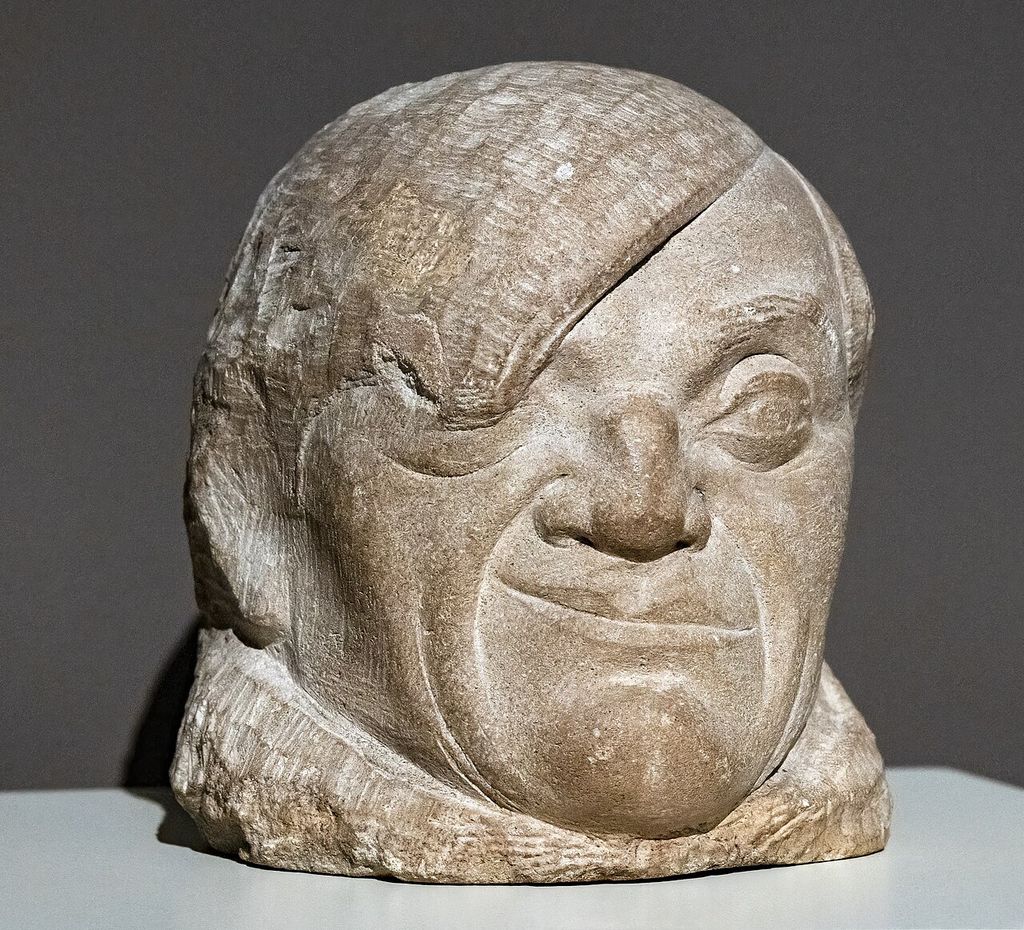
Introduction
Picasso made portraits of friends, writers, dealers, artists and members of his family throughout his career. He also returned to the seated figure, the head and the nude even when no person's identity can be established. To look at these works only as a sequence of changing styles misses the people pictured; to treat them as literal records of those people's feelings misses what Picasso did with line, colour and form. The most useful question is often not “Does it look like the sitter?” but “What kind of likeness is this, and what else was happening between the artist, the subject and the image?”[1][2]
A portrait can be a painting made through many sittings, a quick drawing of a friend, a caricature, a print or a head modelled in clay. It can name someone yet distort their appearance, or resemble someone without bearing a secure title. Picasso's portraits are therefore not one genre with one method. The 1905–06 Gertrude Stein combines a carefully posed body with a face repainted after the sittings. His 1909 sculpted head of Fernande Olivier makes a face from projecting and receding planes. In a portrait of Dora Maar made in 1937, frontal and profile views occupy the same face. These are materially different propositions about how a person can be represented.[2][3][4]
At a Glance
- Subjects: Friends, family, writers, dealers and fellow artists
- Forms: Paintings, drawings, prints and sculpture
- Key question: What kind of likeness does each work make?
Contents
- Portraits of family: learning to look
- Friends and fellow artists in Barcelona
- The Blue Period and the problem of anonymous figures
- Gertrude Stein and the construction of a likeness
- Dealers, writers and other working relationships
- Olga and a classical form of portrait
- Marie-Thérèse Walter and portraits of the 1930s
- Dora Maar as sitter and artist
- Françoise Gilot and Jacqueline Roque
- Faces, figures and self-portraits are not the same thing
Portraits of family: learning to look
Long before those experiments, Picasso portrayed the people around him at home. Barcelona's Museu Picasso holds his 1896 pastel The Artist's Mother, depicting María Picasso López in profile. At fifteen, he was studying at La Llotja, and the museum describes the portrait as an exercise made from life. The soft surface of pastel lets him build the face through light and colour as well as contour. This is not merely an early demonstration of skill: it is a particular view of a named woman at rest. Conservation work revealed a different, bearded male figure drawn on the back of the sheet. The reverse reminds us that even a seemingly self-contained family portrait can have a material history of reuse and revision.[28]
His father, José Ruiz Blasco, was himself a painter and art teacher. A 1896 watercolour at the Barcelona museum shows him three-quarter length. The collection holds several portrayals of José in different techniques, so “The Artist's Father” is not enough to identify one object without date, medium and inventory number. The 1896 watercolour's identity matters here because it belongs to Picasso's formal training as well as to family life: the artist was picturing someone who taught him and repeatedly sat for him. A portrait made in that setting cannot be reduced to either an impersonal school exercise or an uncomplicated private token.[29]
His sister Dolores, known as Lola, appears in Lola with a Doll, an oil on wood probably painted in Barcelona in 1896. The Museo Picasso Málaga identifies it as Picasso's first major portrait of her and records an earlier drawing with a similar subject. Lola faces the artist with a doll on her lap; the relationship between the living child and the toy gives the picture more structure than a simple likeness alone. He also painted his paternal aunt Josefa Ruiz Blasco, “Aunt Pepa,” in Málaga that summer. The Barcelona museum rejects the old story that the powerful oil portrait was finished in under an hour, pointing instead to the work's technical quality. These distinct images show a young painter testing pastel, watercolour and oil with people he knew, before a later history of Picasso portraits made formal change seem synonymous with Cubism.[30][31]
Friends and fellow artists in Barcelona
In the Barcelona years, portraits also recorded a social world. Picasso drew and painted people he met around Els Quatre Gats and shared studios with other young artists. The Museu Picasso Barcelona's portrait research identifies Àngel Fernández de Soto as a painter whom Picasso knew through the Edèn Concert; they shared a studio in 1902 and again in 1903. Picasso portrayed him more than once. The repeated images show him revisiting a recognisable friend in different circumstances; their individual dates and mediums matter when one is singled out for discussion.[5]
Portrait of Àngel Fernández de Soto (1903)
The 1903 oil Portrait d'Angel Fernández de Soto is the particular image often called the “Absinthe Drinker.” De Soto sits at a table with a glass in front of him, his dark clothes and pale face drawn into the painting's blue range. One hand gestures near his chest while the other appears beneath it; the visible pipe and glass place him in a café-like setting. Museu Picasso Barcelona distinguishes this privately held canvas from its own drawings of the same friend. Christie's 2010 sale catalogue records a signed and dated oil on canvas painted in Barcelona, 70.3 by 55.3 centimetres. The dimensions and medium matter because an earlier pastel and several drawings can also bear de Soto's name.[36][37]
The glass has encouraged stories about his state of mind, but a prop and a pose do not establish what de Soto drank that day or felt while sitting. Nor should the auction value become the chief reason to study the image. Its real value to a portrait history lies in the tension between a specific friend, a staged social identity and the tight blue tonal design. The painting gives de Soto a recognisable face while making the café setting part of the likeness. It also belongs beside Picasso's more informal images of him: friendship produced more than one visual answer, and the famous canvas is not the whole record.[5][36][37]
Jaume Sabartés
Jaume Sabartés was another figure in this circle. The Barcelona museum describes him as a sculptor, writer and later Picasso's secretary, and as a founder of the museum. Picasso represented him across many decades, sometimes with affectionate but sharp caricature. A 1904 portrait, an early charcoal image and the 1939 Sabartés with Ruff and Hat do not share a single treatment. A portrait in costume can register a private joke and an art-historical reference while still remaining a picture of the same man. Sabartés was a writer and organiser in his own right, not merely a face made available to Picasso.[6]
Sabartés also makes a useful test of what counts as continuity in a portrait series. A caricature may enlarge a feature or put its subject into a costume; it does not necessarily break the link to the person pictured. Nor does repeated portrayal make every image interchangeable. The early drawings belong to a shared Barcelona youth, while the ruff and hat of 1939 deliberately ask a viewer to see Sabartés through the conventions of an earlier European portrait tradition. A date in a caption is therefore more than a way to order the pictures. It separates an encounter between young friends from a later act of staging, when both artist and sitter had lived through many more years of collaboration. The museum's person-based research helps link those moments without claiming that a single fixed personality can be read from either face.[6]
These early portraits caution against reading every difference in handling as a neat “period” switch. One artist may draw a friend rapidly and paint a formal portrait at much the same time. What changes is also the relationship between task, medium and setting. The Barcelona exhibition puts poets, patrons, family members and fellow artists in the same field of inquiry, giving the portraits a wider human geography than a list of Picasso's romantic partners.[1][6]
Watch: Pablo Picasso
Explore Picasso through five videos from museums, broadcasters and art educators.
Picasso’s Guernica: Great Art Explained
Explore the composition and historical setting of Picasso’s best-known response to war.
Watch on YouTubeThe Blue Period and the problem of anonymous figures
Portrait of Suzanne Bloch
Picasso painted some of his most closely observed early heads within the range of work often called the Blue Period. Portrait of Suzanne Bloch, dated 1904 and now at MASP in São Paulo, pictures an identifiable opera singer. The museum's Portuguese catalogue explains that Bloch belonged to the Paris artistic circles Picasso frequented. Its account notes a related drawing and describes how the restrained blue palette brings figure and ground into a close relation. She should not be reduced to a generic “sad woman”: her name, musical career and the painting's making are part of the work's history.[7]
The museum records the painting as an oil on canvas, 65 by 54 centimetres, acquired by donation in 1947. Its composition concentrates on Bloch's pale face and level gaze beneath a dark mass of hair, while the blue clothing is close in tone to the surrounding field. The visible Picasso inscription at upper left is part of the painted image, not a reason to infer that any later print bearing it was signed individually by the artist. MASP's catalogue also names a related pen-and-gouache drawing in a Swiss collection. Drawing and canvas make a small portrait sequence, but the record does not licence treating them as the same object or claiming that the depicted expression tells us what the singer felt. Bloch's documented work as a performer gives this specific likeness a social identity that an anonymous figure painting cannot supply.[7]
Femme aux bras croisés
Other Blue Period figures do not come with a secure sitter's name. Femme aux bras croisés—a woman with folded arms—appears in a photograph made by Ambroise Vollard and preserved by the Musée d'Orsay. The title identifies a pose, not a biography. Folded arms, a grave face and blue paint might invite an account of isolation, but they do not prove that the woman was depressed or explain her circumstances. When the person is unidentified, a portrait guide can discuss the visible relation among pose, colour and viewer without claiming access to a private life the archive has not supplied.[8]
The painting has a more exact history than its unnamed sitter. A Christie's catalogue records it as an oil on canvas measuring 81.3 by 58.4 centimetres, painted in 1901–02; earlier publications gave it different dates and titles. Gertrude Stein once owned it. The auction catalogue also describes an X-ray showing that Picasso altered the woman's hair and removed an earlier hood. The change is evidence of work on the canvas, not proof of the sitter's identity. Curators have connected the hood to imagery associated with the Saint-Lazare hospital-prison in Paris, but that association should remain an interpretation, not become a claim that this particular woman was an inmate. The portrait's formal restraint and uncertain biography can be discussed together without turning a title or a technical finding into an invented life story.[38]
The woman's arms do much of the picture's work. They close across the torso, bringing hands, elbows and face into a compact vertical shape; the blue of her clothing is close enough to the surrounding colour that the body does not simply stand out as a bright object against a dark room. Her gaze reaches the viewer while her pose withholds the open-handed welcome associated with some formal portraits. That tension can be described without choosing between two fictional biographies—one of a vulnerable inmate and one of a defiantly independent stranger. The painted decisions are visible; the sitter's circumstances are not. Even the broad label “Blue Period” helps only up to a point. It identifies a cluster of choices made in these years, not a single emotion shared by every person Picasso depicted.[8][38]
Other Blue Period figures and Casagemas
The named singer and the unnamed woman present a useful pair. Suzanne Bloch's name can be connected to a specific social and musical milieu through MASP's catalogue; the woman with folded arms survives for us chiefly through a title describing her pose and through the painting's later provenance. The difference changes what can responsibly be written. It does not make one face more worthy of sustained looking. Nor does the existence of an old photograph of Femme aux bras croisés at the Musée d'Orsay make that archival print the painting itself: one is evidence of the canvas's circulation, the other the object whose surface Picasso revised.[7][8][38]
Carles Casagemas belonged to Picasso's Barcelona and Paris circle, and his death in 1901 became important to later accounts of the Blue Period. Picasso portrayed him in works connected to his friend’s death; La Vie later gave Casagemas's features a role in a larger composition. These are images of mourning and memory as well as experiments in painting. They should be studied as individual works, not reduced to the claim that one event automatically caused Picasso to paint everything blue.[9]
A smaller drawing titled Casagemas, Nude makes that distinction especially important. A Museu Nacional d'Art de Catalunya exhibition dossier lists it as ink and coloured pencil on paper and dates it to 1903; an earlier Catalan illustrated index dates a work with the same title to 1904 and describes pen and blue pencil. Both dates follow Casagemas's death, so neither version of the catalogue supports a claim that he sat nude for Picasso at that time. The records also disagree too much to justify a precise year or medium without checking the physical sheet and its catalogue history. What can be said is that Picasso continued to return to his friend's image after 1901, in drawings as well as the better-known paintings.[46][47]
Lovers (1904): a work on paper
Les Amants, or The Lovers, brings a different question to a guide to portraits. The Musée national Picasso-Paris catalogues the sheet as a watercolour, ink and charcoal drawing made in Paris in 1904, measuring 37.2 by 26.7 centimetres. Its inscriptions read “Picasso” at lower left and “Agosto 1904” at upper right. These unusually specific details distinguish it from paintings and later drawings that share a title about lovers. They also help place it within the moment when Picasso was working through new ways to set figures together on a page.[43]
The two elongated nude bodies incline diagonally towards the lower right. Their heads bend together near the upper left, while the lighter, sparer contours of their legs meet the washed, darkened ground. Line and wash do different jobs: a few dark strokes weight the heads and shoulders, and finer, partly open outlines leave the feet and lower limbs less fixed. The sheet presents an encounter rather than an identified pair of sitters. Nothing in the museum record names either person or confirms a story about Picasso's own emotional recovery. Within a portrait survey it is useful precisely as a boundary case: figures may suggest closeness without supplying a biographical likeness, and a dated work on paper should not be turned into an oil painting for the sake of a familiar title.[43]
Gertrude Stein and the construction of a likeness
The Metropolitan Museum of Art dates Gertrude Stein to 1905–06. Stein, an American writer and collector living in Paris, sat for the painting, but the final face did not simply reproduce what Picasso saw in the last sitting. The Met's object and technical research describe reworking: Picasso covered an earlier face and repainted it after returning from Gósol. The stylised, masklike head seems to sit on a body painted in an earlier mode. Rather than smoothing that difference away, the picture makes it central to its force.[3]
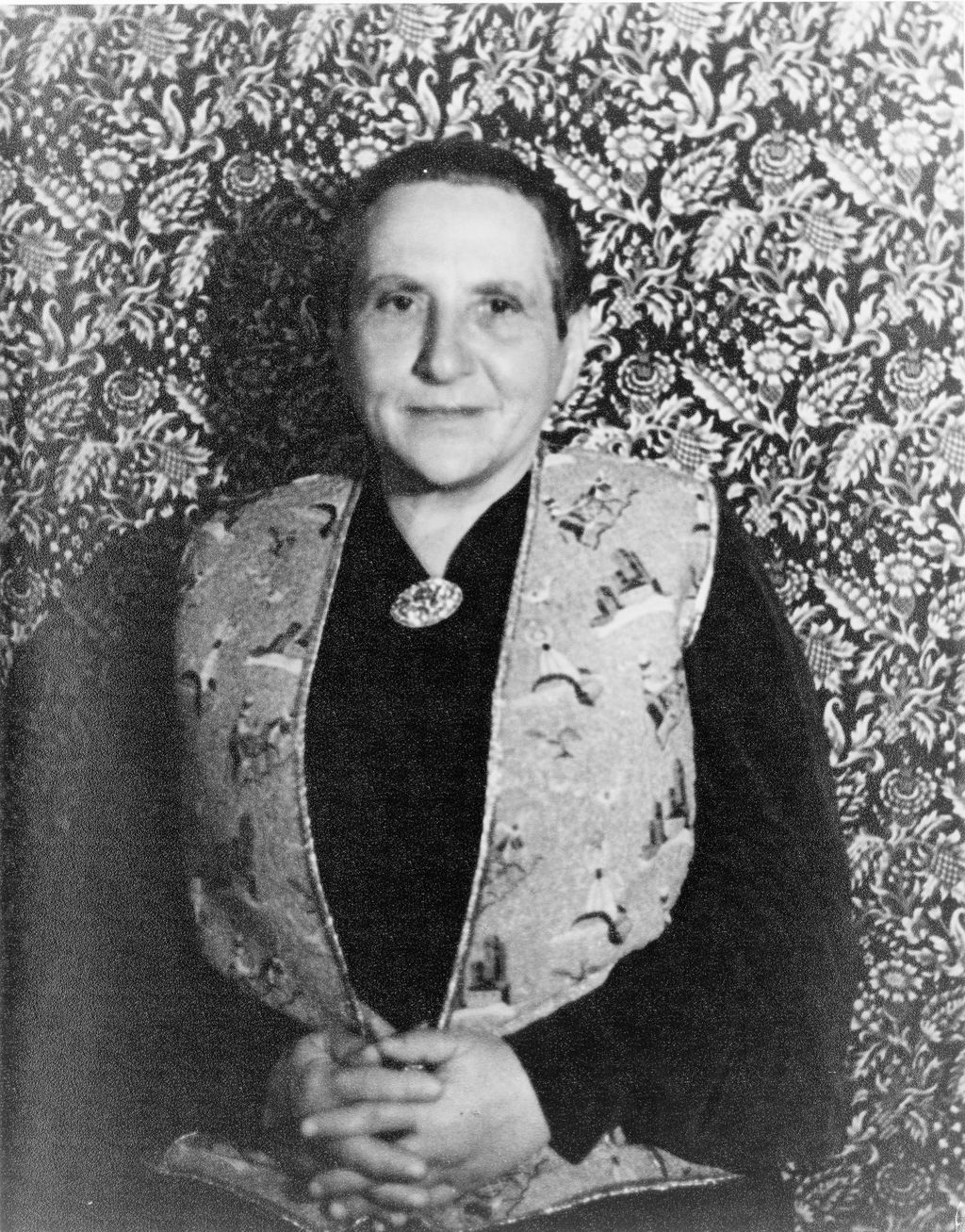
The oft-repeated claim that Stein sat eighty or ninety times belongs to the story she and others told about the portrait, not to a count that technical examination can prove. The image became important to Stein's own account of her identity and to the way she presented herself in her home and writing. She bequeathed it to the Met. To call her simply a passive “muse” would erase the writer, collector and person who lived with the portrait and helped shape its public meaning. The Gertrude Stein portrait has its own fuller history; here it shows how Picasso could seek likeness through deliberate alteration rather than finish by adding more naturalistic detail.[3]
Fernande Olivier's face offered another kind of experiment. Picasso made many drawings and paintings of her, but MoMA's Woman's Head (Fernande) turns a modelled head into changing volumes. He shaped it in clay in autumn 1909; casts followed with his permission. The nose, cheeks and hair remain legible, yet light across the projections and recesses makes the head look different as a viewer moves. The sculpted portrait can suggest several aspects of a person without pretending that one fixed view could contain her. It also belongs to a practical chain of modelling and casting, not to the myth of an isolated artist making every later object by hand.[4]
Dealers, writers and other working relationships
Picasso's sitters included people whose work helped his art circulate. The Museum of Modern Art's portrait exhibition noted dealers Ambroise Vollard, Wilhelm Uhde and Daniel-Henry Kahnweiler, alongside writers such as Guillaume Apollinaire and Stein. These are not incidental exceptions to an oeuvre of female portraits. Portraiture was also a way of picturing friendships, business relationships and the cultural network around the studio.[2]
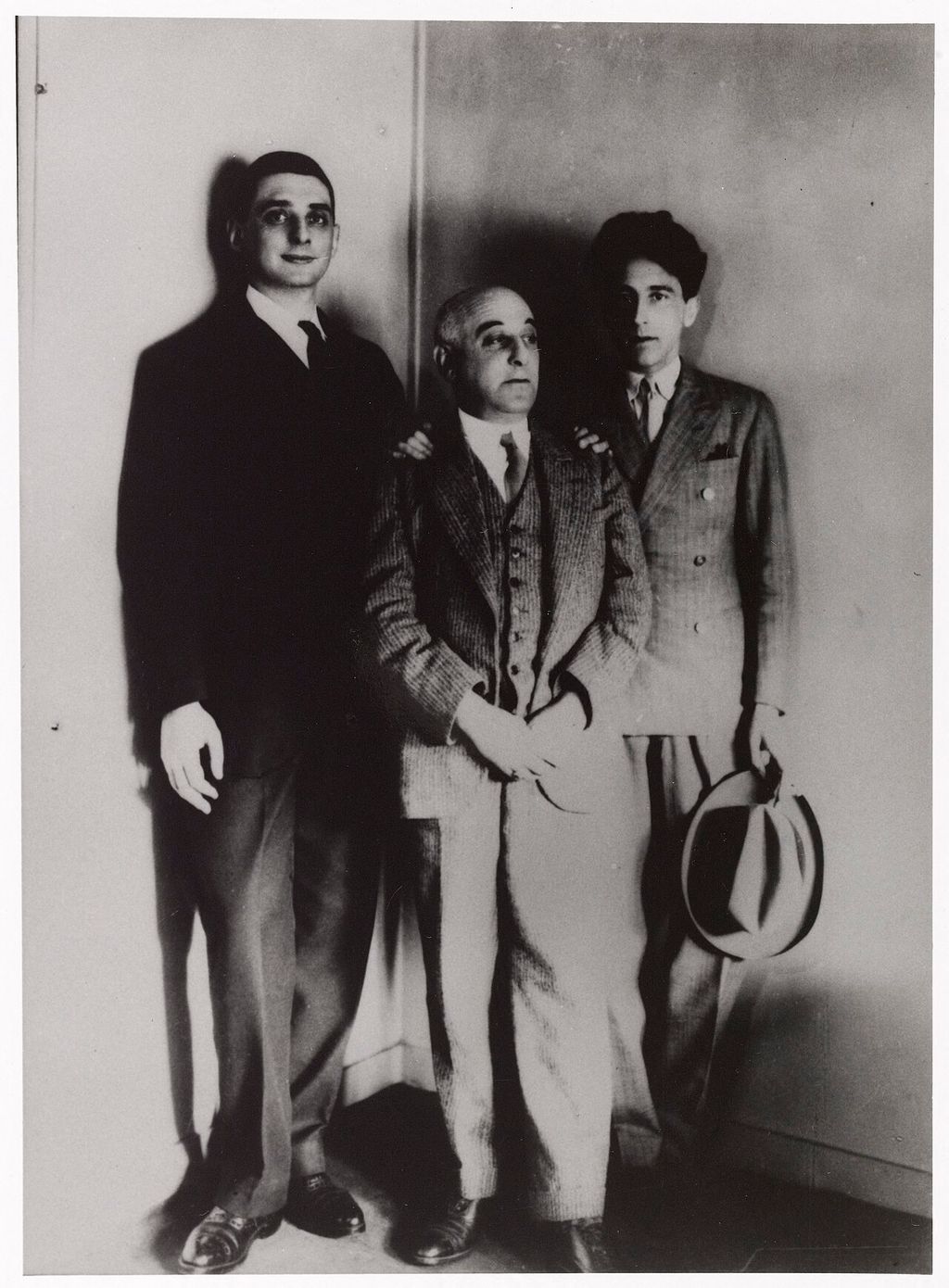
One earlier dealer portrait makes that network unusually visible. Picasso painted the Catalan dealer Pere, or Pedro, Mañach in 1901. The National Gallery of Art's canvas shows him standing against a yellow field with his name painted prominently in the picture. This is a named likeness in a literal sense, but the inscription also makes a claim about who belonged to the young artist's Paris circle. Barcelona's Museu Picasso records that Mañach helped bring about Picasso's 1901 exhibition at Vollard's gallery; the National Gallery lists the portrait among the works shown there. The picture therefore joined a sitter's identity to the circumstances in which Picasso's own paintings were being introduced to a Paris audience. Mañach should be seen as a working participant in that history, not simply as a moustached figure in an early style.[34][35]
The Art Institute of Chicago dates Picasso's Daniel-Henry Kahnweiler to autumn 1910. Kahnweiler was his dealer and an early advocate of Cubism. In this painting, a seated person is broken into small, closely related planes, but the resulting image is not simply a puzzle to be solved for a hidden face. It asks how much of a sitter's presence can survive when figure and surrounding space are treated with similar marks. The portrait is a named encounter as well as an experiment in depicting form. A fuller account of its ownership and technique belongs on the Kahnweiler portrait page.[10]
Portrait of Auguste Renoir after a photograph
Picasso also drew other artists. The Musée national Picasso-Paris holds his 1919–20 Portrait of Auguste Renoir, after a photograph, made in graphite and charcoal on paper. Renoir sits in a cap and coat, his bearded face built with concise contours while darker strokes give the chair and clothing weight. Picasso paid particular attention to the hands at the chair arms. The Royal Academy's Picasso and Paper exhibition guide connects their appearance to Renoir's arthritis and notes Picasso's growing interest in Renoir's paintings in 1919. That context gives the likeness more specificity than a general homage to an older painter.[11][45]
The title's phrase “after a photograph” is equally important. Picasso worked from a prior image, rather than from Renoir sitting opposite him. A photograph in the record does not tell us exactly how Picasso selected or transformed it; it does tell us that this portrait moved between media before it became a drawing. The sheet remains an individual object, not a painting and not merely a neutral copy of its photographic source. Its spare lines describe an elderly artist while leaving much of the paper unworked, so the viewer sees both the recognizable sitter and Picasso's choices about what to omit.[11][45]
Portrait of Erik Satie (1920)
Picasso's drawn likenesses also followed his work in theatre and music. Erik Satie composed the music for the 1917 ballet Parade, for which Picasso designed the sets and costumes. The Musée national Picasso-Paris holds a Portrait d'Erik Satie dated 19 May 1920, made in graphite and charcoal on paper. Satie sits in a wooden chair wearing round spectacles and a long coat. His fingers meet over his lap; lines that describe the chair arms and legs hold the seated body in place while much of the ground remains bare. The drawing is more particular than a quick emblem of a composer: Picasso attends to a person in clothing, with weight on a chair, without needing a painted room around him.[1][2][26][32][51]
A later photograph of a Picasso drawing of Satie, catalogued by the Bibliothèque nationale de France, records the date inscribed on the sheet. The photograph's measurements do not describe the original drawing. A portrait of a collaborator can outlast the project that brought two artists into the same circle. Here the dated drawing gives that relationship a material trace without requiring us to imagine a sitting or a friendship more intimate than the record documents.[32][44]
Portrait of Vollard I (1937)
Printmaking offers a different kind of encounter with a named person. MoMA holds Portrait of Vollard I, an aquatint and engraving from 1937, published in 1939 as part of the Vollard Suite. Its collection record says Picasso made four portraits of the dealer Ambroise Vollard on a single day. That fact distinguishes this suite of printed likenesses from the well-known 1910 painted portrait of Vollard and from a unique sketch. The plate was printed by the Lacourière workshop and issued by Vollard in an edition: portraiture here involved a publisher, printer and multiple impressions. The sitter was also a dealer who shaped how Picasso's works reached viewers. Keeping those roles visible is more illuminating than treating the print as a mere black-and-white substitute for a painting.[33]
What medium does to a portrait
The difference between a painted likeness and a printed one is not just a matter of colour. In the Vollard print, lines are incised or bitten into plates, inked and transferred to paper. The record of an edition means that more than one impression could reach a viewer, and a title such as Portrait of Vollard I identifies a plate within a suite, not a single canvas. A reader encountering a reproduction might see only a small black-and-white head, but the print's object history includes plate, workshop, publisher and paper. Those are part of how Picasso's representation of a dealer became public. The 1910 painted portrait and the 1937 printed heads can then be compared as different responses to the same influential sitter, not mistaken for variants of one object.[2][33]
Drawing can be immediate without being unmediated. Picasso's Renoir image is explicitly after a photograph: he studied an existing likeness of an older artist, rather than observing Renoir across a studio table. The Satie drawing has a precise date and materials in the Paris collection, yet those facts alone do not tell us how long he sat, what he and Picasso discussed or which other versions may exist. A charcoal line can sharpen a recognisable feature and leave the rest of the sheet open; it can also conceal the practical steps between seeing a person and making a public image. Object records answer some questions—who, when, what material—while leaving others open.[11][32]
Sculpture changes the relation again. In the 1909 head of Fernande, the face is not an image on a flat support but a sequence of volumes that a viewer meets from different angles. The work's casts create another important distinction: a cast is not a later photographic copy of a unique original, but an authorised physical version from a model. The structure can be described in relation to Cubism, yet it also remains a portrait of a particular person with whom Picasso lived. If the name “Fernande” is removed, formal analysis becomes too abstract; if the material and multiple viewpoints are ignored, the work becomes an illustration of biography. Holding those two observations together is more exact than choosing one.[4]
Olga and a classical form of portrait
Picasso met the dancer Olga Khokhlova while working with the Ballets Russes in 1917; they married in 1918. Portrait of Olga in an Armchair, held by the Musée national Picasso-Paris, belongs to that year. Its comparatively continuous contours and poised sitter often prompt the label “neoclassical.” The term describes one formal tendency rather than a wholesale abandonment of Picasso's other methods. There are other Olga portraits, and the 1918 armchair picture should not be collapsed into a 1920 drawing or a small drypoint in the Barcelona museum's collection.[12][13][42]
Portrait of Olga (1920): the pencil drawing
A large pencil drawing catalogued by Christie's as Portrait d'Olga shows her in a right-facing profile, her wavy hair pinned back and a pendant at her throat. Its lines are sparse, but they describe the folds of a sleeve and the angle of her neck as attentively as the face. Christie's dates the sheet to 1920 and records its size as 62.2 by 45.7 centimetres. The drawing stayed in Picasso's estate before passing to his son Claude and later owners. Barcelona's Portrait of Olga Picasso also dates from 1920, but it is a small drypoint print showing a more frontal head; it is not another impression of the large pencil sheet. One sitter and one year have produced two materially and visually distinct works. The difference matters more than attaching a single “Olga style” to both.[13][42]
Other classical portraits and uncertain sitters
Olga was a trained performer with a life before and beyond her marriage. The portrait is often explained as an emblem of Picasso's new social world or as a reflection of the public composure of a dancer. Those readings can illuminate the picture, but pose and costume do not grant direct access to her feelings. A late-1920s change in the way Picasso depicted Olga is also too easily told as though a changed painting style proves a single event in the marriage. The pictures have dates, subjects and visible decisions; the emotional history requires separate evidence.[12]
The 1923 Woman in White at the Met shows another aspect of this classical vocabulary. Its sitter is not named in the collection title. The Met places the painting after Picasso's return to Paris from a summer at Cap d'Antibes, and notes that writers have proposed Sara Murphy while photographs of related classical heads connect Olga to the imagery. Neither point settles this canvas's sitter. White drapery, an upright body and restrained setting give the picture a deliberate relation to older figure painting. It can be discussed alongside portraits, but it is more accurate to call it a figure painting than to assign the woman a name the object record does not establish.[14]
Marie-Thérèse Walter and portraits of the 1930s
Woman in Hat and Fur Collar (1937)
Marie-Thérèse Walter appears in many Picasso paintings and drawings of the 1930s. Museums identify her in specific works, while some titles—Seated Woman, Woman in an Armchair or Nude—are too common to carry an identity by themselves. The Museu Nacional d'Art de Catalunya identifies Woman in Hat and Fur Collar as Walter and dates the oil painting to 4 December 1937 in Paris. Its frontal and profile elements coexist in one face. This is a formal effect visible in the painting; it is not proof that Walter felt divided, or that Dora Maar is secretly present in the portrait.[15]
In this relatively small canvas, 61 by 51 centimetres, a red-and-green hat spreads widely above Walter's head. Green hair descends beside the yellow face, whose blue areas and doubled contours make the eyes and nose resist a single viewpoint. The fur at one shoulder and the sharply angled black-and-white collar answer the hat's broad curves with a more broken arrangement below. Colour separates parts of the likeness while the dark lines hold them in contact. MNAC records the painting as an oil on canvas and names its sitter; neither fact means that its formal divisions are a literal account of Walter's feelings. The museum's catalogue places this work at the end of a series in which Picasso pictured Walter alongside, and in tension with, his images of Dora Maar. That is a curatorial interpretation of the sequence, not evidence that Dora is a hidden second sitter within this particular portrait.[15]
Seated Woman (1937): identify which painting
Two Paris-held portraits show how misleading the recurring label “Seated Woman” can be. Portrait de Marie-Thérèse (MP159), dated 6 January 1937, places Walter in a striped orange hat, with green hair, a blue face and one hand lifted near her cheek. The room's angular corners and the patterned dress frame that recognisable person without reducing the picture to a conventional likeness. Picasso painted it in oil on a 100-by-81-centimetre canvas. Femme assise devant la fenêtre (MP161) was made on 11 March 1937 and combines oil and pastel on a larger canvas. Exhibition catalogues have used “Seated Woman (Marie-Thérèse Walter)” for both. The name and pose alone therefore cannot identify which painting a reader has in mind; the visual arrangement, date, medium and museum number must travel together.[16][41]
La Lecture: two paintings, one title
The title La Lecture also identifies more than one painting of Walter. The Musée national Picasso-Paris holds MP137, dated 2 January 1932, in which her face turns towards the viewer as her hands keep her place in an open book. A different La Lecture, catalogued by Sotheby's in 2011, shows a pale head tipped far back, a red chair back studded with small yellow points and a book opened low between curling arms. It is an oil on panel measuring 65.5 by 51 centimetres, not the larger Paris canvas. The latter composition has also been called La Lecture interrompue and The Dream (Reading) in earlier exhibitions. Both belong to Picasso's concentrated exploration of the seated reader, but their bodies, settings and histories differ. A title cannot substitute for looking at the actual object.[17][39][40]
The second painting has an unusual dating problem. Sotheby's records an inscription on its reverse that reads “11 decembre M.CM.XXXII.”, yet the work was exhibited in Paris and Zurich during 1932, before that December. The auction catalogue assigns it to the early-1932 sequence, but the evidence does not support treating the reverse inscription as a reliable day of execution. In the painting itself the book is unmistakable, though Walter's tilted head and closed-looking eyes complicate the notion that she is actively reading. The work holds reading and reverie in tension; it does not give us access to the book's text or to her thoughts. Keeping the date uncertainty visible is more illuminating than inventing the moment when she fell asleep.[39]
The panel's later history is also unusually well documented. Sotheby's traces it through the collections of Keith Warner, David Lloyd Kreeger and James Alsdorf, records a New York auction in May 1989, and says the owner who offered it in 2011 had acquired it in 1996. Its published provenance does not document a separate 1996 Christie's auction. The 1932 exhibition entry establishes where the picture was shown, but cannot by itself tell us what Olga Khokhlova saw or how Picasso's marriage changed. Keeping exhibition, ownership and family narratives apart is important when several paintings of Walter share similar titles.[39]
On 8 February 2011, Sotheby's offered this La Lecture in London with a £12–18 million estimate. A contemporary report from the sale records a £25.2 million result and an anonymous buyer. That price is part of the painting's public history, not a measure of its artistic importance. It belongs to this privately held panel; the Paris museum's distinct MP137 painting should not inherit its sale record.[39][52]
Nude, Green Leaves and Bust (1932)
The large paintings Nude, Green Leaves and Bust and Nude in a Black Armchair make a different demand on the word “portrait.” Both are associated with Walter and were painted in March 1932, but neither is simply a face offered for identification. In Nude, Green Leaves and Bust, a pale, reclining figure stretches across the lower canvas beneath blue drapery. Above her, a painted image of a white sculpted head presents Walter's profile in another material and position. Green philodendron leaves rise beside it. The bust is a representation within the painting, not a piece of plaster fixed to the canvas. The Musée national Picasso-Paris reads the contrast between horizontal body and upright bust as a dialogue between Picasso's painting and sculpture. That account keeps the work's construction visible without treating Walter herself as a symbol of fertility or sleep.[48][49]
Nude in a Black Armchair (1932)
Nude in a Black Armchair is a separate oil painting, also on a canvas roughly 1.6 metres high. The reclining figure fills the foreground against a dark chair; no sculpted double presides above her in the manner of the other picture. MoMA's study of the sequence describes Picasso bringing the body nearer the picture surface and changing the viewer's angle of approach. Seen together, the two canvases show how a recognisable person could be represented through a staged contrast of painting and sculpture in one work, and through the scale and sweep of a reclining body in another. Their common sitter and near-contemporary dates do not make one a copy of the other—or prove that either picture records Walter's thoughts.[49][50] [18]
Reading the 1930s portraits together
The January 1937 Portrait de Marie-Thérèse asks a different kind of close looking. Its figure is seated, but the eye moves among the sharp orange bars of the hat, the soft sweep of green hair, the blue face and the small yellow accents in the dress. The raised fingers make a pause within a surface otherwise crowded by stripes and intersecting edges. This canvas has circulated under generic seated-woman titles, while the museum's own French title names Walter. It should not inherit MP161's later date, pastel medium or window-centred description. Nor should the brightly coloured figure be read as evidence of her feelings. The painting can tell us how Picasso organised a likeness; the museum record anchors whose likeness it is.[41]
Together these works show why portraiture needs more than a sitter's name or a translated title. One reader appears alert and turned towards us; another tips her head back. Two seated women made only weeks apart in 1937 have different surfaces and compositions. A book or a window is part of the picture's structure, not interchangeable furniture around a likeness. The face viewed from more than one angle in a Walter portrait is likewise not simply a failed photographic likeness: it can hold competing positions at once. A careful account lets the image, the physical object and the sitter's documented identity inform one another without pretending that any one of them supplies the whole story.[2][16][17][39][41]
These pictures were made during an overlapping period of Picasso's relationships with Olga, Walter and later Maar. It is reductive to divide the women into “calm” and “distressed” styles, as if each person simply arrived to embody a new formal phase. MoMA's portraiture account explicitly warns that the familiar equation of one partner with one style is often mistaken. Picasso could vary technique within one day and return to a subject years later. The women's own histories do not fit inside his style chronology.[2]
Dora Maar as sitter and artist
Dora Maar was a photographer and artist with an established Surrealist and political milieu when she became close to Picasso. She photographed stages of Guernica in 1937. The Musée national Picasso-Paris holds a 1937 seated Portrait de Dora Maar in which her hand rests against her face and the face is shown from more than one angle. The museum draws attention to both its relation to Cubist fragmentation and its relatively balanced, almost classical pose. There is no need to make every altered feature a symptom of her psychology.[19]
Picasso made many Dora Maar portraits, and the familiar “Weeping Woman” is not a sufficient label for the person or the group. Some images picture tears; others show elegance, stillness or theatrical colour. Maar's photographic documentation of Guernica means she was also an image-maker watching and recording Picasso's work. A responsible portrait history should allow both roles to remain visible. It should also leave interpretive claims—such as a proposed link between formal distortion and the climate of war—labelled as interpretations, not a sitter's diagnosed emotional state.[19]
Françoise Gilot and Jacqueline Roque
Françoise Gilot was herself a painter and writer. Museo Picasso Málaga holds Woman in an Armchair (Françoise Gilot), dated 15 June 1946. Its triangles and circles make a recognisable seated figure without copying the outward details of a face. The museum describes a carefully joined geometric structure and records related studies. The portrait can be read as an arrangement of form, but it is also a painting of another working artist. Gilot's own practice and testimony should not disappear beneath an account of Picasso's invention.[20]
Jacqueline Roque met Picasso at the Madoura pottery in Vallauris in 1952 and married him in 1961. She appears in drawings, paintings, cut-metal works and the old-master variations of the later years. A 1961 cut and folded metal Woman at the Málaga museum is identified as Jacqueline: its outline and open spaces make a profile and a body through real material. Barcelona's portrait research also connects her image to paintings after Velázquez and Delacroix. The relationship between a known sitter and an imagined figure varies from work to work, so even a late female head should not automatically be named Jacqueline.[21][22]
Roque was not only a represented person. The Museu Picasso Barcelona remembers her as a significant benefactor who donated forty-one ceramics and a painting to its collection. That later activity cannot be read from a painted face, but it matters to her place in the history of Picasso's work and its preservation. The phrase “last muse” obscures both the different media in which Picasso depicted her and her actions outside the role of sitter.[23]
Faces, figures and self-portraits are not the same thing
Two Nudes
Picasso's portraits help us see why categories matter. MoMA's Two Nudes, an oil painting from late 1906, is a figure composition: the two women are nearly mirrored, and a curtain helps establish their relation to the viewer. MoMA also owns a different 1906 drawing called Two Nudes. Medium and collection number distinguish them; the shared title does not. The painting's visible relation to Les Demoiselles d'Avignon can be discussed without calling its women portraits of known individuals or assigning them a profession without evidence.[24]
In the canvas, the left-hand figure turns towards us and lifts one hand near the curtain, while the right-hand figure faces her in profile with her back partly presented. Their feet meet the narrow strip of floor in different orientations; one body invites looking, the other turns away. MoMA relates the terracotta colouring and weight of the forms to Picasso's interest in ancient Iberian sculpture, and sees a visual connection between the left figure and a woman in the later Demoiselles. That is a comparison of painted forms, not evidence that the two canvases depict the same sitters. The oil's scale—roughly one and a half metres high—also separates it from the museum's similarly titled drawing. The figures are central to a history of Picasso's treatment of people, but no identified individual's biography can be inferred from them.[24]
Figure studies and self portraits
Some drawings of reclining or seated women are similarly figure studies rather than portraits of an identifiable person. The Courtauld's Femme assise is a drawing whose careful line and pose recall both academic modelling and older sculpture; the record does not name a sitter. By contrast, a self-portrait explicitly asks how Picasso represented himself, and that subject has its own history from early paintings to late drawn heads. Date, medium and catalogue matter for both kinds of work.[25]
Two self-portraits from 1906 make the point especially clearly. The Met holds a small oil painting made after Picasso's summer in Gósol, where his forms became more simplified and sculptural. The museum says he followed it with the larger Self-Portrait with Palette, now in Philadelphia. In the latter painting he wears a work shirt and holds a palette, but no brush appears. The Philadelphia museum describes it as his first completed self-portrait showing himself in the act of painting and relates its stylised face to his interest in ancient Iberian sculpture. These are two distinct objects, despite their shared year and subject. They also ask different questions of a portrait: one concentrates on the head; the other shows the artist presenting the work of looking and making. A fuller history of Picasso's changing self-image belongs in the self-portraits guide, not in a caption that mistakes one 1906 painting for the other.[27]
There is an ethical as well as a cataloguing reason to keep these categories distinct. A female nude with no identified sitter is not evidence for a named woman's life; a late head cannot be assigned to Jacqueline because Picasso made many images of her; a quickly drawn male face cannot become a self-portrait because it resembles another one. Conversely, a documented portrait should not be stripped of its sitter's work, choices and public role just because its surface is formally adventurous. The named portraits of Bloch, Stein, Maar and Gilot involve a singer, writer, photographer and painter. Their identities are not prizes a viewer must guess from facial features. They come from records that can be checked, and those records set limits as well as possibilities for interpretation.[2][3][7][19][20]
The portraits offer a way to compare rather than flatten. Put Stein's repainted face beside the modelled planes of Fernande's head; compare the named singer Suzanne Bloch with the unnamed woman whose arms cross her body; set Olga's poised armchair picture against the geometric Françoise Gilot and the varied late images of Jacqueline. The transformations belong to Picasso's art, but the names refer to people who lived beyond it. A good portrait reading keeps both facts in view.[3][4][7][12][20][21]
Discussion
Use the evidence and your own close looking to explain your view. These are editorial prompts, not reader comments.
Reader Insights
What makes a named sitter recognisable when the face is transformed?
How do the sitter’s own life and work affect your reading of the portrait?
Which claim about a model’s feelings exceeds the evidence in the image?
Join the Conversation
Which reading best fits the evidence?
References
- Museu Picasso Barcelona, Picasso Portraits exhibition room texts and people index.
- MoMA, Picasso and Portraiture: Representation and Transformation.
- The Met, Gertrude Stein, technical study and Stein's relationship to the portrait.
- MoMA, Woman's Head (Fernande).
- Museu Picasso Barcelona, Àngel Fernández de Soto.
- Museu Picasso Barcelona, Jaume Sabartés.
- MASP, Retrato de Suzanne Bloch.
- Musée d'Orsay, Ambroise Vollard photograph of Femme aux bras croisés.
- Museu Picasso Barcelona, Carles Casagemas and Cleveland Museum of Art, technical study of La Vie.
- Art Institute of Chicago, Daniel-Henry Kahnweiler.
- Musée national Picasso-Paris, Portrait d'Auguste Renoir, d'après une photographie.
- Musée national Picasso-Paris, Portrait d'Olga dans un fauteuil.
- Museu Picasso Barcelona, Portrait of Olga Picasso.
- The Met, Woman in White.
- Museu Nacional d'Art de Catalunya, Woman in Hat and Fur Collar.
- Musée national Picasso-Paris, Femme assise devant la fenêtre.
- Musée national Picasso-Paris, Picasso 1932 exhibition record.
- MoMA, Picasso One on One educational research.
- Musée national Picasso-Paris, Portrait de Dora Maar and collection entry.
- Museo Picasso Málaga, Woman in an Armchair (Françoise Gilot); Barcelona, Gilot profile.
- Museu Picasso Barcelona, Jacqueline Roque profile.
- Museo Picasso Málaga, 1961 cut-metal Woman.
- Museu Picasso Barcelona, Jacqueline's donations.
- MoMA, 1906 Two Nudes painting and separate drawing.
- The Courtauld, Femme assise drawing.
- The Met, Jean Cocteau and the Parade collaboration.
- The Met, Self-Portrait (1906); Philadelphia Museum of Art, Self-Portrait with Palette (1906).
- Museu Picasso Barcelona, The Artist's Mother and the museum's conservation study.
- Museu Picasso Barcelona, The Artist's Father (watercolour, MPB 110.331).
- Museo Picasso Málaga, Lola with a Doll (The Artist's Sister).
- Museu Picasso Barcelona, Aunt Pepa.
- Musée national Picasso-Paris, Portrait d'Erik Satie, MP910.
- MoMA, Portrait of Vollard I from the Vollard Suite.
- National Gallery of Art, Pedro Mañach (1901).
- Museu Picasso Barcelona, the Vollard exhibition and Pere Mañach.
- Museu Picasso Barcelona, Àngel Fernández de Soto and the 1903 blue portrait.
- Christie's, Portrait d'Angel Fernández de Soto (2010 lot record).
- Christie's, Femme aux bras croisés object and technical account.
- Sotheby's, 2011 La Lecture lot 8, with object, inscription and exhibition history.
- Museo Picasso Málaga, exhibition reproduction of the distinct Paris-held La Lecture (MP137).
- Musée national Picasso-Paris, Portrait de Marie-Thérèse (MP159) and GrandPalaisRmn, museum-credited reproduction.
- Christie's, Portrait d'Olga (1920) pencil drawing and provenance; Museu Picasso Barcelona, separate 1920 drypoint.
- Musée national Picasso-Paris, Les Amants (MP483); French Ministry of Culture POP/Joconde record and credited image.
- Bibliothèque nationale de France, photograph of a Picasso drawing of Erik Satie seated on a chair.
- Royal Academy of Arts, Picasso and Paper exhibition guide, Renoir portrait entry.
- Museu Nacional d'Art de Catalunya, Carles Casagemas exhibition dossier, Casagemas, desnudo entry.
- Fundació Arquia, Catalan Picasso illustrated index, Casagemas, nu entry.
- Christie's, Nude, Green Leaves and Bust, object details and exhibition history.
- Musée national Picasso-Paris, Picasso 1932 exhibition research and chronology.
- MoMA, Anne Umland, Picasso One on One, March 1932 painting analysis and figure captions.
- Bridgeman Images, museum-identified Portrait of the Composer Erik Satie reproduction, in copyright.
- The Guardian, contemporary report on Sotheby's London sale of La Lecture, 8 February 2011.
Image Credits
- Didier Descouens. CC BY-SA 4.0. Source: Wikimedia Commons. Resized to 1024px; no crop. Source record. Licence.
- Carl Van Vechten, 4 November 1934. Library of Congress, Prints & Photographs Division, Carl Van Vechten Collection, LC-USZ62-103678. The Library considers this collection public domain; donor restrictions expired in 1986. Privacy and publicity rights may apply. Uncropped and uncolourised; proportional resize only. Source record. Licence.
- Anonyme, photographe. CC0. Source: Wikimedia Commons. Resized proportionally to 1024px wide; no crop. Source record. Licence.
- Bonachera jf, 18 May 2016. Wikimedia Commons, CC BY-SA 4.0. Proportional resize only; derivative retains CC BY-SA 4.0. Source record. Licence.


