


 by Tom Gurney
Tom Gurney BSc (Hons) is an art history expert with over 20 years experience
Email: tomgurney1@gmail.com / Phone: +44 7429 011000
Introduction
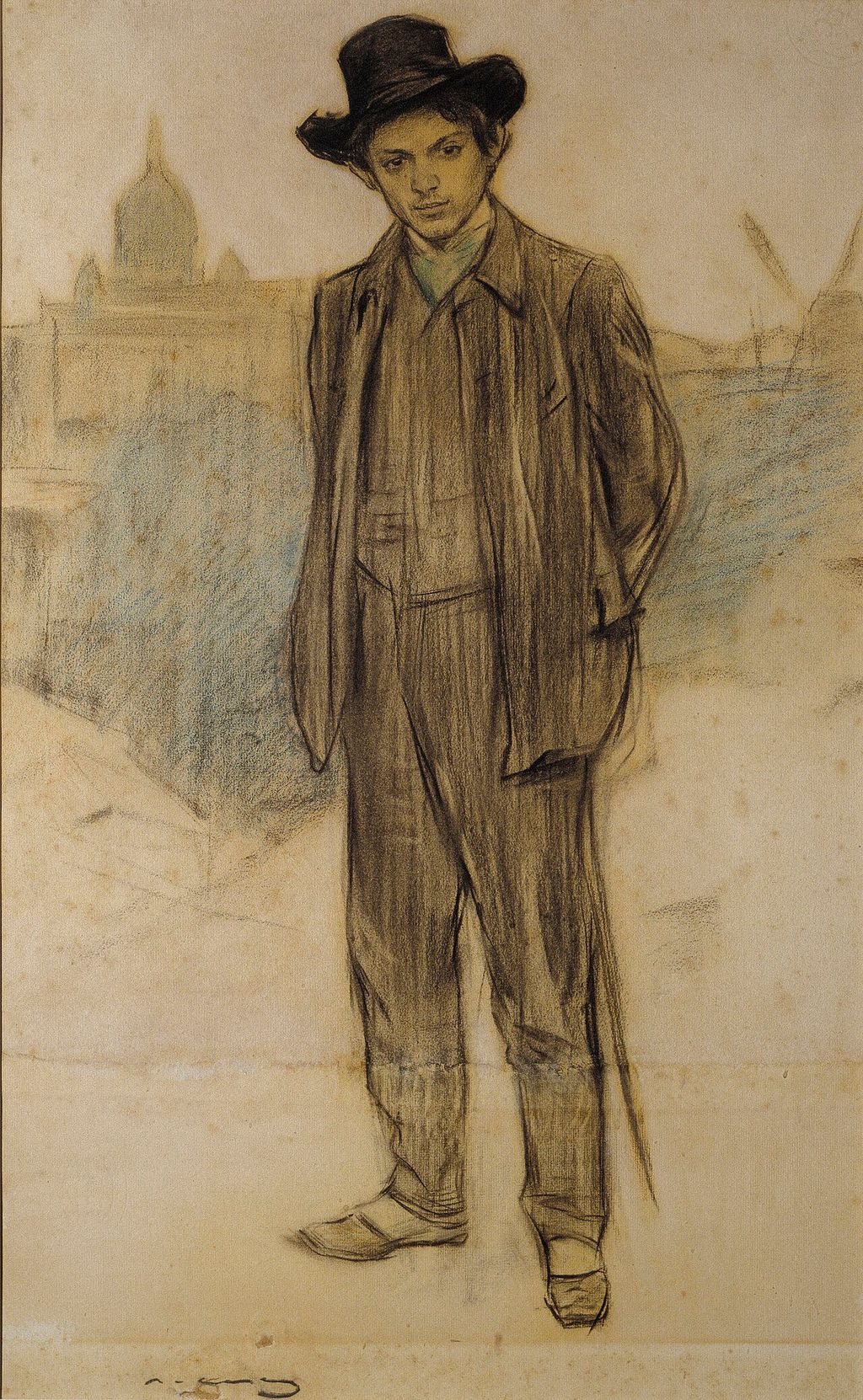
Picasso pictured himself from adolescence to the final years of his life, but not in a continuous sequence of portraits made in the same way. A schoolboy could study his face in oil or drawing; a young artist could dress as an older master; a painter in a late print might be a role Picasso tried on without being a likeness of his face. His self-portraits are valuable because they show him testing what an artist's image can do, not because every change in colour or expression provides a reliable diary of his feelings.[1]
The distinction matters particularly in Picasso's case. “Self-portrait” can mean a work named as such in a collection catalogue, a recognisable figure within a larger scene, or a symbolic painter whom scholars read as Picasso's double. These are related but different kinds of evidence. The Museu Picasso Barcelona's exhibition Yo Picasso made that range central: it included conventional self-portraits alongside photographs, costumes, prints and imagined versions of the artist. It also found the most sustained attention to the genre in Picasso's youth and, less consistently, in his late work. Between those concentrations, self-representation did not vanish; it became less likely to look like a straightforward face before a mirror.[1]
At a Glance
- Span: From adolescence to Picasso’s final years
- Forms: Documented self-portraits and images in which he takes on an artist’s role
- Caution: Expression is not a reliable diary of the artist’s feelings
Contents
- Early self-portraits and artistic training
- Different selves in 1901
- The distinct self-portraits of 1906 and 1907
- When the artist appears without a conventional self-portrait
- Late prints and performed identities
- The self-images of 1972
Early self-portraits and artistic training
Several self-portraits from 1896 survive in the Barcelona museum's collection. They should not be flattened into the often-repeated comparison between Picasso's supposedly “first” and “last” self-portrait. One catalogued 1896 oil on canvas, MPB 110.076, measures 32.9 by 23.5 centimetres; the museum also records other 1896 self-images on canvas and wood. The shared title and year do not make them the same object. What matters at this stage is that the young painter worked repeatedly with his own appearance, using the portable, always-available subject to practise and vary the terms of a portrait.[2]
Picasso's formal training in Barcelona did not prevent him from trying out identities that were less literal than a school exercise. Self-Portrait with Wig, catalogued as 1900, shows him in a large seventeenth-century-style wig and tie. The Barcelona museum relates the costume to his encounter with old-master painting at the Prado during a period of study in Madrid. The dress locates Picasso in an invented past, while the painting's quick handling and partly visible underlying work resist the smooth finish one might expect of a historical portrait. He presents himself as someone looking at and through earlier painters, not simply as a young man recording his current clothes.[3]
That tension between observation and invention was present in the way Picasso made images for others to see. Barcelona's exhibition account describes youthful self-portraits produced for local journals and a magazine he helped edit. Such a drawing may begin with a face, but publication changes its function: it becomes a public sign of the artist, circulating beyond his studio. The wig portrait similarly stages a painterly ancestry. Neither kind of image should be dismissed as a childish prelude to the supposedly “real” modern Picasso. They show him developing a sense of how an artist could be recognised.[1][3]
Different selves in 1901
In 1901 Picasso made self-images whose differences resist the idea that one year can be assigned one mood or style. MoMA's Self Portrait (Yo) is an oil on cardboard mounted on wood. Its title preserves the Spanish “I,” an unusually direct claim of presence. Barcelona's self-portrait exhibition contrasts this assertive painting with more introspective pictures from the same year. The comparison is important: Picasso could present himself with outward energy while making other works with more muted colours and a more withdrawn pose. Neither image cancels the other.[1][4]
The Musée national Picasso-Paris holds a different 1901 Autoportrait, made in Paris late in the year. This large oil on canvas, inventory MP4, belongs to the emergence of the paintings called the Blue Period. The cold range of colour and the guarded, frontal figure have encouraged readings of grief and isolation, especially in light of the death of Picasso's friend Carles Casagemas earlier in 1901. That historical connection is worth knowing, but the portrait cannot certify a medical diagnosis, the temperature of the room or an exact private thought. An artist can make a sombre image by deliberate formal choices. The face, coat and surrounding blue field are available to study; an invented scene of insomnia is not.[5]
The Paris painting has its own object history. The museum's catalogue dates it to the end of 1901 and records an oil painting made in Paris. Another museum page gives a slightly different measurement, a reminder that a citation should identify the precise record used. The work later belonged to the artist's studio and entered the Paris museum through the Picasso estate. It merits close treatment as an individual artwork; in a survey of self-portraits, its importance is also comparative. Place it beside Yo, and the Blue Period ceases to look like a simple switch that turned every image of Picasso into the same melancholy confession.[4][5]
Parody of Manet's Olympia with Junyer and Picasso
A small drawing made around 1901–03 places Picasso and his friend Sebastià Junyer Vidal inside a reworking of Édouard Manet's Olympia. Sotheby's catalogues it as Parodie de l'Olympia de Manet représentant Junyer et Picasso: wax crayon, pen and ink on paper, 14.9 × 21.5 cm, signed at upper left. Its recorded provenance begins with Junyer Vidal. The date is approximate, not a securely documented day in 1901, and the work is neither an oil painting nor one of the distinct 1901 frontal self-portraits discussed above.[20]
The reclining blue figure, two male figures, fruit, dog and cat remain visible in the legacy reproduction; Sotheby's catalogues the same arrangement. Manet's 1863 canvas provides the bed, reclining nude and visitor/servant relationship that Picasso rearranged, but a formal comparison does not prove what any depicted person privately thought. Sotheby's title supports identifying Junyer and Picasso among the figures without assigning every gesture a fixed biographical meaning. Here Picasso's self-image is staged through a borrowed composition and company rather than isolated as a head-and-shoulders likeness.[20][21]
Watch: Pablo Picasso
Explore Picasso through five videos from museums, broadcasters and art educators.
Picasso’s Guernica: Great Art Explained
Explore the composition and historical setting of Picasso’s best-known response to war.
Watch on YouTubeThe distinct self-portraits of 1906 and 1907
The phrase “Picasso self-portrait 1906” is ambiguous. At least three significant oil paintings made that year survive in different museums. The Musée national Picasso-Paris catalogues an autumn 1906 Autoportrait, inventory MP8, painted after Picasso's stay in Gósol. It shows a bust against a quiet ground, with a face reduced toward a mask and a body organised through firm outlines. The museum connects those choices to ancient Iberian sculpture and to a broader search for sculptural form. This is not a failure to produce a likeness. It is a test of how much personal identity a face can carry when naturalistic modelling is stripped away.[6]
The Metropolitan Museum of Art owns a smaller 1906 Self-Portrait, oil on canvas mounted on panel. Its catalogue likewise places the work after the summer in Gósol and describes a new simplification of form. The Met says Picasso made it shortly before the larger Self-Portrait with Palette in Philadelphia. These are separate paintings: the Met's picture is not a small reproduction or preparatory view of Philadelphia's finished canvas merely because both share a date. Comparing their scale and presentation helps reveal how Picasso could approach his own face through a series of related but distinct decisions.[7]
In Philadelphia's Self-Portrait with Palette, Picasso wears a work shirt and holds a palette in his left hand. The museum draws attention to a missing brush: the painting depicts the artist equipped for work without showing the expected tool in action. It calls this his first completed self-portrait in the act of painting. That statement is about the pictured role, not a claim that he had never portrayed himself before. The face has the large eyes and stylised features Philadelphia connects to his interest in ancient Iberian sculpture. In this version Picasso makes the painter's body, gaze and palette part of the question of likeness.[8]
The three works provide a better route through 1906 than a single famous image. Paris's bust presses the face toward an impersonal sculptural type; the Met's small canvas is an intimate-scale experiment in simplification; Philadelphia's painting gives the maker a working identity. It would be misleading to label every 1906 self-image a direct step toward Cubism as though the destination were already settled. They were made amid Picasso's study of older and non-European objects, whose distinct histories should not be collapsed into a vague claim that one culture supplied modern art's forms.[6][7][8]
Their titles present a small but consequential research problem. Paris and New York both catalogue an unqualified Self-Portrait from 1906, while Philadelphia adds the palette to its title. A search result, thumbnail or old website caption that says only “Self-Portrait, 1906” is therefore insufficient to identify the painting. The holding institution, object number where supplied, support, dimensions and pictured attributes must travel with the title. This is not pedantry: the Met's oil is mounted on panel, the Paris work is a larger canvas, and the Philadelphia figure visibly holds a palette. Conflating them produces false claims about what Picasso painted and what a reader is actually looking at.[6][7][8]
The National Gallery Prague's 1907 Autoportrét takes the challenge further. The gallery's Czech account describes sharp contours, almond-shaped eyes, flattened colour and a face that no longer relies on traditional shading to suggest volume. It relates the painting to Iberian and African sculptural sources and to the questions of form Picasso and Georges Braque would later pursue. The gallery also records that collector Vincenc Kramář bought the work from Ambroise Vollard in 1911. Thus a self-portrait that reconsidered how a face could be seen also travelled into a collection that helped Czech artists encounter new French painting. Its later history is part of its significance, not an afterthought to a story told only from Picasso's studio.[9]
When the artist appears without a conventional self-portrait
Picasso did not stop thinking about his own image after 1907. The Barcelona exhibition suggests that traditional self-portraiture became less central, while other forms of self-representation grew. One work might show a painter before a canvas; another might make the artist a spectator, a bohemian or a figure in historical costume. These roles are not interchangeable with a work explicitly catalogued as Self-Portrait. A symbolic painter may resemble Picasso, borrow details from his life or serve as a way to think about artistic labour, yet the identification can remain interpretive.[1]
There are also plainly titled self-portraits between the early and late concentrations. The National Gallery of Art in Washington holds a 1919 watercolour and graphite Self-Portrait on a small sheet of laid paper. Its survival contradicts any simple claim that the genre ended with the faces of 1906 or 1907. At the same time, its medium is a reminder that a survey built only around famous oils gives a false impression of the range of Picasso's practice. Drawing, print and photograph can carry a different pace and level of finish without becoming less important as ways of representing an artist.[10]
The most revealing middle-years example may be a work not titled Self-Portrait. The Musée national Picasso-Paris describes its 1928 Peintre à la palette et au chevalet—Painter with Palette and Easel, MP104—as a return to the self-portrait theme through the figure of a working painter. This is a large oil on canvas, not a small likeness. Palette and brush identify the profession, while the painter's head is built from opposed black and white profiles that seem to meet around two eyes. The body, by comparison, is schematically drawn. In the museum's interpretation, a few strokes at the nape recall Picasso's own hairstyle. Such clues make the self-image plausible, but they do different work from an inscription naming the subject. The painting asks viewers to recognise Picasso through his role and pictorial experiment rather than through conventional facial resemblance.[16]
The same museum connects that picture with studies for The Painter and His Model and with a photographic image of Picasso from 1927. These relations should be kept at the level the evidence permits: they show an artist returning to a problem of how to represent painter, model and studio across media, not a code that lets us translate every masklike face into a private event. The museum's more confident psychological reading of the painting is one possible interpretation, not an established fact about Picasso's marriage or mental state. This distinction matters because a self-portrait may be made from the circumstances of a life without being a transparent account of that life.[16]
A 1933 etching in the Paris collection makes the layers of self-representation almost literal. Its descriptive title, Sculptor and Model Looking at Each Other in a Mirror Resting on a Sculpted Self-Portrait, tells us there is a sculptor, a model, a mirror and a sculpted self-image within the scene. The museum dates the copper-plate etching to 8 April 1933 and identifies its impression as a trial proof pulled by Roger Lacourière in 1937 for the Vollard edition. The date of the plate and the date of this particular impression are therefore not identical. Nor is the sculptor's face simply equivalent to a head-and-shoulders portrait. The scene stages several ways to look: between artist and model, into a mirror, and at an object that represents its maker. The title is unusually explicit about an autoportrait sculpté, but it does not require every human figure to be read as a literal Picasso likeness.[17]
Madrid's Museo Reina Sofía identifies the painter-and-model theme and the Minotaur as recurring subjects in Picasso's prints of the 1930s and beyond. It also notes that biographical and symbolic elements mingle in these series. The Paris etching shows why the qualification is important. A recurring artist figure can carry Picasso's concerns about making, looking and being looked at while still belonging to an invented narrative. To call such a scene a “self-portrait” without explaining its structure would blur the difference between the artist's own represented face, a sculpted image inside the picture, and an allegorical role he might inhabit.[17][18]
Photography changes the question again. Barcelona's self-portrait exhibition includes pictures Picasso made of himself and images by other photographers that he used or altered. Authorship, pose and later intervention need to be separated. A photograph taken by another person is not automatically a photographic self-portrait; nor does pressing a shutter guarantee an unplanned, truthful view. The museum describes some images as carefully staged projections of Picasso in his studio. That is a useful way to read them: the artist controlled aspects of the public image even when the camera, unlike a brush, also registered the immediate surroundings.[1]
Paris's museum account of Picasso's studios adds a concrete setting for that control. It describes photographs of early Paris workspaces made by Picasso or people around him, and observes that he arranged his own works alongside objects he collected. In the Bateau-Lavoir photograph by Gelett Burgess, Picasso appears amid instruments and sculpture; later studio photographs show art, frames and materials deliberately juxtaposed. These are not substitutes for the painted 1901 or 1906 self-portraits. They show how an artist's image could be made through surroundings, chosen company and the display of work as much as through his features. They also have their own makers and rights: an image by Burgess or Brassaï is not suddenly Picasso's photograph because Picasso appears in it.[19]
The genre becomes most uncertain when an artist's shadow, profile or stand-in appears within a scene. Barcelona's curators distinguish explicit self-portraits from evocative and symbolic ones. This is a practical safeguard for readers. If a museum catalogues a 1901 painting as Autoportrait, one can begin with a secure identification. If a late canvas shows a painter whose tools or age resemble Picasso's, the question is more open: what evidence makes the figure a self-image, and what part of the scene remains invention? Treating every painter or musketeer as Picasso would make the category so broad that it loses its usefulness.[1]
Late prints and performed identities
In later printmaking Picasso could picture the artist as an actor within a crowded world. Barcelona's collection includes the etching Picasso, His Work and His Public, shown in its self-portrait exhibition. The title sets the artist between what he makes and those who look at it. Unlike a single painted head, the print can stage an encounter: self-representation becomes a question of audience and reputation as well as appearance. The museum records the impression as a proof associated with Jaume Sabartés, made by etching a copper plate and printing it on Rives paper. Those material details matter because an etching is not merely a drawing reproduced by a camera; the plate and impression are part of its making.[11]
The exhibition also includes Return to the Origins: Picasso Tourist at the Canaletes Fountain, another etching in Barcelona's collection. The title places a performed Picasso back in the city where much of his youthful self-portraiture took shape. A tourist is a role rather than a face alone. The work allows a late artist to revisit an earlier place through invented action, not just through a literal record of a visit. Its relation to Barcelona is clear from title and subject; the exact degree to which a depicted figure should be read as a factual self-portrait belongs to interpretation.[12]
Barcelona's curators connect such late work to the Suite 347 and Suite 156, where artist figures assume different ages and characters. Their account is valuable for the pattern but should not become a claim that every plate depicts Picasso's literal body. A caricatured old man, a tourist, a newborn or a performer can function as an image of the artist's possible selves. In print, he could return to and vary a theme across a series rather than fix a single authoritative likeness. That multiplicity is part of the achievement.[1]
The Reina Sofía's survey of its Picasso prints supplies a useful longer view: it holds prints dated from 1922 to 1972 and singles out the Vollard Suite of the 1930s and the late suites as substantial concentrations. Its Spanish text names the final major group Suite 157, whereas Barcelona's exhibition uses Suite 156. Those labels should not be silently treated as the same counted set; print suites can be described and grouped differently. For this page, the common point is better supported than a disputed number: Picasso kept using repeated printed scenes to vary an artist persona and to revisit the painter–model relationship long after his youthful painted likenesses.[1][18]
The self-images of 1972
Picasso made self-portraits in 1972, the year before his death. Barcelona's exhibition describes a group of works from that summer, not one uncontested “final self-portrait.” A MoMA exhibition checklist records a 1972 Self-Portrait in crayon and coloured crayons on paper, then listed in a Tokyo collection. A Paris museum dossier refers to a self-portrait made at Mougins on 30 June 1972 in a private collection. Those descriptions are useful anchors, but a reader should not be asked to treat them as the same sheet until their catalogues and images are reconciled. The medium, date and holding history matter more than a dramatic title added later.[1][13][14]
The late drawn faces can be startlingly direct in their gaze while departing far from the forms of Picasso's schoolboy likenesses. That difference does not prove a simple story of decline or fear. A drawing may address age, mortality, performance or the stubborn act of making an image; none of those possibilities gives us automatic access to Picasso's private state. The public habit of pairing one 1896 and one 1972 image as if seventy-six years of work were a before-and-after demonstration misses the long intervals, different media and invented roles between them.[1][2][13]
One 1972 painting makes the boundary of self-portraiture especially productive. The Musée national Picasso-Paris catalogues Le Jeune Peintre, or The Young Painter, dated 14 April 1972. The figure has a palette, brush and hat, and it is tempting to see a rejuvenated Picasso. The Paris museum acknowledges that reading but argues that the painting can also be understood as a more general figure of a painter and an address to artistic succession. That caution matters. A self-portrait guide should make room for an image that refers to the artist without declaring its identity settled when the holding institution itself keeps the question open.[15]
Picasso's self-portraits finally invite comparison rather than a single verdict about the man. The seventeenth-century wig, the assertive Yo, the blue Paris canvas, three different 1906 oils, the small 1919 drawing, the crowded late print and the 1972 sheets each propose a different relation between an artist and an image of himself. We can trace what is visible, what the catalogue establishes and where curators disagree. That is a richer account than treating every stylised face as a confession or every late figure as a farewell.[1][3][4][5][6][10][11][13]
For a reader encountering a single reproduction, the most useful questions are modest ones. Which object is it—identified by holding institution, date, medium and, when available, inventory number? Did Picasso name it as a self-portrait, or is that a later curatorial reading? Does the figure show his face, an artist's tools, or only a role associated with him? How was the image circulated: as a unique painting, a drawing, an etching proof or a photograph made by someone else? These questions do not make interpretation cold. They let each version of Picasso's self-image remain particular, and prevent a dramatic but unsupported story from standing in for the work.[1][6][10][17]
Discussion
Use the evidence and your own close looking to explain your view. These are editorial prompts, not reader comments.
Reader Insights
Which feature identifies a documented self-portrait rather than an assumed stand-in?
How does Picasso cast himself as an artist rather than record a neutral likeness?
What evidence would be needed to treat a facial expression as autobiography?
Join the Conversation
Which reading best fits the evidence?
References
- Museu Picasso Barcelona, Yo Picasso. Self-Portraits exhibition.
- Museu Picasso Barcelona, Self-Portrait (1896), MPB 110.076; museum collection update distinguishing other 1896 objects.
- Museu Picasso Barcelona, Self-Portrait with Wig.
- MoMA, Self Portrait (Yo).
- Musée national Picasso-Paris, late-1901 Autoportrait, MP4 and museum essay.
- Musée national Picasso-Paris, autumn-1906 Autoportrait, MP8.
- The Met, Self-Portrait (1906).
- Philadelphia Museum of Art, Self-Portrait with Palette (1906).
- National Gallery Prague, 1907 Autoportrét.
- National Gallery of Art, Self-Portrait (1919).
- Museu Picasso Barcelona, Picasso, His Work and His Public.
- Museu Picasso Barcelona, Return to the Origins: Picasso Tourist at the Canaletes Fountain.
- MoMA, exhibition master checklist with 1972 Self-Portrait.
- Musée national Picasso-Paris, exhibition dossier referring to the 30 June 1972 Mougins self-portrait.
- Musée national Picasso-Paris, Le Jeune Peintre, MP228.
- Musée national Picasso-Paris, Peintre à la palette et au chevalet, MP104.
- Musée national Picasso-Paris, Sculpteur et modèle se regardant dans un miroir calé sur un autoportrait sculpté, MP1982-128.
- Museo Reina Sofía, Picasso grabador exhibition text.
- Musée national Picasso-Paris, Les ateliers de Picasso.
- Sotheby's, Parodie de l'Olympia de Manet représentant Junyer et Picasso, 2025 London lot 5, with illustration, medium, date range, dimensions and provenance.
- Musée d'Orsay, Édouard Manet's Olympia, RF 644, 1863 oil-painting collection record.
Image Credits
- Ramon Casas. Public domain. Source: Wikimedia Commons. Resized to 1024px; no crop. Source record. Licence.
