


 by Tom Gurney
Tom Gurney BSc (Hons) is an art history expert with over 20 years experience
Email: tomgurney1@gmail.com / Phone: +44 7429 011000
Introduction
Olga Khokhlova sits upright in a patterned chair, a fan spread across her lap. Her dark, flowered dress and carefully parted hair have the precision of a formal portrait. Around them, however, Picasso leaves a surprising amount unresolved. The chair seems to lose its lower structure, and the pale canvas behind Olga is scarcely made into a room. She is a recognisable person placed within a picture that openly shows its making.
This is Portrait d'Olga dans un fauteuil—usually translated as Portrait of Olga in the Armchair—painted at Montrouge in spring 1918. The oil on canvas measures 130 × 88.8 centimetres and belongs to the Musée national Picasso-Paris[1], which records it as MP55. Its date is important: a 1917 encounter between Picasso and Olga belongs to the story behind the painting, but the museum dates the painting itself to 1918. Nor is it interchangeable with every later work called Olga in an Armchair. This particular portrait holds together a meeting of two lives, a photographic source and Picasso's deliberate movement between finish and exposure. [1]
At a Glance
- Sitter: Olga Khokhlova
- French title: Portrait d’Olga dans un fauteuil
- Look for: A formal seated portrait with visibly unfinished surroundings
Portrait of Olga in the Armchair in Picasso's career
The highlighted work is dated with the qualifications explained in the sources on this page. The other works are selective points of comparison, not the start or end of a style.
Contents
- Who was Olga Khokhlova?
- Looking at the portrait
- A photograph, and what Picasso changed
- Classicism without a simple return
- A dancer seen at rest
- Where is the painting, and which Olga portrait is this?
Who was Olga Khokhlova?
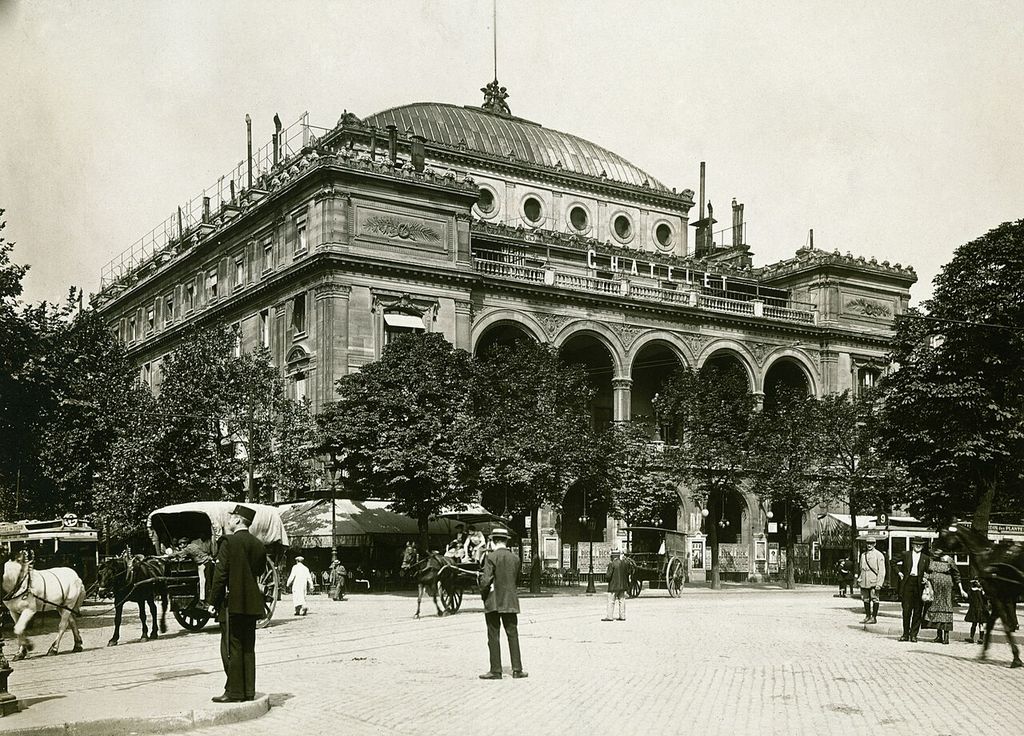
Olga Khokhlova was born in 1891 in Nizhyn, then in the Russian Empire and now in Ukraine. She was a dancer with Sergei Diaghilev's Ballets Russes, an international company whose productions brought artists, composers and performers into close collaboration. Picasso met her in Rome in 1917, while working on designs for the ballet Parade. Musée national Picasso-Paris records[6] that Parade premiered at Paris's Théâtre du Châtelet on 18 May 1917. That theatre is part of the couple's shared ballet context, not the setting of the 1918 portrait. Olga did not enter his life as a blank figure waiting to be painted. She had already trained, travelled and performed in a demanding profession with its own networks and history. [6]
The pair spent time in Barcelona in 1917; Museu Picasso Barcelona's account of that year[4] places their stay amid Picasso's work and family contacts there. They married in Paris on 12 July 1918, a few months after the date assigned to this portrait. Their son Paulo was born in February 1921. Those dates establish a relationship around the painting without making it a wedding picture or proof of how either person felt during a sitting. Later photographs and letters complicate any story of an uncomplicated domestic idyll. [4]
The Musée national Picasso-Paris's Olga Picasso research[3] reconstructs her career and family history from a substantial archive. Olga's relatives lived through revolution and its aftermath at a distance from her, and the correspondence preserves anxieties and obligations that an art-historical shorthand such as “Picasso's wife” cannot contain. Much of the surviving family-letter sequence dates from 1919 to 1933, after this spring 1918 painting. It tells us more about Olga's subsequent circumstances and her relationship to her family; it does not let us diagnose the emotion on her painted face in 1918. Looking closely at the portrait and taking her documentary life seriously are complementary tasks, but they must not be confused. [3]
Looking at the portrait
Olga sits facing the viewer with a slight turn to the body. Her head is small in relation to the broad sweep of the chair and dress, and the dark mass of her hair frames a face drawn with unusual restraint. The central parting, the long nose and the light accents around her eyes and cheeks give her presence specificity without excessive expression. It is possible to read her as poised or reserved. Neither description proves a private feeling: the stillness may belong as much to the conventions of portraiture and to the source photograph as to the sitter.
The chair is almost a second subject. Its back rises around Olga, crowded with floral ornament. Across its upholstery Picasso differentiates clustered motifs, pale highlights and darker passages. The folds of her black dress carry their own flowered pattern; it takes a little time to separate fabric from chair. The opened fan marks her hands and lap with a lighter, radiating shape. These details invite the viewer toward the concentrated centre of the picture, but they do not continue evenly across the surface.
The scale reinforces that effect. At 130 centimetres high, this is not a casual small likeness to be held in the hand. Its narrow, upright format gives the seated figure a presence close to a standing person, even though her body is contained within the chair. The viewer's eye can travel from the dark crown of her head down through the angular folds of the fan, then out into the comparatively open lower canvas. The portrait therefore changes pace as we look: passages dense with descriptive marks are followed by areas where a few strokes carry almost all the spatial work. That rhythm is a formal experience available in the painting itself, independent of any claim about Olga's character.
Below and around Olga, the image thins out. The chair's seat and legs do not fully appear. Her lower legs have no conventionally completed setting. The pale, exposed ground retains broad or loose marks rather than an elaborated interior, while a faint shadow suggests where a body and chair might meet space. A portrait often uses a background to stabilise its subject—to say where she sits and how the room surrounds her. Here the absence of that completion makes us notice the decisions by which Picasso has made Olga visible. The most exact passages and the apparently unfinished ones belong to the same painting.
That contrast does not mean that Picasso ran out of time, or that the portrait is an abandoned study. The museum's object account[1] records it as an oil painting in its collection and explains how the photographic setting was pared away. We can describe what remains visible, but there is no need to invent an undocumented reason why Picasso stopped at precisely this degree of finish. A useful question is what the incomplete setting does: it directs attention to the figure while revealing that likeness need not depend on a fully furnished illusion. [1]
Watch: Pablo Picasso
Explore Picasso through five videos from museums, broadcasters and art educators.
Picasso’s Guernica: Great Art Explained
Explore the composition and historical setting of Picasso’s best-known response to war.
Watch on YouTubeA photograph, and what Picasso changed
The portrait is unusually well anchored by a photographic source. The Paris museum keeps an archival image of Olga seated with a fan in a chair[2], catalogued to the photographer Émile Delétang. Museu Picasso Barcelona's photography research[4] also identifies Delétang's 1918 photograph as the basis of this painting. The existence of the photograph does not reduce the canvas to a transcription; it lets us see more clearly which parts of a visual record Picasso accepted, emphasised or discarded. [2] [4]
He kept the memorable pose, the fan, the flowered dress and much of the decorative chair. He did not give the photograph's studio surroundings the same authority. In the painting, the seat and legs of the chair, Olga's lower limbs and the complete background recede or disappear. The fan and brocade have a concentrated density against the open canvas. A camera fixes the light and objects available to it at one instant. Picasso's painting is an arrangement made after that instant: a selection and transformation of information, not a demand that every part of the photograph be carried across.
This is also a reminder that the subject, photographer and painter have different roles. Olga supplied the pose and her own physical presence; Delétang made the preserved photograph according to the archival attribution; Picasso reworked its image in paint. Some short accounts of the portrait say Picasso himself took the source photograph. The museum's archival catalogue and Barcelona's exhibition research give the more specific Delétang credit, so the surviving record does not support confidently assigning that shutter-click to Picasso. It is enough to recognise the photograph's place in the process without converting a disputed credit into a fact about his authorship.
Classicism without a simple return
The frontal composure, carefully modelled head and elaborate furnishing are unlike the fragmented figures through which Picasso had become famous in Cubism. They recall a longer European tradition of formal portraiture. Curators have compared the picture's drawn finish and seated pose with Jean-Auguste-Dominique Ingres, one of the nineteenth century's major portrait painters. That comparison can help us see how consciously the painting works with line, figure and decorative setting. It is a comparison of artistic languages, not evidence that Picasso copied one named Ingres picture or intended an exact homage.
It is equally misleading to turn this canvas into the moment Picasso “gave up” Cubism. His work around 1917–18 moved between classicising and experimental vocabularies. The Barcelona museum's study of 1917[4] presents those pursuits side by side. The measured face in Portrait of Olga in the Armchair and the active incompletion of its setting can be read together: solidity in one passage does not make the entire work a retreat into traditional illusion. Picasso could test the expressive possibilities of different pictorial systems without placing them in a single, irreversible sequence. [4]
The First World War was still being fought when the painting was made, and artists in its aftermath were later discussed through the idea of a “return to order.” The term can offer historical context for renewed interest in legible figures and older forms. It should not act as a shortcut that explains everything about this particular sitter, photograph or canvas. Nor should Olga be made the cause of an entire stylistic change because she appears in a classicising portrait. The painting belongs to a broader artistic moment while remaining a distinct set of decisions about one person.
The calendar makes a further distinction worth keeping. Picasso's collaboration on Parade and his first meeting with Olga occurred in 1917, the year to which this picture is sometimes casually assigned. Their Barcelona months belong to that same earlier chapter. Spring 1918 at Montrouge was a different setting and a different stage of their relationship. The museum's date is not a minor catalogue preference that can be blurred into a general “around 1917” label: it prevents the picture from being treated as a visual diary of their first encounter. In the absence of a documented sitting account, even the source photograph gives a visual basis, not a transcript of the circumstances in which every brushstroke was made.
A dancer seen at rest
Olga's professional life as a dancer matters partly because the portrait does not show it directly. She is seated, still, formally dressed, far from the movements of a performance. It would be easy to set up an over-simple opposition—Olga the dancer versus Olga the wife—as if a portrait could display only one identity. The archive surrounding her contains costumes, photographs and family correspondence as well as artworks. These traces suggest a life larger than any single role assigned by Picasso or later commentators.
The formal pose also resists treating her merely as an emblem of Picasso's supposed happiness or a passive “muse.” She occupies the picture on her own terms as far as a painted portrait can allow: the gaze, dress, fan and steadiness all ask for attention. At the same time, it was Picasso who controlled the painted surface, and the photograph provided one mediation of how she appeared. The power relations involved in portrait-making are real, but the evidence does not authorise us to replace one reductive story with another—that the image reveals her exact thoughts or predicts the marriage's later course.
The marriage did change. Olga and Picasso separated in 1935, although they remained legally married until her death in 1955. Those later facts are part of the biography, not hidden symbols inside a spring 1918 fan, pattern or shadow. Their son Paulo and the subsequent family history deserve to be understood on their own dates. The portrait's closeness to the wedding may make viewers curious about the beginning of the relationship; it does not make the painted expression a forecast of its end.
Where is the painting, and which Olga portrait is this?
The canvas remained associated with Picasso's studio and entered the French national collection through the 1979 dation recorded by the Musée national Picasso-Paris[1]. A dation is a transfer to the state in settlement of inheritance tax. The painting is now held by the Paris museum as MP55. Its presence in past exhibitions or a museum's present display arrangement should not be mistaken for a different owner or a promise that it will always be on view. [1]
Picasso made other images of Olga in chairs and in other settings. The Paris museum catalogues a later ink drawing, Olga dans un fauteuil (MP854)[7], from late 1919. The Museo Picasso Málaga's Retrato de Olga[5] is a work dated 10 November 1923. A 1917 mantilla portrait belongs to the earlier Barcelona context. Similar English titles, the same sitter and recurring seated poses make these works easy to merge in search results. They are not alternate dates or versions of MP55. For the painting considered here, the safest identifying combination is the ornate floral chair, open fan, exposed canvas, Montrouge, spring 1918 and Paris inventory MP55. [7] [5]
Málaga's research also notes that the 1918 portrait was grouped with other family images at Picasso's 1932 retrospective. By then the canvas had acquired a public life beyond its making and beyond any private photograph. Today it asks two different kinds of attention: to Olga, whose documented life reaches beyond her part in Picasso's biography, and to a painterly construction in which an exact face and patterned fabric emerge from a space intentionally left open. The portrait is strongest when neither attention erases the other.
Discussion
Use the evidence and your own close looking to explain your view. These are editorial prompts, not reader comments.
Reader Insights
Which parts of Olga’s dress and fan appear carefully resolved?
What does the unfinished surrounding canvas do to the seated pose?
How does the work differ from a photographic record of Olga?
Join the Conversation
Which reading best fits the evidence?
References
- Musée national Picasso-Paris, MP55 object and catalogue essay.
- Musée national Picasso-Paris, archival Olga-with-fan photograph APPH2771.
- Musée national Picasso-Paris, Olga Picasso exhibition and research and English dossier.
- Museu Picasso Barcelona, Picasso behind and in front of the camera and 1917 Barcelona research.
- Museo Picasso Málaga, Olga Picasso exhibition and distinct 1923 Retrato de Olga.
- Musée national Picasso-Paris records. View source
- Olga dans un fauteuil (MP854). View source
Image Credits
- Lansiaux, Charles Joseph Antoine (Aniche, 09–03–1855 - Paris, après 06–04–1939), photographe. CC0. Source: Wikimedia Commons. Resized proportionally to 1024px wide; no crop. Source record. Licence.
