


 by Tom Gurney
Tom Gurney BSc (Hons) is an art history expert with over 20 years experience
Email: tomgurney1@gmail.com / Phone: +44 7429 011000
Introduction
Pablo Picasso's Woman Ironing (La repasseuse) centres on one worker and one repeated task. A thin woman bends over a table, both hands pressing a heavy iron onto fabric. Her head sinks toward her arm; a bowl and cloth occupy the lower right. Almost everything else has been pared away. Painted in Paris in 1904, the tall canvas belongs to the end of Picasso's Blue Period and is held by the Solomon R. Guggenheim Museum in New York as part of the Thannhauser Collection, accession 78.2514.41. It is an oil painting measuring 116.2 by 73 centimetres.[1][2]
The painting is familiar as an image of weariness, but looking at it closely reveals more than a mood. Its light greys and cold blues were carefully made, and conservation has shown that they partly cover a different Picasso portrait, turned upside down beneath the laundress. A later Guggenheim study also questions the traditional spring 1904 dating, arguing for autumn or early winter of that year. The visible woman, the hidden man and the painting's ownership history each require separate evidence; none is explained simply by saying that Picasso was sad and poor.[2][3]
At a Glance
- Made: Paris, 1904; the precise season is disputed
- Medium and size: Oil on canvas, 116.2 × 73 centimetres
- Collection: Solomon R. Guggenheim Museum, Thannhauser Collection, 78.2514.41
- Beneath the surface: An upside-down portrait identified in later research as Ricard Canals
Woman Ironing in Picasso's career
First Communion
1896Woman Ironing
1904Three Musicians
1921Las Meninas series
1957The highlighted work is dated with the qualifications explained in the sources on this page. The other works are selective points of comparison, not the start or end of a style.
Contents
- A task made visible through the body
- At the edge of the Blue Period
- Spring 1904 or later that year?
- A portrait beneath the ironing woman
- What cleaning changed
- Picasso was not the first to picture an ironer
- Who was the woman?
- The painting's journey and its contested 1938 sale
- Looking beyond a reproduction
A task made visible through the body
The iron sits near the centre of the lower half of the composition. Both of the woman's arms converge upon it, making the tool the point toward which her head, shoulders and hands seem to move. The table's horizontal edge checks that downward movement. Her spine and shoulders create a long arc; her sleeves fall almost vertically to the working surface. The pose makes pressure visible before we know anything about the person's name.[1][4]
Her face is present but hard to read as a portrait. Dark hair hangs beside it; the eyes appear shadowed. The bent body brings the head close to the labour rather than raising it to address the viewer. The surrounding space is spare. We do not see a busy laundry with other workers, an employer, or a domestic interior. Picasso gives us enough objects to understand the action—the iron, table, bowl and cloth—then concentrates the scene in one figure.[1][4]
The basin matters because it prevents the white foreground from becoming an empty abstract plane. It belongs to the work of ironing, as does the cloth beside it. A museum teaching text explains how a heavy iron of this sort would have needed reheating and how water could be sprinkled on fabric. Those details make the repeated effort easier to imagine, but the painting itself does not tell us how many hours this woman had worked, what she was paid, or whether she ironed in a commercial laundry or at home. We can describe the depicted task without inventing a documentary record of her day.[4]
The figure is stretched and narrowed. Her forearms seem unusually long in relation to the small, lowered face. The pale blouse catches more light than the surrounding space; dark lines mark the hair, eyes, folded body and iron. These distortions heighten the image's visual force. They are not simply signs that Picasso could not draw anatomy accurately. The Guggenheim's curatorial writing relates the attenuated form and angular contours to El Greco, while its teaching material calls the figure almost an icon rather than a scene. Those are interpretations of Picasso's formal language, not evidence that he copied one El Greco painting or had a single symbolic message in mind.[4][5]
The image may prompt sympathy, but sympathy should not become a fictional biography. A bent pose and gaunt features suggest exhaustion or hardship. They do not establish a medical condition, a particular wage, the worker's private thoughts or a personal relationship with Picasso. The figure's anonymity can give the painting reach beyond one sitter; it can also obscure the real women whose labour supplied its subject. Both possibilities are worth holding in view. She is not merely a device for describing Picasso's own poverty.[2][4]
At the edge of the Blue Period
Picasso's Blue Period is usually dated from 1901 to 1904, when he worked between Barcelona and Paris and repeatedly pictured vulnerability, labour and social exclusion. Woman Ironing belongs near the end of that span. Compared with the dense, saturated blues of works such as The Old Guitarist, it uses a lighter range of silver-grey, white, muted flesh colour and blue. The background is dark enough to set off the woman but not a descriptive room. Colour, thin paint and elongated contour work together to make her task feel concentrated and difficult.[2][4][6]
It is tempting to explain every Blue Period work as a direct result of the 1901 death of Picasso's friend Carles Casagemas. That event matters to Picasso's early history and to some museum accounts of the period. It cannot, by itself, establish why he chose a woman ironing in 1904 or why he arranged this particular body and table as he did. The subject also belongs to a broader nineteenth-century interest in workers, including laundresses. Picasso was looking at art and life, not simply illustrating one bereavement.[4][6][7]
The painting does not announce a clean switch from one colour-coded period to another. Guggenheim conservator Julie Barten's technical study calls attention to a silvery, transitional palette and to forms and procedures that connect with works made after Picasso settled in Paris in 1904. Its visible woman still belongs to the vocabulary of Blue Period labour, but the faint warmer tones and more open surface also complicate the idea of an abrupt Blue-to-Rose boundary. Such period labels help orient us; they cannot replace close attention to one canvas.[3][6]
Watch: Pablo Picasso
Explore Picasso through five videos from museums, broadcasters and art educators.
Picasso’s Guernica: Great Art Explained
Explore the composition and historical setting of Picasso’s best-known response to war.
Watch on YouTubeSpring 1904 or later that year?
The Guggenheim's older public caption places Woman Ironing at the Bateau-Lavoir in spring 1904. A detailed Guggenheim Bilbao catalogue essay published in 2018 proposes a later sequence. Barten and imaging scientist John K. Delaney argue that Picasso first painted the portrait underneath, let its fuller passages dry, turned the canvas and painted the laundress in autumn or early winter 1904. Their argument draws on the hidden sitter's likely identity, the appearance of the two paint layers, comparisons with other works, and Picasso's Paris chronology.[1][3]
The distinction is not an argument about two different paintings. Both sources concern the Guggenheim canvas. Nor does the newer study deny the secure year 1904. It challenges the older assumption that the visible picture was finished soon after Picasso moved to Paris that April. As of the sources consulted here, the general museum caption and the later technical interpretation coexist. The honest label is therefore “Paris, 1904,” with the seasonal dating dispute explained rather than silently decided.[1][3]
Early exhibitions show that even the year did not always appear consistently. The 1913 Munich Picasso exhibition listed the work in German as Die Büglerin and dated it 1906; a 1927 Hamburg exhibition gave 1905. The Guggenheim's later catalogue dates it 1904 after more than a century of scholarship. Historic labels are evidence of how a painting circulated and was understood, not a reason to replace current research with the earliest printed date.[2]
A portrait beneath the ironing woman
In 1989 an examination revealed that another composition lay under Woman Ironing. The hidden picture is not a vague stain or a second laundress. It is a three-quarter-length portrait of a standing man, turned upside down relative to the final image. He wears a dark jacket and a light shirt, with a tie at his neck. Some parts appear relatively complete; the lower area is more sketch-like. The existence and orientation of the portrait are observations made through technical study, not details that can be seen clearly in a normal photograph of the painting.[3][8]
Later research combined near-infrared imaging at many narrow wavelengths, X-radiography, microscopy and pigment analysis. These methods answer different questions. Infrared data improved the visibility of dark contours and brushwork beneath the laundress; X-rays showed passages containing lead white, including parts of the man's face and sleeve. Neither image is a colour photograph of the buried picture. Sampling and microscopic examination found pink flesh tones and a dark-red cravat. A false-colour or monochrome digital reconstruction should not be taken as the original palette.[3][8]
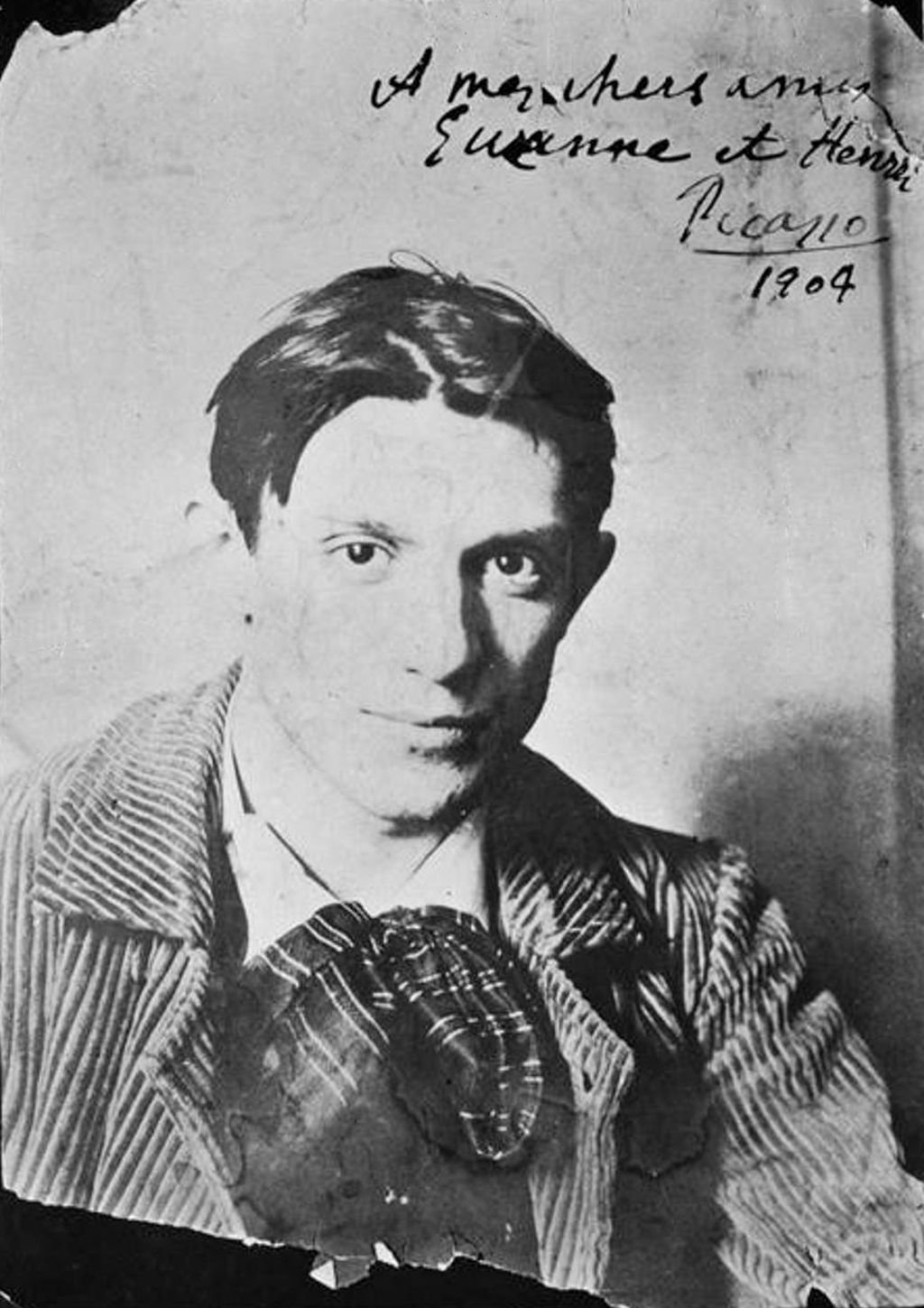
The comparison also shows why conservators resist a single spectacular “X-ray discovery” story. The male figure had been detected decades earlier. Better instruments made its contours clearer, while physical examination supplied information about colour and layering that imaging alone could not. The 2018 catalogue identifies the man as the Catalan painter and printmaker Ricard Canals, Picasso's contemporary and friend. Its authors compared the underportrait with historical photographs, including one sent to Picasso by Canals's son, and with photographs Picasso took in 1904. The earlier suggestion that the sitter was Picasso's tailor Benet Soler was rejected in that study.[3][8][9]
This identification is stronger than a casual resemblance guessed from a scan, but it is still useful to know its evidential basis. The man's face and dress were compared with photographs and Picasso's circle; no inscription visible through the paint announces “Ricard Canals.” A 2015 report from the Museu Picasso Barcelona cautiously said the portrait could be Canals, while the later Guggenheim catalogue presented its fuller comparison as a confident identification. Those differences record research in progress rather than two independent men hidden in the same canvas.[3][9]
What Picasso meant by covering the portrait is less recoverable. The lower painting's surface and the orientation of the figures show deliberate reuse of the support. They do not prove that a rejected friendship, a quarrel, poverty alone, or an artistic manifesto caused him to turn it. Picasso reused supports at other times, and a canvas in an early studio was a working material. To say that the buried portrait “reveals his grief” would give an object fact an unsupported psychological explanation.[3]
The two pictures are not entirely isolated from one another. Barten's study observes that some of the lower portrait's marks influence the final composition: dark passages contribute to the basin's shadow, while traces of the earlier structure remain beneath thin upper paint. Picasso also scraped portions of the visible layer, particularly around the woman's neck, shoulder, hands and iron. The woman's pale form is therefore not a simple opaque curtain hiding a finished earlier image. The canvas records a sequence of painting, turning, adapting and revising.[3]
What cleaning changed
The painting suffered a serious physical event after Picasso made it. During an attempted theft at a Paris exhibition in 1952, slashes damaged two edges. A repair involved lining the canvas; adhesive residue remained over parts of the face of the painting. With time, that glue darkened and became brittle, putting small areas of paint at risk and muting colour differences. Guggenheim conservators later cleaned and stabilised the surface while examining the buried portrait.[8]
Cleaning did not “restore the hidden painting” or remove Picasso's laundress to expose the man. It addressed the visible surface and earlier repair material. The work revealed a cooler palette and finer differences among greys, whites and flesh tones than older, yellowed reproductions suggested. It also made the relationship between thicker lead-white highlights and thinner surrounding paint easier to study. A modern online image may therefore look different from an older book plate for reasons other than inconsistent digital colour settings.[3][8]
The 1952 damage also makes a precise point about the word “original.” The original is not a surface frozen in 1904 and untouched since. It has travelled, been exhibited, damaged, repaired, researched and treated. Conservation records distinguish Picasso's paint and support from later materials so that the work can be preserved and accurately described. They are part of the painting's history, not a distraction from its appearance.[2][8]
Picasso was not the first to picture an ironer
Women washing, drying and ironing clothes appeared frequently in French art before 1904. Edgar Degas returned to laundresses, as did Honoré Daumier. The Metropolitan Museum of Art holds Degas's A Woman Ironing of 1873, whose figure is silhouetted against light; the Musée d'Orsay records an 1869 Degas La Repasseuse on paper and later compositions of ironers. These works establish a visual tradition, not a one-to-one source for Picasso's canvas.[7][10][11]
The distinction matters because an older account of Picasso's picture says he mirrored a specific “1890 Degas” ironer. The available museum records do not document that claim. The Met observes that Daumier's prints circulated in Barcelona studios and that relatively few Degas works were publicly visible in Paris around the turn of the century. That makes artistic influence possible but a precise copy claim difficult to substantiate. Picasso's single bent figure, compressed working surface and nearly erased setting can be discussed beside Degas and Daumier without asserting a documented viewing encounter.[7][10][11]
There are also other Woman Ironing works by Picasso. The Met owns a separate 1901 painting, a much smaller oil on canvas mounted on cardboard, numbered 49.70.2. It passed through Jaime Sabartés and Alfred Stieglitz. The Museu Picasso Barcelona records a graphite drawing titled Mujer planchando from 1894 in A Coruña, accession MPB 110.902R. Neither is the tall 1904 Guggenheim canvas. A catalogue title is not an object identifier: date, medium, dimensions, appearance and collection number distinguish these three works.[7][12]
The Guggenheim study also notices affinities between Woman Ironing and Picasso's 1904 etching The Frugal Repast: the table's level, cloth, slender figures and light direction invite comparison. The Met documents the etching separately, including its later printed edition. The comparison is useful for Picasso's treatment of deprivation and the working body; it does not prove that the two works were conceived as a commissioned pair or that they portray the same woman.[3][13]
Who was the woman?
Some accounts name the sitter “Margot,” associating her with the Montmartre café Le Lapin Agile. The 2018 Guggenheim catalogue is more careful. It notes resemblances to several women in Picasso's circle: Madeleine, Alice Princet and Marguerite Luc, known as Margot. Margot was the stepdaughter of Frédé Gérard, the café's proprietor. Resemblance is not conclusive identification, and the painting's handling also generalises the figure. Naming one woman as certainly pictured would suppress a real evidential gap.[3]
This is not a demand that the woman remain only a symbol. It is a way of respecting the difference between an identifiable historical person and an art-historical hypothesis. The work's force does not depend on a named sitter. It lies partly in how a recognisable job and a particular bodily effort are made visible, even while the woman's personal history remains unavailable. The hidden man's possible identity and the visible woman's uncertain one are two separate questions.[3][4]
The painting's journey and its contested 1938 sale
The Guggenheim's Thannhauser catalogue traces the painting from Ambroise Vollard in Paris through Munich dealers to Karl Adler, who owned it from 1916, and then to Justin K. Thannhauser. Adler sold it to Thannhauser on or about 29 October 1938. Under Thannhauser's arrangements it went on long loan to the Guggenheim in 1965 and entered the foundation's collection in 1978. That route explains the museum's credit line; it should not be reduced to a seamless list of famous dealers and collectors.[2]
Karl and Rosa Adler were German Jews who had fled Nazi persecution. In 2023 their heirs brought a claim seeking the return of Woman Ironing, arguing that the 1938 sale was made under duress as the family raised money to escape Europe. A New York appellate court in October 2025 affirmed dismissal of the case on grounds of delay and prejudice to the museum; it expressly treated the duress argument as academic after that ruling. The Appellate Division denied leave to appeal in January 2026, but a subsequently consulted Court of Appeals list still includes motions under the case name, so a final procedural status should not be assumed here. The rulings cited do not establish that the 1938 sale was morally untroubled, free of coercion or unaffected by persecution. The court's own opinion acknowledges the Adlers' circumstances.[14][15][16]
The painting remained catalogued by the Guggenheim at the time of this research. Its ownership history is part of how we understand a celebrated image of labour and hardship today, even though the 1938 sale cannot be read back into what Picasso intended in 1904. Stating the documented chain, the heirs' claim and the limited judicial outcome is more accurate than either ignoring the dispute or declaring that the court resolved every historical question.[2][14]
Looking beyond a reproduction
A photograph can convey the bowed pose and the broad contrast between pale figure and darker ground. It cannot show the full texture of Picasso's scraped and repainted passages, or make the buried portrait visible without technical imaging. Even photographs taken at different times can differ because conservation removed discoloured repair material from the surface. The Guggenheim's object record and conservation study help keep these distinct kinds of evidence apart: the painting as it is seen today, the earlier composition revealed by instruments and the record of later treatment.[1][3][8]
Woman Ironing is more than a familiar image of a tired person. Its converging arms, lowered head and spare tools make labour the structure of the composition. The visible layer was built over an earlier portrait; technical study has changed how its colour and possible date are understood. Its physical and ownership histories have continued long after it left Picasso's studio. Those layers do not cancel the woman at work. They make looking at her—and describing what can actually be known—more exacting.[1][2][3]
Discussion
Use the evidence and your own close looking to explain your view. These are editorial prompts, not reader comments.
Reader Insights
How do the iron and bowed posture direct your attention to labour?
What does the Guggenheim’s object record fix about this 1904 canvas?
Where does interpretation of the worker’s experience go beyond the evidence?
Join the Conversation
Which reading best fits the evidence?
References
- Solomon R. Guggenheim Museum, Woman Ironing exhibition object caption.
- Guggenheim Bilbao, Thannhauser catalogue object entry for La repasseuse, Basque, 2018.
- Julie Barten with John K. Delaney, study of Woman Ironing and its hidden portrait, Guggenheim Bilbao, 2018.
- Guggenheim, Picasso Black and White teaching resource, Woman Ironing.
- Guggenheim, Nancy Spector on Picasso's Blue Period and Woman Ironing.
- Art Gallery of Ontario and Phillips Collection, Picasso: Painting the Blue Period.
- Metropolitan Museum of Art, Picasso's distinct 1901 Woman Ironing.
- Solomon R. Guggenheim Museum, conservation study of Woman Ironing.
- Museu Picasso Barcelona, Catalan report on Blue Period technical study; Spanish essay on Ricard Canals.
- Metropolitan Museum of Art, Degas's A Woman Ironing, 1873.
- Musée d'Orsay, Degas's La Repasseuse, 1869; Repasseuses.
- Museu Picasso Barcelona, Mujer planchando, 1894, MPB 110.902R.
- Metropolitan Museum of Art, Picasso's The Frugal Repast.
- New York Appellate Division, Bennigson v Solomon R. Guggenheim Foundation, 21 October 2025.
- New York Appellate Division, order denying leave to appeal, 15 January 2026.
- New York Court of Appeals, undecided-motions list consulted 3 October 2026.
Image Credits
- Ricard Canals i Llambí, 1904. Wikimedia Commons labels the photograph public domain; its source credits RMN-Grand Palais. Resized to 1024px; no crop. Source record. Licence.
