


 by Tom Gurney
Tom Gurney BSc (Hons) is an art history expert with over 20 years experience
Email: tomgurney1@gmail.com / Phone: +44 7429 011000
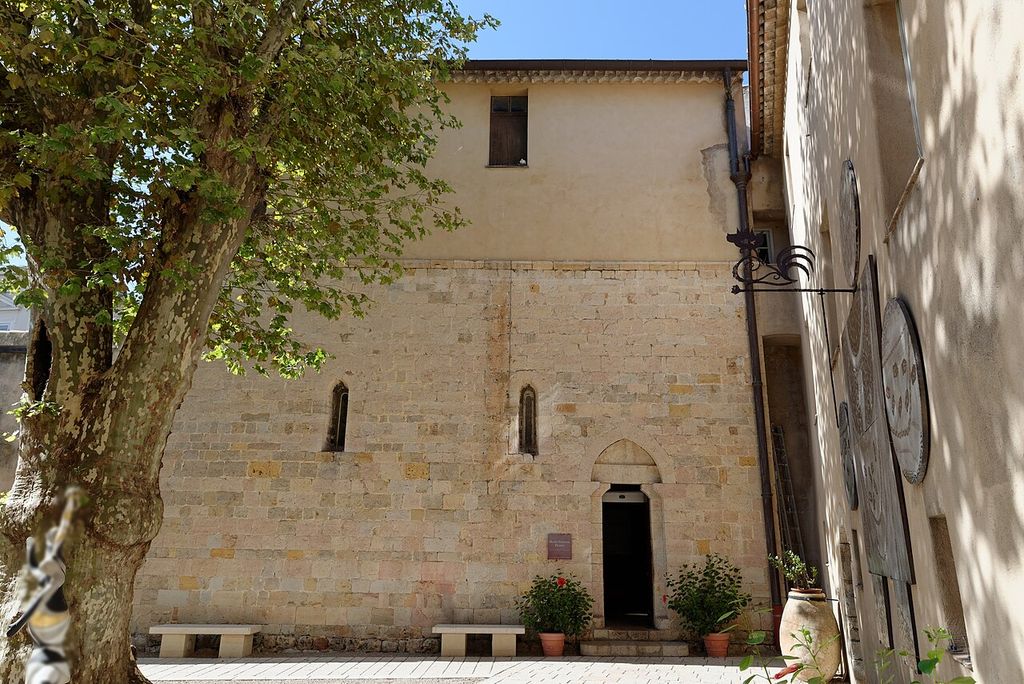
Vallauris setting: Château de Vallauris
Introduction
Pablo Picasso's Mediterranean Landscape fills nearly its whole surface with a villa, terraces, garden walls and steps. Palms rise around the buildings; beyond them, a small sailing boat crosses a strip of deep-blue sea. The view is sunlit and colourful, but it is also crowded. Architecture presses into architecture, and the open water appears only through a narrow break. That contrast between a dense home and a distant horizon gives the painting more to offer than the easy label of a cheerful Riviera scene.[1]
The work discussed here is Mittelmeerlandschaft in Vienna's Albertina, Batliner Collection, object GE101DL. The German title means Mediterranean Landscape. Picasso painted it at Vallauris in 1952; an inscription on the reverse reads “Vallauris 10.9.1952.” The holding museum catalogues it as oil on Isorel, a hardboard support, measuring 81 by 125 centimetres. Its subject is the Villa La Galloise, where Picasso lived with the artist Françoise Gilot and their children. These details identify a particular painting, rather than every Picasso landscape of the Mediterranean coast.[1][2]
At a Glance
- Made: Vallauris, 10 September 1952, as inscribed on the reverse
- Subject: Villa La Galloise, garden and a narrow view to the sea
- Medium: Oil on Isorel, 81 × 125 cm
- Collection: Albertina, Vienna · Batliner Collection · GE101DL
Mediterranean Landscape in Picasso's career
First Communion
1896Three Musicians
1921Guernica
1937Las Meninas series
1957The highlighted work is dated with the qualifications explained in the sources on this page. The other works are selective points of comparison, not the start or end of a style.
Contents
- The villa between garden and sea
- Picasso at Vallauris in 1952
- Françoise Gilot and the meaning of home
- Geometry without a Cubist label doing all the work
- Similar titles and different paintings
- Seeing the painting as a particular place
The villa between garden and sea
La Galloise dominates the picture. Its red-roofed rooms, pale walls, openings and balconies are not arranged as a calm architectural elevation. Picasso pushes the building's parts toward the viewer, tilting and fitting them together. A staircase runs through the compressed space. Dark lines divide the walls and terraces, sometimes clarifying an edge and sometimes making neighbouring planes compete. The house is recognisable, but it is also constructed as a lively pattern of angles.[1]
The garden does not simply decorate the foreground. Walls, plants and small coloured patches divide it into areas that the eye crosses before it reaches the villa. The palms offer tall accents against lower roofs and the intense sky. They also help frame the opening toward the water. The little boat matters because it gives the viewer a sharply different scale: the house feels massive and near, while the sail is distant and fragile. In an image so packed with solid forms, that small glimpse becomes conspicuous.[1]
The Albertina describes the depth as reduced. The observation is useful: instead of inviting us to move along one clear path from the garden into a measurable room, the painting builds a shallow field of overlapping shapes. A wall can seem both to recede and to face us. A roof edge can start as the top of one building and lead the eye toward another. This is not an attempt to draw a surveyor's plan of La Galloise. Picasso keeps the place recognisable while reorganising how its surfaces meet on a flat support.[1]
Colour reinforces that double effect. Blue is concentrated in the sea and sky; reds, oranges, yellow and green enliven the architecture and vegetation. Thick dark contours hold some shapes apart, yet adjacent bright areas can make walls and plants feel closely connected. A viewer can enjoy the Mediterranean light and still notice how little unoccupied space the composition allows. “Bright” does not automatically mean “peaceful,” just as angular forms do not automatically mean “distressed.” The tension is a feature one can see before giving it a biographical explanation.[1]
The painting's subject is a home, not an anonymous village. The Albertina identifies the villa by name, and the Musée national Picasso-Paris places it on the hill of Les Mauruches near Vallauris. The French museum holds a separate 1949 drawing of La Galloise. Those records give the building a real setting. They do not require every wall in the 1952 painting to match a photograph. An artist can paint a place he knows intimately and still rearrange its geometry to solve a pictorial problem or express a feeling.[1][2]
Picasso at Vallauris in 1952
After the Second World War, Picasso's life and work became closely tied to southern France. The Paris Picasso museum describes his move to Vallauris with Françoise Gilot and their children and his intense engagement with the town's ceramic workshops. He did not stop painting to become solely a ceramicist: the landscape around Vallauris, his family, sculpture, printmaking and new work in clay all belonged to this period. Mediterranean Landscape is one painting within that wider activity, not evidence of a wholesale return to one earlier style.[2][3]
The villa was both a place to live and part of a working landscape. From its hill near Vallauris, the coast and vegetation could enter pictures of the house. Picasso's view does not separate an immaculate resort from ordinary life. Walls, stairs and buildings fill the field; the sea is visible but not all-consuming. The Paris museum also notes that La Galloise was relatively cramped and that Picasso acquired the Fournas workspace in 1953. It would be anachronistic to say that a 1952 painting depicts the new 1953 workshop. The older home is the subject here.[1][2]
The reverse inscription is unusually helpful. It ties the work to Vallauris and to 10 September 1952, more precisely than a retrospective impression that it “looks like the early 1950s.” The Albertina catalogues the reverse wording, not merely a date assigned from style. A Robert Doisneau photograph in the Paris Picasso museum archive is titled as showing Picasso and Gilot at La Galloise in September 1952, providing contemporary documentation of the shared setting. The photograph is a different, separately protected work; it is not needed as an illustration to establish the painting's basic identity.[1][4]
The medium deserves the same care. The Albertina's current record says oil on Isorel. Isorel is a manufactured wood-fibreboard, not a stretched canvas. A shorter museum press list calls the support “wood,” a broader description, while the detailed collection catalogue supplies the more precise material term. A commercially reproduced picture cannot disclose its support, and generic web captions that say “oil on canvas” or “enamel” should not override the holding institution's record without new technical evidence.[1][5]
The dimensions also change how we imagine the original. At 81 by 125 centimetres, the image is large enough for the stairways, roof edges and planted foreground to register as a broad visual field, not a little souvenir view. The online copy through which many people first encounter it compresses those relationships into a screen. Its bright patches may stand out first, while the pressure of its densely interlocked black lines takes longer to follow. The museum's measurements and support description keep a discussion of the painting anchored in the physical object rather than only in the popular reproduction.[1]
That physical identity is especially useful because Picasso was working in several materials at Vallauris. The ceramics for which the town became famous are shaped and fired objects; this landscape remains an oil painting on a rigid panel. A painted scene of the villa is not a ceramic design merely because the two were made within the same period. Yet the broader context reminds us that Picasso was not repeating one kind of work. He could return to the place where he lived as a motif while also using other workshops and supports to pursue quite different projects.[1][2][3]
Watch: Pablo Picasso
Explore Picasso through five videos from museums, broadcasters and art educators.
Picasso’s Guernica: Great Art Explained
Explore the composition and historical setting of Picasso’s best-known response to war.
Watch on YouTubeFrançoise Gilot and the meaning of home
Françoise Gilot lived and worked at La Galloise, but she was not simply a supporting character in Picasso's domestic scene. She was a painter with her own career. The National Gallery of Victoria records her contract with Galerie Louise Leiris and her first exhibition there in 1952, the year of Mediterranean Landscape. Her artistic life is part of the historical setting of the house, even though this particular painting is Picasso's view of it. The work does not tell us what Gilot herself thought of the painted building or the sailboat.[2][6]
The Albertina interprets the crowded construction as reflecting tension in Picasso and Gilot's relationship, which ended in 1953. It sees the walled garden as confining and the sea and boat as suggesting a desire to leave. This is a coherent reading of a painting that puts so much weight on the villa and so little space beyond it. It is nonetheless a reading offered by the museum, not a statement of intent found on the painting's reverse or in a dated account by Picasso. The 1953 separation happened after the painting was made, so it cannot simply be treated as an event he illustrated in advance.[1]
There is another reason to be precise. When a work is explained entirely through the artist's later romantic life, its visual organisation can become a set of clues to a story we think we already know. In this picture, the relation between near walls and far water can be observed without deciding that the boat is a secret message from Picasso to Gilot. The house may feel protective, busy, oppressive or playful to different viewers. The museum's interpretation is valuable because it notices tension within an apparently idyllic scene; it should remain open to comparison with the visible work rather than replacing looking.[1]
Gilot's own painting further cautions against reducing the moment to a one-person psychological drama. Her 1952 exhibition means the household included two active artists, not an artist and a silent “muse.” The Villa La Galloise was a family place, a creative setting and a subject Picasso transformed. The portrait of a relationship offered in later biographies cannot be read straight off every line in its architecture. A text-led account can name the people and the subsequent separation while preserving the painting's uncertainty.[1][2][6]
Geometry without a Cubist label doing all the work
The angled walls and compressed viewpoints may remind viewers of Cubism. That resemblance is real, but calling Mediterranean Landscape a “Cubist painting” and stopping there does not explain what Picasso was doing in 1952. His most concentrated early Cubist investigations had taken place decades before. Here a vividly coloured, locatable house remains legible. Its geometry does not dissolve the villa into near-unrecognisable fragments; it lets the viewer see a building as interlocking planes and experiences the space as crowded and active.[1][2]
The steps provide a way in. Follow one line of the stair and it meets a wall, a balcony or a roof that asks the eye to change direction. Move upward toward the palms and the image opens into sky. Move rightward toward the sail and the tightly fitted architecture suddenly gives way to distance. These are effects of composition, not a formula in which every triangle must represent a separate viewpoint. The picture's liveliness comes from such shifts between recognisable place and painted construction.[1]
It is also distinct from a conventional landscape organized around a long view. Picasso does show the sea, but the villa takes priority. The painting could almost be called a portrait of a dwelling in its surroundings. It lets the house stand for a lived environment without needing to depict its inhabitants. The Albertina's identification of La Galloise is therefore more informative than a general statement that Picasso liked Mediterranean scenery. It connects visual specificity to a real place and particular date.[1][2]
The broader Vallauris context also prevents a misleading story about Spanish landscape art. Nothing in the holding museum's record suggests that Picasso invented Cubist landscape in 1952 to fill a gap left by earlier political conflicts in Spain. Landscapes had long been part of his practice and of European painting. The relevant question is more local: how did Picasso turn the villa, garden and coast he knew into this compressed yet luminous composition? The painting itself, its inscribed date and the museum's identification let us answer that without inventing a grand national explanation.[1][2][3]
Similar titles and different paintings
“Mediterranean Landscape” is a descriptive English title, so it can mislead a searcher looking for an exact object. The secure identifier here is the Albertina's Mittelmeerlandschaft, GE101DL, dated 1952 and 81 by 125 centimetres. The Viennese museum's catalogue lists the work in the Batliner Collection and records its inscription. A museum's exhibition image may make the painting familiar, but object number, support and date are what stop its details from drifting onto another landscape.[1]
Picasso painted a separate Gardens at Vallauris, now at the Nelson-Atkins Museum of Art in Kansas City. That work is dated 1953, oil on canvas and much smaller. Its museum record describes red-roofed structures, garden and hills rather than the La Galloise composition with sea and sailboat. The old claim that Mediterranean Landscape was made in 1953 could easily be repeated when nearby landscapes are discussed together. The two paintings need their own titles, dimensions and collection records.[1][7]
There is also a 1953 painting actually titled Mediterranean Landscape by Nicolas de Staël at the Museo Nacional Thyssen-Bornemisza. It is a different artist's work, made in a different style and held in Madrid. The shared English words do not create a link of authorship or ownership. For Picasso's La Galloise picture, the German holding-museum title, accession and dated reverse remove that ambiguity.[1][8]
The Albertina's bibliography shows the 1952 Picasso work was recorded and exhibited across later decades, including an exhibition in Milan in 1953. An exhibition date is not a creation date. Nor does the Batliner Collection credit, by itself, provide a complete chain of sales from Picasso to Vienna. The public record gives solid present-day identification and selected historical waypoints, but it should not be stretched into a provenance story that has not been researched in full.[1]
Seeing the painting as a particular place
What makes Mediterranean Landscape memorable is the way an intimate building seems to compete with an immense setting. La Galloise occupies almost all the available space; the sea persists as a concentrated blue promise beyond it. Picasso holds recognisable palms, roofs, stairs and sailboat inside a design that gives each line pressure. The viewer may experience sunshine and confinement at once, or simply enjoy the shifts between near geometry and far water. The image can accommodate those responses without requiring one to be declared Picasso's private confession.[1]
The documented facts are unusually clear: a 1952 painting made at Vallauris, oil on hardboard, now in Vienna, portraying the villa Picasso shared with Françoise Gilot and their family. Its emotional reading remains less certain. The Albertina's collection record for Mittelmeerlandschaft[1] allows readers to verify the object and see the holding museum's own interpretation. The painting is best approached through both kinds of attention: exact identity, then close looking at how a home, garden and open sea have been fitted into one restless surface.[1]
Discussion
Use the evidence and your own close looking to explain your view. These are editorial prompts, not reader comments.
Reader Insights
Where does the architecture block or open a view of the sea?
How does the documented Villa La Galloise compare with its painted form?
What makes this more than a simple record of a sunny place?
Join the Conversation
Which reading best fits the evidence?
References
- Albertina Wien, Mittelmeerlandschaft, GE101DL.
- Musée national Picasso-Paris, “Les années Méditerranéennes,” French.
- Musée national Picasso La Guerre et la Paix, “Picasso à Vallauris,” French.
- Musée national Picasso-Paris, Robert Doisneau photograph at La Galloise, archival record.
- Albertina Wien, Picasso exhibition press information, German.
- National Gallery of Victoria, “Françoise Gilot: Blue Eyes”.
- Nelson-Atkins Museum of Art, Gardens at Vallauris, 54-96.
- Museo Nacional Thyssen-Bornemisza, Nicolas de Staël, Mediterranean Landscape.
Image Credits
- François de Dijon. CC BY-SA 4.0. Source: Wikimedia Commons. Resized proportionally to 1024px wide; no crop. Source record. Licence.
