


 by Tom Gurney
Tom Gurney BSc (Hons) is an art history expert with over 20 years experience
Email: tomgurney1@gmail.com / Phone: +44 7429 011000
Introduction
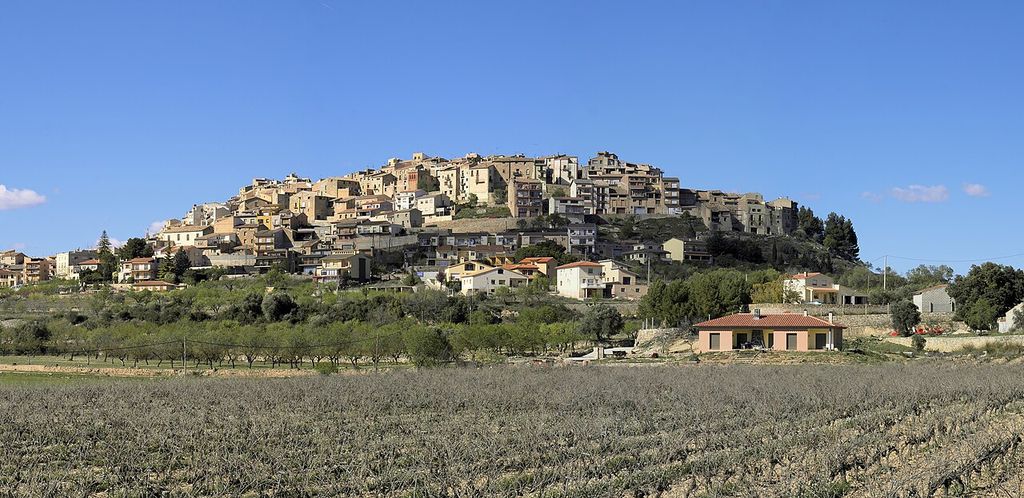
Pablo Picasso's The Reservoir, Horta de Ebro turns a Catalan village into a tightly fitted group of ochre, grey and green planes. The houses rise like blocks, but their edges meet the hillside so closely that it becomes hard to say where built structure ends and land begins. At the foot of the composition a broad, curved form opens onto water. That is the reservoir or cistern of the title. The painting remains a recognisable view of a place while refusing to organise every part of it from one comfortable vantage point.[1]
Picasso painted this particular oil on canvas in the summer of 1909 at Horta de Sant Joan, in Terra Alta, Tarragona. It measures 61.5 by 51.1 centimetres and is now in the Museum of Modern Art, New York, as object 81.1991. MoMA's title uses “Horta de Ebro,” a historical form associated with the town, while Catalan sources give the present name Horta de Sant Joan. The landscape is in southern Catalonia, in northeastern Spain.[1][2][3]
At a Glance
- Artist: Pablo Picasso
- Date: Summer 1909
- Medium: Oil on canvas
- Dimensions: 61.5 × 51.1 cm
- Place: Horta de Sant Joan, Catalonia
- Collection: Museum of Modern Art, New York · 81.1991
The Reservoir in Picasso's career
First Communion
1896The Reservoir
1909Three Musicians
1921Las Meninas series
1957The highlighted work is dated with the qualifications explained in the sources on this page. The other works are selective points of comparison, not the start or end of a style.
Contents
- Looking up at the village and down into water
- Why Horta mattered in 1909
- A landscape at the beginning of Cubism
- Picasso's camera and his paintings
- From the Steins to MoMA
- A real place made newly difficult to see
Looking up at the village and down into water
The painting's first impression may be architectural: a cluster of high, rectangular forms stands against a rocky slope. Light falls on some planes and leaves adjacent faces dark. Picasso strengthens the contrast between ochre and grey rather than describing every roof tile or window. Buildings can be followed as buildings, yet their surfaces also become parts of a continuous geometric arrangement. The image asks the eye to assemble a town from edges, lit faces and shadowed passages.[1]
MoMA's 2024 gallery label notices a particular contradiction in the viewing angle. The steep hillside seems to rise as if seen from below, while the cistern at the bottom offers a view down into its reflective water. A conventional perspective diagram would have difficulty giving both sensations equal force. Picasso keeps them together. The result is not a landscape with “no depth”; it is a landscape in which depth changes as we move our attention from the town to the reservoir.[1]
The curved lip of the cistern matters because it breaks the otherwise insistent straight edges. Its arc crosses the lower picture, drawing a boundary between wall and water. Reflections and shadow complicate what is inside that curve. Above it, the village climbs in compact terraces. Seen together, the arc and the stacked houses give the composition both an anchor and a pressure upward. Without the cistern, the painting could become an abstract-looking wall of buildings; without the buildings, the curve would lose the scale and setting that make it a reservoir.[1]
Colour contributes to this balancing act. The range is restrained, but not colourless: warm ochres and terracotta tones meet cool greys, muted greens and the light surfaces of stucco. A sunlit face can seem to belong to one building until a dark edge ties it to another. These shifts allow the painting to suggest the strong light and hard forms of Horta without relying on a panoramic blue sky or a scenic view down a valley. The place is represented through the meeting of parts.[1]
It is tempting to explain the work with the formula that Cubism shows an object from “many viewpoints.” That can help describe the upward hillside and downward pool, but it can also make the painting sound like a technical demonstration. Picasso did not discard the town. He selected its grouped houses, slopes and water structure, then altered how they connect. Looking at the reservoir, the village and their junction gives a better sense of the work than applying a label to every triangle.[1]
At about 61 centimetres high, the canvas is substantial enough for these interlocking areas to develop across a viewer's field of vision, but it is not a monumental mural. A small screen image can flatten its differences of colour and make the buildings seem more uniformly angular than they are. MoMA's current object record gives both the dimensions and medium. A photograph or old print of the painting may assist recognition, but it should not replace the physical object's data.[1]
Why Horta mattered in 1909
Horta de Sant Joan was not new to Picasso when he arrived in 1909. His friend Manuel Pallarès came from the town, and Picasso had spent time there with him in 1898–99. The Museu Picasso in Barcelona records a second stay with Fernande Olivier from 5 June to early September 1909. That return placed a familiar locality in front of an artist whose methods had changed considerably since the late 1890s. The contrast matters: the 1909 reservoir is not simply a young painter's discovery of an exotic village.[2][3]
Picasso and Olivier reached Horta after time in Barcelona. The Barcelona museum's chronology records their return to Barcelona in September and departure for Paris on 11 September. The precise movements stop us from treating every Horta landscape as made in the Paris studio after the trip. MoMA catalogues The Reservoir as a summer 1909 Horta work, and an archival photograph made by Picasso in a Horta studio identifies the painting there with other works from the same period.[1][2][4]
The village's name needs care. The English title preserves “Horta de Ebro,” a form Picasso used on several canvases to distinguish the place from the Barcelona neighbourhood also called Horta. The current municipality is Horta de Sant Joan, in Catalonia's Terra Alta district. The river name in the older title does not make the painting a view of the Ebro itself, nor should it cause the reader to relocate the town to Spain's south. Geographic accuracy helps explain why its compact buildings and nearby reservoir belong together.[2][5]
The second Horta stay was also shared life, not just a solitary experiment by Picasso. Olivier travelled with him. Barcelona's exhibition on Picasso's photographs names her and records the painting equipment and camera he brought. That source does not turn her into a documented co-author of this canvas or tell us her response to it. It does, however, remind us that an account of the summer should not erase a person present in the place simply because the finished painting has no figures.[2][5]
Watch: Pablo Picasso
Explore Picasso through five videos from museums, broadcasters and art educators.
Picasso’s Guernica: Great Art Explained
Explore the composition and historical setting of Picasso’s best-known response to war.
Watch on YouTubeA landscape at the beginning of Cubism
MoMA describes The Reservoir as important to the development of early Cubism. The painted surfaces of village houses were unusually well suited to Picasso's interest in how solid forms can be simplified, repeated and joined. A wall or roof can be a recognisable local feature and a plane in a larger pictorial structure. The hillside offers another kind of mass, less neatly built but equally capable of being broken into adjoining facets. The painting makes architecture and topography converse through their shapes.[1]
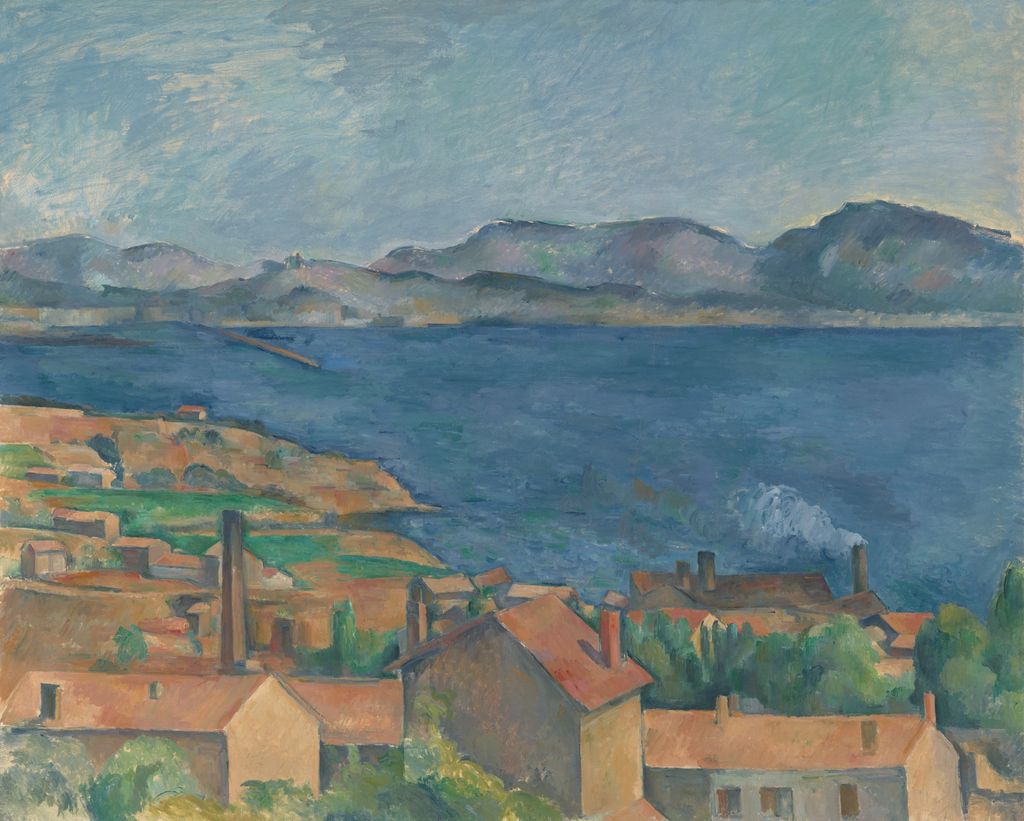
The work followed years in which Picasso and Georges Braque tested new ways of representing form and space, explored further in our Cubism guide. Cézanne's example was significant to that broader history, but it would be too simple to treat this painting as a transplant of one of his landscapes. Its cistern, clustered village and specific 1909 Horta setting belong to Picasso's own observation and rearrangement. Nor should “Analytic Cubism” be treated as a switch that was thrown on one summer day. Older catalogues have used the label to describe the Horta works; MoMA's present object text more cautiously describes an early Cubist style.[1][6]
What does “spatial ambiguity” actually look like here? In one passage, a bright wall appears to face us; nearby shadow makes another part of the same building recede. Lines that might divide two houses can also bind them into one stack. Farther up, the rocky ground and architecture share such similar angular rhythms that a viewer must work to distinguish them. Yet the cistern's round edge returns us to a specific human-made structure. Picasso is not asking the viewer to abandon place; he is letting place resist one fixed diagram of space.[1]
The visual pressure can feel almost sculptural. There are broad surfaces that seem to have weight, and dark channels that make some shapes project while others withdraw. Still, the canvas does not become a model of Horta's actual buildings. It is a painted construction whose angles and tones serve an arrangement on a flat surface. This distinction is useful when comparing it with photographs of the same locality. A photograph may establish that the reservoir and houses existed, but it cannot by itself explain why Picasso joined them exactly this way.[1][4][7]
The painting also differs from later Cubist still lifes where letters, signs or everyday objects may be fragmented so far that identification becomes a puzzle in itself. Here the title and visible cistern direct us to a real landscape. The work allows the viewer to alternate between reading it as a town and as an interlocking structure. That alternation is one of its achievements, not a failure to render a more conventional village view.[1]
Picasso's camera and his paintings
Picasso took photographs during the 1909 stay. The Musée national Picasso-Paris preserves an image titled as a view of Horta's reservoir, as well as a photograph of the Horta studio showing Le réservoir alongside L'usine à Horta de Ebro and another work. The studio photograph is especially strong evidence: it documents the paintings as distinct objects present in the working setting. The reservoir photograph shows Picasso using a camera to attend to the same locality that he painted.[4][7][8]
The date of a photographic print should not be confused with the date of its view. One Paris museum record catalogues a print of the reservoir photograph as made around 1940 while identifying the scene as Horta in 1909. Another record preserves a different print of the 1909 view. The place and exposure belong to Picasso's Horta stay; a later print has its own material history. That distinction keeps the photographic evidence in the correct sequence without assuming that the painting must have followed the photograph.[7][8]
The Museu Picasso Barcelona has treated the Horta photographs as an important part of Picasso's artistic practice rather than mere holiday snapshots. Its exhibition records that he travelled with a camera and sent images of his new Cubist works to Gertrude Stein. It describes an archive of 45 photographs associated with the Horta report. The French Paris museum notes that an example of the reservoir view sent to Stein was later published in Transition in 1928. These sources show a real exchange between photography, painting and artistic communication.[5][8]
They do not prove a neat one-way process in which Picasso first took a reservoir photograph and then copied its perspective into the MoMA canvas. Nor do the painting's fractured angles prove that he was making an “anti-photographic” statement. A painter who takes photographs can still choose to depart radically from their apparent viewpoint. The camera records and the oil painting answer different questions. Comparing them can illuminate selection and transformation; calling one a source requires a careful image-by-image argument, not just their shared title.[4][5][7]
The studio photograph also guards against confusing neighbouring works. The Factory at Horta or The Brick Factory at Tortosa is a different 1909 painting, as is The Mill at Horta. They belong to Picasso's work in and around the same place, but they do not contain MoMA's distinctive foreground cistern. Photographic and museum catalogue records help keep each work's title, dimensions and ownership from drifting onto the others.[1][4]
From the Steins to MoMA
The painting's documented ownership story begins with Picasso and then Leo and Gertrude Stein, who acquired it from him in 1909, according to MoMA's provenance research. Gertrude held it after 1913 and until her death in 1946. Her estate, administered in Paris through Alice B. Toklas, retained it until 1968. That year a Museum of Modern Art syndicate purchased it from the Stein heirs, and David and Peggy Rockefeller acquired it from the syndicate.[1]
The Rockefellers held the painting for decades. MoMA's current object credit is their gift; the provenance record describes a fractional and promised gift to the museum in 1990, while retaining a 1968–91 Rockefeller ownership span. Those entries should be read as stages in a complex gift arrangement, not as evidence that the museum bought the work directly from Gertrude Stein in 1968. The latter claim in some older online accounts compresses away the estate, syndicate and Rockefeller transactions, and conflicts with MoMA's own record.[1]
The painting was visible well before its present MoMA display. The museum lists it in the 1970–71 Four Americans in Paris exhibition about the Stein family collections, in the 1980 Picasso retrospective and in the 1989–90 Picasso and Braque exhibition. These records help explain its importance in the public account of early Cubism. They do not change the date when Picasso made the canvas or prove that every Horta painting passed through the same owners.[1]
MoMA labels its provenance a continuing research project. That is a reminder to use its recorded chain as the current institutional account, not a declaration that every transaction in the painting's life is known beyond revision. It is enough to correct the false simple story while preserving the museum's own uncertainty about future research.[1]
A real place made newly difficult to see
The Reservoir, Horta de Ebro is memorable because it makes a real place look both solid and unstable. The village rises in block-like planes; the land joins it; the reservoir offers a curved opening and a different angle of view. We can identify houses and water without being able to stand at one imaginary point from which every line falls into place. That carefully sustained tension is more revealing than saying merely that the painting is “geometric.”[1]
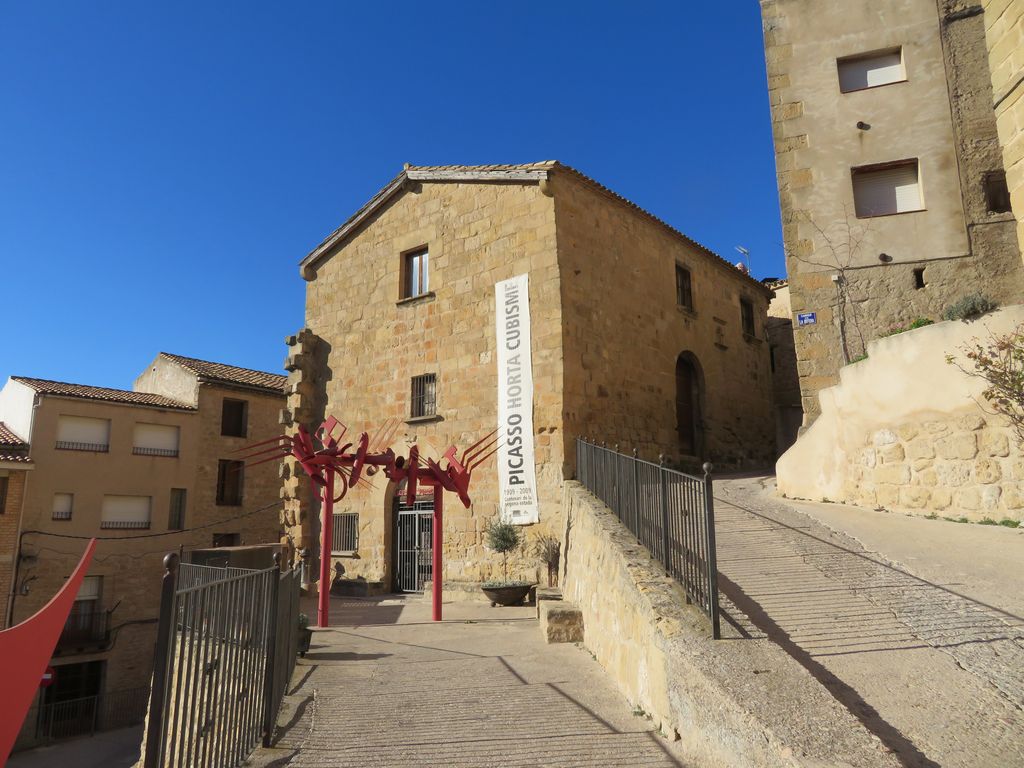
The work is securely anchored: Horta de Sant Joan in the summer of 1909, oil on canvas, now at MoMA; photographs in Picasso's own archive document both the locality and the painting in a Horta studio. Its place within early Cubism and Stein-family collecting is also well supported. What remains open is how exactly a photograph affected each painted angle and what Picasso intended viewers to conclude from the fractured space. The MoMA object and provenance record[1] provides a firm point of reference for looking, while the Catalan and French archival sources give the locality and camera work their own histories.[1][2][4][5]
Discussion
Use the evidence and your own close looking to explain your view. These are editorial prompts, not reader comments.
Reader Insights
How does the painted reservoir alter your sense of where the viewer stands?
The Horta photograph documents place; it is not a reproduction of the MoMA canvas.
What can Picasso's 1909 photographs establish, and what can they not prove about his painting process?
Join the Conversation
Which reading best fits the evidence?
References
- Museum of Modern Art, The Reservoir, Horta de Ebro, object 81.1991 and provenance. View source.
- Museu Picasso Barcelona, Picasso chronology, Catalan; Spanish version. View source 1; View source 2.
- Museu Picasso Barcelona, Horta de Sant Joan and Picasso, Spanish. View source.
- Musée national Picasso-Paris, Picasso's 1909 Horta studio photograph APPH17398. View source.
- Museu Picasso Barcelona, Picasso, the Photographer's Gaze, Horta section; Picasso, fotògraf d'Horta, Catalan. View source 1; View source 2.
- MoMA, Picasso in the Collection of the Museum of Modern Art exhibition catalogue, 1972. View source.
- Musée national Picasso-Paris, 1909 reservoir photograph MP1998-103. View source.
- Musée national Picasso-Paris, later print of the 1909 reservoir photograph APPH2809. View source.
Image Credits
- Hans Hillewaert. CC BY-SA 3.0. Source: Wikimedia Commons. Resized to 1024px; no crop. Source record. Licence.
- Paul Cezanne. CC0. Source: Art Institute of Chicago (The Bay of Marseille, Seen from L'Estaque). 1024px proportional sRGB JPG derivative; no crop. Source record. Licence.
- Juan Emilio Prades Bel, 12 January 2024. Wikimedia Commons, CC BY 4.0. Proportional resize only. Source record. Licence.

