


 by Tom Gurney
Tom Gurney BSc (Hons) is an art history expert with over 20 years experience
Email: tomgurney1@gmail.com / Phone: +44 7429 011000
Beverly Hills Housewife: Introduction
A woman in a long pink dress stands on the terrace of a modern Californian house. Around her, furniture, sculpture, glass and garden occupy an unusually broad field. David Hockney’s Beverly Hills Housewife, painted in 1966–67, gives this domestic setting the scale of a public encounter: the acrylic diptych measures 72 × 144 inches, or approximately 183 × 366 centimetres. Its sitter is Betty Freeman, whose collecting and support for contemporary music extended far beyond the role announced in the title. [1] [2]
The painting invites two kinds of attention. We can follow the measured relationships between a standing figure and the surrounding architecture, or ask how a portrait’s title shapes our expectations of the person it depicts. Both approaches matter here. Freeman’s house provides evidence of her taste, but her visible possessions cannot encompass everything she did. Hockney made an image in which an identifiable person and an organised environment continually draw attention towards one another.
At a Glance
- ArtistDavid Hockney
- TitleBeverly Hills Housewife
- Date1966–67
- Medium and formatAcrylic diptych; approximately 6 × 12 feet
- CollectionPrivate collection
This work across David Hockney’s career
A Rake’s Progress
1961–63 [3]A Bigger Splash
1967 [3]Mr and Mrs Clark and Percy
1970–71 [3]My Parents
1977 [3]Garrowby Hill
1998 [3]A Year in Normandie
2020–21 [4]Contents
- Betty Freeman’s work beyond the portrait
- From a visit to a monumental painting
- Figure, glass and architectural space
- Objects that help make the portrait
- What does “housewife” tell us?
- A house connected to new music
- California, portraiture and composed reality
- Ownership, exhibition and reception
Betty Freeman’s work beyond the portrait
Freeman had already developed a serious involvement with music before Hockney painted her. A Wellesley graduate who subsequently studied at Juilliard, she began supporting musicians in 1961. From 1964 she served on the board of Encounters, the Pasadena Art Museum’s concert programme. Experimental composition was already part of her life when she stood for Hockney. [2]
Her engagement with painting also involved sustained intellectual work. The Smithsonian’s Archives of American Art preserves the research she assembled on Clyfford Still and Sam Francis: correspondence, photographs, notes and unpublished manuscript drafts. The institution records that the Francis manuscript coincided with another publication on the painter, while Still withdrew permission to quote and reproduce material he controlled. Neither book appeared. These circumstances distinguish the existence of substantial writing from the quite different question of publication. Freeman was studying artists closely as well as buying their work. [5]
That distinction changes how we encounter the setting. A sculpture in a collector’s home may announce ownership, but it also points towards decisions: what to look at, whose work to follow and which new forms to bring into daily life. Freeman’s involvement with artists and composers gives the objects an active context. The house is a place where contemporary culture was selected, discussed and supported, as well as displayed. The portrait preserves the physical setting of those choices without illustrating the labour behind them.
From a visit to a monumental painting
Despite its sitter’s subsequent ownership, Beverly Hills Housewife did not begin as a commissioned portrait. In his account of the collection before its 2009 sale, KCRW critic Edward Goldman explained that Hockney initially intended to depict the area around Freeman’s swimming pool, then asked her to pose. The artist’s attention moved from a promising Californian setting to the person living within it. [6]
The David Hockney Foundation identifies this as the first painting he based on his own preparatory black-and-white photographs. Its account also stresses that he rearranged the house and garden to serve the composition. Photography supplied observations that Hockney could adjust as the picture took shape. There were drawings too: a related sheet catalogued by Sotheby’s is signed, titled and dated December 1966, and combines pencil with crayon. That work on paper is a separate object from the large acrylic painting, and records another medium through which Hockney developed the subject. [7] [8]
The photographs’ monochrome character is particularly useful to remember when considering the painting’s colour. A black-and-white record could help Hockney locate a pose or architectural edge, but it could not simply deliver the final relationship between pink clothing, green foreground and pale built surfaces. Those relationships had to be constructed in paint. Recognisable surroundings and a carefully posed sitter could therefore coexist with substantial pictorial invention.
The diptych also arose from practical circumstances. According to the Foundation, the restricted space of Hockney’s Pico Boulevard studio led him to use two joined canvases; he recalled being unable to stand more than about five feet from the work. The painting’s twelve-foot width thus developed under conditions quite unlike the spaciousness it presents. [7]
The term “diptych” describes the two-part support. Freeman is the single human sitter, and the continuous domestic setting carries the eye across both panels. The breadth makes the surrounding space consequential. If the picture were cropped closely around her head and shoulders, it would lose the distances, thresholds and objects through which Hockney establishes this particular encounter.
Figure, glass and architectural space
Freeman’s long pink dress gives the figure a clear vertical presence against the architecture. The body remains legible within the wide composition because its colour and outline differ from the long, straight divisions of the setting. Christie’s 2009 account describes her position on the covered patio and emphasises the setting’s crisp light. These are also the conditions that allow a figure to become one measured shape among other shapes without disappearing into them. [9]
The surrounding glass has a more complicated role than an open view into the house. It can admit a sightline, reflect light or make a surface visible. The Foundation draws attention to Hockney’s stylised marks for light striking the glass walls. Such marks make us recognise glazing through a visible convention: a sign painted on an opaque canvas stands for a surface through which we might otherwise expect to see. The house offers depth, while these repeated graphic signals keep bringing attention back to the painted plane. [7]
The edge where lawn meets patio creates another firm division. Garden and house belong to the same scene, but the change of surface marks the viewer’s separation from Freeman’s position. We look across an interval before reaching her. That interval contributes to the portrait’s formality through scale, placement and intervening space. Freeman’s physical presence is clear, yet the composition requires us to approach her across a carefully measured distance.
The broad format also sets up a rhythm between occupied and unoccupied areas. Furniture can suggest how a space might be used even when nobody sits in it. Empty floor and garden remain visible around Freeman instead of being crowded with incident. Looking takes time because attention travels between the person, the objects and the house’s divisions. The stillness is made through arrangement: there is relatively little action to follow, but much to compare.
Objects that help make the portrait
The abstract sculpture belongs to a specific collecting history. In a 2015 statement, the gallery Offer Waterman identified it as William Turnbull’s Lama of 1961. The dealer described recognising the sculpture in Hockney’s painting at LACMA in 2006, subsequently visiting Freeman’s home and later buying the work from her. The identification comes from a participant in the sculpture’s later history and connects the painted object with an actual work in Freeman’s collection. [10]
The reclining chaise longue supplies a different bodily reference. A chair is made to accommodate a person, yet its reclining form contrasts with Freeman’s upright pose. Sotheby’s discussion of the related drawing identifies both the chaise and the abrupt boundary between lawn and patio in the finished composition. Read together, these details explain how domestic equipment participates in the painting’s structure. The curved support of a body at rest and the standing figure offer different possibilities within the same built environment. [8]
A mounted animal head introduces another kind of presence. Christie’s interpreted Hockney’s addition of the trophy as a humorous face-off with the sitter. The auction house’s reading draws attention to a directional relationship between the two forms. Whatever weight we give the joke, the conspicuous head makes the room a more particular and unexpected setting, interrupting the regularity of the architectural divisions. [9]
These objects offer more than a catalogue of expensive things. They distribute different forms around the human figure: a sculpture, a seat designed around the body, and an animal likeness mounted for display. The painting asks us to notice how each occupies space. Freeman is part of this arrangement, but identifying the sitter gives her a history that the other objects cannot supply.
What does “housewife” tell us?
The title turns a named individual into an apparently general social figure. The inscription on the reverse, recorded in the auction catalogue, begins “A Beverly Hills housewife”. Its indefinite article makes the classification especially noticeable: one woman can stand for a recognisable kind of affluent Californian life. Yet the person represented was Freeman, with particular commitments and relationships. That difference between a category and an individual is central to the portrait’s continuing interest. [1]
Music historian Jake Johnson, citing Barbara Jepson’s 1987 Connoisseur article, records Freeman’s claim that she herself suggested the title. Johnson also confirms that the painting was not commissioned. The reported suggestion gives Freeman a role in the work’s naming, though it does not settle every possible interpretation of the words. Humour, social identification and simplification can operate together in a title. [11]
Calling her a housewife should therefore open a question about representation, rather than close the account of her life. A title can direct attention towards a house, its social setting and its occupant’s relationship to it. It can also leave important activity outside the frame. In Freeman’s case, a reader who stops at the label misses an experienced listener, an organiser and a writer. Knowing those things does not require us to reject the painting; it allows us to see the limits of the information that any one portrait can offer.
Johnson’s wider study examines the ways Freeman used domestic and maternal language to describe her patronage. He draws on her letters about musical works she supported, and considers how her identity developed through those relationships. His historical interpretation helps explain why the domestic sphere could be a place of cultural agency, as well as a subject of social expectation. [11]
A house connected to new music
Freeman’s support could involve much more than a contribution towards a score. The University of Illinois’s Harry Partch collection records that she met the composer in Pasadena in 1964 and helped him find studios, establish the Harry Partch Foundation, arrange a production of Delusion of the Fury at UCLA and purchase a home in Encinitas. She also produced the documentary The Dreamer That Remains. These activities brought practical resources to an unusually demanding musical practice. [12]
From 1981 she hosted Monday Evening Musicales at her Beverly Hills home. Johnson dates the series to 1981–91 and describes composers presenting their music to an audience that included performers, critics and fellow patrons. The portrait predates those gatherings, so it cannot document them. Their later history nevertheless expands our understanding of what a private house could become: a meeting place through which unfamiliar work reached listeners and supporters. [2] [11]
Freeman also photographed the musical community herself. Her Music People photographs were exhibited internationally. UC San Diego’s collection preserves portraits, scores, unpublished writings and correspondence with composers including John Cage, Steve Reich and John Adams. The woman who became a subject for Hockney was thus also a maker of portraits and a recorder of other people’s work. That reciprocal activity gives a useful perspective on the painting’s apparent division between an observing artist and an observed collector. [2]
The friendship outlasted the original encounter by decades. In a 2026 interview, author James Cahill described the affectionate correspondence uncovered during research into Freeman and Hockney, and distinguished the early painting from later, more intimate portrayals. Their subsequent familiarity developed over time; the painting preserves an earlier stage of looking, before decades of shared experience. The wider intersection of music, friendship and pictorial invention also runs through Hockney’s opera and stage design. [13]
California, portraiture and composed reality
Cahill also connects the portrait’s sparse space and static figure with Hockney’s admiration for Piero della Francesca. In the interview he proposes a comparison with The Flagellation of Christ, particularly its light, architecture and half-turned figures. The analogy draws attention to the deliberate construction of stillness and the way architecture can hold a human presence within a larger order. [13]
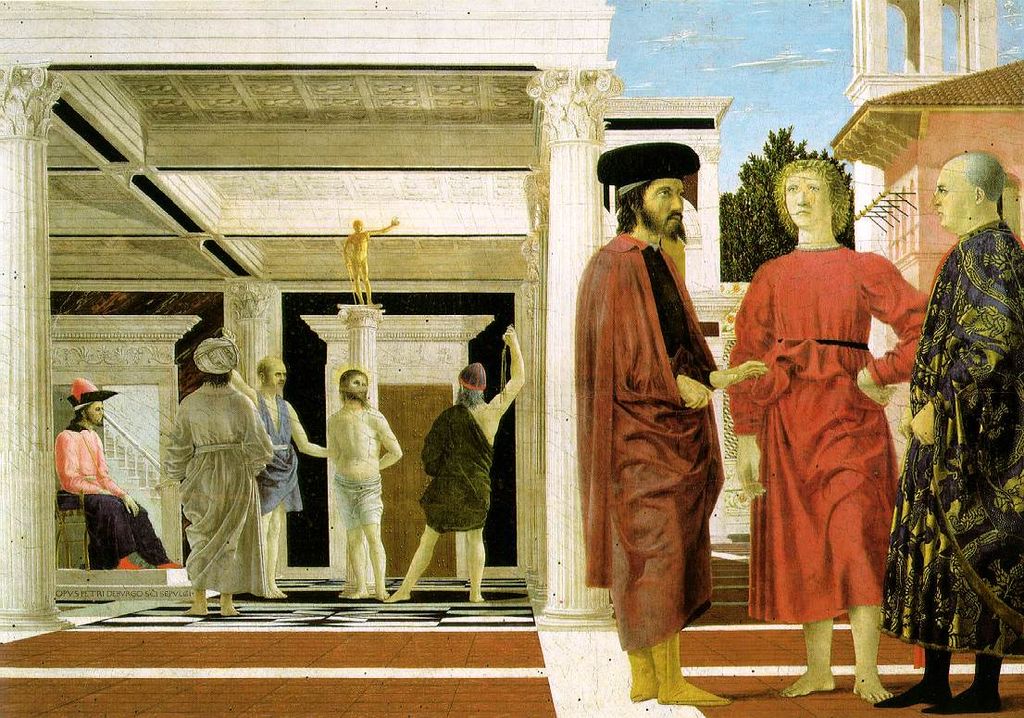
Piero della Francesca, The Flagellation of Christ, 1459–60, Galleria Nazionale delle Marche, Urbino. A historical comparison for architecture, light and standing figures. Piero della Francesca / Galleria Nazionale delle Marche / Web Gallery of Art / Wikimedia Commons. Image source. Public domain. Resized and converted to JPEG; no crop or recolouring.
A closer comparison within Hockney’s own work is American Collectors (Fred and Marcia Weisman) of 1968. The Foundation preserves his explanation that this later portrait existed in the whole setting, including the surrounding sculptures, as well as in the faces. Freeman’s picture already makes the environment a substantial part of portraiture. The comparison helps us follow a developing pictorial concern: how a person’s taste can become part of a portrait’s structure. [14]
The glass and architectural divisions also connect the portrait with Hockney’s experiments in representing water. Writing in Apollo, Matthew Sperling follows the different graphic languages of the Californian pool pictures, where a reflective, changing substance becomes a problem of lines, colour and flat surface. In Beverly Hills Housewife, the pool that prompted the visit yielded attention to another problem of seeing: a person situated among transparent, reflective and solid planes. Both subjects allowed an ordinary feature of Californian life to become a sustained pictorial investigation. The larger history belongs to Hockney in California, while his portraits reveal how differently a familiar person might be represented over time. [15]
Ownership, exhibition and reception
The published provenance records Freeman’s purchase from Landau-Alan Gallery, New York, on 25 February 1967. The painting was shown there that spring, and subsequently appeared in the 1970 Whitechapel–Hannover exhibition, the 1988–89 retrospective and the touring David Hockney: Portraits exhibition of 2006–07. LACMA’s own record confirms its Los Angeles presentation from 11 June to 4 September 2006. These loans gave the privately owned work a substantial public exhibition history. [1] [16]
Its position within Los Angeles’s cultural memory became particularly explicit before the Freeman collection was dispersed. Goldman argued in March 2009 that the picture should remain in the city and urged LACMA to acquire it. His broadcast records a local critical response to the impending sale. The work’s association with Los Angeles had become strong enough for the possibility of its departure to prompt an argument about the city’s public collections. [6]
At Christie’s New York sale on 13 May 2009, the painting achieved approximately $7.9 million, then an auction record for Hockney. The result marked a later stage in the reception of a work originally acquired from a gallery by its own sitter. [17]
Freeman’s documented work gives this carefully ordered domestic scene a wider resonance. The house contains the visible evidence of collecting and later became a meeting place for new music. Hockney’s portrait holds its sitter at one particular moment, while the history of the person in pink continues beyond the frame.
Works directory
This source-bounded directory combines the works in the Metropolitan Museum’s 2017 retrospective checklist with reviewed museum object records and the additional works and series examined in this guide. It spans several media and is not a complete catalogue raisonné. Titles without an article link remain useful dated records. Metropolitan Museum final retrospective checklist (2017); additional object and series sources are given in the linked articles. [3]
| Name | Date | Medium |
|---|---|---|
| Love Painting | 1960 | Painting |
| Shame | 1960 | Painting |
| The Third Love Painting | 1960 | Painting |
| Tyger Painting No. 2 | 1960 | Painting |
| A Rake’s Progress | 1961–63 | Print series |
| Tea Painting in an Illusionistic Style | 1961 | Painting |
| The Cha-Cha That Was Danced in the Early Hours of 24th March | 1961 | Painting |
| Cleaning Teeth, Early Evening (10pm) W11 | 1962 | Painting |
| Flight into Italy - Swiss Landscape (Painting in a Scenic Style) | 1962 | Painting |
| Man in a Museum (or You're in the Wrong Movie) | 1962 | Painting |
| My Brother is Only Seventeen | 1962 | Painting |
| The First Marriage (A Marriage of Styles I) | 1962 | Painting |
| Domestic Scene, Los Angeles | 1963 | Painting |
| Play Within a Play | 1963 | Painting |
| The Hypnotist | 1963 | Painting |
| Arizona | 1964 | Painting |
| California Art Collector | 1964 | Painting |
| Man in Shower in Beverly Hills | 1964 | Painting |
| Portrait Surrounded by Artistic Devices | 1965 | Painting |
| Rocky Mountains and Tired Indians | 1965 | Painting |
| Beverly Hills Housewife | 1966–67 | Painting |
| Medical Building | 1966 | Painting |
| Peter | 1966 | Drawing |
| Peter Getting Out of Nick’s Pool | 1966 | Painting |
| A Bigger Splash | 1967 | Painting |
| A Lawn Being Sprinkled | 1967 | Painting |
| Kasmin in Bed in His Chateau in Carennac | 1967 | Drawing |
| Peter Feeling Not Too Good | 1967 | Drawing |
| Savings and Loan Building | 1967 | Painting |
| The Room, Tarzana | 1967 | Painting |
| American Collectors (Fred and Marcia Weisman) | 1968 | Painting |
| Christopher Isherwood and Don Bachardy | 1968 | Painting |
| Henry Geldzahler and Christopher Scott | 1968-1969 | Painting |
| W. H. Auden | 1968 | Drawing |
| Peter Langan in His Kitchen at Odins | 1969 | Drawing |
| Mark Glazebrook | 1970 | Drawing |
| Mr and Mrs Clark and Percy | 1970-1971 | Painting |
| Ossie Wearing a Fairisle Sweater | 1970 | Drawing |
| Pool and Steps, Le Nid du Duc | 1971 | Painting |
| Rubber Ring Floating in a Swimming Pool | 1971 | Painting |
| Celia in a Black Dress with White Flowers | 1972 | Drawing |
| Mount Fuji and Flowers | 1972 | Painting |
| Portrait of an Artist (Pool with Two Figures) | 1972 | Painting |
| Portrait of the Artist's Mother, Mrs Laura Hockney, Bradford | 1972 | Drawing |
| The Artist's Father | 1972 | Drawing |
| Dr Eugene Lamb, Lucca | 1973 | Drawing |
| Andy, Paris | 1974 | Drawing |
| Contre-jour in the French Style (Against the Day dans le Style-Français) | 1974 | Painting |
| Gregory Sitting on Base of Column | 1975 | Drawing |
| Kerby (after Hogarth) Useful Knowledge | 1975 | Painting |
| Ron Kitaj Outside Akademie der Kunste Vienna | 1975 | Drawing |
| Kasmin Reading the Udaipur Guide | 1977 | Drawing |
| Looking at Pictures on a Screen | 1977 | Painting |
| My Parents | 1977 | Painting |
| Canyon Painting | 1978 | Painting |
| Mother, Bradford, 19 Feb. 1979 (inscribed 1978) | 1979 | Drawing |
| Mulholland Drive: The Road to the Studio | 1980 | Painting |
| Nichols Canyon | 1980 | Painting |
| Outpost Drive, Hollywood | 1980 | Painting |
| Hollywood Hills House | 1981-1982 | Painting |
| Celia. Los Angeles. April 10th 1982 | 1982 | Polaroid composite |
| Don + Christopher, Los Angeles, 6th March 1982 | 1982 | Polaroid composite |
| Gregory Swimming Los Angeles March 31st 1982 | 1982 | Polaroid composite |
| My Mother, Bolton Abbey, Yorkshire, Nov. 1982 | 1982 | Photocollage |
| Self Portrait 30th Sept. 1983 | 1983 | Drawing |
| Pearblossom Hwy., 11-18th April 1986, #1 | 1986 | Photocollage |
| Pearblossom Hwy., 11–18th April 1986, #2 | 1986 | Photocollage |
| Large Interior, Los Angeles | 1988 | Painting |
| Breakfast at Malibu, Sunday, 1989 | 1989 | Painting |
| Pacific Coast Highway and Santa Monica | 1990 | Painting |
| The Other Side | 1991-1993 | Painting |
| The Eleventh V. N. Painting | 1992 | Painting |
| The Twenty Sixth V. N. Painting | 1992 | Painting |
| The Road Across the Wolds | 1997 | Painting |
| 9 Canvas Study of the Grand Canyon | 1998 | Painting |
| A Bigger Grand Canyon | 1998 | Painting |
| Colorado River | 1998 | Painting |
| Garrowby Hill | 1998 | Painting |
| Colin St. John Wilson. London. 3rd June 1999 | 1999 | Drawing |
| Gregory Evans. Los Angeles. 18th September 1999 | 1999 | Drawing |
| Laura Huston. London. 22nd June 1999 | 1999 | Drawing |
| Lindy. Marchioness of Dufferin and Ava. London. 17th June | 1999 | Painting |
| Going Up Garrowby Hill | 2000 | Painting |
| Red Pots in the Garden | 2000 | Painting |
| A Closer Winter Tunnel, February - March | 2006 | Painting |
| Elderflower Blossom, Kilham, July 2006 | 2006 | Painting |
| The Road to Thwing, July 2006 | 2006 | Painting |
| Bigger Trees near Warter | 2007 | Painting |
| Hawthorn Blossom near Rudston | 2008 | Painting |
| Views Through the Artist's Bedroom Window, Bridlington | 2010-2013 | Digital animation |
| The Arrival of Spring in Woldgate, East Yorkshire in 2011 (twenty eleven) | 2011 | Painting / digital series |
| 82 Portraits and 1 Still-life | 2013–16 | Portrait series |
| Garden | 2015 | Painting |
| Garden with Blue Terrace | 2015 | Painting |
| Garden #3 | 2016 | Painting |
| A Bigger Interior with Blue Terrace | 2017 | Painting |
| Interior with Blue Terrace and Garden | 2017 | Painting |
| A Year in Normandie | 2020–21 | Digital frieze |
Discussion
Look again at the images and ideas explored in Beverly Hills Housewife. These editorial prompts invite your observations.
Reader Insights
How does the twelve-foot width change your understanding of Freeman compared with an imagined portrait cropped around her face?
Does knowing that Freeman reportedly suggested the title alter how you read the word “housewife”?
Which comparison clarifies the painting more for you: the collected objects in American Collectors, or the reflective surfaces in Hockney’s pool paintings?
Join the Conversation
Share a detail, comparison or question about Beverly Hills Housewife below.
References
- Christie’s. “David Hockney: Beverly Hills Housewife,” lot 14, Post-War and Contemporary Evening Sale, New York, 13 May 2009; object details, provenance and exhibition history. View source.
- UC San Diego Library, Special Collections & Archives. “Betty Freeman Papers, 1965–2009,” MSS 227; Biography and relevant collection descriptions. View source.
- The Metropolitan Museum of Art, David Hockney, final exhibition checklist, 15 November 2017. View source.
- The David Hockney Foundation, 2021 chronology. View source.
- Archives of American Art, Smithsonian Institution. “Betty Freeman papers, 1945–circa 1970”; collection summary and biographical note. View source.
- Edward Goldman, KCRW. “Beverly Hills Housewife for Sale,” Art Talk, 4 March 2009. View source.
- The David Hockney Foundation. “1966”; “Los Angeles” and “Southern Californian lifestyle” sections. View source.
- Sotheby’s. “David Hockney: Beverly Hills Housewife,” lot 129, Contemporary Art Day Auction, London, 2017; drawing details and catalogue note. View source.
- Christie’s. “Hockney’s Beverly Hills Housewife Highlights Christie’s Post-War & Contemporary Art Sale on May 13, 2009 in New York,” 20 February 2009, pp. 2–3. View source.
- Offer Waterman. “Offer Waterman to represent the Estate of William Turnbull,” 2015, p. 1; account of Lama, 1961. View source.
- Jake Johnson. “Performing the Patron: Betty Freeman and the Avant-Garde,” Tempo, 68, no. 269, July 2014, pp. 42–49, especially pp. 44–46 and notes 14–16. View source.
- Tom McGeary, Noah Lenstra, Elizabeth Surles and Scott Schwartz, University of Illinois. “Finding Aid for Music and Performing Arts Library Harry Partch Collection, 1914–2016,” Series 4: Betty Freeman Collection. View source.
- James Cahill, interviewed by Gareth Harris. “When Hockney met Betty: new book uncovers mysterious Beverly Hills Housewife in famous Los Angeles painting,” The Art Newspaper, 1 September 2026. View source.
- The David Hockney Foundation. “1968”; “Double-portraits” section, including Hockney’s account of American Collectors. View source.
- Matthew Sperling. “Water Marks: The Pull of Hockney’s Pool Paintings,” Apollo, February 2017, pp. 52–58; repository manuscript proof. View source.
- Los Angeles County Museum of Art. “David Hockney Portraits,” exhibition record, 11 June–4 September 2006. View source.
- Christie’s. “Christie’s International Announces Worldwide Sales of £1.2 Billion ($1.8 Billion) for First Half 2009,” 23 July 2009, PDF p. 5; May New York sale results. View source.
More HOCKNEY Works
A Bigger Splash
A momentary disturbance becomes the focus of a large acrylic painting, made through weeks of patient work.
Mr and Mrs Clark and Percy
The designers Celia Birtwell and Ossie Clark occupy a room shaped by light, repeated sittings and the demands of a double portrait.
A Bigger Grand Canyon
Sixty canvases gather memory, studies and changing viewpoints into an immense painting of 1998.
Garrowby Hill
The 1998 oil painting transforms a remembered Yorkshire journey into a road, fields and an expansive view.
Portrait of an Artist (Pool with Two Figures)
Photographic studies, two figures and a swimming pool become a carefully constructed painting of 1972.
My Parents
The 1977 oil painting sets Kenneth and Laura Hockney within a quietly organised interior.
Pearblossom Hwy., 11–18th April 1986, #2
Hundreds of separately made photographs construct a road scene that unfolds through movement and time.
Bigger Trees near Warter
Fifty canvases join into a large outdoor painting of Yorkshire trees, with photography helping the artist organise the whole.