


 by Tom Gurney
Tom Gurney BSc (Hons) is an art history expert with over 20 years experience
Email: tomgurney1@gmail.com / Phone: +44 7429 011000
David Hockney’s Flowers and Still Lifes: Introduction
A vase of flowers gave David Hockney several subjects at once: the shape of a bloom, the space between stems, the light passing through water and the table beneath it. Returning to flowers allowed him to ask fresh questions of familiar things. An etched shadow, a brightly coloured lithograph and a flower drawn on a telephone could each describe something that the others handled differently. Curator Ai Kusumoto made this continuity central to the Museum of Contemporary Art Tokyo’s 2023 exhibition, bringing flower pictures from widely separated years into conversation. [1]
These works also belong to daily life. Flowers arrived as bouquets, stood in the studio, appeared beside portrait sitters and became pictures sent to friends. Outdoors, blossom made a flowering tree into a brief event that demanded attention. Following these subjects across Hockney’s career reveals how observation, friendship and practical experiment repeatedly met in the same modest arrangement.
At a Glance
- ArtistDavid Hockney
- Born9 July 1937, Bradford, England
- Died11 June 2026
- FocusFlowers and Still Lifes
Contents
- Vase, flowers and shadow
- Flowers in a room with a sitter
- An amaryllis and an expanding table
- Still life through the photocopier and camera
- Fresh flowers on the telephone
- A drawing on a screen and an edition on paper
- Blossom changes the scale of the subject
- The twenty flowers: making and exhibiting
- The pond, replay and later London flowers
Vase, flowers and shadow
Vase and Flowers dates from 1969. The Museum of Contemporary Art Tokyo records its medium as etching and aquatint: a useful starting point, because the image combines different kinds of printed mark rather than translating everything into one uniform outline. [2]
Kusumoto singled out the distinction between the vase and its pale shadow. Their contrasting textures demonstrate how Hockney searched for marks particular to a medium. In the Tokyo exhibition, this print stood beside No. 118, 16th March 2020, an iPad flower picture from the Normandy spring sequence. The pairing joined a recurring subject to a changing material vocabulary. A flower did not cease to interest him once he had found one successful way to draw it. [1]
The combination of etching and aquatint helps explain that vocabulary. Etched line can articulate an edge or a stalk; aquatint offers areas of tone. A shadow needs a different kind of presence from the object casting it. It spreads across a surface, while the vase appears to stand above that surface. Attending to the difference makes the still life an exercise in spatial relationships as well as a record of flowers. The broader history of Hockney’s prints places this investigation alongside his other uses of original printmaking.
Flowers in a room with a sitter
Still life could also supply the setting for a portrait. Hockney’s 1971 painting of Sir David Webster, the Royal Opera House director, brought its sitter into the artist’s own studio. Hockney recalled struggling to find the right setting because he and Webster lacked the familiarity he enjoyed with friends. His eventual solution was to use the studio’s table, chair and flowers. The arrangement grew out of a concrete problem: where could he make this person present in a convincing painted room? [3]
The flowers establish something about the room, give the eye another form to examine and set organic growth beside furniture and the seated body. A portrait’s still life can reward attention in its own right. The studio explanation also cautions against assigning flowers a single fixed meaning across Hockney’s work. Their significance depends on the particular setting, their relationship to other forms and what is known about the picture’s making.
The connection between drawing a person and drawing nearby objects runs through Hockney’s drawings. Both depend on deciding where to look, what to describe closely and which marks will carry the description. The vase remains recognisable, but its role changes when it shares a room with a sitter.
An amaryllis and an expanding table
In Amaryllis in Vase (1984), the table becomes especially active. Kunstmuseum Luzern’s account identifies its reverse perspective: Hockney turns the familiar arrangement of a vanishing point around, placing that point behind the viewer. The surface supporting the flowers therefore challenges the expectation that parallel edges should converge neatly into the distance. The bouquet sits within a space that seems to open towards the person looking. [4]
This is a lithograph on paper, part of the Moving Focus investigations. The Musée Granet’s Tate exhibition account places these intensely coloured still lifes alongside interiors and portraits concerned with memory, perspective and movement. Their spatial changes ask the viewer to imagine looking around a place, gathering impressions over time. A table can be understood through the experience of moving beside it, looking down at it and then towards what it holds. [5]
The amaryllis gives that spatial experiment a familiar anchor. We recognise a vase resting on furniture, so a change to the furniture’s geometry registers immediately. Reverse perspective is more than an unusual outline around a floral subject: it changes how close the arrangement feels and how the viewer relates to the surrounding room. Luzern’s curators connect Hockney’s multiple viewpoints with the mobility of ordinary perception, in which attention rarely remains fixed on one point. [4]
Still life through the photocopier and camera
Hockney’s flowers and fruit also passed through the office photocopier. In 1986 he began the Home Made Prints, using coloured cartridges, repeated elements and changes of scale to build layered images. The Foundation’s chronology includes Flowers, Apple & Pear on a Table, July 1986, Red, Blue & Green Flowers, July 1986 and Dancing Flowers, May 1986. Their titles place bouquets within the same everyday repertoire as fruit bowls, chairs and people. [6]
The machine altered the working process. Hockney could carry out the stages himself, moving between the scanner and the emerging print. A still life offered forms that could be repeated, rearranged and brought into contact with different colours. These experiments extend the distinction already visible in Vase and Flowers: the means of making the picture contributes to its appearance. A photocopier supplied possibilities quite different from an etched plate or a lithographic workshop. [6]
By 1995 he was making another kind of encounter between a flower and its image. The Foundation describes photographs of his paintings together with their motifs, produced through an 8-by-10-inch camera, scanned transparencies and inkjet printing at Nash Editions. Its work list includes Photograph of a Photograph with Photograph of Painting and Motif. July 10th 1995 and Roses for Mother 4 Dec 1995. The picture could now contain evidence of another picture, keeping the observed object and its successive representations in play. [7]
Fresh flowers on the telephone
By 2009, flowers had acquired a new route between Hockney and his friends. Martin Gayford’s 2010 interview recalled Hockney drawing them on his iPhone and sending the images to a small circle in the morning. John Fitzherbert bought bouquets, and Hockney worked beside his bedroom window as the light changed. The screen’s illumination particularly suited luminous subjects, including the light caught by glass and water. [8]
These were acts of looking with a social destination. A bouquet bought for the room could become a drawing received elsewhere that morning. The recipient encountered Hockney’s touch as well as the flowers. The image preserved an arrangement that would change, while its quick circulation retained something of a freshly offered gift.
The tools also required learning. In the same interview, Hockney described mastering thicker and thinner lines, transparency and softened edges in Brushes. He valued the flow of drawing on glass while acknowledging that it lacked paper’s resistance. When he began working on the larger iPad in spring 2010, there was more room for his hand and marks. These material differences matter when looking at a petal, a translucent vase or the light spreading across a table. [8]
A drawing on a screen and an edition on paper
The early digital flower titles need to be kept distinct. L.A. Louver’s 2018 exhibition record identifies White Rose (2009) as an iPhone drawing printed on paper and Sunflowers (2010) as an iPad drawing printed on paper. Both are recorded in editions of twenty-five. The device, date and printed form are all parts of their identities. [9]
A digital flower could circulate among friends and also become a carefully specified paper work. Those are different ways of encountering it: a glowing screen held in the hand, or a sheet seen at a chosen size on a wall. The printed edition gives the digital drawing a physical surface and dimensions. It also belongs to a wider body of domestic subjects. NGV curator Jessica Cole described the museum’s gift of twenty-seven drawings from 2009–12 as including flower vases, fruit, ashtrays, scissors, interiors and window views. The flowers sit among the things Hockney actually lived with. [10]
The software changed over time too. According to its developer, Reflex Arc, the early work used Steve Sprang’s Brushes; most development of the separate, bespoke Hockney Brushes took place in early 2018. Richard England and the studio shaped the new software around Hockney’s working preferences and brushes. Reflex Arc explains that it retained stroke information used for replay and re-rendering at exhibition scale. This specific later history should accompany the Normandy flower pictures, while the early phone flowers retain their own technological context. The fuller account of Hockney’s iPad art explores these changes. [11]
Blossom changes the scale of the subject
Outdoors, flowers could occupy an entire landscape. In May Blossom on the Roman Road (2009), hawthorn flowering became a substantial subject in oil across eight canvases. The Fondation Louis Vuitton’s 2025 curatorial text identifies the bush as hawthorn and describes the work within Hockney’s renewed attention to Yorkshire. The change of scale is striking: flowering is no longer contained by the rim of a vase, but spreads through an encounter with a particular place. [12]
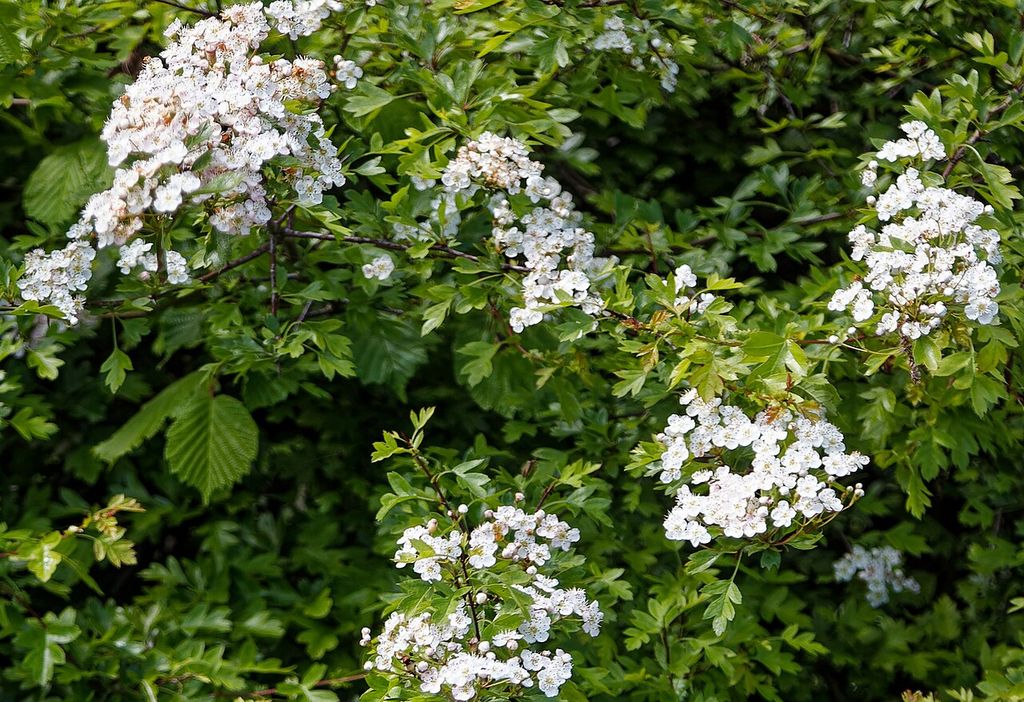
Botanical comparison: hawthorn blossom in the Gibberd Garden, Essex. Acabashi / Wikimedia Commons. Image source. CC BY-SA 4.0. Resized and converted to JPEG; no crop or recolouring. Image derivative retains CC BY-SA 4.0.
A cut bouquet and a flowering tree invite different kinds of return. Indoors, the artist can revisit the same table and arrangement. In the landscape, light, foliage and the surrounding view keep changing together. The picture preserves a stage in that process, and the scale allows the brief flowering to command sustained attention. The familiar seasonal subject becomes something a viewer can stand before and explore.
In Normandy during 2020, Hockney followed this change with repeated iPad observations. His account, preserved by the Foundation, traces bare winter branches through buds and full blossom, then towards leaves and small fruit as petals fell. He described the passage from blossom to young fruit and leaves as taking about two weeks. That was one transformation within a longer spring. The resulting 116-image The Arrival of Spring, Normandy, 2020 was exhibited at the Royal Academy in 2021. [13]
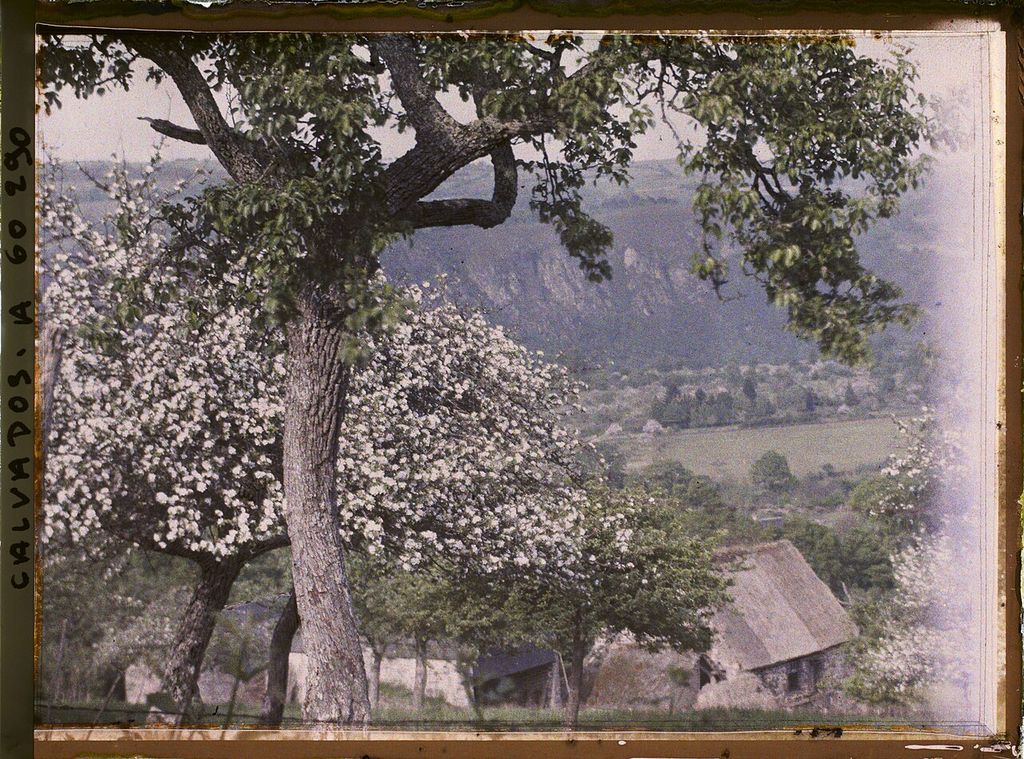
Historical comparison: Roger Dumas, apple blossom near Clécy, Normandy, May 1929, autochrome, musée Albert-Kahn. Roger Dumas / Département des Hauts-de-Seine, musée Albert-Kahn / Wikimedia Commons. Image source. CC BY-SA 4.0. Resized and converted to JPEG; no crop or recolouring. Image derivative retains CC BY-SA 4.0.
The sequence gives blossom a role that a single still life cannot supply. One image can be compared with another: what has thickened, opened, disappeared or taken its place? Hockney’s account also connects his growing command of marks on the screen with the later water lilies in the pond. Plant growth and developing pictorial language unfolded together. His Normandy work follows this relationship across the larger seasonal projects. [13]
The twenty flowers: making and exhibiting
The twenty flower pictures associated with 20 Flowers and Some Bigger Pictures were made in 2021. The Musée Matisse’s French press dossier dates the bouquets between 30 January and 21 April that year. They featured in its Hockney–Matisse: Un paradis retrouvé exhibition in Nice in summer 2022. Their making dates help place the later presentations: the year in an exhibition title does not necessarily date every work in the room. [14]
In his published account, Hockney recalled starting from flowers on the table at home, with low winter sunlight casting a deep shadow. The bouquets came from a florist in Dozulé, ordered with colour in mind. He first used a ceramic vase, then recognised the further interest of sunlight catching water inside glass. A change of vessel opened another painting problem. The series developed through adjustments to something seen close at hand. [15]
The Nice presentation placed the iPad pictures in carved wooden frames. Its curators discussed their fluid marks alongside Matisse’s Flowers and Fruits, making a particular exhibition dialogue between the two artists. This offers a useful comparison of colour, flowering and the visible act of making without requiring every Hockney bouquet to be read as an imitation of Matisse. The curatorial setting invited attention to what the two practices could illuminate in one another. [14]
Hockney’s own essay explains how the frames entered the project during a visit to the Paris art supplier Marin. Their visibly worked wood interested him beside pictures made by hand on an iPad. Framing thus became part of the encounter between the digital image and its physical presentation. He also recalled supplying the twenty flower pictures and four spring images for Die Welt. The arrangements travelled into a newspaper as well as onto gallery walls. [15]
Annely Juda Fine Art showed 20 Flowers and Some Bigger Pictures in London from November to December 2022. Its records identify the flower prints as editions of fifty, including 28th February 2021, Roses in a Blue Vase and 20th March 2021, Flowers, Glass Vase on a Table. These are separate edition specifications from those of White Rose and Sunflowers. The London display also included the 2022 photographic drawing 25th June 2022, Looking at the Flowers (Framed). [16]
In that photographic drawing, Hockney appears twice, looking towards the twenty flower pictures arranged on a blue wall. Pace’s account of its 2023 New York presentation describes a panorama assembled from individual photographs. The flowers become the subject of looking a second time: first as observed arrangements, then as framed works studied within a constructed room. The doubled artist helps turn an exhibition of still lifes into a picture about viewing them. [17]
The pond, replay and later London flowers
The still-life series shared its exhibitions with larger compositions. 10th–22nd June 2021, Water Lilies in the Pond with Pots of Flowers consists of six iPad paintings forming one work. Annely Juda’s record specifies the printed form as two sheets of paper mounted on two sheets of Dibond, in an edition of twenty-five. The title joins plants growing in water to flowers held in pots: different arrangements of living forms within the same view. [16]
Salts Mill subsequently presented the work in another form alongside its exhibition titled 20 Flowers for 2025 and Some Bigger Pictures. Its official account describes a six-screen installation replaying the iPad brushstrokes used to make the pond picture. Viewers could watch the image accumulate. A finished still life gathers its marks into a simultaneous surface; replay allows attention to follow their order of arrival. The flowers remain the subject, while the act of picturing them becomes visible through time. [18]
Flowers also continued in paint. Delphiniums on My Garden Table, July 2025 is acrylic on canvas. In the catalogue excerpt published with Annely Juda’s work record, Martin Gayford identified its bouquet as a gift sent for Hockney’s eighty-eighth birthday on 9 July. The table and the flowers again joined an occasion in the artist’s life to an opportunity for looking. Gayford’s account places the delphiniums alongside roses and lilies in other new paintings. [19]
The Foundation locates these later paintings within Hockney’s London studio work of 2025, when he was continuing to develop reverse perspective. The digital flower was one strand of a practice that also found fresh possibilities in acrylic, furniture and the space around a bouquet. [20]
Across these encounters, the recurring subject remains open. The flower can test a printed tone, catch light through a vase, mark a season or carry the warmth of a gift. Looking closely means attending to the stems and petals, but also to the supporting table, the picture’s surface and the route by which it reaches another person.
Works directory
This source-bounded directory combines the works in the Metropolitan Museum’s 2017 retrospective checklist with reviewed museum object records and the additional works and series examined in this guide. It spans several media and is not a complete catalogue raisonné. Titles without an article link remain useful dated records. Metropolitan Museum final retrospective checklist (2017); additional object and series sources are given in the linked articles. [21]
| Name | Date | Medium |
|---|---|---|
| Love Painting | 1960 | Painting |
| Shame | 1960 | Painting |
| The Third Love Painting | 1960 | Painting |
| Tyger Painting No. 2 | 1960 | Painting |
| A Rake’s Progress | 1961–63 | Print series |
| Tea Painting in an Illusionistic Style | 1961 | Painting |
| The Cha-Cha That Was Danced in the Early Hours of 24th March | 1961 | Painting |
| Cleaning Teeth, Early Evening (10pm) W11 | 1962 | Painting |
| Flight into Italy - Swiss Landscape (Painting in a Scenic Style) | 1962 | Painting |
| Man in a Museum (or You're in the Wrong Movie) | 1962 | Painting |
| My Brother is Only Seventeen | 1962 | Painting |
| The First Marriage (A Marriage of Styles I) | 1962 | Painting |
| Domestic Scene, Los Angeles | 1963 | Painting |
| Play Within a Play | 1963 | Painting |
| The Hypnotist | 1963 | Painting |
| Arizona | 1964 | Painting |
| California Art Collector | 1964 | Painting |
| Man in Shower in Beverly Hills | 1964 | Painting |
| Portrait Surrounded by Artistic Devices | 1965 | Painting |
| Rocky Mountains and Tired Indians | 1965 | Painting |
| Beverly Hills Housewife | 1966–67 | Painting |
| Medical Building | 1966 | Painting |
| Peter | 1966 | Drawing |
| Peter Getting Out of Nick’s Pool | 1966 | Painting |
| A Bigger Splash | 1967 | Painting |
| A Lawn Being Sprinkled | 1967 | Painting |
| Kasmin in Bed in His Chateau in Carennac | 1967 | Drawing |
| Peter Feeling Not Too Good | 1967 | Drawing |
| Savings and Loan Building | 1967 | Painting |
| The Room, Tarzana | 1967 | Painting |
| American Collectors (Fred and Marcia Weisman) | 1968 | Painting |
| Christopher Isherwood and Don Bachardy | 1968 | Painting |
| Henry Geldzahler and Christopher Scott | 1968-1969 | Painting |
| W. H. Auden | 1968 | Drawing |
| Peter Langan in His Kitchen at Odins | 1969 | Drawing |
| Mark Glazebrook | 1970 | Drawing |
| Mr and Mrs Clark and Percy | 1970-1971 | Painting |
| Ossie Wearing a Fairisle Sweater | 1970 | Drawing |
| Pool and Steps, Le Nid du Duc | 1971 | Painting |
| Rubber Ring Floating in a Swimming Pool | 1971 | Painting |
| Celia in a Black Dress with White Flowers | 1972 | Drawing |
| Mount Fuji and Flowers | 1972 | Painting |
| Portrait of an Artist (Pool with Two Figures) | 1972 | Painting |
| Portrait of the Artist's Mother, Mrs Laura Hockney, Bradford | 1972 | Drawing |
| The Artist's Father | 1972 | Drawing |
| Dr Eugene Lamb, Lucca | 1973 | Drawing |
| Andy, Paris | 1974 | Drawing |
| Contre-jour in the French Style (Against the Day dans le Style-Français) | 1974 | Painting |
| Gregory Sitting on Base of Column | 1975 | Drawing |
| Kerby (after Hogarth) Useful Knowledge | 1975 | Painting |
| Ron Kitaj Outside Akademie der Kunste Vienna | 1975 | Drawing |
| Kasmin Reading the Udaipur Guide | 1977 | Drawing |
| Looking at Pictures on a Screen | 1977 | Painting |
| My Parents | 1977 | Painting |
| Canyon Painting | 1978 | Painting |
| Mother, Bradford, 19 Feb. 1979 (inscribed 1978) | 1979 | Drawing |
| Mulholland Drive: The Road to the Studio | 1980 | Painting |
| Nichols Canyon | 1980 | Painting |
| Outpost Drive, Hollywood | 1980 | Painting |
| Hollywood Hills House | 1981-1982 | Painting |
| Celia. Los Angeles. April 10th 1982 | 1982 | Polaroid composite |
| Don + Christopher, Los Angeles, 6th March 1982 | 1982 | Polaroid composite |
| Gregory Swimming Los Angeles March 31st 1982 | 1982 | Polaroid composite |
| My Mother, Bolton Abbey, Yorkshire, Nov. 1982 | 1982 | Photocollage |
| Self Portrait 30th Sept. 1983 | 1983 | Drawing |
| Pearblossom Hwy., 11-18th April 1986, #1 | 1986 | Photocollage |
| Pearblossom Hwy., 11–18th April 1986, #2 | 1986 | Photocollage |
| Large Interior, Los Angeles | 1988 | Painting |
| Breakfast at Malibu, Sunday, 1989 | 1989 | Painting |
| Pacific Coast Highway and Santa Monica | 1990 | Painting |
| The Other Side | 1991-1993 | Painting |
| The Eleventh V. N. Painting | 1992 | Painting |
| The Twenty Sixth V. N. Painting | 1992 | Painting |
| The Road Across the Wolds | 1997 | Painting |
| 9 Canvas Study of the Grand Canyon | 1998 | Painting |
| A Bigger Grand Canyon | 1998 | Painting |
| Colorado River | 1998 | Painting |
| Garrowby Hill | 1998 | Painting |
| Colin St. John Wilson. London. 3rd June 1999 | 1999 | Drawing |
| Gregory Evans. Los Angeles. 18th September 1999 | 1999 | Drawing |
| Laura Huston. London. 22nd June 1999 | 1999 | Drawing |
| Lindy. Marchioness of Dufferin and Ava. London. 17th June | 1999 | Painting |
| Going Up Garrowby Hill | 2000 | Painting |
| Red Pots in the Garden | 2000 | Painting |
| A Closer Winter Tunnel, February - March | 2006 | Painting |
| Elderflower Blossom, Kilham, July 2006 | 2006 | Painting |
| The Road to Thwing, July 2006 | 2006 | Painting |
| Bigger Trees near Warter | 2007 | Painting |
| Hawthorn Blossom near Rudston | 2008 | Painting |
| Views Through the Artist's Bedroom Window, Bridlington | 2010-2013 | Digital animation |
| The Arrival of Spring in Woldgate, East Yorkshire in 2011 (twenty eleven) | 2011 | Painting / digital series |
| 82 Portraits and 1 Still-life | 2013–16 | Portrait series |
| Garden | 2015 | Painting |
| Garden with Blue Terrace | 2015 | Painting |
| Garden #3 | 2016 | Painting |
| A Bigger Interior with Blue Terrace | 2017 | Painting |
| Interior with Blue Terrace and Garden | 2017 | Painting |
| A Year in Normandie | 2020–21 | Digital frieze |
Discussion
Look again at the images and ideas explored in David Hockney’s Flowers and Still Lifes. These editorial prompts invite your observations.
Reader Insights
How does the pale shadow in Vase and Flowers change your attention to the vase, compared with the expanding table space described in Amaryllis in Vase?
What changes when a flower drawing arrives on a friend’s telephone, appears as a numbered paper edition or hangs in a carved wooden frame?
Would you spend longer with a single flowering tree, a sequence from blossom to fruit or the brushstroke replay of the water-lily picture, and why?
Join the Conversation
Share a detail, comparison or question about David Hockney’s Flowers and Still Lifes below.
References
- Tamaki Sugihara / Tokyo Art Beat. Interview with Museum of Contemporary Art Tokyo curator Ai Kusumoto, 25 August 2023; sections on the 1969/2020 flower pairing and medium-specific marks. View source.
- Museum of Contemporary Art Tokyo / Art Platform Japan. David Hockney, Vase and Flowers, 1969, collection record, accession 1994-00-1140-000; museum data published by Art Platform Japan. View source.
- The David Hockney Foundation. “1971”, section “Sir David Webster”, including Hockney’s account of the studio setting. View source.
- Kunstmuseum Luzern. “Moving Focus”, 2022 exhibition interpretation; “Reverse Perspective” and “Many Perspectives”. View source.
- Musée Granet / Tate. David Hockney: Works from the Tate Collection, 2023 press pack, p. 16, “Moving Focus”. View source.
- The David Hockney Foundation. “1986”, section “Home Made Prints” and associated work titles. View source.
- The David Hockney Foundation. “1995”, section “Digital Inkjet Prints” and associated work titles. View source.
- Martin Gayford / The Telegraph. “David Hockney’s iPad art”, 20 October 2010, pp. 1–4; period interview, preserved by Richard Gray Gallery. View source.
- L.A. Louver. David Hockney: iPhone and iPad Drawings, 2009–12, 28 March–25 May 2018; White Rose and Sunflowers object records. View source.
- Jessica Cole / National Gallery of Victoria. “David Hockney Sunflowers”, 9 May 2019. View source.
- Reflex Arc. “The iPad painting app we built for David Hockney”; developer’s account, particularly “Before the app”, “Which app, when” and “Hockney Brushes, 2018”. View source.
- Fondation Louis Vuitton. David Hockney 25, 9 April–1 September 2025; Yorkshire and May Blossom on the Roman Road interpretation and object details. View source.
- The David Hockney Foundation. “2021”, section “The Arrival of Spring, Normandy, 2020”, including Hockney’s description of blossom, fruit and mark-making. View source.
- Musée Matisse Nice. Hockney–Matisse: Un paradis retrouvé, French press dossier, 2022, p. 5, “Fresh Flowers”; exhibition 9 June–18 September 2022. View source.
- David Hockney / Pace Gallery. “20 Flowers and Some Bigger Pictures”, artist’s essay published online 12 January 2023. View source.
- Annely Juda Fine Art. David Hockney: 20 Flowers and Some Bigger Pictures, 3 November–23 December 2022, works and edition records. View source.
- Pace Gallery. David Hockney: 20 Flowers and Some Bigger Pictures, 13 January–25 February 2023, exhibition account of Looking at the Flowers (Framed). View source.
- Salts Mill. “20 Flowers for 2025 and Some Bigger Pictures”, official exhibition description and six-screen brushstroke-replay account. View source.
- Martin Gayford / Annely Juda Fine Art. “Lessons in Chairs – and the Joy of Delphiniums”, 2025 catalogue excerpt accompanying Delphiniums on My Garden Table, July 2025, with the gallery’s medium record. View source.
- The David Hockney Foundation. “2025”, London studio paintings and reverse-perspective account. View source.
- The Metropolitan Museum of Art, David Hockney, final exhibition checklist, 15 November 2017. View source.
More HOCKNEY Works
A Bigger Splash
A momentary disturbance becomes the focus of a large acrylic painting, made through weeks of patient work.
Mr and Mrs Clark and Percy
The designers Celia Birtwell and Ossie Clark occupy a room shaped by light, repeated sittings and the demands of a double portrait.
A Bigger Grand Canyon
Sixty canvases gather memory, studies and changing viewpoints into an immense painting of 1998.
Garrowby Hill
The 1998 oil painting transforms a remembered Yorkshire journey into a road, fields and an expansive view.
Portrait of an Artist (Pool with Two Figures)
Photographic studies, two figures and a swimming pool become a carefully constructed painting of 1972.
My Parents
The 1977 oil painting sets Kenneth and Laura Hockney within a quietly organised interior.
Pearblossom Hwy., 11–18th April 1986, #2
Hundreds of separately made photographs construct a road scene that unfolds through movement and time.
Bigger Trees near Warter
Fifty canvases join into a large outdoor painting of Yorkshire trees, with photography helping the artist organise the whole.