


 by Tom Gurney
Tom Gurney BSc (Hons) is an art history expert with over 20 years experience
Email: tomgurney1@gmail.com / Phone: +44 7429 011000
David Hockney Paintings: Introduction
David Hockney’s paintings offer several different pleasures: the sudden white burst of a splash, two people sharing a room, a road twisting across a hillside, or branches spreading across a wall of canvases. Their recognisable subjects can make the changes between them seem less radical than they are. Hockney continually reconsidered the materials, marks and arrangements through which a picture could give an experience of the world. A handwritten word, an unmodulated field of acrylic blue and a thickly painted tree each brought something different to that task. The Metropolitan Museum’s retrospective in 2017 placed his experiments with abstraction, illusion, realism and landscape within this sustained investigation of movement, space and time. [1]
Following those changes gives a fuller understanding of his painting than treating the swimming pools as a signature formula. His early pictures made desire explicit through writing and deliberately unstable styles. The pools turned transparency into a problem of coloured marks. Double portraits tested the relationship between bodily presence and pictorial construction. Later landscapes stretched the canvas into a field through which the eye could travel. Oil painting, acrylic painting, drawing, photography and digital work repeatedly overlapped. Their exchanges helped painting develop, while the canvas remained a place to pursue questions that another medium had opened.
At a Glance
- ArtistDavid Hockney
- Born9 July 1937, Bradford, England
- Died11 June 2026
- FocusPaintings
Contents
- Words, figures and the freedom to change style
- Acrylic, California and the changing surface of water
- Double portraits: people and the spaces between them
- Painting after naturalism
- California seen in motion
- Intimacy, repetition and a return to acrylic
- Yorkshire: memory becomes sustained observation
- Building a painting from many canvases
- Painting the interval between seasons
- Normandy and the late London paintings
Words, figures and the freedom to change style
At the Royal College of Art, Hockney briefly tried the abstract painting favoured by many of the students he considered adventurous. He wanted to participate in contemporary art, but he also wanted to introduce the human figure and subjects that mattered to him. Writing provided a way through that difficulty. Words could direct an otherwise ambiguous arrangement towards love, sex or a particular person without requiring a conventionally modelled body. His reading of Walt Whitman informed the love paintings of 1960, and Adhesiveness used numbers corresponding to initials to connect its interpenetrating figures with Hockney and Whitman. Hockney subsequently described it as an early attempt at a double portrait. [2]
The marks in these paintings have several jobs. A passage of handwriting is part of the painted surface, but it also asks to be read. That changes the viewer’s distance and pace: a picture that first registers as large shapes can require a closer encounter with something small and personal. The Third Love Painting (1960), made in oil on Masonite, belongs to this productive border between an abstract arrangement and a declaration. Hockney’s own account emphasised how its graffiti drew the viewer towards the surface. Its human content did not depend on transforming every area of paint into an identifiable object. [3] [2]
The early pictures consequently demand a more flexible understanding of representation than a division between realistic and abstract art allows. A word can identify a feeling without illustrating it; a number can stand for a person; a loosely formed body can make contact between people tangible. These devices also give private experience a public form. The paintings’ references to male desire belong to their structure and language. They explain why a letter, a suggestive contour or a coded name could carry such weight within an apparently unruly surface.
Picasso offered another kind of permission. Hockney saw the major Tate exhibition in 1960, and the example of an artist able to work in widely different manners strengthened his resistance to a single compulsory style. At the 1962 Young Contemporaries exhibition he grouped four paintings as Demonstrations of Versatility. As the Tate and Musée Granet guide explains, consciously choosing a manner, or allowing several manners to coexist, became part of the work itself. A painting’s style could be a decision made in relation to its subject. [4]
The titles make the experiment unusually visible. Tea Painting in an Illusionistic Style (1961) identifies an effect it is trying out, while Flight into Italy—Swiss Landscape (Painting in a Scenic Style) (1962) treats landscape as something that can be staged through a chosen convention. Both are oils on canvas, as is The First Marriage (A Marriage of Styles I) (1962). The subject and the method of representing it become simultaneous concerns. The viewer is invited to recognise an image and notice the pictorial language that has made recognition possible. [3]
The sharper architectural spaces and more continuous bodies of the subsequent California paintings developed within this freedom to change the rules. Naturalism would become another choice, available when it served a particular picture.
Explore the paintings
A Bigger Splash
A momentary disturbance becomes the focus of a large acrylic painting, made through weeks of patient work.
Mr and Mrs Clark and Percy
The designers Celia Birtwell and Ossie Clark occupy a room shaped by light, repeated sittings and the demands of a double portrait.
A Bigger Grand Canyon
Sixty canvases gather memory, studies and changing viewpoints into an immense painting of 1998.
Garrowby Hill
The 1998 oil painting transforms a remembered Yorkshire journey into a road, fields and an expansive view.
Portrait of an Artist (Pool with Two Figures)
Photographic studies, two figures and a swimming pool become a carefully constructed painting of 1972.
My Parents
The 1977 oil painting sets Kenneth and Laura Hockney within a quietly organised interior.
Bigger Trees near Warter
Fifty canvases join into a large outdoor painting of Yorkshire trees, with photography helping the artist organise the whole.
Mulholland Drive: The Road to the Studio
The large 1980 panorama brings the experience of travelling through Los Angeles into an arrangement of vivid colour and changing viewpoints.
Nichols Canyon
A winding Los Angeles route becomes a network of road, vegetation and emphatic colour in 1980.
The Arrival of Spring in Woldgate
A thirty-two-canvas oil painting and an associated sequence of iPad drawings offer distinct ways of following spring in 2011.
Acrylic, California and the changing surface of water
Hockney arrived in Los Angeles in 1964 and established a home and studio in Santa Monica. His first painting there, Plastic Tree Plus City Hall, used acrylic, a change of material that accompanied the change of environment. The Foundation chronology connects the new surroundings with his first swimming-pool paintings and bold treatments of the Southern Californian landscape. Acrylic would become central to many of the pictures through which he explored the city’s architecture, bodies, light and water. [5]
The pools presented a particularly testing subject. Water is visible through its depth, movement, reflections and the things it distorts, yet none of those qualities supplies a fixed outline or local colour. Matthew Sperling’s Apollo essay identifies the variety of Hockney’s responses: patches of interlocking colour in Picture of a Hollywood Swimming Pool (1964), white linear movements in Peter Getting Out of Nick’s Pool and Sunbather (both 1966), and the almost abstract possibilities of falling water in Different Kinds of Water Pouring into a Swimming Pool, Santa Monica (1965). Each required a different vocabulary. [6]
That variety is important when looking at a familiar Hockney pool. A line on blue paint may describe a reflection, but it also remains an emphatic line; a patchwork of shapes can suggest the changing appearance of water without behaving like a transparent window. The subject makes the act of depiction conspicuous. We recognise liquid through arrangements that could otherwise belong to an abstract painting. The pool’s containing edges establish a firm geometry, allowing the unstable marks within it to appear especially mobile.
The surrounding domestic setting gave this formal investigation a human scale. A pool was a place where a body could be seen at rest, climbing out or moving underwater. Its architectural boundaries also turned it into a kind of outdoor room. Sperling relates the paintings to the erotic and domestic possibilities that California offered Hockney, while stressing the technical challenge that water increasingly presented. Desire, a place to live and a problem in painting could occupy the same rectangle. The figure and the surface were connected subjects. [6]
In A Bigger Splash (1967), the relationship between movement and stillness becomes exceptionally concentrated. The painting is acrylic on canvas, nearly two and a half metres high and wide. The rigid poolside architecture makes the erupted water seem more irregular, while the diver’s disappearance leaves an event to be inferred from its effects. Its subject is already over, yet its painted trace continues to command attention. Hockney’s own account set the long labour of painting against the tiny interval occupied by a real splash. The contradiction between making time and depicted time is central to the picture’s force. [3] [7]
A Lawn Being Sprinkled (1967) brings water into a different relationship with the built landscape. Here the subject is the repeated action of irrigation, and the lawn provides a surface across which water can make a pattern. The Foundation pairs it with A Bigger Splash in discussing Hockney’s growing resourcefulness with liquid, reflective and transparent effects. Repetition replaces the single eruption as the organising idea. These are related investigations with different pictorial rhythms. [7] [3]
Across the group, the pool can be a plane, a pattern, a depth and a setting for bodies. Hockney’s broader style and techniques developed through that willingness to let the chosen subject determine how marks would function.
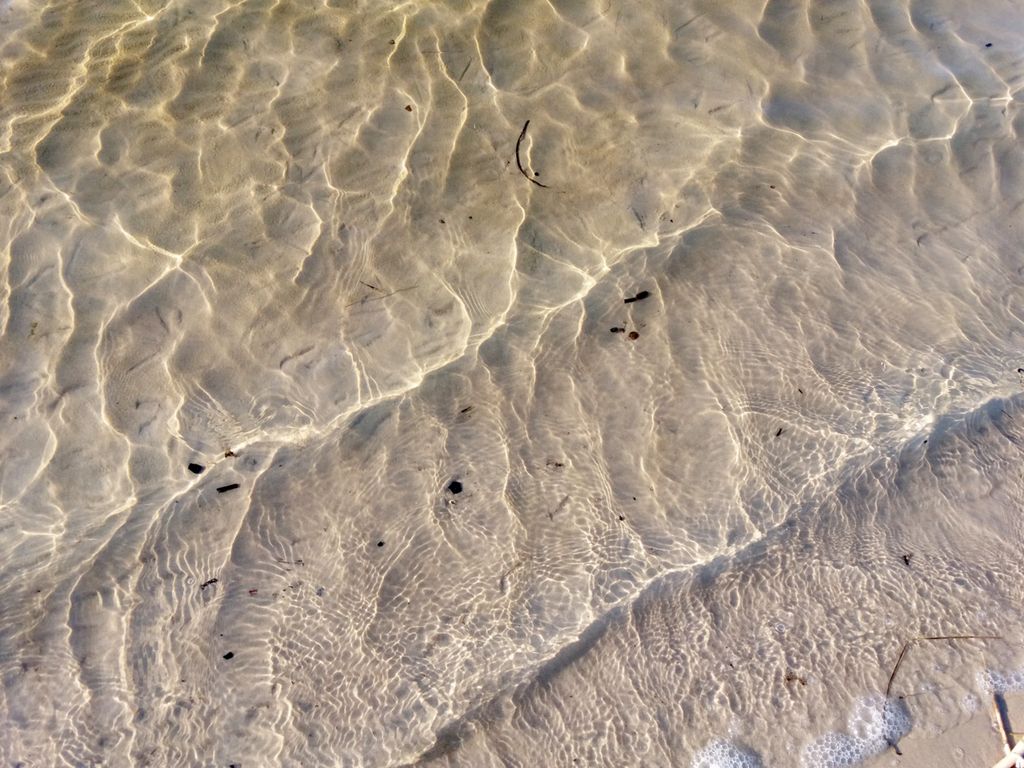
Physical comparison: concentrated patterns of light in shallow water at a beach. Peacelovedeathmetal2 / Wikimedia Commons. Image source. CC BY-SA 4.0. Resized and converted to JPEG; no crop or recolouring. Image derivative retains CC BY-SA 4.0.
Double portraits: people and the spaces between them
From the late 1960s, large double portraits offered another demanding structure. Two figures introduce several relationships at once: between each sitter and the painter, between the sitters, and between their bodies and the room or garden. The paintings often approach the scale of an encounter with actual people. Their breadth gives furniture, objects and empty intervals room to contribute. The setting becomes part of how a portrait works, even when it supplies no definite story about what its occupants are thinking.
Christopher Isherwood and Don Bachardy and American Collectors (Fred and Marcia Weisman), both painted in acrylic in 1968, demonstrate different uses of that structure. Hockney explained that Isherwood habitually looked towards Bachardy when he relaxed, while Bachardy looked towards him, the painter. He retained those different directions of attention in the composition. For the Weismans, he described the surrounding sculptures and the whole setting as part of the portrait. One painting develops from the relation of two gazes; the other extends likeness into an environment of collected objects. [8] [3]
These differences prevent the double portraits from becoming a sequence of interchangeable social documents. In one, the sitters’ habitual behaviour supplies the arrangement. In another, the things around them enlarge the idea of a portrait beyond facial features. The intervals between bodies matter as much as the bodies themselves: the eye must cross them, and in doing so becomes conscious of the painting’s construction. A pair of people is also a problem in composition, with distances, angles and changes of attention that a single head does not require.
Mr and Mrs Clark and Percy (1970–71) took that ambition into an interior whose central light source created a difficult tonal problem. Hockney wanted the presence of two nearly life-size people, the fashion designer Ossie Clark and textile designer Celia Birtwell. His account makes clear how much work lay behind the apparent ease: substantial painting from life, studio sittings, repeated alterations and the struggle to organise tones around the bright opening in the middle. The finished picture’s clarity should not be mistaken for a quick or mechanically photographic procedure. [9]
The technical issue is also a useful way into the painting. A visible source of daylight has to remain convincing within a surface made entirely of paint. The painter must arrange the surrounding tones so that the light appears to illuminate the room and its occupants. Meanwhile, the scale has to hold the two figures together without making them a single compact group. Hockney linked these difficulties to his wish to paint their relationship. That testimony supports attention to the arrangement, while leaving the sitters’ private feelings open. The painting does not need to become a prediction of the couple’s later history. [9]
Portrait of an Artist (Pool with Two Figures) (1972) combines the pool subject with another two-person arrangement. The standing figure and the underwater swimmer appear in different states of visibility: one clothed, upright and outside the water; the other extended within it. Christie’s documented account of the painting’s making traces its origin to an accidental conjunction of photographs, followed by new pool studies in southern France and separate photographs of Peter Schlesinger in London. The scene is a constructed image assembled through repeated decisions, rather than a record of one observed encounter at a Los Angeles pool. [10]
The painting’s coherence depends on making those separate sources work together. It connects a figure viewed through water with another viewed through air, and binds both to the pool’s strict boundaries and the surrounding landscape. The different bodies also extend the early interest in bringing different kinds of representation into one work. Its emotional possibilities remain inseparable from these formal decisions. Knowing the documented process helps us see the labour of joining, arranging and revising that the finished surface makes appear continuous.
The oil painting My Parents (1977) offers a quieter form of doubleness. Laura Hockney sits facing forwards while Kenneth reads, so their attention takes different directions. A reproduction of Piero della Francesca’s The Baptism of Christ also enters its pictorial world, a connection explored by the National Gallery’s 2024 exhibition Hockney and Piero: A Longer Look. Family observation and the observation of paintings meet within the same domestic arrangement. Hockney’s portraits repeatedly make room for both the people he knew and the art through which he continued to think. [11] [12] [13]
Painting after naturalism
The increasing naturalism of the double portraits brought a difficulty of its own. In her account of Hockney’s 1970s transition, Museum of Contemporary Art Tokyo curator Ai Kusumoto describes his growing dissatisfaction with the claim that a geometrically consistent, naturalistic image necessarily came closest to lived experience. She connects the changes that followed with several encounters: concentrated drawing in Paris, renewed attention to Picasso through work with the printer Aldo Crommelynck, theatre, and Japanese and Chinese art. In this reading, the development of multiple viewpoints emerged through interlocking experiences and practices. [14]
Oil paintings continued through this period of reconsideration. Contre-jour in the French Style (1974), Kerby (after Hogarth) Useful Knowledge (1975) and Looking at Pictures on a Screen (1977) take the problems of illumination, representation and looking into their titles. Their place between the large acrylic double portraits and the 1980s landscapes is consequential. The changing practice did not require the figure or the room to disappear. Familiar subjects remained available while the rules for organising them became open to question. [3]
The distinction was between a convincing picture and a complete account of how vision happens. A coherent illusion could still leave out the time spent looking, the movement of the head or the changing attention paid to different objects. Those omissions became productive problems for Hockney. The experience of actual theatrical space and alternative pictorial conventions, in Kusumoto’s account, helped make a stationary view seem one option among others. Painting could reorganise a room or a landscape to acknowledge a more mobile observer. [14]
California seen in motion
The acrylic Mulholland Drive: The Road to the Studio (1980) changes the relation between the viewer and a painted place. More than six metres wide, it organises a journey through Los Angeles into a panoramic field. LACMA describes it as a personalised map based on Hockney’s route from his Hollywood Hills home to his studio on Santa Monica Boulevard. Painted from memory, it alternates identifiable things—houses, trees, tennis courts and power lines—with abstract planes and grids. The road carries the eye across a landscape assembled from different kinds of information. [15]
Such a picture has to convey more than what could be seen through a windscreen at a particular second. A remembered journey includes changing altitude, nearby details, distant districts and turns in the road. Those experiences do not arrive at the eye simultaneously, but painting can bring them together. The broad canvas provides room for a succession of attentions. An area of dense detail and an area of simplified colour need not obey the same descriptive rule to participate in a continuous journey.
LACMA identifies the road’s movement across the upper part of the painting with Hockney’s experience of the ridge route. This gives the composition a directional energy without reducing it to a conventional map. Its colours and changes of pattern also make the surface active in its own right. The landscape is both a place to be travelled and an arrangement through which looking can travel. Memory becomes a method of selecting and connecting, retaining the importance of one feature while compressing another. [15]
The same year’s Nichols Canyon, also in acrylic, belongs to this renewed concentration on California landscape. Its upright format differs sharply from the expansive horizontal field of Mulholland Drive. Even before considering individual motifs, that difference changes the kind of movement a painting can sustain: the eye negotiates ascent and compression within a tall rectangle, while the panorama allows an extended sweep. Format becomes an active part of the subject. A landscape’s size and proportions can guide an experience as decisively as the objects represented inside it. [3]
The reconsideration of space continued indoors. In Large Interior, Los Angeles (1988), oil painting combines with ink on cut-and-pasted paper. The Met connects the room’s fragmented perspective with Cubism and the experience of Chinese scroll paintings, in which looking unfolds across multiple viewpoints and takes time. References to Picasso appear within the pictured interior itself. The living room becomes a place where modern art, the artist’s surroundings and the means of representation can meet, without requiring a single stationary viewing position to explain every part. [16]
This material combination is worth taking literally. Paper and ink enter a painting as physical elements, while the depicted space also contains pictures and objects. Hockney could work on the relationship between a surface and an illusion by changing the construction of the surface itself. Hollywood Hills House (1981–82), recorded as oil, charcoal and collage across three canvases, is another reminder of that material breadth. The presence of collage does not automatically make such a work a photographic joiner. These paintings belong to an expanding practice of painting, even when they share questions with his photography. [3]
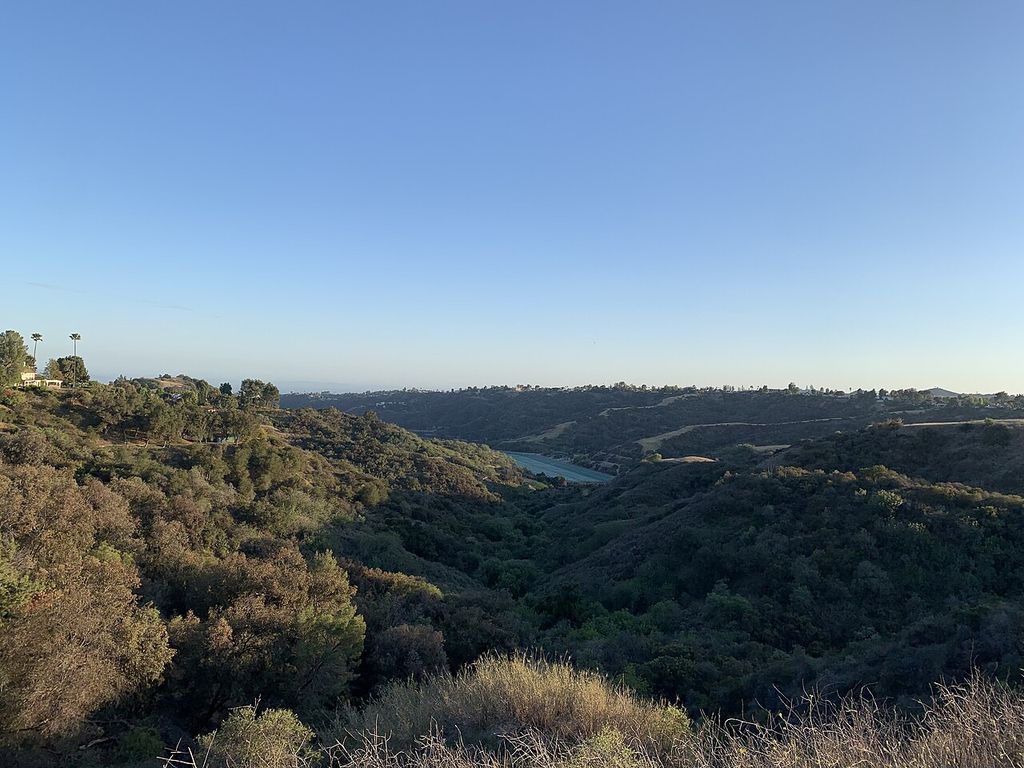
Los Angeles context: Stone Canyon Reservoir and the surrounding hills. DocFreeman24 / Wikimedia Commons. Image source. CC BY-SA 4.0. Resized and converted to JPEG; no crop or recolouring. Image derivative retains CC BY-SA 4.0.
Intimacy, repetition and a return to acrylic
Large landscape experiments coexisted with smaller, more intimate painting. The oils Breakfast at Malibu, Sunday (1989), The Eleventh V. N. Painting and The Twenty Sixth V. N. Painting (both 1992) each measure 24 by 36 inches. Such works complicate any account that sees Hockney’s career as a steady movement towards ever larger pictures. A compact canvas brings the painted object back into close proximity with the viewer. A relatively small format can also hold an ambitious exploration of spatial relationships. [3]
The sea opened another line of enquiry at Malibu. The Tate and Musée Granet guide connects the paintings made at his beach house in the early 1990s with the exploration of deep space, alongside small oil portraits of friends and family. The distinction matters within a practice often associated with enclosed pools. The open sea offered a different spatial subject, while the small portraits maintained a close, bounded encounter with a sitter. Expansive space and intimate scale remained concurrent interests. [4]
In the 2010s, acrylic supported another sustained return to the person in front of the easel. The paintings gathered as 82 Portraits and 1 Still-life were largely made between 2013 and 2016 in the Hollywood Hills studio. LACMA’s account records a consistent 48-by-36-inch canvas, the same yellow chair and a blue ground adjusted in relation to the sitter’s clothing. The sitters were invited rather than commissioned, and each portrait occupied a concentrated period of sitting. This was a deliberately repeated framework within which differences could become visible. [17]
A stable framework changes the work of comparison. When dimensions, chair and general setting recur, the placing of hands, a tilt of the head or the disposition of clothing can register more strongly. The series therefore made continuity a source of variation. Its single still life arose when a sitter rescheduled, according to LACMA, allowing objects to occupy the place temporarily reserved for a person. The shared format connected the genres without making their subjects equivalent. [17]
The garden and interior paintings of the same period also returned to acrylic. The 2015 Garden and Garden with Blue Terrace, followed by A Bigger Interior with Blue Terrace and Interior with Blue Terrace and Garden in 2017, place the relationship between inside and outside directly in their titles. The repetition of a terrace across different arrangements makes a familiar setting available for continued invention. Hockney’s later painting could be serial, domestic and analytical at the same time, without depending on a dramatic new destination. [3]
Yorkshire: memory becomes sustained observation
The renewed Yorkshire landscapes emerged from repeated contact with a familiar region. During Jonathan Silver’s final illness in 1997, Hockney travelled through the countryside between Bridlington and visits to his friend. The Foundation chronology records how those drives prompted a new body of work. His recollection of the journeys also emphasised agricultural change: growing wheat, harvesting and ploughing continually altered the visible surface of the land. The landscape offered both broad vistas and a subject that would be different when he returned. [18]
This combination gave familiarity a practical role. Repeated journeys allow particular turns, groups of trees and fields to become recognisable; they also make alterations easier to notice. A place remembered from childhood was being experienced again through the habits of an artist who had spent decades painting elsewhere. The resulting works carried experience across locations. The California road paintings and the Yorkshire landscapes could share an interest in moving through space even when their climates, vegetation and scale of settlement were very different.
Back in Los Angeles, Hockney continued to paint Yorkshire from memory. Garrowby Hill (1998), an oil painting in the Museum of Fine Arts, Boston, belongs to this phase. Memory allowed the artist to keep working with a route after he had left it: the vividness of a landscape is not proof that it was painted outdoors. The later Going Up Garrowby Hill (2000) returned to the subject in a tall, upright oil painting, changing the format within which the journey could unfold. [19] [20] [3]
The longer Yorkshire engagement of the following decade brought sustained work in front of the landscape. Guggenheim Bilbao’s 2012 survey placed paintings made from 2004 onwards at its centre, alongside drawings, sketchbooks, digital work and video. The presence of different media did not diminish oil painting’s role. They offered complementary ways of attending to a subject, from an individual study to a broad arrangement of canvases. The landscapes increasingly concerned what repeated observation could discover over time. [21]
A Closer Winter Tunnel, February–March (2006) makes that commitment concrete. The Art Gallery of New South Wales’s acquisition account describes Hockney working outdoors with canvases, easels and paints transported in a pick-up truck. The picture comprises six panels, making a substantial encounter with the landscape possible through units that could be handled separately. Its title also registers season and duration. A winter tunnel of trees offered an arrangement of branches and openings that a later stage of growth would alter. The work’s scale depended on a practical method of looking and making. [22]
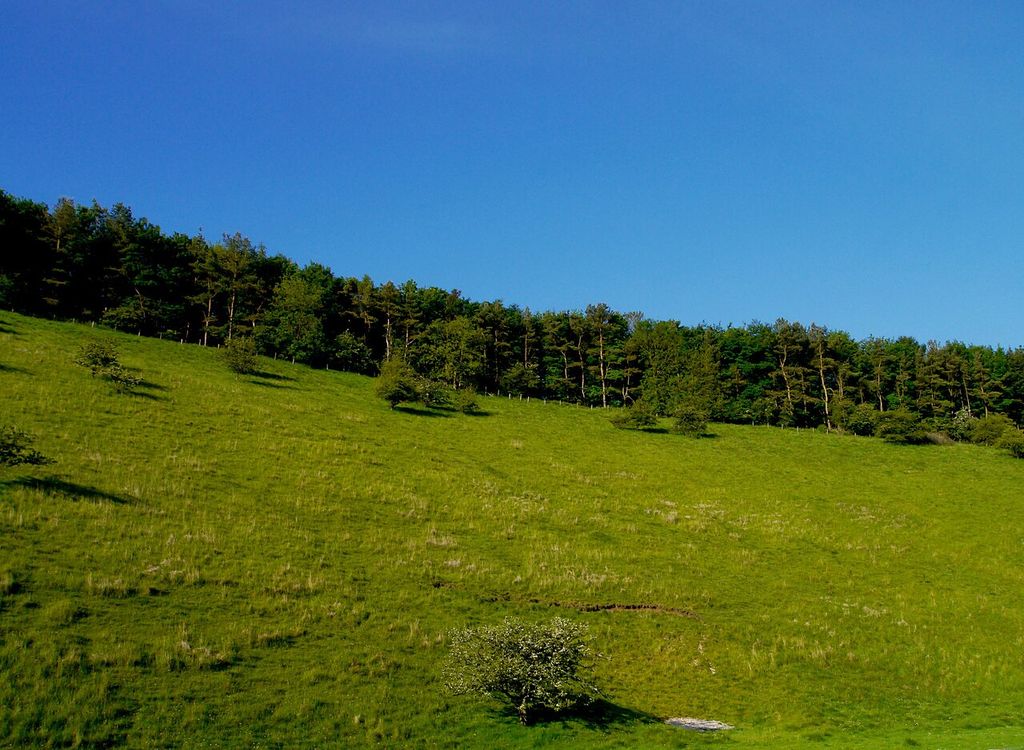
Regional context: the dry chalk valley of Water Dale, near Thixendale in the Yorkshire Wolds. Andy Beecroft / Wikimedia Commons. Image source. CC BY-SA 2.0. Resized and converted to JPEG; no crop or recolouring. Image derivative retains CC BY-SA 2.0.
Building a painting from many canvases
Multiple canvases helped Hockney address a central difficulty of landscape: the discrepancy between the breadth of a place and the limits of a portable rectangle. In A Bigger Grand Canyon (1998), sixty canvases form one painting. The National Gallery of Australia presented it alongside related drawings and photographic collages in its 1999–2000 exhibition Hockney & Stella, making the work’s connections with other kinds of image available for comparison. Within the painting itself, each unit participates in the panorama while the complete field asks for more than a single glance. [23]
The Foundation distinguishes two major canyon paintings from that year. A Bigger Grand Canyon drew on recollection and photographic work, while A Closer Grand Canyon followed a further visit during which Hockney made studies from observation. These are separate works and different processes. The comparison shows that memory, drawing and photography could enter painting in different proportions. A method that served one image did not have to become a rule for the next. The canvas grid provided a structure within which those differences could be developed. [19]
The Yorkshire Bigger Trees near Warter (2007) applied a related capacity for assembly to an outdoor painting on fifty canvases, approximately fifteen feet high and forty feet wide. Hockney described how seeing reproductions of earlier six-canvas paintings arranged together helped him imagine the much larger work. Digital photography enabled him to monitor the developing whole. The technology served the coordination of painted parts: the final object remained oil paint on canvases worked on in the landscape. [24] [25]
Its organisation involved more than enlarging a preliminary image. Hockney’s account describes prolonged looking at the branches and drawings intended to guide the distribution of the composition across its separate canvases. That distinction changes how we understand the work’s size. The painting required decisions about where a branch would continue, how one panel would meet another and how the entire structure would hold together. Its monumentality grew from a sequence of manageable acts, each constrained by the changing outdoor subject. [24]
At this scale, the viewer’s own position becomes more consequential. From a distance the canvases combine into a broad landscape; nearby, the same field exceeds easy inspection and must be explored in parts. The grid makes that relationship available to the eye. A seam may interrupt the illusion of continuous ground or sky, yet it also exposes how continuity has been made. The picture can offer an expansive place and a legible assembly of painted surfaces at once.
Painting the interval between seasons
Yorkshire supplied different kinds of seasonal subject, each asking for a different organisation. Bilbao’s exhibition records The Big Hawthorn (2008) across nine canvases, Winter Timber (2009) across fifteen, and Under the Trees, Bigger (2010–11) across twenty. The differing units matter: multi-canvas painting was a flexible construction method, not a fixed monumental format. The subject could be a flowering tree, worked timber or the experience of being beneath a canopy, with the breadth and arrangement adjusted accordingly. [21]
Seasons also changed what could be seen within a place. Branches exposed in winter could become concealed by leaves; an open interval could thicken into a screen; blossom could briefly dominate an otherwise familiar tree. Such changes gave repeated painting a specific purpose. Returning to the same landscape was a way of encountering different structures, colours and degrees of visibility. The pictures register the instability of a subject that might superficially seem permanent.
The Arrival of Spring in Woldgate, East Yorkshire in 2011 (twenty eleven) brought these questions into a particularly expansive installation. The painting itself is oil on thirty-two canvases. Alongside it, the 2012 Royal Academy presentation included fifty-one selected iPad drawings from more than a hundred Hockney had made. The painted work and the digital sequence had different roles and should not be collapsed into a single medium or object count. They allowed an extended seasonal account and a large painted statement to be encountered together. [26]
Hockney’s description of the painting concentrated on the moment when early leaves begin to appear low on the trees and seem to float before full growth obscures the branches. This is a precise choice within the season. Spring did not simply provide a general emblem of renewal; it offered a temporary relationship between leaves, branches and open space. Painting could hold that interval at a scale larger than an individual study, while the accompanying drawings tracked successive changes. The two forms made time visible in different ways. [26]
Normandy and the late London paintings
Normandy continued the seasonal enquiry while giving acrylic painting fresh company. The Fondation Louis Vuitton’s account of its 2025 survey distinguishes the entirely digital 220 for 2020 from a separate group of acrylic landscapes, noting the animated touches with which Hockney treated their skies. It also identifies La Grande Cour (2019) as a panorama of twenty-four ink drawings. These distinctions preserve the particular work each medium was doing. A broad landscape could be drawn in ink, painted on a screen or developed in acrylic without becoming the same kind of object. [25]
The Normandy paintings also extended an art-historical conversation that had accompanied Hockney since the beginning. The 2025 survey placed recent works beside his engagement with painters including Claude, Cézanne, Van Gogh and Picasso. Its final London section included After Munch: Less is Known than People Think (2023) and After Blake: Less is Known than People Think (2024). The titles declare that looking at another artist could still lead to a new painting, across a very different interval from the early encounter with Picasso. [25]
The Foundation’s account of the 2024 Rouen exhibition likewise stresses the continued presence of painting on canvas alongside digital work. Its record identifies Giverny by DH (2023) as acrylic on canvas. Painting was still available for the landscape, just as it remained available for portraiture and the domestic interior. The later history is therefore a story of media accumulating and interacting. A device acquired for one task did not require the abandonment of tools already capable of producing another experience. [27]
In London during 2025, Hockney pursued reverse perspective in a new group of paintings. The Foundation’s chronology connects the pictures made in his studio that year with Some Very, Very, Very New Paintings Not Yet Shown in Paris at Annely Juda Fine Art. The gallery’s publication record identifies both Gauguin’s Chair and Vincent’s Chair, July 2025 and The Moon, August 25th, 2023 as acrylics on canvas. Chairs, the sky and inherited artistic subjects continued to provide concrete occasions for experiments with a painted rectangle. [28] [29]
The paintings presented at Serpentine in 2026 introduced another controlled comparison. Five portraits of people in Hockney’s close circle accompanied five still lifes, united by frontal compositions and the recurring setting of a gingham tablecloth. Abstraction Resting on a Red and White Checkered Tablecloth (2025) makes the relationship between abstract and figurative representation explicit in its title. An abstract arrangement can itself become something represented within a still life. The tablecloth gives different subjects a common pictorial stage. [30]
Serpentine paired these paintings with the separate digital frieze A Year in Normandie (2020–21). The juxtaposition made the continuity of Hockney’s interests clear without erasing differences of material, scale or construction. Painted faces and objects occupied discrete canvases; the seasonal work unfolded as an extended digitally made panorama. Both asked the viewer to attend to a representation, yet they organised that attention differently. His final years of work retained the freedom to place such distinct propositions beside one another. [30]
Following the paintings across the wider work
The most revealing comparisons cross the familiar divisions of Hockney’s career. The coded pair in Adhesiveness, the life-size double portraits and the repeated chair of the later portrait series all ask how people can be brought into a picture. The pools, California roads and Yorkshire woods ask how a surface can suggest something that changes as it is seen. Handwriting, a reflection line, a panel seam and a repeated tablecloth make the means of depiction available for inspection.
Hockney’s paintings reward attention to those means as well as to their subjects. Oil and acrylic, a narrow upright canvas and a panoramic assembly, direct observation and a remembered journey each offer different possibilities. His practice kept those possibilities open. Following a particular painting into its materials, format and process reveals a body of work whose recognisable places and people sustained a remarkably varied investigation of what painting could make visible.
Works directory
This source-bounded directory combines the works in the Metropolitan Museum’s 2017 retrospective checklist with reviewed museum object records and the additional works and series examined in this guide. It spans several media and is not a complete catalogue raisonné. Titles without an article link remain useful dated records. Metropolitan Museum final retrospective checklist (2017); additional object and series sources are given in the linked articles. [3]
| Name | Date | Medium |
|---|---|---|
| Love Painting | 1960 | Painting |
| Shame | 1960 | Painting |
| The Third Love Painting | 1960 | Painting |
| Tyger Painting No. 2 | 1960 | Painting |
| A Rake’s Progress | 1961–63 | Print series |
| Tea Painting in an Illusionistic Style | 1961 | Painting |
| The Cha-Cha That Was Danced in the Early Hours of 24th March | 1961 | Painting |
| Cleaning Teeth, Early Evening (10pm) W11 | 1962 | Painting |
| Flight into Italy - Swiss Landscape (Painting in a Scenic Style) | 1962 | Painting |
| Man in a Museum (or You're in the Wrong Movie) | 1962 | Painting |
| My Brother is Only Seventeen | 1962 | Painting |
| The First Marriage (A Marriage of Styles I) | 1962 | Painting |
| Domestic Scene, Los Angeles | 1963 | Painting |
| Play Within a Play | 1963 | Painting |
| The Hypnotist | 1963 | Painting |
| Arizona | 1964 | Painting |
| California Art Collector | 1964 | Painting |
| Man in Shower in Beverly Hills | 1964 | Painting |
| Portrait Surrounded by Artistic Devices | 1965 | Painting |
| Rocky Mountains and Tired Indians | 1965 | Painting |
| Beverly Hills Housewife | 1966–67 | Painting |
| Medical Building | 1966 | Painting |
| Peter | 1966 | Drawing |
| Peter Getting Out of Nick’s Pool | 1966 | Painting |
| A Bigger Splash | 1967 | Painting |
| A Lawn Being Sprinkled | 1967 | Painting |
| Kasmin in Bed in His Chateau in Carennac | 1967 | Drawing |
| Peter Feeling Not Too Good | 1967 | Drawing |
| Savings and Loan Building | 1967 | Painting |
| The Room, Tarzana | 1967 | Painting |
| American Collectors (Fred and Marcia Weisman) | 1968 | Painting |
| Christopher Isherwood and Don Bachardy | 1968 | Painting |
| Henry Geldzahler and Christopher Scott | 1968-1969 | Painting |
| W. H. Auden | 1968 | Drawing |
| Peter Langan in His Kitchen at Odins | 1969 | Drawing |
| Mark Glazebrook | 1970 | Drawing |
| Mr and Mrs Clark and Percy | 1970-1971 | Painting |
| Ossie Wearing a Fairisle Sweater | 1970 | Drawing |
| Pool and Steps, Le Nid du Duc | 1971 | Painting |
| Rubber Ring Floating in a Swimming Pool | 1971 | Painting |
| Celia in a Black Dress with White Flowers | 1972 | Drawing |
| Mount Fuji and Flowers | 1972 | Painting |
| Portrait of an Artist (Pool with Two Figures) | 1972 | Painting |
| Portrait of the Artist's Mother, Mrs Laura Hockney, Bradford | 1972 | Drawing |
| The Artist's Father | 1972 | Drawing |
| Dr Eugene Lamb, Lucca | 1973 | Drawing |
| Andy, Paris | 1974 | Drawing |
| Contre-jour in the French Style (Against the Day dans le Style-Français) | 1974 | Painting |
| Gregory Sitting on Base of Column | 1975 | Drawing |
| Kerby (after Hogarth) Useful Knowledge | 1975 | Painting |
| Ron Kitaj Outside Akademie der Kunste Vienna | 1975 | Drawing |
| Kasmin Reading the Udaipur Guide | 1977 | Drawing |
| Looking at Pictures on a Screen | 1977 | Painting |
| My Parents | 1977 | Painting |
| Canyon Painting | 1978 | Painting |
| Mother, Bradford, 19 Feb. 1979 (inscribed 1978) | 1979 | Drawing |
| Mulholland Drive: The Road to the Studio | 1980 | Painting |
| Nichols Canyon | 1980 | Painting |
| Outpost Drive, Hollywood | 1980 | Painting |
| Hollywood Hills House | 1981-1982 | Painting |
| Celia. Los Angeles. April 10th 1982 | 1982 | Polaroid composite |
| Don + Christopher, Los Angeles, 6th March 1982 | 1982 | Polaroid composite |
| Gregory Swimming Los Angeles March 31st 1982 | 1982 | Polaroid composite |
| My Mother, Bolton Abbey, Yorkshire, Nov. 1982 | 1982 | Photocollage |
| Self Portrait 30th Sept. 1983 | 1983 | Drawing |
| Pearblossom Hwy., 11-18th April 1986, #1 | 1986 | Photocollage |
| Pearblossom Hwy., 11–18th April 1986, #2 | 1986 | Photocollage |
| Large Interior, Los Angeles | 1988 | Painting |
| Breakfast at Malibu, Sunday, 1989 | 1989 | Painting |
| Pacific Coast Highway and Santa Monica | 1990 | Painting |
| The Other Side | 1991-1993 | Painting |
| The Eleventh V. N. Painting | 1992 | Painting |
| The Twenty Sixth V. N. Painting | 1992 | Painting |
| The Road Across the Wolds | 1997 | Painting |
| 9 Canvas Study of the Grand Canyon | 1998 | Painting |
| A Bigger Grand Canyon | 1998 | Painting |
| Colorado River | 1998 | Painting |
| Garrowby Hill | 1998 | Painting |
| Colin St. John Wilson. London. 3rd June 1999 | 1999 | Drawing |
| Gregory Evans. Los Angeles. 18th September 1999 | 1999 | Drawing |
| Laura Huston. London. 22nd June 1999 | 1999 | Drawing |
| Lindy. Marchioness of Dufferin and Ava. London. 17th June | 1999 | Painting |
| Going Up Garrowby Hill | 2000 | Painting |
| Red Pots in the Garden | 2000 | Painting |
| A Closer Winter Tunnel, February - March | 2006 | Painting |
| Elderflower Blossom, Kilham, July 2006 | 2006 | Painting |
| The Road to Thwing, July 2006 | 2006 | Painting |
| Bigger Trees near Warter | 2007 | Painting |
| Hawthorn Blossom near Rudston | 2008 | Painting |
| Views Through the Artist's Bedroom Window, Bridlington | 2010-2013 | Digital animation |
| The Arrival of Spring in Woldgate, East Yorkshire in 2011 (twenty eleven) | 2011 | Painting / digital series |
| 82 Portraits and 1 Still-life | 2013–16 | Portrait series |
| Garden | 2015 | Painting |
| Garden with Blue Terrace | 2015 | Painting |
| Garden #3 | 2016 | Painting |
| A Bigger Interior with Blue Terrace | 2017 | Painting |
| Interior with Blue Terrace and Garden | 2017 | Painting |
| A Year in Normandie | 2020–21 | Digital frieze |
Discussion
Look again at the images and ideas explored in David Hockney Paintings. These editorial prompts invite your observations.
Reader Insights
Which painting most clearly makes you notice the difference between a convincing scene and its constructed surface?
How does Hockney’s use of colour change between the California pools and the Yorkshire landscapes?
What does comparing a single canvas with a multi-canvas painting reveal about scale and looking?
Join the Conversation
Share a detail, comparison or question about David Hockney Paintings below.
References
- The Metropolitan Museum of Art, David Hockney, retrospective exhibition overview, 2017–18. View source.
- The David Hockney Foundation, 1960, sections on the Royal College of Art, Picasso, Whitman and the love paintings. View source.
- The Metropolitan Museum of Art, David Hockney: Final Checklist, 15 November 2017, PDF pp. 2–19. View source.
- Tate and Musée Granet, David Hockney: Works from the Tate Collection, exhibition press pack, 2023, room guide pp. 8–19, especially p. 9. View source.
- The David Hockney Foundation, 1964, “Move to L.A.” and “Landscapes and swimming pools”. View source.
- Matthew Sperling, “Water Marks: The Pull of Hockney’s Pool Paintings”, Apollo, February 2017, pp. 52–58; relevant pool discussion pp. 52–55, accessed as a UCL repository proof. View source.
- The David Hockney Foundation, 1967, “Infatuated with L.A.” and “A Bigger Splash”. View source.
- The David Hockney Foundation, 1968, “Double-portraits”. View source.
- The David Hockney Foundation, 1971, “Mr. and Mrs. Clark and Percy”. View source.
- Christie’s, David Hockney, Portrait of an Artist (Pool with Two Figures), lot record and essay, sale of 15 November 2018. View source.
- The David Hockney Foundation, My Parents, 1977, artwork record. View source.
- Tate, David Hockney: My Parents, exhibition-print description, including the artist’s account of the sitters. View source.
- The National Gallery, London, Hockney and Piero: A Longer Look, exhibition account, 8 August–27 October 2024. View source.
- Ai Kusumoto, interviewed by Tamaki Sugihara, “混迷から新境地へ。巨匠ホックニーが喜びに満ちた作品に辿り着くまで” [From uncertainty to new ground: Hockney’s path to joyful work], Tokyo Art Beat, 22 September 2023, opening discussion of naturalism and spatial change. View source.
- Los Angeles County Museum of Art, Mulholland Drive: The Road to the Studio, 1980, collection record and curatorial notes. View source.
- The Metropolitan Museum of Art, Large Interior, Los Angeles, 1988, collection record and curatorial description. View source.
- Los Angeles County Museum of Art, “Opening This Week! David Hockney: 82 Portraits and 1 Still-life”, Unframed, 9 April 2018. View source.
- The David Hockney Foundation, 1997, “Visiting Jonathan Silver”. View source.
- The David Hockney Foundation, 1998, “Painting distant landscapes” and “A Closer Grand Canyon”. View source.
- The David Hockney Foundation, Garrowby Hill, 1998, artwork record. View source.
- Guggenheim Bilbao, David Hockney: una visión más amplia, exhibition introduction and selected-work records, 15 May–30 September 2012. View source.
- Art Gallery of New South Wales, “David Hockney acquisition”, 17 September 2007, account of A Closer Winter Tunnel. View source.
- National Gallery of Australia, Hockney & Stella: Masterworks in Paint and Print, exhibition account, 12 October 1999–26 January 2000. View source.
- The David Hockney Foundation, 2007, “Making Bigger Trees” and the artist’s account of planning the painting. View source.
- Fondation Louis Vuitton, David Hockney 25, exhibition introduction and thematic account, 2025. View source.
- The David Hockney Foundation, 2011, “The Arrival of Spring in 2011”. View source.
- The David Hockney Foundation, 2024, Rouen exhibition and Giverny by DH record. View source.
- The David Hockney Foundation, 2025, account of the late London paintings. View source.
- Annely Juda Fine Art, David Hockney: Some Very, Very, Very New Paintings Not Yet Shown in Paris, publication record and cover-work metadata, 2025. View source.
- Serpentine, David Hockney: A Year in Normandie and Some Other Thoughts about Painting, press release, 9 February 2026, PDF pp. 1–2. View source.
More HOCKNEY Works
A Bigger Splash
A momentary disturbance becomes the focus of a large acrylic painting, made through weeks of patient work.
Mr and Mrs Clark and Percy
The designers Celia Birtwell and Ossie Clark occupy a room shaped by light, repeated sittings and the demands of a double portrait.
A Bigger Grand Canyon
Sixty canvases gather memory, studies and changing viewpoints into an immense painting of 1998.
Garrowby Hill
The 1998 oil painting transforms a remembered Yorkshire journey into a road, fields and an expansive view.
Portrait of an Artist (Pool with Two Figures)
Photographic studies, two figures and a swimming pool become a carefully constructed painting of 1972.
My Parents
The 1977 oil painting sets Kenneth and Laura Hockney within a quietly organised interior.
Pearblossom Hwy., 11–18th April 1986, #2
Hundreds of separately made photographs construct a road scene that unfolds through movement and time.
Bigger Trees near Warter
Fifty canvases join into a large outdoor painting of Yorkshire trees, with photography helping the artist organise the whole.