


 by Tom Gurney
Tom Gurney BSc (Hons) is an art history expert with over 20 years experience
Email: tomgurney1@gmail.com / Phone: +44 7429 011000
Portrait of an Artist (Pool with Two Figures): Introduction
A man in a pink jacket stands beside a swimming pool, looking down at a swimmer moving beneath the surface. Behind them, wooded hills rise into the distance. The scene is bright and spacious, but its two people occupy strikingly different worlds: one upright, clothed and sharply outlined; the other horizontal, almost submerged in patterns of light. David Hockney’s Portrait of an Artist (Pool with Two Figures), completed in 1972, brings the intimacy of portraiture into the shifting visual conditions of water. [1]
The standing figure is the artist Peter Schlesinger, Hockney’s former partner. That relationship matters, yet the painting also grew from a problem that fascinated Hockney independently of biography: how could two figures, represented differently, inhabit a convincing pictorial space? Its apparently effortless sunlit scene required an abandoned composition, a fresh photographic campaign in France, further photographs in London and an intense final period of work. Following that process reveals how much invention lies within this seemingly straightforward encounter. [1]
At a Glance
- ArtistDavid Hockney
- TitlePortrait of an Artist (Pool with Two Figures)
- Date1972
- Medium and formatAcrylic on canvas; approximately 213.4 × 304.8 cm
- CollectionPrivate collection
This work across David Hockney’s career
A Rake’s Progress
1961–63 [2]A Bigger Splash
1967 [2]Mr and Mrs Clark and Percy
1970–71 [2]My Parents
1977 [2]Garrowby Hill
1998 [2]A Year in Normandie
2020–21 [3]Contents
- A large painting of a small encounter
- Two snapshots suggest a subject
- Why the first version failed
- A French pool and a new photographic campaign
- Schlesinger’s return to the picture
- Edges, hills and the direction of looking
- Water as depth, pattern and light
- Whose portrait is it?
- The final rush and the first audience
- The painting and the films
A large painting of a small encounter
Painted in acrylic on canvas, Portrait of an Artist measures approximately 213.4 × 304.8 centimetres: seven feet high and ten feet wide. Its breadth gives the pool, terrace and hills room to establish themselves around the figures. At this scale, an ordinary act of looking becomes something a spectator can encounter bodily, across a substantial expanse of wall. The measurements recorded for the Fondation Louis Vuitton’s 2025 exhibition corroborate the familiar seven-by-ten-foot format. [4]
The medium is important to the picture’s appearance. Relatively even areas of colour can sit beside small, distinct marks without either losing its identity. The pool reads as a broad blue field while its light patterns remain visibly drawn in paint. Elsewhere, a jacket, a paved edge and wooded slopes ask for different kinds of description. Hockney coordinated these passages without making their surfaces uniformly detailed. Christie’s catalogue discussion draws attention to the rectilinear foreground, simplified planes and stylised water lines: the scene’s naturalistic effect depends on selective artifice. [1]
Its size also changes the force of the standing man’s downward attention. Schlesinger is one person within a large landscape, yet his gaze gives the surrounding space a point of concentration. The water offers abundant visual incident; his stillness helps us find a way into it. A swimmer’s passing movement and a spectator’s sustained attention become the picture’s two complementary activities.
Two snapshots suggest a subject
Hockney traced the original idea to two photographs lying beside one another on his studio floor. One showed a swimmer underwater, distorted by the water, in a photograph taken in Hollywood in 1966. The other showed a young man looking towards something on the ground. Their accidental arrangement made the second figure appear to be looking at the first. Hockney began exploring the composition in the autumn of 1971. His account, reproduced in Christie’s lot essay, makes clear that the apparent relationship arose between images before it became an event in a painting. [1]
This was a fertile accident because it supplied both a human situation and a formal contrast. Looking downward and swimming underwater could be joined by a line of attention. At the same time, the swimmer’s disrupted appearance could be set against the comparatively stable appearance of someone standing in air. Hockney recalled the attraction of painting “two figures in different styles”. The difference was present in the photographs, but he recognised its potential as a way of organising a canvas. [1]
The initial encounter generated the subject; later photographic sessions helped Hockney construct its setting, light and figures. This sequence matters when considering his use of photography. The camera participated in a series of decisions, supplying material that had never existed as one scene before one lens.
Why the first version failed
The first composition occupied Hockney for months. His recollection, preserved by the David Hockney Foundation, describes figures that failed to relate convincingly to one another or to their surroundings. He tried distant mountains, a confining wall and even a glass wall. These were substantial changes to the conditions of the encounter: an open view could make the figures seem exposed, while an enclosing wall compressed the space around them. Altering the backdrop, however, failed to solve the underlying problem. [5]
Hockney eventually identified the angle of the pool as the difficulty. He had invested so much work in its water that he could neither adjust that passage satisfactorily nor build the rest of the picture around it. His testimony describes the reluctance to abandon months of labour, followed by the decision to repaint the composition completely. The serene arrangement of the surviving work was achieved through this recognition that its spatial foundation needed replacing. [5]
That account gives the pool edge unusual significance. A diagonal that might initially look like a simple device for showing recession had to establish believable relationships between water, body, paving and background. The swimmer needed to seem beneath a surface while the standing man remained securely beside it. If that geometry failed, extra detail could not rescue the encounter. Hockney’s changes of background show him testing the whole pictorial environment, even while the decisive difficulty lay nearer the front.
The final painting belongs to 1972, although its conception and the unsuccessful first version belong to the preceding period. The celebrated burst of finishing came after months of experiment and sustained uncertainty. [1] [5]
A French pool and a new photographic campaign
For the renewed composition, Hockney went to the film director Tony Richardson’s property, Le Nid du Duc, in southern France. Matthew Sperling locates the setting near Saint-Tropez in his study of Hockney’s pool imagery. The wooded hills consequently belong to a different geography from the Los Angeles houses and gardens with which the artist’s pools are often associated. His California paintings had established the motif’s importance, but the 1972 picture carries that continuing interest into a French landscape. [1] [6]
Hockney travelled with his assistant Mo McDermott and the young photographer John St Clair. McDermott stood beside the pool as a substitute for Schlesinger; St Clair supplied the swimming figure. According to the detailed account in Christie’s essay, Hockney used a Pentax camera to make hundreds of photographs, varying the time of day and the swimmer’s speed. The sitting was an experiment in how a body would appear through moving water under particular light. [1]
The swimmer’s identity needs this practical precision. St Clair’s role in making the studies is documented. It does not establish that the painted swimmer represents a particular rival or a new lover. A person who helped create a visual effect and a character assigned a role by later interpretation are different propositions. The photographs explain where Hockney found the body’s pose and distortions; they leave the encounter’s narrative open.
Back in London, the photographs covered Hockney’s studio wall. Their abundance gave him choices among variations in light, bodily position and water, while the new canvas required one coherent arrangement. The hills and pool thus reached the painting through selection and construction. The viewer meets a unified scene; the painter had worked among many partial records of it. [1]
Schlesinger’s return to the picture
The substitute standing figure did not satisfy Hockney. He photographed Schlesinger himself in Kensington Gardens, arranging the pose and lighting to correspond with the French studies. Schlesinger wore the pink jacket that became such a prominent element of the painting. Christie’s account describes a photographic composite of his figure assembled from five sections, another small act of construction within the larger assembly of the scene. [1]
Hockney had met Schlesinger in 1966 while teaching at UCLA. They became partners and lived together in California and London before their relationship ended in 1971. Schlesinger was also an artist, an essential fact when considering a title that identifies an artist without naming him. Hockney’s earlier Peter Getting Out of Nick’s Pool offers another point of contact between this particular person and the pool subject. [1]
By the time he finished the 1972 picture, Hockney was working through the aftermath of the separation. The Foundation’s 1971 chronology describes Schlesinger leaving their Powis Terrace home and Hockney immersing himself in prolonged studio work. The picture emerged among other works from this unusually concentrated period, including Pool and Steps, Le Nid du Duc and Still Life on a Glass Table. [7]
Yet Schlesinger’s participation in the later photographs is a further event within this history. The canvas’s practical needs brought him back as a sitter after the partnership had ended. His likeness was something Hockney wanted to secure through another encounter with the actual person. The resulting standing figure combines personal recognition with a carefully specified pictorial task: he must hold his place, his pose and his gaze within a scene assembled elsewhere.
Edges, hills and the direction of looking
The composition’s most immediate contrast is between the upright man and the swimmer’s horizontal body. Schlesinger’s pink jacket separates him from the greens behind him, while the pale terrace distinguishes his feet from the water. The swimmer, in white trunks, moves in breaststroke beneath the blue and its broken patterns. Sperling identifies the contrast between the submerged swimmer and the fully dressed standing figure; Christie’s formal discussion emphasises the strong geometry that holds them together. [6] [1]
Looking travels across the boundary that the bodies do not cross. Schlesinger’s lowered head directs attention towards the swimmer, but their eyes do not meet. The space between them therefore has an active role. The pool edge gives it a hard architectural definition; the water makes the swimmer’s position harder to judge. We can follow a direction of attention without receiving an answering gesture or an explanatory exchange.
The landscape establishes another order of space. Wooded slopes rise beyond the terrace and overlap as they recede. Against those irregular masses, the pool’s straight edges make an emphatically human geometry. The scene alternates between rounded landforms and measured construction, between distances that unfold through successive hills and a foreground organised by decisive lines. This combination offers a modern setting for the old subject of a bather in a landscape. [1]
Christopher Knight’s interpretation, reproduced by Christie’s, places Hockney’s pools within the pastoral tradition: images of an ideal setting, removed from the pressures of ordinary history. A secluded pool and uninterrupted hills make that association understandable here. The two men seem to have a world to themselves, with no visible work or public activity surrounding them. Yet the pool is also a built enclosure within that landscape. The picture holds the openness of a distant view beside the precise boundaries of a private, cultivated space. Knight’s reading draws attention to the ideal’s appeal while leaving room for the human uncertainties within it. [1]
The viewpoint lets us look down into the pool while also seeing the hills beyond it. This double demand is central to the painting’s spaciousness. The water needs sufficient visible area for its pattern and submerged body; the background needs room to register as a world extending beyond the immediate incident. The standing figure connects those scales. His head belongs against the landscape, his feet to the terrace, and his attention to the pool.
Hockney had described his naturalistic work of around 1969–72 as a search for lucid space, expressing admiration for the spatial clarity of Piero della Francesca. The Foundation reproduces this recollection alongside the difficulties of George Lawson and Wayne Sleep. It helps explain the ambition of Portrait of an Artist: apparent ease of reading could itself be a hard-won artistic achievement. [5]
Water as depth, pattern and light
Water gave Hockney a subject without a fixed visual vocabulary. Sperling’s account follows his changes from irregular coloured patches to white, wavering lines and other solutions across the pool paintings. A body in water introduced an additional difficulty: the figure’s appearance could change while the body itself remained physically continuous. In Portrait of an Artist, the swimmer is recognisable through distortions that also loosen the connection between ordinary anatomy and the painted marks. [6]
The blue offers a broad field on which light can become a network of lines. Those lines help us believe in the water, but they also bring attention to the flat surface carrying the illusion. Looking shifts between a swimmer under water and coloured forms placed on canvas. That movement is especially effective beside Schlesinger’s more stable outline. The two figures remain part of one setting while asking us to accept different degrees of visual disruption. [1]
Hockney later explained his interest through the behaviour of lines painted on the bottom of a pool. Seen through still water they remained steady; disturbance made them appear to wriggle when viewed from above. Looking from beneath the surface changed that appearance again. His account, reproduced in Christie’s catalogue from Lawrence Weschler’s conversation with him, shows how closely he distinguished an object from the changing conditions through which it is seen. [1]
Reflections, transparency and the bending of light can all complicate what a spectator sees in water. The painting turns that instability into a designed pattern, sufficiently regular to hold the blue area together and sufficiently broken to suggest movement. Its marks need not document every fleeting optical effect to make the water persuasive. Selection gives the surface a rhythm that a momentary view would never hold still for inspection.
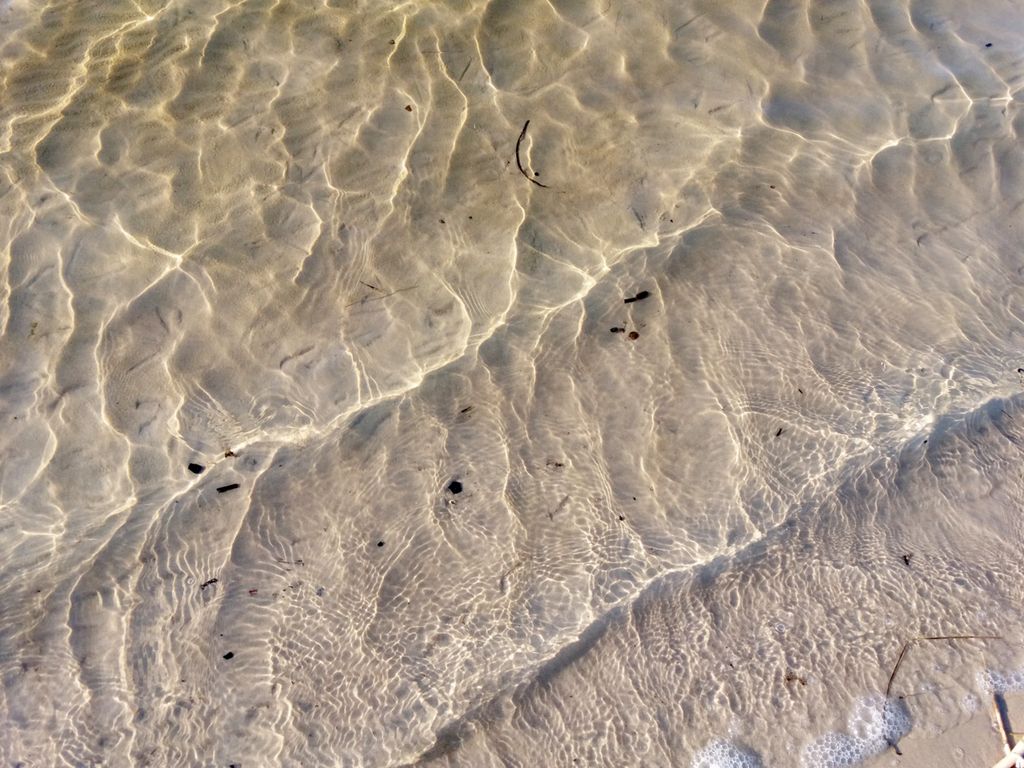
Physical comparison: concentrated patterns of light in shallow water at a beach. Peacelovedeathmetal2 / Wikimedia Commons. Image source. CC BY-SA 4.0. Resized and converted to JPEG; no crop or recolouring. Image derivative retains CC BY-SA 4.0.
This differs from the central action of A Bigger Splash, where displaced water advertises a diver who has disappeared beneath it. Here the human body remains visible, and another person watches. The water mediates their relationship while occupying a substantial portion of the canvas in its own right. Sperling treats the pool as a continuing site of technical experiment across Hockney’s media; the 1972 painting is one particularly concentrated meeting of bodily subject and pictorial problem. [6]
Whose portrait is it?
The title directs attention to an artist, but the picture includes no easel, brushes or studio. Schlesinger’s identity makes one answer available: he is an artist portrayed at the poolside. Another reading considers Hockney’s own presence through the subject he had made so closely associated with his work. In Christopher Knight’s interpretation, reproduced by Christie’s, the pool can function as a picture within the picture, and the standing figure becomes a spectator facing something beautiful that remains beyond his immediate reach. [1]
This reading finds support in the composition’s structure. The man is outside the pool, looking into an area that differs markedly from his surroundings. His act resembles our own attention to an image: he can inspect it without occupying the swimmer’s position. Calling this a portrait of a spectator expands the title’s possibilities without requiring Hockney to be secretly represented by a particular body.
The painting also occupies a distinctive place among Hockney’s portraits. Two visible people do not automatically make a conventional portrait of a couple. One has an identifiable likeness and a documented personal history with the painter; the other is partly transformed by water and performs an action. Their shared space contains an asymmetry of recognition. We know much more about the standing figure, while the submerged one remains available to perception before biography.
Christie’s essay quotes Marco Livingstone and Kay Heymer reading the swimmer’s approach as an acknowledgement of lost love and a desire for a new partner. That is an interpretation of the image within the breakup’s history. It is more specific than anything demonstrated by the swimmer’s pose alone. The documented separation gives the scene emotional resonance, but a lowered head cannot establish a private thought, and water cannot assign a relationship to the man within it. [1]
The picture can feel absorbed, distant, intimate or melancholy without becoming a diagram of one feeling. Two bodies share a sunlit setting, occupy different physical conditions and fail to exchange a gaze. Hockney made those differences clear enough for attention to linger on them.
The final rush and the first audience
For the last campaign, Christie’s account reports working days of up to eighteen hours over roughly two weeks. Hockney’s own recollection, reproduced by the Foundation, describes completing the painting on the night before dispatch, varnishing it and rising early to roll it for transport. It reached New York in time for Paintings and Drawings at the André Emmerich Gallery, held from 13 to 31 May 1972. The scale that now feels so integral to the encounter also made the finished canvas a substantial object to prepare and ship. [1] [5]
Hockney remembered that final intensity with pleasure. In the recollection quoted by Christie’s from Peter Webb’s account, he described loving the work and finding it thrilling. Sustained concentration could itself bring excitement. His recollection gives the bright, lucid result a history of absorbed, pleasurable effort as well as personal loss. [1]
Contemporary responses to the exhibition considered Hockney’s controlled naturalism alongside his celebrity and Pop Art reputation. Reviewing the show in Time on 29 May 1972, Robert Hughes distinguished the serious painter from the conspicuous public personality. He admired the control of Hockney’s talent and examined the unsettling stillness of works including Still Life (Glass Table) and French Shop. His review concerns the exhibition as a whole; it does not supply a specific judgement on Portrait of an Artist. [8]
Hughes’s response is nevertheless useful context. He found precision and deliberation beneath images that appeared unusually straightforward. The relation he noticed between stillness and strangeness offers a contemporary way of approaching this poolside scene, before its subsequent life as an auction headline. James R. Mellow, in the passage from his New York Times review preserved by the Foundation, likewise considered Hockney’s awareness of fashionable society and changing artistic styles. Early viewers encountered the work among questions about naturalism, Pop and the painter’s public persona. [8] [5]
The painting and the films
Jack Hazan’s A Bigger Splash helped bind the making of Portrait of an Artist to the story of Hockney and Schlesinger. The Centre Pompidou dates the film’s production to 1973 and its appearance on cinema screens to 1974; the British Film Institute also catalogues it as a 1974 film. Its title comes from Hockney’s separate painting of 1967, while the struggle over the 1972 double-figure composition supplies a central part of its narrative. [9] [10]
The film shaped an account of these events. In his 1975 review, republished by the BFI, Philip French described the participants acting out their lives under Hazan’s direction. He observed a relationship between the film’s formal organisation and Hockney’s paintings, and discussed how technical problems could serve its emotional narrative. This contemporary reading helps explain the film’s fascination while preserving a distinction between a constructed screen story and evidence for what every gesture in the canvas means. [11]
Sperling identifies a more direct visual afterlife in Pedro Almodóvar’s Bad Education of 2004. Its staged poolside images allude to Hockney’s compositions, including Portrait of an Artist and Peter Getting Out of Nick’s Pool, within a setting near Madrid. Transferring such arrangements into moving images changes their circumstances and narrative. What travels is a recognisable relationship between bodies, architecture and water, available to another filmmaker’s purposes. [6]
The title acquired another cinematic life with Luca Guadagnino’s A Bigger Splash in 2015. Sperling discusses that film as a loose reworking of La Piscine, with a poolside drama relocated to Sicily. It is a later use of the title and its associations, separate from Hazan’s film about Hockney’s circle. The recurrence shows how readily a pool can become a setting for looking, desire and uncertainty; the particular history of the 1972 painting remains its own. [6]
Exhibitions, collecting and the 2018 sale
The painting’s exhibition history extends well beyond its hurried departure for New York. Christie’s recorded its inclusion in the 1974 Paris survey at the Musée des Arts décoratifs, the 1988–89 retrospective that travelled through Los Angeles, New York and London, and the 2017–18 retrospective at Tate Britain, the Centre Pompidou and the Metropolitan Museum of Art. Those repeated encounters placed it within changing accounts of Hockney’s career. [1]
The Metropolitan Museum’s 2017 introduction framed that career around the challenge of representing movement, space and time on a two-dimensional surface. Portrait of an Artist makes those concerns unusually accessible: movement belongs to the swimmer, space to the pool and landscape, and prolonged looking to the standing figure and the spectator. In 2025 the Fondation Louis Vuitton again included it among the early paintings introducing a much wider survey. Its curatorial presentation identified the pool and the double portrait as recurring subjects within that larger history. [12] [4]
Its position in that history also includes a limit. The Foundation’s chronology places it beside Hockney’s growing dissatisfaction with reliance on photographic naturalism and his struggle with the unfinished George Lawson and Wayne Sleep. The lucid poolside scene came near the end of one concentrated phase of his work. Its success did not exhaust his questions about how to make space or represent a person, questions that would continue through other methods and media. [5]
The provenance published in 2018 traced its passage from André Emmerich through private collections and dealers, recording David Geffen’s acquisition in 1983 and a further change of ownership in 1995. This sequence takes the painting through decades of private collecting before its public sale. [1]
On 15 November 2018, Portrait of an Artist sold at Christie’s in New York for a reported $90,312,500. Christie’s announced the result as a world auction record for a work by a living artist at that time. The sale added a conspicuous market identity to a canvas already familiar through exhibitions, books and film. [13]
The picture’s continued interest lies in the relationships that Hockney made legible across its surface. The straight edge of the pool meets unsettled water; a recognisable person looks towards a distorted body; a carefully built foreground opens into hills. Knowing how those relationships were assembled makes the stillness more absorbing. A chance conjunction of photographs became a painting in which the simple act of looking remains unfinished.
Works directory
This source-bounded directory combines the works in the Metropolitan Museum’s 2017 retrospective checklist with reviewed museum object records and the additional works and series examined in this guide. It spans several media and is not a complete catalogue raisonné. Titles without an article link remain useful dated records. Metropolitan Museum final retrospective checklist (2017); additional object and series sources are given in the linked articles. [2]
| Name | Date | Medium |
|---|---|---|
| Love Painting | 1960 | Painting |
| Shame | 1960 | Painting |
| The Third Love Painting | 1960 | Painting |
| Tyger Painting No. 2 | 1960 | Painting |
| A Rake’s Progress | 1961–63 | Print series |
| Tea Painting in an Illusionistic Style | 1961 | Painting |
| The Cha-Cha That Was Danced in the Early Hours of 24th March | 1961 | Painting |
| Cleaning Teeth, Early Evening (10pm) W11 | 1962 | Painting |
| Flight into Italy - Swiss Landscape (Painting in a Scenic Style) | 1962 | Painting |
| Man in a Museum (or You're in the Wrong Movie) | 1962 | Painting |
| My Brother is Only Seventeen | 1962 | Painting |
| The First Marriage (A Marriage of Styles I) | 1962 | Painting |
| Domestic Scene, Los Angeles | 1963 | Painting |
| Play Within a Play | 1963 | Painting |
| The Hypnotist | 1963 | Painting |
| Arizona | 1964 | Painting |
| California Art Collector | 1964 | Painting |
| Man in Shower in Beverly Hills | 1964 | Painting |
| Portrait Surrounded by Artistic Devices | 1965 | Painting |
| Rocky Mountains and Tired Indians | 1965 | Painting |
| Beverly Hills Housewife | 1966–67 | Painting |
| Medical Building | 1966 | Painting |
| Peter | 1966 | Drawing |
| Peter Getting Out of Nick’s Pool | 1966 | Painting |
| A Bigger Splash | 1967 | Painting |
| A Lawn Being Sprinkled | 1967 | Painting |
| Kasmin in Bed in His Chateau in Carennac | 1967 | Drawing |
| Peter Feeling Not Too Good | 1967 | Drawing |
| Savings and Loan Building | 1967 | Painting |
| The Room, Tarzana | 1967 | Painting |
| American Collectors (Fred and Marcia Weisman) | 1968 | Painting |
| Christopher Isherwood and Don Bachardy | 1968 | Painting |
| Henry Geldzahler and Christopher Scott | 1968-1969 | Painting |
| W. H. Auden | 1968 | Drawing |
| Peter Langan in His Kitchen at Odins | 1969 | Drawing |
| Mark Glazebrook | 1970 | Drawing |
| Mr and Mrs Clark and Percy | 1970-1971 | Painting |
| Ossie Wearing a Fairisle Sweater | 1970 | Drawing |
| Pool and Steps, Le Nid du Duc | 1971 | Painting |
| Rubber Ring Floating in a Swimming Pool | 1971 | Painting |
| Celia in a Black Dress with White Flowers | 1972 | Drawing |
| Mount Fuji and Flowers | 1972 | Painting |
| Portrait of an Artist (Pool with Two Figures) | 1972 | Painting |
| Portrait of the Artist's Mother, Mrs Laura Hockney, Bradford | 1972 | Drawing |
| The Artist's Father | 1972 | Drawing |
| Dr Eugene Lamb, Lucca | 1973 | Drawing |
| Andy, Paris | 1974 | Drawing |
| Contre-jour in the French Style (Against the Day dans le Style-Français) | 1974 | Painting |
| Gregory Sitting on Base of Column | 1975 | Drawing |
| Kerby (after Hogarth) Useful Knowledge | 1975 | Painting |
| Ron Kitaj Outside Akademie der Kunste Vienna | 1975 | Drawing |
| Kasmin Reading the Udaipur Guide | 1977 | Drawing |
| Looking at Pictures on a Screen | 1977 | Painting |
| My Parents | 1977 | Painting |
| Canyon Painting | 1978 | Painting |
| Mother, Bradford, 19 Feb. 1979 (inscribed 1978) | 1979 | Drawing |
| Mulholland Drive: The Road to the Studio | 1980 | Painting |
| Nichols Canyon | 1980 | Painting |
| Outpost Drive, Hollywood | 1980 | Painting |
| Hollywood Hills House | 1981-1982 | Painting |
| Celia. Los Angeles. April 10th 1982 | 1982 | Polaroid composite |
| Don + Christopher, Los Angeles, 6th March 1982 | 1982 | Polaroid composite |
| Gregory Swimming Los Angeles March 31st 1982 | 1982 | Polaroid composite |
| My Mother, Bolton Abbey, Yorkshire, Nov. 1982 | 1982 | Photocollage |
| Self Portrait 30th Sept. 1983 | 1983 | Drawing |
| Pearblossom Hwy., 11-18th April 1986, #1 | 1986 | Photocollage |
| Pearblossom Hwy., 11–18th April 1986, #2 | 1986 | Photocollage |
| Large Interior, Los Angeles | 1988 | Painting |
| Breakfast at Malibu, Sunday, 1989 | 1989 | Painting |
| Pacific Coast Highway and Santa Monica | 1990 | Painting |
| The Other Side | 1991-1993 | Painting |
| The Eleventh V. N. Painting | 1992 | Painting |
| The Twenty Sixth V. N. Painting | 1992 | Painting |
| The Road Across the Wolds | 1997 | Painting |
| 9 Canvas Study of the Grand Canyon | 1998 | Painting |
| A Bigger Grand Canyon | 1998 | Painting |
| Colorado River | 1998 | Painting |
| Garrowby Hill | 1998 | Painting |
| Colin St. John Wilson. London. 3rd June 1999 | 1999 | Drawing |
| Gregory Evans. Los Angeles. 18th September 1999 | 1999 | Drawing |
| Laura Huston. London. 22nd June 1999 | 1999 | Drawing |
| Lindy. Marchioness of Dufferin and Ava. London. 17th June | 1999 | Painting |
| Going Up Garrowby Hill | 2000 | Painting |
| Red Pots in the Garden | 2000 | Painting |
| A Closer Winter Tunnel, February - March | 2006 | Painting |
| Elderflower Blossom, Kilham, July 2006 | 2006 | Painting |
| The Road to Thwing, July 2006 | 2006 | Painting |
| Bigger Trees near Warter | 2007 | Painting |
| Hawthorn Blossom near Rudston | 2008 | Painting |
| Views Through the Artist's Bedroom Window, Bridlington | 2010-2013 | Digital animation |
| The Arrival of Spring in Woldgate, East Yorkshire in 2011 (twenty eleven) | 2011 | Painting / digital series |
| 82 Portraits and 1 Still-life | 2013–16 | Portrait series |
| Garden | 2015 | Painting |
| Garden with Blue Terrace | 2015 | Painting |
| Garden #3 | 2016 | Painting |
| A Bigger Interior with Blue Terrace | 2017 | Painting |
| Interior with Blue Terrace and Garden | 2017 | Painting |
| A Year in Normandie | 2020–21 | Digital frieze |
Discussion
Look again at the images and ideas explored in Portrait of an Artist (Pool with Two Figures). These editorial prompts invite your observations.
Reader Insights
How does the pink jacket change your route through the picture, especially where the standing figure meets the green hillscape?
What happens to your sense of distance when you follow the hard pool edge and then look at the swimmer through the patterned water?
Does knowing that Schlesinger was an artist change whom you understand the title to describe, or how you interpret his role as a spectator?
Join the Conversation
Share a detail, comparison or question about Portrait of an Artist (Pool with Two Figures) below.
References
- Christie’s. David Hockney, Portrait of an Artist (Pool with Two Figures), lot 9, Post-War and Contemporary Art Evening Sale, New York, 15 November 2018. Object record, provenance, exhibition history and complete lot essay; artist testimony and critical interpretations as reproduced there. View source.
- The Metropolitan Museum of Art, David Hockney, final exhibition checklist, 15 November 2017. View source.
- The David Hockney Foundation, 2021 chronology. View source.
- Fondation Louis Vuitton. David Hockney 25, exhibition, 9 April–1 September 2025. Curatorial introduction and Portrait of an Artist object caption. View source.
- The David Hockney Foundation. Chronology: 1972. Painting’s development, artist recollections, James R. Mellow review excerpt and exhibition dates. View source.
- Matthew Sperling. “Water Marks: The Pull of Hockney’s Pool Paintings”, Apollo, February 2017, pp. 52–58. Four-page repository proof, especially pp. 54–57. View source.
- The David Hockney Foundation. Chronology: 1971, “Global travel” and “Hard at work in the studio”. View source.
- Robert Hughes. “Art: Bland and Maniacal”, Time, 29 May 1972. Review of Hockney’s André Emmerich Gallery exhibition. View source.
- Centre Pompidou. David Hockney — A Bigger Splash, screening and discussion, 22 June 2017. Film production and release chronology. View source.
- British Film Institute. A Bigger Splash (1974), film record. View source.
- Philip French. “The whole film is centred upon Hockney’s art”: A Bigger Splash reviewed in 1975, Sight and Sound archive, republished by the British Film Institute, 12 June 2026. View source.
- The Metropolitan Museum of Art. David Hockney, exhibition overview, 27 November 2017–25 February 2018. View source.
- Christie’s. Results: Post-War and Contemporary Evening Sale Totals $357.6 Million Led by David Hockney, 15 November 2018. View source.
More HOCKNEY Works
A Bigger Splash
A momentary disturbance becomes the focus of a large acrylic painting, made through weeks of patient work.
Mr and Mrs Clark and Percy
The designers Celia Birtwell and Ossie Clark occupy a room shaped by light, repeated sittings and the demands of a double portrait.
A Bigger Grand Canyon
Sixty canvases gather memory, studies and changing viewpoints into an immense painting of 1998.
Garrowby Hill
The 1998 oil painting transforms a remembered Yorkshire journey into a road, fields and an expansive view.
Portrait of an Artist (Pool with Two Figures)
Photographic studies, two figures and a swimming pool become a carefully constructed painting of 1972.
My Parents
The 1977 oil painting sets Kenneth and Laura Hockney within a quietly organised interior.
Pearblossom Hwy., 11–18th April 1986, #2
Hundreds of separately made photographs construct a road scene that unfolds through movement and time.
Bigger Trees near Warter
Fifty canvases join into a large outdoor painting of Yorkshire trees, with photography helping the artist organise the whole.