


 by Tom Gurney
Tom Gurney BSc (Hons) is an art history expert with over 20 years experience
Email: tomgurney1@gmail.com / Phone: +44 7429 011000
Normandy: Introduction
In Normandy, David Hockney could watch an entire landscape change without leaving the place where he lived. A house, orchard, garden and pond supplied subjects at several different speeds: blossom appeared and fell, leaves thickened, reflections shifted, and moonlight briefly altered the familiar buildings. He made his home in the Pays d’Auge in 2019, bringing years of experience of drawing seasonal change to a new setting. The surroundings soon became an extensive working subject, explored in ink, acrylic and on the iPad. [1] [2]
These works reward attention to the everyday circumstances of their making. Normandy gave Hockney both a closely known territory and repeated opportunities to test how pictures convey time. The garden’s growth, a walk around the house and the slow progress of a viewer along a panorama became connected problems. The region also brought him into renewed contact with the Bayeux Tapestry, whose unfolding narrative offered a way of thinking about a landscape that could never be fully understood in one glance. [3]
At a Glance
- ArtistDavid Hockney
- Born9 July 1937, Bradford, England
- Died11 June 2026
- FocusNormandy
Contents
- A home and a working landscape
- The orchard’s changing timetable
- The spring of 2020 and the larger year
- Digital marks in a familiar place
- Bayeux, scrolls and the moving viewer
- Paint, people and the studio
- Normandy after dark
- A place carried into the late exhibitions
A home and a working landscape
Hockney arrived in rural Normandy in March 2019. He settled into a seventeenth-century half-timbered cottage and converted the neighbouring barn into a studio. The combination put home, workplace and subjects within immediate reach of one another. L.A. Louver’s account of his early Normandy work describes four views of the house, taken from the cardinal directions, alongside images of the studio and intimate digital views of the domestic interior. The place was being learnt through several kinds of picture at once. [2]
Looking at a building from north, south, east and west changes the task of representing it. A house that seems compact from one side opens into a different arrangement of walls, roofs and surrounding vegetation from another. The series lets recognition accumulate. Its connection to Hockney’s wider experiments with multiple viewpoints is practical: walking around a subject supplies information that a single fixed view leaves out. Pace’s contemporary description of the 2019 drawings emphasised this combination of experiences of place. [3]
The grounds had their own distinct inhabitants. Pace identified cherry, pear and apple trees, hawthorn thickets and patches of elderflower in the large panorama La Grande Cour. This was a place with specific structures of growth, including trees whose flowers and fruit would visibly register the year’s progress. La Grande Cour belongs to the first Normandy phase of 2019: the Fondation Louis Vuitton later identified it precisely as a panorama comprising twenty-four ink drawings. Its medium and date distinguish it from the digital work of the following year. [3] [4]
Paper remained important during this move. The Morgan Library’s exhibition labels describe two sketchbooks made in the summer of 2019, chiefly in ink and watercolour. The first was filled in California; the second recorded his new life back in Normandy, including the local town, the orchard, visitors and himself. While in Los Angeles, he had also begun a painting of the Normandy house from memory. The change of country therefore involved journeys between places, remembered views and fresh observation, a pattern familiar from his biography. [5]
Other early works already explored the setting across seasons. The companion panoramas Autour de la maison, Été and Autour de la maison, Hiver, both dated 2019, were exhibited as frieze prints at L.A. Louver in 2021. The gallery described repetition within their broad views of house and grounds as a means of conveying time. Summer and winter gave the familiar site different appearances before the year-long digital frieze developed. [2]
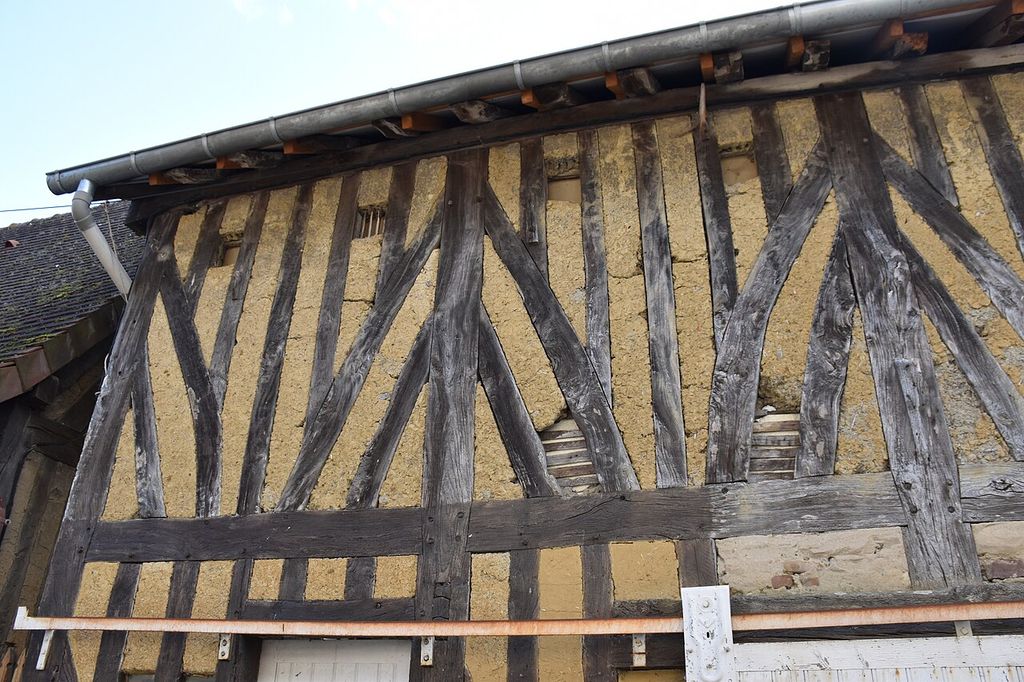
Normandy context: timber framing in Beuvron-en-Auge. Renhour48 / Wikimedia Commons. Image source. CC0 / Public domain. Resized and converted to JPEG; no crop or recolouring.
The orchard’s changing timetable
Spring already had a long history in Hockney’s landscape art. The Royal Academy explained that he prolonged his 2019 stay because he wanted to observe a Norman spring, anticipating differences from those he had drawn and painted in Yorkshire. This gave the new work a basis in comparison. Experience helped him recognise what to watch for, while the new location required him to look again. [6]
His own description of working in 2020 gives the orchard a clear sequence. First came the winter trees, then buds, developing blossom and full flowering. Leaves followed, blossom fell, and small fruit remained. One of these transformations could occupy about a fortnight, within a spring that he described as taking roughly three months to arrive. He was drawing at least once a day during lockdown and becoming more accomplished at making marks on the screen as the subjects changed around him. [6] [7]
That account links two processes: the trees’ development and the artist’s learning. New growth required fresh decisions about the density, colour and rhythm of marks. Bare branches expose a tree’s divisions; blossom clusters around them; leaves eventually conceal much of the structure. Following the same tree through those changes makes the task more demanding than producing a single general sign for spring. Hockney’s description keeps the attention on these successive appearances and on the work needed to draw them. [6]
The pond added another set of difficulties. In the same account, Hockney said that he eventually turned to its water lilies, explicitly invoking Monet. A pond offers a different organisation of space from the orchard: objects rest on a surface that also reflects light and its surroundings. In Normandy, the water and the trees could be revisited as neighbouring parts of one environment, with changes in one motif prompting different ways of looking at another. The flowers and still lifes similarly connect small, familiar subjects to a wider investigation of light and colour. [7]
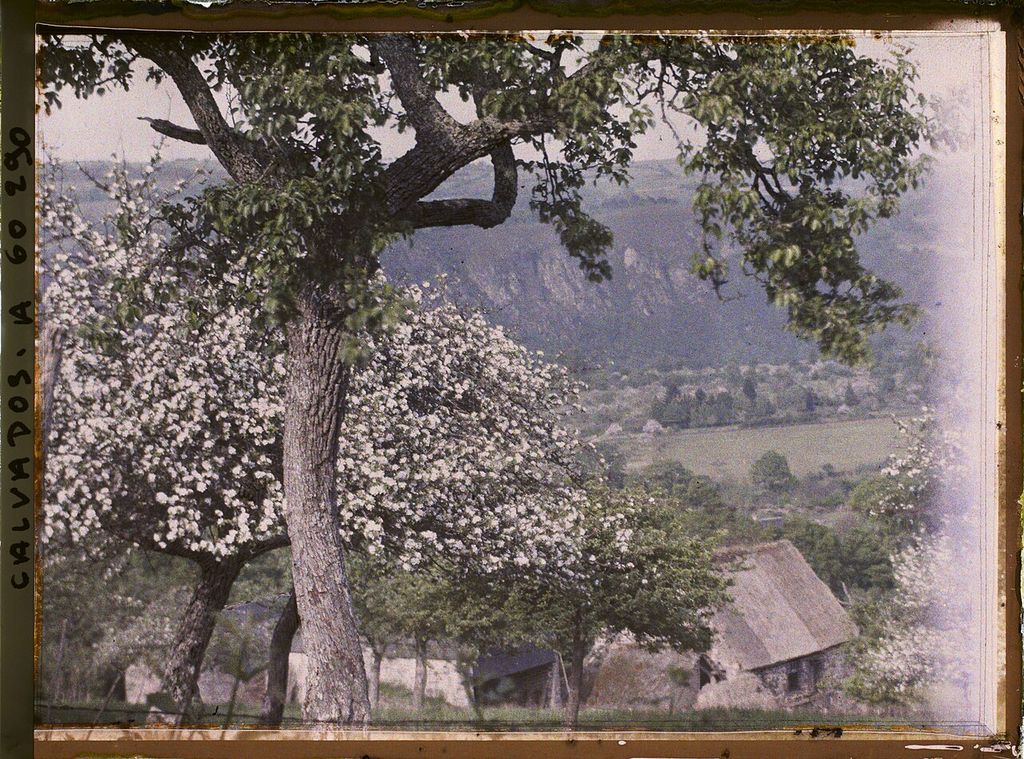
Historical comparison: Roger Dumas, apple blossom near Clécy, Normandy, May 1929, autochrome, musée Albert-Kahn. Roger Dumas / Département des Hauts-de-Seine, musée Albert-Kahn / Wikimedia Commons. Image source. CC BY-SA 4.0. Resized and converted to JPEG; no crop or recolouring. Image derivative retains CC BY-SA 4.0.
The spring of 2020 and the larger year
The pandemic arrived after Hockney had already chosen to work in Normandy. The place and the seasonal project preceded the restrictions; lockdown intensified a practice that was under way. The Royal Academy’s 2021 exhibition, The Arrival of Spring, Normandy, 2020, brought together 116 iPad images from that period, printed on paper. [6] [7]
There are several related bodies of work to keep in view. La Grande Cour is the 2019 ink panorama. The spring exhibition comprised 116 digital images. The broader digital series 220 for 2020, presented at the Fondation Louis Vuitton in 2025, follows variations of light through the year. A Year in Normandie, dated 2020–21, is the composite frieze assembled from selected iPad paintings. These names describe different works and groupings, even though they share a setting and many motifs. [4] [7] [8]
The distinction also helps explain what prolonged residence made possible. A selection of spring images concentrates attention on emergence and growth. A year’s work includes the fullness of summer, autumn colour and winter exposure. A composite panorama introduces another decision: how to connect separate observations into a work that unfolds continuously for its viewer. In its 2026 guide, Serpentine described Hockney selecting around half of more than two hundred Normandy paintings for the frieze. The year supplied material; selection and arrangement gave that material a further form. [8]
The hopeful reception of the spring pictures has a concrete basis in their subjects. Their attention falls on processes that continued during a period when human routines had been interrupted. Yet the work’s interest extends beyond its pandemic circumstances. Trees, changing weather and repeated observation had occupied Hockney before 2020. Ai Kusumoto, curator of his 2023 Tokyo exhibition, connected his pleasure in spring with the difficulty and pleasure of looking at a world that keeps changing. Her reading gives the optimism a foundation in sustained artistic work. [9]
Digital marks in a familiar place
The iPad suited a practice in which a subject could change before conventional equipment was ready. It allowed Hockney to begin quickly, carry colour with him and respond to what was happening nearby. His earlier experience had already taught him to consider the screen’s particular qualities. Speaking to Martin Gayford in 2010, he associated its illumination with luminous subjects and described placing vivid colour over another colour without the muddying that can occur in physical paint. These were discoveries he brought to Normandy after years of digital work. [10]
By this period, the software had also become more specific to his needs. Richard England’s company, Reflex Arc, states that it built the bespoke Hockney Brushes app mainly in early 2018, working with the artist and his assistants. It developed from Steve Sprang’s open-source Brushes software, but was a separate application shaped around Hockney’s preferred workflow and custom brushes. The Foundation preserves his own recollection of asking for new brushes in 2018. The Normandy paintings therefore belong to a later technical phase than his first iPad drawings of 2010. [11] [7]
Kusumoto offers a useful way to understand the result. She distinguishes rapidly observed iPad drawings from more elaborately constructed iPad paintings, discussing the Normandy flower image dated 16 March 2020 as an example of a composition developed through layers. She also points to small leaf-like forms and dots made with the newer brushes. A similar mark can describe grass in one passage and a roof in another. Its meaning emerges through placement, repetition and its relation to neighbouring marks. [12]
This economy of means brings the setting and the tool together. A garden offers many small repeated forms, but an artist has to decide which differences to retain. The same digital brush can become a way of thinking across materials and distances. Kusumoto’s account helps explain why close attention to a Normandy image involves both recognising plants or buildings and noticing how they have been made. The broader development of these tools is explored in Hockney’s iPad art. [12]
Reflex Arc explains that the app retained strokes, allowing images to be replayed and rendered again for particular large displays. This is a specific account of the studio’s software and export process. It helps explain the journey from portable drawing device to printed panorama: the intimacy of drawing outdoors and the scale of an exhibition were connected through further technical work. Enlarging and presenting the images involved collaboration as well as Hockney’s hand on the screen. [11]
Bayeux, scrolls and the moving viewer
Normandy supplied an encounter with another kind of long picture. The Bayeux Tapestry tells a story through an extended embroidered sequence, and Hockney returned to it during his time in the region. Its relevance was already visible in the 2019 drawings. Pace related their combination of viewpoints and moments to both the tapestry and Chinese scroll paintings. The local historical work met an interest in extended pictorial space that Hockney had pursued for decades. [3]
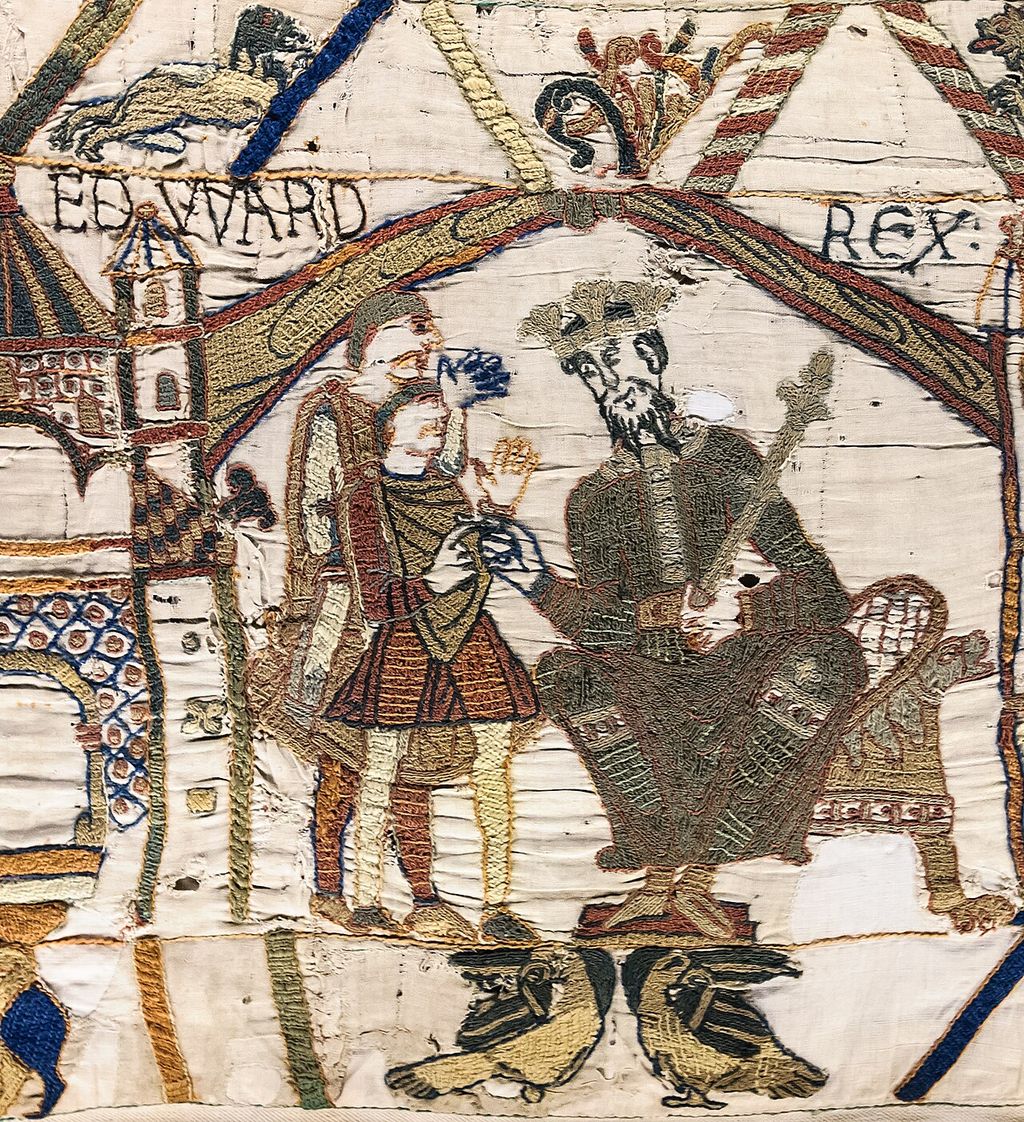
Historical comparison: the opening Edward the Confessor scene of the Bayeux Tapestry, photographed by Myrabella. Myrabella / Wikimedia Commons. Image source. Public domain. Resized and converted to JPEG; no crop or recolouring.
Kusumoto places this interest within his concern for the viewer’s body. In her account, a fixed viewpoint restricts the viewer to one position, whereas scrolls suggest a world that can be entered and travelled through. A long Normandy panorama makes looking take time: the viewer has to move, remember earlier passages and connect them with what comes next. This comparison concerns how images organise experience; it allows the distinct traditions to remain distinct. [9]
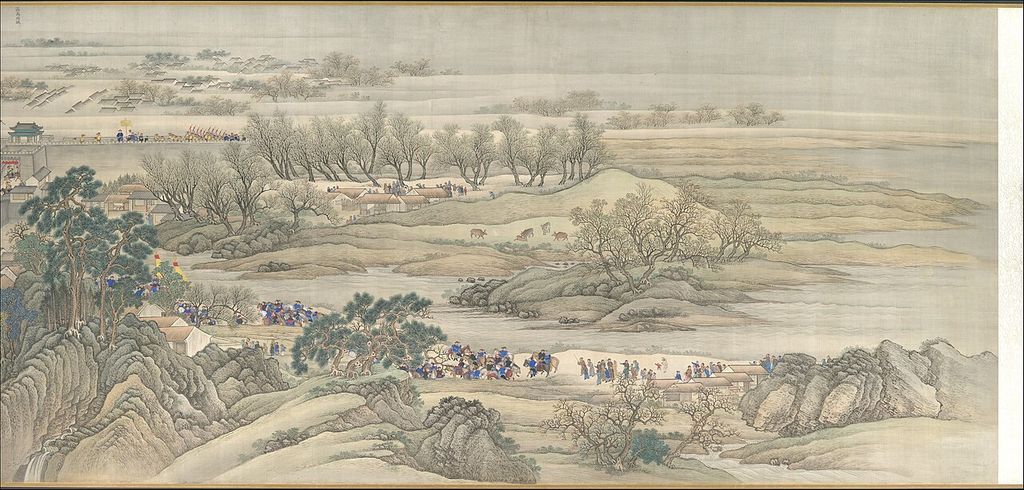
Handscroll comparison: Wang Hui and assistants, The Kangxi Emperor’s Southern Inspection Tour, Scroll Three: Ji’nan to Mount Tai, datable to 1698, Metropolitan Museum of Art. Wang Hui and assistants / The Metropolitan Museum of Art / Wikimedia Commons. Image source. CC0 / Public domain. Resized and converted to JPEG; no crop or recolouring.
In A Year in Normandie, the activities of nature supply the unfolding events. Serpentine’s guide contrasts the tapestry’s moving figures, horses and ships with the trees and streams of Hockney’s frieze; a chair or treehouse occasionally registers human presence. The garden becomes a setting in which time can be followed through changes of appearance. The work’s full sequence and construction are discussed in A Year in Normandie. [8]
The regional relationship became particularly tangible in 2022, when the Bayeux Tapestry Museum announced an exhibition placing half-scale reproductions of the two long works in dialogue. That presentation returned Hockney’s seasonal narrative to the place associated with one of its sources. Visitors could compare how an extended image carried a sequence of historical action with how another carried the passage of a year. [13]
The Musée de l’Orangerie had offered a different comparison in its exhibition of October 2021 to February 2022. It explicitly presented Hockney’s frieze in relation to Monet’s Water Lilies. Here, the connection involved nature, repeated observation and a picture’s capacity to extend around its audience. The orchard and pond entered a French history of ambitious landscape painting while retaining Hockney’s bright flat colours and digital marks. [1]

Claude Monet, The Water Lilies – The Clouds (Les Nuages), 1915–26, Musée de l’Orangerie, Paris. A historical comparison for the extended, horizonless pond. Claude Monet / RMN (Musée de l’Orangerie), Michel Urtado / Wikimedia Commons. Image source. Public domain. Resized and converted to JPEG; no crop or recolouring.
Paint, people and the studio
Life in Normandy also expanded again after quarantine. The National Portrait Gallery’s 2023 labels describe Hockney inviting people into the studio from 2021 and making portraits from life through 2022. He began with familiar sitters, including his partner Jean-Pierre Gonçalves de Lima and his friend Charlie Scheips, before painting a wider circle. His studio assistant, gardener and chiropodist joined friends and visitors as subjects. These pictures reveal the social relationships within the working environment. [14]
The portraits were made in acrylic, applied quickly to canvas without underdrawing, over two or three sittings. The gallery described his enjoyment of holding brushes again after the intensive digital landscape work. Its account then follows him back towards new media and the landscapes around his home. That movement between subjects and materials is characteristic of Normandy’s role: the same place sustained several investigations, and the practical act of painting remained available alongside the screen. [14]
The Normandy landscapes in acrylic had their own public presence. The Fondation Louis Vuitton’s 2025 presentation placed a group of them after the digital 220 for 2020 series, drawing attention to the sky’s animated touches and suggesting a distant affinity with Van Gogh. In Rouen in 2024, recent landscapes were shown alongside Monet, with other paintings placed among works by Blanche and Renoir. These curatorial choices made the connection between Hockney’s local practice and the region’s painting collections visible. [4] [15]
Normandy after dark
Moonlight opened another route through the familiar surroundings. Galerie Lelong’s account of The Moon Room begins with an unusually bright night in April 2020, when Hockney drew the full moon from his window. The gallery connects the subsequent project with his reading of Maupassant’s Clair de lune, set in the same landscape. Its 2026 presentation comprised fifteen nocturnes dated between 8 April and 5 December 2020. [16]
The gallery gives a particularly concrete account of 31 October. Hockney made five drawings that night, leaving the window and going into the garden. The house appeared with its windows lit, while the moon changed position between evening and morning. This brought two kinds of light together: the illumination from inside the dwelling and the light that transformed the sky above it. A place he knew in daylight became a subject to be learnt again through changing visibility. [16]
These night views acquired a larger public presence several years after their making. Rouen’s Normandism exhibition in 2024 described a Moon Room containing thirteen nocturnal iPad drawings and two paintings on canvas, in blues and blacks with pale or golden lunar reflections. Lelong’s 2026 account described its fifteen digital nocturnes printed on paper and mounted on aluminium. The exhibition title encompassed different presentations; the nocturnal work had begun during the same year as the spring observations. [15] [16]
A place carried into the late exhibitions
Normandy occupied an entire floor of the Fondation Louis Vuitton survey in 2025, bringing the digital year, acrylic landscapes and 2019 ink panorama into successive galleries. In 2026, Serpentine paired A Year in Normandie with Hockney’s late London paintings. Its guide noted that the frieze appeared again within the backgrounds of two recent portraits. The remembered landscape could now become part of the studio pictures themselves. [4] [8]
Hockney died on 11 June 2026. The Normandy work belongs to the final years of his career, but its value rests in the specific opportunities this place gave him: an orchard observed closely enough to catch short transformations, a pond that renewed the problem of depicting water, a house explored from several sides, a studio welcoming sitters and a garden revisited under the moon. Across these subjects, living somewhere became a sustained method of looking. [17]
Works directory
This source-bounded directory combines the works in the Metropolitan Museum’s 2017 retrospective checklist with reviewed museum object records and the additional works and series examined in this guide. It spans several media and is not a complete catalogue raisonné. Titles without an article link remain useful dated records. Metropolitan Museum final retrospective checklist (2017); additional object and series sources are given in the linked articles. [18]
| Name | Date | Medium |
|---|---|---|
| Love Painting | 1960 | Painting |
| Shame | 1960 | Painting |
| The Third Love Painting | 1960 | Painting |
| Tyger Painting No. 2 | 1960 | Painting |
| A Rake’s Progress | 1961–63 | Print series |
| Tea Painting in an Illusionistic Style | 1961 | Painting |
| The Cha-Cha That Was Danced in the Early Hours of 24th March | 1961 | Painting |
| Cleaning Teeth, Early Evening (10pm) W11 | 1962 | Painting |
| Flight into Italy - Swiss Landscape (Painting in a Scenic Style) | 1962 | Painting |
| Man in a Museum (or You're in the Wrong Movie) | 1962 | Painting |
| My Brother is Only Seventeen | 1962 | Painting |
| The First Marriage (A Marriage of Styles I) | 1962 | Painting |
| Domestic Scene, Los Angeles | 1963 | Painting |
| Play Within a Play | 1963 | Painting |
| The Hypnotist | 1963 | Painting |
| Arizona | 1964 | Painting |
| California Art Collector | 1964 | Painting |
| Man in Shower in Beverly Hills | 1964 | Painting |
| Portrait Surrounded by Artistic Devices | 1965 | Painting |
| Rocky Mountains and Tired Indians | 1965 | Painting |
| Beverly Hills Housewife | 1966–67 | Painting |
| Medical Building | 1966 | Painting |
| Peter | 1966 | Drawing |
| Peter Getting Out of Nick’s Pool | 1966 | Painting |
| A Bigger Splash | 1967 | Painting |
| A Lawn Being Sprinkled | 1967 | Painting |
| Kasmin in Bed in His Chateau in Carennac | 1967 | Drawing |
| Peter Feeling Not Too Good | 1967 | Drawing |
| Savings and Loan Building | 1967 | Painting |
| The Room, Tarzana | 1967 | Painting |
| American Collectors (Fred and Marcia Weisman) | 1968 | Painting |
| Christopher Isherwood and Don Bachardy | 1968 | Painting |
| Henry Geldzahler and Christopher Scott | 1968-1969 | Painting |
| W. H. Auden | 1968 | Drawing |
| Peter Langan in His Kitchen at Odins | 1969 | Drawing |
| Mark Glazebrook | 1970 | Drawing |
| Mr and Mrs Clark and Percy | 1970-1971 | Painting |
| Ossie Wearing a Fairisle Sweater | 1970 | Drawing |
| Pool and Steps, Le Nid du Duc | 1971 | Painting |
| Rubber Ring Floating in a Swimming Pool | 1971 | Painting |
| Celia in a Black Dress with White Flowers | 1972 | Drawing |
| Mount Fuji and Flowers | 1972 | Painting |
| Portrait of an Artist (Pool with Two Figures) | 1972 | Painting |
| Portrait of the Artist's Mother, Mrs Laura Hockney, Bradford | 1972 | Drawing |
| The Artist's Father | 1972 | Drawing |
| Dr Eugene Lamb, Lucca | 1973 | Drawing |
| Andy, Paris | 1974 | Drawing |
| Contre-jour in the French Style (Against the Day dans le Style-Français) | 1974 | Painting |
| Gregory Sitting on Base of Column | 1975 | Drawing |
| Kerby (after Hogarth) Useful Knowledge | 1975 | Painting |
| Ron Kitaj Outside Akademie der Kunste Vienna | 1975 | Drawing |
| Kasmin Reading the Udaipur Guide | 1977 | Drawing |
| Looking at Pictures on a Screen | 1977 | Painting |
| My Parents | 1977 | Painting |
| Canyon Painting | 1978 | Painting |
| Mother, Bradford, 19 Feb. 1979 (inscribed 1978) | 1979 | Drawing |
| Mulholland Drive: The Road to the Studio | 1980 | Painting |
| Nichols Canyon | 1980 | Painting |
| Outpost Drive, Hollywood | 1980 | Painting |
| Hollywood Hills House | 1981-1982 | Painting |
| Celia. Los Angeles. April 10th 1982 | 1982 | Polaroid composite |
| Don + Christopher, Los Angeles, 6th March 1982 | 1982 | Polaroid composite |
| Gregory Swimming Los Angeles March 31st 1982 | 1982 | Polaroid composite |
| My Mother, Bolton Abbey, Yorkshire, Nov. 1982 | 1982 | Photocollage |
| Self Portrait 30th Sept. 1983 | 1983 | Drawing |
| Pearblossom Hwy., 11-18th April 1986, #1 | 1986 | Photocollage |
| Pearblossom Hwy., 11–18th April 1986, #2 | 1986 | Photocollage |
| Large Interior, Los Angeles | 1988 | Painting |
| Breakfast at Malibu, Sunday, 1989 | 1989 | Painting |
| Pacific Coast Highway and Santa Monica | 1990 | Painting |
| The Other Side | 1991-1993 | Painting |
| The Eleventh V. N. Painting | 1992 | Painting |
| The Twenty Sixth V. N. Painting | 1992 | Painting |
| The Road Across the Wolds | 1997 | Painting |
| 9 Canvas Study of the Grand Canyon | 1998 | Painting |
| A Bigger Grand Canyon | 1998 | Painting |
| Colorado River | 1998 | Painting |
| Garrowby Hill | 1998 | Painting |
| Colin St. John Wilson. London. 3rd June 1999 | 1999 | Drawing |
| Gregory Evans. Los Angeles. 18th September 1999 | 1999 | Drawing |
| Laura Huston. London. 22nd June 1999 | 1999 | Drawing |
| Lindy. Marchioness of Dufferin and Ava. London. 17th June | 1999 | Painting |
| Going Up Garrowby Hill | 2000 | Painting |
| Red Pots in the Garden | 2000 | Painting |
| A Closer Winter Tunnel, February - March | 2006 | Painting |
| Elderflower Blossom, Kilham, July 2006 | 2006 | Painting |
| The Road to Thwing, July 2006 | 2006 | Painting |
| Bigger Trees near Warter | 2007 | Painting |
| Hawthorn Blossom near Rudston | 2008 | Painting |
| Views Through the Artist's Bedroom Window, Bridlington | 2010-2013 | Digital animation |
| The Arrival of Spring in Woldgate, East Yorkshire in 2011 (twenty eleven) | 2011 | Painting / digital series |
| 82 Portraits and 1 Still-life | 2013–16 | Portrait series |
| Garden | 2015 | Painting |
| Garden with Blue Terrace | 2015 | Painting |
| Garden #3 | 2016 | Painting |
| A Bigger Interior with Blue Terrace | 2017 | Painting |
| Interior with Blue Terrace and Garden | 2017 | Painting |
| A Year in Normandie | 2020–21 | Digital frieze |
Discussion
Look again at the images and ideas explored in Normandy. These editorial prompts invite your observations.
Reader Insights
How does Hockney’s sequence from bare branches to blossom, leaves and small fruit change your understanding of what a spring landscape can record?
What might four views around a house reveal that a single view from one position cannot?
How does the move from a window to the moonlit garden change the relationship between home, light and observation in the nocturnes?
Join the Conversation
Share a detail, comparison or question about Normandy below.
References
- Musée de l’Orangerie. “David Hockney. A Year in Normandie”, exhibition, 13 October 2021–14 February 2022. View source.
- L.A. Louver. “David Hockney: My Normandy”, press release, January 2021, pp. 1–2. View source.
- Pace Gallery. “David Hockney: La Grande Cour, Normandy”, exhibition, 14 September–19 October 2019. View source.
- Fondation Louis Vuitton. “David Hockney 25”, exhibition, 9 April–1 September 2025, curatorial account of galleries 5–7. View source.
- The Morgan Library & Museum. David Hockney: Drawing from Life, large-print labels, 2020–21, label for “David Hockney turning pages of the LA Sketchbook and Normandy Sketchbook”. View source.
- Royal Academy of Arts. “David Hockney: The Arrival of Spring, Normandy, 2020”, press release, 20 April 2021, pp. 1–2. View source.
- The David Hockney Foundation. “2021”, chronology, sections “Spring Cannot be Cancelled” and “The Arrival of Spring, Normandy, 2020”. View source.
- Serpentine. A Year in Normandie and Some Other Thoughts about Painting, exhibition guide, 2026, pp. 1–2. View source.
- Tamaki Sugihara interviewing Ai Kusumoto. “混迷から新境地へ。巨匠ホックニーが喜びに満ちた作品に辿り着くまで”, Tokyo Art Beat, 22 September 2023, sections on the viewer’s body, scrolls and spring. View source.
- Martin Gayford. “David Hockney’s iPad art”, The Telegraph, 20 October 2010, pp. 2–3 of the Richard Gray Gallery reprint. View source.
- Reflex Arc. “The iPad painting app we built for David Hockney”, developer’s project account, sections “Hockney Brushes, 2018” and “At scale, 2021”, accessed 5 November 2026. View source.
- Tamaki Sugihara interviewing Ai Kusumoto. “ホックニーはなぜ評価と人気を60年も獲得し続けられたのか?”, Tokyo Art Beat, 25 August 2023, section on medium-specific marks. View source.
- Bayeux Museum. “Artist David Hockney presents A Year in Normandie at the Bayeux Tapestry Museum”, press release, 2022, p. 1. View source.
- National Portrait Gallery. David Hockney: Drawing from Life, large-print labels, 2023, pp. 53–54, “The Normandy Portraits”. View source.
- Musée des Beaux-Arts de Rouen. “David Hockney Normandism”, exhibition, 22 March–22 September 2024. View source.
- Galerie Lelong & Co. “David Hockney: The Moon Room”, exhibition, 19 March–7 May 2026. View source.
- The David Hockney Foundation. “2026”, chronology. View source.
- The Metropolitan Museum of Art, David Hockney, final exhibition checklist, 15 November 2017. View source.
More HOCKNEY Works
A Bigger Splash
A momentary disturbance becomes the focus of a large acrylic painting, made through weeks of patient work.
Mr and Mrs Clark and Percy
The designers Celia Birtwell and Ossie Clark occupy a room shaped by light, repeated sittings and the demands of a double portrait.
A Bigger Grand Canyon
Sixty canvases gather memory, studies and changing viewpoints into an immense painting of 1998.
Garrowby Hill
The 1998 oil painting transforms a remembered Yorkshire journey into a road, fields and an expansive view.
Portrait of an Artist (Pool with Two Figures)
Photographic studies, two figures and a swimming pool become a carefully constructed painting of 1972.
My Parents
The 1977 oil painting sets Kenneth and Laura Hockney within a quietly organised interior.
Pearblossom Hwy., 11–18th April 1986, #2
Hundreds of separately made photographs construct a road scene that unfolds through movement and time.
Bigger Trees near Warter
Fifty canvases join into a large outdoor painting of Yorkshire trees, with photography helping the artist organise the whole.