


 by Tom Gurney
Tom Gurney BSc (Hons) is an art history expert with over 20 years experience
Email: tomgurney1@gmail.com / Phone: +44 7429 011000
Garrowby Hill: Introduction
The road in David Hockney’s Garrowby Hill seems to arrive at the viewer’s feet before carrying the eye out across Yorkshire. Its bends give the landscape a pulse. Nearby ground rises towards us, fields spread away in coloured pieces, and the horizon sits high enough for the land to occupy almost the whole picture. A familiar journey has become a way of organising an expansive view.
Painted in 1998, Garrowby Hill is an oil on canvas measuring 60 × 76 inches, approximately 152.4 × 193 centimetres, in the Museum of Fine Arts, Boston. Its breadth matters: there is room for the road’s forward movement and for the eye to leave that route and wander across the fields. The painting gives two pleasures at once, the pull of travelling through a place and the freedom of looking over it. [1]
The scene also carries the history of a return. Hockney’s renewed attention to Yorkshire grew from journeys to visit his seriously ill friend Jonathan Silver in 1997. Back in Los Angeles, he continued painting the country he remembered. Distance from Yorkshire was therefore part of this picture’s making, alongside the repeated experience of its roads. [2] [3]
At a Glance
- ArtistDavid Hockney
- TitleGarrowby Hill
- Date1998
- MediumOil on canvas
- Dimensions60 × 76 inches; approximately 152.4 × 193 centimetres
- CollectionMuseum of Fine Arts, Boston
- Related workGoing Up Garrowby Hill, 2000, a separate, vertically proportioned painting
This work across David Hockney’s career
A Rake’s Progress
1961–63 [4]A Bigger Splash
1967 [4]Mr and Mrs Clark and Percy
1970–71 [4]My Parents
1977 [4]A Year in Normandie
2020–21 [5]Contents
- The journeys behind the painting
- Where Garrowby Hill belongs
- Following the road
- Colour, pattern and the size of the canvas
- A remembered view and the experience of travelling
- The 1998 painting and Going Up Garrowby Hill
- From the 1998 exhibition to Boston
- A road towards the later Yorkshire landscapes
The journeys behind the painting
In late summer 1997 Hockney spent an extended period in Yorkshire while Silver was in the final stages of cancer. The journeys from Bridlington across the county made landscape an insistent presence in his days. The Foundation’s chronology records how this travelling prompted him to consider painting the country of his youth. Its account also preserves his recollection of noticing agricultural change: crops growing, harvesting and ploughing continually altered the ground. Looking became a repeated activity, sensitive to differences between one journey and the next. [2]
This background gives the fields a particular importance. They belong to a countryside used and revisited, where the surface can change while the main shapes of hill, valley and road remain recognisable. Repetition makes both kinds of knowledge possible. A traveller comes to anticipate the next bend, yet notices a newly exposed patch of earth or a different relationship between neighbouring fields. The painting’s strong structure and varied surface can be read together in that light: a settled knowledge of the route accommodates a lively awareness of change.
Silver had encouraged Hockney to paint Yorkshire. Filmmaker Bruno Wollheim, who knew the artist over many years, later described Hockney bringing wet canvases to show his friend. Wollheim identified The Road to York through Sledmere, The Road across the Wolds and North Yorkshire, all from 1997, as early results of these journeys, followed by the painting of Salts Mill. The road pictures emerged within a relationship sustained through looking, conversation and the practical business of making paintings. [6]
The friendship gives this history its human weight. Hockney turned journeys made to see Silver into paintings that his friend could see. In Garrowby Hill, the close road, strongly divided ground and opening distance continue to engage a viewer who knows nothing about those circumstances. Knowledge of the friendship adds another dimension to the act of returning.
The Foundation places the 1998 Yorkshire paintings within Hockney’s work from memory after his return to Los Angeles. That location is essential to understanding Garrowby Hill. The picture gathers the remembered force of a familiar route across a considerable physical distance. Hockney could choose which turns, intervals and contrasts would make the experience legible on canvas. The subject had been encountered repeatedly; the painting was made through the further work of recollection. [3]
Where Garrowby Hill belongs
Garrowby Hill lies north of Bishop Wilton in the East Riding of Yorkshire. The parish council’s account places the village within a landscape of Wolds walks and views towards the Vale of York. This is the country behind the painting’s combination of elevated ground and a far-reaching prospect: a place where a road can bring the traveller into a sudden relationship with a much larger stretch of land. [7]
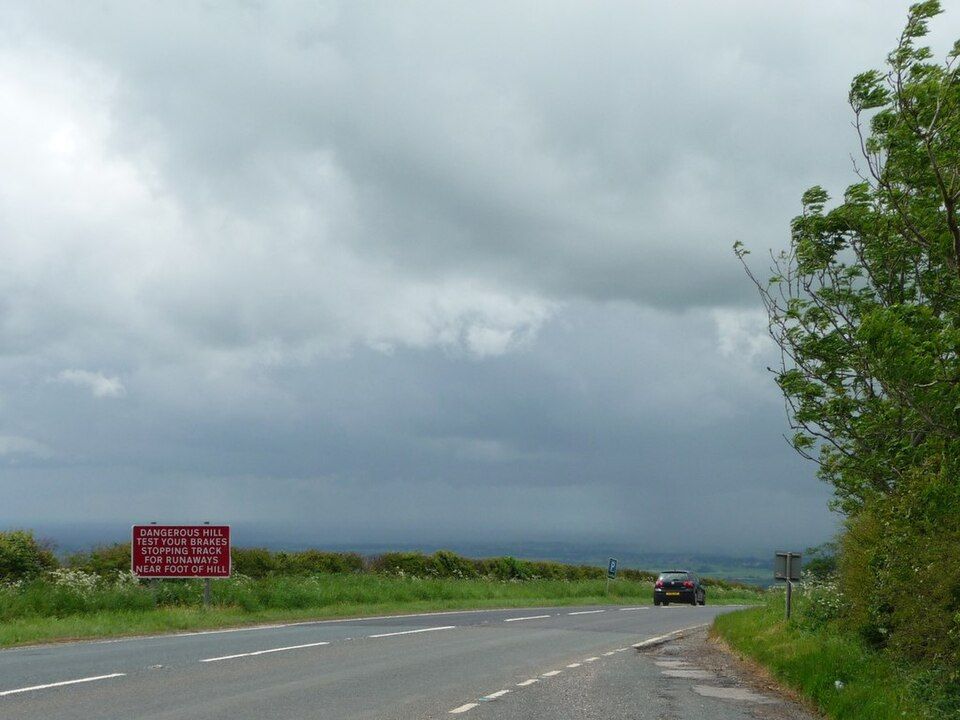
Garrowby Hill Top, photographed in 2013. The road and warning sign give context for the steep route and the distant landscape beyond. Christine Johnstone / Wikimedia Commons. Image source. CC BY-SA 2.0. Image resized; framing and colours retained. This derivative retains CC BY-SA 2.0.
The Yorkshire Wolds have a specific physical character. Natural England describes a chalk landscape whose escarpment rises above the Vale of York to the west, with open higher ground, broad views and deeply cut dry valleys. Much of the land is cultivated. Limited woodland cover helps to expose the larger shapes of the countryside, while trees become more concentrated in some valleys and on parts of the scarp. That alternation between openness and enclosure gives a useful geographical setting for the painting’s broad fields and darker masses of trees. [8]
The fields also have a human history. Natural England traces much of the region’s regular field pattern, hedges, dispersed farmsteads and wide drove roads to Parliamentary enclosure. This regional history helps us recognise the subject as worked countryside. A landscape that can resemble an arrangement of coloured shapes is also land organised for cultivation. Its divisions give the painter a ready vocabulary of edges and intervals, which can be made more emphatic through colour. [8]
Hockney’s patterning makes that organisation unusually easy to register. A field has a shape, an edge and a relationship to the next field. Repeated across the view, those divisions let the eye measure how the land spreads and changes direction. The painting’s colour heightens the differences between adjacent pieces, giving each a moment of attention within the larger prospect. We can move across the surface field by field, just as we can follow the road bend by bend.
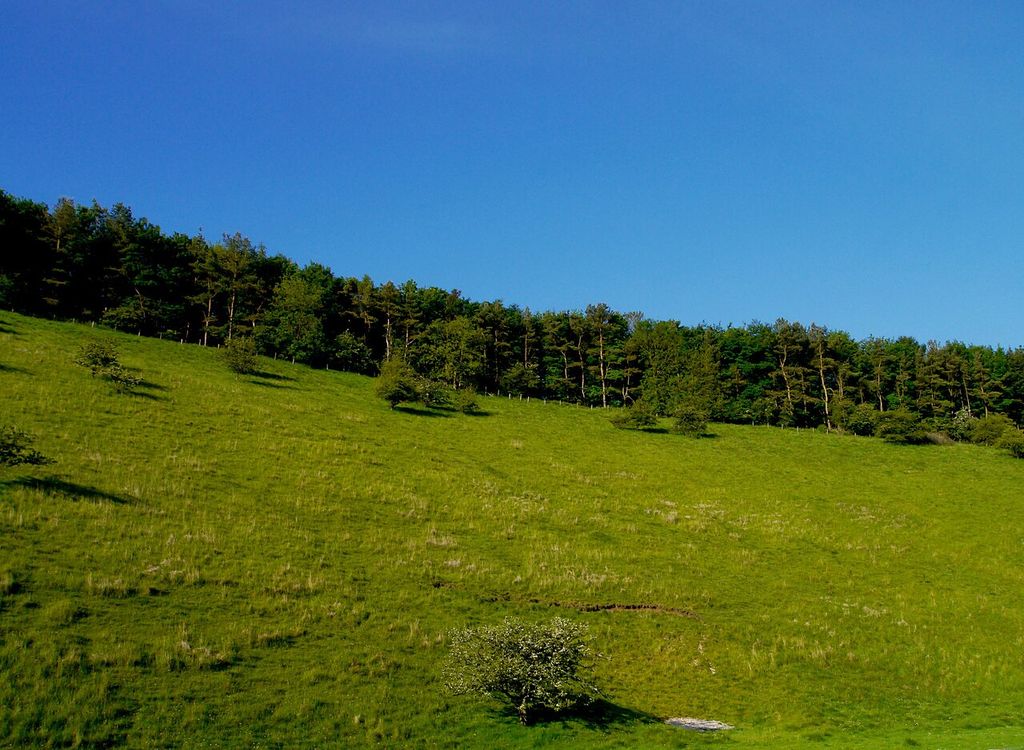
Regional context: the dry chalk valley of Water Dale, near Thixendale in the Yorkshire Wolds. Andy Beecroft / Wikimedia Commons. Image source. CC BY-SA 2.0. Resized and converted to JPEG; no crop or recolouring. Image derivative retains CC BY-SA 2.0.
Following the road
The road begins at the bottom of the painting, placing its nearest stretch directly beside the viewer’s own space. Art historian Anthi-Danaé Spathoni makes this entry point central to her reading of Garrowby Hill. In her study of Hockney’s moving landscapes, she describes an inviting pictorial space in which the viewer follows the winding route over time. The road offers a sequence to experience, making the act of looking part of the subject. [9]
Its curve is especially effective because it keeps changing the direction of attention. A straight diagonal could deliver the eye rapidly to a distant destination. Here the route asks us to adjust as it turns. Each bend makes a small event out of the next stretch of ground. The road can be understood immediately as a continuous form, but following it requires a succession of movements. That difference between grasping the whole and travelling through its parts gives the picture much of its momentum.
The high horizon strengthens this effect. With comparatively little sky above it, the ground becomes the principal field of action. There is distance to explore, but the nearest land retains a forceful presence. The composition brings together a view down into the landscape and a view outward across it. We feel the fall of the road while also taking in the wider arrangement of fields. The resulting space is both encompassing and unstable enough to keep the eye moving.
Looking need not remain obedient to the route. Field boundaries establish competing directions, and areas of colour draw attention sideways. The eye can cross a patch of land, return to the road and set off again. This is why the painting rewards more than a quick recognition of its subject. Its winding line provides a strong thread through the scene, while the surrounding pattern creates numerous departures from that thread.
Spathoni connects such landscapes with Hockney’s wider exploration of multiple viewpoints and with lessons carried between photography and painting. Her account is valuable as an interpretation of the viewer’s active role. In Garrowby Hill, the apparent availability of the foreground, road and far distance makes it possible to feel several stages of a journey within a single composition. The picture’s coherence depends on how those experiences are brought together. [9]
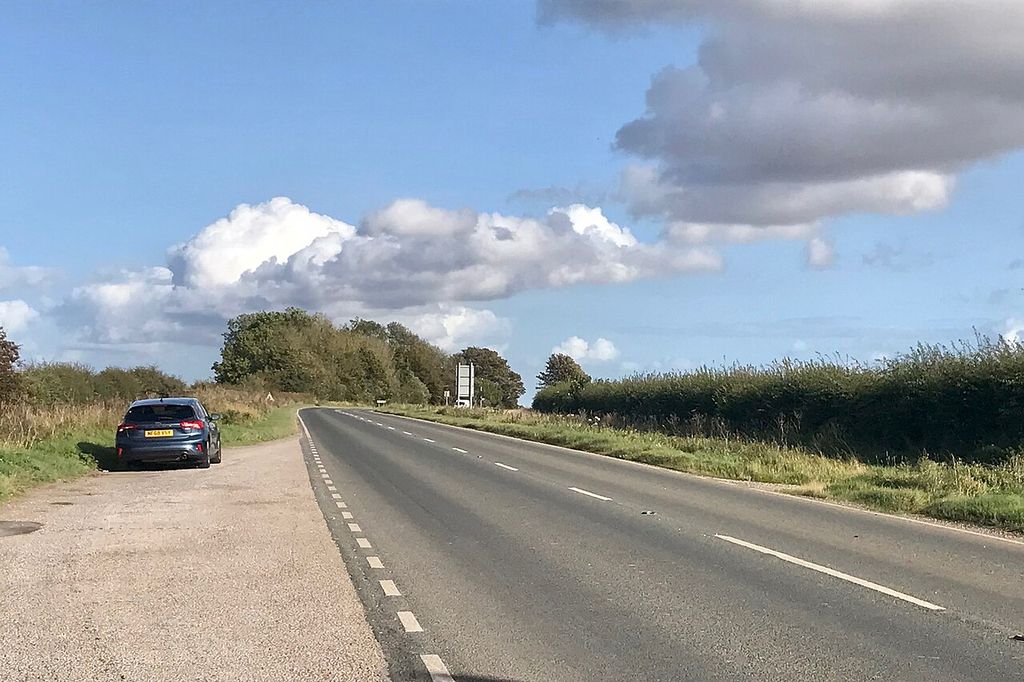
Geographic context: a roadside lay-by at Garrowby Hill, photographed in 2023. David Dixon / Wikimedia Commons. Image source. CC BY-SA 2.0. Resized and converted to JPEG; no crop or recolouring. Image derivative retains CC BY-SA 2.0.
Colour, pattern and the size of the canvas
Greens, yellows, oranges and blue tones separate the cultivated ground into a varied patchwork. Darker trees interrupt that open arrangement. The road remains distinct enough to act as a guide, yet every major part of the scene also functions as a shape on the canvas. This double reading gives the painting its liveliness: the colours belong to a landscape and continually ask to be enjoyed as colour. [9]
The patchwork provides a scale against which the road can move. Where the route bends across or between fields, it meets forms with a different rhythm. The road flows; the fields divide. Neither rhythm dominates for long. The eye alternates between the continuous pale passage and the more abruptly separated units of ground, making the landscape feel assembled from many distinct encounters.
Writing about the 1998 landscape exhibition at L.A. Louver, the critic William Wilson identified a related tension across the group. He noted Hockney’s bright colour and his resistance to the convention of muting distant hues. Wilson understood the paintings as pursuing the sensation of space, and discussed their elevated views and multiple vanishing points in relation to driving. These were observations about the exhibition’s landscapes collectively, but they offer a useful contemporary setting for Garrowby Hill’s combination of depth and emphatic surface. [10]
Colour can make a distant field insist on its presence even when its position tells us that it lies far away. The result is a productive tension between recession and proximity. We read a spacious countryside, then notice how firmly its pieces hold their places on a flat surface. The painting does not need to settle this tension. It gives the viewer reasons to move between the large view and the painted arrangement that makes the view possible.
The canvas is substantial, roughly one and a half metres high and nearly two metres wide. At that size, the route can be encountered as a broad physical shape before its smaller turns and surrounding divisions receive attention. From farther away, the composition coheres around its major contrasts. Closer looking breaks that unity into separate passages. Its scale therefore supports changes in viewing distance as well as movement within the scene. [1]
Wollheim’s later commentary on Hockney’s road pictures begins with an everyday problem: people often carry a ready-made idea of the colour of tarmac, which can stand in the way of noticing its actual appearance. Applied to Garrowby Hill, this observation encourages attention to the road’s place among other colours. Its pale passage is seen against neighbouring fields and trees, and its effect changes as those surroundings change. Recognising the object as a road is only the beginning of looking at it. [6]
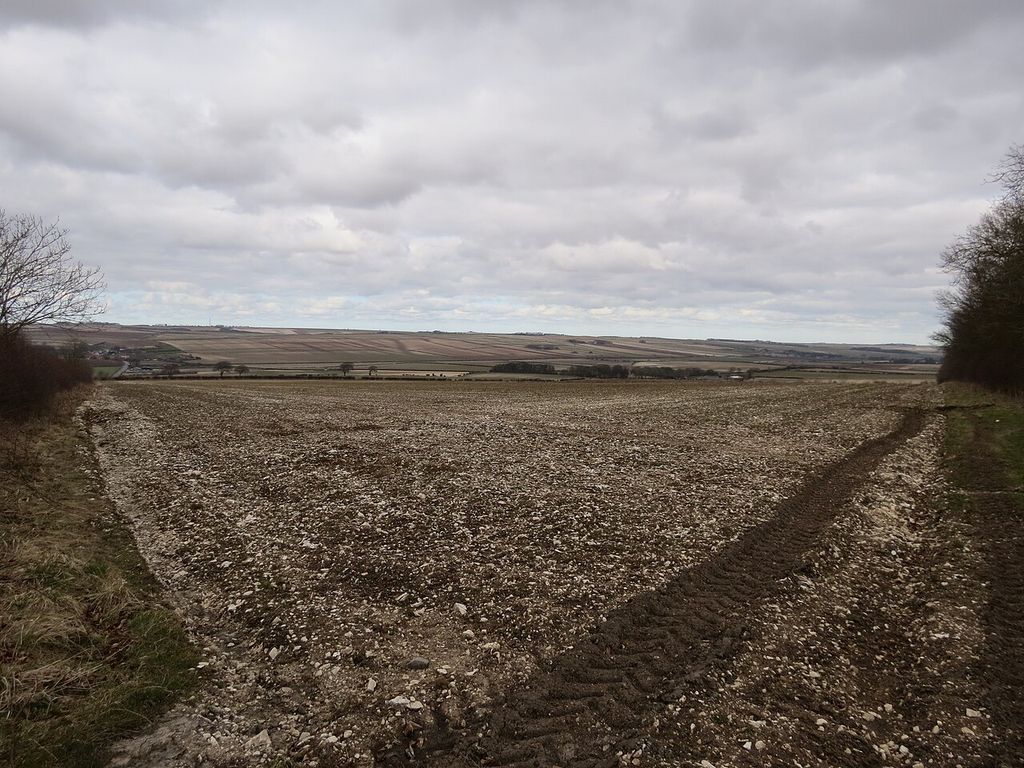
Regional context: cultivated fields and open horizons in the Yorkshire Wolds. Martin Dawes / Wikimedia Commons. Image source. CC BY-SA 2.0. Resized and converted to JPEG; no crop or recolouring. Image derivative retains CC BY-SA 2.0.
A remembered view and the experience of travelling
The picture’s elevated prospect can tempt a viewer to imagine one exact spot from which everything would fall into place. Its history encourages a broader understanding. Hockney had travelled the route repeatedly, then painted Yorkshire from memory in California. Familiarity supplied much more than the appearance of a place at a single instant: it included approach, descent, the expectation of a bend and the recognition of ground seen on earlier journeys. [2] [3]
Wollheim described the early Yorkshire road pictures as imaginative syntheses of a car journey and compared them with Hockney’s California road paintings of 1980. That connection runs through Garrowby Hill: a road becomes a structure for conveying remembered experience. The earlier Mulholland Drive: The Road to the Studio offers a useful companion, with its different terrain and panoramic format. Yorkshire gave an established pictorial concern another setting. [6]
The relationship also complicates any easy division between Hockney’s American and English landscapes. In the Foundation’s 1997 chronology, he associated the enormous vistas he rediscovered in Yorkshire with ideas developed in the American West. In 1998 the remembered Yorkshire pictures and the Grand Canyon paintings occupied the same period of work. The two regions were different in geology, scale and lived associations, yet each offered problems of distance and spatial experience that could be explored through painting. [2] [3]
Hockney was also publicly considering the claims of different kinds of image. The Foundation’s 1998 chronology reproduces a passage from his writing in Modern Painters that spring. He questioned the camera’s capacity to convey how the world both appears and feels, acknowledged that images are constructed, and defended the continuing possibilities of work made through the hand and eye. This was an argument for the resources of painting at a time when he was making these remembered landscapes. [3]
Garrowby Hill gives that argument a concrete form. The familiar road remains recognisable, but its bends also regulate the viewer’s attention. Fields describe cultivated land and establish intervals of colour. The picture can preserve relationships accumulated through repeated journeys while giving them a new organisation on canvas. Its claim on the viewer rests in the experience that arrangement makes possible: we follow, pause, look across, then return to the route. The still image accommodates the time it takes to encounter it.
The 1998 painting and Going Up Garrowby Hill
The title Garrowby Hill belongs to this horizontal painting of 1998. Hockney returned to the subject in Going Up Garrowby Hill, dated 2000. The Metropolitan Museum of Art’s checklist for its 2017–18 retrospective records that later work as oil on canvas, 84 × 60 inches, or 213.4 × 152.4 centimetres. Its height exceeds its width, giving it a different physical orientation from the Boston picture. The checklist named a private collection in Topanga at the time of the exhibition. [4]
The difference is useful when following Hockney’s treatment of a repeated subject. A place could support further paintings with fresh proportions and a new emphasis in the title. In the 1998 picture, the horizontal expanse gives considerable room to the fields surrounding the route. The road’s journey sits within that spreading view. Comparing the recorded formats makes clear how much a decision about the shape of the canvas can affect a landscape’s possibilities, even before individual details are considered.
From the 1998 exhibition to Boston
L.A. Louver included Garrowby Hill in Looking at Landscape / Being in Landscape, held from 15 September to 24 October 1998. The exhibition brought Yorkshire pictures together with Grand Canyon work, placing Hockney’s renewed attention to his home county beside his exploration of the American West. Its title gives a particularly apt context for a painting that moves between surveying an extensive view and feeling drawn into a route through it. [11]
Wilson’s contemporary review treated space as the unifying concern of the exhibition. He also drew attention to the different experiences offered by looking at a large painting from a distance and approaching its surface. That response helps recover how the Yorkshire pictures were discussed in 1998: they formed part of an active investigation of landscape, colour and perception, seen alongside works of markedly different size and subject. [10]
In Boston, later presentations have made other aspects of Garrowby Hill available. The MFA included it in Landscape, abstracted, an installation that opened in August 2014. Paintings appeared alongside sculpture, installation and video in a programme exploring contemporary approaches to landscape. Organiser Al Miner placed the exhibition within the continuing attraction of nature for artists working with the inheritance of twentieth-century abstraction. Hockney’s recognisable road and fields could participate in that discussion because colour and pattern are so active in the painting’s construction. [12]
An individual response adds another kind of history. Reporting on Malcolm Rogers’s survey of acquisitions made during his directorship, Boston Magazine recorded his personal association with Garrowby Hill in 2015. Rogers remembered the hill from childhood journeys in England, when it stood between him and the seaside. Looking towards the coast had carried a feeling of possibility and anticipation. His recollection gives a particular example of how a landscape painting can meet memories its maker could never fully prescribe. For this viewer, the hill belonged to another familiar journey with its own destination. [13]
The museum offered a different context in Community Arts Initiative: Our Family Portrait, held from May to October 2024. That exhibition centred on young people’s cyanotype portraits of biological and chosen families. The MFA explained that Garrowby Hill represented home understood through landscape and through communities of family and friends; it was shown alongside portraits by Charles Allston and Alice Neel. The pairing allowed a picture without a conventional portrait subject to contribute to a discussion of belonging. [14]
These two presentations illuminate different capacities within the same work. Its fields can sustain attention to colour, shape and abstraction. Its remembered route can also make place part of a conversation about home. The 2024 interpretation has a particular resonance with the painting’s origins in repeated journeys to a friend, while remaining a later museum reading with its own audience and purpose.
A road towards the later Yorkshire landscapes
Garrowby Hill belongs to the late-1990s renewal of Hockney’s Yorkshire landscape painting. It preceded the sustained work from 2004 onwards that formed the centre of the Royal Academy’s A Bigger Picture exhibition and its presentation in Bilbao in 2012. The Guggenheim’s account emphasised both the range of media in that later work and Hockney’s emotional relationship with the countryside of his youth. The 1998 painting gives an earlier, concentrated expression to that engagement with remembered place. [15]
Later projects changed the conditions of looking. Bigger Trees near Warter extended the scale of the Yorkshire landscape across multiple canvases, while other works returned to particular woods and routes through seasonal change. [9] In 2019 the Van Gogh Museum’s Hockney – Van Gogh: The Joy of Nature presented the Yorkshire landscapes within a dialogue about nature and artistic attention, including the vast, 32-canvas Arrival of Spring in Woldgate. That later dialogue with Van Gogh helps place Garrowby Hill within a long investigation of how landscape can keep looking fresh through changes of scale, medium and viewpoint. [16]
Within Hockney’s broader landscape painting and his repeated returns to Yorkshire, Garrowby Hill preserves the encounter between a deeply familiar place and a newly alert way of seeing it.
Works directory
This source-bounded directory combines the works in the Metropolitan Museum’s 2017 retrospective checklist with reviewed museum object records and the additional works and series examined in this guide. It spans several media and is not a complete catalogue raisonné. Titles without an article link remain useful dated records. Metropolitan Museum final retrospective checklist (2017); additional object and series sources are given in the linked articles. [4]
| Name | Date | Medium |
|---|---|---|
| Love Painting | 1960 | Painting |
| Shame | 1960 | Painting |
| The Third Love Painting | 1960 | Painting |
| Tyger Painting No. 2 | 1960 | Painting |
| A Rake’s Progress | 1961–63 | Print series |
| Tea Painting in an Illusionistic Style | 1961 | Painting |
| The Cha-Cha That Was Danced in the Early Hours of 24th March | 1961 | Painting |
| Cleaning Teeth, Early Evening (10pm) W11 | 1962 | Painting |
| Flight into Italy - Swiss Landscape (Painting in a Scenic Style) | 1962 | Painting |
| Man in a Museum (or You're in the Wrong Movie) | 1962 | Painting |
| My Brother is Only Seventeen | 1962 | Painting |
| The First Marriage (A Marriage of Styles I) | 1962 | Painting |
| Domestic Scene, Los Angeles | 1963 | Painting |
| Play Within a Play | 1963 | Painting |
| The Hypnotist | 1963 | Painting |
| Arizona | 1964 | Painting |
| California Art Collector | 1964 | Painting |
| Man in Shower in Beverly Hills | 1964 | Painting |
| Portrait Surrounded by Artistic Devices | 1965 | Painting |
| Rocky Mountains and Tired Indians | 1965 | Painting |
| Beverly Hills Housewife | 1966–67 | Painting |
| Medical Building | 1966 | Painting |
| Peter | 1966 | Drawing |
| Peter Getting Out of Nick’s Pool | 1966 | Painting |
| A Bigger Splash | 1967 | Painting |
| A Lawn Being Sprinkled | 1967 | Painting |
| Kasmin in Bed in His Chateau in Carennac | 1967 | Drawing |
| Peter Feeling Not Too Good | 1967 | Drawing |
| Savings and Loan Building | 1967 | Painting |
| The Room, Tarzana | 1967 | Painting |
| American Collectors (Fred and Marcia Weisman) | 1968 | Painting |
| Christopher Isherwood and Don Bachardy | 1968 | Painting |
| Henry Geldzahler and Christopher Scott | 1968-1969 | Painting |
| W. H. Auden | 1968 | Drawing |
| Peter Langan in His Kitchen at Odins | 1969 | Drawing |
| Mark Glazebrook | 1970 | Drawing |
| Mr and Mrs Clark and Percy | 1970-1971 | Painting |
| Ossie Wearing a Fairisle Sweater | 1970 | Drawing |
| Pool and Steps, Le Nid du Duc | 1971 | Painting |
| Rubber Ring Floating in a Swimming Pool | 1971 | Painting |
| Celia in a Black Dress with White Flowers | 1972 | Drawing |
| Mount Fuji and Flowers | 1972 | Painting |
| Portrait of an Artist (Pool with Two Figures) | 1972 | Painting |
| Portrait of the Artist's Mother, Mrs Laura Hockney, Bradford | 1972 | Drawing |
| The Artist's Father | 1972 | Drawing |
| Dr Eugene Lamb, Lucca | 1973 | Drawing |
| Andy, Paris | 1974 | Drawing |
| Contre-jour in the French Style (Against the Day dans le Style-Français) | 1974 | Painting |
| Gregory Sitting on Base of Column | 1975 | Drawing |
| Kerby (after Hogarth) Useful Knowledge | 1975 | Painting |
| Ron Kitaj Outside Akademie der Kunste Vienna | 1975 | Drawing |
| Kasmin Reading the Udaipur Guide | 1977 | Drawing |
| Looking at Pictures on a Screen | 1977 | Painting |
| My Parents | 1977 | Painting |
| Canyon Painting | 1978 | Painting |
| Mother, Bradford, 19 Feb. 1979 (inscribed 1978) | 1979 | Drawing |
| Mulholland Drive: The Road to the Studio | 1980 | Painting |
| Nichols Canyon | 1980 | Painting |
| Outpost Drive, Hollywood | 1980 | Painting |
| Hollywood Hills House | 1981-1982 | Painting |
| Celia. Los Angeles. April 10th 1982 | 1982 | Polaroid composite |
| Don + Christopher, Los Angeles, 6th March 1982 | 1982 | Polaroid composite |
| Gregory Swimming Los Angeles March 31st 1982 | 1982 | Polaroid composite |
| My Mother, Bolton Abbey, Yorkshire, Nov. 1982 | 1982 | Photocollage |
| Self Portrait 30th Sept. 1983 | 1983 | Drawing |
| Pearblossom Hwy., 11-18th April 1986, #1 | 1986 | Photocollage |
| Pearblossom Hwy., 11–18th April 1986, #2 | 1986 | Photocollage |
| Large Interior, Los Angeles | 1988 | Painting |
| Breakfast at Malibu, Sunday, 1989 | 1989 | Painting |
| Pacific Coast Highway and Santa Monica | 1990 | Painting |
| The Other Side | 1991-1993 | Painting |
| The Eleventh V. N. Painting | 1992 | Painting |
| The Twenty Sixth V. N. Painting | 1992 | Painting |
| The Road Across the Wolds | 1997 | Painting |
| 9 Canvas Study of the Grand Canyon | 1998 | Painting |
| A Bigger Grand Canyon | 1998 | Painting |
| Colorado River | 1998 | Painting |
| Garrowby Hill | 1998 | Painting |
| Colin St. John Wilson. London. 3rd June 1999 | 1999 | Drawing |
| Gregory Evans. Los Angeles. 18th September 1999 | 1999 | Drawing |
| Laura Huston. London. 22nd June 1999 | 1999 | Drawing |
| Lindy. Marchioness of Dufferin and Ava. London. 17th June | 1999 | Painting |
| Going Up Garrowby Hill | 2000 | Painting |
| Red Pots in the Garden | 2000 | Painting |
| A Closer Winter Tunnel, February - March | 2006 | Painting |
| Elderflower Blossom, Kilham, July 2006 | 2006 | Painting |
| The Road to Thwing, July 2006 | 2006 | Painting |
| Bigger Trees near Warter | 2007 | Painting |
| Hawthorn Blossom near Rudston | 2008 | Painting |
| Views Through the Artist's Bedroom Window, Bridlington | 2010-2013 | Digital animation |
| The Arrival of Spring in Woldgate, East Yorkshire in 2011 (twenty eleven) | 2011 | Painting / digital series |
| 82 Portraits and 1 Still-life | 2013–16 | Portrait series |
| Garden | 2015 | Painting |
| Garden with Blue Terrace | 2015 | Painting |
| Garden #3 | 2016 | Painting |
| A Bigger Interior with Blue Terrace | 2017 | Painting |
| Interior with Blue Terrace and Garden | 2017 | Painting |
| A Year in Normandie | 2020–21 | Digital frieze |
Discussion
Look again at the images and ideas explored in Garrowby Hill. These editorial prompts invite your observations.
Reader Insights
How does the road direct an imagined journey through the painting?
Which field division or change of colour most affects your sense of distance?
How does the documented role of memory change your expectations of a landscape tied to a named place?
Join the Conversation
Share a detail, comparison or question about Garrowby Hill below.
References
- The David Hockney Foundation. “Garrowby Hill,” 1998, artwork record. View source.
- The David Hockney Foundation. “1997,” especially “Visiting Jonathan Silver” and Hockney’s recollections of the Yorkshire journeys. View source.
- The David Hockney Foundation. “1998,” especially “Painting distant landscapes.” View source.
- The Metropolitan Museum of Art. David Hockney, final illustrated exhibition checklist, 15 November 2017, entry for Going Up Garrowby Hill, printed p. 16, PDF p. 17. View source.
- The David Hockney Foundation, 2021 chronology. View source.
- Bruno Wollheim. “What colour is the road? David Hockney tells us to take a closer look,” The Art Newspaper, 9 October 2020. View source.
- Bishop Wilton Parish Council. “History,” geographical account of Bishop Wilton and Garrowby Hill. View source.
- Natural England. “Yorkshire Wolds: Description,” National Character Area 27, especially “The Yorkshire Wolds today” and “The landscape through time.” View source.
- Anthi-Danaé Spathoni. “David Hockney’s Moving Landscapes,” Revista de História da Arte, série W, no. 11, April 2022, pp. 95–103, especially pp. 100–101. View source.
- William Wilson. “‘landscape’ a Panoramic Look at Hockney’s Use of Space,” Los Angeles Times, 22 September 1998; text preserved by L.A. Louver, PDF pp. 1–3. View source.
- L.A. Louver. “David Hockney: Looking at Landscape / Being in Landscape,” exhibition archive, 15 September–24 October 1998. View source.
- Museum of Fine Arts, Boston. “‘Landscape, abstracted’ Debuts New Works in the Linde Family Wing for Contemporary Art,” 31 July 2014. View source.
- Olga Khvan. “Malcolm Rogers Presents 20 Years of Acquisitions at the MFA,” Boston Magazine, 26 February 2015, especially “A Childhood Memory.” View source.
- Museum of Fine Arts, Boston. “Community Arts Initiative: Our Family Portrait,” exhibition, 18 May–27 October 2024. View source.
- Guggenheim Bilbao. “David Hockney: una visión más amplia,” exhibition account, 15 May–30 September 2012. View source.
- Van Gogh Museum. Annual Report 2019, “Hockney – Van Gogh: The Joy of Nature,” pp. 8–9. View source.
More HOCKNEY Works
A Bigger Splash
A momentary disturbance becomes the focus of a large acrylic painting, made through weeks of patient work.
Mr and Mrs Clark and Percy
The designers Celia Birtwell and Ossie Clark occupy a room shaped by light, repeated sittings and the demands of a double portrait.
A Bigger Grand Canyon
Sixty canvases gather memory, studies and changing viewpoints into an immense painting of 1998.
Garrowby Hill
The 1998 oil painting transforms a remembered Yorkshire journey into a road, fields and an expansive view.
Portrait of an Artist (Pool with Two Figures)
Photographic studies, two figures and a swimming pool become a carefully constructed painting of 1972.
My Parents
The 1977 oil painting sets Kenneth and Laura Hockney within a quietly organised interior.
Pearblossom Hwy., 11–18th April 1986, #2
Hundreds of separately made photographs construct a road scene that unfolds through movement and time.
Bigger Trees near Warter
Fifty canvases join into a large outdoor painting of Yorkshire trees, with photography helping the artist organise the whole.