


 by Tom Gurney
Tom Gurney BSc (Hons) is an art history expert with over 20 years experience
Email: tomgurney1@gmail.com / Phone: +44 7429 011000
My Parents: Introduction
Laura Hockney looks towards her son; Kenneth Hockney bends over a book. Between them, a green trolley supports flowers and a small mirror, making a third centre of interest in a portrait of two people. David Hockney’s My Parents gives these separate activities the scale and deliberation of a formal painting. Its subject includes the experience of sitting together: the different ways people occupy a room, direct their attention and accommodate another person’s presence.
Completed in 1977, the picture is an oil painting on canvas measuring 182.9 × 182.9 centimetres. Tate purchased it in 1981. Its square format allows space for both figures and the objects between them, without turning their surroundings into a panoramic interior. [1]
At a Glance
- ArtistDavid Hockney
- TitleMy Parents
- Date1977
- Medium and formatOil on canvas; 182.9 × 182.9 cm
- CollectionTate, London
This work across David Hockney’s career
A Rake’s Progress
1961–63 [1]A Bigger Splash
1967 [1]Mr and Mrs Clark and Percy
1970–71 [1]Garrowby Hill
1998 [1]A Year in Normandie
2020–21 [2]Contents
- Kenneth and Laura
- A room organised around attention
- From My Parents and Myself to My Parents
- Books and a still life
- Piero in the mirror
- Oil paint and the double portrait
- Later portraits and a longer look
Kenneth and Laura
Hockney’s parents belonged to the Bradford world recorded in his early drawings. The National Portrait Gallery describes their household as an unconventional working-class family which supported his decision to become an artist. Kenneth worked as a clerk, drew and painted as an amateur, campaigned against smoking and held strong political views. Laura was a committed Methodist, vegetarian and teetotaller. These were individuals with convictions and interests of their own, long before they became familiar figures in their son’s pictures. [3]
That familiarity mattered to the making of the portrait. Speaking to curator Sarah Howgate in September 2019, Hockney remembered his mother as a good sitter. His father found prolonged stillness difficult and repeatedly picked up a book; eventually Hockney incorporated the reading into the painting. The pose therefore records a practical negotiation between painter and sitter. Kenneth could do something that interested him while his son continued to work. [4]
Their bodies establish different rhythms. Laura’s hands rest together in her lap, and her feet are placed close to one another. Kenneth’s downward look and differently positioned feet make his posture less settled. The Bucerius Kunst Forum’s teaching resource draws attention to precisely these contrasts between hands, feet and gaze. Hockney allowed the two figures to remain distinct within a shared arrangement: one offers a sustained frontal presence, while the other’s attention follows the pages in his hands. [5]
We meet Laura’s gaze where the painter would have stood. Kenneth’s book creates another destination for the eye, within the painted room. The resulting triangle involves mother, father and son even though only two of them are bodily present. It also leaves the viewer with two different kinds of encounter: being looked at, and watching someone absorbed in an activity. Hockney’s account of the sittings makes this difference particularly tangible. [4]
A room organised around attention
The central trolley joins the figures while preserving the interval between them. Its shelves provide a compact structure for books; above them the flowers and mirror lead the eye upwards. The furniture’s plainness gives each object a clear position. A shift from a face to a book becomes consequential within this spare setting. [5]
Light from the left catches Laura’s hair and blue dress; Kenneth’s brown suit is more subdued. [6]
The square holds the outward-facing sitter and the reader in balance, while the still life gives us somewhere to look between their faces. These different destinations keep the eye moving around a composition whose human subjects remain seated.
Hockney’s own explanation of the subject began with everyday companionship. In the recollection preserved by his Foundation, he noticed how his parents could be together while each did something different. After decades of marriage, communication included the face and familiar small actions as well as conversation. This is a useful way into the picture’s quietness. Separate gazes can coexist with shared experience; the space between the chairs gives that coexistence a visible form. [7]
Laura’s willingness to pose and Kenneth’s need for occupation are both accommodated. Nothing in the arrangement requires a definitive verdict on the marriage. The portrait’s interest lies in the behaviour Hockney chose to observe and in the painterly order he gave it.
From My Parents and Myself to My Parents
The project developed over several years. The Morgan Library’s label for Study for “My Parents and Myself” dates that coloured-pencil drawing to 1974 and connects the preparatory work with visits his parents made while he was living intermittently in Paris between 1973 and 1975. In the study, Hockney inserted himself through a reflection in the mirror on the cart. A proposed family portrait thus became a means of asking where the artist himself belonged within the family group. [8]
The National Gallery states that two earlier attempts preceded the completed My Parents. One earlier campaign was painted over, as the Foundation’s chronology records. The surviving unfinished My Parents and Myself, dated 1976 by the National Portrait Gallery, is a separate oil painting with masking tape still attached. The Gallery explains that the tape had held paper over the central area while Hockney reworked its surroundings. It is material evidence of an unresolved composition, not a deliberate finish adopted for the Tate picture. [9] [7] [3]
The decisive change is easy to describe but has considerable effect. In the earlier work the mirror contains Hockney’s own face. In the completed painting it reflects a reproduction of Piero della Francesca’s The Baptism of Christ. The artist removes his literal likeness from the centre, giving the parents and the reflected picture different relations to the surrounding space. We now have to infer his position through Laura’s gaze and through the objects he selected. [9]
The unfinished picture remained important to him despite his dissatisfaction. When it was first publicly displayed at the National Portrait Gallery in 2020, the Foundation recorded his explanation that he had kept it because it had been painted from life and his parents were no longer alive. That later attachment brings a second history to the work: an abandoned artistic problem could become a valued record of time spent with particular people. The completed 1977 painting and the unfinished 1976 canvas therefore preserve different forms of achievement, and different stages of the same sustained attention. [10]
Books and a still life
Kenneth’s reading has a subject as well as a practical purpose. The book is Aaron Scharf’s Art and Photography. On the trolley, a volume about Chardin accompanies books identified in Tate’s acquisition catalogue, as reported by art historian Jamin An, as an English translation of Proust’s À la recherche du temps perdu. These references introduce Hockney’s own interests into the room alongside his parents. They also give the still life a different kind of duration: books are things to return to, handle and spend time with. [11]
Chardin provides a particularly relevant comparison. His paintings gave sustained attention to ordinary domestic activities and objects. The Bucerius Kunst Forum connects the Chardin book with Hockney’s interest in people, form and colour, placing this family sitting within a history of painters finding subjects in the occupations and belongings around them. [5]
The books also complicate any easy distinction between a portrait and a still life. Kenneth uses a book; other books rest on the shelf; the mirror returns a picture to our attention. An object may be part of someone’s immediate activity and part of the painter’s arrangement at the same time. The flowers introduce a further change of shape among the rectangular furniture, books and mirror. The central group becomes a bridge between the human bodies and the small, ordered surfaces that surround them.
Piero in the mirror
The reflected Baptism is a reproduction of the National Gallery’s painting, dated by the Gallery to probably about 1437–45. Hockney paints a reflected image of a reproduction: several stages separate it from the Renaissance original. The mirror extends the room beyond the main view, while the reproduction brings another painter’s construction of space into his own. [9]
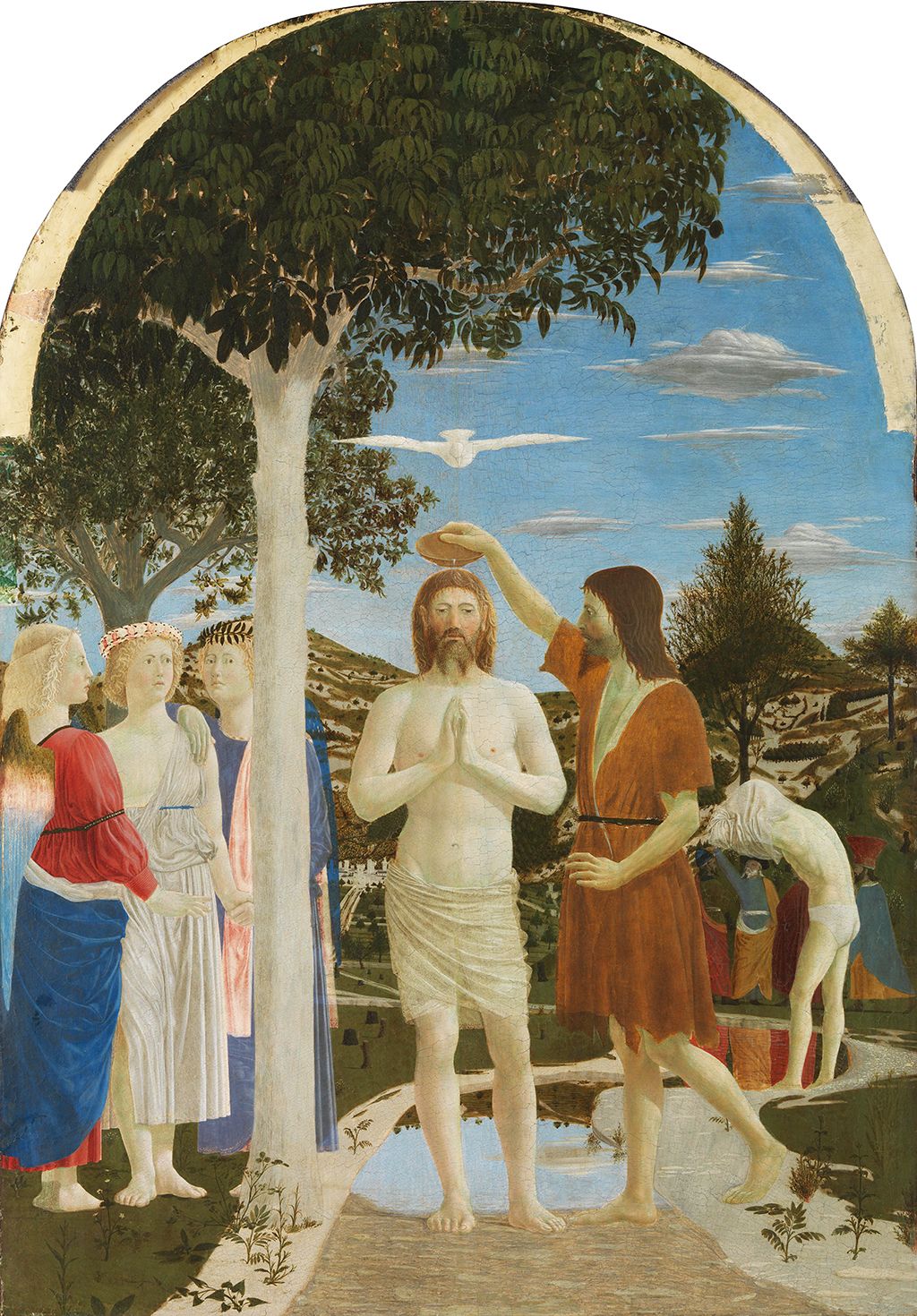
Historical comparison: Piero della Francesca, The Baptism of Christ, probably about 1437–45, National Gallery, London, NG665. A reproduction of this painting appears in the mirror in My Parents.
For Hockney, reproductions could sustain a real relationship with a picture. The National Gallery’s account of his conversation with Martin Gayford describes his repeated visits to its collection and his enjoyment of paintings through books, postcards and posters. It also preserves his distinction between the information a reproduction carries and the experience of standing before painted matter. He included Piero’s Baptism in the National Gallery selection he curated for The Artist’s Eye in 1981. In My Parents, a modest reproduction becomes part of the environment in which people sit, read and look. Art history enters the room through something that can be kept close at hand. [12]
The religious subject should be considered alongside that history of looking. Laura’s Methodism is documented, but the National Gallery’s account states that Hockney especially valued Piero’s spatial relationships; the Christian narrative was less important to him. The reflected image can therefore hold different associations without becoming a fixed declaration of either sitter’s beliefs. Its position makes it central to the composition, while its status as a favourite picture keeps it closely connected to the artist. [3] [12]
Green drapery also appears in the mirror. Its precise identification has been disputed in scholarship, and the broader effect does not depend on resolving that question: the reflection makes the room a place containing other images as well as people. An argues that the absence of Hockney’s face need not amount to the artist’s disappearance from the picture. His choices and artistic attachments can make him present in another way. This is an interpretation of the revised composition, rather than evidence of a single concealed intention. [11]
Oil paint and the double portrait
The painting belongs to Hockney’s sustained investigation of pairs of people in interiors. The Tate and Musée Granet account of his naturalistic work emphasises the combination of informal poses with the scale and formality of traditional portraiture. It also places drawing and photography together within his investigation of figures, light and pictorial depth. My Parents brings that ambition into an especially familiar setting, where the sitters’ habits had been known to him for years. [13] The Foundation locates its completion at Powis Terrace in London, where Hockney had expanded his studio. [7]
Its medium deserves attention. The completed canvas is oil, while the earlier Mr and Mrs Clark and Percy is acrylic. Both are carefully constructed encounters with people in a room, but a single label such as photographic realism cannot explain the full range of decisions involved. Preparatory drawing, a sitter’s movements and the painter’s revisions all contribute to the final arrangement. The surviving parents study and unfinished canvas make that process unusually visible in the documentary record. [1] [8] [3]
The finished room has the clarity of something settled, yet its history is one of adjustment. The mirror was reconsidered; the father’s reading was accommodated; the family grouping had to be attempted again. That difference between the apparent stillness of a picture and the activity required to make it is central to Hockney’s portraits. Here it gives the quiet scene a particular density: several kinds of looking and several periods of work have been brought into one durable arrangement.
Later portraits and a longer look
Kenneth died in February 1979. Hockney’s Mother, Bradford. 19 Feb 1979 was made on the day of the funeral. The Morgan’s label identifies its economical sepia-ink line and Laura’s direct gaze, and explains that the artist later mistakenly inscribed the year as 1978. This is a distinct drawing, made under different circumstances from the 1977 double portrait. Its small scale and reduced means make an affecting comparison with the room, furniture and paired figures of My Parents. [14]
Laura continued to sit for her son across changing media. In an essay for the National Gallery of Victoria, curator Meg Slater places My Parents within that longer relationship and reads Laura’s upright attention as an expression of the bond between mother and son. Slater also cautions, in discussing later photographs, against allowing knowledge of a sitter’s death to reduce a lifetime of images to anticipations of loss. The 1977 painting rewards the same care: it records people living, reading and being painted in one another’s company. [15]
The Foundation records William Feaver’s contemporary description of the painting as “devoted and altogether fine”. In 2024, the National Gallery exhibited it beside Looking at Pictures on a Screen (1977) and Piero’s original Baptism. Hockney and Piero: A Longer Look ran from 8 August to 27 October, bringing the reflected reproduction into a direct conversation with its source. [7] [9]
The comparison extends the painting beyond family biography without loosening its attachment to Kenneth and Laura. A mother looks towards her son, a father reads, and an admired painting appears in a mirror. Each directs attention differently. Hockney gives them room to coexist, asking us to move between a person’s face, an everyday action and the images through which a painter continued to learn to see.
Works directory
This source-bounded directory combines the works in the Metropolitan Museum’s 2017 retrospective checklist with reviewed museum object records and the additional works and series examined in this guide. It spans several media and is not a complete catalogue raisonné. Titles without an article link remain useful dated records. Metropolitan Museum final retrospective checklist (2017); additional object and series sources are given in the linked articles. [1]
| Name | Date | Medium |
|---|---|---|
| Love Painting | 1960 | Painting |
| Shame | 1960 | Painting |
| The Third Love Painting | 1960 | Painting |
| Tyger Painting No. 2 | 1960 | Painting |
| A Rake’s Progress | 1961–63 | Print series |
| Tea Painting in an Illusionistic Style | 1961 | Painting |
| The Cha-Cha That Was Danced in the Early Hours of 24th March | 1961 | Painting |
| Cleaning Teeth, Early Evening (10pm) W11 | 1962 | Painting |
| Flight into Italy - Swiss Landscape (Painting in a Scenic Style) | 1962 | Painting |
| Man in a Museum (or You're in the Wrong Movie) | 1962 | Painting |
| My Brother is Only Seventeen | 1962 | Painting |
| The First Marriage (A Marriage of Styles I) | 1962 | Painting |
| Domestic Scene, Los Angeles | 1963 | Painting |
| Play Within a Play | 1963 | Painting |
| The Hypnotist | 1963 | Painting |
| Arizona | 1964 | Painting |
| California Art Collector | 1964 | Painting |
| Man in Shower in Beverly Hills | 1964 | Painting |
| Portrait Surrounded by Artistic Devices | 1965 | Painting |
| Rocky Mountains and Tired Indians | 1965 | Painting |
| Beverly Hills Housewife | 1966–67 | Painting |
| Medical Building | 1966 | Painting |
| Peter | 1966 | Drawing |
| Peter Getting Out of Nick’s Pool | 1966 | Painting |
| A Bigger Splash | 1967 | Painting |
| A Lawn Being Sprinkled | 1967 | Painting |
| Kasmin in Bed in His Chateau in Carennac | 1967 | Drawing |
| Peter Feeling Not Too Good | 1967 | Drawing |
| Savings and Loan Building | 1967 | Painting |
| The Room, Tarzana | 1967 | Painting |
| American Collectors (Fred and Marcia Weisman) | 1968 | Painting |
| Christopher Isherwood and Don Bachardy | 1968 | Painting |
| Henry Geldzahler and Christopher Scott | 1968-1969 | Painting |
| W. H. Auden | 1968 | Drawing |
| Peter Langan in His Kitchen at Odins | 1969 | Drawing |
| Mark Glazebrook | 1970 | Drawing |
| Mr and Mrs Clark and Percy | 1970-1971 | Painting |
| Ossie Wearing a Fairisle Sweater | 1970 | Drawing |
| Pool and Steps, Le Nid du Duc | 1971 | Painting |
| Rubber Ring Floating in a Swimming Pool | 1971 | Painting |
| Celia in a Black Dress with White Flowers | 1972 | Drawing |
| Mount Fuji and Flowers | 1972 | Painting |
| Portrait of an Artist (Pool with Two Figures) | 1972 | Painting |
| Portrait of the Artist's Mother, Mrs Laura Hockney, Bradford | 1972 | Drawing |
| The Artist's Father | 1972 | Drawing |
| Dr Eugene Lamb, Lucca | 1973 | Drawing |
| Andy, Paris | 1974 | Drawing |
| Contre-jour in the French Style (Against the Day dans le Style-Français) | 1974 | Painting |
| Gregory Sitting on Base of Column | 1975 | Drawing |
| Kerby (after Hogarth) Useful Knowledge | 1975 | Painting |
| Ron Kitaj Outside Akademie der Kunste Vienna | 1975 | Drawing |
| Kasmin Reading the Udaipur Guide | 1977 | Drawing |
| Looking at Pictures on a Screen | 1977 | Painting |
| My Parents | 1977 | Painting |
| Canyon Painting | 1978 | Painting |
| Mother, Bradford, 19 Feb. 1979 (inscribed 1978) | 1979 | Drawing |
| Mulholland Drive: The Road to the Studio | 1980 | Painting |
| Nichols Canyon | 1980 | Painting |
| Outpost Drive, Hollywood | 1980 | Painting |
| Hollywood Hills House | 1981-1982 | Painting |
| Celia. Los Angeles. April 10th 1982 | 1982 | Polaroid composite |
| Don + Christopher, Los Angeles, 6th March 1982 | 1982 | Polaroid composite |
| Gregory Swimming Los Angeles March 31st 1982 | 1982 | Polaroid composite |
| My Mother, Bolton Abbey, Yorkshire, Nov. 1982 | 1982 | Photocollage |
| Self Portrait 30th Sept. 1983 | 1983 | Drawing |
| Pearblossom Hwy., 11-18th April 1986, #1 | 1986 | Photocollage |
| Pearblossom Hwy., 11–18th April 1986, #2 | 1986 | Photocollage |
| Large Interior, Los Angeles | 1988 | Painting |
| Breakfast at Malibu, Sunday, 1989 | 1989 | Painting |
| Pacific Coast Highway and Santa Monica | 1990 | Painting |
| The Other Side | 1991-1993 | Painting |
| The Eleventh V. N. Painting | 1992 | Painting |
| The Twenty Sixth V. N. Painting | 1992 | Painting |
| The Road Across the Wolds | 1997 | Painting |
| 9 Canvas Study of the Grand Canyon | 1998 | Painting |
| A Bigger Grand Canyon | 1998 | Painting |
| Colorado River | 1998 | Painting |
| Garrowby Hill | 1998 | Painting |
| Colin St. John Wilson. London. 3rd June 1999 | 1999 | Drawing |
| Gregory Evans. Los Angeles. 18th September 1999 | 1999 | Drawing |
| Laura Huston. London. 22nd June 1999 | 1999 | Drawing |
| Lindy. Marchioness of Dufferin and Ava. London. 17th June | 1999 | Painting |
| Going Up Garrowby Hill | 2000 | Painting |
| Red Pots in the Garden | 2000 | Painting |
| A Closer Winter Tunnel, February - March | 2006 | Painting |
| Elderflower Blossom, Kilham, July 2006 | 2006 | Painting |
| The Road to Thwing, July 2006 | 2006 | Painting |
| Bigger Trees near Warter | 2007 | Painting |
| Hawthorn Blossom near Rudston | 2008 | Painting |
| Views Through the Artist's Bedroom Window, Bridlington | 2010-2013 | Digital animation |
| The Arrival of Spring in Woldgate, East Yorkshire in 2011 (twenty eleven) | 2011 | Painting / digital series |
| 82 Portraits and 1 Still-life | 2013–16 | Portrait series |
| Garden | 2015 | Painting |
| Garden with Blue Terrace | 2015 | Painting |
| Garden #3 | 2016 | Painting |
| A Bigger Interior with Blue Terrace | 2017 | Painting |
| Interior with Blue Terrace and Garden | 2017 | Painting |
| A Year in Normandie | 2020–21 | Digital frieze |
Discussion
Look again at the images and ideas explored in My Parents. These editorial prompts invite your observations.
Reader Insights
How does Kenneth’s reading pose change when you know Hockney adopted it in response to his difficulty sitting still?
What changes in the family portrait when Hockney’s reflected face is replaced by a reproduction of Piero’s Baptism?
Compare Laura’s direct gaze in My Parents with the 1979 funeral-day drawing: what difference do the room, second sitter and still life make?
Join the Conversation
Share a detail, comparison or question about My Parents below.
References
- The Metropolitan Museum of Art, David Hockney, final exhibition checklist, 15 November 2017, pp. 9, 12, entries for Mr and Mrs Clark and Percy and My Parents. View source.
- The David Hockney Foundation, 2021 chronology. View source.
- National Portrait Gallery, “David Hockney: Drawing from Life”, learning resource, especially “The artist and relationships” and “David Hockney – my parents”. View source.
- Sarah Howgate and David Hockney, September 2019 interview excerpt, reproduced by Peggy Roalf, “David Hockney: Drawing From Life”, DART / AI-AP, 30 September 2020. View source.
- Bucerius Kunst Forum, David Hockney: My Parents, 1977 — Kunst für Zuhausebleiber:innen, educational resource, pp. 2–3, undated. View source.
- Jonathan Jones, “My Parents, David Hockney (1977)”, The Guardian, 19 January 2002; light and clothing description. View source.
- The David Hockney Foundation, “1977”, especially “Return to Powis Terrace”; artist’s recollection and William Feaver quotation as reproduced by the Foundation. View source.
- The Morgan Library & Museum, “Study for ‘My Parents and Myself’”, David Hockney: Drawing from Life, online exhibition label, 2020. View source.
- The National Gallery, “Hockney and Piero: A Longer Look”, 2024 exhibition press release; exhibition dates, earlier attempts and reflected reproduction. View source.
- The David Hockney Foundation, “2020”, especially “My Parents and Myself, On View”. View source.
- Jamin An, The Curator as the Artist’s Friend: Henry Geldzahler Negotiating Artistic Autonomy in the 1960s, PhD dissertation, University of California, Los Angeles, 2021, pp. 51–59, especially pp. 54–57 and note 49 citing Tate’s 1984 acquisition catalogue. View source.
- The National Gallery, “David Hockney and the National Gallery: A lifelong source of inspiration”, 2024; online article based on David Hockney’s conversation with Martin Gayford. View source.
- Tate and Musée Granet, David Hockney: Works from the Tate Collection, English press pack, 2023, p. 14, “Towards Naturalism”. View source.
- The Morgan Library & Museum, “Mother, Bradford. 19 Feb 1979”, David Hockney: Drawing from Life, online exhibition label, 2020. National Portrait Gallery, David Hockney: Drawing from Life, large-print labels, 2023, p. 30; death month and corrected drawing date. View source 1. View source 2.
- Meg Slater, “Recording Loss and Servicing Grief: The Photographic Work of Sophie Calle and David Hockney”, in MOTHER: Digital Publication, National Gallery of Victoria, undated, relevant Hockney passages. View source.
More HOCKNEY Works
A Bigger Splash
A momentary disturbance becomes the focus of a large acrylic painting, made through weeks of patient work.
Mr and Mrs Clark and Percy
The designers Celia Birtwell and Ossie Clark occupy a room shaped by light, repeated sittings and the demands of a double portrait.
A Bigger Grand Canyon
Sixty canvases gather memory, studies and changing viewpoints into an immense painting of 1998.
Garrowby Hill
The 1998 oil painting transforms a remembered Yorkshire journey into a road, fields and an expansive view.
Portrait of an Artist (Pool with Two Figures)
Photographic studies, two figures and a swimming pool become a carefully constructed painting of 1972.
My Parents
The 1977 oil painting sets Kenneth and Laura Hockney within a quietly organised interior.
Pearblossom Hwy., 11–18th April 1986, #2
Hundreds of separately made photographs construct a road scene that unfolds through movement and time.
Bigger Trees near Warter
Fifty canvases join into a large outdoor painting of Yorkshire trees, with photography helping the artist organise the whole.