


 by Tom Gurney
Tom Gurney BSc (Hons) is an art history expert with over 20 years experience
Email: tomgurney1@gmail.com / Phone: +44 7429 011000
California: Introduction
David Hockney’s California begins with a peculiar kind of recognition: he arrived somewhere he had already pictured. Modern houses, men beside swimming pools and the promise of a different social life had reached him in Britain through photographs and print. When he first visited Los Angeles in 1964, the city supplied actual distances, friendships and working conditions to set against those images. Over the following decades, its pools and roads became ways of asking how a picture could contain light, movement and the experience of looking. [1]
California occupied several different roles in his life. It was a new environment in the 1960s, a renewed home and working base in the late 1970s, a place of experiments with cameras and office machines, and a studio location from which he could paint remembered Yorkshire. His movements repeatedly connected Los Angeles with London, Paris and northern England. Reading the California work through those journeys reveals a changing artistic geography: the domestic enclosure of a pool, the descent through a canyon, the expansiveness of a desert crossroads and the concentrated encounter between painter and sitter. [2]
At a Glance
- ArtistDavid Hockney
- Born9 July 1937, Bradford, England
- Died11 June 2026
- FocusCalifornia
Contents
- California before the journey
- Arrival, materials and a circle of friends
- Water, glass and the modern house
- People and the spaces around them
- California as a workshop
- The road to the studio
- Pools and desert roads through the camera
- Malibu: water close to home
- Returning, remembering and painting people again
California before the journey
Hockney’s first American visit was to New York in 1961; he returned there in 1963. Los Angeles came afterwards, in 1964. The distinction matters because California had already entered his paintings before he saw it. Domestic Scene, Los Angeles, made in 1963, drew on an image of two men from the magazine Physique Pictorial. Its imagined domestic intimacy belonged to the work he was developing in London, where photographs could give visible form to desires and situations beyond his immediate surroundings. [2] [3]
The literary scholar Matthew Sperling identifies two photographic attractions in Hockney’s later account of his journey: Julius Shulman’s photograph of Case Study House No. 21 and the male bodies published by the Athletic Model Guild in Physique Pictorial. Architecture and erotic imagery arrived together. The photographs promised spaces where the body might be seen differently, against glass walls and beside private pools. Sperling also records Hockney’s surprise at seeing so many blue pools from the aircraft. The actual city added colour, scale and repetition to a visual vocabulary previously encountered in black and white. [1]
Another imagined Los Angeles came through John Rechy’s novel City of Night. Hockney recalled trying to reach its Pershing Square nightlife by cycling along Wilshire Boulevard from Santa Monica. A continuous line on the map concealed a journey of roughly eighteen miles; he arrived to find the square deserted and faced the ride home. In the Foundation’s account, his response was to acquire a car. The episode has a practical consequence for the later art: understanding Los Angeles required him to experience distance through driving. Its geography could not be absorbed in the same way as a compact walking city. [4]
Arrival, materials and a circle of friends
Hockney set up a home and studio in Santa Monica in 1964. His first Los Angeles painting, Plastic Tree Plus City Hall, used acrylic, and he also began taking Polaroid photographs. New materials accompanied new subjects. The photographs offered immediate, portable observations; painting allowed him to select and invent. In the early Californian works, the city’s recognisable signs could be assembled into a picture without becoming a record of a single location. The Foundation preserves his description of California Art Collector as an invented scene whose pool came from a newspaper advertisement. [4]
The city was also a network of people. Among those he met were the writer Christopher Isherwood and the artist Don Bachardy, the dealer Nicholas Wilder, the actor Jack Larson, the screenwriter and director Jim Bridges, and the printer Ken Tyler. Those encounters connected domestic life with literature, film, galleries and the workshop. Friends could become sitters, a visit could produce photographs, and a printer could propose a new way of making a picture. The artist’s illustrated chronology places this rapid expansion of his circle within his first Los Angeles visit. [5]
In 1966 he returned to Los Angeles and worked in a studio on Pico Boulevard. While teaching drawing at the University of California, Los Angeles, he met Peter Schlesinger, who became his partner and a frequent model. He also met the arts patron Betty Freeman. In Beverly Hills Housewife, her home offered an architectural framework of glass, garden and strong light. Hockney used his own preparatory black-and-white photographs and rearranged the elements for the composition. Even a painting so closely associated with a named Californian person and house was a constructed relationship between figure and setting. [6]
Water, glass and the modern house
The modern house presented Hockney with surfaces that complicated what could be seen: glass might reveal an interior while reflecting its surroundings, and water might show a swimmer while breaking the body into moving patterns. The Tate and Musée Granet exhibition guide connects the shower paintings with his interest in transparency and the moving body. These pictures also placed a contemporary American setting within the much longer artistic subject of bathing. A shower, pool or glass wall supplied both an intimate situation and a problem of depiction. [7]
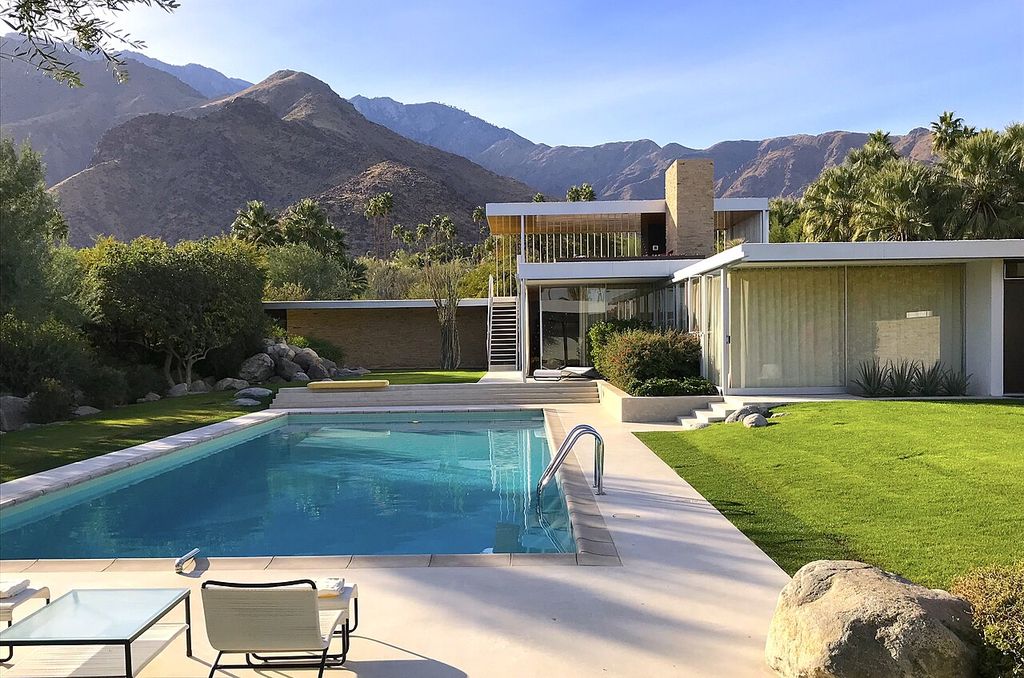
Architectural comparison: the Kaufmann House and swimming pool in Palm Springs, photographed in 2017. Pmeulbroek / Wikimedia Commons. Image source. CC BY-SA 4.0. Image resized; framing and colours retained. This derivative retains CC BY-SA 4.0.
Hockney described the difficulty of giving water a stable visual description: it changes colour and moves, offering no single form to copy. The Foundation connects Sunbather and Portrait of Nick Wilder with this investigation. The human figure and the surface around it demand different kinds of attention. A body can establish a scale and a recognisable action, while the water alters what can be seen of it. The pool becomes a testing ground for marks that must suggest transparency, reflection and movement on the same flat surface. [6]
In 1967, while living with Schlesinger in Los Angeles and teaching for a term at Berkeley, he continued exploring glistening surfaces in A Bigger Splash and A Lawn Being Sprinkled. The duration of making became part of the problem. Hockney contrasted the fleeting event of a splash with the prolonged work needed to fix its appearance in paint. The pool’s architectural surroundings provide a stable framework against which that disturbance becomes legible. The separate study of A Bigger Splash follows the individual canvas more closely; within the California work, it shows how a familiar backyard could support an exacting investigation of time. [8]
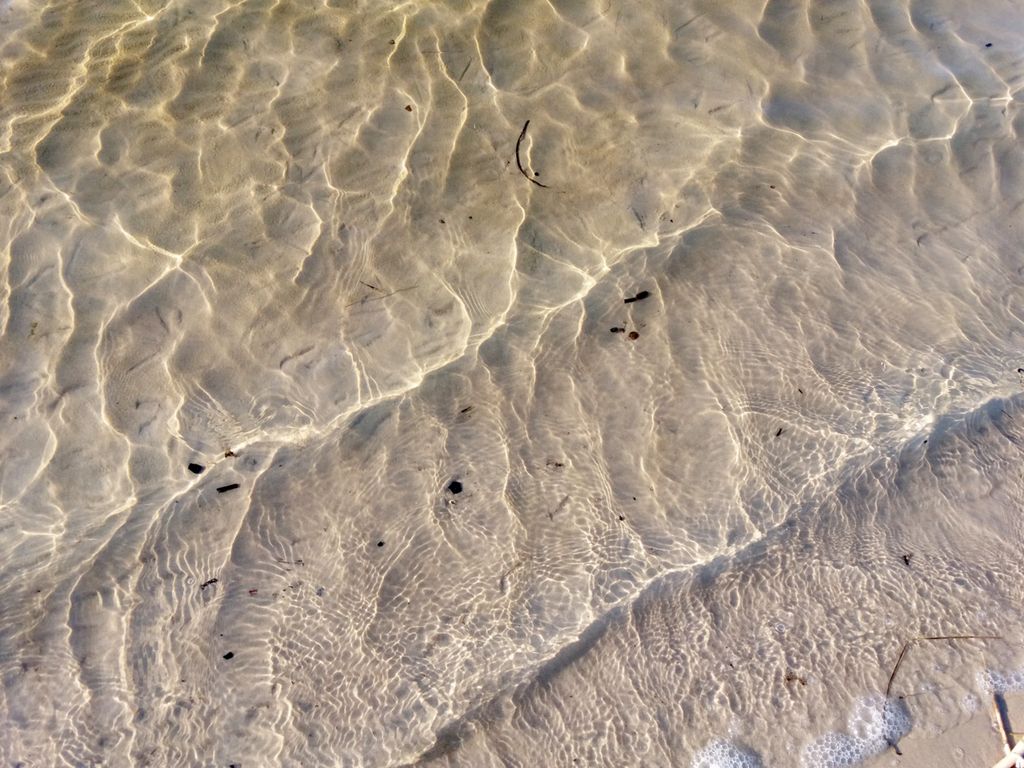
Physical comparison: concentrated patterns of light in shallow water at a beach. Peacelovedeathmetal2 / Wikimedia Commons. Image source. CC BY-SA 4.0. Resized and converted to JPEG; no crop or recolouring. Image derivative retains CC BY-SA 4.0.
People and the spaces around them
By 1968, the Californian interior and garden had become settings for Hockney’s large double portraits. He spent the first half of that year in Santa Monica working on Christopher Isherwood and Don Bachardy and American Collectors (Fred and Marcia Weisman). His account of posing Isherwood and Bachardy is unusually concrete. When relaxed, Isherwood crossed his leg and looked towards Bachardy; Bachardy looked towards the painter. Their different directions of attention supplied the arrangement. The picture’s structure grew from an observed encounter between people who knew one another. [9]
Writing for the Metropolitan Museum, Michael Cirigliano II describes the resulting composition as a triangle linking the two men and the viewer. He places their visible partnership within the hostility faced by gay couples in mid-century America. That history gives the domestic setting particular weight. The room provides a space in which two men can occupy a large, sustained portrait together, with the individuality of their poses intact. Their differing directions of attention also involve the viewer in the painted encounter. [10]
In American Collectors, Hockney extended portraiture into the objects surrounding the sitters. He explained that the sculptures and the whole setting formed part of his portrayal of Fred and Marcia Weisman. This makes the California house more than a backdrop. Collecting, display and the organisation of outdoor space participate in how the figures are presented. The two double portraits therefore use domestic geography differently: one emphasises an arrangement of attention within a couple, while the other gives their possessions and environment a substantial role in the portrait. [9]
The pool motif travelled with him. Portrait of an Artist (Pool with Two Figures), finished in 1972, drew on photographs made at Tony Richardson’s French pool at Le Nid du Duc, near Saint-Tropez, and on separately made figure studies. Its French landscape and connection with Schlesinger carried the subject beyond the Californian pool paintings. The image belongs to an exchange between places, assembled through photographs and decisions made in the London studio. [11]
California as a workshop
Los Angeles also connected Hockney with the technical possibilities of collaborative printmaking. The National Gallery of Australia identifies his first project with Tyler as A Hollywood Collection, six colour lithographs made at the Gemini Ltd workshop on Melrose Avenue in 1965. Each sheet evokes a different category of painting, creating a small collection through prints. Their later collaboration on the Weather series in 1973 gave Hockney a range of drawing and wash effects on lithographic stones or plates. The workshop expanded his means of describing a world already under investigation in paintings and drawings. [12]
That collaboration crossed the continent. The Paper Pools of 1978 were made at Tyler’s workshop in Bedford Village, New York, using coloured paper pulp. They were unique objects, with the image formed through the sheet’s material. Hockney’s account stresses the bold masses of colour demanded by the process, a different operation from drawing a fine etched line. A subject associated with California developed through work elsewhere, circulating between technologies and places. [12] [13]
Hockney’s renewed settlement in Los Angeles took shape in 1978–79. The Foundation dates the establishment of his permanent residence to August 1978 and records his return to painting in the Los Angeles studio that autumn. [13]
Its 1979 account places him in a house high in the Hollywood Hills. His work that year also continued between Gemini G.E.L. in Los Angeles and Tyler Graphics, with lithographic portraits of friends among the results. His California base remained connected to other working places. [14]
The road to the studio
The new hillside position changed what a journey could contribute to a painting. Hockney repeatedly travelled between his elevated home and the studio below. In his account of Nichols Canyon, he began by drawing a winding line down the canvas, recalling the turns he physically experienced during the daily drive. In the autumn of 1980, Nichols Canyon and Mulholland Drive: The Road to the Studio gave different structures to this problem. A road could organise the surface while carrying the memory of ascent, descent and repeated turning. [15]
Mulholland Drive spreads across a canvas more than six metres wide. LACMA describes it as a personalised panoramic map, painted from memory, of the journey from the Hollywood Hills home to the Santa Monica Boulevard studio. Trees, houses, tennis courts and power lines alternate with simpler areas of colour and grids. Those variations allow the view to move between particular things and the larger organisation of the city. The road across the upper part carries the eye laterally, translating the changing altitude and motion of the ridge drive into a sequence of looking. [16]
Nichols Canyon gives the route a tall format, in contrast to that lateral panorama. The difference is useful: the same habitual movement could generate more than one pictorial organisation. Anthi-Danaé Spathoni’s study of Hockney’s landscapes interprets these road pictures through the participation they require from the viewer. Following a line through the painting takes time; the viewer reconstructs a journey through successive acts of attention. Her argument helps connect these canvases with later works made from multiple photographic views, while the paintings themselves already establish movement as a compositional question. [17] [18]
The problem had also emerged through difficulty. Hockney struggled with the large Santa Monica Blvd., begun in 1978, and came to regard it as too static. In his recollection, Los Angeles signs and buildings were designed to be recognised from a moving car. Collecting their appearances in photographs did not automatically reproduce that experience in painting. In the canyon pictures, the route, its bends and its changes of view could generate the image’s structure. [13]
Distance could sharpen the experience of a house as well. The Foundation records Hockney painting Hollywood Hills House in Bradford at Christmas in 1981, drawing on his recollection of moving through his Los Angeles home. Opera models, a picture painted by his father and a Renaissance postcard belonged to that remembered interior. The Walker Art Center dates the work 1981–82 and identifies its materials as oil, charcoal and collage on canvas. Across its three canvases, a familiar Californian interior becomes a painted reconstruction made in Yorkshire. [19] [20]
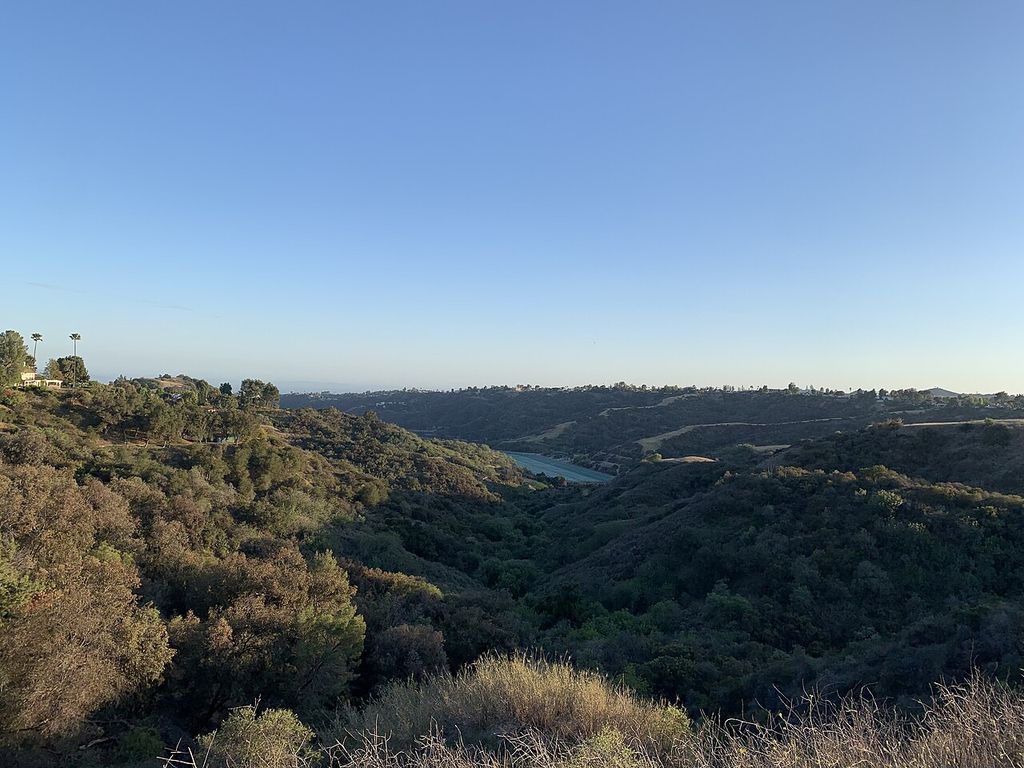
Los Angeles context: Stone Canyon Reservoir and the surrounding hills. DocFreeman24 / Wikimedia Commons. Image source. CC BY-SA 4.0. Resized and converted to JPEG; no crop or recolouring. Image derivative retains CC BY-SA 4.0.
Pools and desert roads through the camera
In 1982, Hockney began making composite Polaroid pictures that brought several views into a single work. Getty’s exhibition labels explain the distinction he sought between an isolated photographic instant and an image containing time and the artist’s presence. Using the Polaroid SX-70, he assembled instantaneous prints into grids. The camera became a means of constructing an extended encounter with a subject. People and surroundings could change while he worked, and the finished composite retained the evidence of successive observations. [21]
The pool gave that experiment a precise test. Getty curator Virginia Heckert describes Jerry Diving, Sunday Feb. 28th 1982 as twenty-one prints arranged in three rows of seven. Jerry Sohn’s dive extends across seven frames, from the diving board to the splash; Sohn told Heckert he had repeated it at least eight times. The result gathers actions across time into a grid that can be inspected at leisure. The pool had already helped Hockney contrast a rapid event with slow painting. Here it allowed him to distribute motion among multiple photographs. [22]
Pearblossom Hwy., 11–18th April 1986, #2 enlarges this investigation into a desert crossroads north of Los Angeles. It is a collage of chromogenic prints, assembled from hundreds of separate photographs. In the explanation published by Getty, Hockney distinguished the driver’s attention to instructions on the right from the passenger’s freer looking on the left. The car remains outside the picture, but the different tasks of its occupants shape the view. Roads, signs and roadside detail become the components of a picture about how people travel through a place. [23] [22]
The construction makes familiar things insist on attention. Getty’s teaching guide points out the visible joins and the unusually large street sign, whose scale does not follow a single photograph’s recession into distance. Such adjustments allow an object encountered closely to remain emphatic within a wider view. The crossroads can be read both as a landscape extending towards the horizon and as a gathering of separately noticed surfaces. This gives the desert road a different density from the open poolside compositions: the eye keeps finding another edge, instruction or interruption to examine. [24]
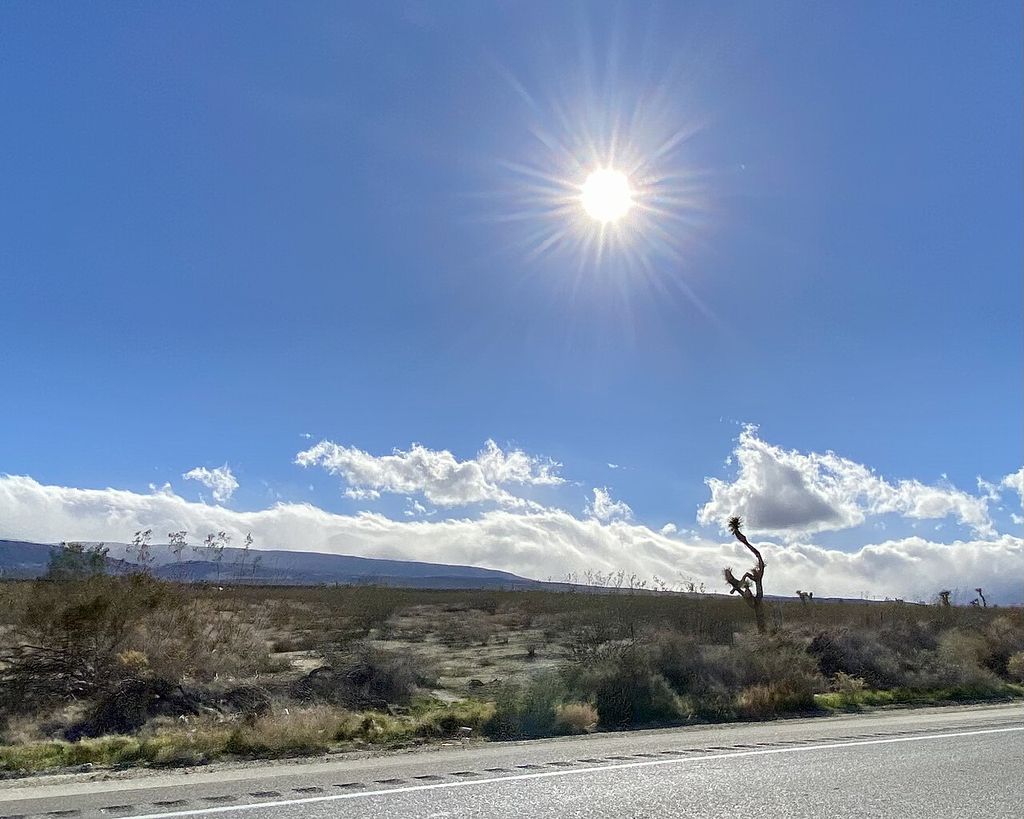
Geographic context: Pearblossom Highway and a Joshua tree, photographed in 2023. Jengod / Wikimedia Commons. Image source. CC BY-SA 4.0. Resized and converted to JPEG; no crop or recolouring. Image derivative retains CC BY-SA 4.0.
Malibu: water close to home
The house and studio Hockney acquired in Malibu in 1988 introduced another relationship with water. He described living so close to the sea that it splashed the windows; the continual movement immediately outside mattered more than the distant horizon. That account changes the scale of the subject. In the pool pictures, architecture often establishes water as an area within a designed enclosure. At Malibu, the water approached the house and filled his attention through its restless nearness. Friends and family also sat for portraits there, which he copied on a Canon colour copier and gave to the sitters. [25]
The neighbouring roads extended the experiment into sound. In 1990, the Foundation records his paintings of the Santa Monica Mountains and the development of Wagner Drive, a timed journey with music along the Pacific Coast Highway and through the mountains. Hockney described coordinating a bend in the road and the sudden appearance of the setting sun with a rise in the music. Passengers could look in several directions from the open car. The work joined duration, sound and unfolding views, giving a shared journey the kind of deliberate organisation he brought to a picture. [26]
Malibu also became a setting for concentrated domestic work. After the deaths of numerous friends, and particularly Henry Geldzahler, Hockney made drawings and paintings of his dachshunds Stanley and Boodgie. The Foundation’s 1995 account preserves his explanation that love for the animals was the subject. Their continual presence made small changes of posture and rest available to repeated observation. The dog paintings belong within this Californian geography as much as the large road pictures: intimacy could emerge through sustained attention to the creatures sharing a home. [27]
Returning, remembering and painting people again
California and Yorkshire increasingly worked upon one another. In 1997 Hockney drove across Yorkshire to visit his terminally ill friend Jonathan Silver, repeatedly travelling between Bridlington and Saltaire. The Foundation connects those journeys with his renewed consideration of the landscape of his childhood. Back in Los Angeles, he continued painting Yorkshire from memory. A California studio could therefore contain the recollected bends and fields of a different country. His landscape painting developed through an exchange between direct encounter, repeated travel and what remained vivid after departure. [28] [29]
The American Southwest supplied further journeys, including his long engagement with the Grand Canyon in Arizona. A Bigger Grand Canyon, completed in 1998, drew on memory and earlier photographic work while Yorkshire landscapes were also being made in Los Angeles. The Arizona canyon and Yorkshire fields entered the work through their connection with a Californian studio. Both demanded ways to organise an extensive, remembered experience of space, and to give the viewer more to do than identify a view. [29]
Hockney returned to Los Angeles in 2013 after years of work on the Yorkshire landscape. The portraits that became 82 Portraits and 1 Still-life largely date from 2013–16 and were made in his Hollywood Hills studio. LACMA records their consistent conditions: acrylic on canvases measuring 48 by 36 inches, a yellow armchair and a blue background adjusted in relation to clothing. The sitters included friends, relatives, artists, employees and acquaintances; none of the portraits was commissioned. Repetition placed the differences between bodies, clothes and chosen positions at the centre of the series. [30] [31]
Stephanie Barron’s recollection of sitting in January 2014 brings those conditions into focus. Hockney asked for three consecutive days. She chose a red outfit, tried positions she could sustain and watched him adjust the chair before beginning. An assistant marked her feet’s positions on the floor with tape so the pose could be resumed. The encounter alternated concentrated looking with breaks and meals in the house. California’s domestic and artistic worlds remained closely connected, now organised around the time given by a sitter and the painter’s returning scrutiny. [31]
Across these different phases, California offered Hockney particular situations in which seeing could be tested: a body through water, two people in a room, a sign recognised at speed, a dive spread across frames, a remembered house painted abroad. Its importance reaches beyond familiar motifs to the practical circumstances through which pictures were made—friendship, workshops, journeys, rooms and time spent looking. Those circumstances also keep his California connected with the other places in his biography, where experiences gathered in one country could become pictures in another. [18] [19]
Works directory
This source-bounded directory combines the works in the Metropolitan Museum’s 2017 retrospective checklist with reviewed museum object records and the additional works and series examined in this guide. It spans several media and is not a complete catalogue raisonné. Titles without an article link remain useful dated records. Metropolitan Museum final retrospective checklist (2017); additional object and series sources are given in the linked articles. [17]
| Name | Date | Medium |
|---|---|---|
| Love Painting | 1960 | Painting |
| Shame | 1960 | Painting |
| The Third Love Painting | 1960 | Painting |
| Tyger Painting No. 2 | 1960 | Painting |
| A Rake’s Progress | 1961–63 | Print series |
| Tea Painting in an Illusionistic Style | 1961 | Painting |
| The Cha-Cha That Was Danced in the Early Hours of 24th March | 1961 | Painting |
| Cleaning Teeth, Early Evening (10pm) W11 | 1962 | Painting |
| Flight into Italy - Swiss Landscape (Painting in a Scenic Style) | 1962 | Painting |
| Man in a Museum (or You're in the Wrong Movie) | 1962 | Painting |
| My Brother is Only Seventeen | 1962 | Painting |
| The First Marriage (A Marriage of Styles I) | 1962 | Painting |
| Domestic Scene, Los Angeles | 1963 | Painting |
| Play Within a Play | 1963 | Painting |
| The Hypnotist | 1963 | Painting |
| Arizona | 1964 | Painting |
| California Art Collector | 1964 | Painting |
| Man in Shower in Beverly Hills | 1964 | Painting |
| Portrait Surrounded by Artistic Devices | 1965 | Painting |
| Rocky Mountains and Tired Indians | 1965 | Painting |
| Beverly Hills Housewife | 1966–67 | Painting |
| Medical Building | 1966 | Painting |
| Peter | 1966 | Drawing |
| Peter Getting Out of Nick’s Pool | 1966 | Painting |
| A Bigger Splash | 1967 | Painting |
| A Lawn Being Sprinkled | 1967 | Painting |
| Kasmin in Bed in His Chateau in Carennac | 1967 | Drawing |
| Peter Feeling Not Too Good | 1967 | Drawing |
| Savings and Loan Building | 1967 | Painting |
| The Room, Tarzana | 1967 | Painting |
| American Collectors (Fred and Marcia Weisman) | 1968 | Painting |
| Christopher Isherwood and Don Bachardy | 1968 | Painting |
| Henry Geldzahler and Christopher Scott | 1968-1969 | Painting |
| W. H. Auden | 1968 | Drawing |
| Peter Langan in His Kitchen at Odins | 1969 | Drawing |
| Mark Glazebrook | 1970 | Drawing |
| Mr and Mrs Clark and Percy | 1970-1971 | Painting |
| Ossie Wearing a Fairisle Sweater | 1970 | Drawing |
| Pool and Steps, Le Nid du Duc | 1971 | Painting |
| Rubber Ring Floating in a Swimming Pool | 1971 | Painting |
| Celia in a Black Dress with White Flowers | 1972 | Drawing |
| Mount Fuji and Flowers | 1972 | Painting |
| Portrait of an Artist (Pool with Two Figures) | 1972 | Painting |
| Portrait of the Artist's Mother, Mrs Laura Hockney, Bradford | 1972 | Drawing |
| The Artist's Father | 1972 | Drawing |
| Dr Eugene Lamb, Lucca | 1973 | Drawing |
| Andy, Paris | 1974 | Drawing |
| Contre-jour in the French Style (Against the Day dans le Style-Français) | 1974 | Painting |
| Gregory Sitting on Base of Column | 1975 | Drawing |
| Kerby (after Hogarth) Useful Knowledge | 1975 | Painting |
| Ron Kitaj Outside Akademie der Kunste Vienna | 1975 | Drawing |
| Kasmin Reading the Udaipur Guide | 1977 | Drawing |
| Looking at Pictures on a Screen | 1977 | Painting |
| My Parents | 1977 | Painting |
| Canyon Painting | 1978 | Painting |
| Mother, Bradford, 19 Feb. 1979 (inscribed 1978) | 1979 | Drawing |
| Mulholland Drive: The Road to the Studio | 1980 | Painting |
| Nichols Canyon | 1980 | Painting |
| Outpost Drive, Hollywood | 1980 | Painting |
| Hollywood Hills House | 1981-1982 | Painting |
| Celia. Los Angeles. April 10th 1982 | 1982 | Polaroid composite |
| Don + Christopher, Los Angeles, 6th March 1982 | 1982 | Polaroid composite |
| Gregory Swimming Los Angeles March 31st 1982 | 1982 | Polaroid composite |
| My Mother, Bolton Abbey, Yorkshire, Nov. 1982 | 1982 | Photocollage |
| Self Portrait 30th Sept. 1983 | 1983 | Drawing |
| Pearblossom Hwy., 11-18th April 1986, #1 | 1986 | Photocollage |
| Pearblossom Hwy., 11–18th April 1986, #2 | 1986 | Photocollage |
| Large Interior, Los Angeles | 1988 | Painting |
| Breakfast at Malibu, Sunday, 1989 | 1989 | Painting |
| Pacific Coast Highway and Santa Monica | 1990 | Painting |
| The Other Side | 1991-1993 | Painting |
| The Eleventh V. N. Painting | 1992 | Painting |
| The Twenty Sixth V. N. Painting | 1992 | Painting |
| The Road Across the Wolds | 1997 | Painting |
| 9 Canvas Study of the Grand Canyon | 1998 | Painting |
| A Bigger Grand Canyon | 1998 | Painting |
| Colorado River | 1998 | Painting |
| Garrowby Hill | 1998 | Painting |
| Colin St. John Wilson. London. 3rd June 1999 | 1999 | Drawing |
| Gregory Evans. Los Angeles. 18th September 1999 | 1999 | Drawing |
| Laura Huston. London. 22nd June 1999 | 1999 | Drawing |
| Lindy. Marchioness of Dufferin and Ava. London. 17th June | 1999 | Painting |
| Going Up Garrowby Hill | 2000 | Painting |
| Red Pots in the Garden | 2000 | Painting |
| A Closer Winter Tunnel, February - March | 2006 | Painting |
| Elderflower Blossom, Kilham, July 2006 | 2006 | Painting |
| The Road to Thwing, July 2006 | 2006 | Painting |
| Bigger Trees near Warter | 2007 | Painting |
| Hawthorn Blossom near Rudston | 2008 | Painting |
| Views Through the Artist's Bedroom Window, Bridlington | 2010-2013 | Digital animation |
| The Arrival of Spring in Woldgate, East Yorkshire in 2011 (twenty eleven) | 2011 | Painting / digital series |
| 82 Portraits and 1 Still-life | 2013–16 | Portrait series |
| Garden | 2015 | Painting |
| Garden with Blue Terrace | 2015 | Painting |
| Garden #3 | 2016 | Painting |
| A Bigger Interior with Blue Terrace | 2017 | Painting |
| Interior with Blue Terrace and Garden | 2017 | Painting |
| A Year in Normandie | 2020–21 | Digital frieze |
Discussion
Look again at the images and ideas explored in California. These editorial prompts invite your observations.
Reader Insights
Compare the California Hockney first imagined through photographs with the city he encountered by bicycle and car. Which change in scale or experience seems most consequential for his pictures?
How does the role of the house differ between the portrait of Isherwood and Bachardy, the Weismans’ setting and the remembered Hollywood Hills House?
Follow the progression from A Bigger Splash to Jerry Diving and Pearblossom Hwy. How does each work ask the viewer to spend time looking?
Join the Conversation
Share a detail, comparison or question about California below.
References
- Matthew Sperling, “Water Marks: The Pull of Hockney’s Pool Paintings”, Apollo, February 2017, pp. 52–58; four-page author’s repository proof, especially pp. 52–55. View source.
- The David Hockney Foundation, “Chronology”, overview entries for 1961–64, 1973–79 and later movements. View source.
- The David Hockney Foundation, “1963”, section “Paintings of couples”. View source.
- The David Hockney Foundation, “1964”, sections “Move to L.A.” and “Landscapes and swimming pools”. View source.
- David Hockney, “Illustrated Biography”, entry for 1964, first Los Angeles visit and new acquaintances. View source.
- The David Hockney Foundation, “1966”, sections “Los Angeles”, “Southern Californian lifestyle” and “Reflections on water”. View source.
- Tate and Musée Granet, David Hockney: Works from the Tate Collection, 2023 press pack, “Section 2: Los Angeles”, PDF p. 11. View source.
- The David Hockney Foundation, “1967”, sections “Infatuated with L.A.” and “A Bigger Splash”. View source.
- The David Hockney Foundation, “1968”, sections “Double-portraits” and “Back in London, with trips to Europe”. View source.
- Michael Cirigliano II, “Exploring the Love Letters of Christopher Isherwood and Don Bachardy”, Metropolitan Museum of Art, 7 February 2018, introductory discussion of the portrait. View source.
- Christie’s, Portrait of an Artist (Pool with Two Figures), 2018 lot record and essay, photographic studies and work in France and London. View source.
- National Gallery of Australia, “David Hockney”, Kenneth E. Tyler Collection, sections on A Hollywood Collection, Weather and Paper Pools. View source.
- The David Hockney Foundation, “1978”, sections “Paper Pools” and “Painting L.A.”. View source.
- The David Hockney Foundation, “1979”, sections “Prints at Gemini G.E.L. and Tyler Graphics” and “A new house in the Hollywood Hills”. View source.
- The David Hockney Foundation, “1980”, section “Different views of L.A.”. View source.
- Los Angeles County Museum of Art, Mulholland Drive: The Road to the Studio, 1980, object M.83.35, catalogue fields and curatorial notes. View source.
- The Metropolitan Museum of Art, David Hockney: Final Checklist, 15 November 2017, PDF p. 13, entries for Nichols Canyon and Hollywood Hills House. View source.
- Anthi-Danaé Spathoni, “David Hockney’s Moving Landscapes”, RHA, no. 11, pp. 95–103, especially pp. 97–100. View source.
- The David Hockney Foundation, “1981”, section “Hollywood Hills House”. View source.
- Walker Art Center, Hollywood Hills House, 1981–82, object 1983.5.1–.3. View source.
- J. Paul Getty Museum, Happy Birthday, Mr. Hockney, 2017 exhibition texts, “Photographs”, PDF p. 3. View source.
- Julian Brooks and Virginia Heckert, “Remembering the Creativity and Humor of David Hockney”, Getty, 3 September 2026, discussion of Jerry Diving and Pearblossom Hwy. View source.
- J. Paul Getty Museum, Pearblossom Hwy., 11–18th April 1986, #2, object 97.XM.39, artist’s explanation of driver and passenger viewpoints. View source.
- Roberta Fong / J. Paul Getty Museum, “In Depth: Pearblossom Highway”, lesson steps 1–6 and discussion of collage, scale and perspective. View source.
- The David Hockney Foundation, “1988”, section “Malibu house/studio”. View source.
- The David Hockney Foundation, “1990”, section “Wagner Drive”. View source.
- The David Hockney Foundation, “1995”, section “Dog Paintings”. View source.
- The David Hockney Foundation, “1997”, section “Visiting Jonathan Silver”. View source.
- The David Hockney Foundation, “1998”, section “Painting distant landscapes”. View source.
- Los Angeles County Museum of Art, “Opening This Week! David Hockney: 82 Portraits and 1 Still-life”, 9 April 2018. View source.
- Stephanie Barron, “Remembering David Hockney”, LACMA, 12 June 2026, recollections of the 2013 return and January 2014 portrait sitting. View source.
More HOCKNEY Works
A Bigger Splash
A momentary disturbance becomes the focus of a large acrylic painting, made through weeks of patient work.
Mr and Mrs Clark and Percy
The designers Celia Birtwell and Ossie Clark occupy a room shaped by light, repeated sittings and the demands of a double portrait.
A Bigger Grand Canyon
Sixty canvases gather memory, studies and changing viewpoints into an immense painting of 1998.
Garrowby Hill
The 1998 oil painting transforms a remembered Yorkshire journey into a road, fields and an expansive view.
Portrait of an Artist (Pool with Two Figures)
Photographic studies, two figures and a swimming pool become a carefully constructed painting of 1972.
My Parents
The 1977 oil painting sets Kenneth and Laura Hockney within a quietly organised interior.
Pearblossom Hwy., 11–18th April 1986, #2
Hundreds of separately made photographs construct a road scene that unfolds through movement and time.
Bigger Trees near Warter
Fifty canvases join into a large outdoor painting of Yorkshire trees, with photography helping the artist organise the whole.