


 by Tom Gurney
Tom Gurney BSc (Hons) is an art history expert with over 20 years experience
Email: tomgurney1@gmail.com / Phone: +44 7429 011000
David Hockney and Vincent van Gogh: Introduction
David Hockney’s relationship with Vincent van Gogh can be traced through things he did: studying drawings, taking up a reed pen, returning to a familiar landscape and painting an empty chair. Van Gogh offered him ways to think about the passage from looking to making a picture. In 1978, long before Hockney’s sustained work in the Yorkshire countryside, the artist was already making quick sepia-ink drawings under Van Gogh’s influence and discussing Café Terrace at Night for a BBC film. Their connection reached beyond a shared appetite for strong colour. [1]
The exhibition Hockney–Van Gogh: The Joy of Nature, held in Amsterdam in 2019, brought that continuing exchange into public view. Landscapes, drawings and experiments with newer media placed Hockney’s work in conversation with pictures made more than a century earlier. The pairing helps us ask a precise question: what can one artist learn from another while continuing to see the world in his own way? Hockney’s practice supplies several answers, from the smallest descriptive mark to the experience of standing before an enormous painting. [2]
At a Glance
- ArtistDavid Hockney
- Born9 July 1937, Bradford, England
- Died11 June 2026
- Focusand Vincent van Gogh
Contents
- Looking at the painting itself
- Sunflowers, a chair and direct borrowings
- The Joy of Nature in Amsterdam and Houston
- Drawing as a way of discovering more
- Familiar places and the discipline of returning
- Colour carries different kinds of meaning
- Scale, movement and different means
- A dialogue that continued into new landscapes
Looking at the painting itself
Books and postcards made pictures available to Hockney for repeated attention away from a museum. He also recognised what they could leave out. A National Gallery article based on a conversation with Martin Gayford, published for its 2024 Hockney and Piero exhibition, records his response to Van Gogh’s physical paint. The thickness of passages describing trees or clouds changed the encounter with the original: “You get the image, but you don’t get the painting.” [3]
The distinction matters particularly with Van Gogh. A coloured shape in a photograph of a painting can also be a ridge, a loaded stroke or a cluster of small projections on the actual canvas. Its surface records decisions about how paint should behave. Hockney’s interest therefore involved an encounter with a working method as well as an image. He included Van Gogh’s Sunflowers in his selection for The Artist’s Eye at the National Gallery in 1981, making the picture part of an exhibition about looking and the relationship between originals and their reproductions. [3]
Sunflowers, a chair and direct borrowings
The National Gallery’s Sunflowers, painted in 1888, rewards this attention to material. Long strokes follow petals and stems, while small, raised touches describe the bristling seed heads. These different marks give different kinds of substance to the flowers. The restricted yellow range also contains considerable variation, from the pale background to warmer ochres and orange tones. Brightness is organised through relationships within that range. The flowers themselves occupy different stages of growth and decline, bringing the passage of time into an apparently stationary arrangement. [4]
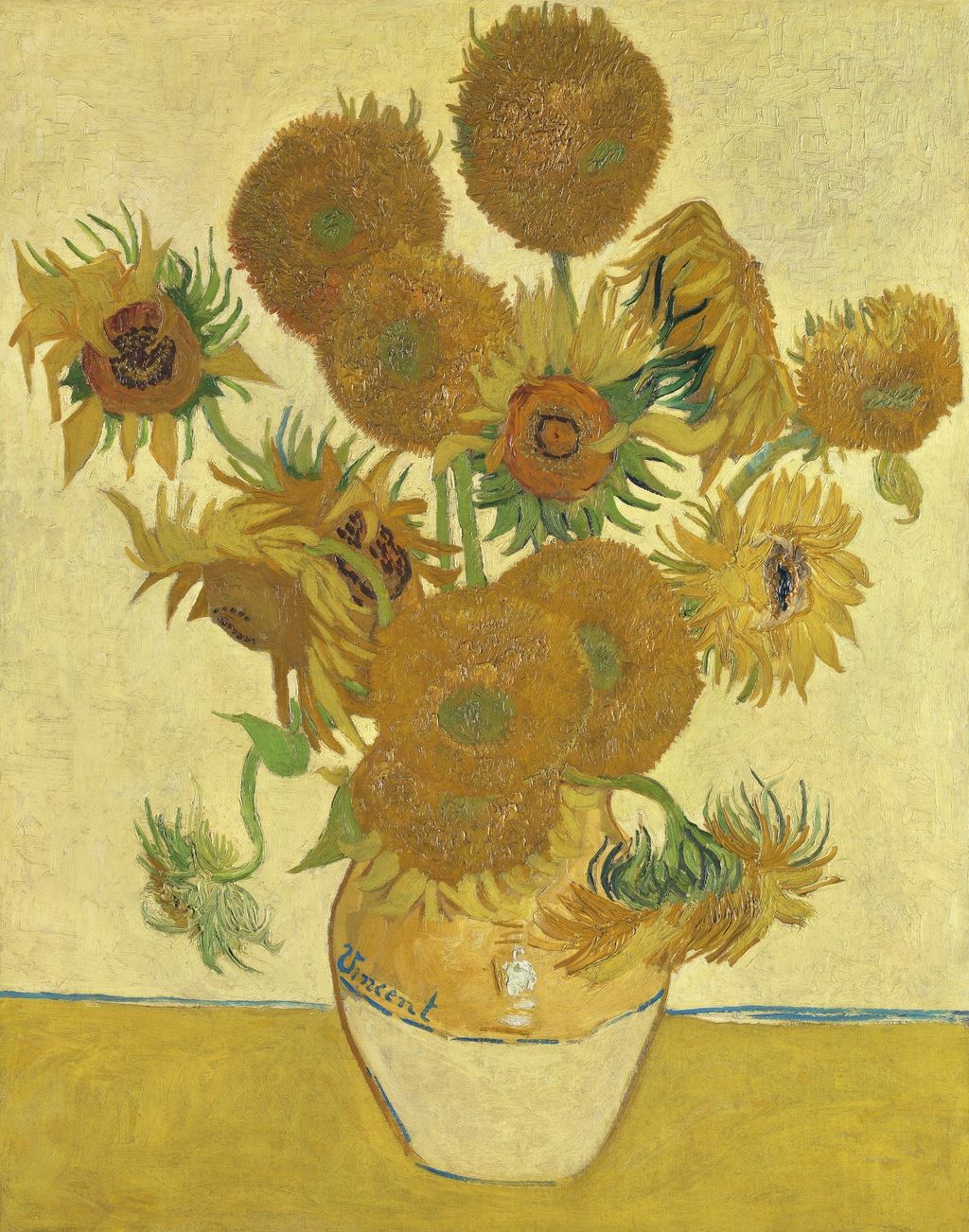
Vincent van Gogh, Sunflowers, 1888, National Gallery, London. The petals, stems and seed heads receive distinct kinds of painted mark.
Hockney’s admiration for this painting does not establish a Van Gogh source for every flower he painted. It does offer a useful way of looking at his own pictures: notice how a flower, a vessel and the space around them require different marks, and how colour can separate things even when their tones are close. The relevant comparison concerns the decisions that make an ordinary subject newly visible. Recognising a familiar flower is only the beginning of looking at its painted form.
With the chair paintings, the connection becomes more direct. Van Gogh’s Van Gogh’s Chair of 1888 shows a plain yellow chair with a rush seat, a pipe and tobacco, set against a cool wall and a floor of terracotta tiles. Its companion, Gauguin’s Chair, substitutes an elaborate armchair, books and artificial illumination. As the National Gallery explains, these objects function as surrogate portraits: the choice of furniture, possessions, light and colour carries a sense of the absent sitter. [5]
In 1988, an invitation to mark the centenary of Van Gogh’s arrival in Arles prompted Hockney to make his own chair portraits. The Foundation records that some used reverse perspective, bringing his longstanding spatial questions into the homage. The National Gallery identifies Vincent’s Chair and Pipe as a direct response to Van Gogh’s painting. Here there is a documented motif and occasion, alongside a new investigation of how the object meets the viewer. [6] [3]
Another specific encounter occurred in 2013. Hockney’s portrait of Jean-Pierre Gonçalves de Lima, painted that July at the beginning of the series that became 82 Portraits and 1 Still-life, pays tribute to Van Gogh’s Sorrowing Old Man (“At Eternity’s Gate”). The sitter adopted the earlier figure’s pose, seated with his head in his hands. This was an explicit return to a particular painting, carried into the company of someone Hockney knew. It shows how Van Gogh remained available to him beyond landscape and flower subjects. [7]
The Joy of Nature in Amsterdam and Houston
Hockney–Van Gogh: The Joy of Nature ran at the Van Gogh Museum from 1 March to 26 May 2019. The museum’s annual report describes the presentation of Hockney’s Yorkshire landscapes through paintings, drawings, sketchbooks, films and iPad drawings. A central work was The Arrival of Spring in Woldgate, East Yorkshire in 2011 (twenty eleven), an oil painting assembled from 32 canvases and measuring approximately 9.75 metres across. The exhibition’s range made the relationship visible through changes of medium and scale as well as through subject matter. [8]
This breadth is essential to the comparison. A sketchbook page can record a concentrated encounter with a plant. A large picture can demand that a viewer move along it. A sequence of drawings can make an interval between visits part of the work. Placing those experiences together asks us to examine how attention develops, instead of searching only for a brushstroke that resembles Van Gogh’s. The exhibition’s title gives pleasure in nature a central place, while the works raise practical questions about how that pleasure becomes a picture.
The exhibition subsequently travelled to the Museum of Fine Arts, Houston, where it ran from 21 February to 20 June 2021. That presentation paired nearly 50 Hockney works with ten original paintings and drawings by Van Gogh. The figures describe the Houston selection, while the broader artistic dialogue extends beyond the works brought together in either exhibition. [9]
Drawing as a way of discovering more
The reed pen provides an early, concrete link between the artists. The Foundation’s 1978 account connects Hockney’s quick sepia drawings with his attention to Van Gogh. A pen places a useful demand on the draughtsman: the same limited means must distinguish a branch, a patch of ground and the open space beyond. Differences in direction, pressure, length and spacing become a vocabulary for things that have very different textures. Looking has to become selective and articulate. [1]
The Houston exhibition labels identify this variety in Van Gogh’s View of Arles of May 1888, made with reed pen, ink and wash over graphite. Darker, ink-laden touches establish the foreground irises, while a varied field of dots and strokes describes the broader scene. Hockney admired that ability to make different marks carry the distinctions found in nature. A landscape could be made legible through the character of its parts, without smoothing them into a uniform finish. [10]
Museum of Contemporary Art Tokyo curator Ai Kusumoto supplied a helpful account of Hockney’s own approach in a 2023 interview with Tamaki Sugihara. She explained that his changing techniques involved a search for the marks particular to each medium. The familiar subject might remain, while the means of describing it changed. Her comparison of a 1969 flower print and a 2020 iPad flower picture makes the point: recurring interests could generate substantially different pictures because the tools offered different possibilities. [11]
This helps clarify what Hockney took from Van Gogh. Learning from a reed-pen drawing did not oblige him to make watercolour behave like ink or a digital stroke behave like oil paint. The Guggenheim Bilbao’s account of his watercolours describes colour applied directly to paper without a preliminary pencil drawing, sometimes using only a few colours. Such economy required him to decide how a small number of strokes would establish space. His developing style and techniques involved choosing the tool that could answer the particular visual problem. [12]
Familiar places and the discipline of returning
The Yorkshire landscapes gave these questions a sustained setting. Hockney returned to roads, trees and woodland junctions that could be revisited in different weather and at different times of year. Lawrence Weschler’s 2013 account describes his growing interest in the time between paintings, including repeated views of Woldgate Woods during 2006. Familiarity made small alterations easier to recognise: a branch lost among summer leaves could become a principal line in winter. Repetition increased the available information. [13]
In 2011 Hockney began drawing the East Yorkshire landscape outdoors on the iPad, developing a record of the movement from winter towards summer. The resulting project included both digital drawings and the separate 32-canvas oil painting. His explanation of the painting focused on the first appearance of leaves low on the trees, before the branches became fully covered. That transitional condition was the subject. The fuller story of The Arrival of Spring in Woldgate depends on keeping the oil painting and the associated digital work distinct. [14]
The charcoal Arrival of Spring of 2013 pursued another form of comparison. Hockney recorded five views of Woldgate across a work of 25 sheets, waiting for sufficient change before returning to each one. His recollection includes the admission that some drawings had followed their predecessors too closely: impatience could produce a new sheet without enough new information. Seasonal observation demanded waiting as well as rapid execution. [7]
Kusumoto’s later interview describes how the 2011 digital drawings move from winter branches and thin ice towards new growth and increasingly dense foliage. She also recalled asking Hockney in 2019 why he drew the arrival of spring. His answer concerned joy; her interpretation extends that pleasure to the difficult acts of seeing and drawing a world that constantly changes. This is a curator’s reading of his practice, rooted in her conversations with him. It makes the sustained attention behind the buoyant colour particularly clear. [15]
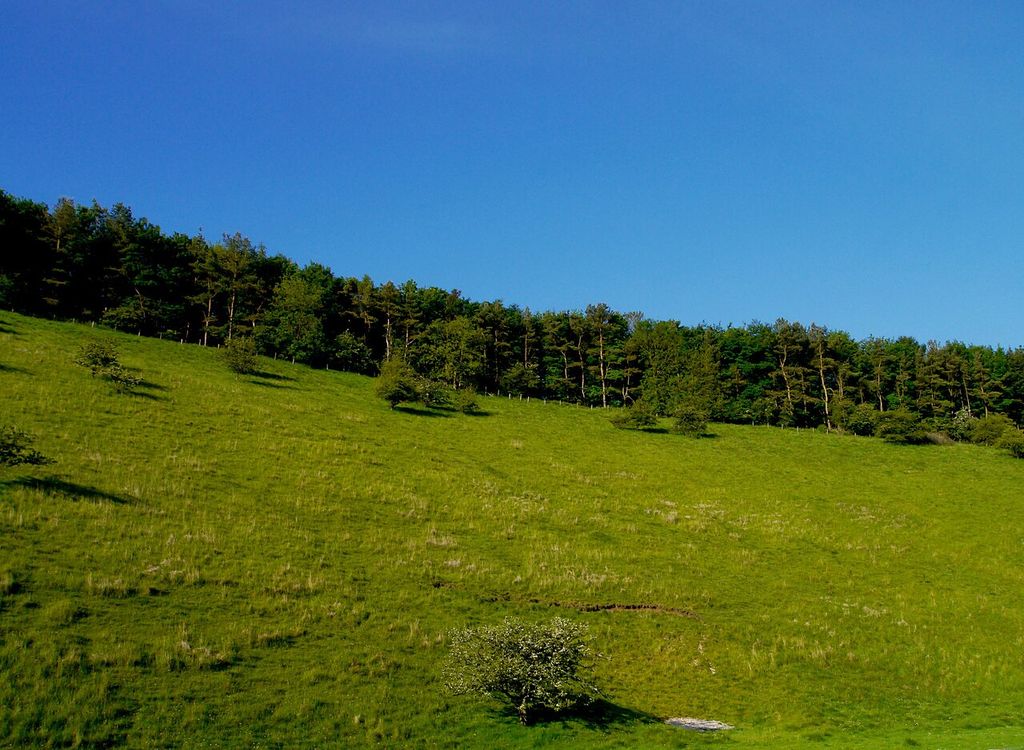
Regional context: the dry chalk valley of Water Dale, near Thixendale in the Yorkshire Wolds. Andy Beecroft / Wikimedia Commons. Image source. CC BY-SA 2.0. Resized and converted to JPEG; no crop or recolouring. Image derivative retains CC BY-SA 2.0.
Colour carries different kinds of meaning
There are useful limits to the resemblance between the two artists’ fields and trees. Van Gogh’s Wheatfield under Thunderclouds of 1890 offers a comparison with Hockney’s landscapes without requiring a claim that Hockney copied it. Its broad format brings a strip of green land beneath a large expanse of blue sky. Variations in the sky and the rhythm of the marks keep those large areas active. The Van Gogh Museum’s Dutch gallery text also connects the painting with his expressed sadness and loneliness, while recording the strengthening effect that he found in such landscapes. The emotional relationship was complex. [16]
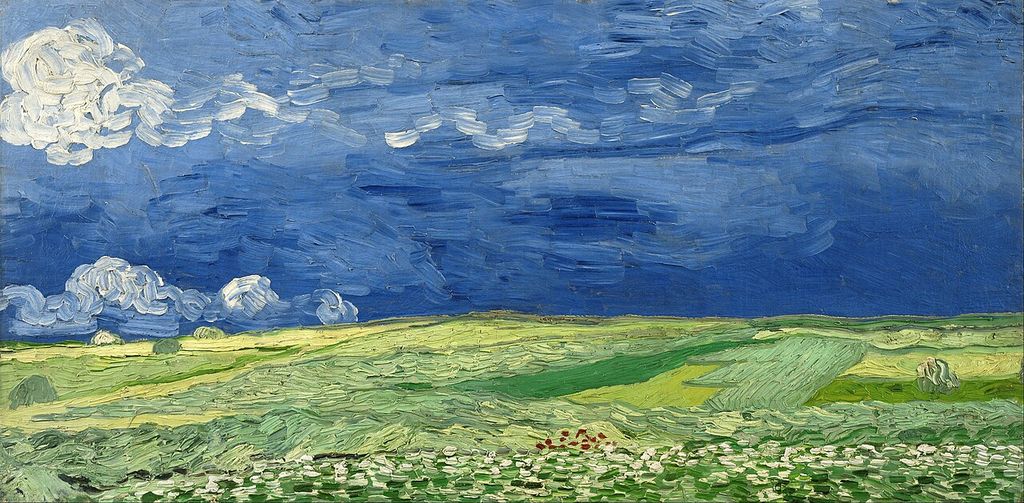
Historical comparison: Vincent van Gogh, Wheatfield under Thunderclouds, 1890. Vincent van Gogh / Wikimedia Commons. Image source. Public domain. Resized and converted to JPEG; no crop or recolouring.
The museum’s Wheatfield with a Reaper, painted at Saint-Rémy in September 1889, makes another distinction possible. In the account supplied by the Van Gogh Museum through Google Arts & Culture, the sunlit field is tied to Van Gogh’s description of humanity as wheat being reaped. He associated the labouring figure with death, yet emphasised the scene’s golden light and absence of sadness. Yellow therefore cannot be translated into a single emotional meaning. A painting can combine mortality, labour and luminous colour. [17]
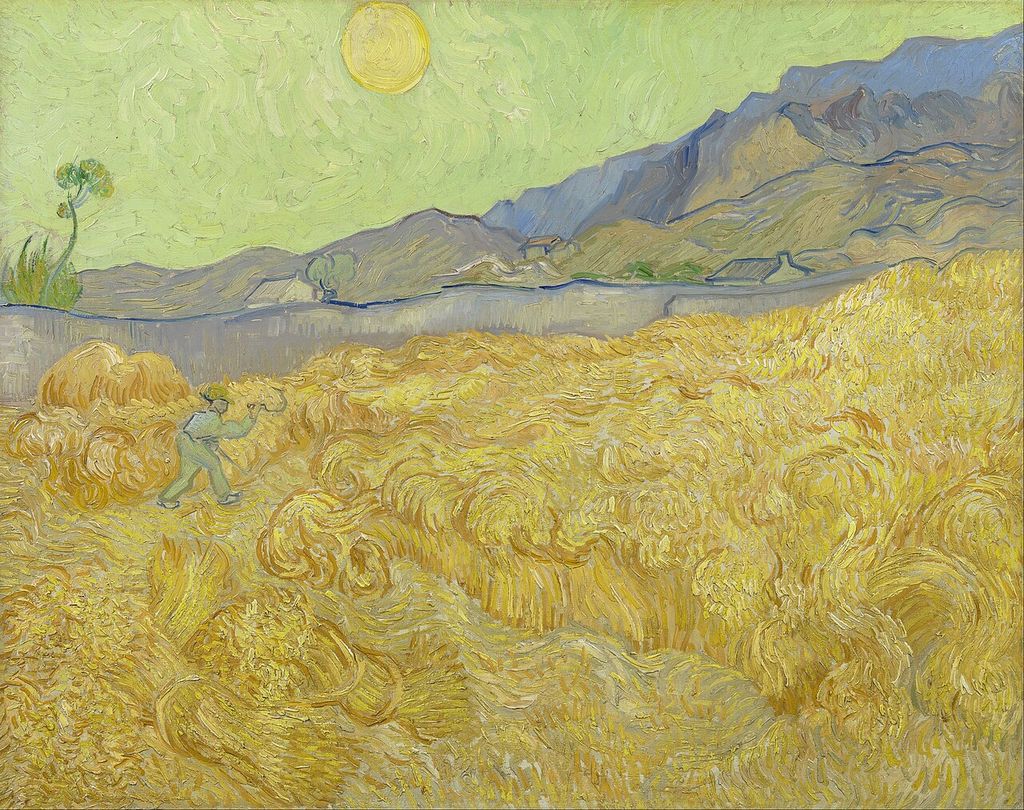
Historical comparison: Vincent van Gogh, Wheatfield with a Reaper, 1889. Vincent van Gogh / Wikimedia Commons. Image source. Public domain. Resized and converted to JPEG; no crop or recolouring.
As comparisons in their own right, these wheatfields show why the shared category of colourful landscape needs careful handling. Van Gogh could invest a field with a biblical analogy or an explicitly stated feeling. Hockney’s recurring Yorkshire subjects concentrated attention on the encounter with a place and its transformation. The paintings can illuminate one another while retaining their distinct circumstances and meanings. Their colours belong to particular decisions within particular works.
For a more specific Hockney example, the Houston curatorial text points to May Blossom on the Roman Road of 2009. It locates Van Gogh’s stylistic influence in the dotted flowers and striped sky. The brief flowering of the hawthorn also set an external deadline: Hockney had to work while the blossom lasted. Here the resemblance is anchored in named passages of a named painting, and colour belongs to a task shaped by time and observation. [10]
Scale, movement and different means
Hockney’s large landscapes changed the viewer’s relationship to these details. Across a multi-canvas painting, a patch of ground or a branching tree can remain substantial even within the larger view. Art historian Anthi-Danaé Spathoni, writing about his landscapes, interprets their expanded spaces through the participation of a moving viewer. Her account connects them with Hockney’s photographic experiments and his attention to Chinese painting. Van Gogh belonged within a much wider field of artistic study; he cannot explain every spatial decision in Hockney’s work. [18]
Film offered a further departure. For The Four Seasons, Woldgate Woods, Hockney returned to a location with a nine-camera arrangement, developing presentations of spring, summer, autumn and winter. The work made duration and movement explicit through moving images and multiple views. An oil painting, a charcoal sequence and a multi-screen film could all explore seasonal change, but they asked the viewer to experience it differently. Hockney’s willingness to change tools was part of the continuing enquiry described across his landscapes. [14]
The material distinction remains important even when a digital image looks painterly. A stroke on an illuminated screen, a printed digital drawing and a raised passage of oil paint meet the eye under different conditions. Hockney’s observation about Van Gogh’s originals gives us a reason to attend to those conditions. It also encourages a more precise comparison: ask what each work makes possible, how its surface or display affects looking, and how much time its arrangement asks us to give it.
A dialogue that continued into new landscapes
Amsterdam’s exhibition coincided with Hockney’s renewed work in northern France. The Foundation records his visits to Normandy in 2019 and the drawings gathered under the title La Grande Cour, including a 24-panel panorama. The same year that the museum presented his conversation with Van Gogh, he was finding a fresh location in which to observe spring. The move extended a practice developed through his sustained attention to Yorkshire, while providing different trees, spaces and circumstances to draw. [2]
The relationship continued to inform later interpretations of his work. The Fondation Louis Vuitton’s 2025 exhibition text identified a distant echo of Van Gogh in the vibrating skies of Hockney’s Normandy acrylic paintings. It also specified that La Grande Cour comprised 24 ink drawings, distinguishing that panorama from the Normandy work made on an iPad. The curators could trace a resonance across the changed materials while keeping each work’s means of construction in view. [19]
What endured was an active relationship with earlier pictures. Hockney could return to a chair, study a draughtsman’s distribution of marks or learn from the physical presence of paint. He then put those lessons to work in media and settings that were his own. The most revealing connection with Van Gogh lies in that continuing activity: looking at a picture closely enough to discover another way of looking at the world.
Works directory
This source-bounded directory combines the works in the Metropolitan Museum’s 2017 retrospective checklist with reviewed museum object records and the additional works and series examined in this guide. It spans several media and is not a complete catalogue raisonné. Titles without an article link remain useful dated records. Metropolitan Museum final retrospective checklist (2017); additional object and series sources are given in the linked articles. [20]
| Name | Date | Medium |
|---|---|---|
| Love Painting | 1960 | Painting |
| Shame | 1960 | Painting |
| The Third Love Painting | 1960 | Painting |
| Tyger Painting No. 2 | 1960 | Painting |
| A Rake’s Progress | 1961–63 | Print series |
| Tea Painting in an Illusionistic Style | 1961 | Painting |
| The Cha-Cha That Was Danced in the Early Hours of 24th March | 1961 | Painting |
| Cleaning Teeth, Early Evening (10pm) W11 | 1962 | Painting |
| Flight into Italy - Swiss Landscape (Painting in a Scenic Style) | 1962 | Painting |
| Man in a Museum (or You're in the Wrong Movie) | 1962 | Painting |
| My Brother is Only Seventeen | 1962 | Painting |
| The First Marriage (A Marriage of Styles I) | 1962 | Painting |
| Domestic Scene, Los Angeles | 1963 | Painting |
| Play Within a Play | 1963 | Painting |
| The Hypnotist | 1963 | Painting |
| Arizona | 1964 | Painting |
| California Art Collector | 1964 | Painting |
| Man in Shower in Beverly Hills | 1964 | Painting |
| Portrait Surrounded by Artistic Devices | 1965 | Painting |
| Rocky Mountains and Tired Indians | 1965 | Painting |
| Beverly Hills Housewife | 1966–67 | Painting |
| Medical Building | 1966 | Painting |
| Peter | 1966 | Drawing |
| Peter Getting Out of Nick’s Pool | 1966 | Painting |
| A Bigger Splash | 1967 | Painting |
| A Lawn Being Sprinkled | 1967 | Painting |
| Kasmin in Bed in His Chateau in Carennac | 1967 | Drawing |
| Peter Feeling Not Too Good | 1967 | Drawing |
| Savings and Loan Building | 1967 | Painting |
| The Room, Tarzana | 1967 | Painting |
| American Collectors (Fred and Marcia Weisman) | 1968 | Painting |
| Christopher Isherwood and Don Bachardy | 1968 | Painting |
| Henry Geldzahler and Christopher Scott | 1968-1969 | Painting |
| W. H. Auden | 1968 | Drawing |
| Peter Langan in His Kitchen at Odins | 1969 | Drawing |
| Mark Glazebrook | 1970 | Drawing |
| Mr and Mrs Clark and Percy | 1970-1971 | Painting |
| Ossie Wearing a Fairisle Sweater | 1970 | Drawing |
| Pool and Steps, Le Nid du Duc | 1971 | Painting |
| Rubber Ring Floating in a Swimming Pool | 1971 | Painting |
| Celia in a Black Dress with White Flowers | 1972 | Drawing |
| Mount Fuji and Flowers | 1972 | Painting |
| Portrait of an Artist (Pool with Two Figures) | 1972 | Painting |
| Portrait of the Artist's Mother, Mrs Laura Hockney, Bradford | 1972 | Drawing |
| The Artist's Father | 1972 | Drawing |
| Dr Eugene Lamb, Lucca | 1973 | Drawing |
| Andy, Paris | 1974 | Drawing |
| Contre-jour in the French Style (Against the Day dans le Style-Français) | 1974 | Painting |
| Gregory Sitting on Base of Column | 1975 | Drawing |
| Kerby (after Hogarth) Useful Knowledge | 1975 | Painting |
| Ron Kitaj Outside Akademie der Kunste Vienna | 1975 | Drawing |
| Kasmin Reading the Udaipur Guide | 1977 | Drawing |
| Looking at Pictures on a Screen | 1977 | Painting |
| My Parents | 1977 | Painting |
| Canyon Painting | 1978 | Painting |
| Mother, Bradford, 19 Feb. 1979 (inscribed 1978) | 1979 | Drawing |
| Mulholland Drive: The Road to the Studio | 1980 | Painting |
| Nichols Canyon | 1980 | Painting |
| Outpost Drive, Hollywood | 1980 | Painting |
| Hollywood Hills House | 1981-1982 | Painting |
| Celia. Los Angeles. April 10th 1982 | 1982 | Polaroid composite |
| Don + Christopher, Los Angeles, 6th March 1982 | 1982 | Polaroid composite |
| Gregory Swimming Los Angeles March 31st 1982 | 1982 | Polaroid composite |
| My Mother, Bolton Abbey, Yorkshire, Nov. 1982 | 1982 | Photocollage |
| Self Portrait 30th Sept. 1983 | 1983 | Drawing |
| Pearblossom Hwy., 11-18th April 1986, #1 | 1986 | Photocollage |
| Pearblossom Hwy., 11–18th April 1986, #2 | 1986 | Photocollage |
| Large Interior, Los Angeles | 1988 | Painting |
| Breakfast at Malibu, Sunday, 1989 | 1989 | Painting |
| Pacific Coast Highway and Santa Monica | 1990 | Painting |
| The Other Side | 1991-1993 | Painting |
| The Eleventh V. N. Painting | 1992 | Painting |
| The Twenty Sixth V. N. Painting | 1992 | Painting |
| The Road Across the Wolds | 1997 | Painting |
| 9 Canvas Study of the Grand Canyon | 1998 | Painting |
| A Bigger Grand Canyon | 1998 | Painting |
| Colorado River | 1998 | Painting |
| Garrowby Hill | 1998 | Painting |
| Colin St. John Wilson. London. 3rd June 1999 | 1999 | Drawing |
| Gregory Evans. Los Angeles. 18th September 1999 | 1999 | Drawing |
| Laura Huston. London. 22nd June 1999 | 1999 | Drawing |
| Lindy. Marchioness of Dufferin and Ava. London. 17th June | 1999 | Painting |
| Going Up Garrowby Hill | 2000 | Painting |
| Red Pots in the Garden | 2000 | Painting |
| A Closer Winter Tunnel, February - March | 2006 | Painting |
| Elderflower Blossom, Kilham, July 2006 | 2006 | Painting |
| The Road to Thwing, July 2006 | 2006 | Painting |
| Bigger Trees near Warter | 2007 | Painting |
| Hawthorn Blossom near Rudston | 2008 | Painting |
| Views Through the Artist's Bedroom Window, Bridlington | 2010-2013 | Digital animation |
| The Arrival of Spring in Woldgate, East Yorkshire in 2011 (twenty eleven) | 2011 | Painting / digital series |
| 82 Portraits and 1 Still-life | 2013–16 | Portrait series |
| Garden | 2015 | Painting |
| Garden with Blue Terrace | 2015 | Painting |
| Garden #3 | 2016 | Painting |
| A Bigger Interior with Blue Terrace | 2017 | Painting |
| Interior with Blue Terrace and Garden | 2017 | Painting |
| A Year in Normandie | 2020–21 | Digital frieze |
Discussion
Look again at the images and ideas explored in David Hockney and Vincent van Gogh. These editorial prompts invite your observations.
Reader Insights
Does the shift from long petal strokes to raised dots in Van Gogh’s Sunflowers change how you understand Hockney’s interest in marks particular to each medium?
What difference does it make to compare Hockney’s documented chair homage with the broader comparison offered by Wheatfield under Thunderclouds?
Hockney sometimes had to wait longer between his 2013 charcoal drawings. How might that waiting change what you notice in a familiar tree or woodland path?
Join the Conversation
Share a detail, comparison or question about David Hockney and Vincent van Gogh below.
References
- The David Hockney Foundation. “1978”, section “Looking at van Gogh”. View source.
- The David Hockney Foundation. “2019”, sections “The Joy of Nature” and “Normandy”. View source.
- The National Gallery. “David Hockney and the National Gallery: A lifelong source of inspiration”, published for Hockney and Piero: A Longer Look, 2024; web article based on a conversation with Martin Gayford. View source.
- The National Gallery. Vincent van Gogh, Sunflowers, 1888, NG3863; collection commentary and audio-description transcript. View source.
- The National Gallery. Vincent van Gogh, Van Gogh’s Chair, 1888, NG3862; collection commentary. View source.
- The David Hockney Foundation. “1988”, section “Van Gogh chairs”. View source.
- The David Hockney Foundation. “2013”, sections “The Arrival of Spring in 2013 (twenty thirteen)” and “Painting portraits in Hollywood”. View source.
- Van Gogh Museum. Annual Report 2019, “Exhibitions”, pp. 8–9; see also “Museum affairs”, p. 23. View source.
- The Museum of Fine Arts, Houston. “Hockney–Van Gogh: The Joy of Nature”, exhibition record, 21 February–20 June 2021. View source.
- The Museum of Fine Arts, Houston. Hockney–Van Gogh: The Joy of Nature, exhibition labels, 2021, PDF pp. 3 and 8: View of Arles and May Blossom on the Roman Road. View source.
- Tamaki Sugihara, interviewing Ai Kusumoto. “Why has Hockney sustained acclaim and popularity for 60 years? The curator of the David Hockney exhibition explains, part one” [Japanese interview], Tokyo Art Beat, 25 August 2023; sections on seeing, drawing and marks particular to a technique. View source.
- Guggenheim Museum Bilbao. “Watercolors”, collection-exhibition commentary. View source.
- Lawrence Weschler. “Why David Hockney Has a Love-Hate Relationship With Technology”, Smithsonian Magazine, September 2013, section “Looking Deeper, Seeing More”. View source.
- The David Hockney Foundation. “2011”, sections “The Arrival of Spring in 2011”, “Drawing on the iPad” and “More multi-camera movies”. View source.
- Tamaki Sugihara, interviewing Ai Kusumoto. “From uncertainty to new ground: how Hockney arrived at works filled with joy. The curator of the David Hockney exhibition explains, part two” [Japanese interview], Tokyo Art Beat, 22 September 2023, section on spring, looking and drawing. View source.
- Van Gogh Museum. Zaalteksten derde verdieping vaste collectie Van Gogh Museum [Third-floor permanent-collection gallery texts], p. 4, Korenveld onder onweerslucht [Wheatfield under Thunderclouds], 1890, commentary and visual description. View source.
- Van Gogh Museum. Vincent van Gogh, Wheatfield with a Reaper, September 1889; museum-supplied object commentary on Google Arts & Culture. View source.
- Anthi-Danaé Spathoni. “David Hockney’s Moving Landscapes”, Revista de História da Arte, W series 11, pp. 95–103, especially pp. 99–102. View source.
- Fondation Louis Vuitton. “David Hockney 25”, exhibition curatorial text, 9 April–1 September 2025; Normandy acrylic paintings and La Grande Cour. View source.
- The Metropolitan Museum of Art, David Hockney, final exhibition checklist, 15 November 2017. View source.
More HOCKNEY Works
A Bigger Splash
A momentary disturbance becomes the focus of a large acrylic painting, made through weeks of patient work.
Mr and Mrs Clark and Percy
The designers Celia Birtwell and Ossie Clark occupy a room shaped by light, repeated sittings and the demands of a double portrait.
A Bigger Grand Canyon
Sixty canvases gather memory, studies and changing viewpoints into an immense painting of 1998.
Garrowby Hill
The 1998 oil painting transforms a remembered Yorkshire journey into a road, fields and an expansive view.
Portrait of an Artist (Pool with Two Figures)
Photographic studies, two figures and a swimming pool become a carefully constructed painting of 1972.
My Parents
The 1977 oil painting sets Kenneth and Laura Hockney within a quietly organised interior.
Pearblossom Hwy., 11–18th April 1986, #2
Hundreds of separately made photographs construct a road scene that unfolds through movement and time.
Bigger Trees near Warter
Fifty canvases join into a large outdoor painting of Yorkshire trees, with photography helping the artist organise the whole.