


 by Tom Gurney
Tom Gurney BSc (Hons) is an art history expert with over 20 years experience
Email: tomgurney1@gmail.com / Phone: +44 7429 011000
Mr and Mrs Clark and Percy: Introduction
Two people look towards us from opposite sides of a bright window. Celia Birtwell stands with one hand at her hip; Ossie Clark sits with a white cat on his knee. Their room is spacious, their clothes distinctive, their attention unexpectedly direct. In David Hockney’s Mr and Mrs Clark and Percy, a domestic interior becomes a place where we meet three separate presences. The cat, attending to something beyond the window, declines the introduction.
Painted in 1970–71, the acrylic canvas measures approximately 213.4 × 304.8 centimetres: seven feet high and ten feet wide. Its breadth gives an ordinary encounter the scale of a public statement. The Friends of the Tate Gallery presented the painting to Tate in 1971. [1] Hockney described his ambition as the “presence of two people in this room”. [2] That aim connects the picture’s familiar human subject to its demanding construction. The distance between the figures, the backlighting and the changes in painted texture all help determine how convincingly these people inhabit the space before us.
At a Glance
- ArtistDavid Hockney
- TitleMr and Mrs Clark and Percy
- Date1970–71
- MediumAcrylic on canvas
- DimensionsApproximately 213.4 × 304.8 cm
- CollectionTate; presented by the Friends of the Tate Gallery, 1971
- SittersTextile designer Celia Birtwell and fashion designer Ossie Clark, with a white cat. [1]
This work across David Hockney’s career
A Rake’s Progress
1961–63 [1]A Bigger Splash
1967 [1]My Parents
1977 [1]Garrowby Hill
1998 [1]A Year in Normandie
2020–21 [3]Contents
- The designers behind Mr and Mrs Clark
- A room organised around two people
- Why the light was so difficult
- Photographs, sketches and actual sittings
- The labour behind the calm surface
- Marriage, looking and the space between
- An encounter with the Arnolfini Portrait
- Percy, Blanche and a memorable title
- From the National Portrait Gallery to Tate
- The double portrait remained an open problem
The designers behind Mr and Mrs Clark
The title gives the couple a shared married name, but the picture brings together two distinct creative careers. Clark designed clothes, with a particular command of cutting, fit and the way fabric moves around a body. Birtwell designed textiles. Their partnership joined his three-dimensional construction to her patterns and colour. They married in 1969, during the period when their work was helping to shape the appearance of fashionable London. [4]
A surviving ensemble of about 1969 in the ASU FIDM Museum makes the division of labour unusually clear. Its dress carries a label crediting Birtwell’s print alongside Clark’s name. The museum describes her patterns as essential to the garments’ appeal and sets the flowing dress against a more structured coordinating coat. Those are useful reminders that fashion involved choices about line, proportion, surface and movement. The sitters brought their own sophisticated visual judgement to the room in which Hockney placed them. [4]
Looking back in a 2023 interview, Birtwell described Clark as an architectural thinker in fashion and explained how her prints softened his designs. She recalled their interest in 1930s clothing and buying older garments at Portobello Road. She also remembered a breakthrough with chiffon in about 1967. Her account gives substance to the period label of Swinging London: this was an energetic working partnership, sustained by technical skill and by looking closely at earlier clothes. [5] The Fashion and Textile Museum’s account of their collaboration similarly emphasises Clark’s cutting and Birtwell’s playful prints, with their references to the Ballets Russes and Art Deco. [6]
Their professional collaboration matters to the portrait because clothing is one of its principal means of giving each figure a shape and a presence. Birtwell’s long dress establishes a dark upright form. Clark’s seated body spreads more loosely across the other side. These differences operate before we know anything about their marriage. They are decisions about two people’s positions, the volume they occupy and the silhouettes through which we recognise them.
Birtwell’s later recollections also place the portrait within ordinary friendship. She remembered encountering Hockney on Portobello Road and becoming better acquainted with him around 1968 through Peter Schlesinger. The people in the painting belonged to a network of visits, conversations, clothes and work. That familiarity helps explain why the grand scale can coexist with such informal poses. [5]
A room organised around two people
The picture belongs to Hockney’s sustained exploration of the large double portrait. The Tate and Musée Granet exhibition guide describes these works as combining informal behaviour with the scale and formality of traditional portraiture. It also connects them to a growing interest in drawing, photographic aids, light and convincing pictorial depth. That combination is important here: the room feels plausible, but its clear arrangement continually draws attention to the work of composition. [7]
Birtwell occupies the left side and Clark the right, with the tall opening between them. Each has space around the body. Their heads belong to different levels, while the standing figure and seated figure make unequal shapes. The window gives the composition an organising centre without placing either sitter there. We are encouraged to compare the two figures across an interval, following the width of the room as well as meeting their faces.
The lower left table brings the interior towards the viewer. The Museum of Contemporary Art Tokyo’s guide specifically draws attention to that table’s position and to the effect of light entering behind the couple. Its account explains that the room was developed through photographs and sketches. [8] The foreground therefore has a practical role in making space readable: we encounter a nearby object before looking farther into the room. At the same time, the table helps balance the large seated form across the canvas.
The sparseness of the furnishings lets small things register strongly. The telephone lies low, away from a conventional desk or side table. The rug spreads beneath Clark; the flowers rise beside Birtwell. In his 2009 discussion, the critic Tom Lubbock treated these objects as clues to a modern interior and the tastes of its occupants. He also drew attention to the sensual detail of bare toes meeting the deep pile of the rug. [9] The room can be read socially, as a particular way of living, while remaining a precise arrangement of contrasting surfaces.
Why the light was so difficult
The central window makes the room’s illumination immediately understandable. It also creates a demanding problem. Hockney explained that a visible light source must remain the painting’s brightest part; putting that source in the middle complicated the tonal relationships around it. He distinguished this task from the easier arrangement in which light comes from an unseen source at the side. [2]
The effect is called contre-jour, or painting against the light. A face seen in this situation cannot be modelled with the same easy progression of highlights and shadows as a face lit from the front. If the darks become too heavy, a person turns into a silhouette. If they are lifted indiscriminately, the luminous opening loses its force. The figures have to remain legible while belonging to an interior whose strongest light lies behind them.
That difficulty gives the white and pale areas particular importance. The cat, flowers and rug offer intermediate points of brightness within the room. They make the eye travel across the interior instead of rushing straight through the opening. Dark clothing and broad quieter areas then give those lighter passages something to work against. The light is distributed across the canvas through comparisons; its source is represented by one opening, but its effect depends on the whole painted surface.
At this size, illumination also becomes a question of bodily presence. We can inspect a head, then move our attention across a substantial span to the other figure. The window’s brightness occupies part of that journey. It holds the couple in a shared environment while making the intervening space unusually conspicuous. The room’s geometry and its illumination become inseparable from the way the two people appear together.
Photographs, sketches and actual sittings
The picture took roughly a year to complete. The Tokyo museum’s account distinguishes the photographs and sketches used for the room from repeated sessions in which the couple posed in Hockney’s studio. [8] Art in Liverpool’s discussion of the painting during its 2009 loan to the Walker Art Gallery also records drawings and photographs made at the couple’s flat, followed by studio modelling because of the canvas’s size. Hockney was best man at their wedding, making this an extended undertaking among friends. [10]
Moving the sitters changed the conditions under which the painter worked. The room could be studied in one place, while the figures were reconsidered elsewhere. A person’s pose, the fall of clothing and the turn of a head had to be brought into agreement with a setting already taking shape on canvas. This helps explain why a picture that looks so settled could demand such prolonged adjustment. Its coherence had to be made across separate encounters.
Birtwell recalled rearranging the bedroom for better light; the dress in the painting differed from her photographed clothes. [11] The interior had already been adapted before its translation into paint. A room can remain recognisably someone’s home while its furnishings and occupants are organised for a picture. The intimacy we experience comes through those choices.
Photographic sources and sittings also supply different kinds of information. A photograph can retain the relation between objects and the view through an opening. Sustained observation of a sitter allows repeated reconsideration of an expression or the balance of a pose. Here the finished surface makes these different encounters look continuous. It gives us a single room in which the figures appear to have been available together, at the same scale, all along.
The labour behind the calm surface
Hockney recalled removing and repainting Clark’s head about twelve times, with paint accumulating there. Peter Quennell, writing in The New York Times, reported sixteen attempts at one face and repeated changes to the window view. Both accounts record extensive revision. [2]
The difference matters less to our understanding than the action they describe. A portrait head was drawn, painted, rejected and attempted again. Likeness had to work within the body and the room, at a scale where a small alteration could change the figure’s entire bearing. The hands, clothes and surrounding space continued to frame each new attempt. Repainting was therefore part of negotiating the whole portrait, even when attention concentrated on a face.
The repeated work also complicates the impression of an immaculate, uniformly smooth picture. Acrylic is the recorded medium, but the canvas does not employ one descriptive treatment throughout. Lubbock noticed changes between recognisable volume, broad flat colour and small economical marks. He discussed the dress, cigarette, flowers and rug as passages that answer different representational demands. His reading draws attention to the painter’s choices within the apparent naturalism. [1] [9]
A dark area of clothing can establish a body without describing every fold. A repeated small stroke can suggest a yielding texture. The portrait head needs a different concentration of information. We move between these degrees of description while continuing to accept the room as a unified space. That flexibility is one reason the painting rewards more than a quick inspection of the sitters’ expressions.
Hockney considered this work exceptionally close to naturalism within his own painting. [2] Naturalism here can be understood as an achieved effect of people and objects occupying believable space. The different marks, revisions and changes of location remain part of how that effect was obtained. They allow the painting to hold together without requiring every passage to imitate vision in precisely the same way.
Marriage, looking and the space between
The seated husband and standing wife reverse a familiar arrangement in formal couple portraits. Clark’s relaxed position and Birtwell’s upright stance create a marked contrast, as the 2009 Liverpool account observes. [10] Yet a difference in pose gives us limited access to a marriage. It can establish the distinct ways two bodies occupy a room without settling who possessed greater authority, affection or independence in daily life.
Both figures look outward. Their attention meets the position of the painter and, through the painting, our own. They do not enact a conversation that we overhear. Instead, we become part of the social arrangement: two people register our presence while sharing the same interior. The empty interval between them is active because our attention must cross it. Looking at one figure makes us aware of the other waiting elsewhere in the canvas.
Clark and Birtwell divorced in 1974. [5] Knowledge of that later event can change the picture’s emotional temperature for a viewer, encouraging us to interpret the space between them as a sign of separation. Such a reading belongs to the painting’s later life. The arrangement itself can also accommodate companionship, self-possession, the formality of posing or the mild interruption of a visitor’s arrival. A face held still for a portrait cannot provide a complete account of what happened between two people.
The picture’s specificity is strong: these individuals, these clothes, this room. Its emotional conclusion is less fixed. Hockney’s stated interest in their relationship directs attention to the distance, poses and looks, while leaving that relationship open to more than one interpretation.
An encounter with the Arnolfini Portrait
Jan van Eyck’s The Arnolfini Portrait of 1434 offers a fruitful historical comparison, discussed by Lubbock in relation to Hockney’s painting. Each work brings a couple, their clothes, possessions and a domestic animal into a carefully articulated interior. [9] The comparison asks how a private room can become a setting for public recognition: what do people choose to show, and what does a painter make from those choices?
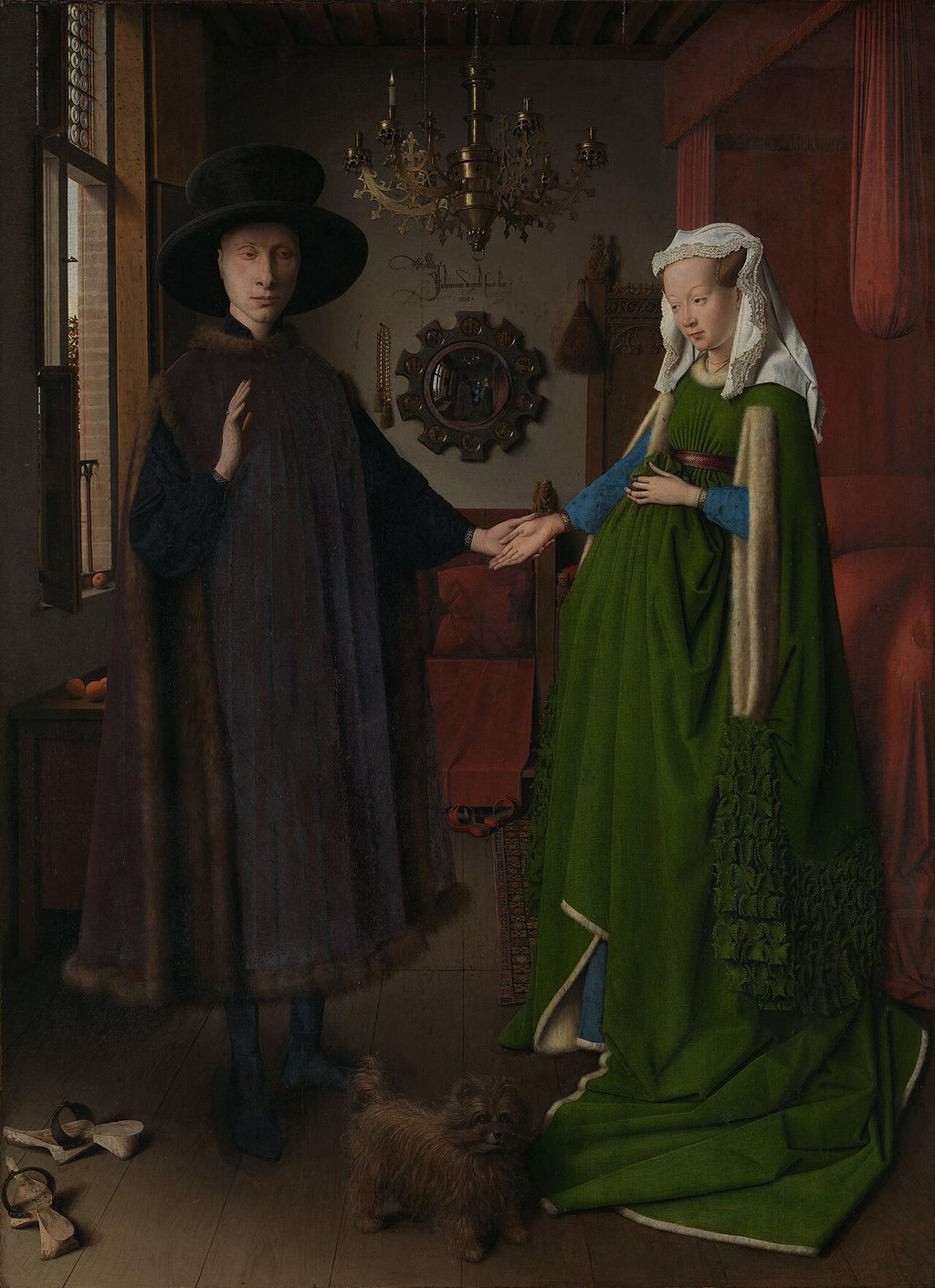
Historical double-portrait comparison: Jan van Eyck, The Arnolfini Portrait, 1434, National Gallery, London. Jan van Eyck / Wikimedia Commons. Image source. Public domain. Resized and converted to JPEG; no crop or recolouring.
The National Gallery describes Van Eyck’s setting as a convincing but constructed space. Its account explains that objects proclaim the couple’s standing and that the room contains spatial inconsistencies. It also makes clear that the older picture is no longer understood simply as the recording of a marriage ceremony. [12] Those qualifications are useful when considering Hockney. A double portrait of a married couple can have a more complex purpose than documenting their wedding.
Technical investigation adds a further connection. The National Gallery records changes to the figures’ faces and positions in Van Eyck’s underdrawing; several familiar objects, including the dog, were added later. [12] The persuasive appearance of an observed moment could emerge through adjustment over time. Read beside Hockney’s recollection of repainting, this offers a useful comparison of how natural-looking portraits are made, without assuming that the two painters followed the same working method.
Van Eyck’s mirror offers a compressed image of people entering the room. In Hockney’s portrait, the bright central opening leads outside, while the sitters look towards our position. These different devices make the spectator aware of an encounter across the picture’s boundary. The room extends beyond its painted limits, and the couple’s relationship with a visitor becomes part of its organisation.
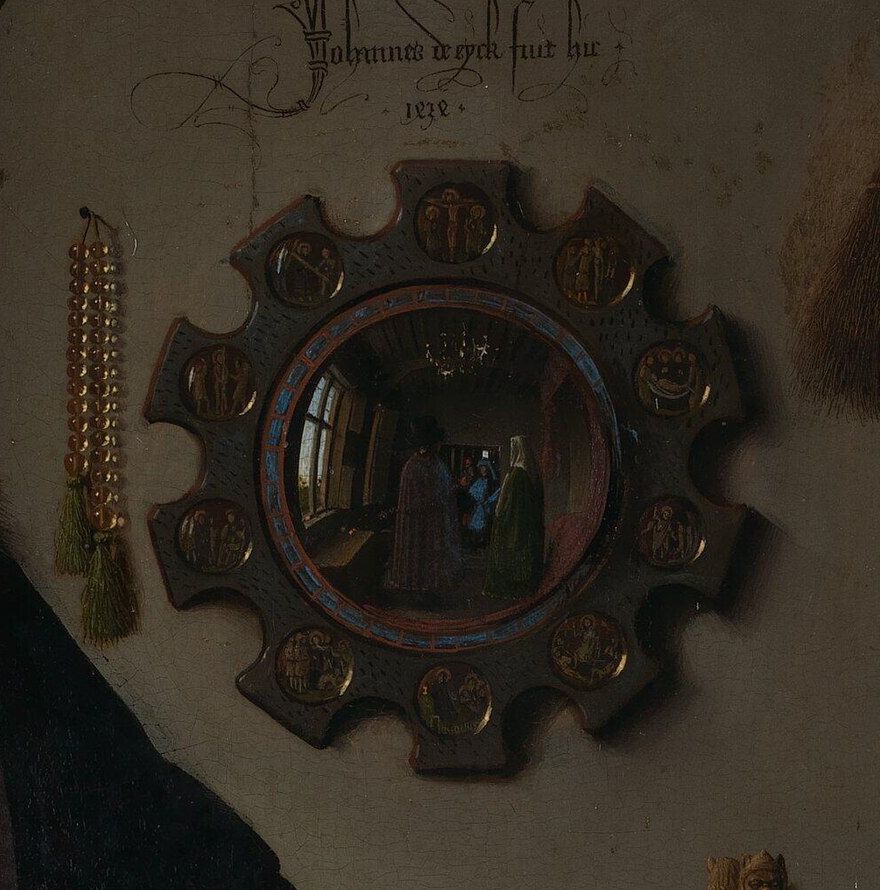
Historical comparison: the mirror and inscription in Jan van Eyck’s The Arnolfini Portrait, 1434. The reflection includes figures in the doorway. National Gallery, London. Jan van Eyck / Wikimedia Commons. Image source. Public domain. Detail cropped from the whole image and converted to JPEG; no recolouring or reconstruction.
Objects can also carry associations beyond their practical use. The Tokyo museum’s guide presents the lilies as possible signs of purity and motherhood, while associating the cat with an independent or changeable disposition. [8] These are interpretative possibilities. They can enrich the exchange with older art without turning every object into a fixed message about the sitters’ private conduct.
The flowers and cat already perform clear pictorial jobs. The flowers lift pale forms against the darker left side; the animal adds brightness and a compact upright presence to the seated figure. The historical associations coexist with those effects. We can attend to them without deciding that a pet certifies infidelity or that a vase announces a future event.
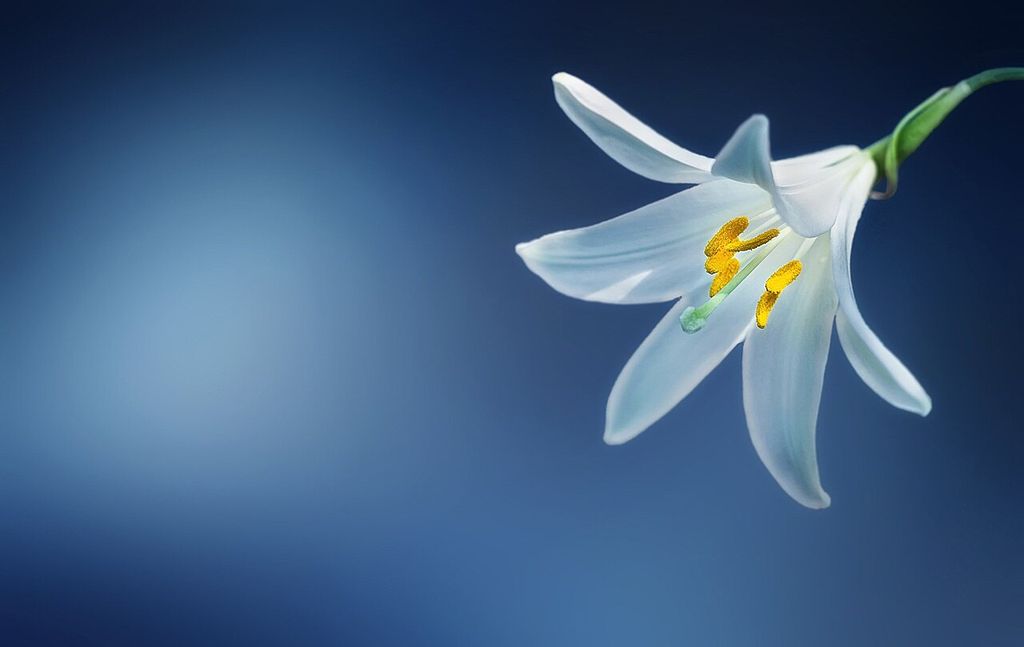
Botanical comparison: a white lily (Lilium candidum). Bessi / Wikimedia Commons. Image source. CC0 / Public domain.
Percy, Blanche and a memorable title
The cat introduces a small but significant complication. Birtwell called it Blanche; Hockney preferred Percy. [11] Simon Wilson separately reported receiving a note from Clark identifying the animal as China, Percy’s mother. [13] These recollections leave its identity less settled than the familiar name suggests.
Within the picture, the animal does something more immediately legible: it looks away. The two human figures acknowledge the viewer, while the cat has its own object of attention. That modest difference prevents the composition from becoming entirely ceremonial. We can imagine the people holding their poses; the animal appears exempt from the obligation to meet our eyes.
The title grants it equal grammatical status. Mr Clark, Mrs Clark and Percy form a three-part household. A ceremonious naming of the couple ends with an ordinary pet’s name, bringing the large portrait back towards domestic familiarity. Whatever the animal’s precise identity, its white body, direction of attention and place in the title each contribute something distinct to the picture.
From the National Portrait Gallery to Tate
The painting made its public debut at the National Portrait Gallery in March 1971. The Foundation records it in connection with Snap! An Exhibition Exploring the Ideas and Motives behind Portraiture, held that March and April. It also preserves Quennell’s response, which praised the balance and exact spacing of the completed work while describing its repeated revisions. [2] That early response identifies an enduring feature: the scene’s deliberation is as striking as its apparent ease.
Its arrival in Tate’s collection in the same year established a further public life for a portrait rooted in friendship. The acquisition credit names the Friends of the Tate Gallery. [1] The painting brought contemporary designers and their domestic surroundings into a national collection, at the scale historically associated with more ceremonious representations of status.
That recognition can be placed beside an earlier institutional hesitation. In her doctoral study, Emily Porter-Salmon transcribes a November 1968 Tate letter declining Hockney’s Christopher Isherwood and Don Bachardy, while expressing admiration and an interest in seeing subsequent work. She contrasts that decision with the later acquisition of Mr and Mrs Clark and Percy. The transcribed letter does not establish why the earlier portrait was declined. [14] The comparison nevertheless shows that the now familiar double portraits did not enter public collections as a single, inevitable group.
In 2005, the painting reached the shortlist of the BBC Today programme’s Greatest Painting in Britain poll. [10] Later criticism has kept its material pleasures in view. Reviewing the 2017 retrospective, Julian Bell singled out the rug’s tactile warmth within an otherwise coolly rendered interior. He also read the room as an image of modern London inhabiting and adapting an older building. [15] His emphasis differs from a reading centred on marital unease. A small physical detail can draw attention towards comfort, texture and inhabitation, changing how the whole scene feels.
The double portrait remained an open problem
Hockney continued to test how two figures could share a picture. The double portrait allowed him to consider differences within an apparently unified subject: two people’s poses, their separate attention and the setting that joined them. Mr and Mrs Clark and Percy provides one particularly concentrated answer, with its balanced room and sustained effort towards naturalism. Other works redistribute the emphasis.
The institutional history offers a clear later example. In 2002 Hockney painted Sir George and Lady Christie, and their portrait became the centrepiece of the National Portrait Gallery’s 2003 display Five Double Portraits. The commission prompted further watercolour portraits of friends. The gallery described these large watercolours as pictures made directly from life in a single seven-hour sitting. [16] A format that had required repeated reworking in the Clark portrait was now being approached through a medium and timetable that demanded different decisions.
Curator Sarah Howgate, recalling the project in 2026, connected the watercolours with Hockney’s wish to work quickly and his preference for familiar sitters. She also described the portraits’ place in the gallery’s later account of his work. [17] Friendship remained important, while the conditions of making a likeness continued to change. The earlier canvas’s patient adjustments and the later watercolours’ concentrated sessions belong to the same continuing investigation.
Birtwell also continued to sit for Hockney. The National Portrait Gallery’s Drawing from Life resource describes their sittings as collaborations grounded in mutual admiration and companionship. It places her coloured-pencil portrait at Carennac in August 1971 within a relationship extending across decades and changing media. [18] Seen within that longer exchange, Mrs Clark becomes Celia again: a designer and friend whose appearance could be revisited without being exhausted by one famous image.
Explore related works
In American Collectors (Fred and Marcia Weisman), Portrait of an Artist (Pool with Two Figures) and My Parents, compare where the figures look and what occupies the space between them. The later 82 Portraits and 1 Still-Life explores presence through repeated conditions. The broader account of Hockney’s portraits places these works within his changing practice.
Works directory
This source-bounded directory combines the works in the Metropolitan Museum’s 2017 retrospective checklist with reviewed museum object records and the additional works and series examined in this guide. It spans several media and is not a complete catalogue raisonné. Titles without an article link remain useful dated records. Metropolitan Museum final retrospective checklist (2017); additional object and series sources are given in the linked articles. [1]
| Name | Date | Medium |
|---|---|---|
| Love Painting | 1960 | Painting |
| Shame | 1960 | Painting |
| The Third Love Painting | 1960 | Painting |
| Tyger Painting No. 2 | 1960 | Painting |
| A Rake’s Progress | 1961–63 | Print series |
| Tea Painting in an Illusionistic Style | 1961 | Painting |
| The Cha-Cha That Was Danced in the Early Hours of 24th March | 1961 | Painting |
| Cleaning Teeth, Early Evening (10pm) W11 | 1962 | Painting |
| Flight into Italy - Swiss Landscape (Painting in a Scenic Style) | 1962 | Painting |
| Man in a Museum (or You're in the Wrong Movie) | 1962 | Painting |
| My Brother is Only Seventeen | 1962 | Painting |
| The First Marriage (A Marriage of Styles I) | 1962 | Painting |
| Domestic Scene, Los Angeles | 1963 | Painting |
| Play Within a Play | 1963 | Painting |
| The Hypnotist | 1963 | Painting |
| Arizona | 1964 | Painting |
| California Art Collector | 1964 | Painting |
| Man in Shower in Beverly Hills | 1964 | Painting |
| Portrait Surrounded by Artistic Devices | 1965 | Painting |
| Rocky Mountains and Tired Indians | 1965 | Painting |
| Beverly Hills Housewife | 1966–67 | Painting |
| Medical Building | 1966 | Painting |
| Peter | 1966 | Drawing |
| Peter Getting Out of Nick’s Pool | 1966 | Painting |
| A Bigger Splash | 1967 | Painting |
| A Lawn Being Sprinkled | 1967 | Painting |
| Kasmin in Bed in His Chateau in Carennac | 1967 | Drawing |
| Peter Feeling Not Too Good | 1967 | Drawing |
| Savings and Loan Building | 1967 | Painting |
| The Room, Tarzana | 1967 | Painting |
| American Collectors (Fred and Marcia Weisman) | 1968 | Painting |
| Christopher Isherwood and Don Bachardy | 1968 | Painting |
| Henry Geldzahler and Christopher Scott | 1968-1969 | Painting |
| W. H. Auden | 1968 | Drawing |
| Peter Langan in His Kitchen at Odins | 1969 | Drawing |
| Mark Glazebrook | 1970 | Drawing |
| Mr and Mrs Clark and Percy | 1970-1971 | Painting |
| Ossie Wearing a Fairisle Sweater | 1970 | Drawing |
| Pool and Steps, Le Nid du Duc | 1971 | Painting |
| Rubber Ring Floating in a Swimming Pool | 1971 | Painting |
| Celia in a Black Dress with White Flowers | 1972 | Drawing |
| Mount Fuji and Flowers | 1972 | Painting |
| Portrait of an Artist (Pool with Two Figures) | 1972 | Painting |
| Portrait of the Artist's Mother, Mrs Laura Hockney, Bradford | 1972 | Drawing |
| The Artist's Father | 1972 | Drawing |
| Dr Eugene Lamb, Lucca | 1973 | Drawing |
| Andy, Paris | 1974 | Drawing |
| Contre-jour in the French Style (Against the Day dans le Style-Français) | 1974 | Painting |
| Gregory Sitting on Base of Column | 1975 | Drawing |
| Kerby (after Hogarth) Useful Knowledge | 1975 | Painting |
| Ron Kitaj Outside Akademie der Kunste Vienna | 1975 | Drawing |
| Kasmin Reading the Udaipur Guide | 1977 | Drawing |
| Looking at Pictures on a Screen | 1977 | Painting |
| My Parents | 1977 | Painting |
| Canyon Painting | 1978 | Painting |
| Mother, Bradford, 19 Feb. 1979 (inscribed 1978) | 1979 | Drawing |
| Mulholland Drive: The Road to the Studio | 1980 | Painting |
| Nichols Canyon | 1980 | Painting |
| Outpost Drive, Hollywood | 1980 | Painting |
| Hollywood Hills House | 1981-1982 | Painting |
| Celia. Los Angeles. April 10th 1982 | 1982 | Polaroid composite |
| Don + Christopher, Los Angeles, 6th March 1982 | 1982 | Polaroid composite |
| Gregory Swimming Los Angeles March 31st 1982 | 1982 | Polaroid composite |
| My Mother, Bolton Abbey, Yorkshire, Nov. 1982 | 1982 | Photocollage |
| Self Portrait 30th Sept. 1983 | 1983 | Drawing |
| Pearblossom Hwy., 11-18th April 1986, #1 | 1986 | Photocollage |
| Pearblossom Hwy., 11–18th April 1986, #2 | 1986 | Photocollage |
| Large Interior, Los Angeles | 1988 | Painting |
| Breakfast at Malibu, Sunday, 1989 | 1989 | Painting |
| Pacific Coast Highway and Santa Monica | 1990 | Painting |
| The Other Side | 1991-1993 | Painting |
| The Eleventh V. N. Painting | 1992 | Painting |
| The Twenty Sixth V. N. Painting | 1992 | Painting |
| The Road Across the Wolds | 1997 | Painting |
| 9 Canvas Study of the Grand Canyon | 1998 | Painting |
| A Bigger Grand Canyon | 1998 | Painting |
| Colorado River | 1998 | Painting |
| Garrowby Hill | 1998 | Painting |
| Colin St. John Wilson. London. 3rd June 1999 | 1999 | Drawing |
| Gregory Evans. Los Angeles. 18th September 1999 | 1999 | Drawing |
| Laura Huston. London. 22nd June 1999 | 1999 | Drawing |
| Lindy. Marchioness of Dufferin and Ava. London. 17th June | 1999 | Painting |
| Going Up Garrowby Hill | 2000 | Painting |
| Red Pots in the Garden | 2000 | Painting |
| A Closer Winter Tunnel, February - March | 2006 | Painting |
| Elderflower Blossom, Kilham, July 2006 | 2006 | Painting |
| The Road to Thwing, July 2006 | 2006 | Painting |
| Bigger Trees near Warter | 2007 | Painting |
| Hawthorn Blossom near Rudston | 2008 | Painting |
| Views Through the Artist's Bedroom Window, Bridlington | 2010-2013 | Digital animation |
| The Arrival of Spring in Woldgate, East Yorkshire in 2011 (twenty eleven) | 2011 | Painting / digital series |
| 82 Portraits and 1 Still-life | 2013–16 | Portrait series |
| Garden | 2015 | Painting |
| Garden with Blue Terrace | 2015 | Painting |
| Garden #3 | 2016 | Painting |
| A Bigger Interior with Blue Terrace | 2017 | Painting |
| Interior with Blue Terrace and Garden | 2017 | Painting |
| A Year in Normandie | 2020–21 | Digital frieze |
Discussion
Look again at the images and ideas explored in Mr and Mrs Clark and Percy. These editorial prompts invite your observations.
Reader Insights
How do the central opening, the sitters’ positions and their looks organise your place in the room?
What does the account of repeated painting and actual sittings reveal beneath the apparently calm surface?
Which comparison with Van Eyck is most illuminating, and where do the two portraits remain different?
Join the Conversation
Share a detail, comparison or question about Mr and Mrs Clark and Percy below.
References
- The Metropolitan Museum of Art. David Hockney: Final Checklist, 15 November 2017, printed p. 8, PDF p. 9: Mr and Mrs Clark and Percy, date, medium, dimensions and Tate presentation credit. View source.
- The David Hockney Foundation. “1971”, especially “Mr. and Mrs. Clark and Percy” and exhibition chronology; includes Hockney’s account and an extract from Peter Quennell’s contemporary review. View source.
- The David Hockney Foundation, 2021 chronology. View source.
- ASU FIDM Museum. “Ossie Clark ensemble, c. 1969”, collection discussion of a dress with print by Celia Birtwell and coordinating coat. View source.
- Celia Birtwell / Christie’s. “Celia Birtwell on David Hockney: ‘I asked who this chap was. He had a certain aura about him’”, interview, 22 February 2023. View source.
- Fashion and Textile Museum. Ossie Clark + Celia Birtwell, exhibition introduction, 2026. View source.
- Tate / Musée Granet. David Hockney: Collection de la Tate, English exhibition press dossier, 2023, “Towards Naturalism”, pp. 14–15. View source.
- Museum of Contemporary Art Tokyo. David Hockney: Guide for Teens, 2023, “Painting people close to him”, entry on Mr and Mrs Clark and Percy. View source.
- Tom Lubbock. “Great Works: Mr and Mrs Clark and Percy (1970–71)”, The Independent, 16 October 2009. View source.
- Art in Liverpool. “Artwork of the Week – David Hockney’s Mr and Mrs Clark and Percy”, 22 November 2009. View source.
- Celia Birtwell, as told to Lauren Cochrane. “Celia Birtwell: ‘I think David Hockney finds me a little bit ridiculous’”, The Guardian, 6 February 2017. View source.
- The National Gallery. “Jan van Eyck: The Arnolfini Portrait”, collection account, especially setting, the marriage interpretation and technical investigation of the underdrawing. View source.
- Simon Wilson. “Percy and his mother”, letter, The Guardian, 22 August 2005. View source.
- Emily Porter-Salmon. Textual Cues, Visual Fictions: Representations of Homosexualities in the Works of David Hockney, PhD thesis, University of Birmingham, June 2011, pp. 186–187; includes a transcription of the Tate letter of 22 November 1968. View source.
- Julian Bell. “More Light!”, The New York Review of Books, 21 December 2017, opening discussion of Mr and Mrs Clark and Percy. View source.
- National Portrait Gallery. Five Double Portraits: New work by David Hockney, display archive, 16 January–29 June 2003. View source.
- Sarah Howgate / National Portrait Gallery. “David Hockney: Life, Love, Art”, 9 July 2026, recollections of the 2003 double portraits and subsequent portrait exhibitions. View source.
- National Portrait Gallery. David Hockney: Drawing from Life, learning resource, especially “David Hockney – portraits”, “The camera” and “Celia”. View source.
More HOCKNEY Works
A Bigger Splash
A momentary disturbance becomes the focus of a large acrylic painting, made through weeks of patient work.
Mr and Mrs Clark and Percy
The designers Celia Birtwell and Ossie Clark occupy a room shaped by light, repeated sittings and the demands of a double portrait.
A Bigger Grand Canyon
Sixty canvases gather memory, studies and changing viewpoints into an immense painting of 1998.
Garrowby Hill
The 1998 oil painting transforms a remembered Yorkshire journey into a road, fields and an expansive view.
Portrait of an Artist (Pool with Two Figures)
Photographic studies, two figures and a swimming pool become a carefully constructed painting of 1972.
My Parents
The 1977 oil painting sets Kenneth and Laura Hockney within a quietly organised interior.
Pearblossom Hwy., 11–18th April 1986, #2
Hundreds of separately made photographs construct a road scene that unfolds through movement and time.
Bigger Trees near Warter
Fifty canvases join into a large outdoor painting of Yorkshire trees, with photography helping the artist organise the whole.