


 by Tom Gurney
Tom Gurney BSc (Hons) is an art history expert with over 20 years experience
Email: tomgurney1@gmail.com / Phone: +44 7429 011000
David Hockney Portraits: Introduction
David Hockney's portraits make familiarity an adventure. A face encountered across a breakfast table or in a printing studio could become the subject of an exact ink drawing, a coloured-pencil study, a grid of photographs or a painting made over several days. Returning to someone gave him a chance to look again, with another material and at another point in both their lives. The people remained recognisable while the means of recognising them changed.
His sitters formed a network of family, friendship, love and work. The exhibition Drawing from Life followed five recurring subjects: Hockney himself, his mother Laura, textile designer Celia Birtwell, Gregory Evans and master printer Maurice Payne. That small selection opened onto decades of changing appearances and approaches. It offers a useful way into his portraiture: follow a few people through time, then consider what each new encounter made possible. [1]
The large double portraits add a further dimension. Here the shape of a room, the direction of a glance and the interval between two bodies become as consequential as a face. Across his portrait work, Hockney explored how people could have a convincing presence in a picture, and how the act of looking could carry the experience of knowing them.
At a Glance
- ArtistDavid Hockney
- Born9 July 1937, Bradford, England
- Died11 June 2026
- FocusPortraits
Contents
- Why knowing the sitter mattered
- Early self-portraits and the precision of a line
- Double portraits: the space between two people
- Celia, Gregory and Maurice across decades
- Parents, presence and memory
- Photographic portraits and accumulated viewpoints
- The self-portraits of 1983
- Watercolour and the duration of a sitting
- 82 Portraits as a controlled series
- Later portraits and the possibilities of media
Why knowing the sitter mattered
Familiarity gave Hockney more to work with than a store of facial features. Someone's habitual way of standing or resting a hand could help a portrait take shape. Sarah Howgate, the National Portrait Gallery curator who also sat for him, recalled a full-length portrait painted in two hours in oils thinned with turpentine. He found her characteristic stance while they were walking around his studio. A pose could emerge from ordinary movement before becoming the structure of a picture. [2]
This helps explain his preference for people already in his life. A regular sitter brought remembered gestures to a new sitting; the artist could compare what he saw that day with what he had seen before. He might concentrate on a familiar profile, attend to a change in posture or allow an unfamiliar medium to make an old subject newly difficult. Each return could produce a different account of someone he knew.
Commissions exposed the value of that accumulated knowledge. The Foundation's account of his 1971 portrait of Royal Opera House director Sir David Webster records Hockney's difficulty in finding a setting for someone he did not know well. He visited Webster repeatedly and eventually used his own studio, with its furniture and flowers. The problem involved the whole situation in which a likeness could become a portrait. [3]
Portraiture also made working relationships visible. Payne helped produce prints; Evans held important roles in the organisation and presentation of Hockney's art; Birtwell had her own highly developed understanding of colour and pattern. Their presence connects the private world of the sitter with the practical world in which pictures were made. A broader account of these relationships belongs to Hockney's biography, but the portraits allow us to encounter them through particular acts of attention. [1]
Explore the portrait studies
Mr and Mrs Clark and Percy
The designers Celia Birtwell and Ossie Clark occupy a room shaped by light, repeated sittings and the demands of a double portrait.
Portrait of an Artist (Pool with Two Figures)
Photographic studies, two figures and a swimming pool become a carefully constructed painting of 1972.
My Parents
The 1977 oil painting sets Kenneth and Laura Hockney within a quietly organised interior.
American Collectors (Fred and Marcia Weisman)
Fred and Marcia Weisman appear within the environment of their collection in a large double portrait of 1968.
Beverly Hills Housewife
Betty Freeman and her home become the subjects of a large acrylic painting made in 1966–67.
82 Portraits and 1 Still-Life
Acrylic portraits explore variation through repeated sittings and a consistent format, accompanied by a single still life.
Early self-portraits and the precision of a line
Hockney's teenage self-portraits already join self-examination to experiment. His Self-Portrait of 1954 is a collage on newsprint. The Morgan's account draws attention to its frontal pose and carefully described clothing, linking these to a developing sense of identity. The choice of collage matters alongside the youthful face: self-representation offered a place to test how a picture could be assembled, as well as what the young artist looked like. [4]
Clothes are useful in a self-portrait because they are both observed things and choices made by the person who wears them. Their edges, folds and patterns can organise the figure; they also contribute to the appearance someone presents to the world. Hockney's later changes of dress, spectacles and hairstyle gave him a shifting vocabulary of visible forms. The self-portrait could register a public appearance while subjecting it to close private scrutiny.
The precision associated with his portraits on paper developed into a particularly economical language. The Morgan's Celia, Paris of 1969 is a pen-and-ink drawing, identified in its collection account with the delicate line Hockney developed through his interest in Ingres and Picasso. The museum also notes the sitter's relaxed pose. A carefully judged contour can describe a body without closing every area into shadow or modelling every surface. The unmarked paper remains active around and within the figure. [5]
Such spareness asks a great deal of the placement of each mark. In a 2019 conversation with Howgate, Hockney explained that he usually began a portrait with the eyes and nose, features he associated particularly with individuality. Starting there establishes relationships between small, strongly recognisable forms before the rest of the head and body develops around them. A slight turn or change of angle must carry information that another painter might distribute through many layers of tone. [6]
The drawing can feel immediate even when its accuracy depends on patient looking. Hockney's drawings make this relationship between observation and economy especially clear.
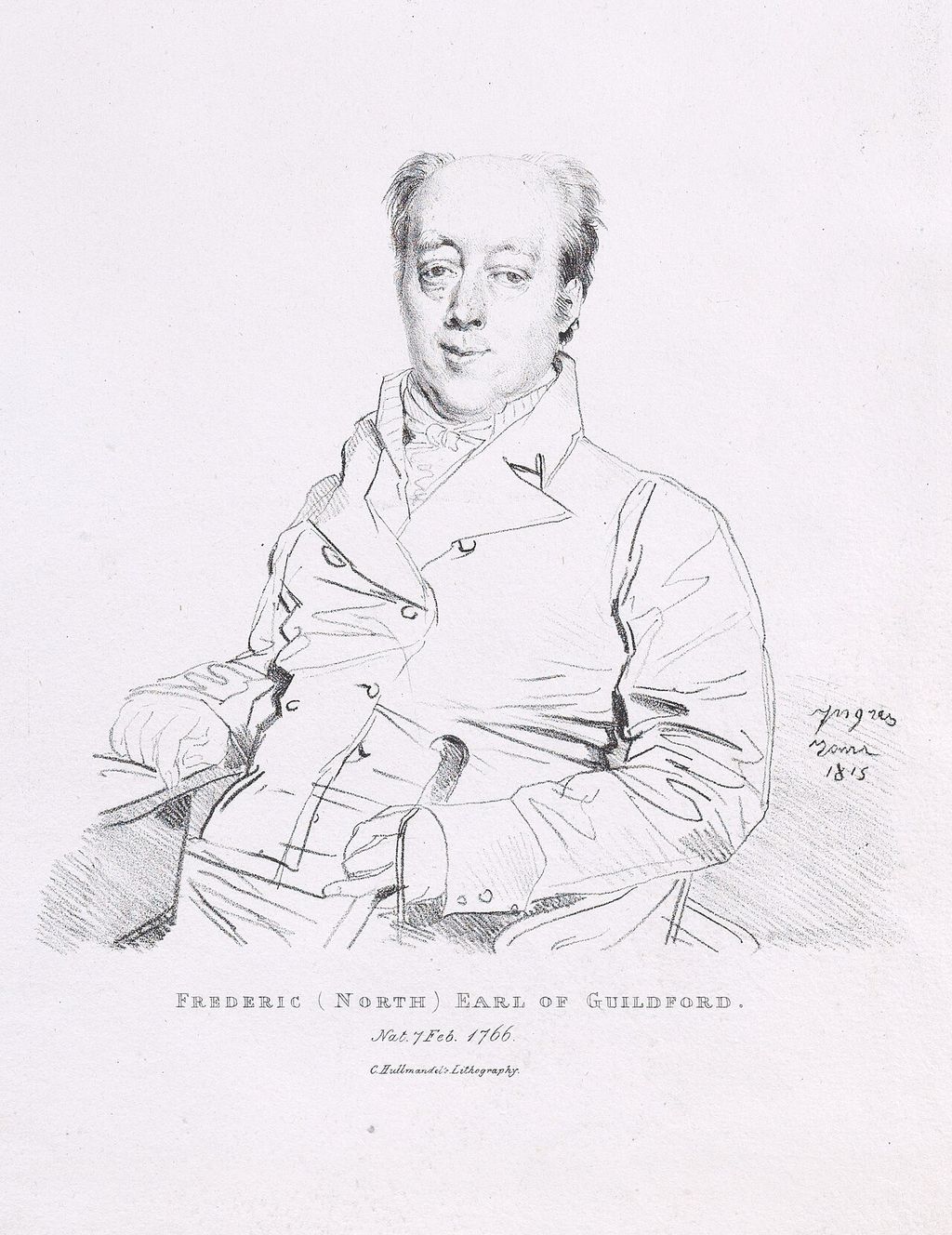
Historical drawing comparison: Jean-Auguste-Dominique Ingres, Portrait of Frederick (North), Earl of Guildford, 1815, Metropolitan Museum of Art. Jean-Auguste-Dominique Ingres / The Metropolitan Museum of Art / Wikimedia Commons. Image source. CC0 / Public domain. Resized and converted to JPEG; no crop or recolouring.
Double portraits: the space between two people
During the late 1960s and 1970s, Hockney enlarged the intimate encounter into rooms occupied by near life-size figures. The Tate and Musée Granet account describes these double portraits as carefully staged pictures combining informal poses with the scale and formality of traditional portraiture. Their realism involved an ambitious construction of light, depth and human presence. [7]
The group includes American Collectors (Fred and Marcia Weisman) and Christopher Isherwood and Don Bachardy, both 1968; Henry Geldzahler and Christopher Scott, 1968–69; and Mr and Mrs Clark and Percy, 1970–71. The Met's 2017 checklist records all four as acrylic paintings, each approximately three metres wide. Their size gives the space around the figures a physical importance, with enough breadth for two people to establish different positions within it. [8]
A double portrait creates several directions of attention at once. One figure may turn towards the other, look out towards us or remain absorbed elsewhere. Furniture can bring the sitters together or make an interval between them more conspicuous. We look from one body to the other and then through the setting, constructing a relationship from their shared space. That relationship can remain open to interpretation without becoming a puzzle with a single hidden answer.
Hockney's own account of Mr and Mrs Clark and Percy makes the technical demands unusually clear. Ossie Clark and Celia Birtwell posed extensively in his studio. He repeatedly removed and repainted Clark's head, while the bright window in the centre made the balance of tonal values difficult. The Foundation quotes his explanation that the main aim was the relationship of the two people. The familiar-looking room was the outcome of sustained revision. [3]
Knowing this history changes how we understand the picture's composure. A convincing presence can be assembled through many sessions and alterations. The broad arrangement must hold while particular features change; the artist must judge the figures both separately and as inhabitants of the same pictorial world. The courtship, marriage or friendship documented by a title supplies context, but it does not authorise us to turn a pose into proof of a private motive.
Portrait of an Artist (Pool with Two Figures), 1972, brings two figures into different physical conditions: one stands beside the pool while another swims beneath its surface. Christie's documented account explains the composition's origins in juxtaposed photographs and its later development through newly staged photographic studies. The standing figure is Peter Schlesinger. Here the encounter was built from separately gathered material, making the finished relation between bodies an achievement of composition. [9]
Hockney subsequently questioned the spatial conventions that had helped these pictures achieve their naturalistic presence. In her 2023 interview, curator Ai Kusumoto describes the patient portrait drawings of his Paris years as an important return to looking and drawing amid that uncertainty. This was a reassessment of how a person could be represented in space. The double portraits had made the question of shared presence especially demanding; later experiments would approach it through new kinds of time and viewpoint. [10]
Celia, Gregory and Maurice across decades
Celia Birtwell offered Hockney a face he repeatedly found worth studying, and clothing that could become a second field of invention. In Celia, Carennac, August 1971, the bold pattern of her dressing gown is set against the more quietly described face and hands. The National Portrait Gallery presents these sittings as collaborations between two creative people. Fabric occupies the body and gives the drawing a rhythm of its own. [11]
Following Celia across different portraits is therefore an exercise in comparing kinds of description. A fine ink line and a broad coloured mark make different demands on her appearance. A pattern may assert itself immediately, while the face emerges through a much smaller number of decisions. The pleasure lies partly in seeing how the artist holds those unequal visual weights together. Familiarity with the sitter allowed him to vary the balance without exhausting the subject.
Gregory Evans became Hockney's partner in Paris in 1974 and later worked as his assistant, studio manager and curator. He remained a recurring sitter across the changing relationship. The portraits carry that long continuity through works made at particular moments. They also remind us that the same person can occupy several roles in an artist's life, roles that a single label cannot fully describe. [11]
Maurice Payne makes the connection between subject and collaborator especially concrete. The Foundation's 1977 chronology records his work with Hockney at Petersburg Press on The Blue Guitar. The Met also holds a 1971 etching titled Maurice Payne. A man engaged in the skilled production of printed pictures could himself become a printed subject. These relationships travelled in both directions: the sitter belonged to the making of the work as well as to its imagery. [12] [13]
Decades later, Maurice Payne, 2008, became an inkjet-printed computer drawing. The Morgan explains that Hockney used Photoshop for a series of portraits in his Bridlington studio, attracted by the speed with which he could draw in colour. The familiar sitter provided continuity while the equipment altered the sequence of decisions. Moving between colours no longer required exchanging physical brushes; drawing and the production of a printed image met within the same working process. [14]
In 2019, Hockney invited Celia, Gregory and Maurice to sit again for drawings associated with Drawing from Life. The National Portrait Gallery's exhibition text describes his use of walnut-brown ink and Japanese brushes with integral reservoirs, enabling continuous lines. These three-quarter-length portraits brought the familiar heads into relation with more of the body. The equipment supported a flowing description of people whose many previous sittings informed the new encounter. [15]
Comparing such works reveals changes in the artist's attention alongside changes in a face. What had once been described through a fine contour might later be established by a coloured plane or by the meeting of photographic fragments. Each encounter tests what that person, in that material, could become in a picture.
Parents, presence and memory
Hockney's family portraits show how long acquaintance could coexist with unresolved pictorial problems. A coloured-pencil Study for “My Parents and Myself” of 1974 places his parents around a cart and includes the artist through his reflection in a mirror. The Morgan connects the study with their visits during his Paris years. The reflected face gives the person making the portrait a position inside the family's arrangement. [16]
The unfinished My Parents and Myself of 1976 remains distinct from the completed My Parents of 1977. The earlier oil painting retains masking tape associated with Hockney's reworking; the later picture is an oil painting on a square canvas, approximately 183 centimetres across. Familiarity with the subjects did not settle the composition in advance. Finding the right arrangement continued across separate works. [11] [8]
Hockney's recollection of his parents as sitters brings these formal decisions close to daily behaviour. He told Howgate that his mother sat well, while his father found it hard to remain still and would pick up a book. He eventually painted him reading. The action gives Kenneth something to do within the portrait, preserving a habit encountered during its making. A practical response to a restless sitter became part of the finished figure. [6]
The scale of the completed painting allows us to spend time with two people sharing a space while retaining their individuality. The preceding study makes another relationship explicit: the son looks at his parents and considers where he belongs in the act of portraying them. The changing solution concerns the maker's position as well as the sitters' poses.
The circumstances of Mother, Bradford. 19 Feb 1979 give repeated looking a different urgency. According to the Morgan's label, Hockney drew Laura on the day of his father's funeral. He later mistakenly inscribed the year as 1978. The museum identifies the drawing as sepia ink on paper, applied with a reed pen, and interprets its minimal line as a form of communication between mother and son. [17]
That interpretation keeps attention on the encounter. The drawing was made in a shared moment, with one person looking at another after a loss they both experienced. Its significance does not depend on elaborate surroundings or a public occasion. A few marks can preserve an exchange of attention, while the title locates that exchange within the larger passage of family time.
Photographic portraits and accumulated viewpoints
Photography gave Hockney another way to reconsider the duration of looking. Getty's 2017 exhibition text explains that his photographs first served documentary and preparatory purposes, before he sought to invest them with time and his own presence. The Polaroid SX-70 allowed him to assemble instantaneous prints into grids of multiple views. A composite could carry a succession of observations inside one larger picture. [18]
The Morgan's account of Gregory, Los Angeles, March 31st 1982 describes how the selection and juxtaposition of Polaroids created a multilayered portrait. It also notes that Hockney soon moved beyond the rigid grid towards freer photocollages. This is an important difference within the photographic work: an orderly array of separate frames and an irregular assembly of fragments offer different ways of moving around a subject. [19]
For portraiture, the composite changes the relationship between a face and the moment supposedly captured by a camera. We can follow several acts of attention across its surface. A head, a hand and the surrounding space need not have been recorded in the same instant or from exactly the same position. The joins make the work of assembling visible, asking us to look actively across the parts.
The Met's checklist places Celia. Los Angeles. April 10th 1982, Gregory Swimming Los Angeles March 31st 1982 and My Mother, Bolton Abbey, Yorkshire, Nov. 1982 within this wider photographic practice. The names are familiar from the drawings, but the means of encounter have changed. The continuity of the subjects makes that change unusually legible. A portrait could retain the intimacy of prolonged attention while allowing the camera to contribute its own distinct fragments of information. [8]
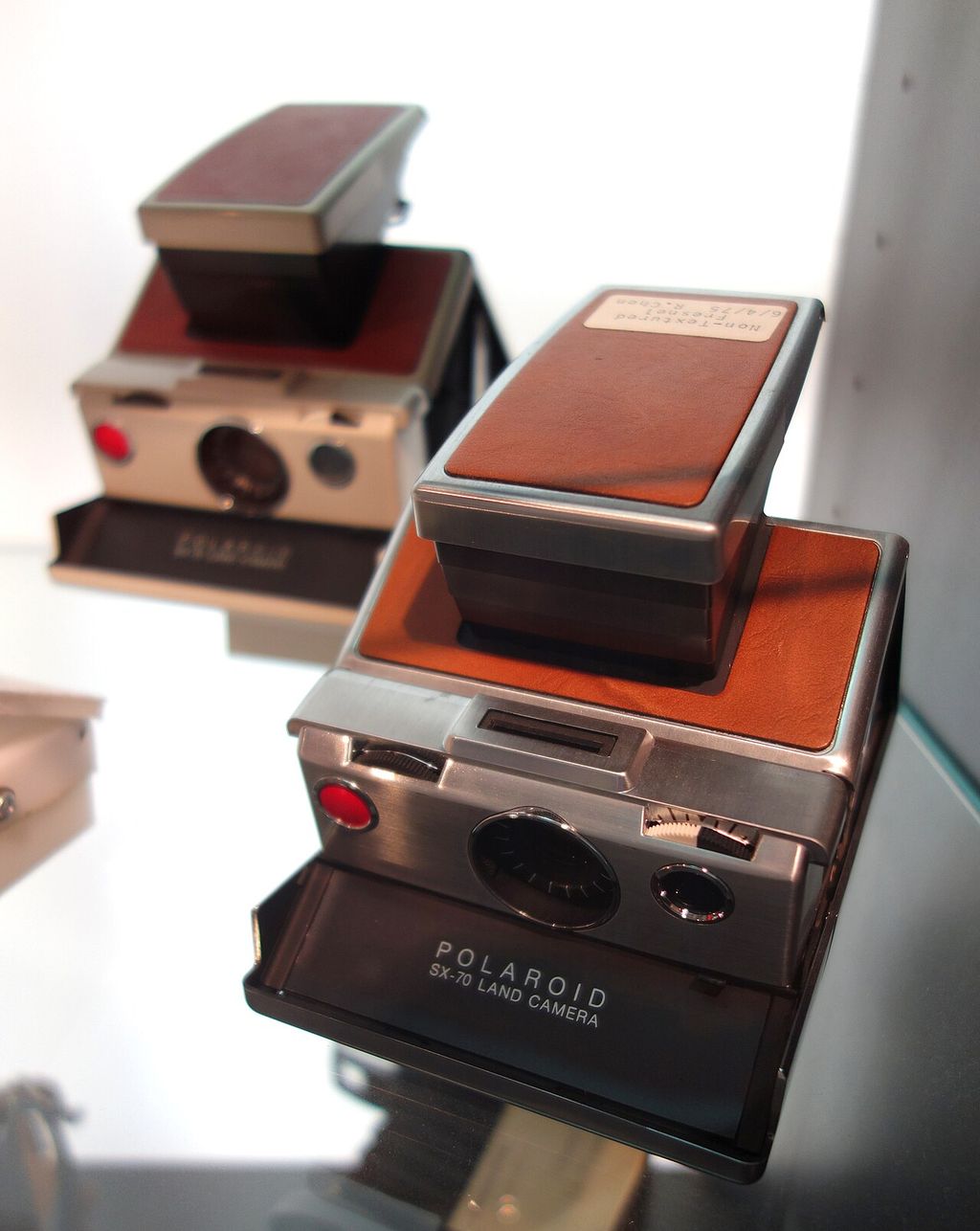
A Polaroid SX-70 Land Camera in the MIT Museum: an example of the model used in Hockney’s composite photography. Daderot / Wikimedia Commons. Image source. CC0 / Public domain. Resized and converted to JPEG; no crop or recolouring.
The self-portraits of 1983
In the autumn of 1983, Hockney repeatedly drew himself in charcoal. The Morgan places this period of self-scrutiny partly in the context of friends' deaths during the HIV/AIDS epidemic. Its account of the 30 September drawing emphasises the daily changes registered across the series and the vulnerability that distinguishes it from his youthful self-portraits. The sequence gives repetition a concentrated, personal force. [20]
The dated sheets offer a succession of encounters with the mirror. A single self-portrait might appear to give a settled account of an artist at a certain age; a series makes that apparent stability harder to maintain. The observer returns, but the expression, the intensity of looking and the distribution of marks can change. Reading the drawings together means attending to differences within continuity, much as we do when following his portraits of friends over longer periods.
Charcoal also changes the kind of attention available. It can establish a firm edge, spread into a broad dark area or leave softer passages where the figure seems less fixed. The medium gives weight to a face without requiring colour. The act of looking at oneself acquires a physical record in the pressure and breadth of the marks, bringing the means of drawing close to the work of scrutiny.
Self-portraiture remained a place for technical play as well as examination. Looking back on Getty's exhibition, curator Julian Brooks described Hockney's 1986 photocopied self-portrait, made by copying his striped shirt and manipulating and recopying the results. The body could supply material for a machine-made image. Across these very different procedures, self-representation allowed the artist to be both an immediately available subject and an experimental resource. [21]
Watercolour and the duration of a sitting
Hockney returned to the double portrait through watercolour in the early 2000s. A National Portrait Gallery commission to portray Sir George and Lady Christie became the catalyst for a larger series of friends. The Gallery's account of its 2003 display describes large works made across four watercolour tablets, each completed in a single seven-hour sitting. Their scale preserved the ambition of the earlier double portraits while changing the pace and practical conditions of making them. [22]
Seven hours is a substantial encounter, yet a tightly bounded period compared with a painting repeatedly revised over months. The sittings gathered two people's presence within the same working day. Watercolour's flow and the intervals needed for its handling made time part of the construction, while the four-part support gave the large image an underlying division. The resulting work could be both expansive and closely tied to an occasion.
Howgate recalled that this rapid watercolour practice contrasted with the precision of Hockney's earlier camera lucida drawings. She also remembered the exchange of sittings between Hockney and Lucian Freud: Hockney sat for Freud for some 120 hours, while Freud in turn sat for Hockney's pen-and-ink drawings. The comparison places very different speeds within the same circle of artists. Duration could be stretched or compressed, with each procedure producing its own record of attention. [2]
Speed therefore needs to be considered alongside prior knowledge. A quickly made portrait may depend on years of looking, and a long sitting may bring small changes that the artist must select among. A time limit establishes conditions for a picture; the marks show what the artist found useful within them. Hockney's portraits repeatedly make those conditions part of their interest.
82 Portraits as a controlled series
The later 82 Portraits and 1 Still-Life placed variation within a particularly consistent framework. LACMA's 2018 account states that the portraits were uncommissioned and that most were painted between 2013 and 2016. Sitters came from the artist's family, friendships, professional circle and everyday life. The acrylic canvases shared a 48-by-36-inch format and a yellow armchair, with the blue background adjusted in response to clothing. [23]
The Ca' Pesaro exhibition account adds the raised platform and describes the works as a single body of paintings. Keeping the chair, format and broad setting consistent made small differences more apparent. A shift in the placement of feet or arms could alter the balance of a figure; clothes could occupy the same rectangle with different masses of colour. The common structure gave viewers a basis for comparison across the series. [24]
Each portrait was made within three days, a duration Hockney called a “20-hour exposure”. LACMA records that the still life arose when a sitter rescheduled an appointment. The phrase borrows photography's language to describe a sustained encounter with paint, while the still life quietly records the practical timetable behind the whole enterprise. The series depended on people arriving, sitting and returning, as well as on a painter's decisions. [23]
Within those shared conditions, a posture remains an observed arrangement rather than a complete explanation of character. Folded hands, a forward lean or an open stance can guide our attention without telling us everything about the person. The repeated format rewards close comparison, but the individuality of each encounter survives the system that brought the paintings together.
Later portraits and the possibilities of media
In 2012, Hockney made a digital self-portrait each day for twenty days, exploring expressions and character types with the example of earlier artists, including Rembrandt, in mind. The iPad gave a familiar routine a new surface and a fresh range of marks and colours. Repetition could support a playful investigation of facial expression as well as the concentrated self-examination of the charcoal sheets. [15]
Getty's 2026 recollection describes the large printed iPad self-portraits in its 2017 exhibition and Hockney's enjoyment of changing scale. An image made on a small illuminated screen could become an imposing face on a gallery wall. The size at which viewers encounter a portrait is part of its effect, alongside the scale at which the artist first drew it. [21]
Kusumoto's account of his practice offers a helpful principle: Hockney sought the marks particular to different media. A new device gave him another way to work on a familiar subject. The relevance to portraiture is clear across the ink drawings, photographic assemblies, watercolours and computer images: the instrument changes what the hand can do and what the viewer must attend to. The face remains a rich testing ground because we are so sensitive to small differences within it. [25]
Painting continued alongside that exploration. The National Portrait Gallery's account of the Normandy portraits of 2021–22 describes works made from life, with sitters choosing their clothes and poses. Hockney used slow-drying acrylic directly on the canvas without an underdrawing, generally over two or three sittings. People visiting his home and studio supplied a renewed circle of subjects. [11]
Seen across the decades, his portraiture remains open to such renewals. A person could return after years; an established relationship could change; a new medium could alter the pace of looking. The double portraits asked how people occupied a shared space, while the recurring individual sitters revealed how much a face could sustain over time. Their common ground is the encounter: one person looks closely at another, and the resulting picture gives that attention a form we can continue to explore.
Works directory
This source-bounded directory combines the works in the Metropolitan Museum’s 2017 retrospective checklist with reviewed museum object records and the additional works and series examined in this guide. It spans several media and is not a complete catalogue raisonné. Titles without an article link remain useful dated records. Metropolitan Museum final retrospective checklist (2017); additional object and series sources are given in the linked articles. [8]
| Name | Date | Medium |
|---|---|---|
| Love Painting | 1960 | Painting |
| Shame | 1960 | Painting |
| The Third Love Painting | 1960 | Painting |
| Tyger Painting No. 2 | 1960 | Painting |
| A Rake’s Progress | 1961–63 | Print series |
| Tea Painting in an Illusionistic Style | 1961 | Painting |
| The Cha-Cha That Was Danced in the Early Hours of 24th March | 1961 | Painting |
| Cleaning Teeth, Early Evening (10pm) W11 | 1962 | Painting |
| Flight into Italy - Swiss Landscape (Painting in a Scenic Style) | 1962 | Painting |
| Man in a Museum (or You're in the Wrong Movie) | 1962 | Painting |
| My Brother is Only Seventeen | 1962 | Painting |
| The First Marriage (A Marriage of Styles I) | 1962 | Painting |
| Domestic Scene, Los Angeles | 1963 | Painting |
| Play Within a Play | 1963 | Painting |
| The Hypnotist | 1963 | Painting |
| Arizona | 1964 | Painting |
| California Art Collector | 1964 | Painting |
| Man in Shower in Beverly Hills | 1964 | Painting |
| Portrait Surrounded by Artistic Devices | 1965 | Painting |
| Rocky Mountains and Tired Indians | 1965 | Painting |
| Beverly Hills Housewife | 1966–67 | Painting |
| Medical Building | 1966 | Painting |
| Peter | 1966 | Drawing |
| Peter Getting Out of Nick’s Pool | 1966 | Painting |
| A Bigger Splash | 1967 | Painting |
| A Lawn Being Sprinkled | 1967 | Painting |
| Kasmin in Bed in His Chateau in Carennac | 1967 | Drawing |
| Peter Feeling Not Too Good | 1967 | Drawing |
| Savings and Loan Building | 1967 | Painting |
| The Room, Tarzana | 1967 | Painting |
| American Collectors (Fred and Marcia Weisman) | 1968 | Painting |
| Christopher Isherwood and Don Bachardy | 1968 | Painting |
| Henry Geldzahler and Christopher Scott | 1968-1969 | Painting |
| W. H. Auden | 1968 | Drawing |
| Peter Langan in His Kitchen at Odins | 1969 | Drawing |
| Mark Glazebrook | 1970 | Drawing |
| Mr and Mrs Clark and Percy | 1970-1971 | Painting |
| Ossie Wearing a Fairisle Sweater | 1970 | Drawing |
| Pool and Steps, Le Nid du Duc | 1971 | Painting |
| Rubber Ring Floating in a Swimming Pool | 1971 | Painting |
| Celia in a Black Dress with White Flowers | 1972 | Drawing |
| Mount Fuji and Flowers | 1972 | Painting |
| Portrait of an Artist (Pool with Two Figures) | 1972 | Painting |
| Portrait of the Artist's Mother, Mrs Laura Hockney, Bradford | 1972 | Drawing |
| The Artist's Father | 1972 | Drawing |
| Dr Eugene Lamb, Lucca | 1973 | Drawing |
| Andy, Paris | 1974 | Drawing |
| Contre-jour in the French Style (Against the Day dans le Style-Français) | 1974 | Painting |
| Gregory Sitting on Base of Column | 1975 | Drawing |
| Kerby (after Hogarth) Useful Knowledge | 1975 | Painting |
| Ron Kitaj Outside Akademie der Kunste Vienna | 1975 | Drawing |
| Kasmin Reading the Udaipur Guide | 1977 | Drawing |
| Looking at Pictures on a Screen | 1977 | Painting |
| My Parents | 1977 | Painting |
| Canyon Painting | 1978 | Painting |
| Mother, Bradford, 19 Feb. 1979 (inscribed 1978) | 1979 | Drawing |
| Mulholland Drive: The Road to the Studio | 1980 | Painting |
| Nichols Canyon | 1980 | Painting |
| Outpost Drive, Hollywood | 1980 | Painting |
| Hollywood Hills House | 1981-1982 | Painting |
| Celia. Los Angeles. April 10th 1982 | 1982 | Polaroid composite |
| Don + Christopher, Los Angeles, 6th March 1982 | 1982 | Polaroid composite |
| Gregory Swimming Los Angeles March 31st 1982 | 1982 | Polaroid composite |
| My Mother, Bolton Abbey, Yorkshire, Nov. 1982 | 1982 | Photocollage |
| Self Portrait 30th Sept. 1983 | 1983 | Drawing |
| Pearblossom Hwy., 11-18th April 1986, #1 | 1986 | Photocollage |
| Pearblossom Hwy., 11–18th April 1986, #2 | 1986 | Photocollage |
| Large Interior, Los Angeles | 1988 | Painting |
| Breakfast at Malibu, Sunday, 1989 | 1989 | Painting |
| Pacific Coast Highway and Santa Monica | 1990 | Painting |
| The Other Side | 1991-1993 | Painting |
| The Eleventh V. N. Painting | 1992 | Painting |
| The Twenty Sixth V. N. Painting | 1992 | Painting |
| The Road Across the Wolds | 1997 | Painting |
| 9 Canvas Study of the Grand Canyon | 1998 | Painting |
| A Bigger Grand Canyon | 1998 | Painting |
| Colorado River | 1998 | Painting |
| Garrowby Hill | 1998 | Painting |
| Colin St. John Wilson. London. 3rd June 1999 | 1999 | Drawing |
| Gregory Evans. Los Angeles. 18th September 1999 | 1999 | Drawing |
| Laura Huston. London. 22nd June 1999 | 1999 | Drawing |
| Lindy. Marchioness of Dufferin and Ava. London. 17th June | 1999 | Painting |
| Going Up Garrowby Hill | 2000 | Painting |
| Red Pots in the Garden | 2000 | Painting |
| A Closer Winter Tunnel, February - March | 2006 | Painting |
| Elderflower Blossom, Kilham, July 2006 | 2006 | Painting |
| The Road to Thwing, July 2006 | 2006 | Painting |
| Bigger Trees near Warter | 2007 | Painting |
| Hawthorn Blossom near Rudston | 2008 | Painting |
| Views Through the Artist's Bedroom Window, Bridlington | 2010-2013 | Digital animation |
| The Arrival of Spring in Woldgate, East Yorkshire in 2011 (twenty eleven) | 2011 | Painting / digital series |
| 82 Portraits and 1 Still-life | 2013–16 | Portrait series |
| Garden | 2015 | Painting |
| Garden with Blue Terrace | 2015 | Painting |
| Garden #3 | 2016 | Painting |
| A Bigger Interior with Blue Terrace | 2017 | Painting |
| Interior with Blue Terrace and Garden | 2017 | Painting |
| A Year in Normandie | 2020–21 | Digital frieze |
Discussion
Look again at the images and ideas explored in David Hockney Portraits. These editorial prompts invite your observations.
Reader Insights
How does seeing the same sitter across several decades change the meaning of a portrait?
Which detail best demonstrates that the space between two sitters can be part of a double portrait’s subject?
What changes when a portrait develops through a sitting, through separate photographs or within a repeated series?
Join the Conversation
Share a detail, comparison or question about David Hockney Portraits below.
References
- The Morgan Library & Museum. David Hockney: Drawing from Life, online exhibition introduction, 2020–21. View source.
- Sarah Howgate, National Portrait Gallery. David Hockney: Life, Love, Art, 9 July 2026. View source.
- The David Hockney Foundation. Chronology: 1971, “Mr. and Mrs. Clark and Percy” and “Sir David Webster”. View source.
- The Morgan Library & Museum. 001. Self-Portrait, 1954, Drawing from Life online exhibition label, 2020–21. View source.
- The Morgan Library & Museum. Celia, Paris, 1969, collection record and curatorial notes. View source.
- Peggy Roalf, AI-AP / DART. David Hockney: Drawing From Life, 30 September 2020, reproducing extracts from Sarah Howgate's September 2019 interview with Hockney. View source.
- Tate and Musée Granet. David Hockney: Works from the Tate Collection, English press pack, 2023, p. 14, “Towards Naturalism”. View source.
- The Metropolitan Museum of Art. David Hockney: Final Checklist, 15 November 2017, printed pp. 6–9 and 11–13 (PDF pp. 7–10 and 12–14). View source.
- Christie's. Portrait of an Artist (Pool with Two Figures), lot 9C, 15 November 2018, object record and lot essay. View source.
- Tamaki Sugihara interviewing Ai Kusumoto, Tokyo Art Beat. From uncertainty to new ground: the curator explains David Hockney, Part Two (Japanese), 22 September 2023, section on naturalism and the Paris drawings. View source.
- National Portrait Gallery. David Hockney: Drawing from Life, learning resource, sections on relationships, parents, Gregory, Celia and the Normandy portraits. View source.
- The David Hockney Foundation. Chronology: 1977, “The Man with the Blue Guitar”. View source.
- The Metropolitan Museum of Art. Maurice Payne, 1971, etching, collection record 1975.599.9. View source.
- The Morgan Library & Museum. 041. Maurice Payne, 2008, Drawing from Life online exhibition label, 2020–21. View source.
- National Portrait Gallery. David Hockney: Drawing from Life, large-print exhibition labels, 2023, pp. 9 and 52, “iPad drawings” and “Recent Portraits of Gregory, Celia and Maurice”. View source.
- The Morgan Library & Museum. 031. Study for “My Parents and Myself”, 1974, Drawing from Life online exhibition label, 2020–21. View source.
- The Morgan Library & Museum. 030. Mother, Bradford. 19 Feb 1979, Drawing from Life online exhibition label, 2020–21. View source.
- J. Paul Getty Museum. Happy Birthday, Mr. Hockney, exhibition texts, 2017, PDF pp. 2–3. View source.
- The Morgan Library & Museum. 032. Gregory, Los Angeles, March 31st 1982, Drawing from Life online exhibition label, 2020–21. View source.
- The Morgan Library & Museum. 048. Self-Portrait, 30 Sept 1983, Drawing from Life online exhibition label, 2020–21. View source.
- Julian Brooks and Virginia Heckert, Getty. Remembering the Creativity and Humor of David Hockney, 3 September 2026. View source.
- National Portrait Gallery. Five Double Portraits: New work by David Hockney, display archive, 16 January–29 June 2003. View source.
- Los Angeles County Museum of Art. Opening This Week! David Hockney: 82 Portraits and 1 Still-life, Unframed, 9 April 2018. View source.
- Fondazione Musei Civici di Venezia, Ca' Pesaro. David Hockney: 82 ritratti e 1 natura morta, exhibition introduction (Italian), 2017. View source.
- Tamaki Sugihara interviewing Ai Kusumoto, Tokyo Art Beat. Why has Hockney maintained acclaim and popularity for sixty years? Part One (Japanese), 25 August 2023, sections on medium-specific marks and technology. View source.
More HOCKNEY Works
A Bigger Splash
A momentary disturbance becomes the focus of a large acrylic painting, made through weeks of patient work.
Mr and Mrs Clark and Percy
The designers Celia Birtwell and Ossie Clark occupy a room shaped by light, repeated sittings and the demands of a double portrait.
A Bigger Grand Canyon
Sixty canvases gather memory, studies and changing viewpoints into an immense painting of 1998.
Garrowby Hill
The 1998 oil painting transforms a remembered Yorkshire journey into a road, fields and an expansive view.
Portrait of an Artist (Pool with Two Figures)
Photographic studies, two figures and a swimming pool become a carefully constructed painting of 1972.
My Parents
The 1977 oil painting sets Kenneth and Laura Hockney within a quietly organised interior.
Pearblossom Hwy., 11–18th April 1986, #2
Hundreds of separately made photographs construct a road scene that unfolds through movement and time.
Bigger Trees near Warter
Fifty canvases join into a large outdoor painting of Yorkshire trees, with photography helping the artist organise the whole.