


 by Tom Gurney
Tom Gurney BSc (Hons) is an art history expert with over 20 years experience
Email: tomgurney1@gmail.com / Phone: +44 7429 011000
A Bigger Splash: Introduction
Someone has entered the water, but the person is already gone from sight. A white eruption hangs above a blue swimming pool, surrounded by a house and sky that seem almost incapable of movement. David Hockney’s A Bigger Splash makes this small interruption fill an enormous picture. Painted in acrylic on canvas in 1967, it measures 242.5 × 243.9 centimetres and entered Tate’s collection through purchase in 1981. The familiar poolside image is a substantial physical object, nearly two and a half metres across. [1]
Bright colour and a clear arrangement make the scene immediately inviting. Hockney’s account of spending weeks on a momentary event introduces another pleasure: the longer we look, the more the splash rewards attention. [2]
At a Glance
- ArtistDavid Hockney
- TitleA Bigger Splash
- Date1967
- Medium and formatAcrylic on canvas; 242.5 × 243.9 cm
- CollectionTate, London
This work across David Hockney’s career
A Rake’s Progress
1961–63 [1]Mr and Mrs Clark and Percy
1970–71 [1]My Parents
1977 [1]Garrowby Hill
1998 [1]A Year in Normandie
2020–21 [3]Contents
- Which splash is this?
- California, imagined and encountered
- A composition built to hold still
- How to paint water without a fixed pattern
- The photograph behind the painting
- Acrylic, rollers and the painted surface
- Seconds of action, weeks of looking
- Painting an action, staging a space
- Tate, exhibitions and a changing afterlife
- The later films called A Bigger Splash
Which splash is this?
A Bigger Splash is the largest and last of three closely related paintings. The other two, A Little Splash and The Splash, date from 1966. Their shared subject and similar titles can make them seem interchangeable, but the 1967 canvas is a separate work. Matthew Sperling’s study of Hockney’s pool imagery places it at the end of this short sequence, in which the surrounding scene becomes a disciplined arrangement of flat planes and the disturbed water commands attention. [4]
The comparative word in the title therefore has a practical basis. Hockney had already tried the motif at smaller scales. Enlarging it altered the relation between the picture and the spectator: a poolside incident could now occupy much of a wall. The title also carries a conversational lightness. It names an ordinary effect without supplying a story about the person responsible. We are given the consequence of an action, with the action itself beyond recovery.
The exact dimensions matter to that encounter. The canvas is close to square, slightly wider than it is high. It has enough breadth to spread out the architecture and enough height to give sky and water large areas of their own. At this scale, simplified colour does considerable work. A relatively small concentration of white marks can interrupt a much larger environment, making the surrounding emptiness active in the experience of the painting. [1]
California, imagined and encountered
Hockney first arrived in Los Angeles in 1964 and established a home and studio in Santa Monica. The Foundation’s chronology describes several discoveries coming together: a new social world, unfamiliar urban scenery, Polaroid photography and acrylic paint. His first painting there, Plastic Tree Plus City Hall, used acrylic, and swimming pools soon became subjects. These developments gave him fresh things to depict and fresh means of depicting them. His California years involved repeated journeys and returns, rather than a single permanent departure from Britain. [5]
The city had already reached him through pictures. Sperling traces Hockney’s interest in modern houses and male bodies to architectural photography and the magazine Physique Pictorial. The painter’s encounter with California thus involved recognising things he had imagined and discovering how different they looked in colour, sunlight and everyday use. Pools seen from the air made a particular impression: an amenity associated with exceptional wealth in England appeared far more common in the Californian climate. [4]
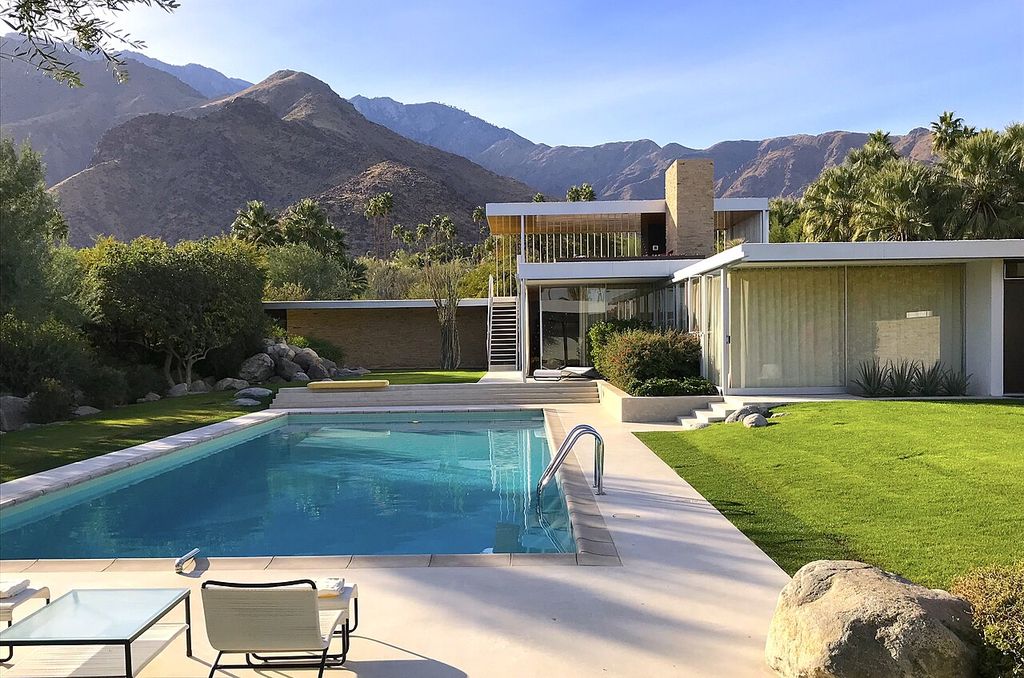
Architectural comparison: the Kaufmann House and swimming pool in Palm Springs, photographed in 2017. Pmeulbroek / Wikimedia Commons. Image source. CC BY-SA 4.0. Image resized; framing and colours retained. This derivative retains CC BY-SA 4.0.
That background helps explain why a pool could carry several interests at once. It belonged to domestic life, leisure and erotic looking; it also presented a demanding visual problem. Water changes its appearance with the light, the surface, the depth and whatever lies around it. A painted swimming pool might require a vocabulary of patterns, reflections or transparent colour even when its rectangular shape looks straightforward. The attraction of a setting and the problem of representing it fed one another. [4]
Art historian Martin Hammer identifies Berkeley, where Hockney was teaching in spring 1967, as the place of completion. The Los Angeles image was being reworked at a geographical distance. [6]
Its clarity can make California seem effortlessly available: house, pool, sunlight, space. Yet this is a highly particular view of a city. Private leisure occupies the whole field; the labour, traffic and public life supporting it fall outside the scene. Sperling reads Hockney’s pool paintings as privileged spaces of gay domestic possibility, while recognising the exclusions of that ideal. Such a reading situates the pictures socially without requiring every empty terrace to conceal an individual drama. [4]
A composition built to hold still
The pool and low building spread across the picture; the diving board enters diagonally from the spectator’s side. Two palms, a chair and window reflections punctuate the simplified scene. The board’s ochre colour echoes the roof, joining foreground and background. Hammer identifies these relationships as part of the painting’s calculated balance. [6]
The horizontals make the scene feel settled. A building, a pool edge and a surface of water are things we know how to read as stable divisions. Repeated across the canvas, their edges encourage the eye to travel laterally and compare one band with another. The splash refuses that rhythm. It rises, spreads and breaks into smaller pieces. Because the surrounding forms are so economical, its irregularity becomes unusually legible. The picture creates the visual quiet that allows a short disturbance to register. [4]
The diagonal board supplies a route into this order. It introduces recession into a scene dominated by forms that stretch across the surface. We can follow its length towards the water, imagining a movement from a position close to our own. Its direction establishes a bodily possibility even though no body is shown. The viewer has a way of entering the picture imaginatively, while the painter keeps the surface broad and simple.
The small chair provides another measure of human use. A terrace intended for sitting and a board intended for diving imply different kinds of activity: rest and exertion, waiting and departure. Emptiness makes those functions easier to notice. The chair can feel expectant, abandoned or merely unused, depending on how a viewer approaches it. None of those impressions establishes the feelings of an absent occupant. What the composition supplies is a place made for people with its people temporarily withheld.
This is also a picture about how little description recognition may require. A roof, a glazed opening, a board and a pool can establish a whole environment without exhaustive detail. Once the scene is recognisable, the broad planes remain visible as shapes of colour. The viewer can move between a plausible poolside space and the arrangements on a flat canvas. That movement is part of Hockney’s wider exploration of style and technique, and it prevents the painting from becoming a neutral record of a view.
The Centre Pompidou’s account of its 1999 Espace/Paysage exhibition placed the painting in a dialogue with formalist abstraction and photographic imagery. Its discussion of the pale surrounding margin is especially useful: a boundary can declare that we are looking at a manufactured image while allowing the enclosed scene to appear convincing. The picture offers depth within a conspicuously bounded, flat object. [7]
How to paint water without a fixed pattern
Water gave Hockney a subject whose identity remained constant while its appearance kept changing. Sperling records the artist’s interest in precisely this difficulty: there is no single colour or stable description that will always signify water. In some paintings Hockney used winding pale lines; elsewhere he developed interlocking areas of colour or almost abstract arrangements of pouring liquid. A Bigger Splash belongs to a sustained experiment, rather than the discovery of one successful formula. [4]
In Peter Getting Out of Nick’s Pool and Sunbather, both from 1966, repeated lines make the water’s surface visibly busy. Picture of a Hollywood Swimming Pool of 1964 uses a different, patchwork vocabulary. Sperling compares such areas to camouflage or a jigsaw. These contrasts matter because the still blue in A Bigger Splash is a choice. Hockney could describe rippling water in many ways; here he concentrates the activity into one local event. [4]
That concentration gives the pool two roles. Across most of its area it participates in the composition’s stillness, a broad colour plane comparable with sky and architecture. Around the splash it becomes a material capable of breaking, rising and falling. The event makes the expanse around it readable as water, while that expanse gives the event room. Representation is distributed unevenly across the surface: one cluster of marks can clarify the identity of a much larger area.
The white passages have to suggest several conditions at once. A splash is water suspended in air, catching light and allowing some of its background to remain visible. It is also an event in the process of losing its shape. Painting gives those unstable appearances a settled arrangement. The apparent disorder can be inspected mark by mark, even though an actual disturbance would have changed before the eye had finished tracing it. This is where the subject’s elusiveness becomes especially productive for a painter. [4]
Comparison with A Lawn Being Sprinkled makes the distinction clearer. Both paintings date from 1967. A sprinkler promises a repeated action; a diver’s impact is a single interruption. The two subjects offer different ways of organising movement within a stationary image. One can make us anticipate the next spray, the other the moment when this particular spray will fall. [1]
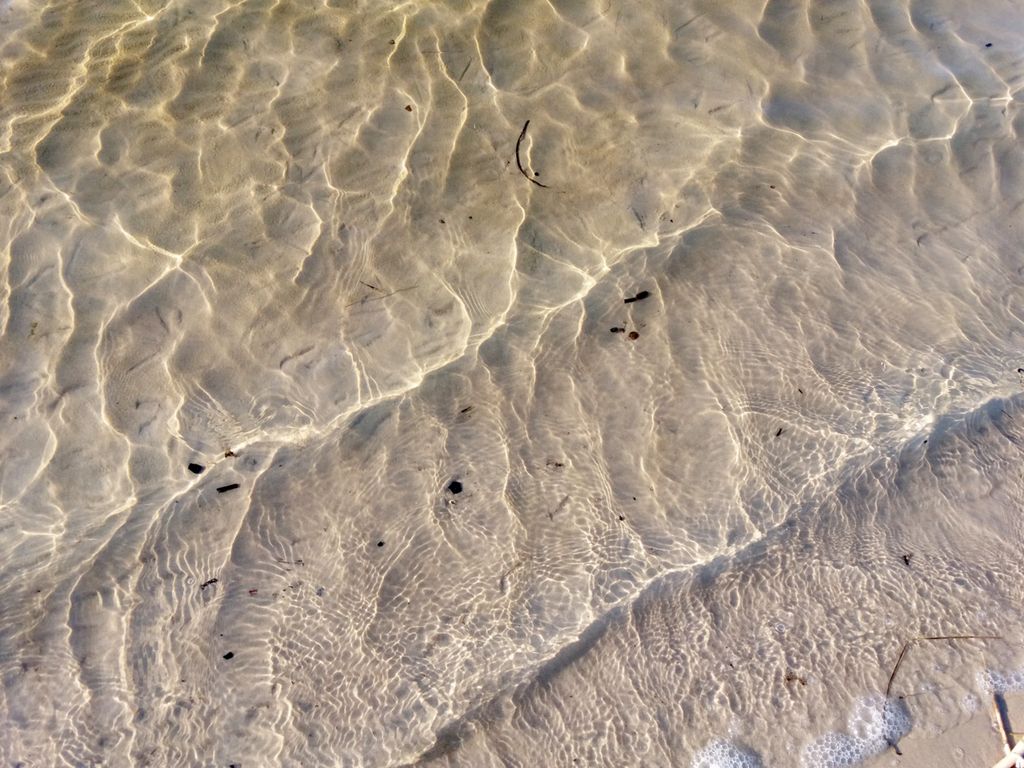
Physical comparison: concentrated patterns of light in shallow water at a beach. Peacelovedeathmetal2 / Wikimedia Commons. Image source. CC BY-SA 4.0. Resized and converted to JPEG; no crop or recolouring. Image derivative retains CC BY-SA 4.0.
The photograph behind the painting
Hammer identifies the photographic source as the cover of Swimming Pools, a practical manual first published in 1959. Hockney had recalled finding a pool-building book at a Hollywood newsstand. The comparison reveals how ordinary promotional imagery became a selective painted construction. [6]
This origin sharpens the significance of the missing person. A practical photograph can demonstrate the pleasure and usefulness of a pool; a painting can rearrange that information until the disturbance itself becomes its principal subject. The motif has travelled between purposes as well as between media. The inviting setting survives, but the image no longer needs to explain the amenity, advertise a family experience or provide an account of a particular swimmer.
Photography also offered access to an appearance that ordinary looking could scarcely hold. A brief exposure can arrest the spray, separating an instant from the movement around it. Painting from such an image allows the artist to study an event after it has disappeared. The photograph is a working resource in this process: the painter can keep returning to a fixed record while deciding what the painted version requires.
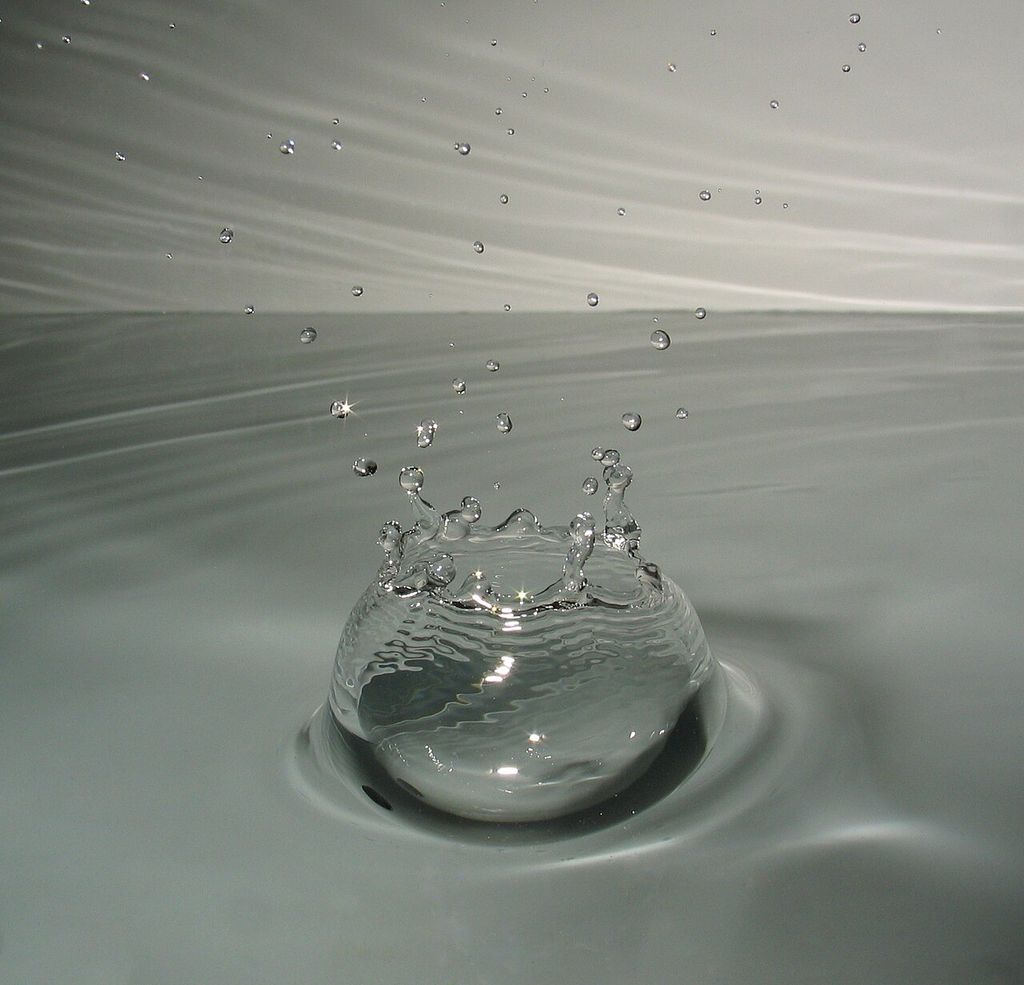
Photographic comparison: a drop striking water, photographed by Roger McLassus on 28 January 2006. The camera holds a fleeting disturbance still for inspection. Roger McLassus / Wikimedia Commons. Image source. CC BY-SA 3.0. Resized and converted to JPEG; no crop or recolouring. Image derivative retains CC BY-SA 3.0.
The Foundation records Hockney’s purchase of a 35mm camera in 1967 and his decision to organise photographs in albums for reference. His increasing use of photographs accompanied an active examination of what painting could make from them. [2]
There is a useful difference between a picture that looks instantaneous and a picture made instantaneously. Here the evidence of a brief event survives through an extended process of attention. A viewer may recognise the photographic possibility of the arrested splash and, at the same time, sense the deliberation that has given it a place within this large composition. Both kinds of image-making contribute to the result.
Acrylic, rollers and the painted surface
Conservation scientist Thomas J. S. Learner used A Bigger Splash to explain the possibilities of acrylic emulsion in Modern Paints Uncovered. His account specifies that the blue sky and water were applied first with a roller, with masking tape helping produce sharp boundaries. Paint went directly onto unprimed cotton canvas. The splash’s white paint was subsequently placed over the blues of the pool. Learner notes that blue did not bleed into those white strokes. [8]
The sequence takes advantage of acrylic’s behaviour after drying: its film does not simply dissolve again when water-based paint is applied over it. Distinct layers can therefore remain clear. For this picture, the property supports a visible contrast between broad areas of colour and finer work placed above them. The materials help explain how water can appear brilliant and mobile within such crisply separated surroundings. The roller and the small brush serve different descriptive tasks on the same canvas. Learner also quotes Hockney on acrylic’s suitability for bold colour and on how its drying speed allowed him to keep working on one picture. A quick-drying medium could sustain a long process of description. [8]
Knowing this changes how the apparent freshness of the splash can be understood. The depicted water erupts, but the paint was carefully applied. Sperling describes fine work with brushes of different sizes against areas made rapidly with a roller. A lively appearance need not be the trace of a single lively gesture. The painting invites us to distinguish the event represented from the actions that produced its representation. [4]
That distinction also gives the smooth areas their importance. They are part of the painting’s expressive organisation, allowing the fine marks to stand out. Different kinds of attention have been allocated to different things: the architecture acquires its stability through broad, controlled divisions; the disturbed water acquires its fleeting character through accumulated detail. Hockney made each manner of working answer a particular pictorial need.
Seconds of action, weeks of looking
Hockney’s account offers a memorable comparison: “two weeks” of painting for an event lasting “two seconds”. His recollection emphasises the mismatch between the subject’s brevity and the attention it received. Weeks of making allow us to examine an occurrence that would otherwise have vanished before we could study it. [2]
Several kinds of time meet here. There is the time implied by the splash: a body has entered the water and the displaced water will fall. There is the time required to paint that appearance. There is also the spectator’s time, which can expand freely because the image will wait. A passing incident has become something durable enough to return to, compare and reconsider. The picture supplies a long encounter with a short event.
The absence of the diver makes that encounter unusual. Ordinarily a person gives a narrative a centre: we watch what they do and follow their subsequent action. Here the person’s presence is inferred from a visible effect. Attention stays with the traces left behind. We can imagine the approach, the leap and the swimmer’s reappearance, but the canvas holds the interval between them. It gives the viewer sufficient information to construct a sequence while refusing to illustrate the whole sequence.
This suspension helps account for the range of moods the painting can accommodate. Its colour and setting may suggest ease, while its emptiness can feel detached. The event itself supplies movement without a visible actor. A viewer need not settle on a secret story to experience those differences. They arise through the balance of implied human activity, architectural stillness and water that has been made permanently unsettled.
Hockney continued to find new ways of representing water and time. In the 1978 Paper Pools, coloured pulp made the image part of the paper’s substance; in the composite Polaroid Gregory Swimming, Los Angeles, March 31st 1982, numerous photographs assemble a swimmer’s movement across a grid. Sperling treats these later returns as fresh technical encounters with a continuing subject. The arrested splash was one possibility among several, followed by pictures that could distribute looking across successive exposures. [4]
Sotheby’s published a recollection in which Hockney connected his interest in painting a splash with Leonardo’s studies of swirling water. The reference places the subject within a much older artistic enquiry, while Hockney’s use of a found photograph and acrylic gives it particular modern resources. His pleasure in the problem could accommodate both an earlier artist’s curiosity and a commercially produced image picked up at a newsstand. [9]
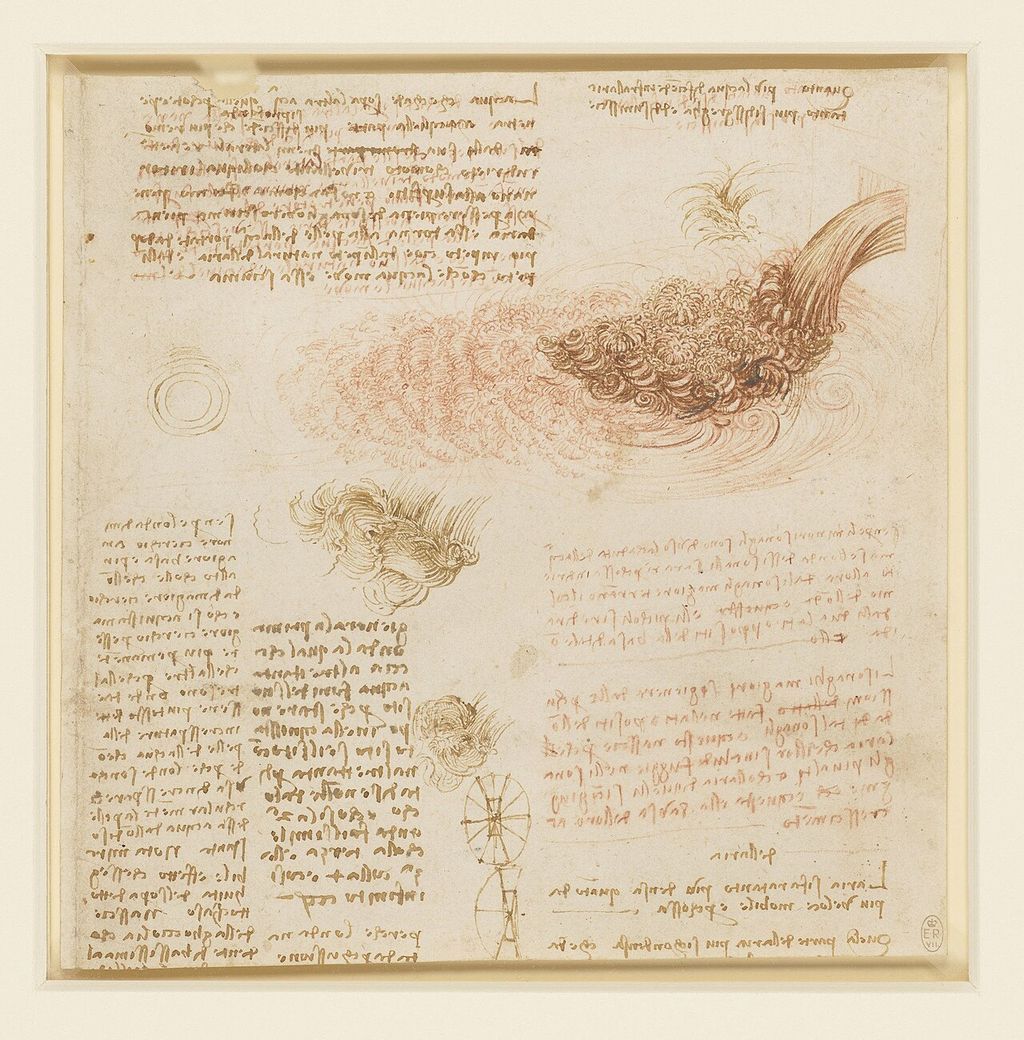
Historical comparison: Leonardo da Vinci, Studies of water, circa 1510–12, Royal Collection, RCIN 912661. Hockney recalled Leonardo’s water studies without naming this particular sheet. Royal Collection Trust.
Painting an action, staging a space
Tate Modern made the distinction between depicted action and the painter’s action the opening of its 2012–13 exhibition A Bigger Splash: Painting after Performance. The show borrowed Hockney’s title and paired his canvas with Jackson Pollock’s Summertime: Number 9A of 1948. Tate’s announcement explained Pollock’s work through the movements recorded in its making, while proposing Hockney’s image as a theatrical space that the spectator might imaginatively enter. [10]
This pairing gives the small brush an unexpected force. A splash can look like an obvious occasion for throwing or pouring paint. Hockney’s careful description makes the relationship less direct: an image of displaced liquid is achieved through a sequence of controlled decisions. The canvas contains evidence of action within its fictional space, while its manufacture follows another tempo. Tate’s exhibition brought that separation into a wider discussion of painting, performance and the body. [10]
The theatrical reading also illuminates the empty architecture. A set can prepare a place for an action and remain legible after the actor has left it. The board and pool organise our expectations in a similar fashion. We recognise where an action might begin and where its result has appeared. The painting’s large scale strengthens the invitation to imagine that space bodily, even as the flat planes and surrounding margin keep reminding us of the constructed image.
This approach gives a more useful account of the work’s relation to abstraction than a simple choice between an abstract painting and a realistic scene. Its broad shapes can satisfy the eye as colour and arrangement, while a handful of descriptive details converts them into a familiar environment. The Centre Pompidou’s historical reading placed this continuing dialogue at the centre of Hockney’s landscapes from the period. [7]
Tate, exhibitions and a changing afterlife
Tate purchased A Bigger Splash in 1981. It later appeared in the major retrospective shared by Tate Britain, the Centre Pompidou and the Metropolitan Museum of Art in 2017–18. The Met presented that survey as an investigation of Hockney’s work across painting, drawing, photography and video, with movement, space and time recurring throughout. In that setting, the pool painting could be encountered as part of a long enquiry into depiction. [1] [11]
The painting also appeared in David Hockney 25 at the Fondation Louis Vuitton in Paris in 2025. That exhibition placed well-known early paintings before an extensive presentation of later work, making the pool imagery an entry into a career that continued to change its subjects and tools. The curatorial structure offers a useful way to approach Hockney’s fame: a recognisable early image can introduce the larger practice without adequately standing for all of it. [12]
Its afterlife extends beyond retrospective display. Sperling considers the pool’s subsequent presence in photography, film and painting, including work by Ed Ruscha, Michael Childers and Caroline Walker. His examples form a history of responses to the wider pool imagery: deserted spaces, reflective surfaces, bodies at leisure and the tension between attraction and unease. These affinities are best understood through particular works and contexts, rather than an assumption that every painted swimming pool descends directly from this one canvas. [4]
Hammer also places the canvas beside the architectural realism of Edward Hopper and Charles Sheeler, and explores darker associations of pools in literature and cinema. Such comparisons open different paths through the painting: its calm can accommodate pleasure, distance or unease. Their value lies in extending interpretation while leaving the absent swimmer’s story unresolved. [6]
One especially clear act of borrowing is Mona Hatoum’s A Bigger Splash of 2009. The Museum of Fine Arts, Houston identifies Hockney’s painting as the source of her title. Working with Murano glassmakers, Hatoum created red glass forms that appear to have splattered across the floor. The museum connects the work with violence and the arrest of a fleeting event, while leaving the possibility of irony in the borrowed title open. The transformation demonstrates how widely the phrase could travel: a California pool painting became a reference within a work of another material, scale of feeling and political charge. [13]
The later films called A Bigger Splash
Jack Hazan’s A Bigger Splash borrowed the painting’s title but concerns a later period in Hockney’s life. The Centre Pompidou identifies the film as a 1973 production that reached screens in 1974; the British Film Institute catalogues it under 1974. Those dates refer to the film’s history, while the painting dates from 1967. The Foundation’s 1974 chronology describes Hazan’s prolonged observation of the artist at work and among friends, including the difficulties surrounding his relationship with Peter Schlesinger. [14] [15] [16]
The painting closely associated with the film’s account of artistic creation is Portrait of an Artist (Pool with Two Figures), completed in 1972. Its visible swimmer and standing figure establish a different poolside situation from the unoccupied architecture of A Bigger Splash. Sperling describes Hazan’s film as a mixture of documentary observation and imaginative staging. It therefore needs to be considered as a work with its own construction, rather than a key that unlocks the earlier canvas’s missing diver. [4]
Luca Guadagnino used the title again for his 2015 feature, a reworking of La Piscine set in the Mediterranean. Sperling places this reuse within the continuing cultural associations of the pool. Neither film changes what the 1967 painting actually supplies: a prepared setting, a vanished actor and a disturbance whose shape has been given time to remain. The wider field of Hockney’s paintings contains many such experiments in how a picture can direct attention, but this one makes the delay between seeing and understanding unusually tangible. [4]
Works directory
This source-bounded directory combines the works in the Metropolitan Museum’s 2017 retrospective checklist with reviewed museum object records and the additional works and series examined in this guide. It spans several media and is not a complete catalogue raisonné. Titles without an article link remain useful dated records. Metropolitan Museum final retrospective checklist (2017); additional object and series sources are given in the linked articles. [1]
| Name | Date | Medium |
|---|---|---|
| Love Painting | 1960 | Painting |
| Shame | 1960 | Painting |
| The Third Love Painting | 1960 | Painting |
| Tyger Painting No. 2 | 1960 | Painting |
| A Rake’s Progress | 1961–63 | Print series |
| Tea Painting in an Illusionistic Style | 1961 | Painting |
| The Cha-Cha That Was Danced in the Early Hours of 24th March | 1961 | Painting |
| Cleaning Teeth, Early Evening (10pm) W11 | 1962 | Painting |
| Flight into Italy - Swiss Landscape (Painting in a Scenic Style) | 1962 | Painting |
| Man in a Museum (or You're in the Wrong Movie) | 1962 | Painting |
| My Brother is Only Seventeen | 1962 | Painting |
| The First Marriage (A Marriage of Styles I) | 1962 | Painting |
| Domestic Scene, Los Angeles | 1963 | Painting |
| Play Within a Play | 1963 | Painting |
| The Hypnotist | 1963 | Painting |
| Arizona | 1964 | Painting |
| California Art Collector | 1964 | Painting |
| Man in Shower in Beverly Hills | 1964 | Painting |
| Portrait Surrounded by Artistic Devices | 1965 | Painting |
| Rocky Mountains and Tired Indians | 1965 | Painting |
| Beverly Hills Housewife | 1966–67 | Painting |
| Medical Building | 1966 | Painting |
| Peter | 1966 | Drawing |
| Peter Getting Out of Nick’s Pool | 1966 | Painting |
| A Bigger Splash | 1967 | Painting |
| A Lawn Being Sprinkled | 1967 | Painting |
| Kasmin in Bed in His Chateau in Carennac | 1967 | Drawing |
| Peter Feeling Not Too Good | 1967 | Drawing |
| Savings and Loan Building | 1967 | Painting |
| The Room, Tarzana | 1967 | Painting |
| American Collectors (Fred and Marcia Weisman) | 1968 | Painting |
| Christopher Isherwood and Don Bachardy | 1968 | Painting |
| Henry Geldzahler and Christopher Scott | 1968-1969 | Painting |
| W. H. Auden | 1968 | Drawing |
| Peter Langan in His Kitchen at Odins | 1969 | Drawing |
| Mark Glazebrook | 1970 | Drawing |
| Mr and Mrs Clark and Percy | 1970-1971 | Painting |
| Ossie Wearing a Fairisle Sweater | 1970 | Drawing |
| Pool and Steps, Le Nid du Duc | 1971 | Painting |
| Rubber Ring Floating in a Swimming Pool | 1971 | Painting |
| Celia in a Black Dress with White Flowers | 1972 | Drawing |
| Mount Fuji and Flowers | 1972 | Painting |
| Portrait of an Artist (Pool with Two Figures) | 1972 | Painting |
| Portrait of the Artist's Mother, Mrs Laura Hockney, Bradford | 1972 | Drawing |
| The Artist's Father | 1972 | Drawing |
| Dr Eugene Lamb, Lucca | 1973 | Drawing |
| Andy, Paris | 1974 | Drawing |
| Contre-jour in the French Style (Against the Day dans le Style-Français) | 1974 | Painting |
| Gregory Sitting on Base of Column | 1975 | Drawing |
| Kerby (after Hogarth) Useful Knowledge | 1975 | Painting |
| Ron Kitaj Outside Akademie der Kunste Vienna | 1975 | Drawing |
| Kasmin Reading the Udaipur Guide | 1977 | Drawing |
| Looking at Pictures on a Screen | 1977 | Painting |
| My Parents | 1977 | Painting |
| Canyon Painting | 1978 | Painting |
| Mother, Bradford, 19 Feb. 1979 (inscribed 1978) | 1979 | Drawing |
| Mulholland Drive: The Road to the Studio | 1980 | Painting |
| Nichols Canyon | 1980 | Painting |
| Outpost Drive, Hollywood | 1980 | Painting |
| Hollywood Hills House | 1981-1982 | Painting |
| Celia. Los Angeles. April 10th 1982 | 1982 | Polaroid composite |
| Don + Christopher, Los Angeles, 6th March 1982 | 1982 | Polaroid composite |
| Gregory Swimming Los Angeles March 31st 1982 | 1982 | Polaroid composite |
| My Mother, Bolton Abbey, Yorkshire, Nov. 1982 | 1982 | Photocollage |
| Self Portrait 30th Sept. 1983 | 1983 | Drawing |
| Pearblossom Hwy., 11-18th April 1986, #1 | 1986 | Photocollage |
| Pearblossom Hwy., 11–18th April 1986, #2 | 1986 | Photocollage |
| Large Interior, Los Angeles | 1988 | Painting |
| Breakfast at Malibu, Sunday, 1989 | 1989 | Painting |
| Pacific Coast Highway and Santa Monica | 1990 | Painting |
| The Other Side | 1991-1993 | Painting |
| The Eleventh V. N. Painting | 1992 | Painting |
| The Twenty Sixth V. N. Painting | 1992 | Painting |
| The Road Across the Wolds | 1997 | Painting |
| 9 Canvas Study of the Grand Canyon | 1998 | Painting |
| A Bigger Grand Canyon | 1998 | Painting |
| Colorado River | 1998 | Painting |
| Garrowby Hill | 1998 | Painting |
| Colin St. John Wilson. London. 3rd June 1999 | 1999 | Drawing |
| Gregory Evans. Los Angeles. 18th September 1999 | 1999 | Drawing |
| Laura Huston. London. 22nd June 1999 | 1999 | Drawing |
| Lindy. Marchioness of Dufferin and Ava. London. 17th June | 1999 | Painting |
| Going Up Garrowby Hill | 2000 | Painting |
| Red Pots in the Garden | 2000 | Painting |
| A Closer Winter Tunnel, February - March | 2006 | Painting |
| Elderflower Blossom, Kilham, July 2006 | 2006 | Painting |
| The Road to Thwing, July 2006 | 2006 | Painting |
| Bigger Trees near Warter | 2007 | Painting |
| Hawthorn Blossom near Rudston | 2008 | Painting |
| Views Through the Artist's Bedroom Window, Bridlington | 2010-2013 | Digital animation |
| The Arrival of Spring in Woldgate, East Yorkshire in 2011 (twenty eleven) | 2011 | Painting / digital series |
| 82 Portraits and 1 Still-life | 2013–16 | Portrait series |
| Garden | 2015 | Painting |
| Garden with Blue Terrace | 2015 | Painting |
| Garden #3 | 2016 | Painting |
| A Bigger Interior with Blue Terrace | 2017 | Painting |
| Interior with Blue Terrace and Garden | 2017 | Painting |
| A Year in Normandie | 2020–21 | Digital frieze |
Discussion
Look again at the images and ideas explored in A Bigger Splash. These editorial prompts invite your observations.
Reader Insights
Which part of the surrounding composition makes the splash seem most active?
How does knowing about the found photograph and the weeks of painting change your sense of the represented instant?
What does the contrast between broad blue areas and small white marks reveal about the work acrylic paint is doing?
Join the Conversation
Share a detail, comparison or question about A Bigger Splash below.
References
- The Metropolitan Museum of Art, David Hockney: Final Checklist, 15 November 2017, printed p. 5 (PDF p. 6), entry for A Bigger Splash. View source.
- The David Hockney Foundation, “1967”, sections “Infatuated with L.A.”, “A Bigger Splash” and “Taking photographs”. View source.
- The David Hockney Foundation, 2021 chronology. View source.
- Matthew Sperling, “Water Marks: The Pull of Hockney’s Pool Paintings”, Apollo, February 2017, pp. 52–58; author’s repository proof. View source.
- The David Hockney Foundation, “1964”, sections “Move to L.A.”, “Landscapes and swimming pools” and “California–Iowa–New York”. View source.
- Martin Hammer, “The photographic source and artistic affinities of David Hockney’s ‘A bigger splash’”, The Burlington Magazine, vol. 159, no. 1370, May 2017. View source.
- Centre Pompidou, David Hockney : espace-paysage, 1999 exhibition record, “Scénographie”. View source.
- Thomas J. S. Learner, “Modern Paints: Uncovering the Choices”, in Modern Paints Uncovered: Proceedings from the Modern Paints Uncovered Symposium, Getty Conservation Institute, p. 7. View source.
- Sotheby’s, “California Dreaming: The Splash”, 13 January 2020, Hockney recollection and comparison of the three splash paintings. View source.
- Tate Modern, “A Bigger Splash: Painting after Performance”, exhibition announcement, 6 November 2012, published by e-flux. View source.
- The Metropolitan Museum of Art, “David Hockney”, exhibition overview, 27 November 2017–25 February 2018. View source.
- Fondation Louis Vuitton, “David Hockney 25”, exhibition, 9 April–1 September 2025, presentation and A Bigger Splash object caption. View source.
- Museum of Fine Arts, Houston, “Mona Hatoum, A Bigger Splash, 2009”, collection record and interpretation, object 2015.418. View source.
- Centre Pompidou, “David Hockney — A bigger Splash”, screening and conversation with Jack Hazan, 22 June 2017. View source.
- British Film Institute, “A Bigger Splash (1974)”, film record. View source.
- The David Hockney Foundation, “1974”, section “A Bigger Splash”. View source.
More HOCKNEY Works
A Bigger Splash
A momentary disturbance becomes the focus of a large acrylic painting, made through weeks of patient work.
Mr and Mrs Clark and Percy
The designers Celia Birtwell and Ossie Clark occupy a room shaped by light, repeated sittings and the demands of a double portrait.
A Bigger Grand Canyon
Sixty canvases gather memory, studies and changing viewpoints into an immense painting of 1998.
Garrowby Hill
The 1998 oil painting transforms a remembered Yorkshire journey into a road, fields and an expansive view.
Portrait of an Artist (Pool with Two Figures)
Photographic studies, two figures and a swimming pool become a carefully constructed painting of 1972.
My Parents
The 1977 oil painting sets Kenneth and Laura Hockney within a quietly organised interior.
Pearblossom Hwy., 11–18th April 1986, #2
Hundreds of separately made photographs construct a road scene that unfolds through movement and time.
Bigger Trees near Warter
Fifty canvases join into a large outdoor painting of Yorkshire trees, with photography helping the artist organise the whole.