


 by Tom Gurney
Tom Gurney BSc (Hons) is an art history expert with over 20 years experience
Email: tomgurney1@gmail.com / Phone: +44 7429 011000
David Hockney Drawings: Introduction
A face described by a few ink lines and a landscape built from charcoal both ask the same practical question: which marks will make something seen become convincing on a flat surface? David Hockney returned to that question throughout his life. Drawing accompanied his painting, printmaking and experiments with cameras, while also producing works complete in themselves. Pencil, coloured crayon, ink, watercolour and the illuminated screen each offered a different way of paying attention. His recurring subjects included people he knew, rooms he occupied and places he revisited. [1]
His drawings reward looking at the distribution of attention. A face may receive patient detail while a sleeve is carried by one long contour. Elsewhere, patterns of clothing become as active as a sitter's features. A sheet can retain large areas of untouched paper without feeling empty. Across these changes, drawing remained a sequence of decisions about what to describe, what to leave open and how long to keep looking.
At a Glance
- ArtistDavid Hockney
- Born9 July 1937, Bradford, England
- Died11 June 2026
- FocusDrawings
Contents
- Learning to draw from life
- What a line can do
- Slowing down in Paris
- Returning to familiar faces
- Charcoal and the daily self-portrait
- Historical models and the flow of watercolour
- Camera lucida: a tool within a drawing practice
- Returning to Yorkshire in charcoal
- Drawing on a screen
- What persists across the materials
Learning to draw from life
Hockney entered Bradford School of Art in 1953, where observational drawing and the human figure formed the basis of his training. Anatomy and perspective were subjects to be studied through practice. He later recalled his enthusiasm for the work, alongside an increasing awareness that the school's teaching gave him little understanding of modern art. The discipline and its limits mattered together: he acquired the means to describe what stood before him, then began questioning what an artist might do with those means. [2]
The tonal teaching at Bradford also helps explain the difference between drawing accurately and drawing in a particular manner. In Hockney's recollection, students concentrated on relationships of light and dark, even when that approach pushed colour into the background. Learning to compare one value with another was a practical preparation for making a body occupy space. His later departures from that teaching were informed choices by someone who understood its procedures. The freedom of the mature work had an exacting apprenticeship behind it. [2]
When he arrived at the Royal College of Art in autumn 1959, Hockney returned to a deliberately demanding exercise: drawing a skeleton. His own account describes two half-life-size studies, each requiring several weeks. A skeleton offers little opportunity to disguise errors beneath clothing or anecdote; its connected parts make proportion and structure unavoidable. Fellow student R. B. Kitaj noticed the work and bought drawings from him. Their friendship also encouraged Hockney to consider subjects drawn from his own interests and experience. [3]
Observation therefore coexisted with invention from the beginning. The early 1960s paintings brought together writing, schematic figures and differing styles. The Musée Granet's account of the Tate collection stresses Hockney's discovery that pictorial conventions could be selected and combined. Drawing could sustain a carefully measured body, but a freehand word or deliberately abbreviated figure could carry meaning too. His development did not follow a simple route from rough marks to polished description. He repeatedly changed the relationship between the mark and the thing it represented. [4]
What a line can do
Ink makes the economy of Hockney's drawing particularly clear. In the 2002 portrait of Drue Heinz, the National Portrait Gallery points to the small number of lines describing her body and clothes, with greater attention concentrated on face and hand. Two lines establish a table. Such decisions give an ordinary object enough presence to locate the sitter without requiring a fully furnished room. The division between detailed and spare passages guides the viewer's eye through the sheet. [5]
The apparent ease depends on selection. A contour has to communicate the direction of a shoulder or the weight of fabric. Ink demands commitment, since a line cannot be rubbed away like pencil. Without shading, each chosen edge carries more of the work. [5]
Different tools gave these decisions a different physical character. W. H. Auden of 1968 is pen and ink on paper; Andy, Paris of 1974 is graphite. The Metropolitan Museum's retrospective checklist identifies the 1972 Celia in a Black Dress with White Flowers as crayon. These are different ways of constructing an image, even when all belong to the broad category of drawing. A graphite line can vary in softness and pressure, while coloured drawing introduces relationships that a black contour alone leaves to the paper and the viewer's imagination. [6]
Several materials could share one sheet. The British Council records Celia, Paris of 1973 as pencil, chalk and crayon on paper. That combination is a useful reminder that drawing need not mean an exclusively linear, monochrome image. Different tools can establish an edge, lighten a passage or build a field of colour within a single work. Looking for those different jobs is more revealing than treating every mark as an expression of one unchanging signature style. [7]
The subject was often as modest as the means. Curator Chris Stephens, discussing the Holburne Museum's exhibition of the 1963–77 drawings, singled out a head resting on a pillow, a pair of glasses protruding from a pocket and furniture that located a friend within a room. The same exhibition included still lifes and interiors. These small particulars make drawing a record of how a place was inhabited: a chair can organise the space, while a displaced object can suggest a moment within an ordinary day. [8]
Slowing down in Paris
The highly finished drawings of the 1970s complicate any assumption that Hockney always worked quickly. After moving to Paris in 1973, he devoted sustained attention to figures close to him. In her interview with Tamaki Sugihara, Museum of Contemporary Art Tokyo curator Ai Kusumoto describes the process as an extended movement between observation and drawing, sometimes continuing for hours or days. She connects it with his questioning of the naturalism pursued in the large double portraits. Drawing offered a place to reconsider the relationship between a picture's persuasive appearance and the experience of seeing. [9]
That distinction matters when assessing a sparse sheet. Few marks do not necessarily mean little time. A line can be the outcome of prolonged comparison: the distance between two features, the angle of a wrist, the way clothing falls when the sitter settles. The finished image may suppress much of the labour that made its clarity possible. In Kusumoto's account, the drawings helped Hockney return to the basic activity of attending to someone immediately before him, at a moment when his established painting procedures had become difficult to sustain. [9]
Drawing also allowed him to move between people and surroundings without the scale and staging of a large canvas. In the Holburne's examples, a twist in Peter Langan's tie or a cigar held by Henry Geldzahler gives an encounter a specific focus. A background need only contain the information that makes the setting intelligible. This is selective description: the drawing establishes a hierarchy among details, allowing some to attract attention while others remain lightly stated. [8]
Returning to familiar faces
The exhibition Drawing from Life followed Hockney through repeated depictions of five subjects: himself, his mother Laura, Celia Birtwell, Gregory Evans and Maurice Payne. Its organising idea was the passage of time across those encounters. A familiar face could be drawn again after a change in medium, after a long interval or simply under different circumstances. The resulting group brings together the changing appearance of the sitter and the changing practice of the artist. [1]
Familiarity supplied knowledge without exhausting the subject. The National Portrait Gallery describes the sittings with textile designer Celia Birtwell as collaborations between friends who admired each other's work. In Celia, Carennac, August 1971, coloured pencil describes a vintage dressing gown whose strong textile pattern contrasts with the handling of face and hands. Clothing becomes a substantial drawing problem in its own right. Hockney could attend to the person and to the visual activity of something she wore, making their different surfaces part of the portrait's structure. [10]
Asked by curator Sarah Howgate where he usually began a portrait, Hockney identified the eyes and nose as a starting point, linking them with the individuality of a face. This was a working preference within a larger encounter. In the same interview, he remembered his mother as a patient sitter and his father as restless: his father would pick up a book, an action Hockney eventually included in a painting. Observation could accommodate what a sitter actually did. [11]
The tools continued changing within these long relationships. For the 2019 drawings of Celia, Gregory and Maurice, the National Portrait Gallery records walnut-brown ink and Japanese brushes with built-in reservoirs. That ink supply allowed Hockney to maintain a continuous line. The practical feature matters: the drawing tool could sustain the movement of the hand across the sheet. A late encounter with an old friend could therefore combine accumulated knowledge of the face with a newly chosen way of making its contours. [12]
Repeated sittings also offered repeated decisions. How much of the body should be included? Would the chair anchor the figure, or would a head occupy nearly the whole sheet? How should attention move between features, hands and the surrounding paper? These questions keep the drawings active as images even when the sitter's identity is already familiar. The wider relationships and the development of the painted likenesses are explored in Hockney's portraits; here, the interest lies in what another encounter allowed him to draw differently.
Charcoal and the daily self-portrait
Self-portraiture made the act of returning especially concentrated. The Getty's 2017 exhibition text describes Hockney's self-images as works made for his own interest, with several series developing through daily practice. The mirror supplied a subject who was always available, but whose appearance and manner of looking were never quite constant. Repetition could expose variation that a single carefully selected likeness would conceal. [13]
Self Portrait 30th Sept. belongs to a group of thirty-five drawings undertaken in September and October 1983, according to the National Portrait Gallery's collection record. Charcoal gave the series a shared material basis. Keeping the tool and subject broadly constant made differences among the individual sheets more consequential: a change in emphasis could arise through the day's looking and the handling of the marks, without requiring a different sitter or an elaborate setting. [14]
In its discussion of the 30 September drawing, the Gallery notes the contrast between detailed treatment of Hockney's face and the more quickly described body, against a plain background. That concentration makes the face the point at which the viewer meets the drawing. The surrounding openness also exposes the act of description: the body is sufficient to support the head without every passage receiving equal finish. [5]
The Gallery places the broader 1983 campaign within a period of self-examination, alongside Hockney's experience of middle age, hearing loss and bereavements. That context deserves recognition, while individual marks remain open to interpretation. A heavily worked passage is evidence of a drawing decision; it cannot by itself establish a precise emotional state. The series is compelling because it keeps the subject available for further examination, allowing different images to coexist without asking one of them to define him permanently. [10]
Historical models and the flow of watercolour
Earlier artists remained practical companions to this work. Kusumoto recalled visiting Hockney in Normandy in 2019 and watching him copy a Rembrandt drawing from a catalogue into a small sketchbook. As he worked, he proposed the order in which Rembrandt had laid down the lines. The anecdote records a particular kind of study: asking how a drawing was built, and testing that understanding through the hand. Admiration became an attempt to follow a sequence of decisions. [15]
The sketchbook itself could be a sustained project. Hockney told Howgate that he wanted to use every page, front and back, extending drawings to the edges, because he regarded a sketchbook as one work. A book offered an order in which separate encounters could accumulate, while the turn of a page introduced another beginning. His account gives the modest, portable object a role beyond storing studies for something to be made later. [11]
His renewed use of watercolour in 2002 similarly involved learning through sustained practice. The Foundation connects it with his encounter with Chinese watercolours at the Metropolitan Museum while he was staying in New York. Friends, plants and the view from his hotel room provided immediate subjects. Hockney later described being drawn to the medium's flow, while recognising the advance planning demanded by working from lighter passages towards darker ones. He committed months to learning its possibilities. [16]
That account makes fluidity sound earned. A flowing brushstroke requires decisions about the amount of water, the colour carried by the brush and the area of paper to be left uncovered. Hockney's recollection emphasises the difficulty of placing a light colour over a dark passage as one might in oil. The order of working therefore becomes part of the image's construction. An immediate-looking result can depend on thinking ahead as well as responding to what is visible. [16]
Self Portrait with Red Braces of 2003 demonstrates the overlap between drawing and painting on paper. The Huntington classifies it among its drawings and records the medium as watercolour. A brush, as much as a pencil, can describe a figure through discrete marks. The example makes material names useful guides to procedure without turning them into rigid boundaries between kinds of art. [17]
In the landscapes made during his early twenty-first-century travels, Hockney sometimes applied watercolour directly, without a preliminary pencil drawing. The Guggenheim Museum Bilbao describes these works in terms of economical brushwork and a restricted palette, sometimes of only four colours. The brush itself had to perform the tasks of placement and description. A few strokes could establish space, while the colour relationships carried information that might elsewhere have been supplied by tone or a network of lines. [18]
Watercolour also connected the travelling sketchbook with more developed work. L.A. Louver's account of the Yorkshire watercolours explains that small notebook studies made during drives became the basis for larger sheets worked up in the studio. Immediate observation and later development belonged to the same project. The change of scale gave Hockney another opportunity to decide which relationships from the study should remain and how broadly they could be stated. [19]
When the Getty included three of his watercolours alongside its 2011 exhibition of historic British works on paper, it placed that practice within a longer landscape tradition. Its description of A Larger Valley, Millington of 2004 singles out a road curving through green hills dotted with trees. The road gives the eye a route into the terrain; the brushwork and colour keep the valley active as a made image. Familiar Yorkshire country offered an opportunity to reconsider space through this newly sustained medium. [20]
Historical drawing comparison: Jean-Auguste-Dominique Ingres, Portrait of Frederick (North), Earl of Guildford, 1815, Metropolitan Museum of Art. Jean-Auguste-Dominique Ingres / The Metropolitan Museum of Art / Wikimedia Commons. Image source. CC0 / Public domain. Resized and converted to JPEG; no crop or recolouring.
Camera lucida: a tool within a drawing practice
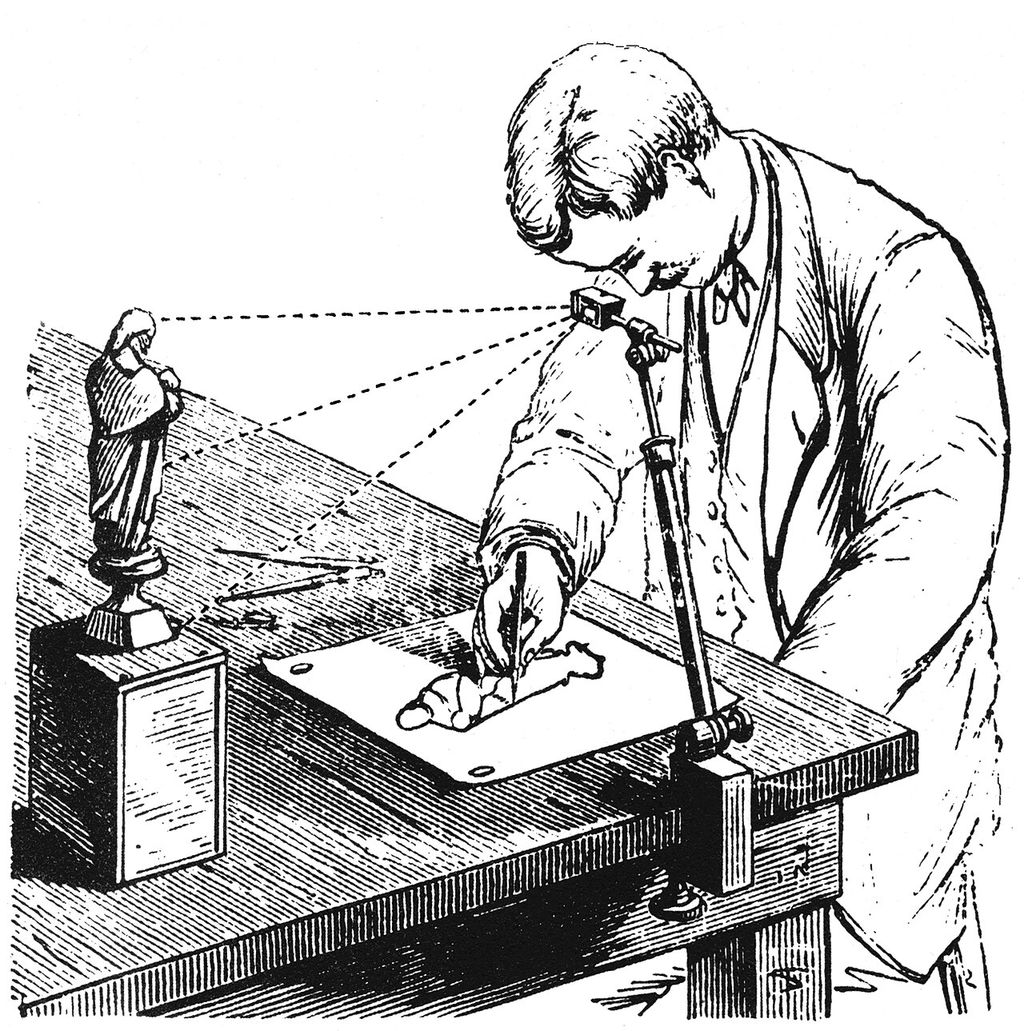
Hockney's camera lucida portraits developed in 1999 from an existing practice of drawing people. The Fitzwilliam Museum's Hockney's Eye labels make that continuity explicit by comparing them with a 1994 portrait of William Hardie. A camera lucida uses a prism to allow the operator to see the subject and the drawing surface together. It provides a visual aid to positioning; the hand must still place the marks. [21]
Hockney's own account stresses how difficult he initially found it. The apparent relationship between subject and paper shifted when he moved his head. He learned to make rapid indications of the positions of eyes, nose and mouth. The procedure demanded concentration and practice over the course of the year. It changed the conditions of observation, requiring him to stabilise an elusive visual relationship before continuing the likeness. [22]
The Fitzwilliam explains that he used the instrument briefly to establish key features before finishing by eye. Its account of 12 Portraits After Ingres in a Uniform Style likewise describes a combination of camera lucida and freehand drawing. The optical stage thus belonged within a larger process. An aid to proportion could leave the artist many decisions about contour, emphasis and completion. [21]
The resulting sheets also varied materially. The Met checklist records several 1999 portraits as graphite on paper using a camera lucida. The Fitzwilliam lists pencil, coloured pencil and gouache for the National Gallery staff portraits. Those descriptions show how measurement could be combined with different kinds of drawn and painted intervention. The instrument supplied one part of the procedure, while the finished works retained the possibilities of their chosen materials. [6] [21]
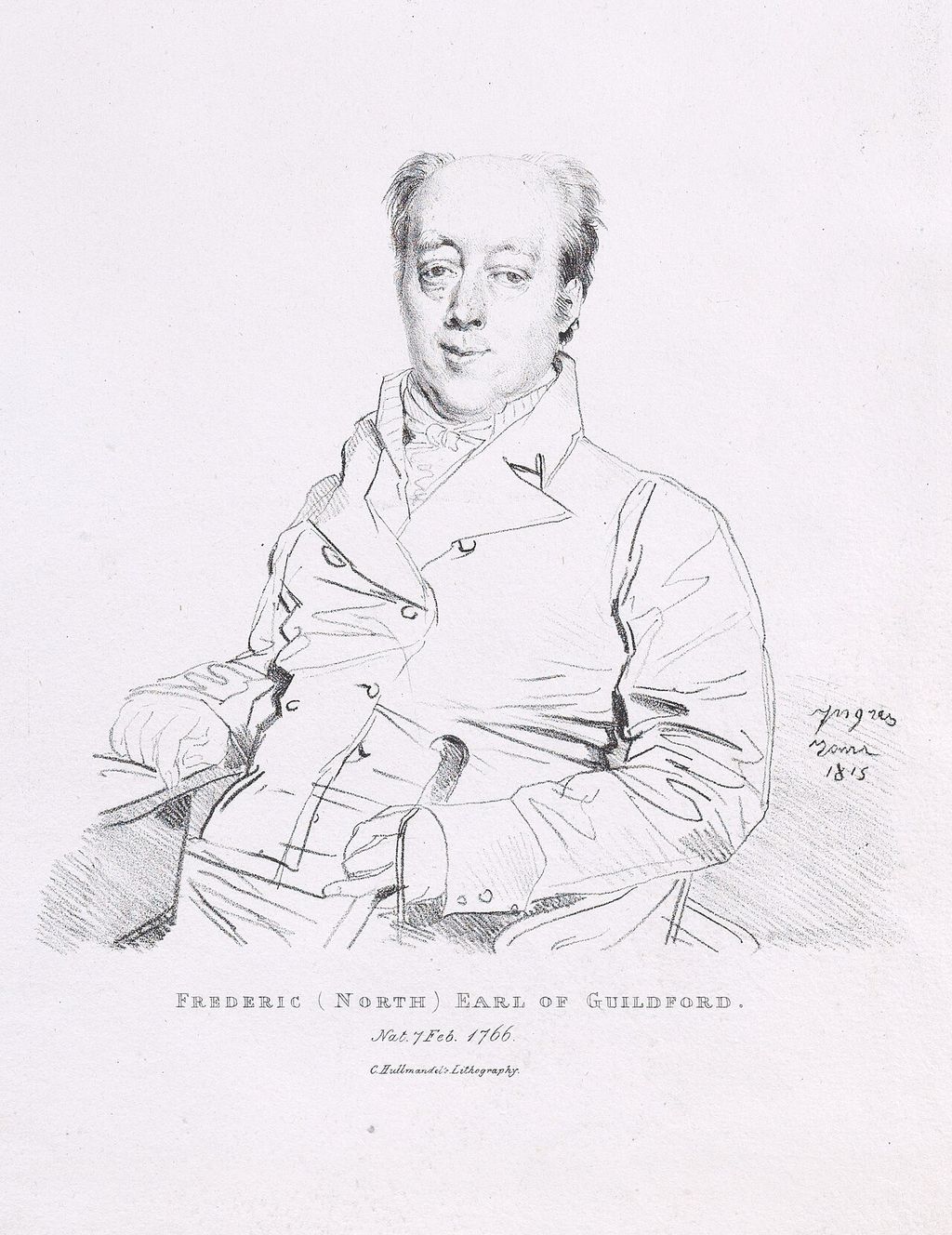
His interest followed close study of Ingres's portraits, whose assured lines encouraged him to investigate possible optical assistance. Hockney's documented use of the device is separate from the historical argument about other artists. Teylers Museum explicitly presents the wider optics thesis as disputed. Readers can follow that argument in Secret Knowledge and the optics debate. For the drawings themselves, the practical evidence is clear: Hockney tested a tool, encountered its difficulties and incorporated it into his own process. [22] [23]
A camera lucida illustrated in Scientific American Supplement, 11 January 1879. Unidentified illustrator / Scientific American Supplement (1879) / Wikimedia Commons. Image source. Public domain. Resized and converted to JPEG; no crop or recolouring.
Returning to Yorkshire in charcoal
The later landscapes brought repeated observation into a different register. The Arrival of Spring in 2013 (twenty thirteen) is a twenty-five-part charcoal work based on five views of Woldgate. The Foundation records Hockney's explanation that he had to wait for sufficient changes between drawings; on some visits he realised he had returned too soon. Repetition became a way to judge the pace of the subject, requiring patience as well as productivity. [24]
Charcoal required seasonal change to be conveyed through a monochrome vocabulary. Successive drawings ask the viewer to attend to growth, changing masses and the distribution of light and dark. Dates establish a sequence, but the marks make it visible. Returning to the same views kept differences in the subject available for scrutiny. [24]
Louisiana Museum's account of its 2015 presentation notes that Hockney sometimes drew outdoors and sometimes from the driver's seat of a parked car. The drawing situation could therefore be an ordinary, workable arrangement close to the motif. That detail helps restore the sustained physical activity behind the series: travelling to a place, settling into a position and giving the scene enough time to become a drawing. [25]
Drawing on a screen
The path towards digital work included experiments with other machines. Getty curator Julian Brooks recalled a 1986 self-portrait made by photocopying Hockney's striped shirt, then manipulating and recopying the images. The resulting work occupied two sheets. Copying had become a method of constructing the picture, with the pattern on an actual garment providing material to be altered through successive operations. The tool changed the route by which marks reached the paper, while the familiar subject of self-portraiture continued. [26]
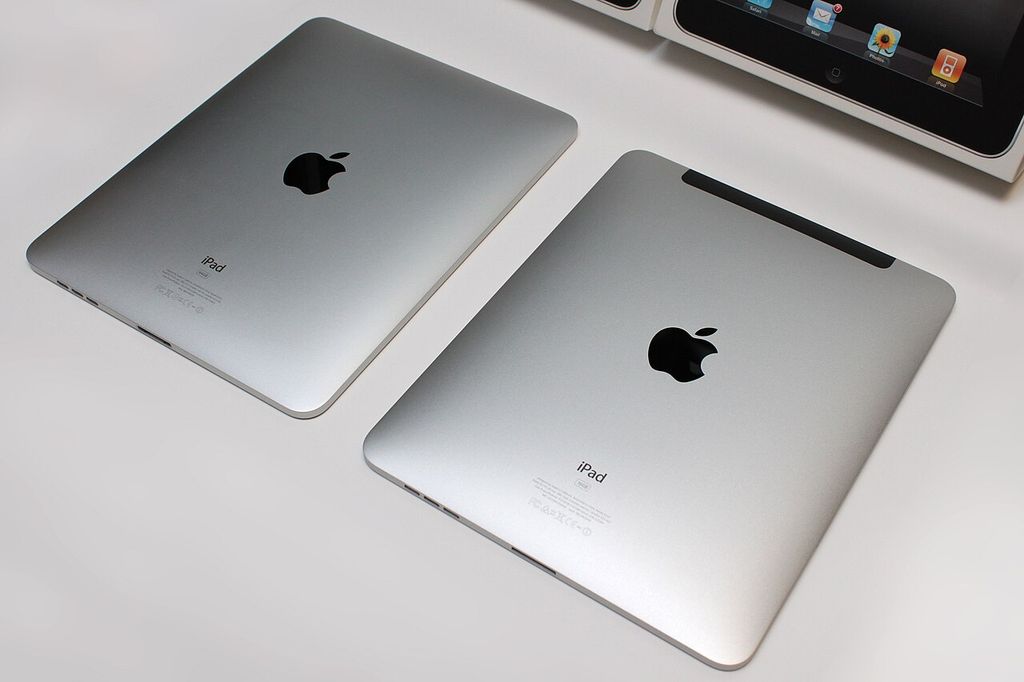
Hockney tried drawing on an iPhone in 2009 and began using the iPad the following year. The new devices joined a practice already accustomed to testing different tools. [15]
The digital landscapes belonged to the same habit of returning. In January 2011 Hockney began drawing the East Yorkshire countryside outdoors on an iPad, developing a series that followed the transition from winter towards summer. The Foundation records more than a hundred drawings, of which fifty-one were printed for the Royal Academy installation alongside a large oil painting. Drawing and painting continued together, while the portable screen offered another working surface for observation. [27]
The comparison with the 2013 charcoals is instructive. Both projects organised attention through return visits, although their materials offered different ways to state what had changed. The iPad allowed strong colour and a range of digital marks; charcoal concentrated the available means into black, white and intervening tones. Neither tool made the seasonal subject self-explanatory. Hockney still had to select the features that would make a particular day's landscape distinct. [24] [27]
Kusumoto also explains Hockney's distinction between iPad drawings and iPad paintings. In her account, the 2011 Woldgate images captured changing conditions with relative immediacy, whereas the Normandy works of 2020 could develop colour and composition through separate layers. The distinction concerned the organisation and complexity of the work on the device. The same screen could support differing processes, just as paper could carry a quick notation or an extended study. [15]
In 2012 he again worked serially on his own face, making a digital self-portrait daily for twenty days; the National Portrait Gallery connects their character types with Rembrandt's early self-portrait prints. [10]
Display introduced further choices. Getty's 2017 exhibition identified Self Portrait, 20 March 2012 (1219) as an iPad drawing printed on paper and mounted on Dibond. In a later recollection, curator Julian Brooks emphasised the large scale of the exhibited digital self-portraits and Hockney's interest in zooming in and out. A mark made on a handheld device could be encountered at a substantially different size. That change gave the drawing another physical relationship with its viewer. [28] [26]
The tools and working methods receive fuller treatment in Hockney's iPad art. His photography and joiners offer a related inquiry into the time involved in seeing. Getty's gallery text explains that he assembled separate photographic views to introduce duration and his own presence into the image. Across media, a picture could be constructed from accumulated attention. [13]
Drawing hardware: the backs of first-generation Wi-Fi and Wi-Fi + 3G iPads. Yutaka Tsutano / Wikimedia Commons. Image source. CC BY 2.0. Resized and converted to JPEG; no crop or recolouring.
What persists across the materials
Hockney's drawings invite a practical kind of looking. Notice where description becomes concentrated, how a figure meets the surrounding paper and which marks establish a room or a stretch of land. Consider the different demands of a line that must be committed in ink, a watercolour passage planned around the light paper, or a digital image assembled through layers. These differences belong to the substance of the work.
The continuity lies in the renewed encounter. A sitter can return, a face in a mirror can change, and a familiar wood can require another visit before its transformation becomes drawable. Hockney kept finding reasons to look again. The drawings preserve the consequences of that attention in material form: the particular line, patch of colour or charcoal mark through which one encounter became an image.
Works directory
This source-bounded directory combines the works in the Metropolitan Museum’s 2017 retrospective checklist with reviewed museum object records and the additional works and series examined in this guide. It spans several media and is not a complete catalogue raisonné. Titles without an article link remain useful dated records. Metropolitan Museum final retrospective checklist (2017); additional object and series sources are given in the linked articles. [6]
| Name | Date | Medium |
|---|---|---|
| Love Painting | 1960 | Painting |
| Shame | 1960 | Painting |
| The Third Love Painting | 1960 | Painting |
| Tyger Painting No. 2 | 1960 | Painting |
| A Rake’s Progress | 1961–63 | Print series |
| Tea Painting in an Illusionistic Style | 1961 | Painting |
| The Cha-Cha That Was Danced in the Early Hours of 24th March | 1961 | Painting |
| Cleaning Teeth, Early Evening (10pm) W11 | 1962 | Painting |
| Flight into Italy - Swiss Landscape (Painting in a Scenic Style) | 1962 | Painting |
| Man in a Museum (or You're in the Wrong Movie) | 1962 | Painting |
| My Brother is Only Seventeen | 1962 | Painting |
| The First Marriage (A Marriage of Styles I) | 1962 | Painting |
| Domestic Scene, Los Angeles | 1963 | Painting |
| Play Within a Play | 1963 | Painting |
| The Hypnotist | 1963 | Painting |
| Arizona | 1964 | Painting |
| California Art Collector | 1964 | Painting |
| Man in Shower in Beverly Hills | 1964 | Painting |
| Portrait Surrounded by Artistic Devices | 1965 | Painting |
| Rocky Mountains and Tired Indians | 1965 | Painting |
| Beverly Hills Housewife | 1966–67 | Painting |
| Medical Building | 1966 | Painting |
| Peter | 1966 | Drawing |
| Peter Getting Out of Nick’s Pool | 1966 | Painting |
| A Bigger Splash | 1967 | Painting |
| A Lawn Being Sprinkled | 1967 | Painting |
| Kasmin in Bed in His Chateau in Carennac | 1967 | Drawing |
| Peter Feeling Not Too Good | 1967 | Drawing |
| Savings and Loan Building | 1967 | Painting |
| The Room, Tarzana | 1967 | Painting |
| American Collectors (Fred and Marcia Weisman) | 1968 | Painting |
| Christopher Isherwood and Don Bachardy | 1968 | Painting |
| Henry Geldzahler and Christopher Scott | 1968-1969 | Painting |
| W. H. Auden | 1968 | Drawing |
| Peter Langan in His Kitchen at Odins | 1969 | Drawing |
| Mark Glazebrook | 1970 | Drawing |
| Mr and Mrs Clark and Percy | 1970-1971 | Painting |
| Ossie Wearing a Fairisle Sweater | 1970 | Drawing |
| Pool and Steps, Le Nid du Duc | 1971 | Painting |
| Rubber Ring Floating in a Swimming Pool | 1971 | Painting |
| Celia in a Black Dress with White Flowers | 1972 | Drawing |
| Mount Fuji and Flowers | 1972 | Painting |
| Portrait of an Artist (Pool with Two Figures) | 1972 | Painting |
| Portrait of the Artist's Mother, Mrs Laura Hockney, Bradford | 1972 | Drawing |
| The Artist's Father | 1972 | Drawing |
| Dr Eugene Lamb, Lucca | 1973 | Drawing |
| Andy, Paris | 1974 | Drawing |
| Contre-jour in the French Style (Against the Day dans le Style-Français) | 1974 | Painting |
| Gregory Sitting on Base of Column | 1975 | Drawing |
| Kerby (after Hogarth) Useful Knowledge | 1975 | Painting |
| Ron Kitaj Outside Akademie der Kunste Vienna | 1975 | Drawing |
| Kasmin Reading the Udaipur Guide | 1977 | Drawing |
| Looking at Pictures on a Screen | 1977 | Painting |
| My Parents | 1977 | Painting |
| Canyon Painting | 1978 | Painting |
| Mother, Bradford, 19 Feb. 1979 (inscribed 1978) | 1979 | Drawing |
| Mulholland Drive: The Road to the Studio | 1980 | Painting |
| Nichols Canyon | 1980 | Painting |
| Outpost Drive, Hollywood | 1980 | Painting |
| Hollywood Hills House | 1981-1982 | Painting |
| Celia. Los Angeles. April 10th 1982 | 1982 | Polaroid composite |
| Don + Christopher, Los Angeles, 6th March 1982 | 1982 | Polaroid composite |
| Gregory Swimming Los Angeles March 31st 1982 | 1982 | Polaroid composite |
| My Mother, Bolton Abbey, Yorkshire, Nov. 1982 | 1982 | Photocollage |
| Self Portrait 30th Sept. 1983 | 1983 | Drawing |
| Pearblossom Hwy., 11-18th April 1986, #1 | 1986 | Photocollage |
| Pearblossom Hwy., 11–18th April 1986, #2 | 1986 | Photocollage |
| Large Interior, Los Angeles | 1988 | Painting |
| Breakfast at Malibu, Sunday, 1989 | 1989 | Painting |
| Pacific Coast Highway and Santa Monica | 1990 | Painting |
| The Other Side | 1991-1993 | Painting |
| The Eleventh V. N. Painting | 1992 | Painting |
| The Twenty Sixth V. N. Painting | 1992 | Painting |
| The Road Across the Wolds | 1997 | Painting |
| 9 Canvas Study of the Grand Canyon | 1998 | Painting |
| A Bigger Grand Canyon | 1998 | Painting |
| Colorado River | 1998 | Painting |
| Garrowby Hill | 1998 | Painting |
| Colin St. John Wilson. London. 3rd June 1999 | 1999 | Drawing |
| Gregory Evans. Los Angeles. 18th September 1999 | 1999 | Drawing |
| Laura Huston. London. 22nd June 1999 | 1999 | Drawing |
| Lindy. Marchioness of Dufferin and Ava. London. 17th June | 1999 | Painting |
| Going Up Garrowby Hill | 2000 | Painting |
| Red Pots in the Garden | 2000 | Painting |
| A Closer Winter Tunnel, February - March | 2006 | Painting |
| Elderflower Blossom, Kilham, July 2006 | 2006 | Painting |
| The Road to Thwing, July 2006 | 2006 | Painting |
| Bigger Trees near Warter | 2007 | Painting |
| Hawthorn Blossom near Rudston | 2008 | Painting |
| Views Through the Artist's Bedroom Window, Bridlington | 2010-2013 | Digital animation |
| The Arrival of Spring in Woldgate, East Yorkshire in 2011 (twenty eleven) | 2011 | Painting / digital series |
| 82 Portraits and 1 Still-life | 2013–16 | Portrait series |
| Garden | 2015 | Painting |
| Garden with Blue Terrace | 2015 | Painting |
| Garden #3 | 2016 | Painting |
| A Bigger Interior with Blue Terrace | 2017 | Painting |
| Interior with Blue Terrace and Garden | 2017 | Painting |
| A Year in Normandie | 2020–21 | Digital frieze |
Discussion
Look again at the images and ideas explored in David Hockney Drawings. These editorial prompts invite your observations.
Reader Insights
Which example makes the greatest amount of a small number of lines?
How does the account of camera-lucida notation and freehand completion change your understanding of an optical aid?
What remains recognisable about Hockney’s drawing when paper, charcoal, watercolour and a screen make different demands?
Join the Conversation
Share a detail, comparison or question about David Hockney Drawings below.
References
- The Morgan Library & Museum, David Hockney: Drawing from Life, online exhibition introduction, 2020–21. View source.
- The David Hockney Foundation, Chronology: 1953–58, Bradford training and tonal teaching sections. View source.
- The David Hockney Foundation, Chronology: 1959, Royal College of Art, Kitaj and skeleton-drawing sections. View source.
- Musée Granet / Tate, David Hockney: Collection de la Tate, English exhibition press dossier, 2023, room guide, pp. 8–19, especially p. 9. View source.
- National Portrait Gallery, Significant artists: drawing and painting with David Hockney, sections on Drue Heinz, ink drawing and the 1983 self-portrait. View source.
- The Metropolitan Museum of Art, David Hockney: Final Checklist, 15 November 2017, printed pp. 6–10 and 15–16 (PDF pp. 7–11 and 16–17). View source.
- British Council Collection, Celia, Paris, 1973, accession P1772, object record. View source.
- The Holburne Museum / Chris Stephens, Love Life: David Hockney Drawings 1963–1977, exhibition announcement, 25 February 2022. View source.
- Tamaki Sugihara interviewing Ai Kusumoto, From difficulty to a new direction: David Hockney exhibition curator interview, part two, Tokyo Art Beat, 22 September 2023, Japanese; opening section on naturalism and Paris drawing. View source.
- National Portrait Gallery, David Hockney: Drawing from Life, learning resource, sections on Celia and self-examination. View source.
- Sarah Howgate interviewing David Hockney, September 2019 interview excerpt, reproduced by Peggy Roalf, David Hockney: Drawing From Life, AI-AP / DART, 30 September 2020. View source.
- National Portrait Gallery, David Hockney: Drawing from Life, 2023 large-print exhibition guide, p. 52, “Recent Portraits of Gregory, Celia and Maurice”. View source.
- The J. Paul Getty Museum, Happy Birthday, Mr. Hockney, gallery text, 2017, PDF pp. 2–3. View source.
- National Portrait Gallery, David Hockney ('Self Portrait 30th Sept.'), 1983, NPG 6473, collection record. View source.
- Tamaki Sugihara interviewing Ai Kusumoto, Why has Hockney sustained acclaim and popularity for sixty years?, part one, Tokyo Art Beat, 25 August 2023, Japanese; Rembrandt copying and medium-specific practice sections. View source.
- The David Hockney Foundation, Chronology: 2002, watercolour section and artist testimony. View source.
- The Huntington Library, Art Museum, and Botanical Gardens, Self Portrait with Red Braces, 2003, object 2021.16.2, collection record. View source.
- Guggenheim Museum Bilbao, Watercolors, exhibition explanatory text. View source.
- L.A. Louver, David Hockney: “Hand Eye Heart”, Watercolors of the East Yorkshire Landscape, 26 February–2 April 2005, exhibition text. View source.
- The J. Paul Getty Museum, Luminous Paper: British Watercolors and Drawings, 2011, “Continuing the British Watercolor Tradition” section. View source.
- The Fitzwilliam Museum, Hockney's Eye: The Art and Technology of Depiction, large-print exhibition labels, 2022, PDF pp. 58, 60, 100, 103 and 108–110. View source.
- The David Hockney Foundation, Chronology: 1999, optical investigations and camera lucida portraits sections. View source.
- Teylers Museum, Hockney's Eye, exhibition archive, sections on optical instruments and the disputed historical thesis, Dutch. View source.
- The David Hockney Foundation, Chronology: 2013, The Arrival of Spring in 2013 (twenty thirteen) section. View source.
- Louisiana Museum of Modern Art, David Hockney, exhibition archive, 19 March–21 June 2015. View source.
- Julian Brooks and Virginia Heckert, Remembering the Creativity and Humor of David Hockney, Getty, 3 September 2026, curatorial conversation on the 2017 exhibitions. View source.
- The David Hockney Foundation, Chronology: 2011, The Arrival of Spring in 2011 section. View source.
- The J. Paul Getty Museum, Happy Birthday, Mr. Hockney, 2017 exhibition page, Self Portrait, 20 March 2012 (1219) caption. View source.
More HOCKNEY Works
A Bigger Splash
A momentary disturbance becomes the focus of a large acrylic painting, made through weeks of patient work.
Mr and Mrs Clark and Percy
The designers Celia Birtwell and Ossie Clark occupy a room shaped by light, repeated sittings and the demands of a double portrait.
A Bigger Grand Canyon
Sixty canvases gather memory, studies and changing viewpoints into an immense painting of 1998.
Garrowby Hill
The 1998 oil painting transforms a remembered Yorkshire journey into a road, fields and an expansive view.
Portrait of an Artist (Pool with Two Figures)
Photographic studies, two figures and a swimming pool become a carefully constructed painting of 1972.
My Parents
The 1977 oil painting sets Kenneth and Laura Hockney within a quietly organised interior.
Pearblossom Hwy., 11–18th April 1986, #2
Hundreds of separately made photographs construct a road scene that unfolds through movement and time.
Bigger Trees near Warter
Fifty canvases join into a large outdoor painting of Yorkshire trees, with photography helping the artist organise the whole.