


 by Tom Gurney
Tom Gurney BSc (Hons) is an art history expert with over 20 years experience
Email: tomgurney1@gmail.com / Phone: +44 7429 011000
David Hockney Photography and Joiners: Introduction
A person turns their head, a swimmer enters the water, a road opens into the distance: seeing takes time. David Hockney made that ordinary fact the starting point for an extraordinary body of photographs. His joiners assemble separate exposures into a larger picture, carrying changes of viewpoint and successive moments across its surface. The spaces between the photographs, and the places where they overlap, help us follow the work of looking. A camera usually associated with fixing an instant became a means of building an experience. [1]
Photography ran through Hockney’s practice in several forms. Snapshots supplied information for paintings; Polaroids became gridded compositions; overlapping colour prints developed into expansive portraits and landscapes. Much later, digital photographs provided material for works he called photographic drawings. Keeping these forms distinct makes their connections more interesting. Hockney repeatedly asked what a particular tool allowed him to notice, remember and arrange, and what he still needed to change with his own judgement. [1] [2]
At a Glance
- ArtistDavid Hockney
- Born9 July 1937, Bradford, England
- Died11 June 2026
- FocusPhotography and Joiners
Contents
- Photographs before the joiners
- The Polaroid breakthrough of 1982
- A dive that takes more than one moment
- From grids to overlapping photographic collages
- Portraits made through an encounter
- Walking around the Japanese garden
- Cubism, scrolls and the moving viewer
- Roads, distance and Pearblossom Highway
- What the joins ask us to do
- Beyond the photographic joiner
Photographs before the joiners
During the 1960s Hockney used a 35mm camera to record friends, family, holidays and journeys, then to gather studies for paintings. Such photographs belonged to a working life that also depended on drawing and sustained observation. A snapshot could hold a pose or preserve the appearance of a place after he had left it. Its usefulness did not settle how the eventual picture should be organised. The distinction between recording something and constructing a painting would become increasingly important. [1]
His account of Mr and Mrs Clark and Percy makes the coexistence of methods particularly clear. Ossie Clark and Celia Birtwell posed for him extensively, including in his studio, while he repeatedly revised the figures. He wanted the large painting to create the presence of two people in a room. Photographs formed part of this period’s practice, but the picture cannot adequately be described as a snapshot transferred to canvas. Its scale, tonal problems and repeated sittings involved decisions made through painting and through being with the subjects. [3]
The making of Portrait of an Artist (Pool with Two Figures) shows another relationship between separate photographs and an invented whole. The composition began with the accidental proximity of two unrelated images, one of an underwater swimmer and another of a boy looking down. For the eventual 1972 painting, Hockney photographed a pool in southern France and later photographed Peter Schlesinger in Kensington Gardens. Christie’s account of the work records a study of Schlesinger assembled from five photographic sections. The finished encounter therefore brought together material from different occasions and locations. [4]
Here the camera offered ingredients, while the painting established their relationship. The swimmer’s position, the standing figure’s downward gaze and the surrounding space had to work together on one surface. An apparently continuous scene could be the result of selection, substitution and revision. The photographs did not remove the need to compose; they gave Hockney more possibilities to test. That practical experience helps explain why joining photographs could eventually become a finished artistic process in its own right. [4]
The National Portrait Gallery also emphasises that drawing continued alongside Hockney’s photographic experiments. In the early 1980s he was making photographs, paintings and drawings, with renewed attention to Picasso and to portraits seen from several directions. The changes did not proceed as a sequence of abandoned media. A problem discovered in one medium could reappear in another, carrying different possibilities for line, colour, scale or duration. [5]
Explore a photographic collage
Pearblossom Hwy., 11–18th April 1986, #2
Hundreds of separately made photographs construct a road scene that unfolds through movement and time.
The Polaroid breakthrough of 1982
The concentrated experiment with composite Polaroids began in 1982. According to the David Hockney Foundation, curator Alain Sayag’s preparations for a photographic exhibition at the Centre Pompidou provided an immediate stimulus: a Polaroid camera was suggested as a way of documenting Hockney’s extensive personal photographs. Hockney soon began making new pictures with it. By May he had produced 150 composite Polaroid works; Drawing with a Camera opened at André Emmerich Gallery in New York in June, followed by the Pompidou exhibition in July. [6]
The Polaroid SX-70 supplied individual prints that could be considered and arranged as the work developed. A grid established a simple outward order, while each exposure carried its own small view. The method was particularly suited to a question that Hockney had already encountered through painting: how could one picture hold the accumulated experience of attending to a subject? The instant print made a component available quickly; constructing the larger picture required a sequence of decisions. [1] [6]
The range of that first campaign appears in works such as Celia. Los Angeles. April 10th 1982, Gregory Swimming Los Angeles March 31st 1982 and Don + Christopher, Los Angeles, 6th March 1982. A friend’s portrait, a body in water and an established couple each offered different relations between movement and stillness. The dates keep the pictures attached to particular encounters, even as their composite construction unsettles the idea of a single captured moment. [7]
Calling these works drawings with a camera draws attention to their making. Each exposure supplies a part, but its eventual function depends on the parts beside it. A fragment may carry a likeness, establish a direction or connect one area of space to another. The artist has to decide how much continuity the whole needs, and how much discrepancy it can hold. The grid gives the viewer something steady against which to register those small changes. [6] [7]
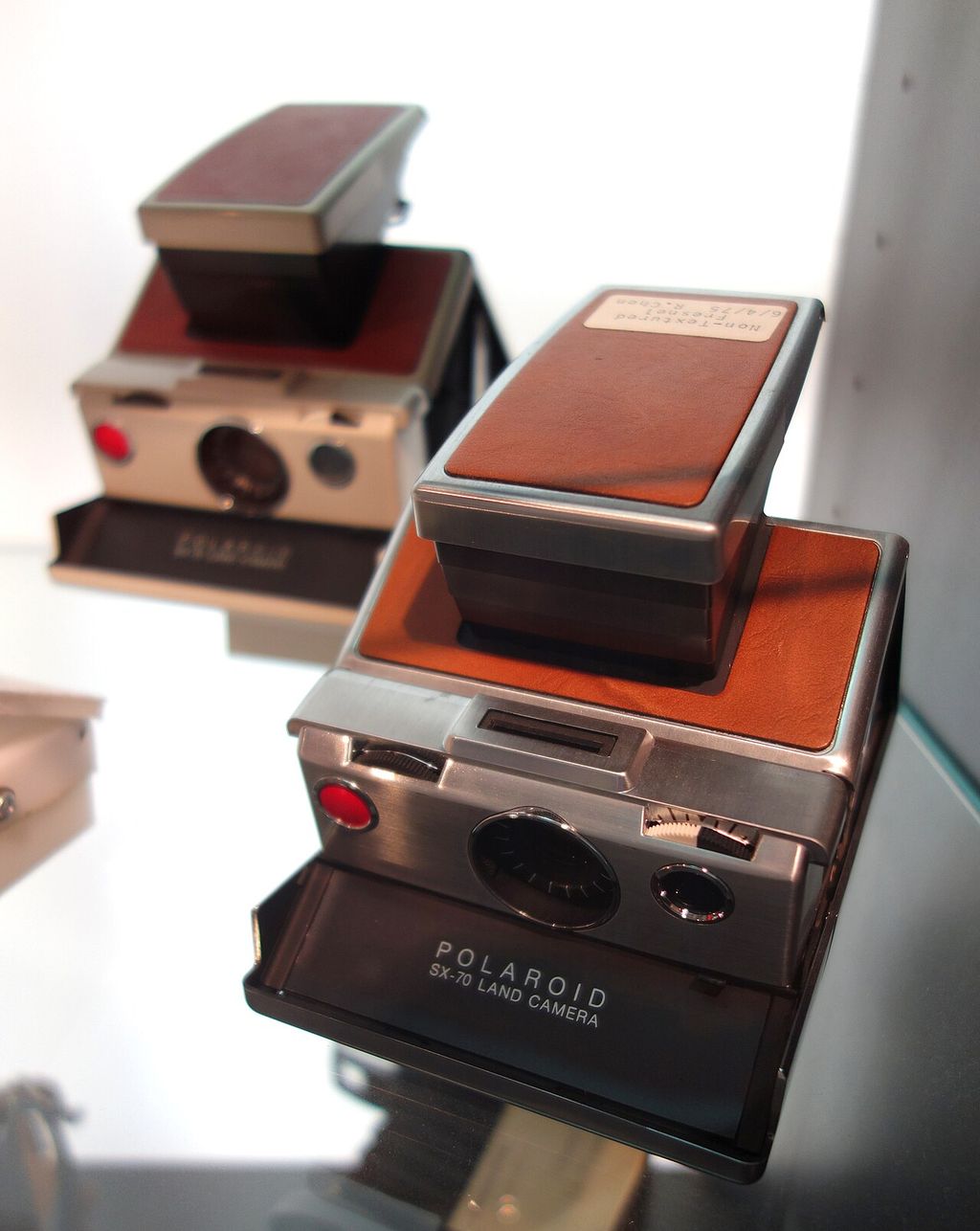
A Polaroid SX-70 Land Camera in the MIT Museum: an example of the model used in Hockney’s composite photography. Daderot / Wikimedia Commons. Image source. CC0 / Public domain. Resized and converted to JPEG; no crop or recolouring.
A dive that takes more than one moment
Jerry Diving, Sunday Feb. 28th 1982 offers a particularly clear way into the Polaroid method. Getty curator Virginia Heckert describes twenty-one prints arranged in three rows of seven. Across seven frames, Jerry Sohn’s action progresses from the diving board at the right towards his entry into the pool at the left. In Heckert’s later interview with Sohn, he recalled repeating the dive at least eight times. The assembled action therefore came from a performed and repeated event. [8]
That distinction changes how we read the picture. A single exposure might isolate the body at the most dramatic point of its trajectory. Hockney allows several stages to remain available together. We can follow the action, move back along it, or pause on the surrounding pool. Heckert singles out the yellow lawn chair and the corner of the house as details that reward attention to the individual photographs. The dive belongs within a place and an afternoon, whose quieter features remain part of the experience. [8]
The work also helps distinguish three kinds of time. There is the action represented, the longer process of collecting its separate exposures, and the viewer’s time moving between them. Those durations need not coincide. The image gives an intelligible shape to an event without pretending that every component happened simultaneously. Its liveliness comes partly from that freedom to organise time spatially. We look across a surface and, by doing so, reconstruct an action. [8] [9]
From grids to overlapping photographic collages
During 1982 Hockney moved from the Polaroid to a Pentax 110, a miniature camera with interchangeable lenses. The prints no longer brought the Polaroid’s white borders into every component of the picture. Processing took longer, however, and Hockney increasingly used notes and diagrams to plan collages while waiting for the photographs. The change brought both greater freedom of arrangement and a stronger demand on memory. [6]
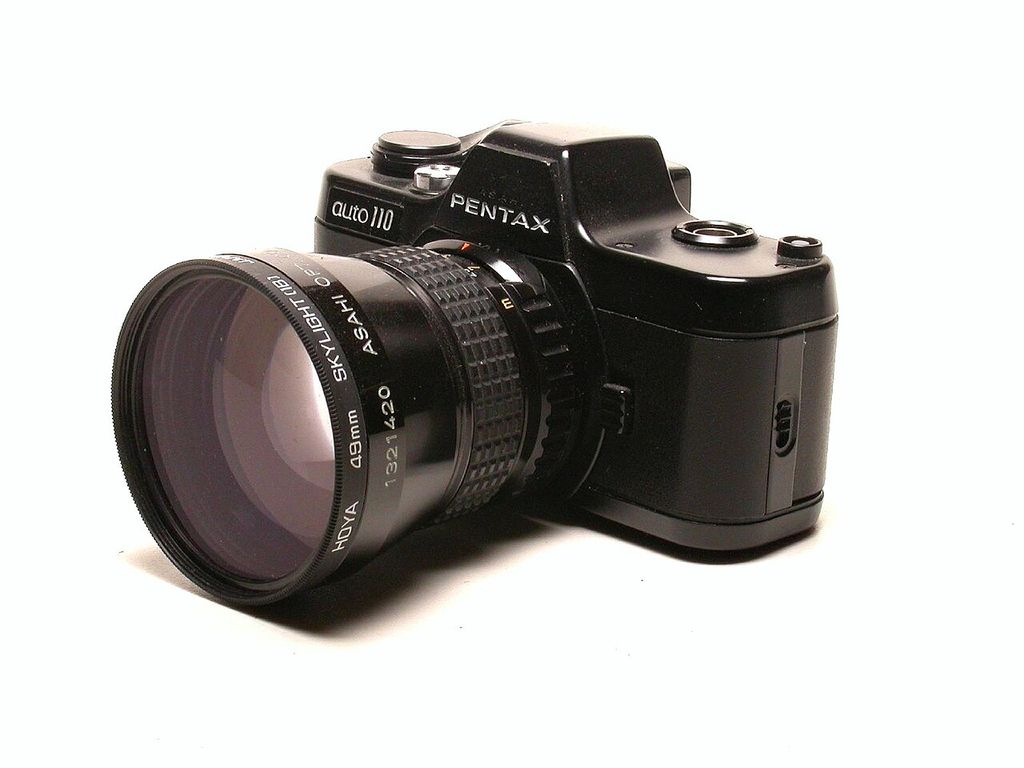
A Pentax Auto 110 camera. An example of the miniature camera model discussed in the transition from instant grids to developed photographs. John Nuttall from Hampshire, United Kingdom / Wikimedia Commons. Image source. CC BY 2.0. Image resized; framing and colours retained.
The distinction between a Polaroid grid and an overlapping photocollage is useful even though both are often called joiners. The grid makes the repeated unit especially conspicuous. In an overlapping construction, one print can cover part of another, allowing the relationships between images to establish the larger shape more freely. Joining becomes an active means of emphasis: what remains visible matters as much as what was originally photographed. [10]
Both the Pentax 110 and a 35mm Nikon contributed to the period’s photographic practice. Family and close friends remained recurring subjects, while Picasso’s fragmentation of a motif offered a model for experiment. Different equipment served a continuing enquiry, with the print becoming something to handle and compose. The camera model alone does not explain the resulting space; the arrangement is where the separate observations enter into a relationship. [11]
This gives the joins real interpretative value. An overlap asks us to recognise continuity across an interruption. We understand a person or place while also registering that our understanding has been assembled from parts. Art historian Anthi-Danaé Spathoni reads Hockney’s photographic work through this interaction of media, movement and the participating spectator. Her useful emphasis is on what the viewer does: the image becomes available through the activity of connecting its changing views. [9]
Portraits made through an encounter
Hockney’s subjects were often people whom he already knew closely. The National Portrait Gallery’s account of his portraiture follows the recurring appearances of his mother Laura, Celia Birtwell, Gregory Evans and Maurice Payne across different media and decades. A photographic collage belongs within that longer practice of returning to a face. Familiarity could support experiment, since recognition did not depend on preserving one fixed pose or one polished view. [5]
My Mother, Bolton Abbey, Yorkshire, Nov. 1982 brings a seated person and a larger environment into the same extended act of attention. The Science Museum Group records a version mounted on grey-green card, bearing Hockney’s handwritten title. Its description identifies the sitter as Laura and explains the composite as a response to the frozen instant. The material object retains the distinctness of its component photographs while making a recognisable portrait from them. [10]
The Morgan Library’s exhibition label describes Laura’s face at the centre, with rain-soaked headstones and the ruined abbey opening around her. Hockney’s leather brogues appear in the foreground. The label reads these shoes as evidence of his physical and emotional presence, connecting the maker to his mother. Its further interpretation of the work as a meditation on mortality is a curatorial reading, grounded in the combination of the widowed sitter and the surrounding graveyard. [12]
The shoes are especially revealing because they give the act of observation a location. The view has a body at its near edge. From there, attention moves towards Laura and into the space around her. Her face remains a centre of interest without requiring the rest of the picture to become neutral background. The setting carries its own claims on the viewer’s time, so that looking at the portrait also involves tracing the distance between mother, son and place. [12]
The social gathering supplied another kind of duration. The Scrabble Game, Jan. 1st 1983 catches Ann Upton, David Graves and Laura Hockney at different moments during play. A game already consists of intervals: considering a move, waiting for another player, attending to the board. The collage’s several moments can therefore belong naturally to a shared activity. Portraiture expands from the appearance of an individual into the experience of spending time together. [13]
Walking around the Japanese garden
In February 1983, during a visit to Japan, Hockney photographed the rock garden at Ryōan-ji in Kyoto. He later assembled Walking in the Zen Garden at the Ryoanji Temple, Kyoto, Feb. 1983. His own account, preserved by the Foundation, stresses movement: taking photographs from different positions allowed him to give the garden a rectangular form where one fixed view would have made it recede differently. His feet appear along the bottom of the picture. [13]
The pebbles demanded close concentration. Hockney described the need to inspect and connect their details while building the collage. Matching that apparently uniform surface depended on close attention to repeated details, bringing successive observations together within a larger field. [13]
Tokyo’s Museum of Contemporary Art lists the work as a photographic collage, measuring 101.6 by 160.7 centimetres. That broad format makes a useful counterpart to the tall portrait of Laura at Bolton Abbey. Both include the observer within the field of observation, but the different proportions organise attention differently. One connects a person to the space surrounding her; the other gathers a place across a moving survey. The method can accommodate a particular encounter or an extended spatial experience. [14] [10]
Curator Ai Kusumoto places these experiments within a longer development. In her interview with Tamaki Sugihara, she links Hockney’s questioning of naturalism to close drawing in Paris, renewed engagement with Picasso, theatrical work, and encounters with Japanese and Chinese art. This is a useful curatorial synthesis because it gives the photographs a wider context. The garden collage belongs to an ongoing enquiry into inhabited space, nourished by experiences that extended well beyond the camera. [15]
Cubism, scrolls and the moving viewer
Cubism mattered to Hockney as a way of considering how an object becomes known through more than one view. Kusumoto explains his understanding of Picasso in these terms: movement around a subject, followed by imaginative construction, could convey an experience of seeing. The photographic fragment gave Hockney a practical unit with which to explore that idea. Its very specificity made the larger reconstruction provocative. Each part belonged to a particular exposure, while the whole escaped the conditions of any one exposure. [15]
Chinese scroll painting offered a related interest in the viewer’s journey. Kunstmuseum Luzern explains that scenes could hold different moments and perspectives within an extended format revealed through unrolling. Its account distinguishes this multiplicity from reverse perspective, in which spatial lines appear to open towards the spectator. Both ideas challenged the assumption that a picture must be organised around one stable position outside it. They are related resources within Hockney’s practice, with different visual consequences. [16]
The comparison becomes clearer if we think about routes through a picture. In a single fixed view, many spatial relationships are settled by the camera’s position. A composite can require us to work through a succession of relationships. A scroll makes that succession part of its physical presentation; a collage can make it visible in the changing views held together on one surface. Hockney’s interest lay in the possibilities these forms opened for experience, rather than in treating distinct artistic traditions as interchangeable. [15] [16]
Those questions travelled into Moving Focus. Luzern describes Hockney walking within the courtyard at Acatlán, making studies from different positions and eventually bringing them together in prints developed with Kenneth Tyler. The camera’s lessons could therefore inform a picture made through other tools. Across Hockney’s styles and techniques, the recurring issue is how a surface can carry the changing relationships between an observer and the space being observed. [16]
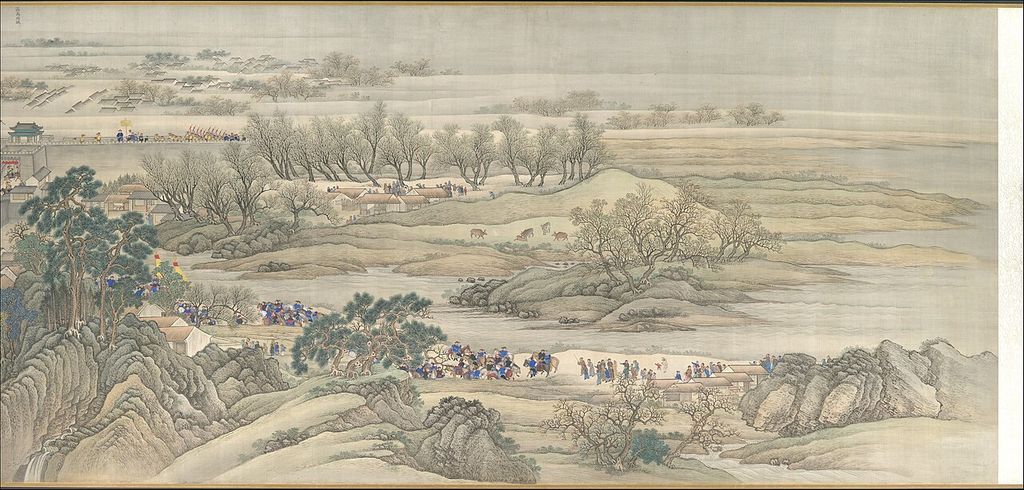
Handscroll comparison: Wang Hui and assistants, The Kangxi Emperor’s Southern Inspection Tour, Scroll Three: Ji’nan to Mount Tai, datable to 1698, Metropolitan Museum of Art. Wang Hui and assistants / The Metropolitan Museum of Art / Wikimedia Commons. Image source. CC0 / Public domain. Resized and converted to JPEG; no crop or recolouring.
Roads, distance and Pearblossom Highway
The open spaces of the American West gave the photographic experiments another scale. Hockney visited the Grand Canyon with the Pentax in 1982, using memory when arranging the results back in the studio. A large view demanded more than the accumulation of exposures: he had to remember how the parts belonged to his experience of being there. The later painted A Bigger Grand Canyon develops that concern through a different medium. [6]
Roads offer a particularly direct connection between space and time, since following one means moving through a landscape. Painted routes such as Mulholland Drive: The Road to the Studio belong to this wider concern. In Pearblossom Hwy., 11–18th April 1986, #2, the road becomes a photographic construction. Getty records the work as a chromogenic print, measuring 181.6 by 271.8 centimetres; its 2026 curatorial account specifies a collage of chromogenic prints. At that scale, many small observations become a picture with the physical breadth of a large painting. [17] [8]
The numbered version matters. The Foundation explains that Hockney made #2 using four-by-six-inch prints after the smaller prints used for #1. The project began with a magazine commission but grew beyond that purpose. These are related constructions with separate identities. The Getty curator’s 2026 description gives an approximation of almost 800 prints for #2, a useful indication of the work’s density rather than a requirement to understand it by counting. The dates in the title attach the picture to its April photographic campaign. [18] [8]
Hockney’s explanation, quoted in Getty’s collection record, distinguishes the attention of a driver from that of a passenger. The right side concerns the signs a driver must read, while the left allows the passenger’s freer look around. Litter, the edge of the pavement and the adjoining desert form part of the picture’s particularity. The subject is therefore a road experienced through different kinds of attention, with the car itself left outside the image. [17]
Hockney distinguished the conventional view down the central road from the many surrounding pictures of surfaces: signs, ground, plants and rubbish. The larger space emerges through their assembly. The local fragments and the distant road ask different things of the eye, combining examination with recession. The fuller account of Pearblossom Highway turns on this conjunction: an ordinary journey becomes a problem of how to build space from sustained, selective looking. [18]
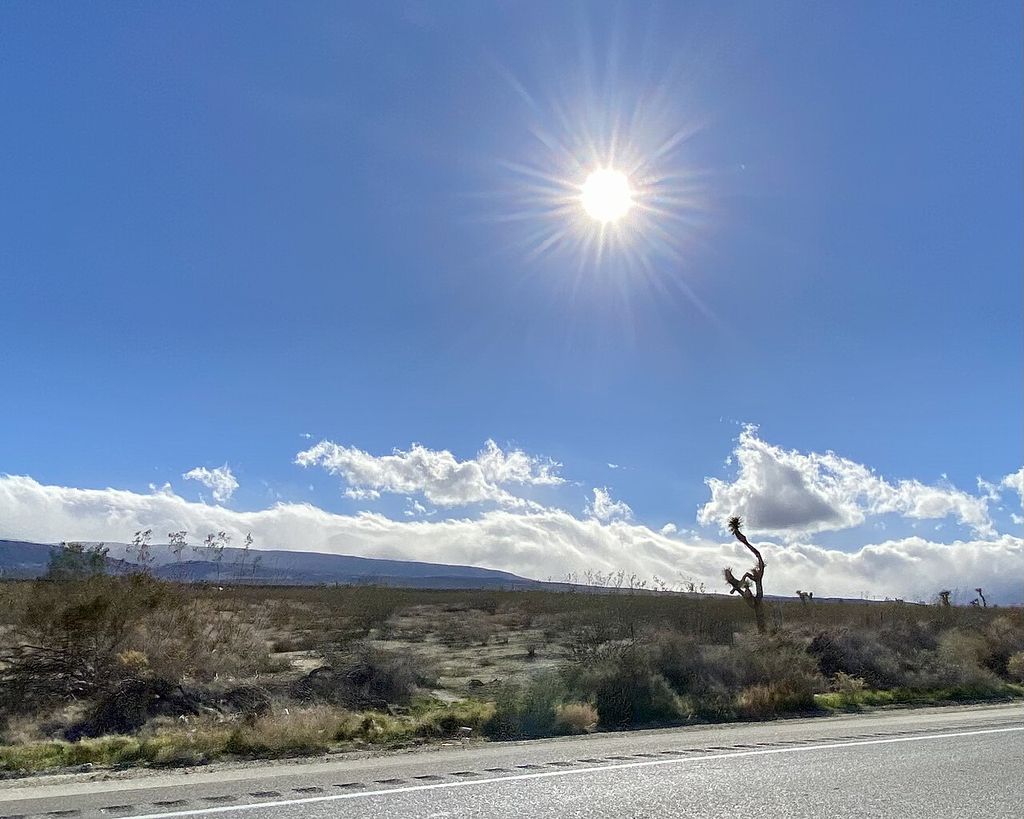
Geographic context: Pearblossom Highway and a Joshua tree, photographed in 2023. Jengod / Wikimedia Commons. Image source. CC BY-SA 4.0. Resized and converted to JPEG; no crop or recolouring. Image derivative retains CC BY-SA 4.0.
What the joins ask us to do
Hockney’s objections to a fixed photographic view should be understood as an artist’s position. The joiners demonstrate a chosen alternative; their effectiveness does not depend on proving that every other kind of photograph fails. A grid can make us track a sequence. Overlapping prints can make us reconstruct a continuous setting. A visible shoe can locate the observer. These are specific pictorial means of giving the viewer more to do. [5] [9]
Spathoni’s account of the participating spectator helps articulate that activity. Looking involves connecting fragments, changing focus and sometimes adjusting bodily position before a large work. We can follow a represented route or interrupt it to inspect something at the edge. The picture establishes relationships without settling every movement of attention in advance. This leaves room for the viewer’s own pace, within a construction shaped carefully by the artist. [9]
Beyond the photographic joiner
The word joiner is most helpful for the constructed photographs, including the Polaroid composites and overlapping photocollages. It needs care when applied beyond them. Hollywood Hills House, dated 1981–82, is listed in the Metropolitan Museum’s checklist as oil, charcoal and collage on three canvases. The word collage in a medium description does not itself make a work a photographic joiner. Hockney’s practice repeatedly crossed boundaries, but the material identity of each object still matters. [7]
Other machines opened other possibilities. The Foundation’s account of the 1986 home-made prints describes Hockney passing paper through an office photocopier, changing colours, altering scale and repeating parts. Direct contact with the machine’s scanning bed supplied another way to make images from objects and surfaces. These works share an interest in assembly and responsive revision, while belonging to his printmaking practice. A tool associated with reproduction could become a means of invention. [18]
A fragment could also belong to a different means of transmission. Kusumoto describes Hockney’s use of fax to send drawings from his Los Angeles studio for assembly in Japanese exhibition spaces in 1990. A large image could travel as many small sheets, with instructions governing their arrangement at the destination. The resulting construction used joined components, but its parts were transmitted drawings. This is another reason to distinguish a general method of assembling a picture from the specific practice of photographic joiners. [19]
Multi-camera films extended the enquiry into moving images. In his 2013 account, Lawrence Weschler describes nine cameras mounted in a three-by-three array on Hockney’s vehicle, with results shown across multiple screens. Different seasons could appear in neighbouring nine-screen groups. The viewer’s attention moved within an image that was itself moving, allowing several views to remain active together. Weschler relates Hockney’s wish to give the spectator time and freedom to look around. [20]
This later work shows why technological novelty alone is an inadequate account of his interest in cameras. A new device mattered when it changed the available structure of attention. In the films, simultaneous screens could preserve alternatives to a single directed view. In his iPad art, a luminous drawing surface offered different possibilities again. Camera-based images and drawings made on a screen should retain those distinctions, even when they share questions about looking, time and scale. [20] [5]
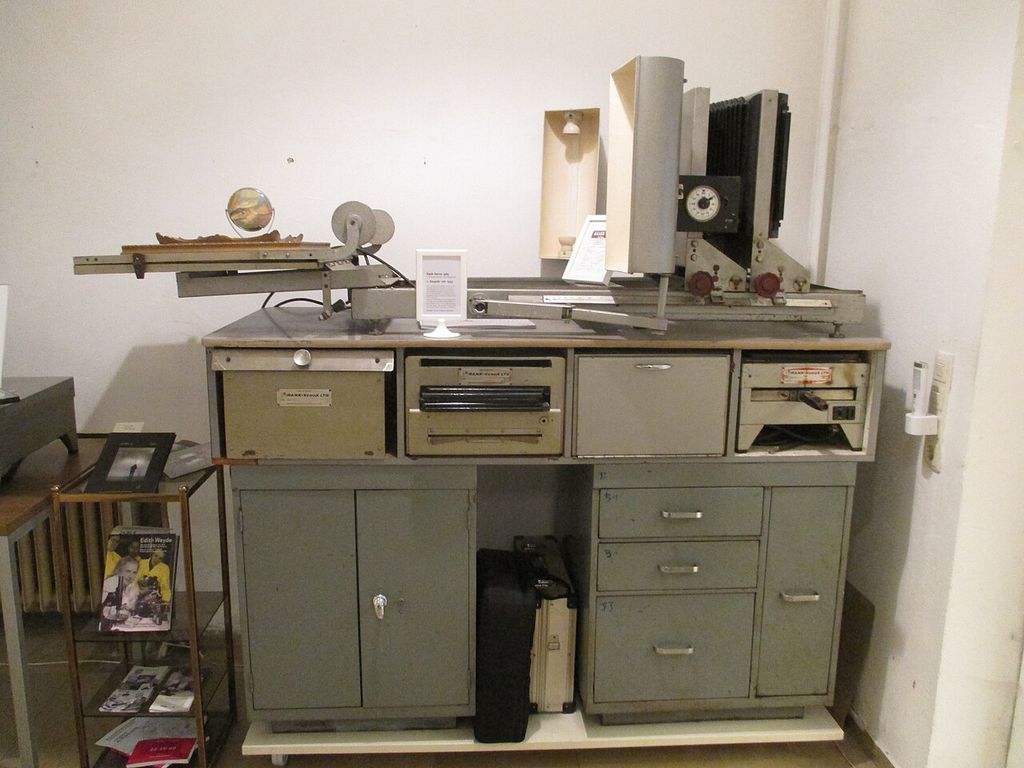
Technology context: historical Rank Xerox reproduction equipment in a museum display. Dat doris / Wikimedia Commons. Image source. CC BY-SA 4.0. Resized and converted to JPEG; no crop or recolouring. Image derivative retains CC BY-SA 4.0.
Later photographic drawings
The term photographic drawing identifies a further development in Hockney’s construction of pictures from camera images. His official website distinguishes these works from its categories for composite Polaroids and photographic collages. Its entry for Inside It Opens Up As Well, 2018, specifies a photographic drawing printed on paper and mounted on Dibond. The terminology keeps the continuing role of the camera visible while drawing attention to the artist’s arrangement of the resulting image. [2]
By 2015, the process already offered a digital counterpart to the earlier handling of separate prints. L.A. Louver described photographic drawings made from hundreds of images taken at close range, gathered and digitally combined into a single composition with multiple vanishing points. Its account of A Bigger Card Players identifies an appearance of Pearblossom Highway within the new picture. A photographic construction could therefore contain an earlier photographic construction, bringing different stages of Hockney’s enquiry together within the social setting of a game. [21]
The close-range source images matter to that process. Each object or figure could receive attention before entering the larger scene. The resulting picture need not accept the relative importance that one distant camera position would assign to everything in front of it. Digital assembly expanded the artist’s ability to set these parts in relation, retaining the central act of judgement that had governed the tabletop arrangement of prints. [21]
In In the Studio, December 2017, Hockney appears surrounded by paintings in a work assembled from 3,000 digital photographs. Made with assistance from Jonathan Wilkinson, the Tate work is printed on seven sheets, mounted on seven Dibond panels, measuring 278 by 760 centimetres. The scale carries the earlier concern with an accumulated view into an expansive digitally constructed interior. [22]
Kunstmuseum Luzern’s discussion points out the disruptions within the apparently panoramic space: fraying contours, indistinct or pixelated passages, orange outlines around parts of an easy chair, and shadows that seem digitally drawn. These details make the photograph’s construction available to scrutiny. The studio also becomes a display of Hockney’s other pictures, so that different approaches to space meet within one large image. A photographic drawing can show paintings while also making its own argument about pictorial space. [23]
The printed work requires the same care over identity as the earlier collages. Washington’s National Gallery of Art records an impression of In the Studio, December 2017 as seven inkjet prints, with an inscription identifying it as 9/12. The numbered impression makes the work’s distribution part of its physical history. Each printed section contributes to a larger encounter: division, extent and presentation determine how the viewer meets the assembled image. [24] [22]
From an instant print handled at a table to a digital image spread across several large panels, Hockney kept composition active after the camera exposure. The individual photograph could preserve a detail, but the finished picture had to establish how its details belonged together. The joiners make that labour visible in borders, overlaps and changing views. They invite us to recognise a world while remaining attentive to the successive acts through which an artist, and then a viewer, comes to see it. [1] [23]
Works directory
This source-bounded directory combines the works in the Metropolitan Museum’s 2017 retrospective checklist with reviewed museum object records and the additional works and series examined in this guide. It spans several media and is not a complete catalogue raisonné. Titles without an article link remain useful dated records. Metropolitan Museum final retrospective checklist (2017); additional object and series sources are given in the linked articles. [7]
| Name | Date | Medium |
|---|---|---|
| Love Painting | 1960 | Painting |
| Shame | 1960 | Painting |
| The Third Love Painting | 1960 | Painting |
| Tyger Painting No. 2 | 1960 | Painting |
| A Rake’s Progress | 1961–63 | Print series |
| Tea Painting in an Illusionistic Style | 1961 | Painting |
| The Cha-Cha That Was Danced in the Early Hours of 24th March | 1961 | Painting |
| Cleaning Teeth, Early Evening (10pm) W11 | 1962 | Painting |
| Flight into Italy - Swiss Landscape (Painting in a Scenic Style) | 1962 | Painting |
| Man in a Museum (or You're in the Wrong Movie) | 1962 | Painting |
| My Brother is Only Seventeen | 1962 | Painting |
| The First Marriage (A Marriage of Styles I) | 1962 | Painting |
| Domestic Scene, Los Angeles | 1963 | Painting |
| Play Within a Play | 1963 | Painting |
| The Hypnotist | 1963 | Painting |
| Arizona | 1964 | Painting |
| California Art Collector | 1964 | Painting |
| Man in Shower in Beverly Hills | 1964 | Painting |
| Portrait Surrounded by Artistic Devices | 1965 | Painting |
| Rocky Mountains and Tired Indians | 1965 | Painting |
| Beverly Hills Housewife | 1966–67 | Painting |
| Medical Building | 1966 | Painting |
| Peter | 1966 | Drawing |
| Peter Getting Out of Nick’s Pool | 1966 | Painting |
| A Bigger Splash | 1967 | Painting |
| A Lawn Being Sprinkled | 1967 | Painting |
| Kasmin in Bed in His Chateau in Carennac | 1967 | Drawing |
| Peter Feeling Not Too Good | 1967 | Drawing |
| Savings and Loan Building | 1967 | Painting |
| The Room, Tarzana | 1967 | Painting |
| American Collectors (Fred and Marcia Weisman) | 1968 | Painting |
| Christopher Isherwood and Don Bachardy | 1968 | Painting |
| Henry Geldzahler and Christopher Scott | 1968-1969 | Painting |
| W. H. Auden | 1968 | Drawing |
| Peter Langan in His Kitchen at Odins | 1969 | Drawing |
| Mark Glazebrook | 1970 | Drawing |
| Mr and Mrs Clark and Percy | 1970-1971 | Painting |
| Ossie Wearing a Fairisle Sweater | 1970 | Drawing |
| Pool and Steps, Le Nid du Duc | 1971 | Painting |
| Rubber Ring Floating in a Swimming Pool | 1971 | Painting |
| Celia in a Black Dress with White Flowers | 1972 | Drawing |
| Mount Fuji and Flowers | 1972 | Painting |
| Portrait of an Artist (Pool with Two Figures) | 1972 | Painting |
| Portrait of the Artist's Mother, Mrs Laura Hockney, Bradford | 1972 | Drawing |
| The Artist's Father | 1972 | Drawing |
| Dr Eugene Lamb, Lucca | 1973 | Drawing |
| Andy, Paris | 1974 | Drawing |
| Contre-jour in the French Style (Against the Day dans le Style-Français) | 1974 | Painting |
| Gregory Sitting on Base of Column | 1975 | Drawing |
| Kerby (after Hogarth) Useful Knowledge | 1975 | Painting |
| Ron Kitaj Outside Akademie der Kunste Vienna | 1975 | Drawing |
| Kasmin Reading the Udaipur Guide | 1977 | Drawing |
| Looking at Pictures on a Screen | 1977 | Painting |
| My Parents | 1977 | Painting |
| Canyon Painting | 1978 | Painting |
| Mother, Bradford, 19 Feb. 1979 (inscribed 1978) | 1979 | Drawing |
| Mulholland Drive: The Road to the Studio | 1980 | Painting |
| Nichols Canyon | 1980 | Painting |
| Outpost Drive, Hollywood | 1980 | Painting |
| Hollywood Hills House | 1981-1982 | Painting |
| Celia. Los Angeles. April 10th 1982 | 1982 | Polaroid composite |
| Don + Christopher, Los Angeles, 6th March 1982 | 1982 | Polaroid composite |
| Gregory Swimming Los Angeles March 31st 1982 | 1982 | Polaroid composite |
| My Mother, Bolton Abbey, Yorkshire, Nov. 1982 | 1982 | Photocollage |
| Self Portrait 30th Sept. 1983 | 1983 | Drawing |
| Pearblossom Hwy., 11-18th April 1986, #1 | 1986 | Photocollage |
| Pearblossom Hwy., 11–18th April 1986, #2 | 1986 | Photocollage |
| Large Interior, Los Angeles | 1988 | Painting |
| Breakfast at Malibu, Sunday, 1989 | 1989 | Painting |
| Pacific Coast Highway and Santa Monica | 1990 | Painting |
| The Other Side | 1991-1993 | Painting |
| The Eleventh V. N. Painting | 1992 | Painting |
| The Twenty Sixth V. N. Painting | 1992 | Painting |
| The Road Across the Wolds | 1997 | Painting |
| 9 Canvas Study of the Grand Canyon | 1998 | Painting |
| A Bigger Grand Canyon | 1998 | Painting |
| Colorado River | 1998 | Painting |
| Garrowby Hill | 1998 | Painting |
| Colin St. John Wilson. London. 3rd June 1999 | 1999 | Drawing |
| Gregory Evans. Los Angeles. 18th September 1999 | 1999 | Drawing |
| Laura Huston. London. 22nd June 1999 | 1999 | Drawing |
| Lindy. Marchioness of Dufferin and Ava. London. 17th June | 1999 | Painting |
| Going Up Garrowby Hill | 2000 | Painting |
| Red Pots in the Garden | 2000 | Painting |
| A Closer Winter Tunnel, February - March | 2006 | Painting |
| Elderflower Blossom, Kilham, July 2006 | 2006 | Painting |
| The Road to Thwing, July 2006 | 2006 | Painting |
| Bigger Trees near Warter | 2007 | Painting |
| Hawthorn Blossom near Rudston | 2008 | Painting |
| Views Through the Artist's Bedroom Window, Bridlington | 2010-2013 | Digital animation |
| The Arrival of Spring in Woldgate, East Yorkshire in 2011 (twenty eleven) | 2011 | Painting / digital series |
| 82 Portraits and 1 Still-life | 2013–16 | Portrait series |
| Garden | 2015 | Painting |
| Garden with Blue Terrace | 2015 | Painting |
| Garden #3 | 2016 | Painting |
| A Bigger Interior with Blue Terrace | 2017 | Painting |
| Interior with Blue Terrace and Garden | 2017 | Painting |
| A Year in Normandie | 2020–21 | Digital frieze |
Discussion
Look again at the images and ideas explored in David Hockney Photography and Joiners. These editorial prompts invite your observations.
Reader Insights
What can an assembled sequence of photographs show about time that one exposure leaves out?
How does the move from a regular Polaroid grid to overlapping prints change your route through a picture?
Where do you sense the photographer’s bodily movement most strongly in the works discussed?
Join the Conversation
Share a detail, comparison or question about David Hockney Photography and Joiners below.
References
- The J. Paul Getty Museum, Happy Birthday, Mr. Hockney, exhibition labels, 2017, pp. 2–4, especially “Photographs”, p. 3. View source.
- David Hockney, “Photographic Drawings”, official works catalogue; entry for Inside It Opens Up As Well, 2018. View source.
- The David Hockney Foundation, “1971”, especially “Mr. and Mrs. Clark and Percy”, including Hockney’s account of sittings and revision. View source.
- Christie’s, Portrait of an Artist (Pool with Two Figures), lot 9C, Post-War and Contemporary Art Evening Sale, 15 November 2018, object record and lot essay. View source.
- National Portrait Gallery, David Hockney: Drawing from Life, learning resource, especially “David Hockney – portraits” and “The camera”. View source.
- The David Hockney Foundation, “1982”, sections “Composite Polaroids”, “Drawing with a Camera”, “Pompidou exhibition”, “Polaroid to Pentax” and “Grand Canyon”. View source.
- The Metropolitan Museum of Art, David Hockney: Final Checklist, 15 November 2017, printed checklist pp. 12–13, entries for Hollywood Hills House and the photographic works. View source.
- Julian Brooks and Virginia Heckert, “Remembering the Creativity and Humor of David Hockney”, Getty, 3 September 2026. View source.
- Anthi-Danaé Spathoni, “David Hockney’s Moving Landscapes”, Revista de História da Arte, Série W, no. 11, 2022, pp. 95–103, especially pp. 98–100. View source.
- Science Museum Group, Photograph of Hockney’s Mother at Bolton Abbey, 1982, collection record 1984-5169. View source.
- Guggenheim Museum Bilbao, “Photography and Optical Technology”, exhibition educational text. View source.
- The Morgan Library & Museum, David Hockney: Drawing from Life, large-print exhibition labels, label for My Mother, Bolton Abbey, Yorkshire, Nov. 1982. View source.
- The David Hockney Foundation, “1983”, especially “Drawing twice”, “Walking in the Zen Garden” and “Studying Chinese scrolls”. View source.
- Museum of Contemporary Art Tokyo, Annual Report 2024, David Hockney exhibition checklist, entry 101, Walking in the Zen Garden at the Ryoanji Temple, Kyoto, Feb. 1983. View source.
- Tamaki Sugihara, interviewing Ai Kusumoto, “混迷から新境地へ。巨匠ホックニーが喜びに満ちた作品に辿り着くまで” [“From confusion to new ground: how Hockney reached works filled with joy”], Tokyo Art Beat, 22 September 2023, especially the sections on naturalism and the viewer’s body. View source.
- Kunstmuseum Luzern, “Moving Focus”, 2022 exhibition microsite, sections on multiple and reverse perspective, scrolls and Acatlán. View source.
- The J. Paul Getty Museum, Pearblossom Hwy., 11–18th April 1986, #2, collection record 97.XM.39, object details and Hockney’s account of driver and passenger. View source.
- The David Hockney Foundation, “1986”, sections “Home Made Prints” and “Pearblossom Highway”. View source.
- Tamaki Sugihara, interviewing Ai Kusumoto, “ホックニーはなぜ評価と人気を60年も獲得し続けられたのか?” [“Why did Hockney maintain recognition and popularity for sixty years?”], Tokyo Art Beat, 25 August 2023, especially the section on medium-specific marks, photocopiers and fax transmission. View source.
- Lawrence Weschler, “Why David Hockney Has a Love-Hate Relationship With Technology”, Smithsonian Magazine, September 2013, especially “More Real Than Real”. View source.
- L.A. Louver, “Hockney continues his relentless endeavor to develop new methods of image making”, 23 June 2015, body text on photographic drawings and A Bigger Card Players. View source.
- Musée Granet / Tate, David Hockney: Works from the Tate Collection, English exhibition press pack, 2023, pp. 14–18, especially “In the Studio”, p. 18. View source.
- Kunstmuseum Luzern, “In the Studio”, 2022 exhibition microsite, especially “Digital Collage”. View source.
- National Gallery of Art, Washington, In the Studio, December 2017, 2017, collection record 2019.40.1.a–g, medium, inscription and provenance. View source.
More HOCKNEY Works
A Bigger Splash
A momentary disturbance becomes the focus of a large acrylic painting, made through weeks of patient work.
Mr and Mrs Clark and Percy
The designers Celia Birtwell and Ossie Clark occupy a room shaped by light, repeated sittings and the demands of a double portrait.
A Bigger Grand Canyon
Sixty canvases gather memory, studies and changing viewpoints into an immense painting of 1998.
Garrowby Hill
The 1998 oil painting transforms a remembered Yorkshire journey into a road, fields and an expansive view.
Portrait of an Artist (Pool with Two Figures)
Photographic studies, two figures and a swimming pool become a carefully constructed painting of 1972.
My Parents
The 1977 oil painting sets Kenneth and Laura Hockney within a quietly organised interior.
Pearblossom Hwy., 11–18th April 1986, #2
Hundreds of separately made photographs construct a road scene that unfolds through movement and time.
Bigger Trees near Warter
Fifty canvases join into a large outdoor painting of Yorkshire trees, with photography helping the artist organise the whole.