


 by Tom Gurney
Tom Gurney BSc (Hons) is an art history expert with over 20 years experience
Email: tomgurney1@gmail.com / Phone: +44 7429 011000
Peter Getting Out of Nick’s Pool: Introduction
The title gives an apparently straightforward account of an everyday movement: Peter is getting out of a swimming pool. Yet David Hockney built this intimate California scene around a photograph taken beside a car. Painted in acrylic on canvas in 1966, Peter Getting Out of Nick’s Pool brings together a real person, a recognisable place and an action created through their combination. Its subject is Peter Schlesinger, the painter who became Hockney’s partner, in the communal pool associated with their friend Nick Wilder. [1]
A body can appear to belong convincingly to a setting without having been photographed there; a pattern can suggest moving water while declaring itself a collection of painted lines. Hockney allowed the pleasures of a sunlit scene and the decisions that constructed it to remain visible together. The picture invites us to notice how readily we turn an arrangement into an event.
At a Glance
- ArtistDavid Hockney
- TitlePeter Getting Out of Nick’s Pool
- Date1966
- Medium and formatAcrylic on canvas
- CollectionWalker Art Gallery, Liverpool
This work across David Hockney’s career
A Rake’s Progress
1961–63 [2]A Bigger Splash
1967 [2]Mr and Mrs Clark and Percy
1970–71 [2]My Parents
1977 [2]Garrowby Hill
1998 [2]A Year in Normandie
2020–21 [3]Contents
- The people behind the pool
- A photograph changes its meaning
- The square and the bare border
- How painted lines become water
- A familiar person and an unequal gaze
- From Hollywood to the John Moores prize
- Different pictures, different pool experiences
The people behind the pool
Schlesinger entered Hockney’s life during a return to Los Angeles in 1966. Hockney was teaching drawing at the University of California, Los Angeles, that summer when they met. The Foundation’s chronology identifies Schlesinger as both a romantic partner and a frequent model: the personal relationship and the working relationship developed together. The painting belongs to that first year of acquaintance, before Schlesinger’s appearances across subsequent paintings, drawings and photographs had accumulated into an extensive record. [4]
“Nick’s pool” was the communal pool at 1145 Larrabee Street in Hollywood, where the dealer Nick Wilder lived and Hockney also stayed during part of 1966–67. A shared amenity becomes, through friendship and everyday use, a place identified by a person’s name. [1]
Hockney remembered 1967, when he and Schlesinger lived on Pico, as an exceptionally happy year. His account places swimming at Wilder’s alongside cinema visits, meals out, reading and work. This helps to give the pool its social scale. It was somewhere friends went together, part of a routine of companionship. Such places give the broader story of Hockney in California its grounding in daily life. [5]
The title preserves that circle in miniature. Peter is named as someone familiar, Nick as the person by whom the place is known. A viewer arriving without either acquaintance is invited into a scene whose participants already have a history together. Its apparent informality is partly a matter of language: the painting sounds like an incident remembered in conversation.
A photograph changes its meaning
The figure’s photographic origin unsettles the event described by the title. Hockney used a Polaroid he had taken of Schlesinger leaning naked against the bonnet of a car. In the painting, that supported pose becomes the movement of someone emerging from the water. The photographic body has been transferred into another setting, and its gesture acquires a new explanation. [1]
This is an economical example of what a painter can do with photographic information. A photograph may supply an outline or a bodily relationship without determining the final narrative. The spectator sees the figure in relation to water and accepts a movement appropriate to a pool. Once the source is known, the same pose can be understood differently. The painting’s action arises between the represented body and its surroundings; it does not reside in the pose alone.
Photography was becoming an increasingly practical resource for Hockney. In his V&A account, curator Zorian Clayton draws on the original label for a 1971 exhibition of Hockney’s photographs. It described albums carefully annotated with places and times, and photographs attached to a canvas or pinned to an easel while he painted. Such photographs were working material, kept available to the eye during the making of another image. Clayton also notes Schlesinger’s presence in that touring exhibition, showing how a person familiar from the paintings remained a subject in the camera work. [6]
The Polaroid source here predates Hockney’s purchase of a 35mm camera in 1967. The new camera extended a practice already under way. That year he also decided to organise photographs in albums for easy reference, making his accumulating images more readily available as working material. [5]
The square and the bare border
The square shape recalls the Polaroid format, but the border complicates that photographic resemblance. Hockney left the surrounding canvas unprimed. According to the museum’s account, he explained that he wanted “to make the picture look more like a painting”. He subsequently regarded this gesture as a timid concession to the expectations of avant-garde painting. The explanation and the later misgiving both belong to the work’s history. [1]
The exposed margin offers a useful place to pause. Within the image, colour and line persuade us to recognise a body, a pool and a building. Around it, the support remains a material surface. The two areas establish different conditions of attention: looking into a represented scene and looking at the object that carries it. The border also makes the image feel selected, bounded and held apart, with an affinity to a photograph that can be picked up and examined.
Hockney’s self-criticism sharpens the issue. Leaving material exposed could demonstrate awareness of contemporary arguments about the picture surface, yet it could also become a device applied because advanced painting was expected to acknowledge its own making. His later judgement need not dictate how we experience the result. We can see why the border interested him, while recognising that he eventually questioned the reason for choosing it.
The related Portrait of Nick Wilder, also dated 1966, shows how photography and formal construction could work together in this period. Christie’s published Hockney’s recollection that early Polaroids served as reminders while much of the painting remained invented. Its essay also quotes Marco Livingstone’s analysis of architecture as a compositional grid: built forms can suggest a place in depth and organise a flat canvas at the same time. Those observations concern Wilder’s portrait, but they clarify a problem shared by the two pool pictures. [7]
For Wilder’s portrait, Hockney recalled asking Mark Lancaster to photograph the dealer with his head emerging from the water; Lancaster himself entered the pool to take the photographs. The contrast with Schlesinger’s source pose is revealing. Two pictures associated with the same pool could begin with quite different photographic arrangements, one devised in the water and one borrowed from beside a car. Their common setting did not impose a common method of gathering material. [7]
In Peter Getting Out of Nick’s Pool, the photographic echo and the visible canvas therefore pull our attention in complementary directions. One encourages a sense of a moment caught; the other makes room for the time and choice involved in painting. Neither exhausts the image. Its construction gives the familiar scene a measured, deliberate presence.
How painted lines become water
Water posed a different problem from the surrounding architecture. Its visible appearance shifts with illumination, depth and disturbance, leaving the painter without one dependable shape or colour to reproduce. In the Foundation’s account of Hockney’s work in 1966, he described this as a formal challenge and stressed the role of invention. His interest in people beside or within pools developed alongside an interest in the changing substance around them. [4]
Matthew Sperling’s essay on the pool paintings makes the variety of Hockney’s solutions especially clear. He identifies the winding white lines in Peter Getting Out of Nick’s Pool and Sunbather as one vocabulary for light on water. Other pictures, including Portrait of Nick Wilder, use interlocking areas of colour. The differences matter: Hockney did not settle on a single recipe and repeat it whenever a pool appeared. The subject supported successive experiments in the relation between recognisable effects and conspicuous marks. [8]
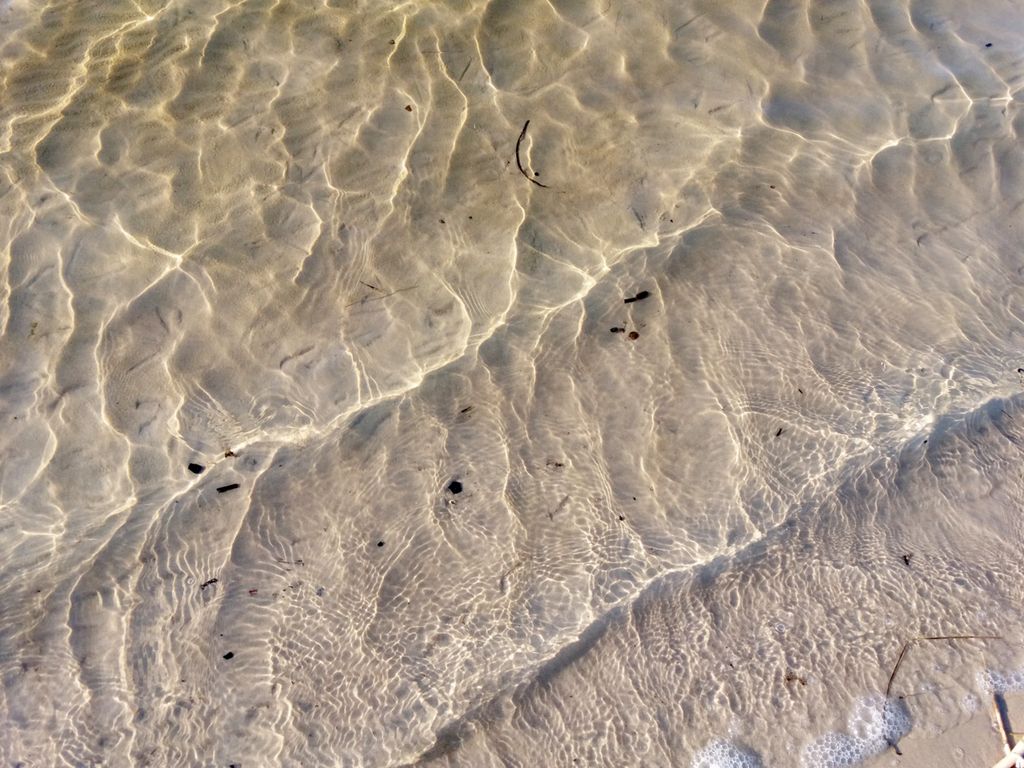
Physical comparison: concentrated patterns of light in shallow water at a beach. Peacelovedeathmetal2 / Wikimedia Commons. Image source. CC BY-SA 4.0. Resized and converted to JPEG; no crop or recolouring. Image derivative retains CC BY-SA 4.0.
The white lines here can be understood as a compact visual language. Their repeated turns suggest a surface in motion, while their continuity makes the water readable as a pattern spread across the picture. We register a flicker without needing an exhaustive inventory of individual reflections. Following a line also changes the pace of looking: the eye travels along its bends, taking time over a surface that the title presents as the setting for one passing action.
That movement gives the figure a particularly useful role. A named person supplies a recognisable point of reference within the patterned water. Conversely, the water gives the borrowed pose its new activity and location. Body and pattern help us interpret one another. The image’s coherence depends on this exchange between different kinds of description, each able to remain relatively economical because the other provides context.
A familiar person and an unequal gaze
The intimacy of the subject does not settle every question about the way Schlesinger is represented. In her doctoral study, Emily Porter-Salmon discusses earlier readings by Andrew Causey and Paul Melia. Causey emphasised the displacement of the photographed body into a different environment; Melia drew attention to the contrast between the full name in Portrait of Nick Wilder and the familiar forenames in Peter Getting Out of Nick’s Pool. Porter-Salmon uses these arguments to question how the images distribute identity, desirability and possession. These are critical interpretations of the pictures, rather than statements by the sitters about their experience. [9]
That distinction allows the questions to remain productive. A familiar first name can draw a viewer closer to someone, but it can also leave that person less fully identified. The name attached to a place can express affection and habit, yet also suggest ownership. The photograph-to-painting transfer gives Hockney considerable control over where and how Schlesinger appears. These features make the painting open to a discussion of looking and power without requiring a verdict on the private relationship.
Its public representation of male desire also carried a particular historical weight. The painting preceded the Sexual Offences Act of 1967. That reform partially decriminalised private sexual acts between consenting men over twenty-one in England and Wales; its scope was restricted. The work’s subsequent recognition in Britain belongs within that history, although the California scene should not be treated as evidence that all difficulties disappeared in a sunnier climate. [10]
Schlesinger’s individuality also extends beyond this single appearance. The National Portrait Gallery describes Hockney’s sustained practice of returning to people he knew, with portraits recording changes in both appearance and relationship. Within that broader practice, the pool painting is one encounter among others, shaped by a particular compositional idea. The wider range of Hockney’s portraits makes it possible to consider intimacy over time, rather than asking one picture to disclose everything about its sitter. [11]
From Hollywood to the John Moores prize
In 1967 the painting won first prize in the sixth John Moores Liverpool Exhibition at the Walker Art Gallery. The exhibition ran from 23 November 1967 to 21 January 1968. John Moores presented the painting to the Walker in 1968, establishing its place in the gallery’s collection. A scene drawn from Hockney’s California friendships thus entered a public collection in Liverpool through the exhibition that had recognised it. [5] [1]
The distinction gave public visibility to a work in which male intimacy, photographic invention and formal experiment were inseparable. Its subject was specific enough to name two acquaintances, while its methods addressed questions extending beyond their circle: how to make a photograph useful to painting, how to evoke water, how to combine a figure and a place into a persuasive scene.
When the Walker returned to Hockney’s early career in the 2013–14 exhibition Early Reflections, Head of Fine Art Ann Bukantas identified this painting as central and connected its prize with the success of a change in his approach and technique. Its place in the exhibition’s “On Reflection” section drew attention to transparent surfaces and the visual signs through which he represented them. Alongside early love paintings, Cavafy etchings and portraits, the picture could be understood through several overlapping interests: water, desire, friendship and the language of painting. [12]
Different pictures, different pool experiences
The painting has a distinct place beside A Bigger Splash, painted in 1967. There the swimmer has vanished beneath the water, leaving the displaced spray as the principal event. Hockney’s recollection emphasised the disproportion between that fleeting disturbance and the time required to paint it. Here the named figure remains present, and the title supplies an ongoing action. One picture asks us to imagine a body from its effect; the other makes a photographed body perform a newly constructed movement. [5] [8]
Portrait of an Artist (Pool with Two Figures), from 1972, offers another instructive comparison. The Foundation traces that work’s origin to two separate snapshots, of a swimmer and a standing figure, brought into a new relationship. Schlesinger appears as the standing man in the finished painting. Its elaborate construction expanded a possibility already clear in the earlier pool picture: photographs of different circumstances can become the basis of one compelling painted encounter. [13]
Works directory
This source-bounded directory combines the works in the Metropolitan Museum’s 2017 retrospective checklist with reviewed museum object records and the additional works and series examined in this guide. It spans several media and is not a complete catalogue raisonné. Titles without an article link remain useful dated records. Metropolitan Museum final retrospective checklist (2017); additional object and series sources are given in the linked articles. [2]
| Name | Date | Medium |
|---|---|---|
| Love Painting | 1960 | Painting |
| Shame | 1960 | Painting |
| The Third Love Painting | 1960 | Painting |
| Tyger Painting No. 2 | 1960 | Painting |
| A Rake’s Progress | 1961–63 | Print series |
| Tea Painting in an Illusionistic Style | 1961 | Painting |
| The Cha-Cha That Was Danced in the Early Hours of 24th March | 1961 | Painting |
| Cleaning Teeth, Early Evening (10pm) W11 | 1962 | Painting |
| Flight into Italy - Swiss Landscape (Painting in a Scenic Style) | 1962 | Painting |
| Man in a Museum (or You're in the Wrong Movie) | 1962 | Painting |
| My Brother is Only Seventeen | 1962 | Painting |
| The First Marriage (A Marriage of Styles I) | 1962 | Painting |
| Domestic Scene, Los Angeles | 1963 | Painting |
| Play Within a Play | 1963 | Painting |
| The Hypnotist | 1963 | Painting |
| Arizona | 1964 | Painting |
| California Art Collector | 1964 | Painting |
| Man in Shower in Beverly Hills | 1964 | Painting |
| Portrait Surrounded by Artistic Devices | 1965 | Painting |
| Rocky Mountains and Tired Indians | 1965 | Painting |
| Beverly Hills Housewife | 1966–67 | Painting |
| Medical Building | 1966 | Painting |
| Peter | 1966 | Drawing |
| Peter Getting Out of Nick’s Pool | 1966 | Painting |
| A Bigger Splash | 1967 | Painting |
| A Lawn Being Sprinkled | 1967 | Painting |
| Kasmin in Bed in His Chateau in Carennac | 1967 | Drawing |
| Peter Feeling Not Too Good | 1967 | Drawing |
| Savings and Loan Building | 1967 | Painting |
| The Room, Tarzana | 1967 | Painting |
| American Collectors (Fred and Marcia Weisman) | 1968 | Painting |
| Christopher Isherwood and Don Bachardy | 1968 | Painting |
| Henry Geldzahler and Christopher Scott | 1968-1969 | Painting |
| W. H. Auden | 1968 | Drawing |
| Peter Langan in His Kitchen at Odins | 1969 | Drawing |
| Mark Glazebrook | 1970 | Drawing |
| Mr and Mrs Clark and Percy | 1970-1971 | Painting |
| Ossie Wearing a Fairisle Sweater | 1970 | Drawing |
| Pool and Steps, Le Nid du Duc | 1971 | Painting |
| Rubber Ring Floating in a Swimming Pool | 1971 | Painting |
| Celia in a Black Dress with White Flowers | 1972 | Drawing |
| Mount Fuji and Flowers | 1972 | Painting |
| Portrait of an Artist (Pool with Two Figures) | 1972 | Painting |
| Portrait of the Artist's Mother, Mrs Laura Hockney, Bradford | 1972 | Drawing |
| The Artist's Father | 1972 | Drawing |
| Dr Eugene Lamb, Lucca | 1973 | Drawing |
| Andy, Paris | 1974 | Drawing |
| Contre-jour in the French Style (Against the Day dans le Style-Français) | 1974 | Painting |
| Gregory Sitting on Base of Column | 1975 | Drawing |
| Kerby (after Hogarth) Useful Knowledge | 1975 | Painting |
| Ron Kitaj Outside Akademie der Kunste Vienna | 1975 | Drawing |
| Kasmin Reading the Udaipur Guide | 1977 | Drawing |
| Looking at Pictures on a Screen | 1977 | Painting |
| My Parents | 1977 | Painting |
| Canyon Painting | 1978 | Painting |
| Mother, Bradford, 19 Feb. 1979 (inscribed 1978) | 1979 | Drawing |
| Mulholland Drive: The Road to the Studio | 1980 | Painting |
| Nichols Canyon | 1980 | Painting |
| Outpost Drive, Hollywood | 1980 | Painting |
| Hollywood Hills House | 1981-1982 | Painting |
| Celia. Los Angeles. April 10th 1982 | 1982 | Polaroid composite |
| Don + Christopher, Los Angeles, 6th March 1982 | 1982 | Polaroid composite |
| Gregory Swimming Los Angeles March 31st 1982 | 1982 | Polaroid composite |
| My Mother, Bolton Abbey, Yorkshire, Nov. 1982 | 1982 | Photocollage |
| Self Portrait 30th Sept. 1983 | 1983 | Drawing |
| Pearblossom Hwy., 11-18th April 1986, #1 | 1986 | Photocollage |
| Pearblossom Hwy., 11–18th April 1986, #2 | 1986 | Photocollage |
| Large Interior, Los Angeles | 1988 | Painting |
| Breakfast at Malibu, Sunday, 1989 | 1989 | Painting |
| Pacific Coast Highway and Santa Monica | 1990 | Painting |
| The Other Side | 1991-1993 | Painting |
| The Eleventh V. N. Painting | 1992 | Painting |
| The Twenty Sixth V. N. Painting | 1992 | Painting |
| The Road Across the Wolds | 1997 | Painting |
| 9 Canvas Study of the Grand Canyon | 1998 | Painting |
| A Bigger Grand Canyon | 1998 | Painting |
| Colorado River | 1998 | Painting |
| Garrowby Hill | 1998 | Painting |
| Colin St. John Wilson. London. 3rd June 1999 | 1999 | Drawing |
| Gregory Evans. Los Angeles. 18th September 1999 | 1999 | Drawing |
| Laura Huston. London. 22nd June 1999 | 1999 | Drawing |
| Lindy. Marchioness of Dufferin and Ava. London. 17th June | 1999 | Painting |
| Going Up Garrowby Hill | 2000 | Painting |
| Red Pots in the Garden | 2000 | Painting |
| A Closer Winter Tunnel, February - March | 2006 | Painting |
| Elderflower Blossom, Kilham, July 2006 | 2006 | Painting |
| The Road to Thwing, July 2006 | 2006 | Painting |
| Bigger Trees near Warter | 2007 | Painting |
| Hawthorn Blossom near Rudston | 2008 | Painting |
| Views Through the Artist's Bedroom Window, Bridlington | 2010-2013 | Digital animation |
| The Arrival of Spring in Woldgate, East Yorkshire in 2011 (twenty eleven) | 2011 | Painting / digital series |
| 82 Portraits and 1 Still-life | 2013–16 | Portrait series |
| Garden | 2015 | Painting |
| Garden with Blue Terrace | 2015 | Painting |
| Garden #3 | 2016 | Painting |
| A Bigger Interior with Blue Terrace | 2017 | Painting |
| Interior with Blue Terrace and Garden | 2017 | Painting |
| A Year in Normandie | 2020–21 | Digital frieze |
Discussion
Look again at the images and ideas explored in Peter Getting Out of Nick’s Pool. These editorial prompts invite your observations.
Reader Insights
Does knowing that Schlesinger’s pose came from a photograph beside a car alter the movement you imagine in the painting?
How do the winding water lines and the exposed canvas border guide you between looking into a scene and looking at a painted surface?
Compare the named figure here with the absent swimmer in A Bigger Splash: how does each picture make you imagine what happens next?
Join the Conversation
Share a detail, comparison or question about Peter Getting Out of Nick’s Pool below.
References
- National Museums Liverpool. “Peter Getting Out of Nick’s Pool,” institution-supplied object account and details, Google Arts & Culture; painting dated 1966. View source.
- The Metropolitan Museum of Art, David Hockney, final exhibition checklist, 15 November 2017. View source.
- The David Hockney Foundation, 2021 chronology. View source.
- The David Hockney Foundation. “1966,” especially “Los Angeles” and “Reflections on water.” View source.
- The David Hockney Foundation. “1967,” especially “Infatuated with L.A.,” “A Bigger Splash,” “Taking photographs,” “Back in the U.K.” and the exhibition chronology. View source.
- Zorian Clayton, Victoria and Albert Museum. “David Hockney in the V&A: printmaker, painter, pioneer,” 9 July 2026; passages on Schlesinger, the 1971 photography exhibition and its original label. View source.
- Christie’s. “David Hockney: Portrait of Nick Wilder,” lot record and essay, especially the discussion of Polaroids, invention and architectural structure. View source.
- Matthew Sperling. “Water Marks: The Pull of Hockney’s Pool Paintings,” Apollo, February 2017, pp. 52–58, especially pp. 54–55; author’s manuscript accessed through UCL Discovery. View source.
- Emily Porter-Salmon. Textual Cues, Visual Fictions: Representations of Homosexualities in the Works of David Hockney, PhD thesis, University of Birmingham, 2011, pp. 174–180, especially pp. 179–180 (PDF pp. 186–187). View source.
- UK Parliament. “Sexual Offences Act 1967,” historical account of the Act’s age, privacy and territorial restrictions. View source.
- National Portrait Gallery. “David Hockney: Drawing from Life,” learning resource, especially “David Hockney – portraits” and “The artist and relationships.” View source.
- National Museums Liverpool. “David Hockney: Early Reflections,” exhibition announcement, 1 August 2013, distributed through Cision. View source.
- The David Hockney Foundation. “1972,” “Portrait of an Artist (Pool with Two Figures).” View source.
More HOCKNEY Works
A Bigger Splash
A momentary disturbance becomes the focus of a large acrylic painting, made through weeks of patient work.
Mr and Mrs Clark and Percy
The designers Celia Birtwell and Ossie Clark occupy a room shaped by light, repeated sittings and the demands of a double portrait.
A Bigger Grand Canyon
Sixty canvases gather memory, studies and changing viewpoints into an immense painting of 1998.
Garrowby Hill
The 1998 oil painting transforms a remembered Yorkshire journey into a road, fields and an expansive view.
Portrait of an Artist (Pool with Two Figures)
Photographic studies, two figures and a swimming pool become a carefully constructed painting of 1972.
My Parents
The 1977 oil painting sets Kenneth and Laura Hockney within a quietly organised interior.
Pearblossom Hwy., 11–18th April 1986, #2
Hundreds of separately made photographs construct a road scene that unfolds through movement and time.
Bigger Trees near Warter
Fifty canvases join into a large outdoor painting of Yorkshire trees, with photography helping the artist organise the whole.