


 by Tom Gurney
Tom Gurney BSc (Hons) is an art history expert with over 20 years experience
Email: tomgurney1@gmail.com / Phone: +44 7429 011000
A Year in Normandie: Introduction
A year can be difficult to see. We notice a tree flowering or a field being cut, but the stages between these events often disappear into habit. David Hockney’s A Year in Normandie (2020–21) gives those changes an extended form. Familiar trees and buildings pass through the seasons in a horizontal landscape that asks the viewer to spend time looking. [1]
Pictures made on an iPad became a composite frieze printed on paper. Hockney and his studio selected and joined observations made across the year; specialist software allowed the marks to be rendered again for enlargement. A small working surface became a landscape that a visitor could walk beside. [2]
At a Glance
- ArtistDavid Hockney
- TitleA Year in Normandie
- Date2020–21
- Medium and formatDigitally drawn, printed frieze
This work across David Hockney’s career
A Rake’s Progress
1961–63 [3]A Bigger Splash
1967 [3]Mr and Mrs Clark and Percy
1970–71 [3]My Parents
1977 [3]Garrowby Hill
1998 [3]Contents
- Three Normandy projects
- The orchard’s changing timetable
- Digital brushes and the character of a mark
- From the tablet to paper
- Bayeux and the unfolding picture
- Paris: a conversation with Monet
- Bayeux, Tokyo and London
- A year that asks for time
Three Normandy projects
The annual frieze belongs to a group of related projects that reward being distinguished. In 2019 Hockney began drawing at La Grande Cour, his new home in Normandy. The property offered buildings, fruit trees and sheltered patches of vegetation within a setting he could revisit easily. Pace’s exhibition that autumn included a twenty-four-panel panorama and four separate views of the seventeenth-century house, looking north, south, east and west. These directional views established the pleasure of returning to one place from several positions. [5]
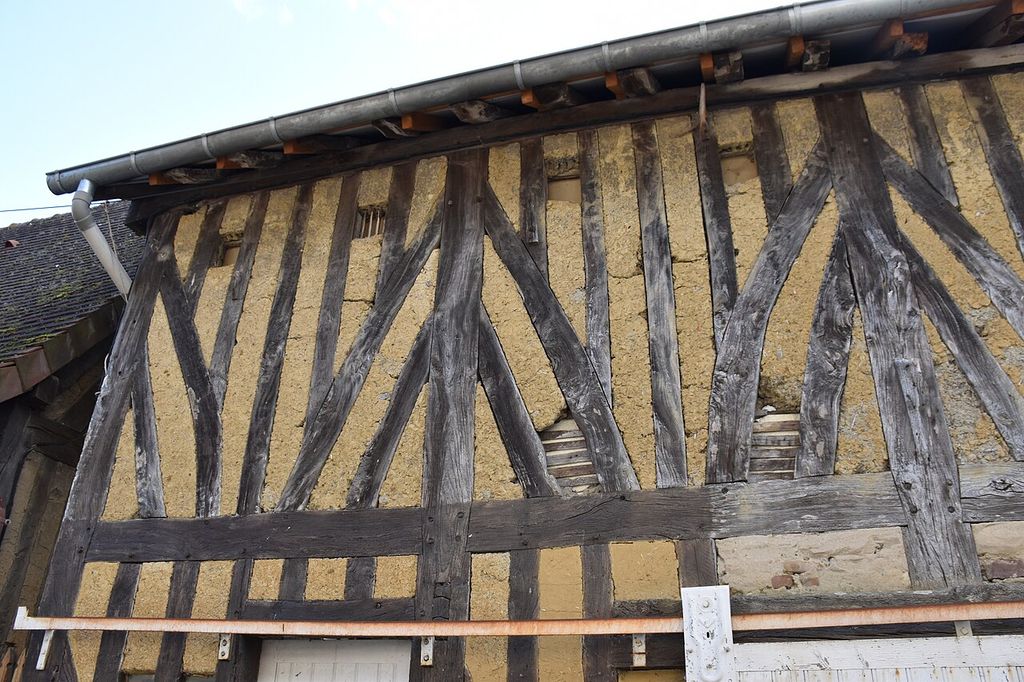
Normandy context: timber framing in Beuvron-en-Auge. Renhour48 / Wikimedia Commons. Image source. CC0 / Public domain. Resized and converted to JPEG; no crop or recolouring.
La Grande Cour itself was an ink project. The Fondation Louis Vuitton’s 2025 exhibition described its panorama as twenty-four ink drawings. In the same exhibition, the digital series 220 for 2020 occupied a different gallery. The shared Normandy setting can make their titles and formats seem interchangeable, but their material identities matter: ink drawing, a large body of iPad paintings and an assembled annual frieze offered different ways to organise the experience of the grounds. [6]
Another distinct presentation was The Arrival of Spring, Normandy, 2020. At the Royal Academy in 2021, it comprised 116 images made on the iPad during the pandemic and printed on paper. Hockney described following the fruit trees from bare branches through buds, blossom and leaves to the appearance of fruit. The exhibition concentrated attention on spring’s accelerated development. A Year in Normandie extended the seasonal account through the rest of the year and brought separate observations together as one long composition. [4]
The frieze also involved selection. Serpentine’s guide described Hockney choosing around half of more than two hundred Normandy iPad paintings for it. A year’s production and the final composition are different quantities: the visitor follows a sequence constructed from that larger body of observations. [1]
The orchard’s changing timetable
Hockney had settled in the Pays d’Auge at the beginning of 2019. His house, garden and surrounding countryside supplied recurring motifs, and the spring project was already taking shape when France entered lockdown in March 2020. The Musée de l’Orangerie’s account emphasised the speed with which he could record light and weather on the iPad. His circumstances brought a restricted territory and a constantly changing subject together. The place remained available while its appearance altered. [7]
Within the spring sequence, observation had a particularly demanding rhythm. Hockney recalled making at least one drawing a day as the orchard changed. Buds enlarged into blossom; leaves appeared; petals fell and small fruit remained. He also described improving his marks on the screen as he worked. The account joins two developments: the trees were changing, and his means of representing them were changing too. Repetition gave him opportunities to compare what he saw with what he had drawn previously. [4]
An orchard is especially useful for this kind of attention because it provides recognisable structures and variable coverings. A trunk or branching pattern can persist while a crown becomes pale with blossom or dense with leaves. In the grounds described by Pace, cherry, pear and apple trees grew alongside hawthorn and elderflower. Such variety complicates the idea of a single moment when spring arrives: the setting contains several overlapping schedules. A landscape experienced repeatedly becomes a set of local events. [5]
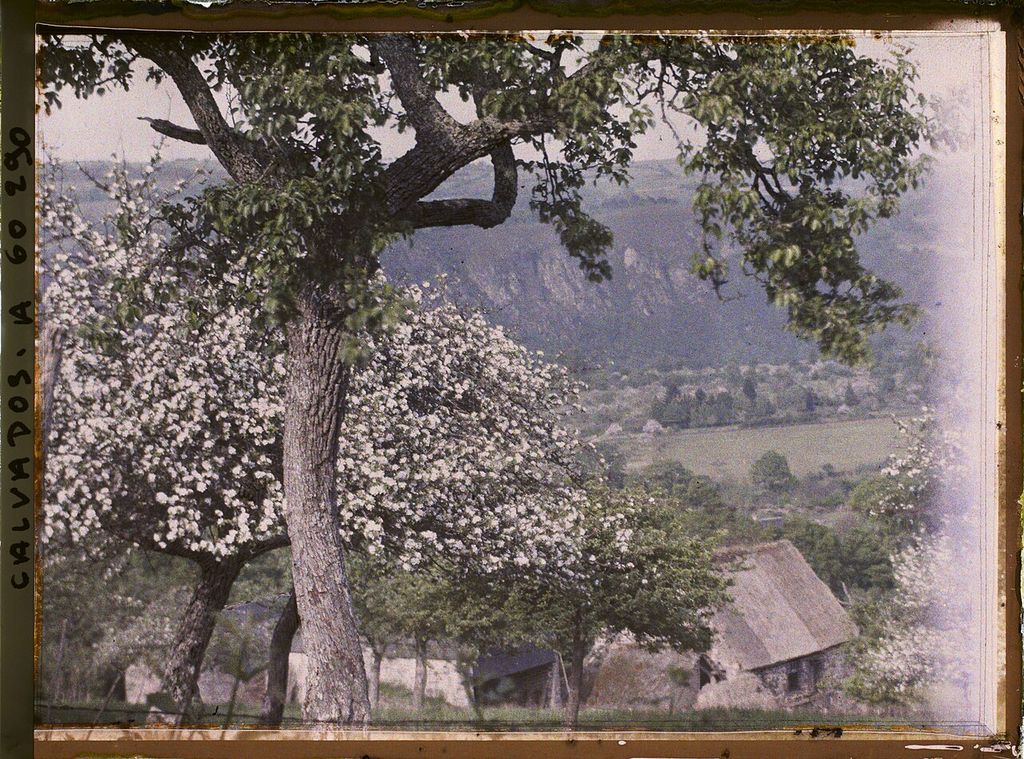
Historical comparison: Roger Dumas, apple blossom near Clécy, Normandy, May 1929, autochrome, musée Albert-Kahn. Roger Dumas / Département des Hauts-de-Seine, musée Albert-Kahn / Wikimedia Commons. Image source. CC BY-SA 4.0. Resized and converted to JPEG; no crop or recolouring. Image derivative retains CC BY-SA 4.0.
The larger work gives the seasons unequal textures. Serpentine’s guide identifies frost, blossom, golden summer fields and autumn’s red and orange colours. Broad changes can be recognised quickly, then explored through the marks that constitute them. From a distance, colour carries the seasonal progression; closer attention distinguishes the branches and foliage through which a particular stretch of the year takes shape. [1]
Digital brushes and the character of a mark
Hockney’s digital tools had developed with his practice. He had used Steve Sprang’s original Brushes on the iPhone and iPad. Richard England and the Leeds company Reflex Arc subsequently built the bespoke Hockney Brushes with the artist and his assistants, chiefly in early 2018. Their account describes simplifying access to preferred brushes and shaping the application around his working habits. [2]
The Tokyo curator Ai Kusumoto drew attention to the frieze’s small leaf-like shapes and dotted marks, made with specially developed digital brushes. A mark used for grass could serve a building’s roof elsewhere. Its identity depended on placement, scale and neighbouring colours. This reuse offers a revealing way into the frieze: the same vocabulary can describe living growth and constructed surfaces. [8]
Kusumoto distinguished Hockney’s iPad drawing from his iPad painting through particular examples. She contrasted the relatively immediate 2011 Woldgate spring drawings with the layered construction of No. 118, 16 March 2020, from the Normandy spring series. Layers allowed colour and composition to be developed before being combined. Swift observation could coexist with deliberate construction, without every constituent image following an identical process. [8]
The comparison with The Arrival of Spring in Woldgate shows how returning to spring involved renewed decisions about building a picture. Brushes and layers expanded the choices described in the wider story of Hockney’s iPad art; the orchard supplied the particular problems to which they were applied. [8]
From the tablet to paper
Enlargement was a further stage of making. Reflex Arc describes retaining stroke information so that a picture could be rendered again at the required output size. The studio joined the pictures using alignment tools added to the application. The frieze’s continuity was composed, while re-rendering preserved the legibility of marks first made on a much smaller surface. That stored sequence also allowed the process of drawing to be replayed as a film. [2]
Paper changes the encounter with those gestures. An illuminated screen emits light; a print depends on light falling on its surface. The visitor also meets the image at a different size and distance. A repeated leaf shape can become conspicuous, while an area that seemed compact on a tablet opens into a passage that takes several steps to follow. Looking across a whole wall and examining a small section become complementary activities. The work’s material presentation gives the marks a public, bodily scale.
The French painter Thomas Lévy-Lasne made this transformation central to his 2022 review of the Orangerie exhibition. He admired the freshness of the colour and the clarity of the print, while questioning what was lost when digital images were compared with the material presence of painting. He also criticised repeated brush patterns and some transitions between constituent pictures. His response identifies a productive tension: the features that make a digital mark distinct can also make its recurrence seem insistent. [9]
These are questions to test while looking. Does a join carry the eye forward, or make it pause over the construction? Does a cluster of repeated marks convey a mass of foliage, or draw attention to the available brush? The frieze permits both responses. Its lengthy sequence can absorb a viewer in the changing year, while its surface keeps the decisions of assembly within reach. The visibility of making becomes part of the experience of duration.
Bayeux and the unfolding picture
The Bayeux Tapestry supplied a connection between a long image and an extended story. This medieval embroidery recounts events associated with the Norman Conquest of England. Bayeux Museum described Hockney’s fascination with its unfolding scenes and his wish to develop a seasonal narrative. The comparison concerns how a continuous horizontal field holds events that happened at different times. [10]
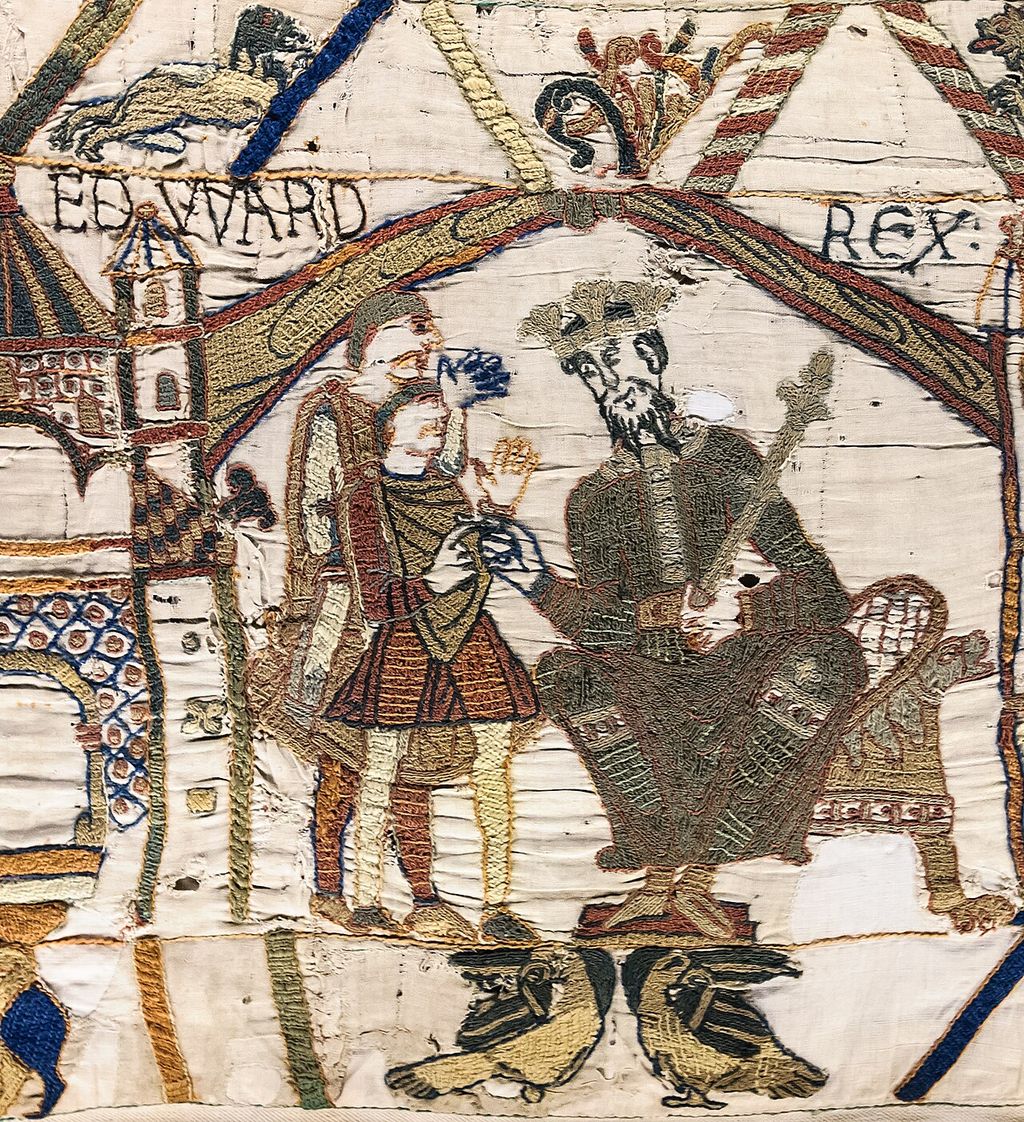
Historical comparison: the opening Edward the Confessor scene of the Bayeux Tapestry, photographed by Myrabella. Myrabella / Wikimedia Commons. Image source. Public domain. Resized and converted to JPEG; no crop or recolouring.
In Hockney’s sequence, change carries the action. Bayeux curator Antoine Verney suggested comparing a stylised tree in the embroidery with a fruit tree in Hockney’s garden. A tree can punctuate a narrative, establish a place or become the subject whose condition the viewer follows. Watching vegetation acquire and lose its coverings gives time a recurring visible structure. [10]
Chinese and Japanese scroll painting offered another important framework. In her 2023 interview, Kusumoto connected Hockney’s interest in scrolls with his longstanding concern for the viewer’s body. A picture could invite the eyes to travel through a landscape, developing an experience across time instead of organising everything around a single stationary position. She placed the Normandy frieze within that larger investigation of how a represented space might be inhabited imaginatively. [11]
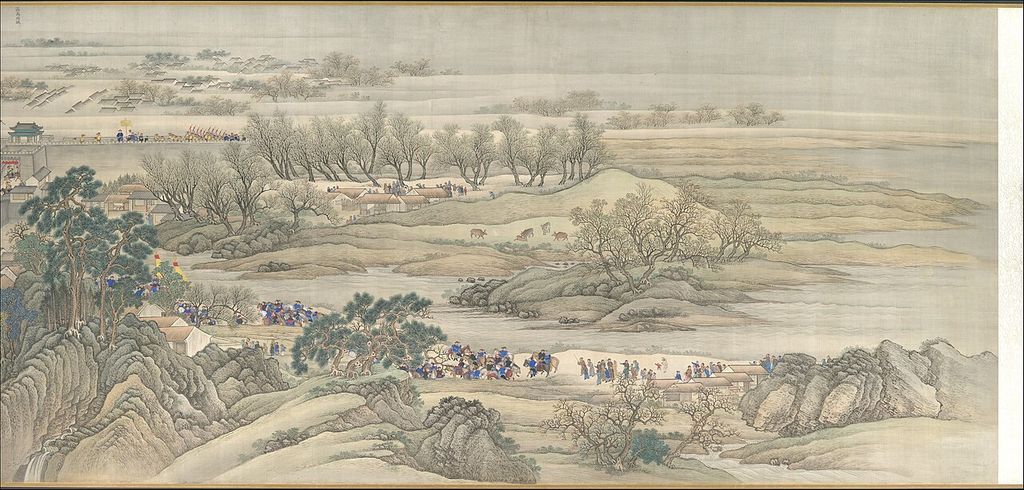
Handscroll comparison: Wang Hui and assistants, The Kangxi Emperor’s Southern Inspection Tour, Scroll Three: Ji’nan to Mount Tai, datable to 1698, Metropolitan Museum of Art. Wang Hui and assistants / The Metropolitan Museum of Art / Wikimedia Commons. Image source. CC0 / Public domain. Resized and converted to JPEG; no crop or recolouring.
The formats also offer different experiences. As Dawn Delbanco explains in the Metropolitan Museum’s account of Chinese handscrolls, a viewer unrolls the picture progressively, usually from right to left, examining a section before rolling it up to reveal the next. The hands control its exposure and pace. [12] In a wall installation, the picture remains available while the visitor changes position. Walking, turning and remembering an earlier passage create continuity. The frieze brings several time scales together: the duration of a drawn gesture, the seasonal changes represented and the minutes spent following them through the gallery.
Anthi-Danaé Spathoni’s study of Hockney’s landscapes offers a related critical vocabulary. Published in RHA in April 2022, the essay argues that his experiments across photography, painting and digital media repeatedly make the viewer an active participant in pictorial space. Its earlier landscape examples provide context for the frieze’s demands on attention and movement. The connection lies in a persistent problem across media: how a still picture can accommodate an experience that develops while someone looks. [13]
Paris: a conversation with Monet
At the Musée de l’Orangerie, A Year in Normandie was exhibited from 13 October 2021 to 14 February 2022 as a contemporary counterpoint. The museum explicitly connected it with Monet’s Water Lilies. The setting gave the seasonal frieze a neighbour whose scale also extends the act of viewing beyond a single glance. Both projects draw sustained attention from repeated contact with a familiar landscape, then bring that attention into the visitor’s experience of an interior. [7]
Monet’s eight Orangerie compositions occupy two oval rooms designed to surround the viewer. The museum describes a water landscape of lilies, willow branches and reflections, without a conventional horizon or bank. In a composition such as The Water Lilies – The Clouds, sky is encountered through the water’s reflective field. Hockney’s garden sequence offers a different kind of orientation: buildings, trees, ground and weather provide recognisable features through which the annual progression can be followed. The comparison sharpens the difference between immersion in a water surface and movement through a seasonal account. [14]

Claude Monet, The Water Lilies – The Clouds (Les Nuages), 1915–26, Musée de l’Orangerie, Paris. A historical comparison for the extended, horizonless pond. Claude Monet / RMN (Musée de l’Orangerie), Michel Urtado / Wikimedia Commons. Image source. Public domain. Resized and converted to JPEG; no crop or recolouring.
The Orangerie also associates Monet’s rooms with the changing light of a day. Hockney’s frieze stretches the interval to a year. The two works make landscape exceed the conventional framed view, but their rhythms differ. Monet’s environment can hold the visitor among reflections; Hockney’s sequence encourages comparisons between earlier and later conditions. A flowering tree has additional meaning when the memory of its bare branches remains available a short walk away. [14]
Bayeux, Tokyo and London
At Bayeux, the exhibition ran from 22 September 2022 to 23 April 2023. The museum specified half-scale reproductions of both the frieze and the embroidery on its second floor; Hockney had proposed reducing his print to accommodate the encounter. These reproduced works were adapted to a particular room, demonstrating how his digitally made image could retain its sequence at a different physical scale. [10]
The Museum of Contemporary Art Tokyo’s exhibition, held from 15 July to 5 November 2023, placed the recent frieze within a broader encounter with Hockney’s career. Kusumoto’s accompanying interview traced connections back through multiple viewpoints, photographic collage and experiments in spatial representation. In that setting, the Normandy year could be understood as a late development of concerns that had occupied him for decades. Her account also treats the pleasure of spring as inseparable from the challenge of seeing and drawing a world that continually changes. [11]
London’s Serpentine North presented A Year in Normandie and Some Other Thoughts about Painting from 12 March to 23 August 2026. This was the frieze’s first London presentation. The gallery connected its Normandy seasons with the surrounding life of Kensington Gardens, allowing the landscape inside to be compared with a landscape undergoing its own changes outside. The exhibition was conceived in close collaboration with Hockney and included paintings made specifically for it. [15]
The frieze extended around the perimeter gallery. Outside, an enlarged detail from its spring cycle, depicting a treehouse, became a printed mural behind the North Gallery. This was a separate treatment of one passage, bringing a fragment of the Normandy garden into another garden. The indoor circuit and outdoor enlargement offered different distances from the same project: one emphasised the annual sequence, while the other isolated an episode within the surrounding park. [16]
The new canvases supplied another point of comparison. Made in late 2025, they comprised five portraits and five still lifes, united by frontal compositions and chequered tablecloths. The portraits included people close to Hockney, while the still lifes played with abstract painting styles. Hannah Silver’s Wallpaper review welcomed the exhibition’s concentrated view of his recent practice. The pairing allowed visitors to consider the printed frieze alongside paintings that continued his investigation of surface, representation and familiar subjects. [17]
The landscapes also entered those new pictures: the portraits of Jack Ransome and Thomas Mupfupi included backgrounds referring to A Year in Normandie. The earlier work had become material for further painting. [1]
A year that asks for time
The frieze’s reception was divided. Lévy-Lasne’s reservations in Paris centred on the printed image’s material qualities and the assembly of separate pictures. [9] In London, Ben Eastham’s Guardian review challenged its artificiality, colour harmony and joins. [18] Silver’s more appreciative account emphasised its modern colour planes and invitation to observe passing time. [17] The disagreement concerns how the work achieves its effects: its digital clarity, repeated vocabulary and expansive format can be experienced as either enabling or limiting.
The Serpentine exhibition opened during the last months of Hockney’s life; he died on 11 June 2026 while it was still running. [19] Yet the annual frieze had been made as an ongoing investigation of a place, with further paintings and exhibitions following it. Within the larger story of his Normandy work, its particular achievement is to make repeated attention shareable. The visitor can move, stop and look back, comparing what has changed with what remains recognisable. Like many of Hockney’s landscapes, it gives the experience of looking an active role in the picture.
Works directory
This source-bounded directory combines the works in the Metropolitan Museum’s 2017 retrospective checklist with reviewed museum object records and the additional works and series examined in this guide. It spans several media and is not a complete catalogue raisonné. Titles without an article link remain useful dated records. Metropolitan Museum final retrospective checklist (2017); additional object and series sources are given in the linked articles. [3]
| Name | Date | Medium |
|---|---|---|
| Love Painting | 1960 | Painting |
| Shame | 1960 | Painting |
| The Third Love Painting | 1960 | Painting |
| Tyger Painting No. 2 | 1960 | Painting |
| A Rake’s Progress | 1961–63 | Print series |
| Tea Painting in an Illusionistic Style | 1961 | Painting |
| The Cha-Cha That Was Danced in the Early Hours of 24th March | 1961 | Painting |
| Cleaning Teeth, Early Evening (10pm) W11 | 1962 | Painting |
| Flight into Italy - Swiss Landscape (Painting in a Scenic Style) | 1962 | Painting |
| Man in a Museum (or You're in the Wrong Movie) | 1962 | Painting |
| My Brother is Only Seventeen | 1962 | Painting |
| The First Marriage (A Marriage of Styles I) | 1962 | Painting |
| Domestic Scene, Los Angeles | 1963 | Painting |
| Play Within a Play | 1963 | Painting |
| The Hypnotist | 1963 | Painting |
| Arizona | 1964 | Painting |
| California Art Collector | 1964 | Painting |
| Man in Shower in Beverly Hills | 1964 | Painting |
| Portrait Surrounded by Artistic Devices | 1965 | Painting |
| Rocky Mountains and Tired Indians | 1965 | Painting |
| Beverly Hills Housewife | 1966–67 | Painting |
| Medical Building | 1966 | Painting |
| Peter | 1966 | Drawing |
| Peter Getting Out of Nick’s Pool | 1966 | Painting |
| A Bigger Splash | 1967 | Painting |
| A Lawn Being Sprinkled | 1967 | Painting |
| Kasmin in Bed in His Chateau in Carennac | 1967 | Drawing |
| Peter Feeling Not Too Good | 1967 | Drawing |
| Savings and Loan Building | 1967 | Painting |
| The Room, Tarzana | 1967 | Painting |
| American Collectors (Fred and Marcia Weisman) | 1968 | Painting |
| Christopher Isherwood and Don Bachardy | 1968 | Painting |
| Henry Geldzahler and Christopher Scott | 1968-1969 | Painting |
| W. H. Auden | 1968 | Drawing |
| Peter Langan in His Kitchen at Odins | 1969 | Drawing |
| Mark Glazebrook | 1970 | Drawing |
| Mr and Mrs Clark and Percy | 1970-1971 | Painting |
| Ossie Wearing a Fairisle Sweater | 1970 | Drawing |
| Pool and Steps, Le Nid du Duc | 1971 | Painting |
| Rubber Ring Floating in a Swimming Pool | 1971 | Painting |
| Celia in a Black Dress with White Flowers | 1972 | Drawing |
| Mount Fuji and Flowers | 1972 | Painting |
| Portrait of an Artist (Pool with Two Figures) | 1972 | Painting |
| Portrait of the Artist's Mother, Mrs Laura Hockney, Bradford | 1972 | Drawing |
| The Artist's Father | 1972 | Drawing |
| Dr Eugene Lamb, Lucca | 1973 | Drawing |
| Andy, Paris | 1974 | Drawing |
| Contre-jour in the French Style (Against the Day dans le Style-Français) | 1974 | Painting |
| Gregory Sitting on Base of Column | 1975 | Drawing |
| Kerby (after Hogarth) Useful Knowledge | 1975 | Painting |
| Ron Kitaj Outside Akademie der Kunste Vienna | 1975 | Drawing |
| Kasmin Reading the Udaipur Guide | 1977 | Drawing |
| Looking at Pictures on a Screen | 1977 | Painting |
| My Parents | 1977 | Painting |
| Canyon Painting | 1978 | Painting |
| Mother, Bradford, 19 Feb. 1979 (inscribed 1978) | 1979 | Drawing |
| Mulholland Drive: The Road to the Studio | 1980 | Painting |
| Nichols Canyon | 1980 | Painting |
| Outpost Drive, Hollywood | 1980 | Painting |
| Hollywood Hills House | 1981-1982 | Painting |
| Celia. Los Angeles. April 10th 1982 | 1982 | Polaroid composite |
| Don + Christopher, Los Angeles, 6th March 1982 | 1982 | Polaroid composite |
| Gregory Swimming Los Angeles March 31st 1982 | 1982 | Polaroid composite |
| My Mother, Bolton Abbey, Yorkshire, Nov. 1982 | 1982 | Photocollage |
| Self Portrait 30th Sept. 1983 | 1983 | Drawing |
| Pearblossom Hwy., 11-18th April 1986, #1 | 1986 | Photocollage |
| Pearblossom Hwy., 11–18th April 1986, #2 | 1986 | Photocollage |
| Large Interior, Los Angeles | 1988 | Painting |
| Breakfast at Malibu, Sunday, 1989 | 1989 | Painting |
| Pacific Coast Highway and Santa Monica | 1990 | Painting |
| The Other Side | 1991-1993 | Painting |
| The Eleventh V. N. Painting | 1992 | Painting |
| The Twenty Sixth V. N. Painting | 1992 | Painting |
| The Road Across the Wolds | 1997 | Painting |
| 9 Canvas Study of the Grand Canyon | 1998 | Painting |
| A Bigger Grand Canyon | 1998 | Painting |
| Colorado River | 1998 | Painting |
| Garrowby Hill | 1998 | Painting |
| Colin St. John Wilson. London. 3rd June 1999 | 1999 | Drawing |
| Gregory Evans. Los Angeles. 18th September 1999 | 1999 | Drawing |
| Laura Huston. London. 22nd June 1999 | 1999 | Drawing |
| Lindy. Marchioness of Dufferin and Ava. London. 17th June | 1999 | Painting |
| Going Up Garrowby Hill | 2000 | Painting |
| Red Pots in the Garden | 2000 | Painting |
| A Closer Winter Tunnel, February - March | 2006 | Painting |
| Elderflower Blossom, Kilham, July 2006 | 2006 | Painting |
| The Road to Thwing, July 2006 | 2006 | Painting |
| Bigger Trees near Warter | 2007 | Painting |
| Hawthorn Blossom near Rudston | 2008 | Painting |
| Views Through the Artist's Bedroom Window, Bridlington | 2010-2013 | Digital animation |
| The Arrival of Spring in Woldgate, East Yorkshire in 2011 (twenty eleven) | 2011 | Painting / digital series |
| 82 Portraits and 1 Still-life | 2013–16 | Portrait series |
| Garden | 2015 | Painting |
| Garden with Blue Terrace | 2015 | Painting |
| Garden #3 | 2016 | Painting |
| A Bigger Interior with Blue Terrace | 2017 | Painting |
| Interior with Blue Terrace and Garden | 2017 | Painting |
| A Year in Normandie | 2020–21 | Digital frieze |
Discussion
Look again at the images and ideas explored in A Year in Normandie. These editorial prompts invite your observations.
Reader Insights
How does remembering a bare tree change your response to a later passage of blossom or dense leaves in the same seasonal sequence?
Does knowing that one digital mark can describe both grass and a roof make its repetition feel more inventive or more conspicuous?
What changes when a continuous picture is followed by walking along a gallery wall, compared with progressively unrolling a handscroll?
Join the Conversation
Share a detail, comparison or question about A Year in Normandie below.
References
- Serpentine. David Hockney: A Year in Normandie and Some Other Thoughts about Painting, exhibition guide, 2026, PDF pp. 2–4. View source.
- Reflex Arc. “The iPad painting app we built for David Hockney – Hockney Brushes,” sections “Before the app,” “Which app, when,” “Hockney Brushes, 2018” and “At scale, 2021,” accessed 5 November 2026. View source.
- The Metropolitan Museum of Art, David Hockney, final exhibition checklist, 15 November 2017. View source.
- The David Hockney Foundation. “2021,” sections “Spring Cannot Be Cancelled” and “The Arrival of Spring, Normandy, 2020.” View source.
- Pace Gallery. “La Grande Cour, Normandy,” exhibition text, 14 September–19 October 2019. View source.
- Fondation Louis Vuitton. “David Hockney 25,” French exhibition text, 2025, Normandy galleries 5–7. View source.
- Musée de l’Orangerie. “David Hockney. A Year in Normandie,” archived exhibition page, 13 October 2021–14 February 2022. View source.
- Tamaki Sugihara, interviewing Ai Kusumoto. “ホックニーはなぜ評価と人気を60年も獲得し続けられたのか?,” Tokyo Art Beat, 25 August 2023, especially the discussion of medium-specific marks, layers and custom brushes. View source.
- Thomas Lévy-Lasne. “Peindre le temps – sur « David Hockney. A Year in Normandie »,” AOC, 21 January 2022; full-text reprint, PDF pp. 4–6. View source.
- Bayeux Museum. “Artist David Hockney Presents ‘His’ Normandy at the Bayeux Tapestry Museum,” press release, 13 June 2022, PDF pp. 1–3. View source.
- Tamaki Sugihara, interviewing Ai Kusumoto. “混迷から新境地へ。巨匠ホックニーが喜びに満ちた作品に辿り着くまで,” Tokyo Art Beat, 22 September 2023, sections on the viewer’s body, scrolls and spring. View source.
- Dawn Delbanco. “Chinese Handscrolls,” Heilbrunn Timeline of Art History, Metropolitan Museum of Art, April 2008. View source.
- Anthi-Danaé Spathoni. “David Hockney’s Moving Landscapes,” RHA: Revista de História da Arte, no. 11, April 2022, pp. 95–103, especially pp. 99–102. View source.
- Musée de l’Orangerie. “Les Nymphéas de Claude Monet,” collection and installation account, accessed 5 November 2026. View source.
- Serpentine. “David Hockney: A Year in Normandie and Some Other Thoughts about Painting,” archived exhibition page, 12 March–23 August 2026. View source.
- Serpentine. “David Hockney: A Year in Normandie and Some Other Thoughts about Painting,” announcement, 9 February 2026, PDF pp. 1–2. View source.
- Hannah Silver. “At Serpentine, David Hockney asks us to pause and observe the passing of time,” Wallpaper, 11 March 2026. View source.
- Ben Eastham. “David Hockney review – a 90-metre vision of nature that only looks great on your phone,” The Guardian, 11 March 2026, updated 12 March 2026. View source.
- The David Hockney Foundation. “2026,” annual chronology, including notice of Hockney’s death on 11 June 2026. View source.
More HOCKNEY Works
A Bigger Splash
A momentary disturbance becomes the focus of a large acrylic painting, made through weeks of patient work.
Mr and Mrs Clark and Percy
The designers Celia Birtwell and Ossie Clark occupy a room shaped by light, repeated sittings and the demands of a double portrait.
A Bigger Grand Canyon
Sixty canvases gather memory, studies and changing viewpoints into an immense painting of 1998.
Garrowby Hill
The 1998 oil painting transforms a remembered Yorkshire journey into a road, fields and an expansive view.
Portrait of an Artist (Pool with Two Figures)
Photographic studies, two figures and a swimming pool become a carefully constructed painting of 1972.
My Parents
The 1977 oil painting sets Kenneth and Laura Hockney within a quietly organised interior.
Pearblossom Hwy., 11–18th April 1986, #2
Hundreds of separately made photographs construct a road scene that unfolds through movement and time.
Bigger Trees near Warter
Fifty canvases join into a large outdoor painting of Yorkshire trees, with photography helping the artist organise the whole.