


 by Tom Gurney
Tom Gurney BSc (Hons) is an art history expert with over 20 years experience
Email: tomgurney1@gmail.com / Phone: +44 7429 011000
David Hockney’s Secret Knowledge and the Optics Debate: Introduction
Could a painted face preserve evidence of a lens? Could a change in the pattern of a carpet reveal a mirror being moved? These were the kinds of questions David Hockney brought to the history of painting in Secret Knowledge: Rediscovering the Lost Techniques of the Old Masters, published in 2001. A BBC documentary carried his investigation to a wider audience that October, and a conference in New York brought artists and scholars together to discuss it in December. An artist’s practical curiosity had become a public argument about how pictures were made. [1]
Hockney and his collaborator, optical scientist Charles M. Falco, proposed that some European painters had used projected images much earlier than conventional accounts allowed. Their technical paper of 2000 looked for evidence in paintings themselves: changes of focus, shifts in perspective and the scale of convincing likenesses. The resulting debate concerns several different questions. An instrument might be capable of producing an image without having been used by a particular artist. A painted effect might fit an optical explanation while also permitting another account. Keeping these distinctions in view makes the inquiry more revealing than a contest between believers and sceptics. [2]
At a Glance
- ArtistDavid Hockney
- Born9 July 1937, Bradford, England
- Died11 June 2026
- FocusSecret Knowledge and the Optics Debate
Contents
- What Hockney proposed
- Camera obscura and camera lucida
- Lotto’s patterned cloth: the optical argument
- Could suitable mirrors have been made?
- Testing van Eyck’s chandelier
- The problem of light
- Why colour complicates tracing
- Falco’s response and the limits of proof
- How museums have presented the debate
- What the inquiry reveals about Hockney
What Hockney proposed
Hockney’s investigation grew out of close attention to the small pencil portraits of Jean-Auguste-Dominique Ingres. The Fitzwilliam Museum’s exhibition Hockney’s Eye describes how seeing Ingres’s portraits at the National Gallery in 1999 strengthened his conviction that a camera lucida could explain aspects of their precision. He experimented with the instrument himself, making portraits of people he knew. An apparent historical puzzle therefore became a drawing problem that he could try with his own hand. [3]
The question soon widened. In their 2000 paper, Hockney and Falco traced the persuasive, photograph-like quality that had interested him in Ingres back to early fifteenth-century painting, including Robert Campin. They argued that some passages in Renaissance pictures carried signs of optical projection. This moved the discussion centuries earlier than the familiar association between cameras and eighteenth-century view painters. It also changed the kind of evidence being offered: a painted pattern or face was being treated as a record of a possible working procedure. [2]
Their proposal did not require an artist to project and trace an entire composition in one operation. A small area might be used to establish a head, an object or a patterned surface, with other parts assembled separately. Hockney and Falco suggested that the limitations of simple optics could help explain both the startling conviction of individual passages and the discontinuities within a larger picture. A lens could supply information while also creating problems of scale, focus and alignment. [2]
The distinctive claim is that particular properties of those tools can be inferred from the finished images. Whether a painted irregularity identifies a physical optical process is where much of the disagreement begins.
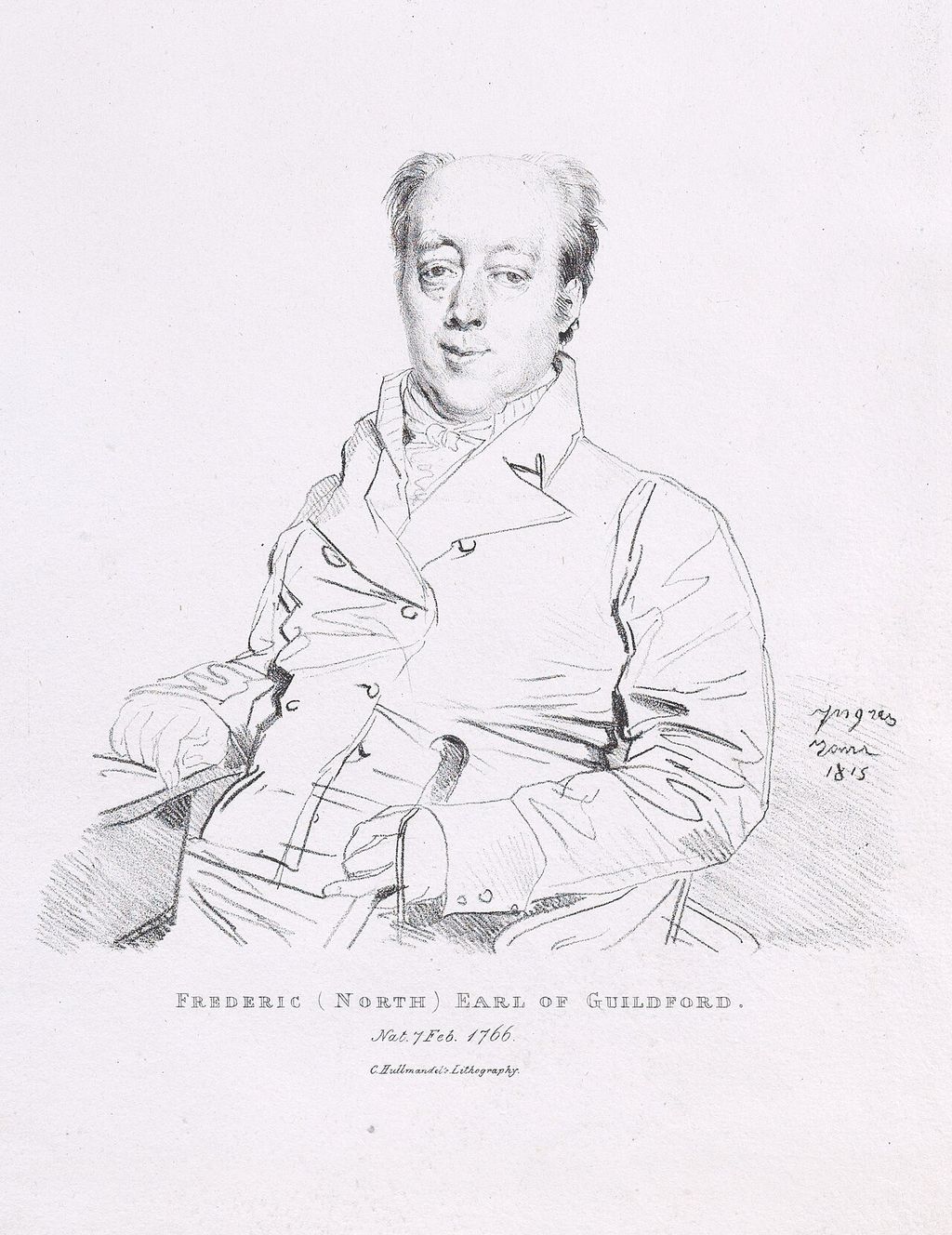
Historical drawing comparison: Jean-Auguste-Dominique Ingres, Portrait of Frederick (North), Earl of Guildford, 1815, Metropolitan Museum of Art. Jean-Auguste-Dominique Ingres / The Metropolitan Museum of Art / Wikimedia Commons. Image source. CC0 / Public domain. Resized and converted to JPEG; no crop or recolouring.
Camera obscura and camera lucida
The two instruments have similar names but work differently. A camera obscura produces a real image that can fall on a surface. In a lens-based version, light from the scene enters a darkened chamber through a lens and forms an inverted view inside. Portable boxes can use an inclined mirror to turn the image into a more convenient orientation on a viewing screen. The Fitzwilliam displayed nineteenth-century examples of this arrangement, helping visitors understand the mechanism without implying that those particular objects belonged to Renaissance painters. [3]
A camera lucida allows its user to see the subject and the drawing surface together through a small optical arrangement. Wollaston’s device, invented in 1806–7, used a prism and a carefully positioned viewing aperture. The artist could look towards the paper while also seeing the scene brought into the same field of view. It did not cast a picture onto the sheet for everyone in the room to inspect. Maintaining the right eye position and coordinating pencil with the apparent image required practice. [3]
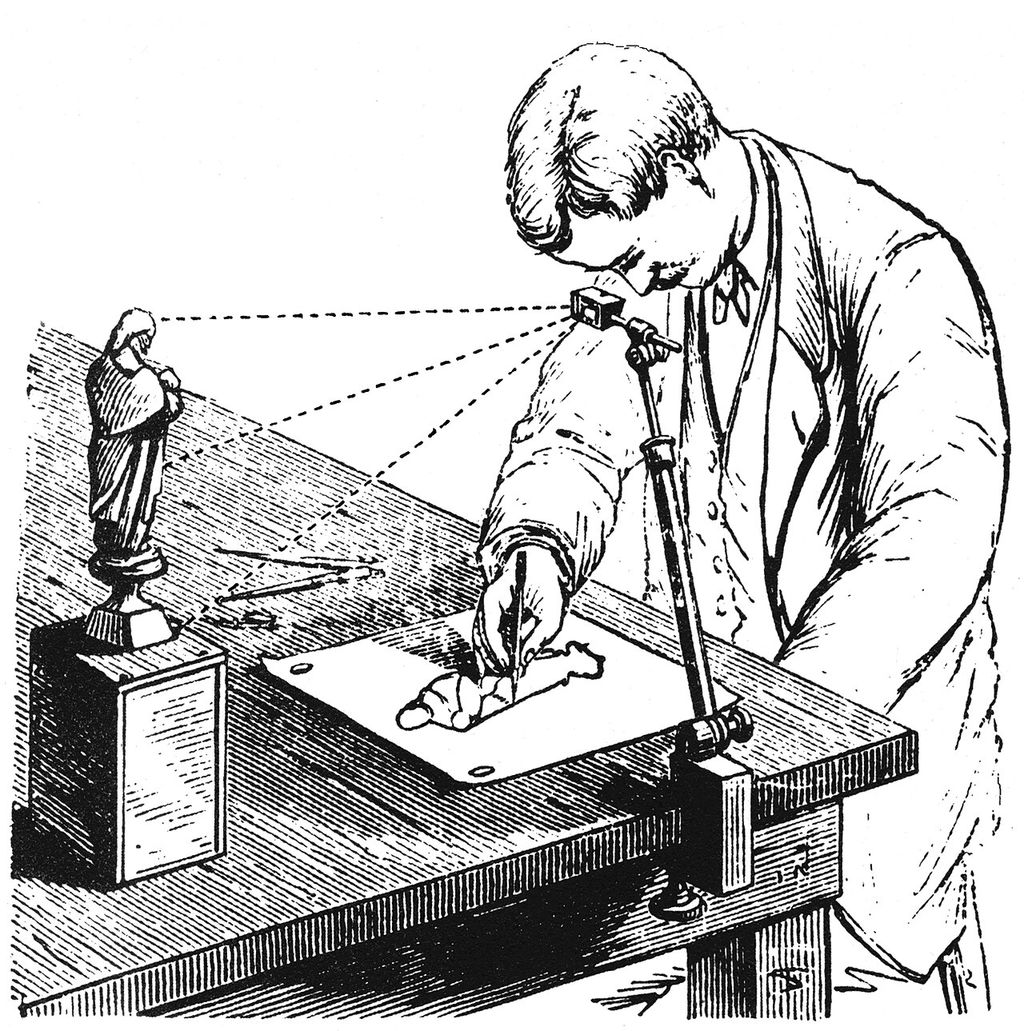
A camera lucida illustrated in Scientific American Supplement, 11 January 1879. Unidentified illustrator / Scientific American Supplement (1879) / Wikimedia Commons. Image source. Public domain. Resized and converted to JPEG; no crop or recolouring.
This distinction separates two parts of Hockney’s historical argument. A camera lucida was chronologically available to Ingres. Wollaston’s nineteenth-century invention cannot explain a fifteenth-century painting. For the earlier works, Hockney and Falco considered projection using a converging glass lens or a concave mirror. A concave mirror curves inward and can bring reflected light together to form an image. The convex mirror familiar from van Eyck’s Arnolfini Portrait curves outward; its painted presence is not itself a demonstration that the room contained a projector. [2]
Hockney and Falco used the term mirror lens for a concave mirror to emphasise its image-forming capacity. Both refractive glass and reflective mirrors could produce projections, but their image orientation differed. In their discussion, a concave mirror allowed a finished image to retain the subject’s left–right arrangement after it had been turned upright. Such details matter when reconstructing a proposed procedure. They do not identify the equipment an artist actually possessed. [2]
The most useful comparison is with evidence that explicitly names a tool. The Fitzwilliam labels discussed Thomas Sandby’s eighteenth-century Windsor panorama, inscribed as drawn in a camera and assembled from four views. Here an artist’s record supports the account of how the image was made. The same exhibition described Daniele Barbaro’s 1568 instructions for using a lens in a darkened room to assist drawing. Neither example establishes the earlier use proposed for van Eyck, but both show what a more direct historical connection between instrument and practice looks like. [3]
Lotto’s patterned cloth: the optical argument
Lorenzo Lotto’s double portrait usually called Husband and Wife supplied Hockney and Falco with a particularly detailed case. Their attention settled on the patterned textile covering the table. In their reading, its central geometric motif becomes less sharply defined as it recedes, while a narrower pattern towards the side remains clearer. They also identified changes in the directions towards which lines in the pattern converge. Those directions are described through vanishing points: the places where parallel lines appear to meet when carried into the distance. [2]
A simple optical system can keep only a limited range of distances acceptably sharp at once. This range is its depth of field. Hockney and Falco proposed that Lotto had encountered that limitation while working from a projected image. Moving the optical element to bring a more distant part of the cloth into focus would also change the image’s scale and perspective. A passage that becomes soft near a change in alignment could therefore preserve the consequences of refocusing. The paired effects, they argued, were more significant than a general resemblance to photography. [2]
Their explanation also addressed the difference between the broad central motif and the narrow border. Refocusing would make it difficult to join together the large pattern at a newly altered scale. Matching the smaller border would be easier. In their reconstruction, the artist’s efforts to accommodate an optical difficulty became visible in the textile. The painted irregularities were read as traces of work, connecting a possible instrument with decisions made during the picture’s construction. [2]
The paper went further and estimated the properties of the supposed device. Its calculations included an assumed shoulder width for the sitter, an estimated studio depth, an inferred working distance and a judgement about how much blur would be acceptable. Under those assumptions, the authors arrived at a focal length of approximately 54 centimetres and an effective optical diameter of about 2.4 centimetres. These are measurements within a reconstruction. They are not measurements of a surviving instrument from Lotto’s studio. The authors acknowledged that an exact focal length would require knowledge of the original arrangement. [2]
Hockney and Falco also compared twelve fifteenth- and sixteenth-century head-and-shoulders portraits that Hockney had already identified as having a photograph-like quality. Although the supports differed considerably in size, they found that the depicted faces were close to a common, near-life-size scale. Their optical modelling suggested that a simple concave mirror would provide a relatively small useful image area, into which those principal features fitted. They presented this as additional circumstantial support. Since the portraits had been selected for the quality the research sought to explain, the comparison should be understood as an investigation of that group, not a survey demonstrating how all Renaissance portraits were produced. [2]
These arguments invite examination of a particular pattern, dimension or discontinuity. Yet the reconstruction supplies a studio geometry that the painting itself cannot fully specify. Its fit with the painted evidence remains dependent on assumptions about the original scene.
Could suitable mirrors have been made?
The historical feasibility of the equipment became a separate question. In a 2004 paper, Hockney and Falco assembled evidence for earlier knowledge of lenses and mirrors. They pointed to spectacles, magnifying glasses and concave mirrors represented in Tomaso da Modena’s fourteenth-century paintings. They also discussed medieval descriptions of making curved metal mirrors and literary accounts of unusual reflected images. These references supported their argument that image-forming optics did not have to await the telescope. Their interpretation of the historical material formed part of the case for technological possibility. [4]
The paper also drew on a 1462 order for spectacles associated with the Duke of Milan, using the quantity, reported production time and price to argue that lenses could be made efficiently and at modest cost. Its date and purpose matter: an order for reading glasses later in that century helps establish manufacturing capacity, but does not document the equipment used for a painting made decades earlier. [4]
Hockney and Falco tested fabrication as well as discussing texts. They reported making small concave metal mirrors with grinding and polishing materials, including a brass example 2.5 centimetres across made in 59 minutes. Despite imperfections that would be undesirable in precision scientific optics, it projected a recognisable image. They used its resolving power to argue that such a mirror could supply detail fine enough to assist a drawing. This was an experimental answer to the suggestion that a useful projector required an implausibly perfect mirror. [4]
They further argued that oxidation complicates the interpretation of surviving metal mirrors. A tarnished object’s present surface cannot automatically stand for its condition when newly polished. That is a relevant caution when testing historical equipment, although their experiments did not establish the original optical quality of every surviving mirror. The practical conclusion remains bounded: a comparatively rough metal mirror can project useful information. Establishing that van Eyck or Lotto used one requires additional evidence about those artists and pictures. [4]
Testing van Eyck’s chandelier
The chandelier in Jan van Eyck’s Arnolfini Portrait became an important test case because its intricate arms look remarkably convincing. Hockney had treated its apparent perspectival accuracy as evidence for projection. Computer-vision researchers Antonio Criminisi and David G. Stork examined that claim in a 2004 paper, comparing the shapes of the painted arms after mathematically adjusting for differences in their orientation. If matching arms were represented by an accurate projection, their corresponding details should align closely once those differences were allowed for. [5]
Their procedure revealed substantial discrepancies. For one illustrated comparison, the average mismatch between the painted arms was approximately 13 per cent of the image width, compared with about 3 per cent for arms in a photographed comparison chandelier. They repeated the analysis with different reference points and other metalwork. Their aim was to distinguish irregularities introduced in making the picture from irregularities already present in the physical object. Comparable surviving chandeliers offered a way to test how much variation historical manufacture might reasonably explain. [5]
The authors also asked the British painter Nicholas Williams to paint elaborate chandeliers by eye. His results combined convincing realism with imperfect geometry, at a level of measured inconsistency comparable to van Eyck’s. This gave the discussion a practical counterexample: an intricate object can look persuasively solid without being an exact perspective projection. The experiment challenged the inference that the chandelier’s convincing appearance required optical assistance, while leaving van Eyck’s actual working procedure unresolved. [5]
Criminisi and Stork concluded that their measurements, together with the absence of corroborating documentation, argued against projection in this case. Their test nevertheless depended on comparisons with other objects and on a model of what a projection would preserve. They recognised that an artist could alter a projected image, while questioning why he would introduce the particular deviations they found. The distinction matters: evidence against accurate tracing of these chandelier arms is narrower than evidence that no artist ever used an optical aid. [5]
Read beside the Lotto argument, this case shows why irregularity does not explain itself. Hockney and Falco saw some discontinuities as consequences of adjusting optical equipment. Criminisi and Stork saw the chandelier’s inconsistencies as evidence against the proposed optical route. The value of either account depends on the particular operation being proposed and the marks that operation would be expected to leave.
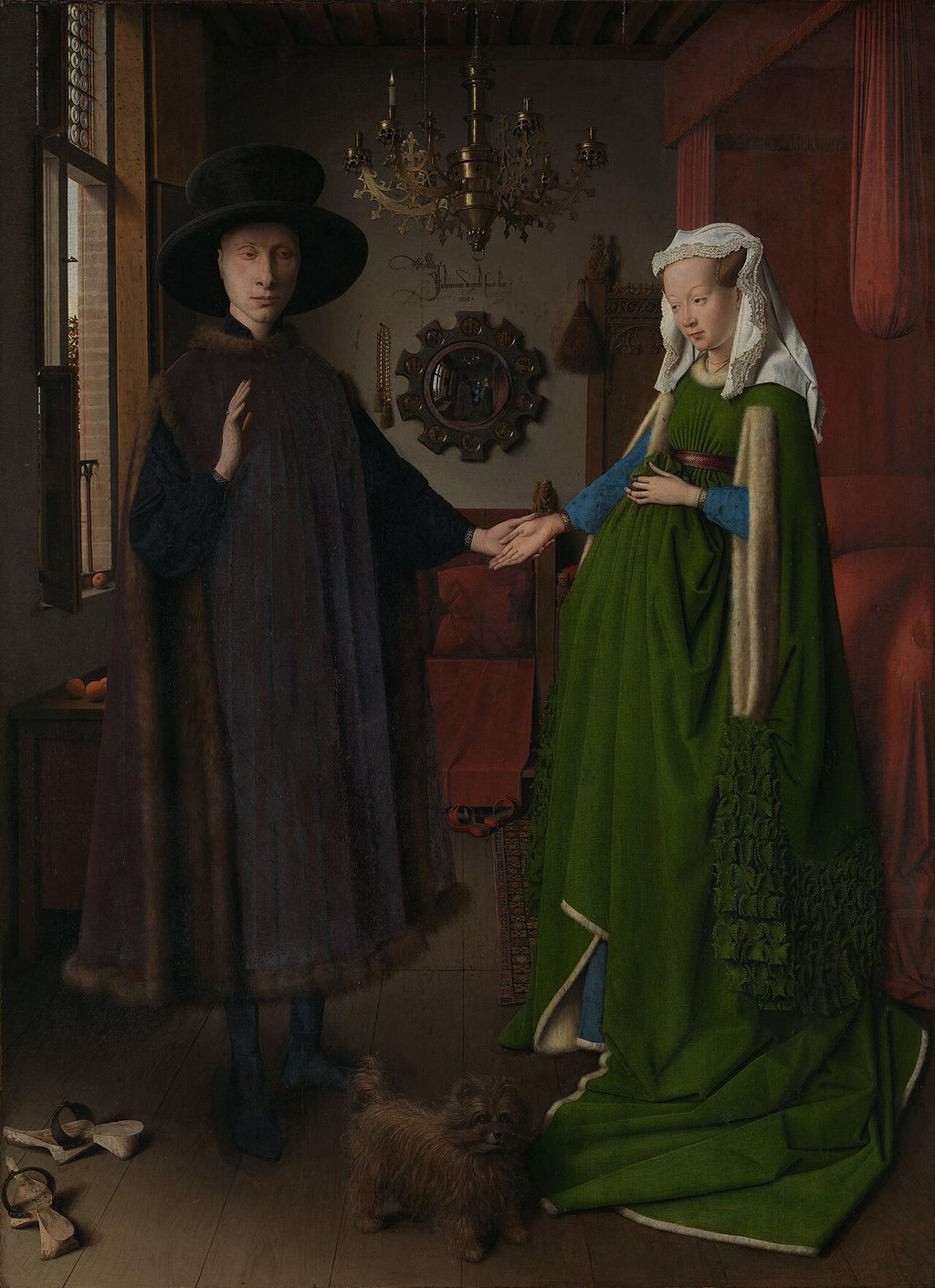
Historical double-portrait comparison: Jan van Eyck, The Arnolfini Portrait, 1434, National Gallery, London. Jan van Eyck / Wikimedia Commons. Image source. Public domain. Resized and converted to JPEG; no crop or recolouring.
The problem of light
A projection can exist and still be too dim to work from comfortably. Stork’s 2003 paper examined this practical difficulty by calculating the light available in proposed arrangements and checking the calculation experimentally. Using the small optical diameter and focal length inferred for the Lotto reconstruction, together with assumptions about reflectance and viewing angle, he estimated that the projected image could receive roughly one-thousandth of the illumination at the subject. He argued that direct sunlight would generally be needed for workable projections in the cases he considered. [6]
This introduces a trade-off already acknowledged in Hockney and Falco’s original paper. Reducing the effective opening of a simple optical element can improve sharpness and increase depth of field, but it also reduces brightness. Enlarging the opening collects more light while allowing greater blur and aberration. Hockney and Falco reported that their small mirror arrangement worked with a subject in strong sunlight. The question is therefore not whether projection is possible in favourable conditions; it is whether the conditions proposed for an individual painting are plausible. [2]
Stork used paintings by Caravaggio to press that question. He considered how many artificial lights might be needed, whether numerous lamps would preserve sharply directed shadows, and whether the illumination represented in a painting fitted direct sunlight. His approximate reconstruction of a candlelit scene was intended to expose the distance between seeing a subject normally and seeing a much dimmer projection of it. The published estimates were explicitly rough. Their force lies in the practical constraint, without requiring every painted shadow to be a literal record of the studio’s lighting. [6]
Demonstrations also need the right comparison. Stork distinguished a brightly sunlit building viewed through a north-facing window from a sitter illuminated only by diffuse northern daylight. Both involve the same window, but the subject receives very different amounts of light. He similarly questioned demonstrations using modern theatrical lighting or a mirror much larger than the device inferred from a painting. An experiment establishes what its actual arrangement can do; transferring the result to another century requires comparable illumination, dimensions and materials. [6]
Why colour complicates tracing
Projection might help locate an eye or the edge of a table. It does not mix paint. Stork argued that the subtle relationships of lightness, saturation and colour were crucial to the convincing appearance Hockney called optical. In his account, accuracy of outline could not by itself explain that quality. His paper used informal alterations of digital reproductions to explore the difference: changing shape while retaining colour, then changing colour while preserving shape. These were illustrative comparisons, not a large controlled study establishing a universal measure of realism. [6]
Painting directly into coloured projected light creates an additional difficulty. A white surface can look red because a red image is falling upon it. Applying pigment while judging its appearance under that illumination entangles the colour of the light with the colour of the paint. When the projection is removed and the picture receives ordinary illumination, the relationship changes. Tracing some outlines and completing the painting under different conditions avoids part of this problem, but it also leaves much of the picture’s convincing colour to the painter’s independent judgement. [6]
Stork also directed attention to the resources of oil painting: its range of light and dark, the possibilities of glazing, and the time its slower drying allows for blending and revision. These offered alternative ways to explain why a painted face or object could acquire unusual depth and presence. Materials and learned handling therefore belong in the account alongside geometry. A method that helps position a contour need not explain the transitions of tone that make the bounded form look rounded. [6]
This is one reason the debate cannot be reduced to accuracy. An optical aid could contribute to one stage while leaving the most demanding decisions elsewhere. Tone, colour, emphasis, handling and revision remain separate activities. A convincing account of a finished painting must explain how these activities worked together, including what the proposed device could contribute and what the artist still had to supply.
Falco’s response and the limits of proof
Falco’s 2006 correspondence in Nature addressed a claim, reported in a review, that suitable fifteenth-century concave mirrors could not have existed. He stressed that the thesis concerned optics broadly and did not depend exclusively on mirrors. The optical evidence he and Hockney had identified, he wrote, could not distinguish reflective from refractive devices. A suitable lens remained another possibility. This repeated a limitation already stated in their 2000 paper, where mirrors received emphasis but were not uniquely identified by the painted evidence. [7]
That response narrows what a successful objection would establish. A problem with one proposed mirror does not automatically eliminate a lens-based arrangement. Equally, preserving an alternative possibility does not demonstrate its historical use. Falco’s short letter addressed the choice of optical element; it did not supply a point-by-point answer to every perspective, lighting or colour objection. Stork’s own 2003 conclusion also stopped short of claiming universal disproof. He argued that proponents needed to establish why their explanation should be preferred to plausible alternatives. [6]
The competing claims can therefore be assessed at different levels. Optical experiments establish capacities under specified conditions. Image analysis asks whether a painted feature fits the expected result of a proposed procedure. Historical evidence asks whether that procedure belongs to the artist’s circumstances: instruments, knowledge, materials, working records and available light. Agreement at one level strengthens a case, but cannot silently replace the others. The absence of a written record is a limit on certainty; it does not establish either use or non-use by itself.
Falco continued presenting the argument internationally. ITMO University’s Russian-language report of his 2017 lecture in St Petersburg described the Lotto textile and the proposed effects of refocusing. The report conveyed his continuing confidence in the optical explanation, showing how the thesis circulated through meetings between science, museums and art history. It records the public presentation of his position, without resolving the objections raised by other researchers. [8]
How museums have presented the debate
Museum displays can bring the physical mechanisms and the historical uncertainties into the same room. Teylers Museum’s account of Hockney’s Eye explicitly described optical aids as a disputed subject. It placed Hockney’s work alongside earlier pictures and instruments he believed their makers might have used, with demonstrations including a camera obscura and a perspective frame. That language of possible use is essential: an instrument can help visitors examine a proposal without verifying it for every adjacent painting. [9]
The Fitzwilliam’s labels were particularly clear about Ingres. They stated that no documentary evidence supported Hockney’s camera lucida explanation, while also observing that no evidence showed Ingres rejecting such tools. Those absences are not equivalent to positive evidence of use. The exhibition nevertheless made Hockney’s reasoning accessible through portraits, instruments and accounts of actual drawing practice. Its presentation allowed viewers to consider the visual question while retaining the difference between a compelling suggestion and a documented procedure. [3]
An exhibition also makes scale and effort tangible. Looking through a device requires the body to be positioned; drawing requires a hand to move; glare, focus and the sitter’s placement can interfere. These practical matters restore something easily lost in discussions of tracing. A projected or superimposed image is available information. Turning it into an articulate line still takes a trained person making choices.
What the inquiry reveals about Hockney
Hockney’s own camera lucida portraits provide firmer ground because their use of the device is recorded. The Fitzwilliam labels identified, among others, his 1999 drawings of Margaret Hockney, Alan Bennett, Ian McKellen and Martin Kemp. They explained that he briefly used the instrument to locate essential facial features, then continued by eye. An apparatus and freehand drawing formed successive parts of the same activity. The resulting work belonged within his long practice of drawing people, rather than beginning a wholly separate kind of portraiture. [3]
For the National Gallery’s Encounters exhibition in 2000, he made 12 Portraits After Ingres in a Uniform Style, depicting front-of-house staff. The Fitzwilliam’s discussion stressed the interaction between consistent format and individual likeness: similar chairs, clothing and identifying badges brought differences between faces into greater prominence. That was an artistic organisation of the subject as well as a technical exercise. Optical assistance could locate features; it did not decide what the ensemble would mean or how its uniformity would make individuality visible. [3]
His interest in cameras also coexisted with dissatisfaction with a single fixed viewpoint. The Fitzwilliam connected his multi-screen Yorkshire videos with the attempt to bring movement and duration into depiction. Its account of Vincent’s Chair and Pipe described a different spatial experiment: the seat opens wider towards the back, allowing several aspects of the chair to appear together. These investigations belong to the wider story of Hockney’s style and techniques and his dialogue with Van Gogh. Studying what optics could do helped him articulate what other ways of seeing might offer. [3]
Secret Knowledge remains most useful when its questions stay close to particular pictures and procedures. The Lotto textile asks how focus and alignment might record a working process. The chandelier asks how convincing appearance relates to measurable geometry. The drawings made with a camera lucida ask how a tool enters an already developed skill. Each directs attention back to the making of an image, where equipment, conditions and the artist’s decisions have to be considered together.
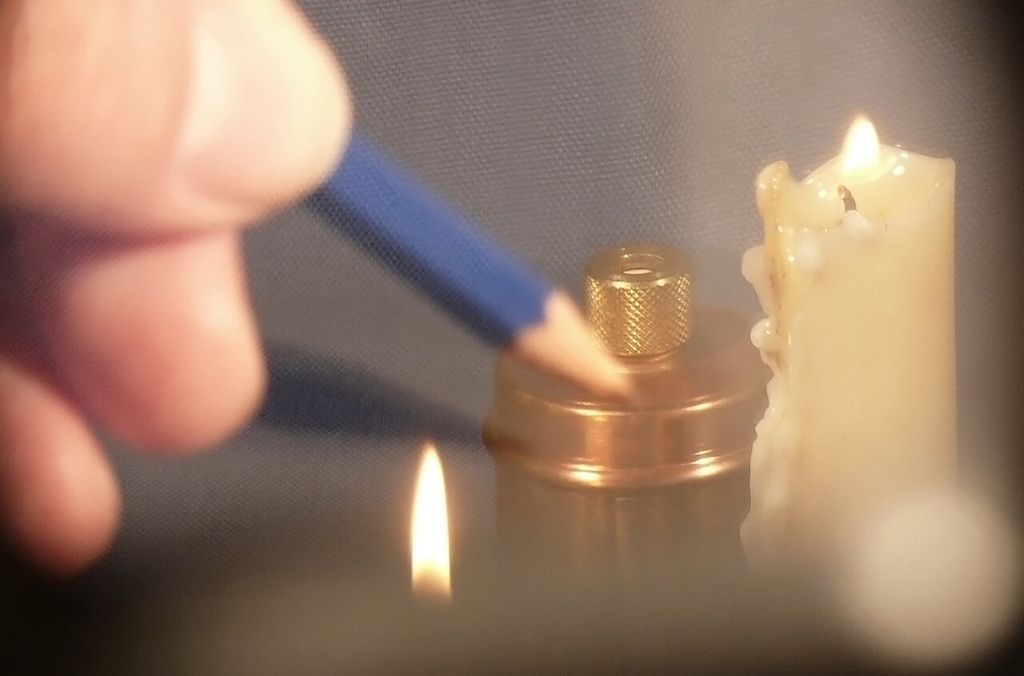
Instrument demonstration: a view through a camera lucida, showing the optical overlap used to guide a drawing. Ad Meskens / Wikimedia Commons. Image source. CC BY-SA 3.0. Resized and converted to JPEG; no crop or recolouring. Image derivative retains CC BY-SA 3.0.
Works directory
This source-bounded directory combines the works in the Metropolitan Museum’s 2017 retrospective checklist with reviewed museum object records and the additional works and series examined in this guide. It spans several media and is not a complete catalogue raisonné. Titles without an article link remain useful dated records. Metropolitan Museum final retrospective checklist (2017); additional object and series sources are given in the linked articles. [10]
| Name | Date | Medium |
|---|---|---|
| Love Painting | 1960 | Painting |
| Shame | 1960 | Painting |
| The Third Love Painting | 1960 | Painting |
| Tyger Painting No. 2 | 1960 | Painting |
| A Rake’s Progress | 1961–63 | Print series |
| Tea Painting in an Illusionistic Style | 1961 | Painting |
| The Cha-Cha That Was Danced in the Early Hours of 24th March | 1961 | Painting |
| Cleaning Teeth, Early Evening (10pm) W11 | 1962 | Painting |
| Flight into Italy - Swiss Landscape (Painting in a Scenic Style) | 1962 | Painting |
| Man in a Museum (or You're in the Wrong Movie) | 1962 | Painting |
| My Brother is Only Seventeen | 1962 | Painting |
| The First Marriage (A Marriage of Styles I) | 1962 | Painting |
| Domestic Scene, Los Angeles | 1963 | Painting |
| Play Within a Play | 1963 | Painting |
| The Hypnotist | 1963 | Painting |
| Arizona | 1964 | Painting |
| California Art Collector | 1964 | Painting |
| Man in Shower in Beverly Hills | 1964 | Painting |
| Portrait Surrounded by Artistic Devices | 1965 | Painting |
| Rocky Mountains and Tired Indians | 1965 | Painting |
| Beverly Hills Housewife | 1966–67 | Painting |
| Medical Building | 1966 | Painting |
| Peter | 1966 | Drawing |
| Peter Getting Out of Nick’s Pool | 1966 | Painting |
| A Bigger Splash | 1967 | Painting |
| A Lawn Being Sprinkled | 1967 | Painting |
| Kasmin in Bed in His Chateau in Carennac | 1967 | Drawing |
| Peter Feeling Not Too Good | 1967 | Drawing |
| Savings and Loan Building | 1967 | Painting |
| The Room, Tarzana | 1967 | Painting |
| American Collectors (Fred and Marcia Weisman) | 1968 | Painting |
| Christopher Isherwood and Don Bachardy | 1968 | Painting |
| Henry Geldzahler and Christopher Scott | 1968-1969 | Painting |
| W. H. Auden | 1968 | Drawing |
| Peter Langan in His Kitchen at Odins | 1969 | Drawing |
| Mark Glazebrook | 1970 | Drawing |
| Mr and Mrs Clark and Percy | 1970-1971 | Painting |
| Ossie Wearing a Fairisle Sweater | 1970 | Drawing |
| Pool and Steps, Le Nid du Duc | 1971 | Painting |
| Rubber Ring Floating in a Swimming Pool | 1971 | Painting |
| Celia in a Black Dress with White Flowers | 1972 | Drawing |
| Mount Fuji and Flowers | 1972 | Painting |
| Portrait of an Artist (Pool with Two Figures) | 1972 | Painting |
| Portrait of the Artist's Mother, Mrs Laura Hockney, Bradford | 1972 | Drawing |
| The Artist's Father | 1972 | Drawing |
| Dr Eugene Lamb, Lucca | 1973 | Drawing |
| Andy, Paris | 1974 | Drawing |
| Contre-jour in the French Style (Against the Day dans le Style-Français) | 1974 | Painting |
| Gregory Sitting on Base of Column | 1975 | Drawing |
| Kerby (after Hogarth) Useful Knowledge | 1975 | Painting |
| Ron Kitaj Outside Akademie der Kunste Vienna | 1975 | Drawing |
| Kasmin Reading the Udaipur Guide | 1977 | Drawing |
| Looking at Pictures on a Screen | 1977 | Painting |
| My Parents | 1977 | Painting |
| Canyon Painting | 1978 | Painting |
| Mother, Bradford, 19 Feb. 1979 (inscribed 1978) | 1979 | Drawing |
| Mulholland Drive: The Road to the Studio | 1980 | Painting |
| Nichols Canyon | 1980 | Painting |
| Outpost Drive, Hollywood | 1980 | Painting |
| Hollywood Hills House | 1981-1982 | Painting |
| Celia. Los Angeles. April 10th 1982 | 1982 | Polaroid composite |
| Don + Christopher, Los Angeles, 6th March 1982 | 1982 | Polaroid composite |
| Gregory Swimming Los Angeles March 31st 1982 | 1982 | Polaroid composite |
| My Mother, Bolton Abbey, Yorkshire, Nov. 1982 | 1982 | Photocollage |
| Self Portrait 30th Sept. 1983 | 1983 | Drawing |
| Pearblossom Hwy., 11-18th April 1986, #1 | 1986 | Photocollage |
| Pearblossom Hwy., 11–18th April 1986, #2 | 1986 | Photocollage |
| Large Interior, Los Angeles | 1988 | Painting |
| Breakfast at Malibu, Sunday, 1989 | 1989 | Painting |
| Pacific Coast Highway and Santa Monica | 1990 | Painting |
| The Other Side | 1991-1993 | Painting |
| The Eleventh V. N. Painting | 1992 | Painting |
| The Twenty Sixth V. N. Painting | 1992 | Painting |
| The Road Across the Wolds | 1997 | Painting |
| 9 Canvas Study of the Grand Canyon | 1998 | Painting |
| A Bigger Grand Canyon | 1998 | Painting |
| Colorado River | 1998 | Painting |
| Garrowby Hill | 1998 | Painting |
| Colin St. John Wilson. London. 3rd June 1999 | 1999 | Drawing |
| Gregory Evans. Los Angeles. 18th September 1999 | 1999 | Drawing |
| Laura Huston. London. 22nd June 1999 | 1999 | Drawing |
| Lindy. Marchioness of Dufferin and Ava. London. 17th June | 1999 | Painting |
| Going Up Garrowby Hill | 2000 | Painting |
| Red Pots in the Garden | 2000 | Painting |
| A Closer Winter Tunnel, February - March | 2006 | Painting |
| Elderflower Blossom, Kilham, July 2006 | 2006 | Painting |
| The Road to Thwing, July 2006 | 2006 | Painting |
| Bigger Trees near Warter | 2007 | Painting |
| Hawthorn Blossom near Rudston | 2008 | Painting |
| Views Through the Artist's Bedroom Window, Bridlington | 2010-2013 | Digital animation |
| The Arrival of Spring in Woldgate, East Yorkshire in 2011 (twenty eleven) | 2011 | Painting / digital series |
| 82 Portraits and 1 Still-life | 2013–16 | Portrait series |
| Garden | 2015 | Painting |
| Garden with Blue Terrace | 2015 | Painting |
| Garden #3 | 2016 | Painting |
| A Bigger Interior with Blue Terrace | 2017 | Painting |
| Interior with Blue Terrace and Garden | 2017 | Painting |
| A Year in Normandie | 2020–21 | Digital frieze |
Discussion
Look again at the images and ideas explored in David Hockney’s Secret Knowledge and the Optics Debate. These editorial prompts invite your observations.
Reader Insights
In the Lotto textile, what would make the combination of blur and changing alignment more persuasive evidence than either feature alone?
How does Nicholas Williams’s ability to paint a convincing chandelier by eye affect your reading of the argument about van Eyck’s chandelier?
Hockney marked facial features with a camera lucida and then drew freehand. Which decisions in a portrait would that procedure help, and which would remain with the artist?
Join the Conversation
Share a detail, comparison or question about David Hockney’s Secret Knowledge and the Optics Debate below.
References
- The David Hockney Foundation, Chronology: 2001, “Secret Knowledge” section, publication, documentary and conference account. View source.
- David Hockney and Charles M. Falco, “Optical Insights into Renaissance Art”, Optics & Photonics News 11(7), July 2000, pp. 52–59, especially pp. 54–59; author-hosted full text. View source.
- The Fitzwilliam Museum, Hockney’s Eye: The Art and Technology of Depiction, large-print exhibition labels, 2022, PDF pp. 3–4, 46, 54–55, 58, 91–92, 96, 100, 103–104, 108–115, 122 and 125–126. View source.
- David Hockney and Charles M. Falco, “Optical Instruments and Imaging: The Use of Optics by 15th Century Master Painters”, SPIE conference paper, 2004, PDF pp. 1–6; author-hosted full text. View source.
- Antonio Criminisi and David G. Stork, “Did the Great Masters Use Optical Projections While Painting? Perspective Comparison of Paintings and Photographs of Renaissance Chandeliers”, Proceedings of the International Conference on Pattern Recognition, 2004, PDF pp. 1–4; Microsoft Research full text. View source.
- David G. Stork, “Color and Illumination in the Hockney Theory: A Critical Evaluation”, Eleventh Color Imaging Conference, 2003, PDF pp. 1–5, with abstract sheet p. 6; author-hosted full text. View source.
- Charles M. Falco, “No Clear Evidence to Disprove Optics Thesis”, Nature 439, 26 January 2006, p. 392, correspondence; author-hosted full text. View source.
- Darya Sofina / ITMO University, “Art&Science: как мировые художники обманывали нас с помощью оптики и почему эластичный разум стал важным стимулятором эволюции”, 21 June 2017, Russian-language Art&Science lecture report, Charles Falco section. View source.
- Teylers Museum, Hockney’s Eye, exhibition archive, Dutch-language exhibition text on optical instruments and the contested historical thesis. View source.
- The Metropolitan Museum of Art, David Hockney, final exhibition checklist, 15 November 2017. View source.
More HOCKNEY Works
A Bigger Splash
A momentary disturbance becomes the focus of a large acrylic painting, made through weeks of patient work.
Mr and Mrs Clark and Percy
The designers Celia Birtwell and Ossie Clark occupy a room shaped by light, repeated sittings and the demands of a double portrait.
A Bigger Grand Canyon
Sixty canvases gather memory, studies and changing viewpoints into an immense painting of 1998.
Garrowby Hill
The 1998 oil painting transforms a remembered Yorkshire journey into a road, fields and an expansive view.
Portrait of an Artist (Pool with Two Figures)
Photographic studies, two figures and a swimming pool become a carefully constructed painting of 1972.
My Parents
The 1977 oil painting sets Kenneth and Laura Hockney within a quietly organised interior.
Pearblossom Hwy., 11–18th April 1986, #2
Hundreds of separately made photographs construct a road scene that unfolds through movement and time.
Bigger Trees near Warter
Fifty canvases join into a large outdoor painting of Yorkshire trees, with photography helping the artist organise the whole.