


 by Tom Gurney
Tom Gurney BSc (Hons) is an art history expert with over 20 years experience
Email: tomgurney1@gmail.com / Phone: +44 7429 011000
David Hockney: Introduction
David Hockney made pictures that invite us to look for longer: at the disturbance a swimmer leaves in water, at two people sharing a room, at a road remembered after a journey, or at branches changing almost imperceptibly as winter gives way to spring. His subjects often seem immediately familiar. The questions inside them are more demanding. How can a flat picture accommodate moving eyes, a moving body, memory and passing time? Across painting, drawing, printmaking, photography, video and digital work, he kept finding different ways to ask. [1]
Hockney was born in Bradford on 9 July 1937. [2] His career became closely associated with both Yorkshire and Los Angeles, while he continued to work and travel between countries. He died on 11 June 2026, aged 88. [3] The paintings of Californian pools remain among his best-known works, but they belong to a much wider career: intimate portraits, literary etchings, expansive landscapes, opera productions and pictures drawn on an illuminated screen. His attraction to a new device usually began with something he wanted a picture to do.
At a Glance
- ArtistDavid Hockney
- Born9 July 1937, Bradford, England
- Died11 June 2026
- FocusDavid Hockney
David Hockney connections
Artists, poetry, friendship and ways of looking.
- Pablo Picasso: Picasso became an important model after Hockney visited Tate’s 1960 retrospective. [4]
- Walt Whitman: Whitman’s poetry gave the early love paintings language for desire and male companionship. [4]
- R. B. Kitaj: At the Royal College of Art, Kitaj encouraged him to paint subjects that mattered in his own life. [5]
- Chinese scroll painting: Hockney recalled that his composite photography led him towards Chinese scrolls and their moving viewpoints. [6]
- Vincent van Gogh: The 2019 Amsterdam exhibition brought their landscape practices into a sustained curatorial dialogue. [7]
David Hockney in context
A Rake’s Progress
1961–63 [15]A Bigger Splash
1967 [15]Mr and Mrs Clark and Percy
1970–71 [15]My Parents
1977 [15]Garrowby Hill
1998 [15]A Year in Normandie
2020–21 [16]Contents
- What made Hockney’s art distinctive?
- Bradford: learning to draw and learning to choose
- London, desire and the freedom of a picture
- California: light, bodies and the problem of water
- Two people in a room
- Drawing people across a lifetime
- A turning point: Paris, prints and the stage
- Roads and photographs that take time
- Copying, transmitting and returning to the everyday
- Yorkshire: memory, friendship and repeated observation
What made Hockney’s art distinctive?
Colour gives many Hockney pictures their first impact, but their construction rewards a second look. A stretch of water can become an arrangement of lines; an interior can make us conscious of where we stand; a sequence of landscape drawings can register changes that a single visit would miss. The continuity lies less in a signature appearance than in the work of translating experience into marks. Curator Ai Kusumoto has described this as an enduring investigation of how the artist saw and how he turned that seeing into a picture. [17]
Hockney accepted that different subjects and purposes might need different pictorial languages. In 1962 he exhibited four paintings as Demonstrations of Versatility, making stylistic variation part of his public argument. A picture could borrow a convention, make a joke about it, or allow several conventions to coexist. The lesson he drew from Picasso was that an artist could choose and change a style. This freedom helps explain why a naturalistic double portrait, a vividly patterned landscape and a disjointed photographic composite can all belong convincingly to the same career. [18]
His art also maintained a particular balance between personal attachment and experiment. The people he knew, the rooms he inhabited and the places he revisited supplied recurring subjects. Repetition gave him something against which to test a new medium. If the subject remained a flower, a friend or a pool, a change in line, scale, viewpoint or surface became easier to notice. The artist’s familiarity with a subject did not exhaust it; familiarity made further distinctions possible.
That is a useful starting point for Hockney’s style and techniques. Look first at what a picture asks the eye to do. Does it hold us at a distance, bring a figure close, lead us along a road, or spread our attention between several moments? Brightness and accessibility are part of the experience, but the decisions beneath them are precise. His pictures offer pleasure while giving viewers an active role in making sense of space.
Four stages of David Hockney’s career
These four phases group related developments. Painting, drawing, travel and experiments with new tools continued to overlap.
Bradford: learning to draw and learning to choose
Hockney’s beginnings were practical as well as artistic. His parents, Kenneth and Laura, encouraged a boy already determined to make art. When the school curriculum left him dissatisfied, they arranged private calligraphy lessons with a tutor from Bradford School of Art. Drawing, lettering and poster design were related activities in his early experience. The brush could carry information, make a likeness or change the appearance of an everyday object. His later curiosity about image-making tools had roots in this broad understanding of what an artist might do. [2]
He entered Bradford School of Art in 1953. The teaching emphasised observation, the figure, anatomy and perspective, and he devoted long hours to it. His early subjects included streets and suburban houses in and around Bradford, painted outdoors with equipment carried on a cart adapted from a pram. A portrait of his father became his first sale, at a Yorkshire Artists Exhibition in Leeds in 1957. These were direct encounters with nearby people and places, long before California or an international career. [19]
The training gave him skills he continued to use, although he later questioned its assumptions. Recalling the school, he distinguished its attention to tonal values from a fuller engagement with colour. He also became conscious of how little modern art he knew. The combination matters: Hockney’s later departures from academic perspective grew out of sustained practice in it. Following art school, he completed National Service as a conscientious objector, working in hospitals in Bradford and Hastings. During this period he saw exhibitions of Alan Davie and Jackson Pollock that expanded his sense of what painting could be. [19]
In autumn 1959 he began at the Royal College of Art in London. There he continued to draw with great concentration, including lengthy studies of a skeleton, while encountering artists and students engaged with newer approaches. His friendship with the older American student R. B. Kitaj helped him connect technique with personal purpose. Kitaj encouraged him to paint the subjects that interested him outside the studio. The question was no longer only how accurately he could draw, but what he could make that came from his own life. [5]
London, desire and the freedom of a picture
At the Royal College, Hockney briefly tried the abstract expressionist painting fashionable among some fellow students. He soon wanted a more direct place for human subjects. The major Picasso exhibition at Tate in 1960 supplied an example of stylistic freedom, while Walt Whitman’s poetry offered a language for affection between men. Hockney’s early love paintings combined approximate figures, writing and codes. In Adhesiveness he used numbers corresponding to initials, bringing himself and Whitman into an imagined pairing. Words made an otherwise ambiguous painted shape more specifically human. [4]
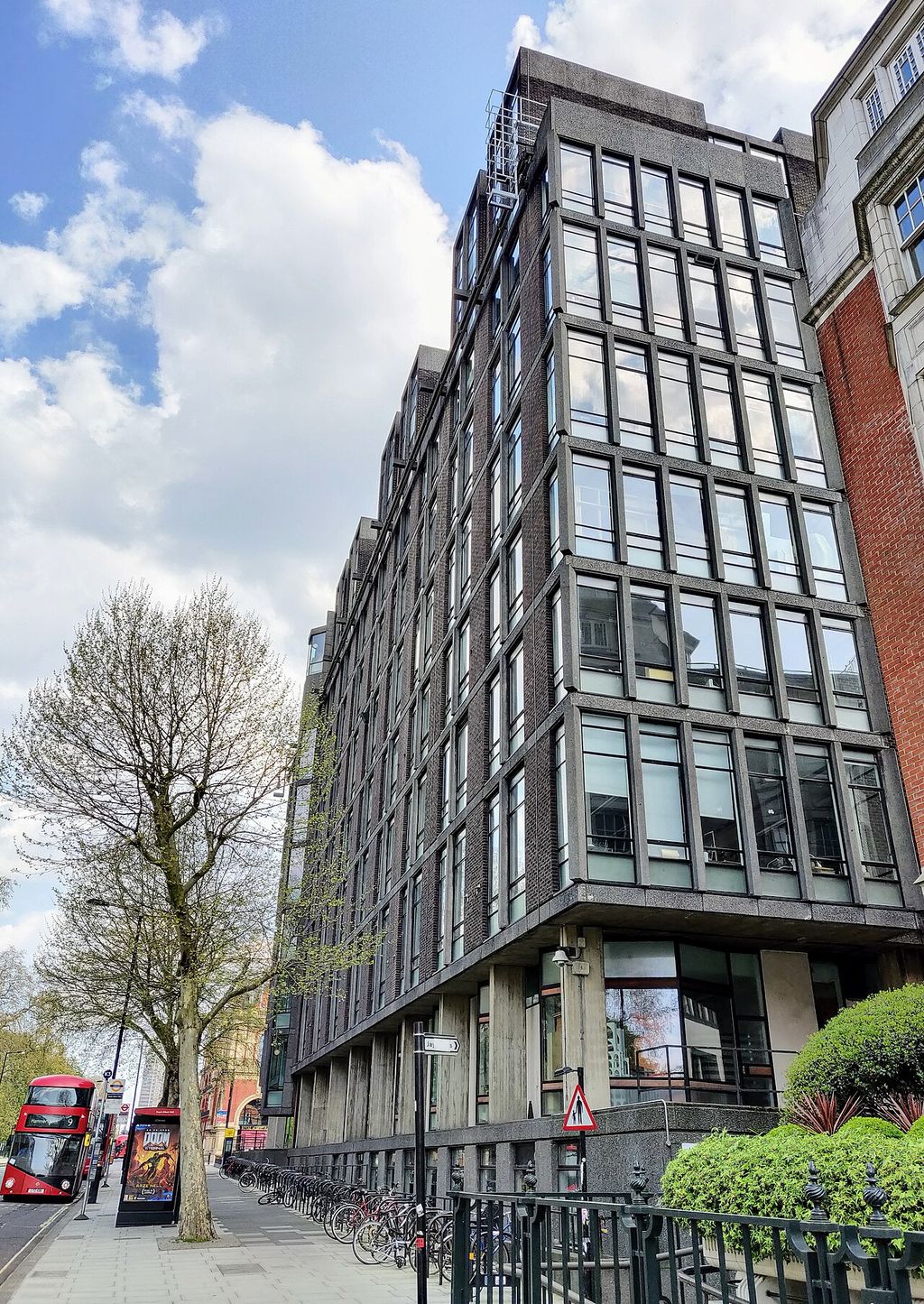
The Royal College of Art’s Darwin Building in South Kensington, photographed in April 2020. A later view of the college’s London setting. Shadowssettle / Wikimedia Commons. Image source. CC BY-SA 4.0. Image resized; framing and colours retained. This derivative retains CC BY-SA 4.0.
These paintings belong to the early history of British Pop, with their references to popular culture and their irreverent mixture of visual languages. Hockney’s use of a pop singer, a packet of tea or a scrawled phrase was tied to his own interests, including desire and the possibility of expressing it. The picture surface could act as a place of disclosure, humour and partial concealment at once. The tension between public display and private meaning gave his early work a distinctive charge. [4]
Practical circumstances also shaped his range. In 1961, with painting materials becoming difficult to afford, he discovered that the Royal College’s graphics department provided the materials for etching. Printmaking offered a financially accessible way to work and a medium suited to concise line and verbal wit. It soon became a major practice in its own right. His first visit to New York came that year; graduation followed in 1962, and his first solo exhibition, Pictures with People In, opened at John Kasmin’s London gallery in 1963. [9] [26]
New York fed the sixteen etchings and aquatints of A Rake’s Progress, made between 1961 and 1963. Hockney reworked the narrative structure of Hogarth’s eighteenth-century series around the adventures of a young visitor to an American city. His protagonist’s experiences were partly autobiographical and partly invented. The suite’s humour depends on that mixture: an inherited story provides a framework for contemporary life, while economical figures and telling objects keep the narrative moving. It demonstrates how readily his drawing could move between observation, recollection and storytelling. [27]
By 1963, paintings of couples and domestic interiors were becoming more prominent. Domestic Scene, Los Angeles was made before Hockney had visited the city, using a magazine photograph as its starting point. California was already a place of images and expectations in his imagination. At the same time, he was thinking about selective attention: a room contains more than a viewer notices at once, and a painting can give priority to some things while leaving others unresolved. [28]
The openness of these subjects should be understood within their historical setting. Sexual relationships between men were criminalised in England during Hockney’s student years. The Sexual Offences Act of 1967 only partly decriminalised consensual private acts between men over 21 in England and Wales; it was not a general legalisation throughout Britain. His early work made affection and desire visible while such restrictions still shaped everyday life. [29]
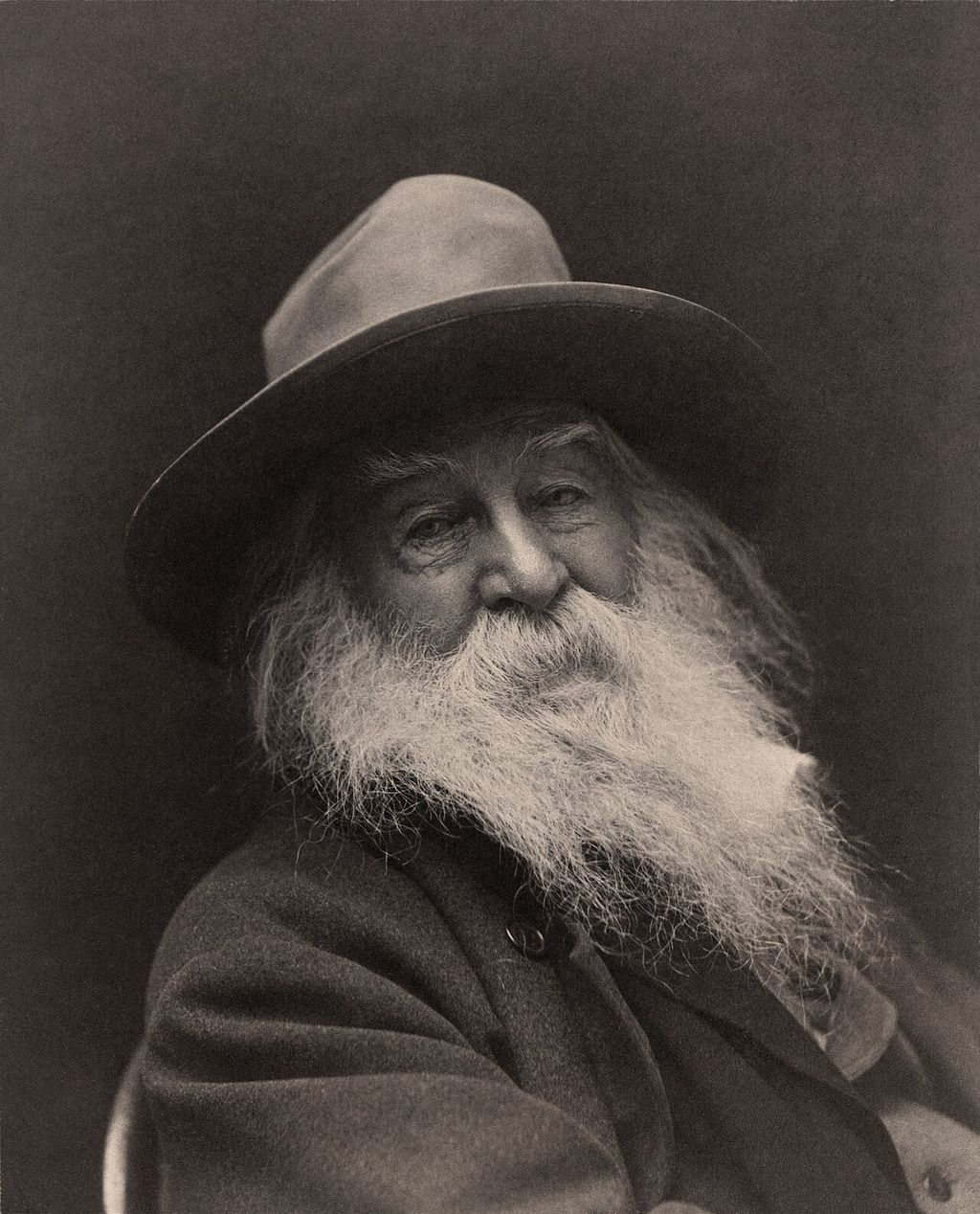
Walt Whitman, photographed by George Collins Cox. His poetry informed Hockney’s early paintings of love and identity. George Collins Cox; restored by Adam Cuerden / Wikimedia Commons. Image source. Public domain. Resized and converted to JPEG; no crop or recolouring.
California: light, bodies and the problem of water
Hockney arrived in Los Angeles in 1964 and established a home and studio in Santa Monica. He encountered a network that included Christopher Isherwood, Don Bachardy, Nicholas Wilder and the printer Ken Tyler. The city gave substance to things he had previously known through books and photographs, but its distances also demanded adjustment: he rapidly discovered that exploring it by bicycle was inadequate. Driving, open spaces and the appearance of the built environment would become part of his pictorial experience. [20]
He began painting the unfamiliar landscape in acrylic and made his first swimming-pool paintings. The material, the subject and the setting developed together. Sunlight could turn a building into sharply separated planes, while water presented the opposite difficulty: transparency, reflection and movement prevented it from having a single stable appearance. A pool was a bounded rectangle whose surface could repeatedly change its visual language. It let Hockney bring formal experiment into a recognisable place. [20]
The pool’s social meaning mattered too. Art historian Matthew Sperling connects Hockney’s pools with the private, erotic and domestic spaces of Californian life, while showing how painting water became an investigation in its own right. Hockney tried wavering white lines, interlocking coloured shapes and arrangements approaching abstraction. Across the pictures, water could be a pattern on the canvas and a substance through which a body was visible. Neither function had to cancel the other. [30]
A Bigger Splash, painted in 1967 in acrylic, concentrates this problem into an abrupt event. The architecture and pool establish an ordered setting; the eruption of water introduces a different kind of mark and a different sense of time. A swimmer has disappeared below the surface, leaving evidence of an action. Sperling draws attention to the discrepancy between the speed of that action and the prolonged work needed to paint the splash. The picture gives a fleeting event the duration of something we can inspect. Tate purchased the painting in 1981. [30] [15]
This is why the pools repay attention beyond their association with sunshine and leisure. Their surfaces set difficult tasks: how to show depth without losing the pattern of light above it; how to suggest movement with stationary paint; how to let a small disturbance alter an otherwise calm composition. The apparent ease of the setting makes those decisions more striking. In the wider account of Hockney’s paintings, the California works form an important stage in a changing practice, with acrylic, photography and drawing all contributing to his solutions.
Two people in a room
During the late 1960s Hockney developed the large double portrait into one of his most absorbing formats. Christopher Isherwood and Don Bachardy and American Collectors (Fred and Marcia Weisman) were painted in 1968. The portrait now extended beyond two faces to include posture, objects and the distribution of space. Hockney recalled that Isherwood habitually looked towards Bachardy when asked to relax, while Bachardy looked towards the artist. A repeated observation could therefore become the basis of a composition. [31]
In the portrait of the Weismans, Hockney regarded the surrounding objects as part of the portrait’s meaning. This offers a useful way to approach the group as a whole. A room or terrace does more than identify a sitter’s possessions. It establishes intervals: between two bodies, between a person and an object, and between the painted people and the person looking. The figures may be still, but the viewer compares their positions and directions of attention. That comparison creates a quiet activity across the canvas. [31]
Mr and Mrs Clark and Percy, made in 1970–71, places Ossie Clark and Celia Birtwell with a cat in an interior. Hockney explained that his central purpose was to establish the presence and relationship of two people. This involved extensive work from life and repeated repainting. The light entering from the centre of the composition created particular tonal difficulties, and the scale required the sitters to pose in his studio. Its composed appearance emerged from a complicated process of adjustment. [21]
In a double portrait, the space between people can become as arresting as the figures themselves. Their poses and directions of attention establish a relationship for the eye to explore, while the room gives that relationship a particular shape. Hockney’s account of the Clarks directs attention to the artistic work of making two presences occupy a convincing shared space. The technical decisions about scale and light participate in that aim. [21]
The closely related Portrait of an Artist (Pool with Two Figures) of 1972 joined a standing figure and an underwater swimmer. The initial idea arose from two snapshots noticed together on the studio floor. Bringing them into one coherent picture proved difficult: Hockney revised the setting and eventually restarted the composition, recognising that the angle of the pool had become a fundamental obstacle. He returned to Tony Richardson’s pool in southern France to make further source material. The work joins observation to deliberate construction, rather than recording one encounter that happened exactly as painted. [32]
Drawing people across a lifetime
Portraiture continued through Hockney’s changes of place and medium. The 2020 exhibition Drawing from Life followed five recurring subjects: Hockney himself, his mother Laura, Celia Birtwell, Gregory Evans and Maurice Payne. Their reappearance across decades gives the drawings a particular depth. A sitter is seen at a specific moment, but each new encounter belongs to a longer history of attention. Changes in materials and line become entangled with changes in age and familiarity. [33]
This continuity also changes how one understands his appetite for technology. A digital portrait and a coloured-pencil drawing can share a subject without producing the same kind of image. Each tool distributes emphasis differently, making some marks easy and others more difficult. The repeated sitter gives those differences a human anchor. His self-portraits are especially revealing in this respect: the same artist both makes and undergoes the scrutiny, adapting his means as his own appearance changes.
In the series 82 Portraits and 1 Still-life, largely painted between 2013 and 2016, Hockney established unusually consistent conditions. The sitters occupied the same yellow chair, on canvases of the same size, with blue backgrounds adjusted in relation to their clothing. The portraits were uncommissioned, and the people included family, friends, artists, employees and acquaintances. Working within a limited number of days for each portrait made comparison part of the series’ structure. [34]
The repeated framework brings differences into view: the disposition of hands, a change of clothing, the amount of space a body seems to occupy. It also gives the viewer a sense of successive appointments in the studio. The still life was painted when a sitter rescheduled, an interruption preserved inside the eventual group. The substitution makes the conditions of production unusually legible. Time set aside for looking was filled with another subject, and the series accommodated the change. [34]
A turning point: Paris, prints and the stage
Kusumoto describes the 1970s as a period in which the achievement of the double portraits also created an impasse. Hockney questioned whether greater apparent accuracy necessarily brought a picture closer to lived experience. After moving to Paris in 1973, he devoted sustained attention to drawing people before him. Work with Picasso’s printer Aldo Crommelynck, renewed engagement with Picasso’s art and involvement in theatre opened further possibilities. These activities overlapped, giving him several ways to reconsider how a picture establishes a world. [35]
Literature remained an important partner in that process. The early Rake’s Progress was followed by prints connected with Cavafy, the Brothers Grimm and Wallace Stevens. Cavafy’s poems prompted intimate drawings of men, bringing Hockney’s friends into a response to an earlier writer’s evocation of desire. The direct storytelling of the Grimm tales offered another kind of stimulus. These suites show how illustration could create a relationship between texts and images without requiring a uniform graphic style. [36]
In The Blue Guitar, published in 1977, Stevens’s engagement with Picasso became part of Hockney’s own conversation with both poet and painter. The coloured etchings were made with Maurice Payne, drawing on techniques Hockney had learned with Crommelynck. Poetry provided images and rhythms to respond to, while printmaking made possible another investigation of colour and line. [37]
Collaboration here was part of artistic invention. A print develops through the interaction of a drawn mark, a prepared surface, ink, paper and the decisions of printers as well as artist. A familiar subject could therefore acquire a materially different life. In the 1978 Paper Pools, coloured pulp made the image integral to the paper itself. Returning to water through this process connected the subject with the wet material used to make it. The pool reappeared as a new physical construction, rather than merely as another version of a painted composition. [30]
Hockney’s first opera design was Stravinsky’s The Rake’s Progress at Glyndebourne in 1975, working with director John Cox; his theatre work had begun earlier, with Ubu Roi in 1966. The opera brought him back to Hogarth through a separate project from his youthful etchings. He adapted the crosshatching of engravings into sets and costumes, testing the scale of lines in the theatre so that they would remain legible from the audience. A mark that worked on a small sheet had to function across a much greater distance. [27] [26]
The Magic Flute followed at Glyndebourne in 1978, again with Cox. Hockney later designed for the Metropolitan Opera in New York, including the triple bill bringing together Satie’s Parade, Poulenc’s Les mamelles de Tirésias and Ravel’s L’enfant et les sortilèges. These commissions placed colour, light, movement and the audience’s position within a real space. The fuller history of Hockney’s opera and stage design shows how substantially this work participated in his thinking about pictures. [38] [39] [40]
Roads and photographs that take time
Hockney’s rethinking of space also changed his landscapes. In Mulholland Drive: The Road to the Studio of 1980, Los Angeles becomes an expansive, personal map. LACMA describes it as a painting made from memory, based on his journey from his Hollywood Hills home to his studio. Detailed trees, houses and power lines coexist with abstracted fields of colour. The winding road leads the eye across a composition that gathers a journey into one large surface. [41]
A remembered route differs from a view taken from one stationary position. It contains changes of direction, recognisable landmarks and impressions collected at successive moments. The painting gives those experiences a shared pictorial space. Its shifts of scale and description invite the viewer to move attention around, following the road and then wandering away from it. This interest in an experienced landscape would remain important when Hockney returned to Yorkshire.
Photography supplied another means of testing the relationship between space and time. Hockney had used a 35mm camera since the 1960s for personal records and studies for paintings. He became dissatisfied with the still photograph’s isolation of one instant and one viewpoint. In 1982, the Polaroid SX-70 allowed him to assemble immediately available prints into grids of related views. Getty’s account emphasises his effort to give a photographic picture a sense of duration and of his own presence. [42]
The decisive change lay in the relationship between photographs. The individual prints did not have to align seamlessly. Differences in position and timing could remain visible, making the act of looking across the composite more active. The Foundation records the rapid development of these works during 1982 and the exhibition title Drawing with a Camera. That title captures his treatment of the device as material for construction. A sequence of exposures could make an image that no single exposure supplied. [22]
Jerry Diving, Sunday Feb. 28th 1982 makes the temporal question especially clear. Getty curator Virginia Heckert describes Jerry Sohn’s dive extending over seven frames within a twenty-one-print grid. The viewer encounters successive stages of an action alongside other parts of the poolside setting. In Pearblossom Hwy., 11–18th April 1986, #2, hundreds of chromogenic prints make a road scene on the scale of a large painting. It is a photographic collage, assembled through many observations. [43]
These composites, often called joiners, reward attention to their seams. Repeated edges, small displacements and changing viewpoints can hold the evidence of an artist moving around a subject. The picture requires time to make and time to read. Hockney’s photography and joiners explore these constructions more closely, including the important distinction between a camera used to gather studies and photographs assembled as the finished work.
His 1983 photographic treatment of the rock garden at Ryōan-ji in Kyoto made movement explicit. Hockney worked from changing positions and included his own feet across the lower part of the picture. He connected the resulting experiments with his growing study of Chinese scrolls. The attraction was to forms of picturing that could unfold through space and accommodate a mobile observer. Different traditions offered different resources for the problem he was pursuing. [6]
Later, multi-screen films extended the composite format into moving images. Views gathered by several cameras could be shown together, allowing a landscape to unfold across a grid. The 2023 Granet/Tate exhibition guide connects this work with Hockney’s effort to draw a landscape in space and time. Movement now occurs both within each view and across the viewer’s attention to the ensemble. The eyes can range among adjacent screens, comparing passages of the scene as they change. The format also turns the earlier joiners into a useful point of comparison: their divisions remain visible, but the images inside them no longer stand still. [18]
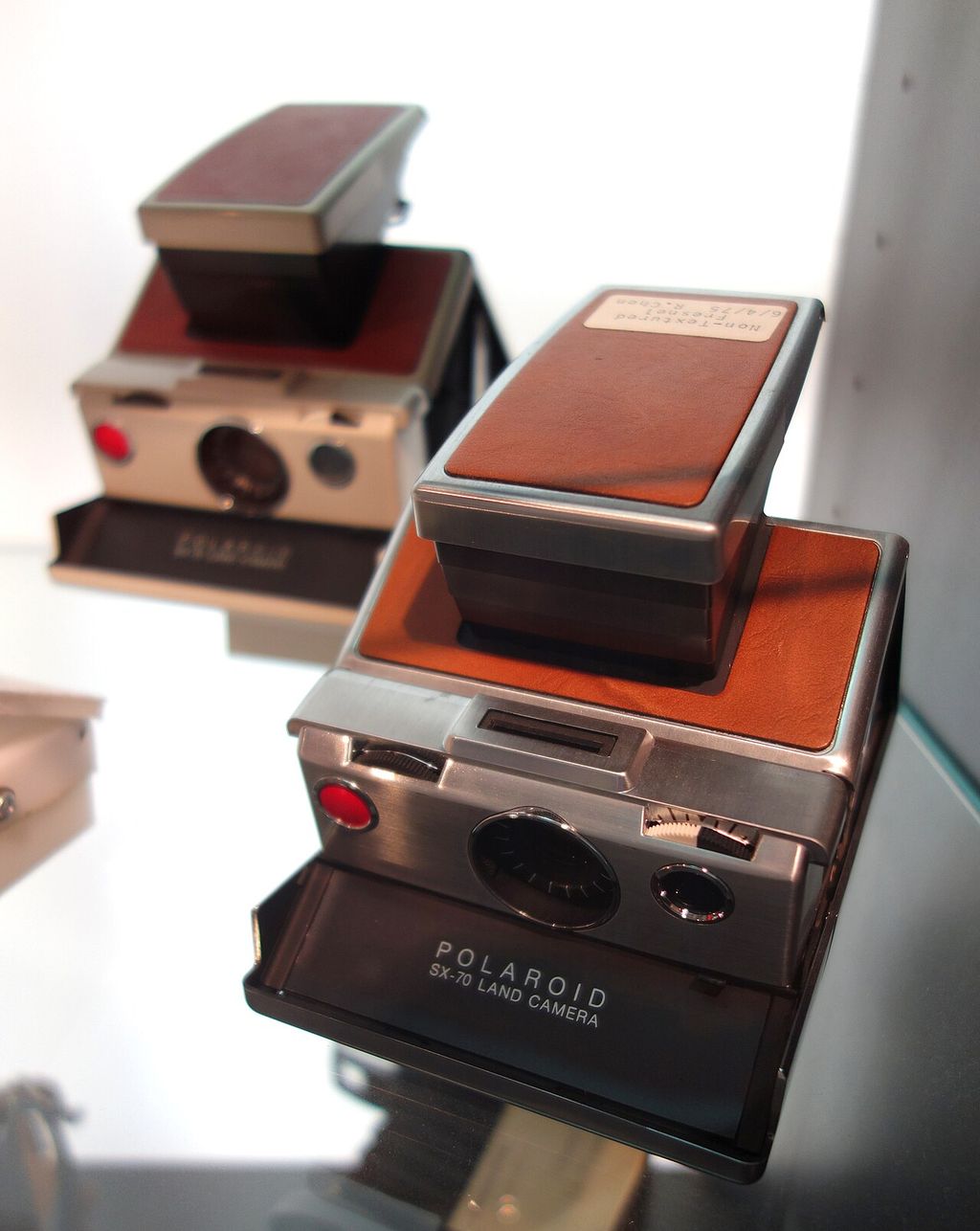
A Polaroid SX-70 Land Camera in the MIT Museum: an example of the model used in Hockney’s composite photography. Daderot / Wikimedia Commons. Image source. CC0 / Public domain. Resized and converted to JPEG; no crop or recolouring.
Copying, transmitting and returning to the everyday
The office photocopier became an artistic tool in 1986. For the Home Made Prints, Hockney could change coloured cartridges, enlarge and reduce, repeat shapes and scan objects, developing images directly in his own studio. The machine offered speed and control over successive stages. Its ordinary office function did not determine its artistic use: changing the scale or order of an image could make copying a means of revision and invention. [44]
Distribution also interested him. In 1987 a work appeared in Bradford’s Telegraph & Argus, connecting image-making technology with the possibility of reaching newspaper readers. Fax later brought together making an image and sending it elsewhere, with small sheets assembled into larger works at the receiving end. Kusumoto places this interest in circulation alongside Hockney’s later practice of sharing drawings made on a screen. The device could alter where a picture travelled as well as what its marks looked like. [45] [17]
Meanwhile, modest subjects retained their importance. The dachshunds Stanley and Boodgie became the focus of an extended body of drawings and paintings. The Foundation connects the work of 1995 with Hockney’s grief after the deaths of friends, especially Henry Geldzahler, and with his wish to paint something loving. This is a case in which the artist’s own explanation gives a particular emotional context to a subject. The dogs’ familiarity made them companions in life and repeatedly available presences in the studio. [46]
The recurring domestic subjects keep the breadth of the career grounded in daily experience. Hockney could turn from technical investigation to a sleeping animal while continuing to attend to the demands of a particular subject: the posture of a body, the curve of its outline and its relation to the space around it.
Yorkshire: memory, friendship and repeated observation
Hockney’s renewed engagement with Yorkshire landscape was bound up with personal relationships and travel. In 1997 he spent time visiting his seriously ill friend Jonathan Silver in Saltaire, driving repeatedly across the county from Bridlington. Those journeys prompted him to consider how to paint landscapes he had known since boyhood. A familiar region became available to a returning eye: remembered roads were also routes experienced again in the present. [47]
Silver had already made Hockney’s work central to a remarkable transformation near Bradford. Textile production at Salts Mill ended in 1986; Silver bought the building in 1987 and developed a place where art and commercial activity could coexist. The relationship gave Hockney a substantial public connection with the area beyond his own birthplace. Saltaire belongs to his story through friendship, the display of his work and the reuse of an industrial building. [48]
Back in Los Angeles in 1998, Hockney painted Yorkshire from memory. The same year he made the sixty-canvas A Bigger Grand Canyon, drawing on recollection and photographic material. Later he returned to the canyon to make observational studies for A Closer Grand Canyon. The distinction is revealing: memory, photographs and sustained work before a landscape offered different resources. His practice moved between them, examining what each could contribute to the experience of a place. [23]
The return to landscape was therefore already connected with the questions explored in his photographic composites. A large terrain cannot be taken in all at once. Its apparent distances change as the eye and body move, while memory compresses some features and retains others. Hockney’s multiple canvases gave him a practical way to extend a surface while preserving separate passages of work. Scale became a means of accommodating attention across an area, not just of making a recognisable view more imposing.
During the early 2000s, longer stays around Bridlington developed into sustained observation. Lawrence Weschler’s account describes watercolour studies in 2004 followed by an intensive return to oil painting in 2005. Watercolour required quick, attentive decisions; repeated visits disclosed differences within apparently ordinary vegetation. The landscape supplied an ongoing task, with familiar paths and trees becoming more particular through renewed scrutiny. [49]
In 2007 Bigger Trees near Warter brought this practice to monumental scale. Its fifty canvases were painted outdoors, with digital photography helping Hockney assess the developing whole. The work measures roughly fifteen by forty feet. The practical problem was considerable: he could work on individual sections at the site, but needed a means of understanding their relationship within a composition far larger than any single canvas. Digital assistance supported the making of an oil painting in front of the landscape. [24]
The seasonal projects made time between pictures as important as time within one. The Arrival of Spring in Woldgate, East Yorkshire in 2011 brought together a thirty-two-canvas oil painting and a sequence of iPad drawings. Hockney made more than a hundred digital drawings; fifty-one were selected for the Royal Academy installation. The large painting and the dated drawings offered complementary experiences: an encompassing statement and a series through which small changes could be followed. [25]
Hockney’s Yorkshire is thus a geography of revisiting. The changing light, first leaves, fuller growth and exposed winter branches gave the artist reasons to return to places he already knew. Seasonal difference also sharpened memory: seeing a tree bare made its summer fullness newly intelligible. The paintings ask for the same kind of discrimination from their viewers, attending to variation within a subject that might initially seem ordinary.
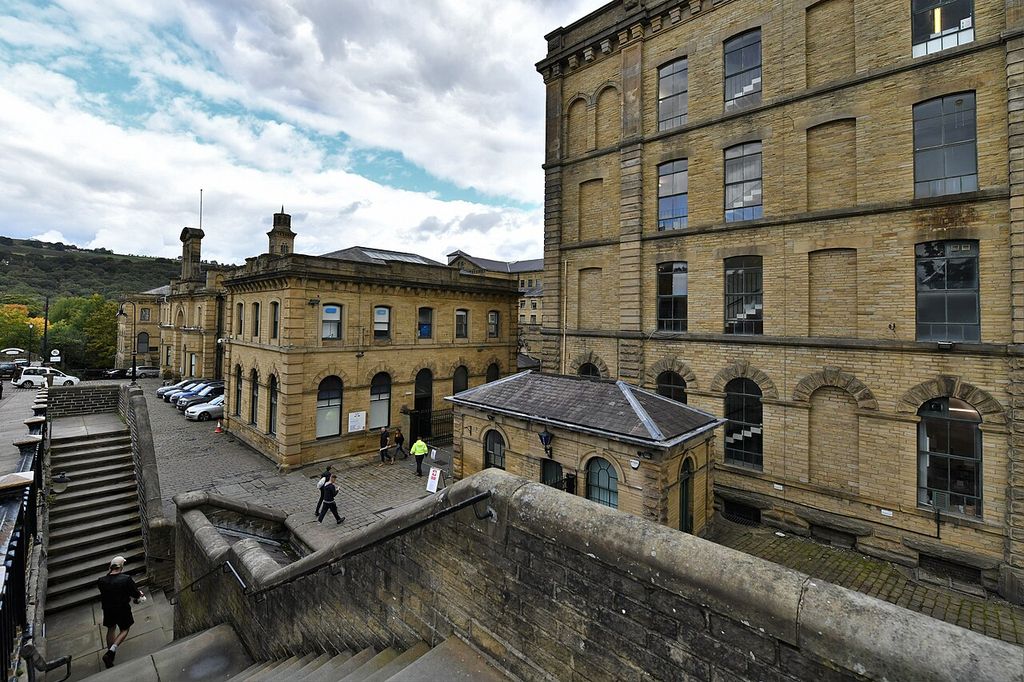
Salts Mill, Saltaire. Jonathan Silver’s redevelopment made the former textile mill an important setting for Hockney’s work. Michael Garlick / Wikimedia Commons. Image source. CC BY-SA 2.0. Resized and converted to JPEG; no crop or recolouring. Image derivative retains CC BY-SA 2.0.
The iPad and Normandy
Hockney began drawing on an iPhone in 2009 and took up the iPad when it appeared in 2010. The screen offered specific possibilities. It was portable, its marks could be altered without the behaviour of wet pigment, and its light allowed drawing in conditions that complicated conventional materials. Weschler describes Hockney’s interest in recording dawn without switching on a lamp that would overwhelm the changing light outside. The technology answered an observational need. [17] [49]
The larger tablet offered a different working surface from the phone, while the resulting image could be displayed on a screen or printed at another scale. The size at which a drawing was made and the size at which it was encountered could therefore diverge. This made scale a further artistic decision. A small gesture could become a conspicuous mark in a large print, placing pressure on how each part of the image had been formed. Hockney’s iPad art developed within that relationship between immediate handling and subsequent presentation.
Normandy gave this practice a new setting. Hockney was drawing there in 2019, when the landscape works shown as La Grande Cour included an expansive twenty-four-panel panorama. The Foundation connects these drawings with his renewed interest in the Bayeux Tapestry and its capacity to gather different narratives and times into one field. The region offered both a landscape to observe and a nearby historical example of extended picturing. [7]
The following spring, during the beginning of the Covid-19 pandemic, he concentrated on the changing surroundings of his Normandy home. The Royal Academy’s account describes a development of the drawing application in response to his specifications and the practical advantage of working without setting up conventional painting equipment. Buds, blossom, leaves and developing fruit supplied successive events within a limited area. The project’s concentration came from the variety available through sustained attention to the same ground. [50]
The Normandy spring works and the long frieze A Year in Normandie, made in 2020–21, are related but distinct projects. The latter extends the seasonal question into a panorama roughly ninety metres long. Kusumoto connects its form with Hockney’s engagement with Chinese and Japanese scrolls as well as Bayeux. Such a work asks the viewer to move along it: the duration of viewing becomes part of the encounter with a represented year. [35] [51]
Digital work continued alongside painting on canvas. The Normandy pictures, later portraits and renewed studio paintings demonstrate a choice among available means. Different materials kept different kinds of attention possible. Even his later technologically elaborate projects retained the question that had animated a student’s drawing: how could a particular mark carry something of what he had seen?
Screens also took his pictures into public space. In May 2021 an iPad animation of the rising sun was shown on large outdoor displays in London, Los Angeles, New York, Tokyo and Seoul. The work brought a brief experience of changing light into busy urban settings. In 2023 Bigger & Closer (not smaller & further away) opened at Lightroom in London, gathering material from across his career into a multimedia presentation. These projects extended his interest in how a picture meets its audience: at intimate scale in the hand, across a gallery wall, or among the lights of a city. [16] [51]
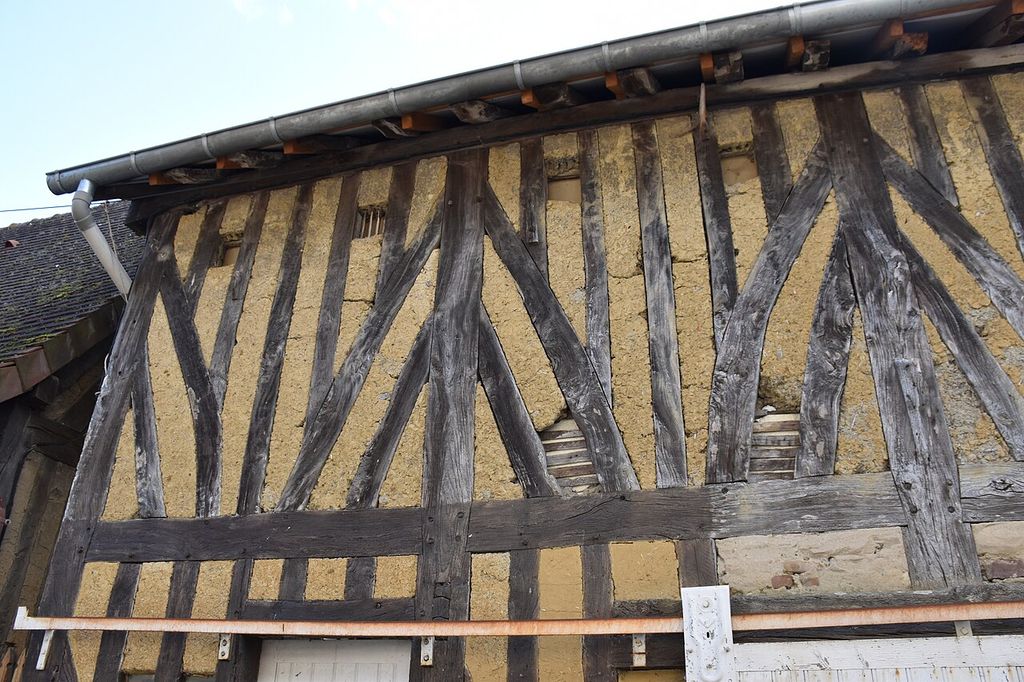
Normandy context: timber framing in Beuvron-en-Auge. Renhour48 / Wikimedia Commons. Image source. CC0 / Public domain. Resized and converted to JPEG; no crop or recolouring.
Looking at art history
Hockney’s engagement with the past was active and questioning. Picasso offered an example of freedom across styles; Hogarth supplied narrative and graphic resources; older paintings presented problems of line, space and depiction that Hockney could investigate through his own practice. In 2024 the National Gallery brought My Parents and Looking at Pictures on a Screen, both from 1977, into a display with Piero della Francesca’s The Baptism of Christ. Both Hockney paintings contain reproductions of Piero’s work. The historical painting was already present within his pictures before the exhibition placed them together. [52]
His optical investigations made this engagement particularly public. Secret Knowledge, published in 2001, proposed a larger role for optical aids in earlier European painting. The Foundation records the lectures, documentary and conference discussions surrounding it. The claim belonged to Hockney’s continuing concern with how an image is produced, extending questions about cameras and drawing into art history. Its publication is an important episode in his career, while its historical argument requires its own assessment. [53]
The thesis provoked substantial disagreement. David G. Stork challenged aspects of the proposed projection methods, including their illumination requirements and implications for colour. Charles M. Falco, Hockney’s collaborator, defended the possibility of optical aids and argued that their evidence did not require a single kind of optical device. Their positions should remain distinct from an established consensus about particular paintings. Hockney’s investigations matter here as evidence of an artist pursuing technical questions into the past, with conclusions that other researchers contested. [54] [55]
His later work returned to earlier artists through making as well as argument. The 2025 Fondation Louis Vuitton survey included dialogues with Fra Angelico, Claude, Cézanne, Van Gogh and Picasso, alongside recent London paintings associated with Munch and Blake. Hockney helped shape the exhibition, which gathered more than four hundred works from 1955 to 2025 and gave substantial attention to the preceding twenty-five years. The arrangement insisted that the later career be considered at length, with Normandy, portraits, art history and the stage all contributing. [56]
A career still opening outward
The final years continued that breadth. The Foundation records new paintings completed in Hockney’s London studio in 2025, developing his use of reverse perspective. Its account of 2026 brings recent painting together with the Normandy frieze at the Serpentine. The last London paintings added another stage to a practice of trying, comparing and adjusting that extended across seven decades. [57] [3]
Hockney’s place in art can be approached through those persistent acts of renewal. A pool returned in acrylic, pulp and photographs; a friend appeared in different materials over decades; a road became a remembered panorama; a tree supplied a sequence of seasonal encounters. Such returns make the career coherent without making it uniform. The work of attention remained, while its means and consequences changed.
The biography follows the relationships and movements that shaped this history. The studies of painting, photography, digital art and stage design follow particular practices in greater detail. Moving between them reveals how often a question first encountered in one medium resurfaced in another. Hockney’s pictures continue to make that curiosity available to viewers: through the pleasure of looking, and through the discovery that there is more to notice.
Essential David Hockney works
A Bigger Splash
1967 · A momentary disturbance becomes the focus of a large acrylic painting, made through weeks of patient work[15]
Mr and Mrs Clark and Percy
1970–71 · The designers Celia Birtwell and Ossie Clark occupy a room shaped by light, repeated sittings and the demands of a double portrait[15]
A Bigger Grand Canyon
1998 · Sixty canvases gather memory, studies and changing viewpoints into an immense painting of 1998[15]
Garrowby Hill
1998 · The 1998 oil painting transforms a remembered Yorkshire journey into a road, fields and an expansive view[15]
A Rake’s Progress
1961–63 · Sixteen etchings with aquatint rework Hogarth’s narrative through Hockney’s first journey to New York[15]
Portrait of an Artist (Pool with Two Figures)
1972 · Photographic studies, two figures and a swimming pool become a carefully constructed painting of 1972[15]
My Parents
1977 · The 1977 oil painting sets Kenneth and Laura Hockney within a quietly organised interior[15]
Pearblossom Hwy., 11–18th April 1986, #2
1986 · Hundreds of separately made photographs construct a road scene that unfolds through movement and time[15]
Bigger Trees near Warter
2007 · Fifty canvases join into a large outdoor painting of Yorkshire trees, with photography helping the artist organise the whole[15]
The Arrival of Spring in Woldgate, East Yorkshire in 2011 (twenty eleven)
2011 · A thirty-two-canvas oil painting and an associated sequence of iPad drawings offer distinct ways of following spring in 2011[25]
Works directory
This source-bounded directory combines the works in the Metropolitan Museum’s 2017 retrospective checklist with reviewed museum object records and the additional works and series examined in this guide. It spans several media and is not a complete catalogue raisonné. Titles without an article link remain useful dated records. Metropolitan Museum final retrospective checklist (2017); additional object and series sources are given in the linked articles. [15]
| Name | Date | Medium |
|---|---|---|
| Love Painting | 1960 | Painting |
| Shame | 1960 | Painting |
| The Third Love Painting | 1960 | Painting |
| Tyger Painting No. 2 | 1960 | Painting |
| A Rake’s Progress | 1961–63 | Print series |
| Tea Painting in an Illusionistic Style | 1961 | Painting |
| The Cha-Cha That Was Danced in the Early Hours of 24th March | 1961 | Painting |
| Cleaning Teeth, Early Evening (10pm) W11 | 1962 | Painting |
| Flight into Italy - Swiss Landscape (Painting in a Scenic Style) | 1962 | Painting |
| Man in a Museum (or You're in the Wrong Movie) | 1962 | Painting |
| My Brother is Only Seventeen | 1962 | Painting |
| The First Marriage (A Marriage of Styles I) | 1962 | Painting |
| Domestic Scene, Los Angeles | 1963 | Painting |
| Play Within a Play | 1963 | Painting |
| The Hypnotist | 1963 | Painting |
| Arizona | 1964 | Painting |
| California Art Collector | 1964 | Painting |
| Man in Shower in Beverly Hills | 1964 | Painting |
| Portrait Surrounded by Artistic Devices | 1965 | Painting |
| Rocky Mountains and Tired Indians | 1965 | Painting |
| Beverly Hills Housewife | 1966–67 | Painting |
| Medical Building | 1966 | Painting |
| Peter | 1966 | Drawing |
| Peter Getting Out of Nick’s Pool | 1966 | Painting |
| A Bigger Splash | 1967 | Painting |
| A Lawn Being Sprinkled | 1967 | Painting |
| Kasmin in Bed in His Chateau in Carennac | 1967 | Drawing |
| Peter Feeling Not Too Good | 1967 | Drawing |
| Savings and Loan Building | 1967 | Painting |
| The Room, Tarzana | 1967 | Painting |
| American Collectors (Fred and Marcia Weisman) | 1968 | Painting |
| Christopher Isherwood and Don Bachardy | 1968 | Painting |
| Henry Geldzahler and Christopher Scott | 1968-1969 | Painting |
| W. H. Auden | 1968 | Drawing |
| Peter Langan in His Kitchen at Odins | 1969 | Drawing |
| Mark Glazebrook | 1970 | Drawing |
| Mr and Mrs Clark and Percy | 1970-1971 | Painting |
| Ossie Wearing a Fairisle Sweater | 1970 | Drawing |
| Pool and Steps, Le Nid du Duc | 1971 | Painting |
| Rubber Ring Floating in a Swimming Pool | 1971 | Painting |
| Celia in a Black Dress with White Flowers | 1972 | Drawing |
| Mount Fuji and Flowers | 1972 | Painting |
| Portrait of an Artist (Pool with Two Figures) | 1972 | Painting |
| Portrait of the Artist's Mother, Mrs Laura Hockney, Bradford | 1972 | Drawing |
| The Artist's Father | 1972 | Drawing |
| Dr Eugene Lamb, Lucca | 1973 | Drawing |
| Andy, Paris | 1974 | Drawing |
| Contre-jour in the French Style (Against the Day dans le Style-Français) | 1974 | Painting |
| Gregory Sitting on Base of Column | 1975 | Drawing |
| Kerby (after Hogarth) Useful Knowledge | 1975 | Painting |
| Ron Kitaj Outside Akademie der Kunste Vienna | 1975 | Drawing |
| Kasmin Reading the Udaipur Guide | 1977 | Drawing |
| Looking at Pictures on a Screen | 1977 | Painting |
| My Parents | 1977 | Painting |
| Canyon Painting | 1978 | Painting |
| Mother, Bradford, 19 Feb. 1979 (inscribed 1978) | 1979 | Drawing |
| Mulholland Drive: The Road to the Studio | 1980 | Painting |
| Nichols Canyon | 1980 | Painting |
| Outpost Drive, Hollywood | 1980 | Painting |
| Hollywood Hills House | 1981-1982 | Painting |
| Celia. Los Angeles. April 10th 1982 | 1982 | Polaroid composite |
| Don + Christopher, Los Angeles, 6th March 1982 | 1982 | Polaroid composite |
| Gregory Swimming Los Angeles March 31st 1982 | 1982 | Polaroid composite |
| My Mother, Bolton Abbey, Yorkshire, Nov. 1982 | 1982 | Photocollage |
| Self Portrait 30th Sept. 1983 | 1983 | Drawing |
| Pearblossom Hwy., 11-18th April 1986, #1 | 1986 | Photocollage |
| Pearblossom Hwy., 11–18th April 1986, #2 | 1986 | Photocollage |
| Large Interior, Los Angeles | 1988 | Painting |
| Breakfast at Malibu, Sunday, 1989 | 1989 | Painting |
| Pacific Coast Highway and Santa Monica | 1990 | Painting |
| The Other Side | 1991-1993 | Painting |
| The Eleventh V. N. Painting | 1992 | Painting |
| The Twenty Sixth V. N. Painting | 1992 | Painting |
| The Road Across the Wolds | 1997 | Painting |
| 9 Canvas Study of the Grand Canyon | 1998 | Painting |
| A Bigger Grand Canyon | 1998 | Painting |
| Colorado River | 1998 | Painting |
| Garrowby Hill | 1998 | Painting |
| Colin St. John Wilson. London. 3rd June 1999 | 1999 | Drawing |
| Gregory Evans. Los Angeles. 18th September 1999 | 1999 | Drawing |
| Laura Huston. London. 22nd June 1999 | 1999 | Drawing |
| Lindy. Marchioness of Dufferin and Ava. London. 17th June | 1999 | Painting |
| Going Up Garrowby Hill | 2000 | Painting |
| Red Pots in the Garden | 2000 | Painting |
| A Closer Winter Tunnel, February - March | 2006 | Painting |
| Elderflower Blossom, Kilham, July 2006 | 2006 | Painting |
| The Road to Thwing, July 2006 | 2006 | Painting |
| Bigger Trees near Warter | 2007 | Painting |
| Hawthorn Blossom near Rudston | 2008 | Painting |
| Views Through the Artist's Bedroom Window, Bridlington | 2010-2013 | Digital animation |
| The Arrival of Spring in Woldgate, East Yorkshire in 2011 (twenty eleven) | 2011 | Painting / digital series |
| 82 Portraits and 1 Still-life | 2013–16 | Portrait series |
| Garden | 2015 | Painting |
| Garden with Blue Terrace | 2015 | Painting |
| Garden #3 | 2016 | Painting |
| A Bigger Interior with Blue Terrace | 2017 | Painting |
| Interior with Blue Terrace and Garden | 2017 | Painting |
| A Year in Normandie | 2020–21 | Digital frieze |
Discussion
Look again at the images and ideas explored in David Hockney. These editorial prompts invite your observations.
Reader Insights
Which change of medium most alters your understanding of Hockney’s way of looking?
What connects the time inside a photographic collage with the time suggested by a painted road?
Which of the individual works would you choose to explore after reading this overview, and why?
Join the Conversation
Share a detail, comparison or question about David Hockney below.
References
- The Metropolitan Museum of Art. David Hockney, exhibition overview, 27 November 2017–25 February 2018. View source.
- The David Hockney Foundation. Chronology: 1937–52, “Born in Bradford”, “Grammar school” and “Private lessons”. View source.
- The David Hockney Foundation. Chronology: 2026, including the record of Hockney’s death on 11 June 2026. View source.
- The David Hockney Foundation. Chronology: 1960, Picasso, Whitman and love-painting sections. View source.
- The David Hockney Foundation. Chronology: 1959, Royal College of Art, Kitaj and skeleton-drawing sections. View source.
- The David Hockney Foundation. Chronology: 1983, “Walking in the Zen Garden” and artist commentary. View source.
- The David Hockney Foundation. Chronology: 2019, “Normandy”. View source.
- The Museum of Modern Art, Pop art. View source.
- The David Hockney Foundation. Chronology: 1961, early etching and Royal College of Art sections. View source.
- The Museum of Modern Art, Cubism. View source.
- The Museum of Modern Art, Abstract Expressionism. View source.
- The Museum of Modern Art, Richard Hamilton. View source.
- The Museum of Modern Art, Andy Warhol. View source.
- The Museum of Modern Art, Roy Lichtenstein. View source.
- The Metropolitan Museum of Art. David Hockney: Final Checklist, 15 November 2017, A Bigger Splash entry, PDF p. 6. View source.
- The David Hockney Foundation. Chronology: 2021, public-screen animation entry. View source.
- Tamaki Sugihara, interviewing Ai Kusumoto. “ホックニーはなぜ評価と人気を60年も獲得し続けられたのか?” [How did Hockney sustain critical recognition and popularity for sixty years?], Tokyo Art Beat, 25 August 2023, part one. View source.
- Musée Granet / Tate. David Hockney: Works from the Tate Collection, exhibition press dossier, 2023, room guide, pp. 8–18, especially p. 9. View source.
- The David Hockney Foundation. Chronology: 1953–58, Bradford art-school training, early paintings and National Service sections. View source.
- The David Hockney Foundation. Chronology: 1964, “Move to L.A.” and “Landscapes and swimming pools”. View source.
- The David Hockney Foundation. Chronology: 1971, “Mr. and Mrs. Clark and Percy” and artist commentary. View source.
- The David Hockney Foundation. Chronology: 1982, “Composite Polaroids” and “Drawing with a Camera”. View source.
- The David Hockney Foundation. Chronology: 1998, “Painting distant landscapes” and “A Closer Grand Canyon”. View source.
- The David Hockney Foundation. Chronology: 2007, “Making Bigger Trees” and artist commentary. View source.
- The David Hockney Foundation. Chronology: 2011, “The Arrival of Spring in 2011”. View source.
- The David Hockney Foundation. Chronology, overview entries for 1961–66. View source.
- Mary Weaver Chapin / Portland Art Museum. David Hockney: A Rake’s Progress, exhibition brochure, 2015, pp. 3–7. View source.
- The David Hockney Foundation. Chronology: 1963, “Paintings of couples” and accompanying artist commentary. View source.
- UK Parliament. “Regulating sex and sexuality: the 20th century”, historical account of the Sexual Offences Act 1967 and later reforms. View source.
- Matthew Sperling. “Water Marks: The Pull of Hockney’s Pool Paintings”, Apollo, February 2017, pp. 52–58; repository manuscript proof, pp. 1–3. View source.
- The David Hockney Foundation. Chronology: 1968, double-portrait section and artist commentary. View source.
- The David Hockney Foundation. Chronology: 1972, “Portrait of an Artist (Pool with Two Figures)”. View source.
- The David Hockney Foundation. Chronology: 2020, “Drawing from Life”. View source.
- Los Angeles County Museum of Art. “Opening This Week! David Hockney: 82 Portraits and 1 Still-life”, Unframed, 9 April 2018. View source.
- Tamaki Sugihara, interviewing Ai Kusumoto. “混迷から新境地へ。巨匠ホックニーが喜びに満ちた作品に辿り着くまで。” [From uncertainty to new ground: Hockney’s path to pictures filled with joy], Tokyo Art Beat, 22 September 2023, part two. View source.
- British Council. David Hockney: Words & Pictures, exhibition account of the Rake, Cavafy, Grimm and Blue Guitar suites. View source.
- The David Hockney Foundation. Chronology: 1977, “The Man with the Blue Guitar”. View source.
- Glyndebourne. “David Hockney at Glyndebourne”, institutional account of the 1975 and 1978 productions and later relationship. View source.
- The David Hockney Foundation. Chronology: 1978, “The Magic Flute”. View source.
- The David Hockney Foundation. Chronology: 1980, “Parade triple bill”. View source.
- Los Angeles County Museum of Art. Mulholland Drive: The Road to the Studio, 1980, collection record and curatorial notes. View source.
- The J. Paul Getty Museum. Happy Birthday, Mr. Hockney, gallery texts, 2017, PDF pp. 2–3. View source.
- Julian Brooks and Virginia Heckert. “Remembering the Creativity and Humor of David Hockney”, Getty News, 3 September 2026. View source.
- The David Hockney Foundation. Chronology: 1986, “Home Made Prints”. View source.
- The David Hockney Foundation. Chronology: 1987, “Color photocopier”. View source.
- The David Hockney Foundation. Chronology: 1995, “Dog Paintings” and artist commentary. View source.
- The David Hockney Foundation. Chronology: 1997, “Visiting Jonathan Silver”. View source.
- Salts Mill. “About Salts Mill”, official institutional history. View source.
- Lawrence Weschler. “Why David Hockney Has a Love-Hate Relationship With Technology”, Smithsonian, September 2013, “Looking Deeper, Seeing More” and “iPaint” sections. View source.
- Royal Academy of Arts. David Hockney: The Arrival of Spring, Normandy, 2020, press release, March 2021, opening project description and artist statement, pp. 1–2. View source.
- The David Hockney Foundation. Chronology: 2023, Würth exhibition and A Year in Normandie entry. View source.
- The David Hockney Foundation. Chronology: 2024, Hockney and Piero: A Longer Look entry. View source.
- The David Hockney Foundation. Chronology: 2001, “Secret Knowledge”. View source.
- David G. Stork. “Color and illumination in the Hockney theory: A critical evaluation”, Eleventh Color Imaging Conference, 2003, abstract and introduction, PDF p. 1. View source.
- Charles M. Falco. “No clear evidence to disprove optics thesis”, Nature 439, 26 January 2006, p. 392, author-hosted correspondence. View source.
- Fondation Louis Vuitton. David Hockney 25, exhibition introduction and gallery themes, 9 April–1 September 2025. View source.
- The David Hockney Foundation. Chronology: 2025, London paintings and reverse-perspective section. View source.
More HOCKNEY Works
A Bigger Splash
A momentary disturbance becomes the focus of a large acrylic painting, made through weeks of patient work.
Mr and Mrs Clark and Percy
The designers Celia Birtwell and Ossie Clark occupy a room shaped by light, repeated sittings and the demands of a double portrait.
A Bigger Grand Canyon
Sixty canvases gather memory, studies and changing viewpoints into an immense painting of 1998.
Garrowby Hill
The 1998 oil painting transforms a remembered Yorkshire journey into a road, fields and an expansive view.
Portrait of an Artist (Pool with Two Figures)
Photographic studies, two figures and a swimming pool become a carefully constructed painting of 1972.
My Parents
The 1977 oil painting sets Kenneth and Laura Hockney within a quietly organised interior.
Pearblossom Hwy., 11–18th April 1986, #2
Hundreds of separately made photographs construct a road scene that unfolds through movement and time.
Bigger Trees near Warter
Fifty canvases join into a large outdoor painting of Yorkshire trees, with photography helping the artist organise the whole.