


 by Tom Gurney
Tom Gurney BSc (Hons) is an art history expert with over 20 years experience
Email: tomgurney1@gmail.com / Phone: +44 7429 011000
Nichols Canyon: Introduction
A winding road holds David Hockney’s Nichols Canyon together. It climbs through an upright canvas, turning between vividly coloured hills and houses, carrying the eye through a landscape that seems both spread beneath us and close enough to enter. Painted in acrylic in 1980, the picture makes an ordinary journey to work into a sustained encounter with colour, direction and changing height. Its subject is a particular part of Los Angeles, but its structure also asks how a painting can contain the experience of travelling through a place. [1] [2]
The landscape grew from Hockney’s repeated drives between his home in the Hollywood Hills and his studio below. Familiarity supplied more than recognisable landmarks: it gave him a sequence of bends that he knew through movement. Alongside the panoramic Mulholland Drive: The Road to the Studio, made in the same year, the painting gave that daily experience a new pictorial structure. [2]
At a Glance
- ArtistDavid Hockney
- TitleNichols Canyon
- Date1980
- Medium and formatAcrylic on canvas; approximately 213.3 × 152.4 cm
- CollectionPrivate collection
This work across David Hockney’s career
A Rake’s Progress
1961–63 [1]A Bigger Splash
1967 [1]Mr and Mrs Clark and Percy
1970–71 [1]My Parents
1977 [1]Garrowby Hill
1998 [1]A Year in Normandie
2020–21 [3]Contents
- The daily drive becomes a subject
- An upright landscape
- Colour, brushwork and the theatre
- Remembering a journey, moving through a painting
- Beside Mulholland Drive
- Exhibitions and later echoes
- The December 2020 sale
The daily drive becomes a subject
In an account preserved by LACMA, Hockney recalled moving to the Hollywood Hills in 1979 while retaining a studio on Santa Monica Boulevard. The change altered his understanding of the city. In the flatlands, buildings, pavements and roads had largely presented him with straight lines; the conspicuous curves in his earlier Los Angeles pictures had belonged to water. Driving through the hills introduced another vocabulary of curves, gradually turning a daily practical experience into a subject for painting. [4]
That distinction matters within Hockney’s California. The city was already deeply familiar to him, yet a change of neighbourhood could disclose a different landscape. The hills brought urban life and irregular terrain together. The studio journey connected a house above the city with a working space below it, so that ascent, descent and repeated turning became part of the artist’s routine. This was a landscape known through use, with the car providing a changing relationship to its slopes. [4] [5]
The Foundation’s 1980 chronology preserves Hockney’s account of beginning Nichols Canyon by drawing a winding line down a large canvas. He linked that beginning to journeys made several times a day, concluding, “I actually felt those wiggly lines.” The phrase gives the road a bodily dimension. A bend was something he had steered around and anticipated, as well as something he had seen. Translated into paint, its changing direction offered a way to organise sensations that could never belong to one stationary view. [5]
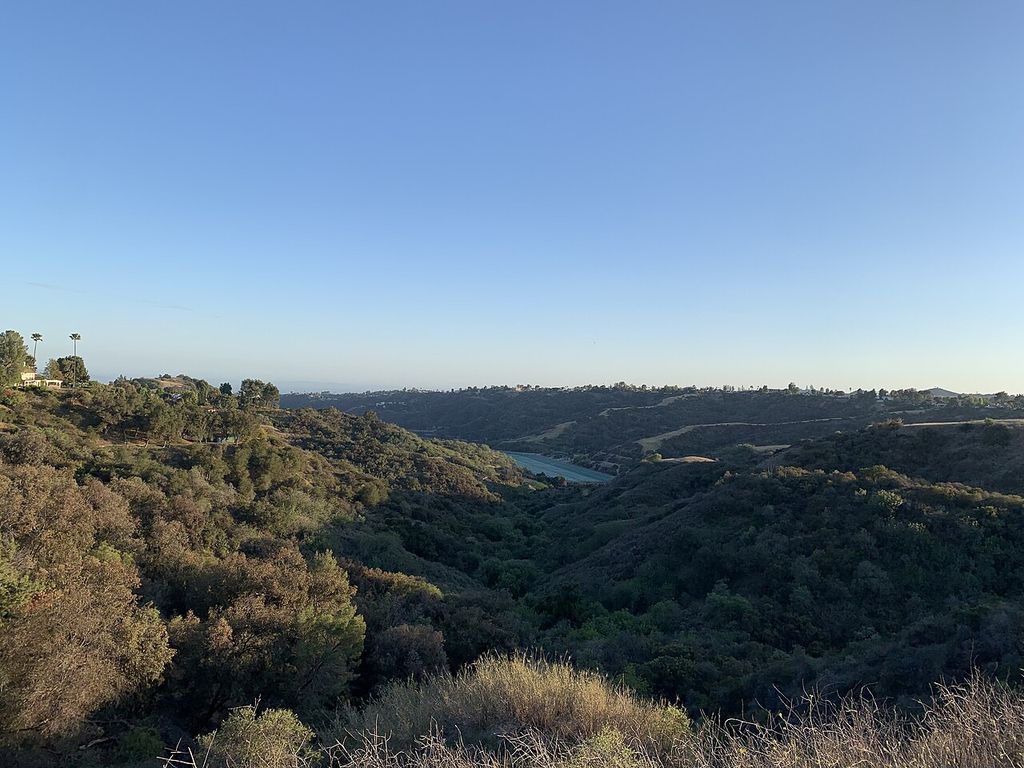
Los Angeles context: Stone Canyon Reservoir and the surrounding hills. DocFreeman24 / Wikimedia Commons. Image source. CC BY-SA 4.0. Resized and converted to JPEG; no crop or recolouring. Image derivative retains CC BY-SA 4.0.
An upright landscape
Nichols Canyon measures 84 by 60 inches, approximately 213 by 152 centimetres. Its height is therefore important to its effect: this is a substantial upright surface, tall enough to confront a standing viewer on a bodily scale. The vertical format draws attention to the road’s progress through the picture. The successive turns make the eye change direction as it moves upwards, so that the canvas’s height becomes something to work through. [1] [2]
The road supplies continuity among areas that remain strikingly different in colour and handling. Its curves prevent it from becoming a straight division between two halves. Following it means repeatedly looking sideways at the surrounding terrain, then finding the line again. The landscape can be understood as a whole, but its details keep interrupting a quick passage through it. Gayford’s account of the painting makes this connection between road, eye and movement central to its meaning. [2]
Kunstmuseum Luzern describes the composition as a view from above in which the road winds between colourful houses and hills, ending abruptly before the picture’s edge. That account captures the painting’s peculiar mixture of overview and journey. We can survey a stretch of territory that a driver would encounter in succession, yet the road invites us to trace it as though moving through it. Its termination also keeps the painted route from dissolving into an indefinitely distant point. The eye reaches a stopping place on the surface. [6]
The result resembles a map without providing the detached consistency of a road atlas. What matters is the relationship between one turn and the next, and the way those turns hold the coloured landscape together. The route is intelligible as a remembered pattern, even where its surrounding forms refuse a single, continuous illusion of distance. The painting gives a familiar drive an order that belongs to the canvas. [6]
The road also carries words. In Beautiful Evidence (2006), Edward Tufte singles out the cartographic lettering of its name, including the abbreviation of canyon. The label makes the map metaphor explicit. He also identifies the painted STOP on the pavement as anamorphic: its distorted letters read correctly from the foreshortened viewpoint of someone on the road. These details give the words different spatial roles. We can read the road name as though consulting a map, then imagine the lower angle from which a traveller would encounter the pavement marking. Small areas of lettering bring an overview and a position within the route into the same painting. [7]
Colour, brushwork and the theatre
The painting emerged during a year in which Hockney’s work on theatre design and his renewed attention to Picasso were closely connected. In 1980 he was designing the Metropolitan Opera’s forthcoming triple bill of Satie’s Parade, Poulenc’s Les mamelles de Tirésias and Ravel’s L’enfant et les sortilèges. He also saw major Picasso exhibitions at the Museum of Modern Art in New York and the Walker Art Center in Minneapolis. The Foundation records his response as an encouragement to paint with greater immediacy, including making paintings of his stage designs. [5]
Martin Gayford’s essay on Nichols Canyon connects the picture’s varied strokes with what Hockney called “French Marks”. Hockney used the term for the flowing painted and drawn calligraphy he associated with artists including Picasso, Matisse and Dufy. Gayford reports that the Ravel designs provided an opportunity to explore this freedom of the arm. The connection helps explain why the landscape’s energy resides in the marks themselves, as well as in the shape of its road. A sweeping line, a compact patch and a broader coloured area can carry different speeds of looking. [2]
In the landscape, reds, greens, yellows and blues set up forceful relationships across the surface. Gayford relates this palette to Matisse and Fauvism, while also stressing Hockney’s recognition of the canyon’s luxuriant vegetation. The colours carry an art-historical memory of expressive painting, and they also answer an actual place experienced as vivid and abundant. Their brightness makes the terrain assert itself. [2]
Phillips’s catalogue discussion, separate from Gayford’s authored essay, draws a further comparison with the theatre: the flat hills and blocks of orange, green, blue and lavender evoke elements of a stage setting. The analogy is useful because a stage can establish a convincing world through distinct planes placed in relation to one another. Here, too, shallow coloured areas can suggest terrain while remaining emphatically visible as painted shapes. Their flatness makes the road’s linking role more apparent. [2]
Hockney was working across problems of colour, gesture and represented space. The stage encouraged him to consider how separate painted elements could create an environment; the drive offered an environment encountered through continuous movement. Nichols Canyon brings those concerns together within a single upright rectangle. [2] [5]
Remembering a journey, moving through a painting
The shifting view has a temporal consequence. A driver cannot see every bend at once, but can remember the shape of the route and anticipate the next turn. A painting can gather those successive encounters onto one surface. Looking then reintroduces time: the eye follows the line, pauses at a colour change and returns to a junction of forms. The picture holds the journey together while allowing each viewer to set a pace through it. [2] [6]
Art historian Anthi-Danaé Spathoni places Hockney’s road landscapes within an account of landscape as a participatory experience. Her discussion of the 1980 paintings emphasises the time required to follow their lines and the changing viewpoints that keep the spectator active. That reading offers a useful way into Nichols Canyon: the road’s turns become instructions for attention. The spectator helps realise the painting’s movement by looking through its successive changes of direction. [8]
Hockney’s own reflections give memory a similarly active role. In LACMA’s transcript, he argued that seeing is inseparable from memory and that different memories produce different perceptions. Applied to this landscape, his account helps explain the value of familiarity. The route’s accumulated identity could become a subject precisely because he had encountered it repeatedly. A remembered drive could contain a coherence that no single glimpse supplied. [4]
Beside Mulholland Drive
The contrast with Mulholland Drive: The Road to the Studio clarifies the choices made here. LACMA’s painting is more than six metres wide: an extended horizontal panorama in acrylic, dated 1980. Its curatorial account describes a personalised map painted from memory, moving between detailed trees, houses, tennis courts and power lines and more abstract colour planes and grids. Its road stretches across the upper part of the composition, carrying the eye laterally through a broad territory. [9]
Nichols Canyon concentrates the journey within a narrower, upright field. Its turns repeatedly redirect attention through the centre and out towards the sides. Comparing the two paintings therefore reveals more than alternative formats for an identical subject. One opens a wide span for lateral exploration; the other folds the route into a tall, compact arrangement. They share the problem of representing a drive, but give the viewer different paths through their surfaces. [1] [2] [9]
Gayford reports Hockney’s explanation that the word Drive in the companion painting’s title refers to the activity of driving. That distinction helps with Nichols Canyon as well. Its title names a place, while the painted road turns the place into an action. The neighbouring paintings show how the same daily experience could support more than one spatial invention. Neither format exhausts what Hockney had learnt from the journey. [2]
Exhibitions and later echoes
Nichols Canyon and Mulholland Drive appeared in the Royal Academy’s A New Spirit in Painting in 1981. The exhibition placed Hockney’s new landscapes within a much broader argument about painting’s possibilities. Looking back in 2020, the Whitechapel Gallery described the 1981 show as an assertion of large-scale painting and the artist’s hand, while also recalling the controversy over its cultural politics. Its 38 exhibitors were all men. The picture thus entered public discussion through a forceful and disputed exhibition, whose significance extended well beyond the development of one artist. [2] [10]
The road and the remembered landscape remained productive subjects in Hockney’s work. In 1998, the Foundation records him painting Yorkshire from memory after returning to Los Angeles, identifying Garrowby Hill among those works. The change of country brought different terrain, but the relationship between recollection and a route through a place offered a continuing connection. Within his wider landscape painting, Nichols Canyon belongs to an ongoing investigation of how an inhabited world becomes a constructed picture. [11]
There is also a specific later response by another artist. Kunstmuseum Luzern discusses Rinus Van de Velde’s charcoal adaptation of Nichols Canyon, which retains much of its arrangement while removing the street names and translating its colour into black and white. The words beneath the landscape ask Hockney how to get there. The museum interprets this as a fictional dialogue about following an artist’s example. A painted route to a studio becomes a question about finding an artistic direction. That transformation shows how the road’s organising structure can remain meaningful after its original colours and practical geography have changed. [6]
The December 2020 sale
Phillips sold Nichols Canyon in New York on 7 December 2020, reporting a price of US$41,067,500. The event brought renewed attention to a painting already associated with major exhibitions, adding a conspicuous market episode to its exhibition history and continuing artistic reception. [2] [12]
The 2020 catalogue also reported that the consigning collector had bought the painting from André Emmerich in January 1982. Its account connected the earlier transfer out of Hockney’s hands with an exchange that enabled him to acquire a Picasso. This reported history adds a further link to an artist whose example had mattered in 1980, and traces the painting’s passage from the studio into a collection nearly four decades before the auction. [2]
Works directory
This source-bounded directory combines the works in the Metropolitan Museum’s 2017 retrospective checklist with reviewed museum object records and the additional works and series examined in this guide. It spans several media and is not a complete catalogue raisonné. Titles without an article link remain useful dated records. Metropolitan Museum final retrospective checklist (2017); additional object and series sources are given in the linked articles. [1]
| Name | Date | Medium |
|---|---|---|
| Love Painting | 1960 | Painting |
| Shame | 1960 | Painting |
| The Third Love Painting | 1960 | Painting |
| Tyger Painting No. 2 | 1960 | Painting |
| A Rake’s Progress | 1961–63 | Print series |
| Tea Painting in an Illusionistic Style | 1961 | Painting |
| The Cha-Cha That Was Danced in the Early Hours of 24th March | 1961 | Painting |
| Cleaning Teeth, Early Evening (10pm) W11 | 1962 | Painting |
| Flight into Italy - Swiss Landscape (Painting in a Scenic Style) | 1962 | Painting |
| Man in a Museum (or You're in the Wrong Movie) | 1962 | Painting |
| My Brother is Only Seventeen | 1962 | Painting |
| The First Marriage (A Marriage of Styles I) | 1962 | Painting |
| Domestic Scene, Los Angeles | 1963 | Painting |
| Play Within a Play | 1963 | Painting |
| The Hypnotist | 1963 | Painting |
| Arizona | 1964 | Painting |
| California Art Collector | 1964 | Painting |
| Man in Shower in Beverly Hills | 1964 | Painting |
| Portrait Surrounded by Artistic Devices | 1965 | Painting |
| Rocky Mountains and Tired Indians | 1965 | Painting |
| Beverly Hills Housewife | 1966–67 | Painting |
| Medical Building | 1966 | Painting |
| Peter | 1966 | Drawing |
| Peter Getting Out of Nick’s Pool | 1966 | Painting |
| A Bigger Splash | 1967 | Painting |
| A Lawn Being Sprinkled | 1967 | Painting |
| Kasmin in Bed in His Chateau in Carennac | 1967 | Drawing |
| Peter Feeling Not Too Good | 1967 | Drawing |
| Savings and Loan Building | 1967 | Painting |
| The Room, Tarzana | 1967 | Painting |
| American Collectors (Fred and Marcia Weisman) | 1968 | Painting |
| Christopher Isherwood and Don Bachardy | 1968 | Painting |
| Henry Geldzahler and Christopher Scott | 1968-1969 | Painting |
| W. H. Auden | 1968 | Drawing |
| Peter Langan in His Kitchen at Odins | 1969 | Drawing |
| Mark Glazebrook | 1970 | Drawing |
| Mr and Mrs Clark and Percy | 1970-1971 | Painting |
| Ossie Wearing a Fairisle Sweater | 1970 | Drawing |
| Pool and Steps, Le Nid du Duc | 1971 | Painting |
| Rubber Ring Floating in a Swimming Pool | 1971 | Painting |
| Celia in a Black Dress with White Flowers | 1972 | Drawing |
| Mount Fuji and Flowers | 1972 | Painting |
| Portrait of an Artist (Pool with Two Figures) | 1972 | Painting |
| Portrait of the Artist's Mother, Mrs Laura Hockney, Bradford | 1972 | Drawing |
| The Artist's Father | 1972 | Drawing |
| Dr Eugene Lamb, Lucca | 1973 | Drawing |
| Andy, Paris | 1974 | Drawing |
| Contre-jour in the French Style (Against the Day dans le Style-Français) | 1974 | Painting |
| Gregory Sitting on Base of Column | 1975 | Drawing |
| Kerby (after Hogarth) Useful Knowledge | 1975 | Painting |
| Ron Kitaj Outside Akademie der Kunste Vienna | 1975 | Drawing |
| Kasmin Reading the Udaipur Guide | 1977 | Drawing |
| Looking at Pictures on a Screen | 1977 | Painting |
| My Parents | 1977 | Painting |
| Canyon Painting | 1978 | Painting |
| Mother, Bradford, 19 Feb. 1979 (inscribed 1978) | 1979 | Drawing |
| Mulholland Drive: The Road to the Studio | 1980 | Painting |
| Nichols Canyon | 1980 | Painting |
| Outpost Drive, Hollywood | 1980 | Painting |
| Hollywood Hills House | 1981-1982 | Painting |
| Celia. Los Angeles. April 10th 1982 | 1982 | Polaroid composite |
| Don + Christopher, Los Angeles, 6th March 1982 | 1982 | Polaroid composite |
| Gregory Swimming Los Angeles March 31st 1982 | 1982 | Polaroid composite |
| My Mother, Bolton Abbey, Yorkshire, Nov. 1982 | 1982 | Photocollage |
| Self Portrait 30th Sept. 1983 | 1983 | Drawing |
| Pearblossom Hwy., 11-18th April 1986, #1 | 1986 | Photocollage |
| Pearblossom Hwy., 11–18th April 1986, #2 | 1986 | Photocollage |
| Large Interior, Los Angeles | 1988 | Painting |
| Breakfast at Malibu, Sunday, 1989 | 1989 | Painting |
| Pacific Coast Highway and Santa Monica | 1990 | Painting |
| The Other Side | 1991-1993 | Painting |
| The Eleventh V. N. Painting | 1992 | Painting |
| The Twenty Sixth V. N. Painting | 1992 | Painting |
| The Road Across the Wolds | 1997 | Painting |
| 9 Canvas Study of the Grand Canyon | 1998 | Painting |
| A Bigger Grand Canyon | 1998 | Painting |
| Colorado River | 1998 | Painting |
| Garrowby Hill | 1998 | Painting |
| Colin St. John Wilson. London. 3rd June 1999 | 1999 | Drawing |
| Gregory Evans. Los Angeles. 18th September 1999 | 1999 | Drawing |
| Laura Huston. London. 22nd June 1999 | 1999 | Drawing |
| Lindy. Marchioness of Dufferin and Ava. London. 17th June | 1999 | Painting |
| Going Up Garrowby Hill | 2000 | Painting |
| Red Pots in the Garden | 2000 | Painting |
| A Closer Winter Tunnel, February - March | 2006 | Painting |
| Elderflower Blossom, Kilham, July 2006 | 2006 | Painting |
| The Road to Thwing, July 2006 | 2006 | Painting |
| Bigger Trees near Warter | 2007 | Painting |
| Hawthorn Blossom near Rudston | 2008 | Painting |
| Views Through the Artist's Bedroom Window, Bridlington | 2010-2013 | Digital animation |
| The Arrival of Spring in Woldgate, East Yorkshire in 2011 (twenty eleven) | 2011 | Painting / digital series |
| 82 Portraits and 1 Still-life | 2013–16 | Portrait series |
| Garden | 2015 | Painting |
| Garden with Blue Terrace | 2015 | Painting |
| Garden #3 | 2016 | Painting |
| A Bigger Interior with Blue Terrace | 2017 | Painting |
| Interior with Blue Terrace and Garden | 2017 | Painting |
| A Year in Normandie | 2020–21 | Digital frieze |
Discussion
Look again at the images and ideas explored in Nichols Canyon. These editorial prompts invite your observations.
Reader Insights
How does following the upright road in Nichols Canyon differ from tracing the broad panorama of Mulholland Drive?
Which gives the stronger sense of movement: the road’s bends, the contrasts between colour areas, or the changing kinds of painted mark?
What does Van de Velde’s black-and-white charcoal response preserve about the route, and what changes when the street names and colour disappear?
Join the Conversation
Share a detail, comparison or question about Nichols Canyon below.
References
- The Metropolitan Museum of Art, David Hockney: Final Checklist, 15 November 2017, printed p. 12 (PDF p. 13), “Nichols Canyon”. View source.
- Martin Gayford and Phillips, “Martin Gayford on Nichols Canyon” and separate catalogue discussions, Nichols Canyon, lot 10, 20th Century & Contemporary Art Evening Sale, New York, 7 December 2020; lot medium, dimensions and result. View source.
- The David Hockney Foundation, 2021 chronology. View source.
- David Hockney / Los Angeles County Museum of Art, “Artists on Art Audio Transcript”, Hockney passages on Mulholland Drive, memory and perception. View source.
- The David Hockney Foundation, “1980”, sections “Parade triple bill”, “Picasso, music, and dance” and “Different views of L.A.”. View source.
- Kunstmuseum Luzern, “Splash!”, 2022 exhibition microsite, sections “In the Hollywood Hills” and “In Search of Hockney’s Hollywood”. View source.
- Edward R. Tufte, Beautiful Evidence (Graphics Press, 2006), chapter 1, “Mapped Pictures”, passage discussing Nichols Canyon. View source.
- Anthi-Danaé Spathoni, “David Hockney’s Moving Landscapes”, Revista de História da Arte, W series, no. 11, April 2022, pp. 95–103, especially p. 97 and pp. 100–101. View source.
- Los Angeles County Museum of Art, “David Hockney, Mulholland Drive: The Road to the Studio, 1980”, object record and curatorial notes. View source.
- Whitechapel Gallery, “The Return of the Spirit in Painting”, exhibition text, 5 February–27 September 2020. View source.
- The David Hockney Foundation, “1998”, “Painting distant landscapes”. View source.
- Phillips, “Phillips Achieves Highest Auction Total in Company History”, 2020 auction results, New York evening sale of 7 December. View source.
More HOCKNEY Works
A Bigger Splash
A momentary disturbance becomes the focus of a large acrylic painting, made through weeks of patient work.
Mr and Mrs Clark and Percy
The designers Celia Birtwell and Ossie Clark occupy a room shaped by light, repeated sittings and the demands of a double portrait.
A Bigger Grand Canyon
Sixty canvases gather memory, studies and changing viewpoints into an immense painting of 1998.
Garrowby Hill
The 1998 oil painting transforms a remembered Yorkshire journey into a road, fields and an expansive view.
Portrait of an Artist (Pool with Two Figures)
Photographic studies, two figures and a swimming pool become a carefully constructed painting of 1972.
My Parents
The 1977 oil painting sets Kenneth and Laura Hockney within a quietly organised interior.
Pearblossom Hwy., 11–18th April 1986, #2
Hundreds of separately made photographs construct a road scene that unfolds through movement and time.
Bigger Trees near Warter
Fifty canvases join into a large outdoor painting of Yorkshire trees, with photography helping the artist organise the whole.