


 by Tom Gurney
Tom Gurney BSc (Hons) is an art history expert with over 20 years experience
Email: tomgurney1@gmail.com / Phone: +44 7429 011000
Yorkshire: Introduction
David Hockney’s Yorkshire was a place of familiar roads that kept producing unfamiliar things to see. Fields changed as crops grew, were harvested and gave way to ploughed earth. His return to the county gathered force through journeys made for a friend. In late summer 1997, while Jonathan Silver was seriously ill, Hockney repeatedly crossed Yorkshire from his base in Bridlington. The travelling gave him time to notice a landscape he knew, and to consider how to paint it afresh. [1]
The pictures did not always follow him home in the same way. Back in Los Angeles in 1998, he continued painting Yorkshire from memory. Place could remain active at a distance, carried in recollection and transformed through colour and composition. [2] Later, longer periods in East Yorkshire brought a different intimacy: the knowledge acquired by returning to a lane in changing light, weather and seasons. Bradford, Saltaire, Bridlington and the Wolds each belonged to this relationship, giving it different beginnings, reasons and working conditions.
At a Glance
- ArtistDavid Hockney
- Born9 July 1937, Bradford, England
- Died11 June 2026
- FocusYorkshire
Contents
- Bradford: learning to look close to home
- Saltaire and Jonathan Silver
- Across the Wolds: the landscape of a journey
- Bridlington as a working base
- Returning to the same woods
- Making the familiar landscape monumental
- Woldgate and the arrival of spring
- The roads in motion
- A place carried between regions
Bradford: learning to look close to home
Hockney was born in Bradford on 9 July 1937. His earliest understanding of art included everyday work with brushes, lettering and painted surfaces. He remembered watching his father refurbish old bicycles after the war and being fascinated by the application of paint. While still at school, he drew for the school magazine and made posters; his parents supported his interest by arranging private calligraphy lessons. Yorkshire supplied a material introduction to making pictures before it became the subject of the large landscapes. [3]
At Bradford School of Art, which he entered in 1953, the training emphasised observation, drawing and the figure. The surrounding city also became a subject. Hockney recalled taking paints out on a small cart adapted from a pram and painting suburban houses on the spot. The practical connection between carrying equipment, finding a view and working in front of it therefore had an early local history. His recollections of the course also stress its concentration on tonal values and his growing awareness of how little he knew about modern art. The later Yorkshire landscapes drew on observational discipline while opening it to far more expansive colour and pictorial invention. [4]
Bradford’s civic collection provides another way into that formation. The museum service describes its Hockney holdings as particularly revealing of the years in which he learned to draw and developed his early work. That local emphasis gives Bradford a distinct role within the wider biography of David Hockney. It preserves the setting in which an artist began to make choices, long before the Yorkshire countryside became an internationally recognised part of his work. [5]
Saltaire and Jonathan Silver
The connection with Saltaire grew through friendship and the reuse of a working building. Salts Mill opened in 1853 as the centre of Titus Salt’s model industrial village. Cloth production ceased in 1986; Jonathan Silver bought the mill in 1987 and developed a combination of cultural and commercial uses. The industrial setting mattered. Hockney’s work became part of the continuing life of a place shaped by Yorkshire’s textile economy, housed within the large spaces that economy had left behind. [6]
The Foundation’s account of 1987 places Silver’s project beside Hockney’s fiftieth birthday and describes the creation of an arts space intended both to show his work and to support the local community. A regional relationship was taking physical form while Hockney continued to live and work abroad. Salts Mill offered a setting in which the career of a Bradford-born artist could be encountered close to its beginnings, without restricting that career to a local story. [7]
When Silver became gravely ill in 1997, the relationship gave Hockney’s journeys a more urgent purpose. Filmmaker Bruno Wollheim records the drives from Bridlington to Silver’s home in Wetherby, across the county from the coast. Silver had encouraged Hockney to paint Yorkshire, and the artist took wet canvases to show his friend. Early works included The Road to York through Sledmere, The Road across the Wolds and North Yorkshire. Their roads belonged to travel between people, with looking and painting folded into those journeys. [8]
Hockney also painted Salts Mill for Silver. His explanation brought together the revitalised cultural centre, his memory of a busy mill and the packed terraces of his Bradford childhood. He described altering the houses’ arrangement to create an effect unavailable from a single exterior position. Industrial Yorkshire was already being reconstructed through remembered experience, a principle that would matter when the subject became open country. [1]
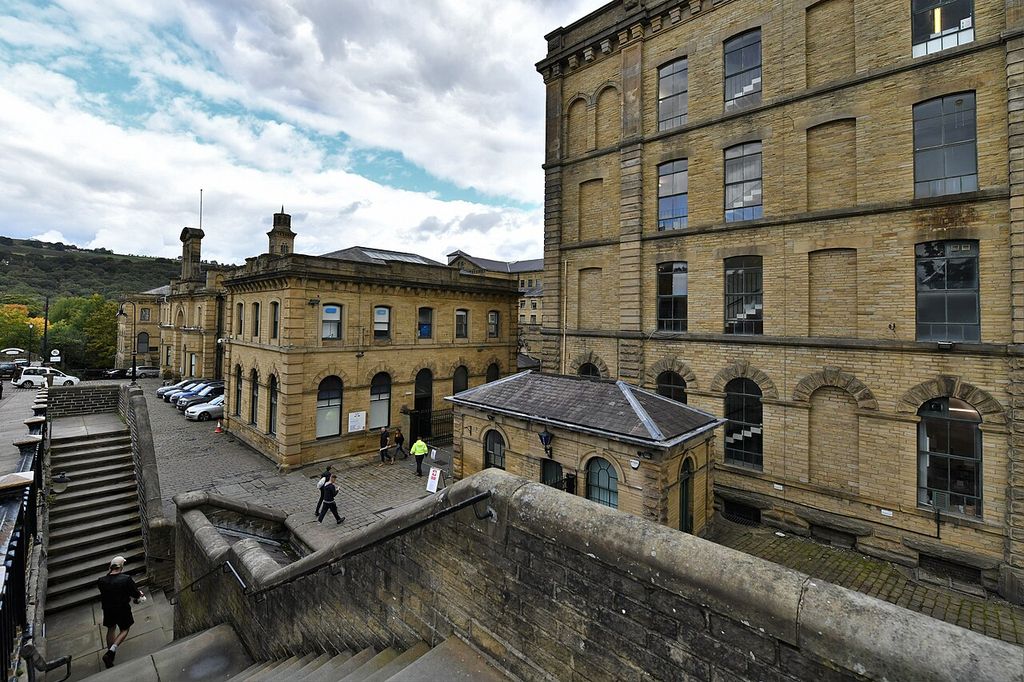
Salts Mill, Saltaire. Jonathan Silver’s redevelopment made the former textile mill an important setting for Hockney’s work. Michael Garlick / Wikimedia Commons. Image source. CC BY-SA 2.0. Resized and converted to JPEG; no crop or recolouring. Image derivative retains CC BY-SA 2.0.
Across the Wolds: the landscape of a journey
The Yorkshire Wolds have a geography capable of surprising anyone who thinks of the county only through Bradford’s urban surroundings or the moors farther north. Natural England describes a predominantly chalk landscape, with an escarpment rising above the Vale of York and the Vale of Pickering, an open plateau and a network of dry valleys. Thin soils can expose the pale chalk through ploughing. Broad skies and comparatively limited woodland give much of the higher country its sense of openness. [9]
This is also land shaped by use. Natural England associates many of its regular fields, planted hedges, isolated farmsteads and broad drove roads with Parliamentary enclosure. Those features gave agriculture a lasting visible framework. The distinction between open ground and a sheltered route has both physical and human histories: chalk, valleys, cultivation and planting contribute to the country through which Hockney travelled. Its apparent simplicity contains many kinds of making and change. [9]
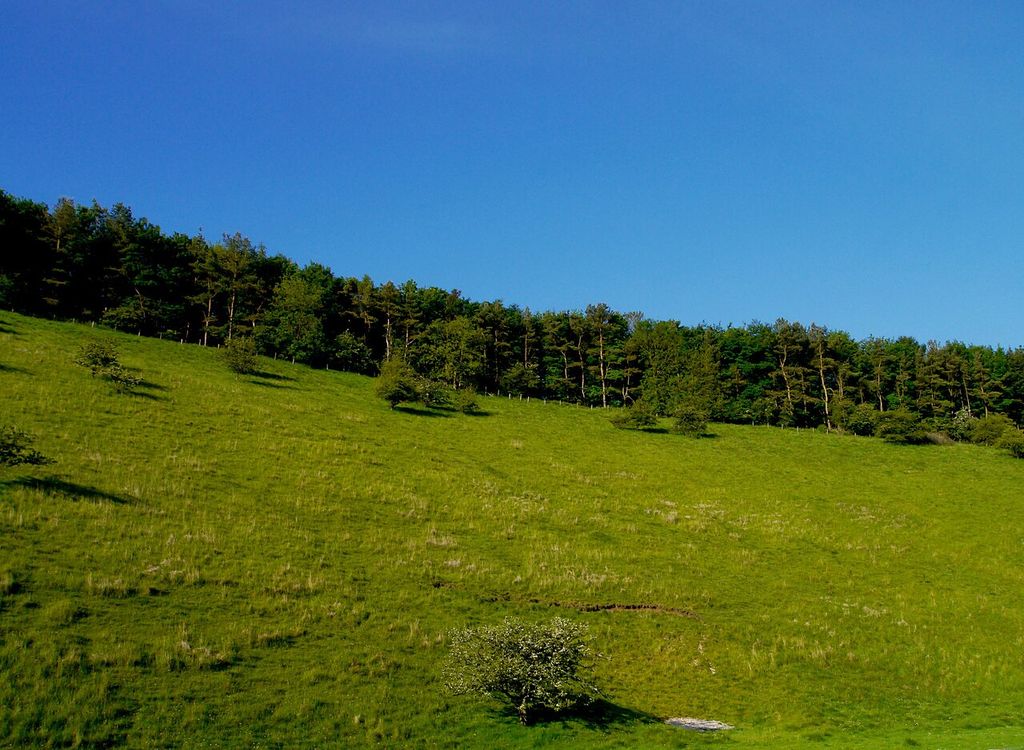
Regional context: the dry chalk valley of Water Dale, near Thixendale in the Yorkshire Wolds. Andy Beecroft / Wikimedia Commons. Image source. CC BY-SA 2.0. Resized and converted to JPEG; no crop or recolouring. Image derivative retains CC BY-SA 2.0.
This helps explain the variety within Hockney’s chosen territory. An extensive view across fields and an enclosed stretch beneath trees could belong to the same working region. Distance, road curves, shelter and gaps in vegetation offered different structures for a picture. Agricultural use added a second kind of change to the natural cycle: growing crops, harvest and cultivation continually remade the visible ground. Hockney explicitly connected that changing surface with his repeated drives in 1997. He also recalled that the great spaces of the American West had helped him recognise Yorkshire’s extensive vistas. Familiar country could be seen through experience acquired elsewhere. [1]
Garrowby Hill gives this travelling landscape a concentrated form. The 1998 work is an oil painting on canvas, 60 by 76 inches, in the Museum of Fine Arts, Boston. Its place in the Foundation’s account of paintings made from memory in Los Angeles is essential to understanding its relationship with Yorkshire. The remembered route had become a composition made at a distance. [10] [2] It should also be distinguished from Going Up Garrowby Hill, a separate oil painting dated 2000, listed in the Metropolitan Museum’s 2017 checklist in a tall, 84-by-60-inch format. [11]
Art historian Anthi-Danaé Spathoni reads the road in the 1998 painting as an invitation to participate in the landscape. Beginning at the lower edge, it asks the eye to follow its bends into the picture. Her account is useful for thinking about Yorkshire across Hockney’s work: a road can organise the viewer’s progress as well as identify a place. The geographical name anchors a lived route, while the painting changes the conditions under which that route is experienced. Matching a picture to a single roadside photograph would leave much of this work unexplained. [12]
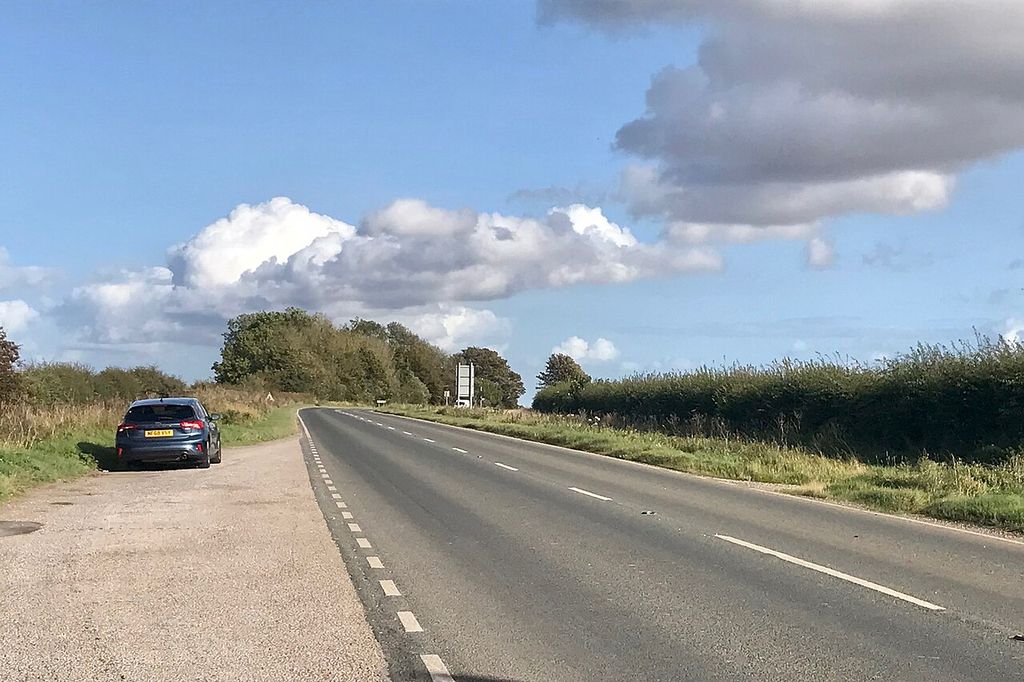
Geographic context: a roadside lay-by at Garrowby Hill, photographed in 2023. David Dixon / Wikimedia Commons. Image source. CC BY-SA 2.0. Resized and converted to JPEG; no crop or recolouring. Image derivative retains CC BY-SA 2.0.
Bridlington as a working base
Bridlington made sustained exploration possible. In summer 2004, Hockney and Jean-Pierre Gonçalves de Lima drove through the region, stopping frequently for drawing. Gonçalves de Lima photographed the development of the work, and Hockney completed the thirty-six watercolours of Midsummer: East Yorkshire. The Foundation reproduces his recollection of stopping to sketch particular grasses and weeds in a low roadside hedge. Drawing sharpened his ability to distinguish one plant from another, giving a future painted foreground a structure assembled from attentive observation. [13]
Those stops changed the scale of attention. A car made a wide area accessible, but the work required interruption of the journey: staying with something small enough to overlook from a moving vehicle. The contrast between a whole valley and a single stalk was productive. Both could be approached through repeated encounters, and the smaller study could inform a much larger view. The working landscape became legible through details as well as distances. [13]
This was a particular Yorkshire campaign within an established engagement with watercolour. Hockney had already made large watercolour double portraits in 2002, including the National Portrait Gallery’s commission of Sir George and Lady Christie. The Gallery’s contemporary account explains that the commission prompted further portraits painted directly from life. Watercolour therefore reached the East Yorkshire roads with a recent history of intensive use in other subjects. [14]
By July 2005 Hockney was back in Bridlington painting the countryside outdoors in oil. He described the freedom of returning to oil after watercolour: its capacity to cover and revise a surface opened different possibilities from a medium usually approached from light towards dark. The regional subjects continued across that material change. The Foundation’s 2005 record includes routes between Kilham and Langtoft, views towards Warter, fields, hedgerows and the rooftops of Bridlington itself. Town and country remained parts of the same field of work. [15]
Knowing the area meant knowing working conditions. Hockney spoke of the early summer light, the need for warm clothing in winter and the unexpected colour he found during the cold months. He also recalled conversations with farmers who recognised the landscape in his use of colour. These remarks locate the work among people who lived and worked there, while making clear how much depended on being present at particular hours and in different weather. The pictures grew from a timetable of looking. [15]
Returning to the same woods
During 2006, Hockney expanded the outdoor paintings from single canvases to groups of two, four and six. That expansion had practical consequences. At first several cars were needed to bring wet paintings back safely. The team then made a rack with six shelves in the back of a truck, allowing the canvases to travel together. Hockney’s recollection joins preparation to apparent spontaneity: a large response to a changing scene depended on arrangements made before the painting began. [16]
The Foundation also records Hockney’s admiration for the scale of Constable’s oil sketches, seen at a Tate Britain retrospective during this period. Observation outdoors and encounters in galleries fed one another. The East Yorkshire campaign joined the immediate demands of a particular site to a continuing interest in what landscape painting could do. [16]
The dated titles give a sense of how the work accumulated. Woldgate Woods, 21, 23 and 29 November 2006 records several days within the name of one six-canvas oil painting. Other titles distinguish winter tunnels, snow and changing months. In the Guggenheim Bilbao’s 2012 exhibition account, those wooded subjects appear alongside the nine-canvas The Big Hawthorn of 2008 and the fifteen-canvas Winter Timber of 2009. The sequence moves between growth, enclosing vegetation and cut wood, extending the seasonal story into a landscape altered by human activity. [17]
Lawrence Weschler’s account emphasises how regularly Hockney revisited chosen sites. He describes repeated paintings of intersecting paths at Woldgate and the trees near Thixendale in different seasons. Winter observation helped Hockney understand the branching structures that summer foliage obscured. This gave repetition a purpose beyond recording a succession of attractive appearances. A later visit could reveal something that made an earlier view newly intelligible; familiarity accumulated through differences. [18]
The dates are consequently part of the pictures’ meaning. A woodland view carries the time spent making it, while neighbouring works supply the wider interval of a changing year. A tree’s outline, the density of leaves or the openness of a route can measure elapsed time. Knowledge builds across visits, allowing Hockney to find new subjects along roads he already knew. [16] [18]
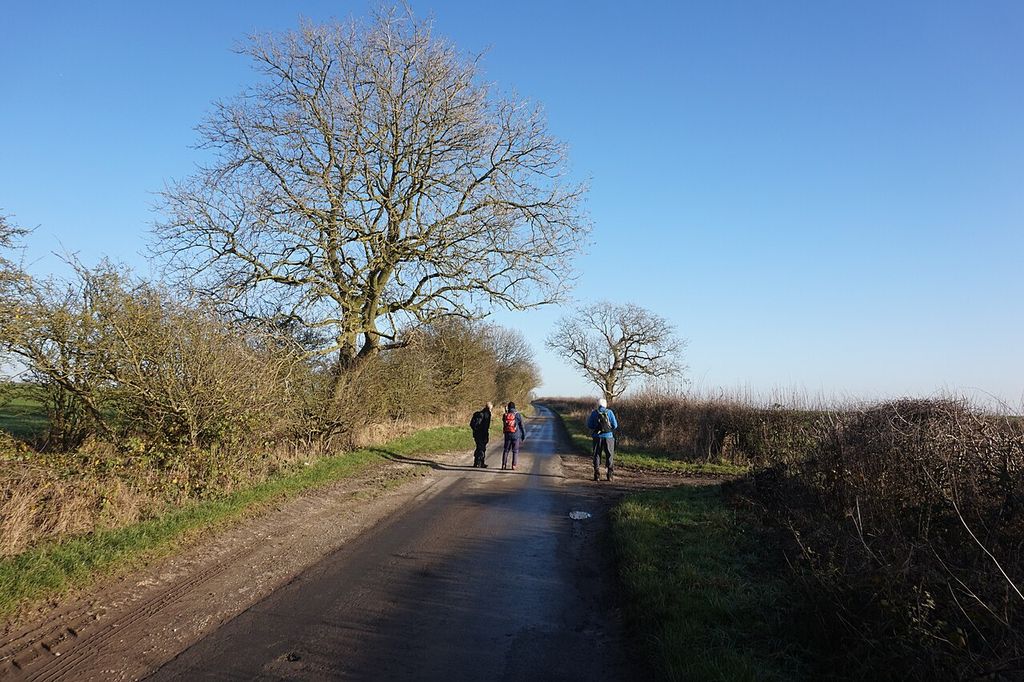
Geographic context: Woldgate towards Bridlington, photographed by Ian S. Ian S / Wikimedia Commons. Image source. CC BY-SA 2.0. Resized and converted to JPEG; no crop or recolouring. Image derivative retains CC BY-SA 2.0.
Making the familiar landscape monumental
Bigger Trees near Warter, completed in 2007, enlarged an observed Yorkshire scene across fifty canvases painted in oil. The Foundation records a composition approximately fifteen feet high and forty feet wide, painted outdoors and planned with digital photography for its appearance at the Royal Academy’s Summer Exhibition. Its scale required movement between the site, the separate canvases and a means of seeing the whole composition together. [19] [20]
Hockney recalled spending long periods looking up at branches before drawing, then using drawings to locate each canvas within the larger arrangement. The planning made a monumental picture possible within the conditions of outdoor work. His Yorkshire project could bring patient observation and new technology into the same process: the computer helped coordinate a painting whose encounter with the trees remained central. Warter became the subject of a gallery-sized experience through many local acts of looking and making. [19]
The enlarged format also changes the viewer’s task. Spathoni argues that these landscapes encourage bodily participation, with the eye and the visitor moving along a work whose extent cannot be absorbed from one fixed point. A familiar group of trees can therefore acquire a scale that makes looking itself conspicuous. Hockney’s broader landscape work repeatedly tests that relationship between a place, its constructed image and the person encountering it. [12]
Woldgate and the arrival of spring
In January 2011, Hockney began drawing the East Yorkshire landscape outdoors on an iPad and recognised the possibility of following the transition from winter towards summer. He made more than one hundred digital drawings. For the Royal Academy installation, fifty-one were selected and printed on paper, accompanying an enormous oil painting on thirty-two canvases. These are distinct parts of The Arrival of Spring in Woldgate: the larger digital corpus, the exhibition selection and the multi-canvas painting. [21]
Hockney described the painting’s subject as the early emergence of leaves, before a full canopy concealed too much of the branching. That interest connected the spectacular format to a narrow interval in the year. [21] Curator Ai Kusumoto, discussing the series in 2023, traced the digital drawings from lingering winter conditions towards the increasingly dense greens of late spring. Her account connects Hockney’s Yorkshire attention to seasonal change with his earlier interest in the shifting light and water of Los Angeles. Different places presented related problems: how to look closely enough, and how to give changing appearances a form. [22]
The roads in motion
Film brought another kind of duration to the same region. In a 2011 conversation with Andrew Marr, preserved in the National Science and Media Museum’s transcript, Hockney connected his arrangements of canvases with the use of nine cameras. Combining cameras meant deciding where one view ended and another began. He treated these choices as drawing, with moving images allowing decisions about time as well as space. His explanation also returned to local knowledge: understanding the geography helped him anticipate the direction of light, and watching successive springs helped him anticipate change. [23]
Weschler described small cameras mounted on a vehicle and the sequences shown across multiple screens. A slow passage beneath trees could be compared with another season’s journey through the same place. The road supplied continuity, while branches, foliage and light made the differences visible. Film extended the paintings’ habits of returning, comparing and letting attention travel. [18]
In another interview excerpt preserved by the museum, Hockney compared Woldgate’s apparently modest lane with the Grand Canyon. His point concerned what sustained attention could make available. A person driving through might register little; drawings, paintings and several cameras could turn the place into an extensive visual experience. The comparison preserves the scale of his ambition without requiring Yorkshire to resemble the American landscape. Each offered space in which looking could become an active undertaking. [23]
A place carried between regions
The Yorkshire years continued to include travel. In 2005, work outdoors around Bridlington overlapped with portrait sessions in Los Angeles. In 2011, Hockney returned to the United States to draw Yosemite on the iPad while preparing the Royal Academy exhibition. The movements matter because they keep the regional story connected to a larger practice. Techniques, memories and visual questions travelled with him; Yorkshire gave them particular roads, seasons and working rhythms. [15] [21]
The distinction between place and picture remains rewarding. Bradford grounds the story in learning and local streets; Saltaire connects it with friendship and a changing industrial community; Bridlington supports repeated excursions; the Wolds offer fields, valleys and wooded routes whose appearances alter across the year. The paintings and films transform those encounters into arrangements of colour, space and time. Their closeness to Yorkshire comes from the depth of the relationship: being there, leaving, remembering, returning and looking again.
Works directory
This source-bounded directory combines the works in the Metropolitan Museum’s 2017 retrospective checklist with reviewed museum object records and the additional works and series examined in this guide. It spans several media and is not a complete catalogue raisonné. Titles without an article link remain useful dated records. Metropolitan Museum final retrospective checklist (2017); additional object and series sources are given in the linked articles. [11]
| Name | Date | Medium |
|---|---|---|
| Love Painting | 1960 | Painting |
| Shame | 1960 | Painting |
| The Third Love Painting | 1960 | Painting |
| Tyger Painting No. 2 | 1960 | Painting |
| A Rake’s Progress | 1961–63 | Print series |
| Tea Painting in an Illusionistic Style | 1961 | Painting |
| The Cha-Cha That Was Danced in the Early Hours of 24th March | 1961 | Painting |
| Cleaning Teeth, Early Evening (10pm) W11 | 1962 | Painting |
| Flight into Italy - Swiss Landscape (Painting in a Scenic Style) | 1962 | Painting |
| Man in a Museum (or You're in the Wrong Movie) | 1962 | Painting |
| My Brother is Only Seventeen | 1962 | Painting |
| The First Marriage (A Marriage of Styles I) | 1962 | Painting |
| Domestic Scene, Los Angeles | 1963 | Painting |
| Play Within a Play | 1963 | Painting |
| The Hypnotist | 1963 | Painting |
| Arizona | 1964 | Painting |
| California Art Collector | 1964 | Painting |
| Man in Shower in Beverly Hills | 1964 | Painting |
| Portrait Surrounded by Artistic Devices | 1965 | Painting |
| Rocky Mountains and Tired Indians | 1965 | Painting |
| Beverly Hills Housewife | 1966–67 | Painting |
| Medical Building | 1966 | Painting |
| Peter | 1966 | Drawing |
| Peter Getting Out of Nick’s Pool | 1966 | Painting |
| A Bigger Splash | 1967 | Painting |
| A Lawn Being Sprinkled | 1967 | Painting |
| Kasmin in Bed in His Chateau in Carennac | 1967 | Drawing |
| Peter Feeling Not Too Good | 1967 | Drawing |
| Savings and Loan Building | 1967 | Painting |
| The Room, Tarzana | 1967 | Painting |
| American Collectors (Fred and Marcia Weisman) | 1968 | Painting |
| Christopher Isherwood and Don Bachardy | 1968 | Painting |
| Henry Geldzahler and Christopher Scott | 1968-1969 | Painting |
| W. H. Auden | 1968 | Drawing |
| Peter Langan in His Kitchen at Odins | 1969 | Drawing |
| Mark Glazebrook | 1970 | Drawing |
| Mr and Mrs Clark and Percy | 1970-1971 | Painting |
| Ossie Wearing a Fairisle Sweater | 1970 | Drawing |
| Pool and Steps, Le Nid du Duc | 1971 | Painting |
| Rubber Ring Floating in a Swimming Pool | 1971 | Painting |
| Celia in a Black Dress with White Flowers | 1972 | Drawing |
| Mount Fuji and Flowers | 1972 | Painting |
| Portrait of an Artist (Pool with Two Figures) | 1972 | Painting |
| Portrait of the Artist's Mother, Mrs Laura Hockney, Bradford | 1972 | Drawing |
| The Artist's Father | 1972 | Drawing |
| Dr Eugene Lamb, Lucca | 1973 | Drawing |
| Andy, Paris | 1974 | Drawing |
| Contre-jour in the French Style (Against the Day dans le Style-Français) | 1974 | Painting |
| Gregory Sitting on Base of Column | 1975 | Drawing |
| Kerby (after Hogarth) Useful Knowledge | 1975 | Painting |
| Ron Kitaj Outside Akademie der Kunste Vienna | 1975 | Drawing |
| Kasmin Reading the Udaipur Guide | 1977 | Drawing |
| Looking at Pictures on a Screen | 1977 | Painting |
| My Parents | 1977 | Painting |
| Canyon Painting | 1978 | Painting |
| Mother, Bradford, 19 Feb. 1979 (inscribed 1978) | 1979 | Drawing |
| Mulholland Drive: The Road to the Studio | 1980 | Painting |
| Nichols Canyon | 1980 | Painting |
| Outpost Drive, Hollywood | 1980 | Painting |
| Hollywood Hills House | 1981-1982 | Painting |
| Celia. Los Angeles. April 10th 1982 | 1982 | Polaroid composite |
| Don + Christopher, Los Angeles, 6th March 1982 | 1982 | Polaroid composite |
| Gregory Swimming Los Angeles March 31st 1982 | 1982 | Polaroid composite |
| My Mother, Bolton Abbey, Yorkshire, Nov. 1982 | 1982 | Photocollage |
| Self Portrait 30th Sept. 1983 | 1983 | Drawing |
| Pearblossom Hwy., 11-18th April 1986, #1 | 1986 | Photocollage |
| Pearblossom Hwy., 11–18th April 1986, #2 | 1986 | Photocollage |
| Large Interior, Los Angeles | 1988 | Painting |
| Breakfast at Malibu, Sunday, 1989 | 1989 | Painting |
| Pacific Coast Highway and Santa Monica | 1990 | Painting |
| The Other Side | 1991-1993 | Painting |
| The Eleventh V. N. Painting | 1992 | Painting |
| The Twenty Sixth V. N. Painting | 1992 | Painting |
| The Road Across the Wolds | 1997 | Painting |
| 9 Canvas Study of the Grand Canyon | 1998 | Painting |
| A Bigger Grand Canyon | 1998 | Painting |
| Colorado River | 1998 | Painting |
| Garrowby Hill | 1998 | Painting |
| Colin St. John Wilson. London. 3rd June 1999 | 1999 | Drawing |
| Gregory Evans. Los Angeles. 18th September 1999 | 1999 | Drawing |
| Laura Huston. London. 22nd June 1999 | 1999 | Drawing |
| Lindy. Marchioness of Dufferin and Ava. London. 17th June | 1999 | Painting |
| Going Up Garrowby Hill | 2000 | Painting |
| Red Pots in the Garden | 2000 | Painting |
| A Closer Winter Tunnel, February - March | 2006 | Painting |
| Elderflower Blossom, Kilham, July 2006 | 2006 | Painting |
| The Road to Thwing, July 2006 | 2006 | Painting |
| Bigger Trees near Warter | 2007 | Painting |
| Hawthorn Blossom near Rudston | 2008 | Painting |
| Views Through the Artist's Bedroom Window, Bridlington | 2010-2013 | Digital animation |
| The Arrival of Spring in Woldgate, East Yorkshire in 2011 (twenty eleven) | 2011 | Painting / digital series |
| 82 Portraits and 1 Still-life | 2013–16 | Portrait series |
| Garden | 2015 | Painting |
| Garden with Blue Terrace | 2015 | Painting |
| Garden #3 | 2016 | Painting |
| A Bigger Interior with Blue Terrace | 2017 | Painting |
| Interior with Blue Terrace and Garden | 2017 | Painting |
| A Year in Normandie | 2020–21 | Digital frieze |
Discussion
Look again at the images and ideas explored in Yorkshire. These editorial prompts invite your observations.
Reader Insights
How does knowing that Garrowby Hill was painted from memory in Los Angeles change your reading of its Yorkshire road?
What might the same Woldgate trees reveal in winter and summer, and how does comparing those seasons change your sense of a familiar place?
Compare Hockney’s roadside watercolour stops with his vehicle-mounted cameras: how does each method turn a journey into sustained looking?
Join the Conversation
Share a detail, comparison or question about Yorkshire below.
References
- The David Hockney Foundation. “1997,” especially “Visiting Jonathan Silver” and “Painting Salts Mill, Saltaire, Yorkshire.” View source.
- The David Hockney Foundation. “1998,” especially “Painting distant landscapes.” View source.
- The David Hockney Foundation. “1937–52,” especially “Born in Bradford” and “Private lessons.” View source.
- The David Hockney Foundation. “1953–58,” especially “Bradford Art School” and “Painting Bradford.” View source.
- Bradford District Museums & Galleries. “The David Hockney Gallery,” description of the formative-years collection, 2026. View source.
- Salts Mill. “About Salts Mill,” institutional history. View source.
- The David Hockney Foundation. “1987,” especially “50th birthday.” View source.
- Bruno Wollheim. “What colour is the road? David Hockney tells us to take a closer look,” The Art Newspaper, 9 October 2020. View source.
- Natural England. “Yorkshire Wolds: Description,” National Character Area 27, especially “The Yorkshire Wolds today” and “The landscape through time.” View source.
- The David Hockney Foundation. “Garrowby Hill,” 1998, artwork record. View source.
- The Metropolitan Museum of Art. David Hockney, final exhibition checklist, 15 November 2017, Going Up Garrowby Hill, printed p. 16, PDF p. 17. View source.
- Anthi-Danaé Spathoni. “David Hockney’s Moving Landscapes,” Revista de História da Arte, série W, no. 11, April 2022, pp. 95–103, especially pp. 100–101. View source.
- The David Hockney Foundation. “2004,” especially “Return to East Yorkshire.” View source.
- National Portrait Gallery. “Five Double Portraits: New work by David Hockney,” display archive, 16 January–29 June 2003, on the 2002 Christie commission and watercolour portraits. View source.
- The David Hockney Foundation. “2005,” especially “East Yorkshire landscapes” and “Oil painting.” View source.
- The David Hockney Foundation. “2006,” especially “Working en plein air.” View source.
- Guggenheim Bilbao. “David Hockney: una visión más amplia,” exhibition account and selected work records, 15 May–30 September 2012. View source.
- Lawrence Weschler. “Why David Hockney Has a Love-Hate Relationship With Technology,” Smithsonian Magazine, September 2013, especially the Yorkshire seasonal and multi-camera passages. View source.
- The David Hockney Foundation. “2007,” especially “Making Bigger Trees” and “The largest en plein air painting.” View source.
- National Museum of Modern and Contemporary Art, Korea. “David Hockney: Bigger Trees Near Warter,” historical exhibition record, 3 September 2013–28 February 2014, object medium and date. View source.
- The David Hockney Foundation. “2011,” especially “The Arrival of Spring in 2011” and “Bigger Yosemite.” View source.
- Ai Kusumoto, interviewed by Tamaki Sugihara. “混迷から新境地へ。巨匠ホックニーが喜びに満ちた作品に辿り着くまで” [From uncertainty to new ground: how Hockney reached works filled with joy], part two, Tokyo Art Beat, 22 September 2023, especially the section on spring. View source.
- National Science and Media Museum. Audio and Video Transcripts for David Hockney: Pieced Together, 2025, PDF pp. 1–2: Start the Week, “David Hockney Special” (BBC Radio 4, 2011), and David Hockney: I Am a Space Freak (Louisiana Channel, 2016). View source.
More HOCKNEY Works
A Bigger Splash
A momentary disturbance becomes the focus of a large acrylic painting, made through weeks of patient work.
Mr and Mrs Clark and Percy
The designers Celia Birtwell and Ossie Clark occupy a room shaped by light, repeated sittings and the demands of a double portrait.
A Bigger Grand Canyon
Sixty canvases gather memory, studies and changing viewpoints into an immense painting of 1998.
Garrowby Hill
The 1998 oil painting transforms a remembered Yorkshire journey into a road, fields and an expansive view.
Portrait of an Artist (Pool with Two Figures)
Photographic studies, two figures and a swimming pool become a carefully constructed painting of 1972.
My Parents
The 1977 oil painting sets Kenneth and Laura Hockney within a quietly organised interior.
Pearblossom Hwy., 11–18th April 1986, #2
Hundreds of separately made photographs construct a road scene that unfolds through movement and time.
Bigger Trees near Warter
Fifty canvases join into a large outdoor painting of Yorkshire trees, with photography helping the artist organise the whole.