


 by Tom Gurney
Tom Gurney BSc (Hons) is an art history expert with over 20 years experience
Email: tomgurney1@gmail.com / Phone: +44 7429 011000
The Arrival of Spring in Woldgate: Introduction
Spring arrives unevenly. A few leaves appear while branches remain exposed; the ground changes colour before a woodland canopy closes overhead. David Hockney made that interval the subject of The Arrival of Spring in Woldgate, East Yorkshire in 2011 (twenty eleven). The project joined the intimacy of repeated outdoor drawing to the physical reach of a painting almost ten metres wide. Its freshness comes from sustained attention: returning to an ordinary place often enough to recognise how much has altered. [1]
The title belongs to a monumental oil painting and an associated sequence of iPad drawings. One picture concentrates the sensation of early growth; the drawings allow the season to unfold through successive encounters. Together, they ask us to look at spring as an event that surrounds us and as a succession of small differences that we might otherwise miss.
At a Glance
- ArtistDavid Hockney
- TitleThe Arrival of Spring in Woldgate, East Yorkshire in 2011 (twenty eleven)
- Date2011
- Medium and formatOil painting on 32 panels and associated digital corpus
- CollectionCentre Pompidou, Paris (oil painting)
This work across David Hockney’s career
A Rake’s Progress
1961–63 [2]A Bigger Splash
1967 [2]Mr and Mrs Clark and Percy
1970–71 [2]My Parents
1977 [2]Garrowby Hill
1998 [2]A Year in Normandie
2020–21 [3]Contents
- One painting, a larger sequence
- Learning a place through return
- The early spring of the oil painting
- What the iPad changed
- Looking closely at the digital marks
- From the screen to the wall
- A room to move through
- The Royal Academy and Bilbao
- A continuing museum life
- Woldgate and the later springs
One painting, a larger sequence
The oil painting dates from 2011 and belongs to the Centre Pompidou, Musée national d’art moderne, Paris. Its collection record identifies a polyptych of thirty-two canvases, painted in Hockney’s studio, measuring 365.6 × 975.2 cm overall. Hockney gave it to the museum in 2017 with the support of the Amis du Centre Pompidou. [4]
The David Hockney Foundation records each canvas as 36 × 48 inches, with the assembled painting measuring 144 × 384 inches. The thirty-two landscape-format units therefore make four rows of eight. That arrangement explains the combination of height and breadth: the work rises well above a standing viewer while extending far beyond the reach of a single close glance. Individual canvases remain manageable parts of an immense painted field. [5]
There are three different quantities to keep in view. Hockney made more than one hundred iPad drawings during the project. Fifty-one were selected for the installation at the Royal Academy in 2012, where they were printed on paper and shown with the thirty-two-canvas oil. The thirty-two counts the components of the painting; fifty-one counts the selected digital drawings. The larger number describes his working production. [1]
The distinction also explains the description of a fifty-two-part work in contemporary exhibition documentation: one oil painting, however many canvases it contains, plus fifty-one printed drawings. The Guggenheim Bilbao’s 2012 press material uses this designation for both the oil and individual digital prints. It describes the assembled installation, rather than turning every canvas into an independent spring scene. [6]
Learning a place through return
Woldgate was part of the countryside Hockney explored from his base in Bridlington, East Yorkshire. His close engagement with this landscape preceded the iPad sequence. The Bilbao exhibition traced the recent landscapes through watercolours and oils made in 2004–05, followed by groups including Woldgate Woods and Thixendale Trees. Working in series gave changing weather and light an organising role. A road, a group of trees or a familiar opening could become a stable point against which differences registered. [6]
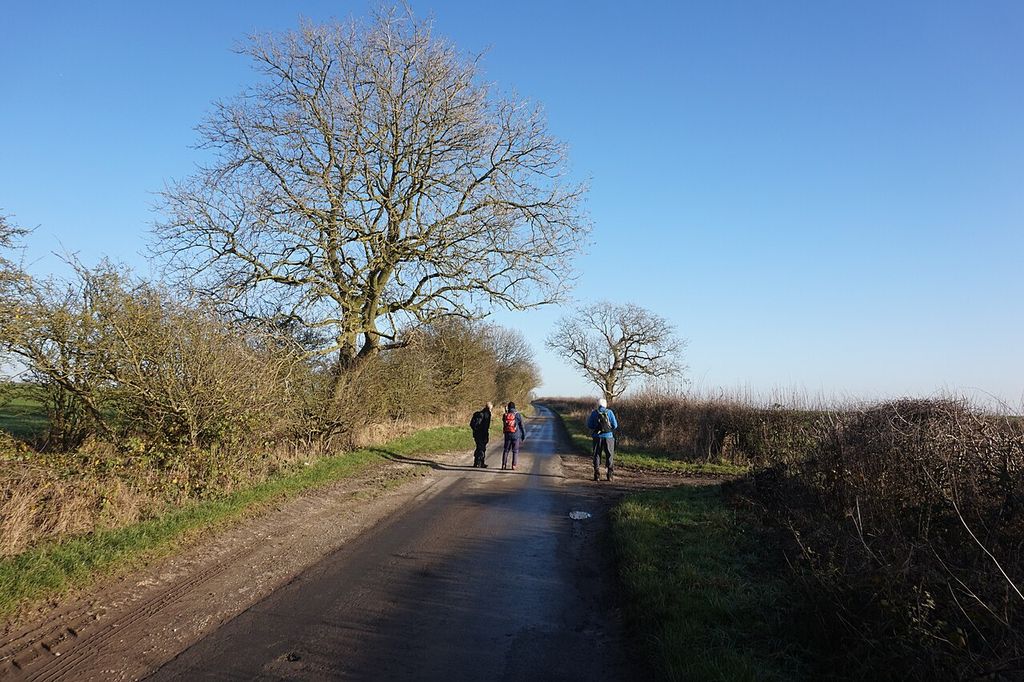
Geographic context: Woldgate towards Bridlington, photographed by Ian S. Ian S / Wikimedia Commons. Image source. CC BY-SA 2.0. Resized and converted to JPEG; no crop or recolouring. Image derivative retains CC BY-SA 2.0.
Lawrence Weschler’s account of visiting Hockney supplies an important context for this discipline. He described an artist increasingly concerned with the time between pictures, repeatedly returning to woodland paths and trees in different seasons. Bare winter branches helped Hockney understand the structures later concealed by foliage. The summer view depended on knowledge acquired when the tree looked quite different. Familiarity enlarged what he could see. [7]
The subject was close enough to revisit, allowing an accumulation of knowledge that a single excursion could scarcely provide. Hockney’s Yorkshire landscapes grew from this practical relationship between access, repetition and attention: the nearby scene remained available, but its appearance could never be held still.
In her discussion of the series, Museum of Contemporary Art Tokyo curator Ai Kusumoto followed its changes from winter’s remaining dead leaves and thin ice to the young growth of March and the increasingly dense greens of May. Her account locates its drama in gradual, observable alterations. More leaves change the balance between branch and background; deeper greens change the weight of vegetation; the same woodland begins to offer a different visual enclosure. [8]
The early spring of the oil painting
The painting focuses this extended experience on a particular stage of growth. Hockney explained that he wanted the sensation of very early spring, when leaves first appeared low on the trees and seemed suspended because their connecting branches were difficult to see. Fully developed foliage would have crowded the effect he wanted. The subject was the moment when spring had begun but had yet to fill the wood. [1]
That explanation gives the leaves a structural importance. They mark the season, but they also alter how the tree can be understood. A leaf has a definite shape; its attachment may be visually elusive. We recognise a living structure while seeing separate patches of new growth. The painting’s scale magnifies this delicate uncertainty. Something small enough to overlook during a walk becomes a feature around which an entire wall is organised.
The studio setting allowed accumulated observation to be organised across a large, assembled surface. The work’s relationship to outdoor experience runs through the selection and development of its subject, as well as through the associated drawings. The Pompidou’s account presents it as a gathering together of Hockney’s investigations across tablet drawing, film and painting. [4]
The grid gives that gathering a physical order. Its regular divisions coexist with a subject defined by irregular branching and growth. A viewer can notice the construction while following the woodland forms across it. This double awareness is useful: the image evokes an environment, while its canvas divisions keep the labour of making a large picture present. Hockney had already explored the possibilities of assembling an observed landscape in Bigger Trees near Warter. Here, the modular method serves an especially fleeting seasonal state.
What the iPad changed
The digital drawings were made with Steve Sprang’s original Brushes app. Hockney had begun using it on the iPhone in 2009 and moved to the iPad in 2010. This was the earlier software, preceding the bespoke Hockney Brushes developed by Reflex Arc principally in early 2018. The developer’s chronology distinguishes those tools, a useful reminder that Hockney’s long engagement with digital drawing involved changing software as well as changing subjects. [9]
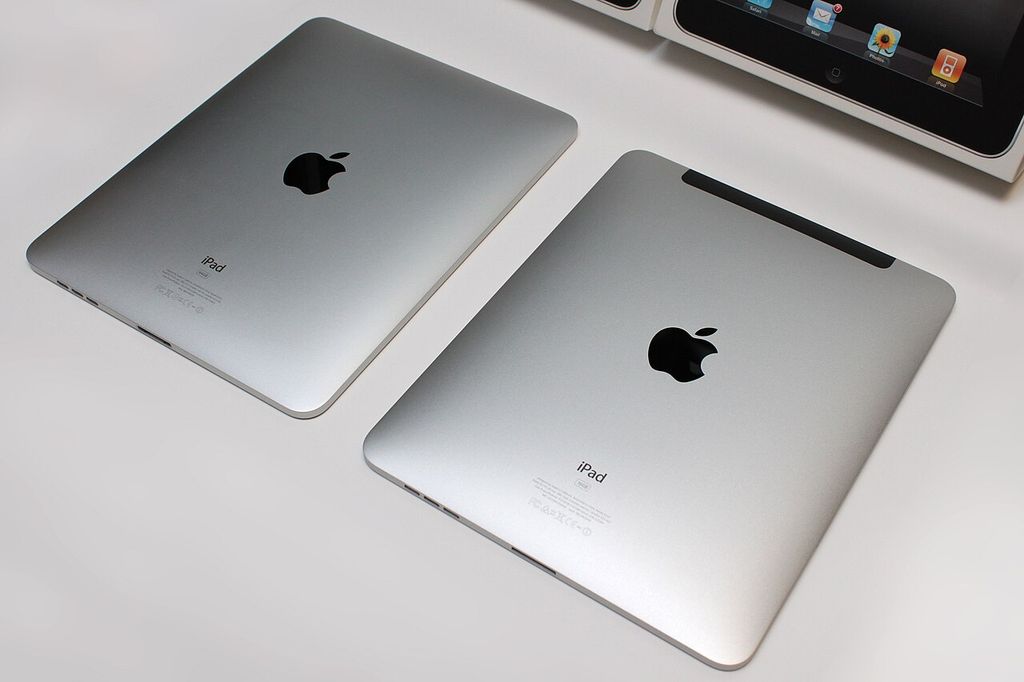
Drawing hardware: the backs of first-generation Wi-Fi and Wi-Fi + 3G iPads. Yutaka Tsutano / Wikimedia Commons. Image source. CC BY 2.0. Resized and converted to JPEG; no crop or recolouring.
The iPad suited a landscape whose light could shift rapidly. Hockney described establishing a palette quickly outdoors, then sometimes continuing in the studio, where he could see the screen more clearly. Observation and subsequent work belonged to one process. The speed of the initial encounter preserved useful colour relationships; further attention could develop what had been put down. [1]
The National Gallery of Victoria connected the Woldgate series with Hockney’s recognition of the possibilities of large-format inkjet printing. Its exhibition account also preserved his emphasis on East Yorkshire’s constant changes of light. The portable screen could respond to a brief condition, while the print could give that response a substantial presence on a gallery wall. Small-scale making and large-scale viewing became parts of the same practice. [10]
Kusumoto made a further distinction within his digital work. She described the 2011 Woldgate pictures as iPad drawings because of their improvised responses to changing scenes, contrasting them with the more elaborately layered development of a Normandy picture from 2020. This is a curatorial account of different working procedures. It draws attention to the directness of the Woldgate encounters while allowing the digital medium a wider range of uses. [11]
The project’s pairing of oil and digital work invites attention to what each method makes possible. Paint builds a physical surface across canvas; a digital drawing develops through marks on a luminous screen and can subsequently be printed. Neither process removes decisions about colour, emphasis or omission. Hockney’s iPad art extends those decisions into another medium, and Woldgate provides an unusually clear case because both methods address the same seasonal experience.
Looking closely at the digital marks
A drawing dated 25 April offers a more specific way into this language. In their study of Hockney’s digital art, Christian Johannessen and Theo van Leeuwen described a pale blue background, soft yellow-green volumes, branches that become sharper towards the foreground, and green, brown and blue dots suggesting foliage in sunlight. Their reading follows the way differences in edge, opacity and repetition establish depth. [12]
Such an account encourages looking beyond the broad category of bright colour. A softened patch can suggest vegetation further away, while a more definite linear mark brings a branch forward. Dots can gather into foliage without requiring every leaf to be separately outlined. The eye shifts between the marks as marks and the trees they describe. The path’s recession depends on this differentiation across the surface.
The scholars called one characteristic dotted trace a “peas-in-a-pod” brush, emphasising how a succession of circles could follow a gesture. Their analysis treats the digital mark as something with its own possibilities, including an evident regularity. The drawing can retain a traditional landscape organisation while making its electronic character visible. Their experimental reconstruction offers an interpretation of its effects, rather than a verified record of Hockney’s precise settings or order of work. [12]
Kusumoto’s broader account of Hockney supplies a helpful companion to this close reading. She stressed his pursuit of marks particular to different techniques, from etching and acrylic to photography and the iPad. The question was what a tool could contribute to a picture. In Woldgate, speed, repeated touches, clear colour and the ability to move from screen to print became resources for describing a landscape in change. [11]
From the screen to the wall
The printed drawings had a physical scale of their own. Bilbao’s press documentation lists 2 January and 12 April, No. 1 at 144.1 × 108 cm each. Those measurements refer to the specified exhibition prints, not to every later edition of every image. They show how far these works had travelled from the dimensions of the handheld device: each sheet was large enough to confront a standing viewer directly. [6]
Enlargement changes the encounter with a mark. A small movement made on a screen becomes a much larger shape on paper, available to inspection from across a room or at close range. Weschler described Hockney and his team exploring how crisply digital images could be transferred to paper at increasing size. The print was a deliberate destination for the drawing, requiring attention to the relationship between its marks and the surface on which they would be seen. [7]
A printed sequence also allows comparisons that a succession of images on one small screen makes differently. Viewers can retain one drawing in sight while glancing towards another. They can compare sparse branches with thicker vegetation, or a particular colour relationship with a neighbouring sheet. The gallery places separate moments into a shared physical field. The date attached to a drawing provides a temporal coordinate; the visible differences give that coordinate meaning.
A room to move through
The spring installation joined two viewing rhythms. The large oil sustained a broad, continuous field, while the separate prints established intervals. Looking could move across the painting, around the room and back towards an earlier drawing. The season’s progression therefore had a spatial form: changes encountered over months could be compared within a walk through a gallery.
Art historian Anthi-Danaé Spathoni’s study of Hockney’s moving landscapes offers a useful framework for this experience. She examined how multiple viewpoints and large formats invite participation, with the viewer’s eyes and body moving through the encounter. Her account also considers digital drawing, printing and the display of making over time. Applied to Woldgate, this approach draws attention to the visitor’s own duration: understanding the installation involves moving, comparing and returning. [13]
The room does not dictate one speed. A visitor might first be caught by the oil’s width, then slow down before an individual print. Another might trace the dated drawings before turning towards the painting. This freedom is part of the installation’s interest. The subject is seasonal time, but the experience depends on the time a viewer gives it. The same attention that built the project becomes an activity the exhibition can encourage.
Hockney’s related The Four Seasons, Woldgate Woods made the question of time explicit through video. The National Gallery of Victoria described each season as occupying nine high-definition screens. The filmed landscape unfolded at a given pace, while the spring prints let viewers make their own comparisons between separate moments. These were different works drawing on a shared interest in how a familiar wood changed, and in how an exhibition could give that experience a physical form. [10]
The Royal Academy and Bilbao
David Hockney: A Bigger Picture ran at the Royal Academy in London from 21 January to 9 April 2012. Reviewing the exhibition, Janet McKenzie defended its colour and formal invention while observing a practical difficulty: crowds made the largest works, including The Arrival of Spring, hard to appreciate within the available gallery space. Monumental scale required room for looking, and popularity could interfere with that requirement. [14]
McKenzie also singled out the saturated palette of The Arrival of Spring and Winter Timber. Her response helps explain the installation’s divisiveness. Colour could communicate the force of renewed growth, but its intensity also challenged expectations of a restrained English landscape. Adrian Searle rejected the iPad prints’ surfaces as lacking the physical character of paint. [14] [15]
The installation placed paint and printed digital marks within one encounter, giving viewers an opportunity to compare their effects. Its reception turned partly on how readily a viewer accepted an electronically generated mark as an expressive means of describing nature.
The exhibition travelled to the Guggenheim Bilbao, where it ran from 15 May to 30 September 2012. The museum described the spring installation occupying a large, irregular gallery, again with the oil surrounded by fifty-one printed iPad drawings. Its account connected this organisation with Hockney’s experience of opera-set design. It also identified three additional Woldgate paintings in the room. Those accompanying works were distinct from the fifty-one digital drawings. [6]
The theatrical comparison is illuminating without making the woodland an invented stage. Gallery architecture becomes part of the presentation: the painting commands one field of attention, and surrounding works extend the experience. The project carries a modest stretch of East Yorkshire into spaces built for public gathering. Its scale asks a familiar landscape to hold the attention usually granted to a more obviously spectacular subject.
A continuing museum life
The oil acquired another setting in 2019, when it became a highlight of Hockney–Van Gogh: The Joy of Nature at the Van Gogh Museum in Amsterdam, held from 1 March to 26 May. The museum’s annual report identified the Pompidou painting, its thirty-two canvases and its approximately 9.75-metre width. The exhibition placed Hockney’s Yorkshire landscapes within a sustained comparison with Van Gogh’s engagement with nature. [16]
The report also recorded Arrival of Spring LIVE, during which an image of the work was projected onto the Museumplein side of the building. This was an audiovisual presentation, distinct from the oil inside the museum. It added a public, architectural form to the work’s reception. The exhibition as a whole attracted nearly 360,000 visitors; that figure describes the complete show, rather than attendance before this individual painting. [16]
The comparison with Van Gogh brings attention back to the marks through which a place becomes visible. A landscape can preserve observation while displaying the means used to organise it. In Hockney’s spring project, the subject remains recognisable across changes of medium and scale. Each presentation nevertheless offers a different relationship between the viewer, the surface and the time represented.
Woldgate and the later springs
Hockney returned to the arrival of spring in different forms. The Arrival of Spring in 2013 (twenty thirteen) is a separate, twenty-five-part work in charcoal. The Foundation records five Woldgate views for which he waited for sufficient seasonal change before drawing again. That restriction makes an instructive comparison with 2011: sustained observation continued to generate new work through a change of medium and a different pattern of return. [17]
The Normandy projects belong to another place and period. La Grande Cour of 2019 is a panorama composed of twenty-four ink drawings, as identified by the Fondation Louis Vuitton’s curatorial account. The later Arrival of Spring, Normandy, 2020 consists of digital work made with the bespoke software developed after the Woldgate sequence; 116 pictures were shown at the Royal Academy in 2021. These projects extend the seasonal enquiry while retaining their own identities. [18] [9]
In A Year in Normandie, the long frieze gave changing seasons a continuous unfolding format. Kusumoto connected its viewing experience with Hockney’s interest in Chinese and Japanese scrolls and his encounter with the Bayeux embroidery. The viewer’s body again became central to how an extended landscape could be apprehended. Woldgate had already made seasonal observation an experience larger than a single view, although its arrangement combined a painting with separate, dated prints. [8]
Across these projects, spring remained a demanding subject because change had to be noticed before it could be drawn. The 2011 installation makes that demand generous and tangible. A leaf emerging low on a tree, a change in green or a newly crowded branch becomes worth sustained attention. Within Hockney’s landscape practice, Woldgate shows how much a familiar place could yield when observation was given time, and how widely that experience could open when brought into a room.
Works directory
This source-bounded directory combines the works in the Metropolitan Museum’s 2017 retrospective checklist with reviewed museum object records and the additional works and series examined in this guide. It spans several media and is not a complete catalogue raisonné. Titles without an article link remain useful dated records. Metropolitan Museum final retrospective checklist (2017); additional object and series sources are given in the linked articles. [2]
| Name | Date | Medium |
|---|---|---|
| Love Painting | 1960 | Painting |
| Shame | 1960 | Painting |
| The Third Love Painting | 1960 | Painting |
| Tyger Painting No. 2 | 1960 | Painting |
| A Rake’s Progress | 1961–63 | Print series |
| Tea Painting in an Illusionistic Style | 1961 | Painting |
| The Cha-Cha That Was Danced in the Early Hours of 24th March | 1961 | Painting |
| Cleaning Teeth, Early Evening (10pm) W11 | 1962 | Painting |
| Flight into Italy - Swiss Landscape (Painting in a Scenic Style) | 1962 | Painting |
| Man in a Museum (or You're in the Wrong Movie) | 1962 | Painting |
| My Brother is Only Seventeen | 1962 | Painting |
| The First Marriage (A Marriage of Styles I) | 1962 | Painting |
| Domestic Scene, Los Angeles | 1963 | Painting |
| Play Within a Play | 1963 | Painting |
| The Hypnotist | 1963 | Painting |
| Arizona | 1964 | Painting |
| California Art Collector | 1964 | Painting |
| Man in Shower in Beverly Hills | 1964 | Painting |
| Portrait Surrounded by Artistic Devices | 1965 | Painting |
| Rocky Mountains and Tired Indians | 1965 | Painting |
| Beverly Hills Housewife | 1966–67 | Painting |
| Medical Building | 1966 | Painting |
| Peter | 1966 | Drawing |
| Peter Getting Out of Nick’s Pool | 1966 | Painting |
| A Bigger Splash | 1967 | Painting |
| A Lawn Being Sprinkled | 1967 | Painting |
| Kasmin in Bed in His Chateau in Carennac | 1967 | Drawing |
| Peter Feeling Not Too Good | 1967 | Drawing |
| Savings and Loan Building | 1967 | Painting |
| The Room, Tarzana | 1967 | Painting |
| American Collectors (Fred and Marcia Weisman) | 1968 | Painting |
| Christopher Isherwood and Don Bachardy | 1968 | Painting |
| Henry Geldzahler and Christopher Scott | 1968-1969 | Painting |
| W. H. Auden | 1968 | Drawing |
| Peter Langan in His Kitchen at Odins | 1969 | Drawing |
| Mark Glazebrook | 1970 | Drawing |
| Mr and Mrs Clark and Percy | 1970-1971 | Painting |
| Ossie Wearing a Fairisle Sweater | 1970 | Drawing |
| Pool and Steps, Le Nid du Duc | 1971 | Painting |
| Rubber Ring Floating in a Swimming Pool | 1971 | Painting |
| Celia in a Black Dress with White Flowers | 1972 | Drawing |
| Mount Fuji and Flowers | 1972 | Painting |
| Portrait of an Artist (Pool with Two Figures) | 1972 | Painting |
| Portrait of the Artist's Mother, Mrs Laura Hockney, Bradford | 1972 | Drawing |
| The Artist's Father | 1972 | Drawing |
| Dr Eugene Lamb, Lucca | 1973 | Drawing |
| Andy, Paris | 1974 | Drawing |
| Contre-jour in the French Style (Against the Day dans le Style-Français) | 1974 | Painting |
| Gregory Sitting on Base of Column | 1975 | Drawing |
| Kerby (after Hogarth) Useful Knowledge | 1975 | Painting |
| Ron Kitaj Outside Akademie der Kunste Vienna | 1975 | Drawing |
| Kasmin Reading the Udaipur Guide | 1977 | Drawing |
| Looking at Pictures on a Screen | 1977 | Painting |
| My Parents | 1977 | Painting |
| Canyon Painting | 1978 | Painting |
| Mother, Bradford, 19 Feb. 1979 (inscribed 1978) | 1979 | Drawing |
| Mulholland Drive: The Road to the Studio | 1980 | Painting |
| Nichols Canyon | 1980 | Painting |
| Outpost Drive, Hollywood | 1980 | Painting |
| Hollywood Hills House | 1981-1982 | Painting |
| Celia. Los Angeles. April 10th 1982 | 1982 | Polaroid composite |
| Don + Christopher, Los Angeles, 6th March 1982 | 1982 | Polaroid composite |
| Gregory Swimming Los Angeles March 31st 1982 | 1982 | Polaroid composite |
| My Mother, Bolton Abbey, Yorkshire, Nov. 1982 | 1982 | Photocollage |
| Self Portrait 30th Sept. 1983 | 1983 | Drawing |
| Pearblossom Hwy., 11-18th April 1986, #1 | 1986 | Photocollage |
| Pearblossom Hwy., 11–18th April 1986, #2 | 1986 | Photocollage |
| Large Interior, Los Angeles | 1988 | Painting |
| Breakfast at Malibu, Sunday, 1989 | 1989 | Painting |
| Pacific Coast Highway and Santa Monica | 1990 | Painting |
| The Other Side | 1991-1993 | Painting |
| The Eleventh V. N. Painting | 1992 | Painting |
| The Twenty Sixth V. N. Painting | 1992 | Painting |
| The Road Across the Wolds | 1997 | Painting |
| 9 Canvas Study of the Grand Canyon | 1998 | Painting |
| A Bigger Grand Canyon | 1998 | Painting |
| Colorado River | 1998 | Painting |
| Garrowby Hill | 1998 | Painting |
| Colin St. John Wilson. London. 3rd June 1999 | 1999 | Drawing |
| Gregory Evans. Los Angeles. 18th September 1999 | 1999 | Drawing |
| Laura Huston. London. 22nd June 1999 | 1999 | Drawing |
| Lindy. Marchioness of Dufferin and Ava. London. 17th June | 1999 | Painting |
| Going Up Garrowby Hill | 2000 | Painting |
| Red Pots in the Garden | 2000 | Painting |
| A Closer Winter Tunnel, February - March | 2006 | Painting |
| Elderflower Blossom, Kilham, July 2006 | 2006 | Painting |
| The Road to Thwing, July 2006 | 2006 | Painting |
| Bigger Trees near Warter | 2007 | Painting |
| Hawthorn Blossom near Rudston | 2008 | Painting |
| Views Through the Artist's Bedroom Window, Bridlington | 2010-2013 | Digital animation |
| The Arrival of Spring in Woldgate, East Yorkshire in 2011 (twenty eleven) | 2011 | Painting / digital series |
| 82 Portraits and 1 Still-life | 2013–16 | Portrait series |
| Garden | 2015 | Painting |
| Garden with Blue Terrace | 2015 | Painting |
| Garden #3 | 2016 | Painting |
| A Bigger Interior with Blue Terrace | 2017 | Painting |
| Interior with Blue Terrace and Garden | 2017 | Painting |
| A Year in Normandie | 2020–21 | Digital frieze |
Discussion
Look again at the images and ideas explored in The Arrival of Spring in Woldgate. These editorial prompts invite your observations.
Reader Insights
How does knowing that the oil painting concentrates on the first low-growing leaves change your reading of its relationship with the longer digital sequence?
In the 25 April drawing, would you look first at the softened distance, the sharper branches or the dotted foliage? How might that choice affect your sense of depth?
Would you prefer to follow the fifty-one prints in date order or move freely between them and the oil? What would each approach reveal about seasonal change?
Join the Conversation
Share a detail, comparison or question about The Arrival of Spring in Woldgate below.
References
- The David Hockney Foundation. “2011,” sections “The Arrival of Spring in 2011” and “Drawing on the iPad.” View source.
- The Metropolitan Museum of Art, David Hockney, final exhibition checklist, 15 November 2017. View source.
- The David Hockney Foundation, 2021 chronology. View source.
- Centre Pompidou. The Arrival of Spring in Woldgate, East Yorkshire in 2011 (twenty eleven), collection record, inventory AM 2018-988; object description and acquisition information. View source.
- The David Hockney Foundation. “The Arrival of Spring in Woldgate, East Yorkshire in 2011 (twenty eleven)”, 2011, artwork record. View source.
- Guggenheim Museum Bilbao. David Hockney: A Bigger Picture, English press dossier, 2012, PDF pp. 3–6, 7 and 10. View source.
- Lawrence Weschler. “Why David Hockney Has a Love-Hate Relationship With Technology,” Smithsonian, September 2013, sections “Looking Deeper, Seeing More” and “iPaint.” View source.
- Tamaki Sugihara, interviewing Ai Kusumoto. “混迷から新境地へ。巨匠ホックニーが喜びに満ちた作品に辿り着くまで。「デイヴィッド・ホックニー展」担当学芸員が徹底解説!【後編】” [From difficulty to new possibilities: curator’s interview, part two], Tokyo Art Beat, 22 September 2023. View source.
- Reflex Arc. “The iPad painting app we built for David Hockney,” sections “Before the app,” “Which app, when,” “Hockney Brushes, 2018” and “The spring paintings, 2020.” View source.
- National Gallery of Victoria. David Hockney: Current, 11 November 2016–13 March 2017, exhibition themes “The Arrival of Spring in Woldgate” and “Yosemite National Park.” View source.
- Tamaki Sugihara, interviewing Ai Kusumoto. “ホックニーはなぜ評価と人気を60年も獲得し続けられたのか?「デイヴィッド・ホックニー展」担当学芸員が徹底解説!【前編】” [Curator’s interview on Hockney’s sustained reputation and popularity, part one], Tokyo Art Beat, 25 August 2023, sections on marks and medium-specific techniques. View source.
- Christian Johannessen and Theo van Leeuwen. “Art as Research in Semiotic Technology: The Case of David Hockney’s Digital Art,” in Mediation and Multimodal Meaning Making in Digital Environments (Routledge, 2022), accepted manuscript pp. 11–13 (PDF pp. 12–14). View source.
- Anthi-Danaé Spathoni. “David Hockney’s Moving Landscapes,” Revista de História da Arte, Série W, no. 11, April 2022, pp. 95–103, especially pp. 100–102. View source.
- Janet McKenzie. “David Hockney: A Bigger Picture,” Studio International, 23 February 2012, passages on the Royal Academy installation, colour and viewing conditions. View source.
- Adrian Searle. “David Hockney landscapes: The wold is not enough,” The Guardian, 16 January 2012, passage on the Arrival of Spring prints. View source.
- Van Gogh Museum. Annual Report 2019, pp. 8–9 (PDF p. 6), “Hockney–Van Gogh: The Joy of Nature.” View source.
- The David Hockney Foundation. “2013,” section “The Arrival of Spring in 2013 (twenty thirteen).” View source.
- Fondation Louis Vuitton. David Hockney 25, 9 April–1 September 2025, curatorial introduction, Normandy galleries and La Grande Cour. View source.
More HOCKNEY Works
A Bigger Splash
A momentary disturbance becomes the focus of a large acrylic painting, made through weeks of patient work.
Mr and Mrs Clark and Percy
The designers Celia Birtwell and Ossie Clark occupy a room shaped by light, repeated sittings and the demands of a double portrait.
A Bigger Grand Canyon
Sixty canvases gather memory, studies and changing viewpoints into an immense painting of 1998.
Garrowby Hill
The 1998 oil painting transforms a remembered Yorkshire journey into a road, fields and an expansive view.
Portrait of an Artist (Pool with Two Figures)
Photographic studies, two figures and a swimming pool become a carefully constructed painting of 1972.
My Parents
The 1977 oil painting sets Kenneth and Laura Hockney within a quietly organised interior.
Pearblossom Hwy., 11–18th April 1986, #2
Hundreds of separately made photographs construct a road scene that unfolds through movement and time.
Bigger Trees near Warter
Fifty canvases join into a large outdoor painting of Yorkshire trees, with photography helping the artist organise the whole.