


 by Tom Gurney
Tom Gurney BSc (Hons) is an art history expert with over 20 years experience
Email: tomgurney1@gmail.com / Phone: +44 7429 011000
David Hockney’s Style and Techniques: Introduction
A thin line around a face, a turquoise swimming pool, a road that bends towards us and a landscape drawn on a luminous screen can all be recognisably David Hockney. Yet the resemblance is difficult to reduce to a single style. Across painting, drawing, printmaking, photography and video, he changed the means by which a picture could describe the world. The Metropolitan Museum of Art framed this continuing enquiry around movement, space and time: the problem was how to give an experience with three dimensions and duration a life on a flat surface. [1]
Hockney’s techniques become clearer when we ask what each choice makes possible. A spare outline can concentrate attention on a person’s posture. Pattern can turn a transparent pool into a visible surface. Several views can bring a room closer to the experience of turning our head inside it. The links between these decisions matter as much as their differences. His work repeatedly invites us to notice that looking takes time, and that a picture is an arrangement of choices through which another person’s looking becomes available to us.
At a Glance
- ArtistDavid Hockney
- Born9 July 1937, Bradford, England
- Died11 June 2026
- FocusStyle and Techniques
Contents
- Why one style is inadequate
- Line, flatness and the space around a figure
- Water, light and the work colour does
- A landscape remembered as movement
- Multiple viewpoints and the time inside a picture
- Reverse perspective, Cubism and scrolls
- What printmaking and collaboration changed
- An optical aid and the artist’s decisions
- Landscape, screens and changing kinds of attention
- Looking beyond a formula
Why one style is inadequate
Hockney made stylistic variety an explicit part of his early work. At the 1962 Young Contemporaries exhibition, he grouped four paintings under the title Demonstrations of Versatility. The Tate and Musée Granet exhibition guide explains this as the discovery that styles could be selected, abandoned or combined within one picture. Such a decision has consequences beyond appearance. A painting can move between a figure, an abstract pattern and an illusionistic object without pretending that these share a single pictorial language. The joins between them can become part of its subject. [2]
The example of Picasso helped make this freedom imaginable. In 1960 he encountered the large Picasso exhibition at Tate, having also experimented briefly with the Abstract Expressionism admired by fellow students at the Royal College of Art. His recollections describe the difficulty of bringing the figure back into a setting where abstraction carried considerable authority. Words helped him make a picture’s feeling more specific. In the early love paintings, writing, simplified bodies and abstract shapes could occupy the same surface. The language asks to be read as well as seen, drawing a viewer closer to the canvas. [3]
This matters when considering Hockney’s association with Pop Art. References to contemporary life do not explain every later choice of medium or form. The early paintings already establish a practice in which an artist could borrow a convention because it served a particular purpose. Stylistic change need not mean that the previous work had failed. A picture organised around an intimate encounter might require a different kind of attention from a vast landscape or a view assembled from photographs.
In her 2023 interview with Tamaki Sugihara, Museum of Contemporary Art Tokyo curator Ai Kusumoto describes a related continuity: Hockney’s interest in the particular marks that each medium could make. Her exhibition paired a 1969 etching and aquatint of flowers with an iPad flower picture made half a century later. The subject endured while the means of describing it changed. That distinction is useful throughout his work. Recognising a Hockney involves attending to how he approached a subject, as well as identifying a palette or a familiar motif. [4]
Line, flatness and the space around a figure
Line in Hockney can be economical without being neutral. A contour decides where a body meets the paper, how an arm turns and where an interval remains open. The Cavafy etchings offer a particularly clear example. Hockney made preparatory drawings in Beirut in 1966 and worked on the prints in London with Maurice Payne. Their delicate lines describe intimate encounters between men inspired by C. P. Cavafy’s poetry. The restrained drawing gives relationships a visible setting without requiring a densely modelled interior. [5]
The unmarked paper participates in this effect. When a few contours establish a bed, a wall or a shoulder, the eye completes connections across empty areas. A line can describe the edge of something solid while remaining plainly a line on a sheet. The Tate and Granet guide connects the sparse drawing of the Cavafy prints to the clarity of the poems, and describes the economy through which a few items can establish a place. This is a chosen degree of description: the picture concentrates what it tells us. [2]
Drawing remained a foundation across Hockney’s changes of medium. The National Portrait Gallery emphasises his continued observational practice and his repeated return to a small group of sitters. Familiar people provided subjects whose appearances could be studied over decades. A portrait could therefore arise from accumulated acquaintance as well as the particular sitting. This also makes comparison revealing. Differences in line, colour and the amount of surrounding space become easier to notice when the person recurs. [6]
Flatness was something Hockney could actively construct. In Tea Painting in an Illusionistic Style (1961), even the canvas’s outline became part of the drawing. His recollection, preserved by the Foundation, explains how he built the stretcher in sections to suggest the shape of a tea packet. The support does some of the representational work usually assigned to painted lines. Its physical shape and the illusion on its face become interdependent. He also remembered misspelling the very short word on the packet while concentrating on its perspective. The anecdote brings the problem into focus: a familiar commercial object had become an intricate negotiation between lettering, shape, flatness and implied depth. [7]
The number of visible marks can be small while the relationships they establish remain complex. An outline can withhold volume, colour can assert the surface, and a recognisable object can still make us aware of how it has been translated into a picture.
Water, light and the work colour does
Water offered Hockney a subject with no fixed outline or reliable local colour. It could be transparent, reflective, patterned by sunlight or briefly thrown into the air. Matthew Sperling’s Apollo essay distinguishes several responses in the pool paintings: wavering white lines in works such as Peter Getting Out of Nick’s Pool (1966), and patches of interlocking colour in Picture of a Hollywood Swimming Pool (1964). These are different visual vocabularies for an unstable subject. A pool provides an architectural container, while its surface unsettles the certainty of that container. [8]
The contrast becomes especially concentrated in A Bigger Splash (1967). Broad, still geometric areas make the burst of water conspicuous. The splash is legible because its irregular, dispersed marks interrupt a much quieter arrangement. Sperling relates the slow, detailed making of this passage to the speed of the event it represents. Looking at the painting brings together two kinds of time: the instant of disruption and the extended work required to make that instant remain visible. [8]
Hockney himself stressed this discrepancy. The Foundation preserves his account of spending weeks painting something that existed for seconds, and his argument that a painted splash has a different effect because a viewer knows it was made slowly. The duration of making becomes part of the encounter with the finished picture. In the same year, A Lawn Being Sprinkled also explored water’s transparent and reflective properties in light. A splash and a repeated spray set different tasks: one concentrates a sudden disturbance, while the other makes an ongoing action available as an ordered pattern. [9]
His arrival in Los Angeles in 1964 brought several tools and subjects together. He made his first painting there, Plastic Tree Plus City Hall, in acrylic, and began both his pool pictures and his use of Polaroid photography. The new environment and the new materials overlapped. The paintings gave Californian light a particular structure through selected colours, edges and intervals. [10]
Colour also works relationally in portraiture. LACMA’s account of 82 Portraits and 1 Still-life describes acrylic paintings of a consistent size, largely made between 2013 and 2016, with sitters in the same yellow armchair. Hockney adjusted the blue background in relation to their clothes. The repeated arrangement exposes differences: a sleeve, a trouser leg or a patch of skin changes the balance of the surrounding colours. Each sitting extended over several days, a duration Hockney compared to an exposure of about twenty hours. Colour and sustained observation worked together within a deliberately restricted format. [11]
A landscape remembered as movement
Space in Hockney is often organised by an experience of travelling through it. Mulholland Drive: The Road to the Studio (1980), an acrylic painting more than six metres wide, is a particularly concrete example. Its panoramic map follows his journey from the Hollywood Hills to his studio on Santa Monica Boulevard, as LACMA’s account explains. Painted from memory, it alternates details of houses, trees, courts and power lines with grids and broader planes of colour. The road moves across its upper area, directing the eye sideways while conveying altitude and motion. [12]
The different kinds of description have distinct jobs. A small, identifiable house offers a point at which to pause. A grid carries a larger stretch of built space with fewer marks. A broad coloured area can hold the whole together while allowing the gaze to travel quickly across it. The painting gives detail an uneven distribution, as a remembered journey does. We encounter a succession of places and changes in attention, assembled into a single field.
Art historian Anthi-Danaé Spathoni reads such works as participatory landscapes: the viewer’s movement and the time needed to follow a route contribute to the picture’s effect. In her account, ideas developed through one medium could pass into another, enriching landscape painting through experiments with cameras and composite images. Her interpretation puts the viewer’s activity beside the artist’s. A winding route offers more than a sign of distance. It establishes a sequence that our eyes can follow. [13]
The distinction between a remembered itinerary and a fixed view also helps explain why distortions can feel purposeful. A bend may become more pronounced, or a stretch of terrain more expansive, because the picture gives that part of the journey a particular weight. The relevant question is what the arrangement enables us to experience. Measuring it against a single photographic position would test only one possible way of making a landscape.
Multiple viewpoints and the time inside a picture
The increasingly naturalistic double portraits of the late 1960s and early 1970s were one phase within this enquiry. Kusumoto interprets the subsequent change as an extended response to the limitations Hockney felt in naturalism. She connects renewed, patient drawing in Paris with his rediscovery of Picasso through work with printer Aldo Crommelynck, his involvement with theatre, and his encounters with Japanese and Chinese art. A change in pictorial space emerged through these interacting kinds of work and looking. [14]
The photographic composites made in 1982 allowed him to test spatial questions with the camera itself. He rapidly adopted instant Polaroid prints to assemble several views in one work. Hockney related the results to Cubism and recognised that the pieces did not need to match seamlessly. An edge that shifts between prints can make us aware that the camera has moved. The whole is assembled from separate acts of looking, whose differences remain visible. [15]
Getty’s 2017 exhibition labels identify the Polaroid SX-70 and explain how Hockney assembled its prints into grids. Their account connects his objection to the static, isolated photographic moment with his effort to put time and his own presence into a picture. The resulting image can hold a succession of viewpoints where a single exposure supplies one. Combining photographs enabled him to work within the medium while questioning the conventions of an isolated view. [16]
The gaps and repetitions affect reading. We can register the larger subject, then move across its individual components and notice the mismatch between them. Recognition is followed by reconstruction. Time enters both through the making of the separate photographs and through our effort to relate them. These experiments in Hockney’s photography and joiners expanded his thinking about pictures across media.
In Walking in the Zen Garden at the Ryoanji Temple, Kyoto, Feb. 1983, the photographer’s movement becomes especially explicit. His feet appear across the bottom of the collage. He explained that moving between positions enabled him to make a rectangular view where a single view would have produced a triangular one. The composition is a constructed encounter with the garden. His position belongs inside the work’s account of space. [17]
Reverse perspective, Cubism and scrolls
Multiple perspective combines views from more than one position. Reverse perspective makes a different intervention: instead of asking spatial lines to converge towards a distant point within the picture, it can organise them as though their convergence lay on the viewer’s side. Kunstmuseum Luzern uses the table in the 1984 lithograph Amaryllis in Vase to explain this reversal. A domestic object becomes a means of reconsidering where we stand in relation to the image. [18]
A table whose far side opens out resists the familiar contraction into depth. It emphasises breadth and makes the activity of looking across it conspicuous. Hockney’s challenge to perspective remained a concern with how to represent space.
Luzern connects this enquiry with Cubism and Chinese scroll painting. Each offered a different model for bringing several views together. A Cubist construction can combine different aspects of a motif within one field. A scroll can unfold a landscape or story through changing viewpoints and moments, with viewing itself extending through time. The connection is especially useful for understanding Hockney’s interest in a picture through which the gaze can travel. Its length, arrangement and sequence become part of its account of the world. [18]
Kusumoto likewise stresses the spectator’s body when discussing his multiple and reverse perspectives. She relates the later long Normandy frieze to his interest in East Asian scrolls and to his renewed encounter with the Bayeux embroidery. The comparison concerns ways of moving through an image and experiencing its duration. The particular format and the viewer’s passage along it remain essential to understanding each work. [14]
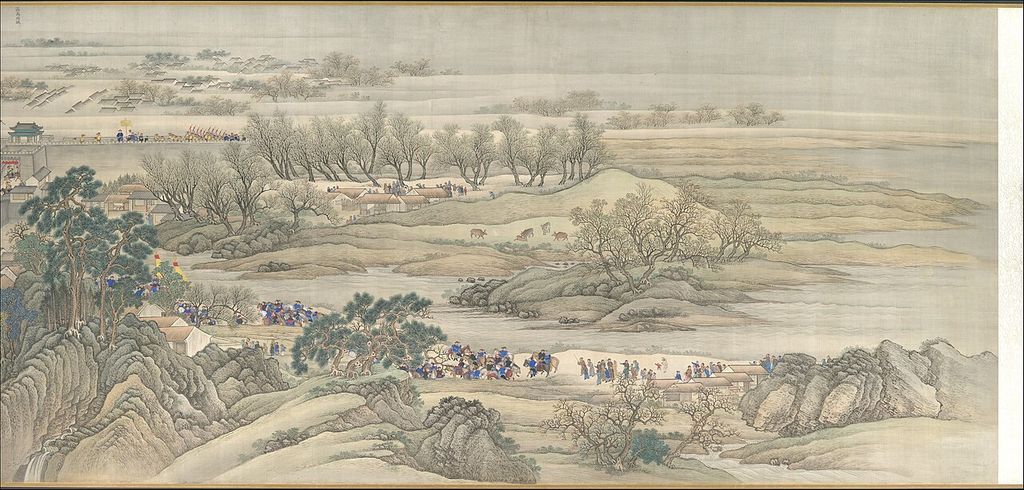
Handscroll comparison: Wang Hui and assistants, The Kangxi Emperor’s Southern Inspection Tour, Scroll Three: Ji’nan to Mount Tai, datable to 1698, Metropolitan Museum of Art. Wang Hui and assistants / The Metropolitan Museum of Art / Wikimedia Commons. Image source. CC0 / Public domain. Resized and converted to JPEG; no crop or recolouring.
The theatre gave these questions a physical setting. For the 1978 Glyndebourne production of The Magic Flute, Hockney chose painted flats that moved in and out. In his account preserved by the Foundation, he connected their clarity, colour and changing arrangement with Mozart’s music. An opening rocky landscape drew on Italian painting, while its dragon came from Uccello. The production placed recognisably painted forms within a space shared by moving performers and a seated audience. Thinking about what a spectator could see from a real seat gave the relationship between a flat image and a surrounding space another practical dimension. [19]
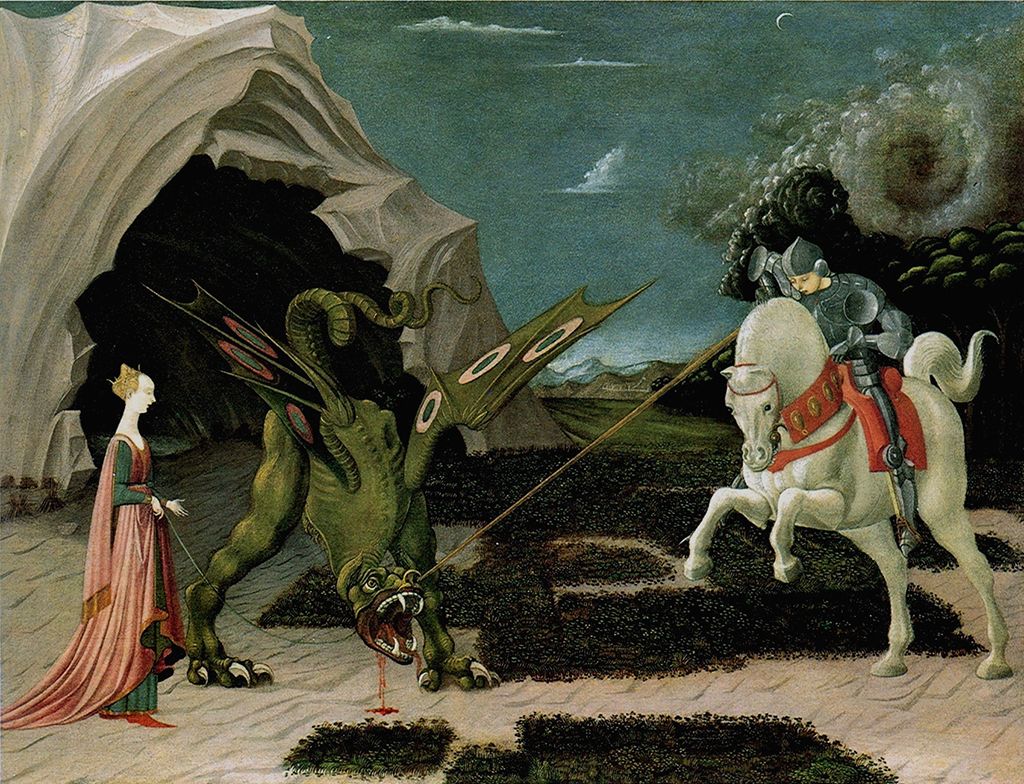
Paolo Uccello, Saint George and the Dragon, about 1470, National Gallery, London, NG6294. Hockney named Uccello’s dragon when describing The Magic Flute designs.
What printmaking and collaboration changed
The choice of a printing process could determine where Hockney drew and how colour accumulated. Luzern’s technical account explains that, for his lithographs, he could draw on special transparent sheets whose images were transferred photographically to printing plates. Separate sheets carried the different colours. This allowed drawn marks to become components in a carefully registered, layered image. The apparent immediacy of a line on the final sheet could therefore coexist with a complex sequence of workshop decisions. [20]
The Hotel Acatlán prints make this practical freedom spatially significant. Writing for the National Gallery of Australia in 2019, David Greenhalgh describes Tyler’s portable drawing pad of textured, near-transparent Mylar. It could hold lithographic drawing materials, with separate sheets used for colours. At the Mexican hotel, Hockney moved his working position along the veranda and into the courtyard. The equipment made that mobility possible. Greenhalgh also distinguishes the earlier sketches towards an oil painting from the subsequent return with Tyler to work on prints. The same courtyard gave rise to distinct objects through different processes. [21]
Paper presented a more fundamental possibility in Paper Pools (1978). In the contemporary account republished by the Crafts Council, Hockney explained that colour became part of the sheet while it was being made. He found that the pulp required bold treatment and connected its watery character with the swimming pool at Tyler’s workshop. The published workshop account describes coloured pulp placed within metal moulds, followed by freer additions and pressing. Hockney’s decisions about scale and simplified form developed in response to the material. [22]
Collaboration belonged to the making of these objects. The Crafts account names Tyler and papermaker Lindsay Green alongside other workshop contributors. Their work enabled experiments in colour, moulds and the formation of sheets. Here the support itself was an image-bearing material: the colour did not merely sit on finished paper. Understanding that distinction changes how we read a patch of blue or the boundary of a pool. The visible form records choices made within a specific process. [22]
The office photocopier offered a different balance of control and assistance. Hockney could change coloured cartridges, enlarge or reduce elements, repeat them and scan objects directly, as the Foundation’s account of 1986 explains. His Home Made Prints let him move between such operations in his studio without a printer assisting at every stage. A machine commonly used to duplicate existing information became a means of constructing original images. The attraction lay partly in how quickly a new decision could become visible. [23] His printmaking therefore embraces several relationships between hand, machine, material and workshop, each with its own pace.
An optical aid and the artist’s decisions
Hockney’s camera lucida portraits provide a precise example of how an instrument entered his drawing. In 1999 he worked with the device after studying Ingres’s portraits. As he explained, it produced a visual illusion in the eye, requiring rapid notations of the positions of features. Moving his head disturbed the alignment. Acquiring the instrument did not remove the demands of observation and coordination. [24]
The Fitzwilliam Museum’s Hockney’s Eye labels explain the mechanism: a prism lets the operator see the subject and the drawing surface together. Its account of Hockney’s portraits states that he used it briefly to place key features and expression, then completed the drawings by eye. The resulting work combined an optical reference with freehand drawing. What matters stylistically is the division of decisions: an initial relationship of features could be established through the aid, while the drawing’s further articulation remained his work. [25]
This documented practice should be kept distinct from his historical proposition about Ingres. The Fitzwilliam labels explicitly note the absence of documentary evidence that Ingres used the instrument. Hockney’s own experiment shows what he did with an aid; it cannot by itself establish another artist’s method. The wider historical argument is considered in Secret Knowledge and the optics debate. [25]
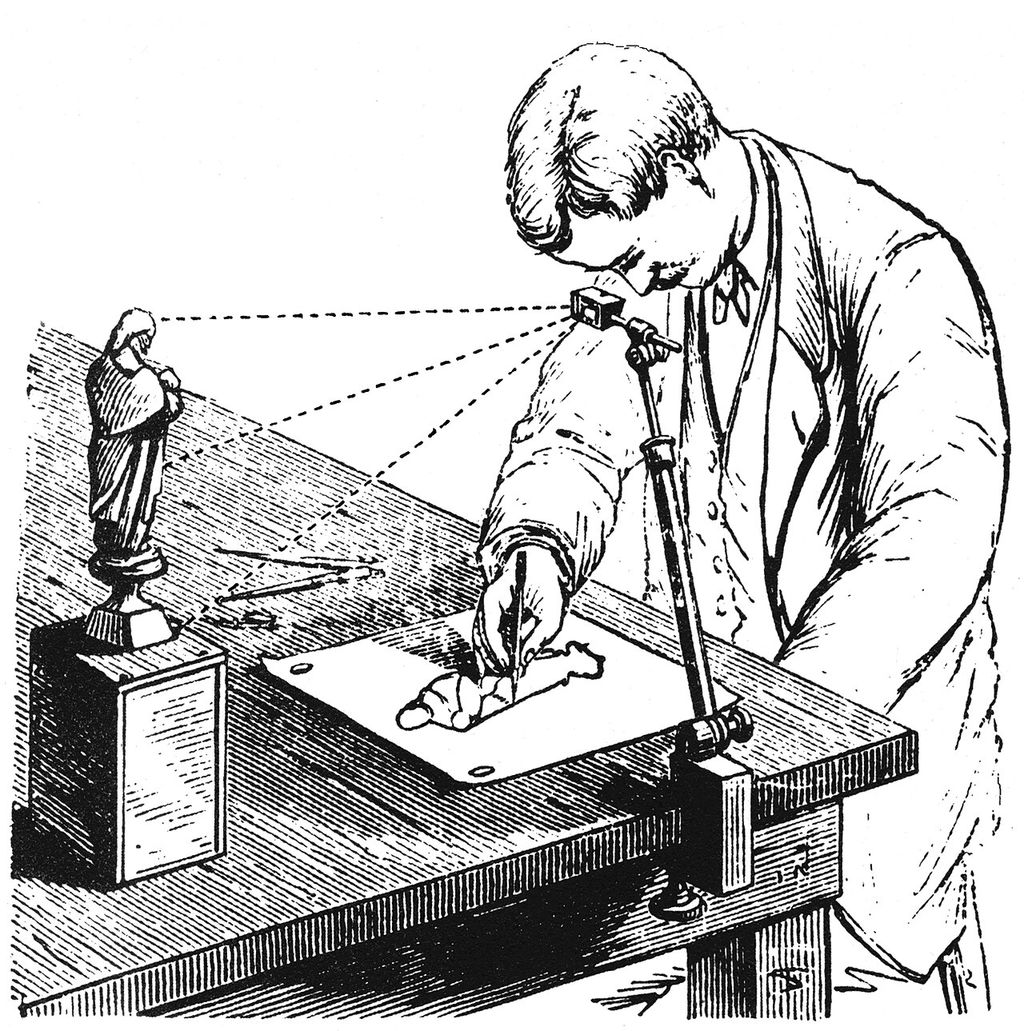
A camera lucida illustrated in Scientific American Supplement, 11 January 1879. Unidentified illustrator / Scientific American Supplement (1879) / Wikimedia Commons. Image source. Public domain. Resized and converted to JPEG; no crop or recolouring.
Landscape, screens and changing kinds of attention
The speed of a medium could alter the demands of looking. In his 2013 account, Lawrence Weschler describes Hockney’s intensive Yorkshire watercolour studies of 2004 and the return to those places in oil in 2005. He relates the difficulty of revising watercolour to the need for attentive initial observation. The sequence illustrates a passage between media in which the earlier work sharpened looking for the next. Weschler’s account also describes multi-camera video as an extension of the composite picture: several screens offered simultaneous views and allowed attention to move between them. [26]
Digital photography could also serve a painting’s practical construction. For Bigger Trees near Warter (2007), photographs helped Hockney plan and see the growing whole of fifty canvases painted outdoors. His preliminary drawings guided the positioning of individual canvases within the composition. A large work required close observation of branches and a means of keeping track of their place within a much larger field. The computer and camera supported the organisation of the outdoor painting. [27]
The 2011 Arrival of Spring project makes the overlap of media particularly clear. Hockney made more than a hundred iPad drawings of the East Yorkshire landscape as winter changed into summer. The Royal Academy installation brought fifty-one selected drawings, printed on paper, together with a painting on thirty-two canvases. Hockney wanted to catch the moment when the first leaves appeared low on the trees. The project combines the time within a single observation with changes registered through repeated visits. [28]
Screens brought their own possibilities. Weschler describes the practical advantage of drawing a dawn on a luminous phone: Hockney could see his working surface without turning on a lamp that overwhelmed the faint light outside. A tool’s physical character could make a particular subject more accessible. Its value arose from a specific working problem. [26]
The screen also changes colour’s material basis. The Fitzwilliam labels connect Hockney’s range of greens to emitted light. A printed version is encountered through light reflected from paper, so a digital drawing can have a different physical presence on screen and on a wall. [25]
The marks themselves could also change. Kusumoto describes Hockney working with a developer to devise digital brushes whose repeated small forms served several subjects. A mark used for grass could also describe a roof. Her account distinguishes relatively immediate iPad drawings from more layered iPad paintings. In either case, the application became an instrument whose vocabulary he selected and developed. [4] Such decisions give Hockney’s iPad art its particular character.
Looking beyond a formula
To analyse a Hockney, begin with the particular object and what it asks of the eye. Identify the medium, then consider what its marks are doing. A line may describe an edge, establish a rhythm or connect two areas. Colour may model a solid form, flatten it into pattern or make a passage advance within the composition. A visible join may preserve the difference between separate views. Scale may require the body to move before the picture’s relationships become clear.
Next consider the kind of time involved. A splash represents an instant through patient work. A portrait develops through sustained attention to a sitter. A composite photograph brings several moments into one arrangement, while a seasonal series makes change visible between images. These distinctions prevent the broad idea of “time” from becoming an explanation that fits everything equally. Each work gives it a particular form.
Finally, look at the relation between the picture’s space and your own. Does a road lead inward, move sideways or spread towards you? Does a table organise one stable view or invite several? Where does detail ask you to pause? Such questions bring the different parts of Hockney’s practice into conversation without turning them into a recipe. His paintings and works in other media reward attention to individual decisions: the chosen mark, the constructed interval and the movement through which a world becomes a picture.
Works directory
This source-bounded directory combines the works in the Metropolitan Museum’s 2017 retrospective checklist with reviewed museum object records and the additional works and series examined in this guide. It spans several media and is not a complete catalogue raisonné. Titles without an article link remain useful dated records. Metropolitan Museum final retrospective checklist (2017); additional object and series sources are given in the linked articles. [29]
| Name | Date | Medium |
|---|---|---|
| Love Painting | 1960 | Painting |
| Shame | 1960 | Painting |
| The Third Love Painting | 1960 | Painting |
| Tyger Painting No. 2 | 1960 | Painting |
| A Rake’s Progress | 1961–63 | Print series |
| Tea Painting in an Illusionistic Style | 1961 | Painting |
| The Cha-Cha That Was Danced in the Early Hours of 24th March | 1961 | Painting |
| Cleaning Teeth, Early Evening (10pm) W11 | 1962 | Painting |
| Flight into Italy - Swiss Landscape (Painting in a Scenic Style) | 1962 | Painting |
| Man in a Museum (or You're in the Wrong Movie) | 1962 | Painting |
| My Brother is Only Seventeen | 1962 | Painting |
| The First Marriage (A Marriage of Styles I) | 1962 | Painting |
| Domestic Scene, Los Angeles | 1963 | Painting |
| Play Within a Play | 1963 | Painting |
| The Hypnotist | 1963 | Painting |
| Arizona | 1964 | Painting |
| California Art Collector | 1964 | Painting |
| Man in Shower in Beverly Hills | 1964 | Painting |
| Portrait Surrounded by Artistic Devices | 1965 | Painting |
| Rocky Mountains and Tired Indians | 1965 | Painting |
| Beverly Hills Housewife | 1966–67 | Painting |
| Medical Building | 1966 | Painting |
| Peter | 1966 | Drawing |
| Peter Getting Out of Nick’s Pool | 1966 | Painting |
| A Bigger Splash | 1967 | Painting |
| A Lawn Being Sprinkled | 1967 | Painting |
| Kasmin in Bed in His Chateau in Carennac | 1967 | Drawing |
| Peter Feeling Not Too Good | 1967 | Drawing |
| Savings and Loan Building | 1967 | Painting |
| The Room, Tarzana | 1967 | Painting |
| American Collectors (Fred and Marcia Weisman) | 1968 | Painting |
| Christopher Isherwood and Don Bachardy | 1968 | Painting |
| Henry Geldzahler and Christopher Scott | 1968-1969 | Painting |
| W. H. Auden | 1968 | Drawing |
| Peter Langan in His Kitchen at Odins | 1969 | Drawing |
| Mark Glazebrook | 1970 | Drawing |
| Mr and Mrs Clark and Percy | 1970-1971 | Painting |
| Ossie Wearing a Fairisle Sweater | 1970 | Drawing |
| Pool and Steps, Le Nid du Duc | 1971 | Painting |
| Rubber Ring Floating in a Swimming Pool | 1971 | Painting |
| Celia in a Black Dress with White Flowers | 1972 | Drawing |
| Mount Fuji and Flowers | 1972 | Painting |
| Portrait of an Artist (Pool with Two Figures) | 1972 | Painting |
| Portrait of the Artist's Mother, Mrs Laura Hockney, Bradford | 1972 | Drawing |
| The Artist's Father | 1972 | Drawing |
| Dr Eugene Lamb, Lucca | 1973 | Drawing |
| Andy, Paris | 1974 | Drawing |
| Contre-jour in the French Style (Against the Day dans le Style-Français) | 1974 | Painting |
| Gregory Sitting on Base of Column | 1975 | Drawing |
| Kerby (after Hogarth) Useful Knowledge | 1975 | Painting |
| Ron Kitaj Outside Akademie der Kunste Vienna | 1975 | Drawing |
| Kasmin Reading the Udaipur Guide | 1977 | Drawing |
| Looking at Pictures on a Screen | 1977 | Painting |
| My Parents | 1977 | Painting |
| Canyon Painting | 1978 | Painting |
| Mother, Bradford, 19 Feb. 1979 (inscribed 1978) | 1979 | Drawing |
| Mulholland Drive: The Road to the Studio | 1980 | Painting |
| Nichols Canyon | 1980 | Painting |
| Outpost Drive, Hollywood | 1980 | Painting |
| Hollywood Hills House | 1981-1982 | Painting |
| Celia. Los Angeles. April 10th 1982 | 1982 | Polaroid composite |
| Don + Christopher, Los Angeles, 6th March 1982 | 1982 | Polaroid composite |
| Gregory Swimming Los Angeles March 31st 1982 | 1982 | Polaroid composite |
| My Mother, Bolton Abbey, Yorkshire, Nov. 1982 | 1982 | Photocollage |
| Self Portrait 30th Sept. 1983 | 1983 | Drawing |
| Pearblossom Hwy., 11-18th April 1986, #1 | 1986 | Photocollage |
| Pearblossom Hwy., 11–18th April 1986, #2 | 1986 | Photocollage |
| Large Interior, Los Angeles | 1988 | Painting |
| Breakfast at Malibu, Sunday, 1989 | 1989 | Painting |
| Pacific Coast Highway and Santa Monica | 1990 | Painting |
| The Other Side | 1991-1993 | Painting |
| The Eleventh V. N. Painting | 1992 | Painting |
| The Twenty Sixth V. N. Painting | 1992 | Painting |
| The Road Across the Wolds | 1997 | Painting |
| 9 Canvas Study of the Grand Canyon | 1998 | Painting |
| A Bigger Grand Canyon | 1998 | Painting |
| Colorado River | 1998 | Painting |
| Garrowby Hill | 1998 | Painting |
| Colin St. John Wilson. London. 3rd June 1999 | 1999 | Drawing |
| Gregory Evans. Los Angeles. 18th September 1999 | 1999 | Drawing |
| Laura Huston. London. 22nd June 1999 | 1999 | Drawing |
| Lindy. Marchioness of Dufferin and Ava. London. 17th June | 1999 | Painting |
| Going Up Garrowby Hill | 2000 | Painting |
| Red Pots in the Garden | 2000 | Painting |
| A Closer Winter Tunnel, February - March | 2006 | Painting |
| Elderflower Blossom, Kilham, July 2006 | 2006 | Painting |
| The Road to Thwing, July 2006 | 2006 | Painting |
| Bigger Trees near Warter | 2007 | Painting |
| Hawthorn Blossom near Rudston | 2008 | Painting |
| Views Through the Artist's Bedroom Window, Bridlington | 2010-2013 | Digital animation |
| The Arrival of Spring in Woldgate, East Yorkshire in 2011 (twenty eleven) | 2011 | Painting / digital series |
| 82 Portraits and 1 Still-life | 2013–16 | Portrait series |
| Garden | 2015 | Painting |
| Garden with Blue Terrace | 2015 | Painting |
| Garden #3 | 2016 | Painting |
| A Bigger Interior with Blue Terrace | 2017 | Painting |
| Interior with Blue Terrace and Garden | 2017 | Painting |
| A Year in Normandie | 2020–21 | Digital frieze |
Discussion
Look again at the images and ideas explored in David Hockney’s Style and Techniques. These editorial prompts invite your observations.
Reader Insights
Which concrete choice of line, colour or support seems more useful than a single label for Hockney’s style?
How do multiple viewpoints and reverse perspective ask different things of the viewer?
Which example most clearly shows a tool enabling decisions while leaving the artist’s judgement essential?
Join the Conversation
Share a detail, comparison or question about David Hockney’s Style and Techniques below.
References
- The Metropolitan Museum of Art. David Hockney, exhibition overview, 2017–18. View source.
- Tate and Musée Granet. David Hockney: Works from the Tate Collection, exhibition press pack, 2023, room guide, pp. 9 and 15. View source.
- The David Hockney Foundation. 1960, “Peers at the RCA”, “Pablo Picasso at Tate Gallery” and the love-painting passages. View source.
- Tamaki Sugihara, interviewing Ai Kusumoto. “ホックニーはなぜ評価と人気を60年も獲得し続けられたのか?”, Tokyo Art Beat, 25 August 2023, especially the discussions of medium-specific marks and digital brushes. View source.
- The David Hockney Foundation. 1966, “Beirut and Cavafy”. View source.
- National Portrait Gallery. David Hockney: Drawing from Life, learning resource, introductory and portrait sections. View source.
- The David Hockney Foundation. 1961, “Tea Painting in an Illusionistic Style”. View source.
- Matthew Sperling. “Water Marks: The Pull of Hockney’s Pool Paintings”, Apollo, February 2017, pp. 52–58, especially pp. 54–55; repository proof. View source.
- The David Hockney Foundation. 1967, “Infatuated with L.A.” and “A Bigger Splash”. View source.
- The David Hockney Foundation. 1964, “Landscapes and swimming pools”. View source.
- Los Angeles County Museum of Art. “Opening This Week! David Hockney: 82 Portraits and 1 Still-life”, 9 April 2018. View source.
- Los Angeles County Museum of Art. Mulholland Drive: The Road to the Studio, 1980, collection record and curatorial notes, accession M.83.35. View source.
- Anthi-Danaé Spathoni. “David Hockney’s Moving Landscapes”, RHA 11, pp. 95–103, especially pp. 97 and 100–102. View source.
- Tamaki Sugihara, interviewing Ai Kusumoto. “混迷から新境地へ。巨匠ホックニーが喜びに満ちた作品に辿り着くまで”, Tokyo Art Beat, 22 September 2023, discussions of naturalism, pictorial space and the viewer’s body. View source.
- The David Hockney Foundation. 1982, “Composite Polaroids” and “Drawing with a Camera”. View source.
- The J. Paul Getty Museum. Happy Birthday, Mr. Hockney, exhibition labels, 2017, “Photographs”, p. 3. View source.
- The David Hockney Foundation. 1983, “Walking in the Zen Garden”. View source.
- Kunstmuseum Luzern. Moving Focus, 2022 exhibition theme text, sections on reverse perspective, multiple perspective and Acatlán. View source.
- The David Hockney Foundation. 1978, “The Magic Flute”, including Hockney’s account of moving flats and painted space. View source.
- Kunstmuseum Luzern. Stil & Technik, 2022 exhibition theme text, “Lithografie”. View source.
- David Greenhalgh / National Gallery of Australia. “Travelling through images: David Hockney in Mexico”, 26 November 2019, especially “Views of a hotel courtyard”. View source.
- Crafts Council. “David Hockney’s Paper Pools – from Crafts magazine May/June 1979”, contemporary artist and workshop accounts republished 17 June 2026. View source.
- The David Hockney Foundation. 1986, “Home Made Prints”. View source.
- The David Hockney Foundation. 1999, “Camera lucida portraits”. View source.
- The Fitzwilliam Museum. Hockney’s Eye: The Art and Technology of Depiction, large-font label book, 2022, pp. 100, 103–104, 108–115 and 128–130. View source.
- Lawrence Weschler. “Why David Hockney Has a Love-Hate Relationship With Technology”, Smithsonian, September 2013, “Looking Deeper, Seeing More”, “iPaint” and “More Real Than Real”. View source.
- The David Hockney Foundation. 2007, “Making Bigger Trees” and “The largest en plein air painting”. View source.
- The David Hockney Foundation. 2011, “The Arrival of Spring in 2011”. View source.
- The Metropolitan Museum of Art, David Hockney, final exhibition checklist, 15 November 2017. View source.
More HOCKNEY Works
A Bigger Splash
A momentary disturbance becomes the focus of a large acrylic painting, made through weeks of patient work.
Mr and Mrs Clark and Percy
The designers Celia Birtwell and Ossie Clark occupy a room shaped by light, repeated sittings and the demands of a double portrait.
A Bigger Grand Canyon
Sixty canvases gather memory, studies and changing viewpoints into an immense painting of 1998.
Garrowby Hill
The 1998 oil painting transforms a remembered Yorkshire journey into a road, fields and an expansive view.
Portrait of an Artist (Pool with Two Figures)
Photographic studies, two figures and a swimming pool become a carefully constructed painting of 1972.
My Parents
The 1977 oil painting sets Kenneth and Laura Hockney within a quietly organised interior.
Pearblossom Hwy., 11–18th April 1986, #2
Hundreds of separately made photographs construct a road scene that unfolds through movement and time.
Bigger Trees near Warter
Fifty canvases join into a large outdoor painting of Yorkshire trees, with photography helping the artist organise the whole.