


 by Tom Gurney
Tom Gurney BSc (Hons) is an art history expert with over 20 years experience
Email: tomgurney1@gmail.com / Phone: +44 7429 011000
A Lawn Being Sprinkled: Introduction
A sprinkler turns an ordinary garden into a changing display of light. Water crosses the air and disappears into grass; its shape changes while the mechanism repeats its work. In A Lawn Being Sprinkled, painted in 1967, David Hockney gives this passing activity a lasting, carefully ordered form. The square canvas holds the water against a setting of lawn, fence, house and sky. We recognise the domestic scene quickly, then discover how many different kinds of mark are needed to make it seem so clear. [1] [2]
The subject brings together two kinds of order. The garden has been divided and maintained; the water is distributed by a machine. Yet the sprays introduce something much harder to contain: countless fragments of brightness, each suspended between visibility and disappearance. The painting's interest lies in the encounter between those conditions. Its lawn can read as an expanse extending away from us and as a dense pattern spread across a flat surface.
At a Glance
- ArtistDavid Hockney
- TitleA Lawn Being Sprinkled
- Date1967
- Medium and formatAcrylic on canvas; 152.4 × 152.4 cm
- CollectionPrivate collection
This work across David Hockney’s career
A Rake’s Progress
1961–63 [3]A Bigger Splash
1967 [3]Mr and Mrs Clark and Percy
1970–71 [3]My Parents
1977 [3]Garrowby Hill
1998 [3]A Year in Normandie
2020–21 [4]Contents
- The exact 1967 painting
- A California garden without its occupants
- The lawn as space and pattern
- Finding marks for water and light
- Drawing, photography and the work of translation
- Repeated action and patient making
- Geometry, acrylic and abstraction
- The painting and the Lear collection
The exact 1967 painting
A Lawn Being Sprinkled is acrylic on canvas, measuring 152.4 × 152.4 centimetres, or 60 inches square. The David Hockney Foundation records it as privately owned. The inscription on the reverse includes Los Angeles and the date 1967, linking the object directly with the place that supplied so many of Hockney's subjects during these years. [1] [2]
There is another 1967 painting with a closely related title: A Lawn Sprinkler, in the Museum of Contemporary Art Tokyo. That smaller acrylic is a separate work; Japan's national collections database records it at 125.8 × 123.8 centimetres. [5] Christie's places the two canvases alongside A Neat Lawn as a sprinkler group, related to the three splash paintings: A Little Splash, The Splash and A Bigger Splash. [2]
The distinction also makes the repeated subject more interesting. Hockney could return to a sprinkler without merely repeating a finished solution. A different arrangement of house, ground and spray could reopen the relationship between an identifiable place and an arrangement of colour. His water pictures belong to a sustained investigation in which recognisable motifs provide opportunities to change the terms of representation.
A California garden without its occupants
At the beginning of 1967, Hockney and Peter Schlesinger were living together on Pico Boulevard in Los Angeles. Hockney taught at Berkeley during the spring term and returned to Los Angeles at weekends. The Foundation's chronology places A Lawn Being Sprinkled beside A Bigger Splash as evidence of his developing interest in water, light and reflective surfaces. This was a period of concentrated work within a familiar social and domestic world. [6]
The garden brings that world into view through its physical organisation. A house establishes habitation; a fence divides space; a lawn presents an area of cultivated growth. The sprinkler implies regular attention even though no gardener or resident supplies the action. Human use remains present in the equipment and the layout. We encounter a place arranged around people while watching an operation that can continue without anybody standing beside it.
That absence allows the smallest event to become the main event. There is no face to interpret, no conversation to follow and no body directing our attention through the setting. Instead, the repeated spray asks for the kind of looking that an ordinary garden might rarely receive. The picture expands a minor incident into a subject capable of holding a substantial square canvas. Its connection with Hockney's California begins with this close attention to the appearance of everyday surroundings.
It is tempting to give the empty setting a single mood: contentment, solitude or unease. The composition leaves room for such responses without confirming a story about the house's occupants. Its stillness comes first from the visible arrangement. Architecture supplies fixed edges, the lawn fills its allotted area, and the water remains caught in an action that cannot finish.
The lawn as space and pattern
The painting distributes repetition across things of very different sizes. Roof tiles, fence slats, grass marks and the sequence of sprays each offer a rhythm. Christie's discussion of the canvas draws attention to this ordered framework, as well as to the smaller sprinklers and grass marks that suggest distance. These observations help explain why the garden can feel simultaneously constructed and recognisable. [2]
A repeated mark does more than describe the object it belongs to. It also invites comparison with the next mark. We begin by recognising a fence, then find ourselves following its intervals. We recognise grass, then examine how small strokes collect into a continuous field. The eye moves between individual units and the larger areas they make together. The garden's geometry operates through this change of scale as much as through its broad divisions.
Recession and surface pattern need not cancel one another. Smaller forms can encourage us to look into the scene, while the consistent intensity of the green keeps the lawn visually close. Space is offered through selected cues, then checked by the insistence of the painted surface. We can imagine standing before the garden while remaining aware of the canvas that contains it. This is one reason the picture rewards more time than its immediate legibility might suggest.
The densely marked lawn also gives the water something to act against. Both grass and spray are made from accumulated small elements, but they describe different conditions: growth rooted in the ground and liquid momentarily carried through the air. Their meeting makes the boundary between solidity and dispersal especially active. The sprinkler's purpose is to join water to earth; the painting holds them at the instant when their appearances remain distinct.
Finding marks for water and light
Water did not offer Hockney a stable visual formula. Matthew Sperling's account of the pool paintings follows the changing means he devised: winding pale lines, interlocking coloured shapes and the concentrated disturbance of a splash. In Peter Getting Out of Nick's Pool, for example, a busy linear pattern describes the surface. A sprinkler poses another problem, because water must remain legible after it has left any containing pool. [7]
Shower pictures provide a further connection. Sperling describes Domestic Scene, Los Angeles, painted in 1963 before Hockney first reached the city, as a scene of two naked men showering, based on a magazine photograph. Water already belonged to his imagined California through an intimate human activity. In the lawn painting, the stream has moved into an unoccupied garden. A shower directs water towards a body; a sprinkler distributes it across ground. Both familiar arrangements give flowing water a purpose and an expected direction. With the figure absent, attention can settle more fully on the spray's own changing appearance. [7]
The sprays can be read at two scales. Their overall forms make the distribution of water intelligible, while their finer marks suggest its break-up. From a distance, the eye can gather a spray into a single shape; closer attention disperses that shape into separate incidents. This movement between whole and part suits a substance that briefly acquires a visible form and then loses it. The painting supplies enough organisation to hold the water together without making it resemble a solid object.
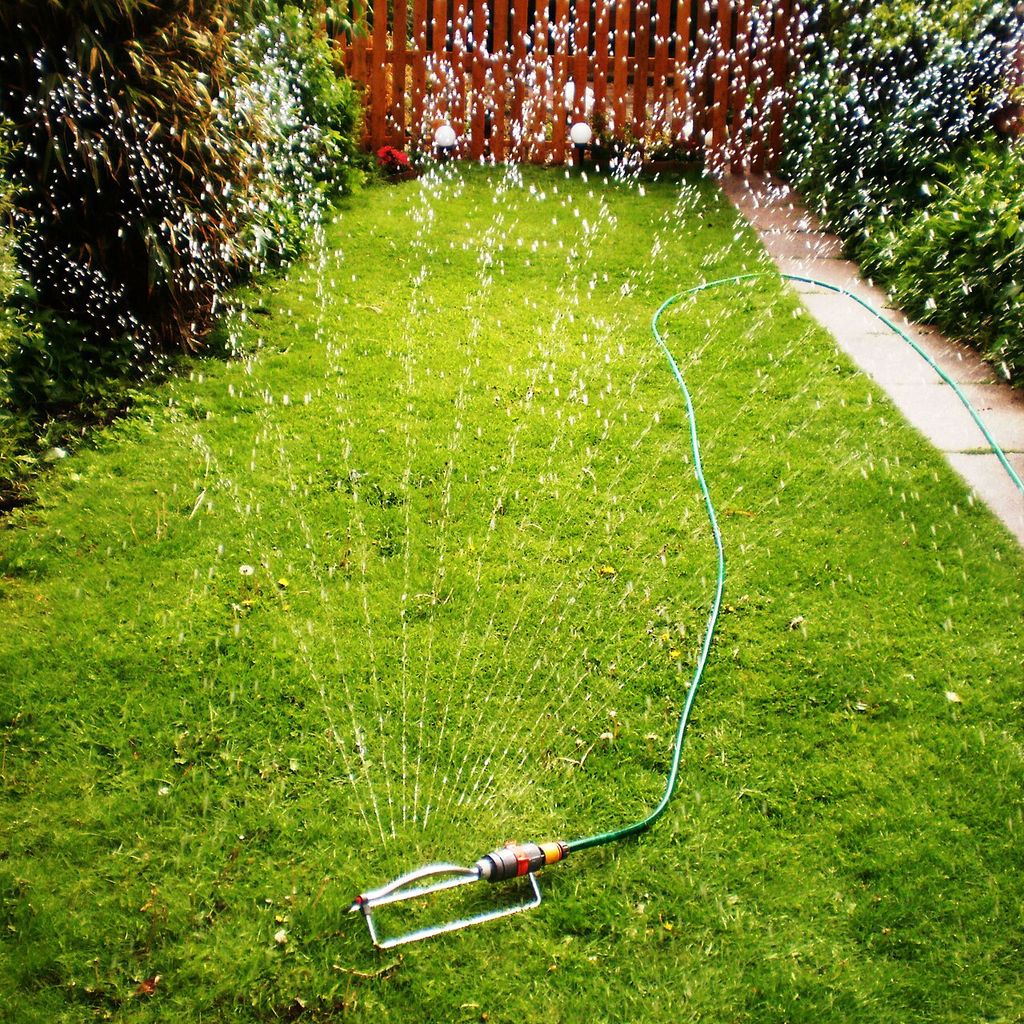
Physical comparison: an oscillating lawn sprinkler distributes water in a fan of separate jets and droplets. steve p2008 / Wikimedia Commons. Image source. CC BY 2.0. Image resized; framing and colours retained.
Brightness is crucial to that recognition. Water in air has no dependable local colour comparable to the green assigned to the lawn. Its visibility depends on the light it catches and the background across which it passes. The repeated sprays therefore organise relationships between colours as well as describing a mechanical action. What seems delicate in the subject can become forceful in the composition because a pale mark interrupts a stronger field.
The curator Ai Kusumoto has explained Hockney's practice through his search for the particular marks that different media can make. In her 2023 interview with Tamaki Sugihara, she also grouped pools, showers and sprinklers around changing water and light. Her account offers a useful way into this painting: the familiar subject matters, but so does the act of translating its appearance into the available marks of a chosen medium. [8]
The sky, grass and water ask for different treatment within the same picture. A comparatively even field can establish clear weather; repeated strokes can gather into a lawn; a more dispersed vocabulary can suggest water crossing the space between them. Variety of handling becomes a way to distinguish materials. The picture's clarity depends on those differences, even as its overall design binds them together.
Drawing, photography and the work of translation
Christie's traces A Lawn Being Sprinkled to a drawing made in the preceding year. The sprinkler was already a subject to work through on paper: L.A. Louver's selected works record lists Lawn Sprinkler, a 1966 work in coloured crayon. Drawing offered a means of establishing a subject whose appearance could then be reconsidered in paint. [2] [9]
Moving from a drawing to a large acrylic canvas changes the relationship between a stroke and the area around it. A small mark on paper must take its place in a much larger field; an outline or patch of colour must remain convincing beside broader, more emphatic planes. The result can preserve the recognition achieved in drawing while developing a different balance of density, colour and scale.
Photography supplies a related way of thinking about arrested movement. The Foundation records Hockney buying a 35mm camera later in 1967 and organising photographs into albums as working references. That broader development belongs to the period's history, but it does not establish a particular photograph as the source for this lawn painting. Its documented relation to an earlier drawing deserves to retain its own importance. [6]
A still photograph and a painting can both hold a spray after the real water has fallen. Painting additionally lets the maker decide how one kind of description meets another across the surface. The abruptness of an edge, the density of the grass and the dispersal of the spray can be adjusted separately. The image's apparent precision therefore need not mean that it reproduces a single, mechanically captured view. Precision can arise through selection and construction.
Repeated action and patient making
The title gives the garden an ongoing activity. A lawn is being sprinkled: the operation is under way. It implies neither a clear beginning nor an imminent climax. The mechanism promises another cycle, and another after that. Although the marks remain still, the subject encourages us to imagine repetition beyond the moment shown.
This differs from the event in A Bigger Splash. A diver's impact creates a disturbance that will subside; the sprinkler sustains a process by renewing it. Hockney's well-known comparison between weeks of painting and seconds of action concerned the splash canvas. It illuminates a shared problem of making movement durable, but it supplies no exact working time for A Lawn Being Sprinkled. [6]
The distinction affects how we experience the two pictures. A splash encourages us to imagine what has just happened and what will happen next. A sprinkler invites attention to a recurring condition. Its particular drops fall and vanish, but the action continues. The painting can therefore feel both instantaneous and extended: we see a fixed arrangement while imagining the repeated operation that would keep producing related arrangements.
There is another duration in the spectator's encounter. We can inspect the relationship between one spray and the next, move across the grass, then return to the water. Nothing escapes while our attention is elsewhere. Painting gives this changing subject a patience that the real garden cannot offer. The work's stillness is productive because it lets us study what movement ordinarily carries away.
Geometry, acrylic and abstraction
The relationship with abstract painting was part of the artistic setting in which these works appeared. Writing about A Bigger Splash, Martin Hammer connects its flat colour and controlled geometry with artists shown by Hockney's dealer Kasmin, including Robyn Denny. Hammer also discusses Hockney's comparison between Denny's work and the separate A Lawn Sprinkler. That comparison belongs to the Tokyo canvas; it provides context for the group without becoming a statement about the making of every sprinkler painting. [10]
For A Lawn Being Sprinkled, the useful question is how a recognisable scene can retain the force of an arrangement of shapes. A band of colour can describe a stretch of garden and still be apprehended as a band. The repeated sprays can suggest distance and form a pattern across the surface. Representation gives these relationships a subject, while the formal relationships determine how that subject reaches us. Hockney's broader style and techniques repeatedly allowed those interests to coexist.
The border sharpens this awareness. Raw canvas and a narrow red line frame the scene within the physical support, making the painted garden feel deliberately bounded. Christie's also proposes that a roller was used for the sky and that masking and sprayed paint may have helped produce the water. Those are qualified suggestions about technique, not established findings from a technical examination. [2]
The contrast remains useful even when the exact tools are uncertain. Broad colour areas and finer dispersed marks perform different jobs. The painting can make us think about how it was constructed because its changes of handling correspond so closely to changes in what is represented. Its convincing garden and its visible organisation belong to the same experience of looking.
The painting and the Lear collection
Peter Goulds of L.A. Louver recalled in May 2024 that Norman Lear asked him to find a Hockney painting in 1978. Goulds located A Lawn Being Sprinkled through the dealer Hans Neuendorf in Hamburg and subsequently sold it to Lear. He also remembered making the purchase conditional on obtaining a copy of Hockney's 1970 Whitechapel catalogue. His account gives the transaction a practical texture: dealers, personal contacts and a hard-to-find book helped bring a Californian subject back to a Los Angeles collection. [11]
The Metropolitan Museum's 2017 exhibition checklist listed the painting as a loan from the Lear Family Collection, with the same 1967 date, acrylic medium and 60-inch-square dimensions. The canvas participated in the retrospective shared by Tate Britain, the Centre Pompidou and the Met in 2017–18. The Foundation lists it in a private collection. [3] [2] [1]
That history places the canvas within both private domestic life and public retrospective study. Its subject, meanwhile, remains an unusually concentrated domestic spectacle: a lawn receiving water, a mechanism doing its work, and a painter distributing attention between the fixed and the fleeting. The longer we follow those relationships, the more the apparently simple garden opens into questions about how a few kinds of mark can make space, light and repeated movement visible.
Works directory
This source-bounded directory combines the works in the Metropolitan Museum’s 2017 retrospective checklist with reviewed museum object records and the additional works and series examined in this guide. It spans several media and is not a complete catalogue raisonné. Titles without an article link remain useful dated records. Metropolitan Museum final retrospective checklist (2017); additional object and series sources are given in the linked articles. [3]
| Name | Date | Medium |
|---|---|---|
| Love Painting | 1960 | Painting |
| Shame | 1960 | Painting |
| The Third Love Painting | 1960 | Painting |
| Tyger Painting No. 2 | 1960 | Painting |
| A Rake’s Progress | 1961–63 | Print series |
| Tea Painting in an Illusionistic Style | 1961 | Painting |
| The Cha-Cha That Was Danced in the Early Hours of 24th March | 1961 | Painting |
| Cleaning Teeth, Early Evening (10pm) W11 | 1962 | Painting |
| Flight into Italy - Swiss Landscape (Painting in a Scenic Style) | 1962 | Painting |
| Man in a Museum (or You're in the Wrong Movie) | 1962 | Painting |
| My Brother is Only Seventeen | 1962 | Painting |
| The First Marriage (A Marriage of Styles I) | 1962 | Painting |
| Domestic Scene, Los Angeles | 1963 | Painting |
| Play Within a Play | 1963 | Painting |
| The Hypnotist | 1963 | Painting |
| Arizona | 1964 | Painting |
| California Art Collector | 1964 | Painting |
| Man in Shower in Beverly Hills | 1964 | Painting |
| Portrait Surrounded by Artistic Devices | 1965 | Painting |
| Rocky Mountains and Tired Indians | 1965 | Painting |
| Beverly Hills Housewife | 1966–67 | Painting |
| Medical Building | 1966 | Painting |
| Peter | 1966 | Drawing |
| Peter Getting Out of Nick’s Pool | 1966 | Painting |
| A Bigger Splash | 1967 | Painting |
| A Lawn Being Sprinkled | 1967 | Painting |
| Kasmin in Bed in His Chateau in Carennac | 1967 | Drawing |
| Peter Feeling Not Too Good | 1967 | Drawing |
| Savings and Loan Building | 1967 | Painting |
| The Room, Tarzana | 1967 | Painting |
| American Collectors (Fred and Marcia Weisman) | 1968 | Painting |
| Christopher Isherwood and Don Bachardy | 1968 | Painting |
| Henry Geldzahler and Christopher Scott | 1968-1969 | Painting |
| W. H. Auden | 1968 | Drawing |
| Peter Langan in His Kitchen at Odins | 1969 | Drawing |
| Mark Glazebrook | 1970 | Drawing |
| Mr and Mrs Clark and Percy | 1970-1971 | Painting |
| Ossie Wearing a Fairisle Sweater | 1970 | Drawing |
| Pool and Steps, Le Nid du Duc | 1971 | Painting |
| Rubber Ring Floating in a Swimming Pool | 1971 | Painting |
| Celia in a Black Dress with White Flowers | 1972 | Drawing |
| Mount Fuji and Flowers | 1972 | Painting |
| Portrait of an Artist (Pool with Two Figures) | 1972 | Painting |
| Portrait of the Artist's Mother, Mrs Laura Hockney, Bradford | 1972 | Drawing |
| The Artist's Father | 1972 | Drawing |
| Dr Eugene Lamb, Lucca | 1973 | Drawing |
| Andy, Paris | 1974 | Drawing |
| Contre-jour in the French Style (Against the Day dans le Style-Français) | 1974 | Painting |
| Gregory Sitting on Base of Column | 1975 | Drawing |
| Kerby (after Hogarth) Useful Knowledge | 1975 | Painting |
| Ron Kitaj Outside Akademie der Kunste Vienna | 1975 | Drawing |
| Kasmin Reading the Udaipur Guide | 1977 | Drawing |
| Looking at Pictures on a Screen | 1977 | Painting |
| My Parents | 1977 | Painting |
| Canyon Painting | 1978 | Painting |
| Mother, Bradford, 19 Feb. 1979 (inscribed 1978) | 1979 | Drawing |
| Mulholland Drive: The Road to the Studio | 1980 | Painting |
| Nichols Canyon | 1980 | Painting |
| Outpost Drive, Hollywood | 1980 | Painting |
| Hollywood Hills House | 1981-1982 | Painting |
| Celia. Los Angeles. April 10th 1982 | 1982 | Polaroid composite |
| Don + Christopher, Los Angeles, 6th March 1982 | 1982 | Polaroid composite |
| Gregory Swimming Los Angeles March 31st 1982 | 1982 | Polaroid composite |
| My Mother, Bolton Abbey, Yorkshire, Nov. 1982 | 1982 | Photocollage |
| Self Portrait 30th Sept. 1983 | 1983 | Drawing |
| Pearblossom Hwy., 11-18th April 1986, #1 | 1986 | Photocollage |
| Pearblossom Hwy., 11–18th April 1986, #2 | 1986 | Photocollage |
| Large Interior, Los Angeles | 1988 | Painting |
| Breakfast at Malibu, Sunday, 1989 | 1989 | Painting |
| Pacific Coast Highway and Santa Monica | 1990 | Painting |
| The Other Side | 1991-1993 | Painting |
| The Eleventh V. N. Painting | 1992 | Painting |
| The Twenty Sixth V. N. Painting | 1992 | Painting |
| The Road Across the Wolds | 1997 | Painting |
| 9 Canvas Study of the Grand Canyon | 1998 | Painting |
| A Bigger Grand Canyon | 1998 | Painting |
| Colorado River | 1998 | Painting |
| Garrowby Hill | 1998 | Painting |
| Colin St. John Wilson. London. 3rd June 1999 | 1999 | Drawing |
| Gregory Evans. Los Angeles. 18th September 1999 | 1999 | Drawing |
| Laura Huston. London. 22nd June 1999 | 1999 | Drawing |
| Lindy. Marchioness of Dufferin and Ava. London. 17th June | 1999 | Painting |
| Going Up Garrowby Hill | 2000 | Painting |
| Red Pots in the Garden | 2000 | Painting |
| A Closer Winter Tunnel, February - March | 2006 | Painting |
| Elderflower Blossom, Kilham, July 2006 | 2006 | Painting |
| The Road to Thwing, July 2006 | 2006 | Painting |
| Bigger Trees near Warter | 2007 | Painting |
| Hawthorn Blossom near Rudston | 2008 | Painting |
| Views Through the Artist's Bedroom Window, Bridlington | 2010-2013 | Digital animation |
| The Arrival of Spring in Woldgate, East Yorkshire in 2011 (twenty eleven) | 2011 | Painting / digital series |
| 82 Portraits and 1 Still-life | 2013–16 | Portrait series |
| Garden | 2015 | Painting |
| Garden with Blue Terrace | 2015 | Painting |
| Garden #3 | 2016 | Painting |
| A Bigger Interior with Blue Terrace | 2017 | Painting |
| Interior with Blue Terrace and Garden | 2017 | Painting |
| A Year in Normandie | 2020–21 | Digital frieze |
Discussion
Look again at the images and ideas explored in A Lawn Being Sprinkled. These editorial prompts invite your observations.
Reader Insights
How does the repeated marking of the grass affect your sense of the lawn's depth? Where does it become most noticeable as a surface pattern?
Compare the sprinkler's recurring action with the single disturbance in A Bigger Splash. How does each subject change the kind of time you imagine beyond the painted moment?
What changes when you notice the raw canvas and red border around the garden? Does that boundary alter your experience of the space inside it?
Join the Conversation
Share a detail, comparison or question about A Lawn Being Sprinkled below.
References
- The David Hockney Foundation. A Lawn Being Sprinkled, 1967, artwork record. View source.
- Christie's. David Hockney: A Lawn Being Sprinkled, lot 10 B, 20th Century Evening Sale, New York, 16 May 2024; object record, provenance, exhibition history and lot essay. View source.
- The Metropolitan Museum of Art. David Hockney: Final Checklist, 15 November 2017, printed p. 6 / PDF p. 7, A Lawn Being Sprinkled; related water paintings on printed pp. 4–5. View source.
- The David Hockney Foundation, 2021 chronology. View source.
- National Center for Art Research, Japan. A Lawn Sprinkler, 1967, Art Platform Japan collection record W951226, drawing on Tokyo Museum Collection data. View source.
- The David Hockney Foundation. 1967, chronology, sections “Infatuated with L.A.”, “A Bigger Splash” and “Taking photographs”. View source.
- Matthew Sperling. “Water Marks: The Pull of Hockney's Pool Paintings”, Apollo, February 2017, pp. 52–58; author proof, PDF pp. 1–4, especially p. 2. View source.
- Tamaki Sugihara and Ai Kusumoto. “ホックニーはなぜ評価と人気を60年も獲得し続けられたのか?「デイヴィッド・ホックニー展」担当学芸員が徹底解説!【前編】” [Why has Hockney sustained critical recognition and popularity for sixty years? Part One], curator interview, Tokyo Art Beat, 25 August 2023, especially the discussion of marks and changing light. View source.
- L.A. Louver. David Hockney: Selected works placed by L.A. Louver in private and public collections, 1960–69 entries, Lawn Sprinkler, 1966. View source.
- Martin Hammer. “The photographic source and artistic affinities of David Hockney's ‘A bigger splash’”, The Burlington Magazine, vol. 159, no. 1370, May 2017, pp. 386–393, especially p. 386 and the separate sprinkler caption on p. 388. View source.
- Peter Goulds. From the Archive: A Lawn Being Sprinkled, L.A. Louver, May 2024. View source.
More HOCKNEY Works
A Bigger Splash
A momentary disturbance becomes the focus of a large acrylic painting, made through weeks of patient work.
Mr and Mrs Clark and Percy
The designers Celia Birtwell and Ossie Clark occupy a room shaped by light, repeated sittings and the demands of a double portrait.
A Bigger Grand Canyon
Sixty canvases gather memory, studies and changing viewpoints into an immense painting of 1998.
Garrowby Hill
The 1998 oil painting transforms a remembered Yorkshire journey into a road, fields and an expansive view.
Portrait of an Artist (Pool with Two Figures)
Photographic studies, two figures and a swimming pool become a carefully constructed painting of 1972.
My Parents
The 1977 oil painting sets Kenneth and Laura Hockney within a quietly organised interior.
Pearblossom Hwy., 11–18th April 1986, #2
Hundreds of separately made photographs construct a road scene that unfolds through movement and time.
Bigger Trees near Warter
Fifty canvases join into a large outdoor painting of Yorkshire trees, with photography helping the artist organise the whole.