


 by Tom Gurney
Tom Gurney BSc (Hons) is an art history expert with over 20 years experience
Email: tomgurney1@gmail.com / Phone: +44 7429 011000
A Bigger Grand Canyon: Introduction
David Hockney’s A Bigger Grand Canyon turns a view across an immense landscape into an encounter with the act of looking. Painted in 1998 in oil on sixty canvases, it belongs to the National Gallery of Australia. Its subject is immediately recognisable, yet the picture refuses to settle into the distant, self-contained prospect that a small landscape photograph might offer. The canyon spreads sideways, opens downwards and seems to press forward into the room. Looking involves choosing a route through its space. [1]
The painting measures 207 by 744.2 centimetres: a little over two metres high and nearly seven and a half metres wide. These proportions matter as much as its considerable area. A viewer can face one part closely, or retreat to take in the relationship between the two ends, but those experiences reveal different things. The broad image and its many local incidents remain in productive tension. The National Gallery’s acquisition account described a landscape experienced through movement and time, giving a useful starting point for understanding why Hockney made it this way. [2] [3]
At a Glance
- ArtistDavid Hockney
- TitleA Bigger Grand Canyon
- Date1998
- Medium and formatOil on 60 canvases; 207 × 744.2 cm
- CollectionNational Gallery of Australia, Canberra
This work across David Hockney’s career
A Rake’s Progress
1961–63 [4]A Bigger Splash
1967 [4]Mr and Mrs Clark and Percy
1970–71 [4]My Parents
1977 [4]Garrowby Hill
1998 [4]A Year in Normandie
2020–21 [5]Contents
- Sixty canvases, one changing view
- Photographs made in 1982, a collage assembled in 1986
- Painting the remembered canyon
- Colour that changes the distance
- Drawing the parts of an enormous whole
- Powell Point and the experience of an edge
- Thomas Moran and the challenge of a vast landscape
- Cubism, scrolls and a moving viewer
- A Bigger Grand Canyon and A Closer Grand Canyon
- Exhibitions, argument and Australian ownership
Sixty canvases, one changing view
The grid is five canvases high and twelve wide. [6] It supplies a regular framework for an irregular terrain. A straight joint may pass through a slope, a shadow or a rock face; the rectangular units continue steadily across a subject made of ledges, ravines and abrupt changes in direction. The structure thus makes two kinds of order available at once. There is the measured order of the painted object and the more complicated order of the land it describes.
The seams also allow the image to be read at different scales. A patch that contributes to the whole canyon can become an arrangement of colour and marks when attended to separately. Move the eye sideways and a neighbouring canvas brings another small field into prominence. The painting’s coherence depends on these relationships across divisions. It does not require the divisions to disappear. Hockney made the assembly part of the work’s visible language, as he had already done with photographic collage. [7]
This is one reason the title’s word Bigger has more substance than a claim to impressive dimensions. Enlargement gives the image room to accommodate different directions of attention. A small reproduction may let the whole composition enter the eye quickly; the original asks the viewer to negotiate between breadth and detail. The panorama can be understood as a large statement about the canyon while still being encountered through many successive, smaller acts of looking.
The support itself remains straightforward: oil paint on canvas, multiplied into sixty units. The complexity lies in coordinating the parts and their perspectives. The painting should consequently be distinguished from the photographic constructions that preceded it. Its grid recalls those works, but each unit here is painted. The connection concerns how an image is organised, and how a viewer passes through it, as much as the appearance of the joins. [1] [8]
Photographs made in 1982, a collage assembled in 1986
Hockney’s work on the canyon developed over many years. The National Gallery of Australia traces the painting’s beginnings to photographs taken in 1982, followed by a large collage of sixty photographs in 1986 and a painted composition in 1997. The dates identify stages of a sustained investigation. They also prevent a misleading compression in which the finished oil painting seems to have followed immediately from one photographic visit. [8]
Lightroom’s gallery guide records the photographic antecedent as The Grand Canyon Looking North II, September 1982, Collage No. 2, Made May 1986. The title carries two different moments: making the photographs and assembling the collage. A scene first encountered through a camera could be reconsidered later through the placement of the prints. [3]
His broader photographic practice helps explain why this mattered. In 1982 he began making composite Polaroids and subsequently used a Pentax 110, whose film required processing. While waiting for prints, he planned arrangements in notes and diagrams. At the Grand Canyon, the interval between being at the site and constructing a two-dimensional image made memory part of the work. Hockney later described the early canyon collages as a means of training his visual memory. [9]
The delay was therefore productive. He had to remember where he had looked, how the parts related and what kind of experience the assembled image should recover. A photograph supplied information, but the arrangement supplied connections between pieces of information. In the resulting collage, the camera’s separate observations could be made to coexist without pretending that every print belonged to an identical instant or position. This is central to Hockney’s photography and joiners, and to the later passage from prints to painted canvases. [9]
Hockney’s questions about a single photographic view accompanied his further uses for photographic material. A Bigger Grand Canyon preserves the lesson of assembly and gives it another medium, making its own decisions about colour, continuity and scale. [8]
Painting the remembered canyon
Hockney’s official illustrated biography dates the painting to February–May 1998. The months of studio work are significant: this huge panorama was developed through an extended process, after years of returning to the subject. The same chronology places it beside his paintings of Yorkshire, made after journeys through the county in 1997. American and English landscapes were occupying his imagination together. [10]
For the first large canyon painting, he deliberately allowed remembered experience to take precedence over another immediate visit. In an account preserved by the Foundation, he explained that he had considered going in January and decided against it. The weather and atmosphere might have redirected the picture. What interested him was the canyon retained in memory and the force that actual pigments could give it. His phrase “strong pure color put right” makes colour sound like an exacting act of placement. [11]
That decision changes the question a viewer brings to the picture. Asking whether its colour matches a photograph taken on a particular afternoon is less useful than asking what the colour does to the distances within it. A concentrated orange may assert the presence of a rock face; a purple passage may establish a separate zone of depth; a green accent can pull attention back towards the nearer ground. The remembered canyon becomes a set of relationships that must be made convincing in paint.
Memory here includes the understanding acquired through repeated looking. It can hold together a sequence of impressions that no one exposure contains. Hockney had also revisited the canyon during a journey through the American Southwest in 1997. The painting’s distance from the site at the moment of execution should therefore be considered alongside a substantial history of direct encounter. Recollection and visual documentation worked together. [10] [12]
Colour that changes the distance
The colour can initially seem to bring everything forward. Vivid reds and oranges establish an insistent painted surface, while purples complicate the shadows and greens punctuate the foreground. The effect is especially striking because the subject is so deep. Hockney makes the viewer feel the pull between a readily visible arrangement of pigments and the vast recession that arrangement describes.
The Australian painter Ben Quilty discussed precisely this tension with Jennifer Higgie in the National Gallery’s Artists’ Artists podcast. He drew attention to the orange and purple running through the picture and the green that stands out near the front. For Quilty, the audacity of the palette was among its strongest qualities. His response comes from a fellow painter, attending to how colours sustain one another across an enormous composition. [13]
It helps to look for changes within the colour families instead of reducing the picture to a few loud hues. Neighbouring reds can separate a lit surface from a differently inclined one. A darker band interrupts a broader expanse, making a ledge or recess legible. The canyon’s folds depend on such transitions. Colour carries the terrain’s divisions, and repeated colours can reconnect areas that the ravines appear to separate.
The National Gallery’s acquisition account placed the painting in conversation with English Romantic and French Symbolist traditions. That interpretation recognises a landscape whose expressive force exceeds the transcription of local appearance. Hockney’s particular contribution lies in bringing that force together with the multiple perspectives developed through his photographic work. A powerful colour can establish a place in the image without submitting to one continuous atmospheric fade into the distance. [2]
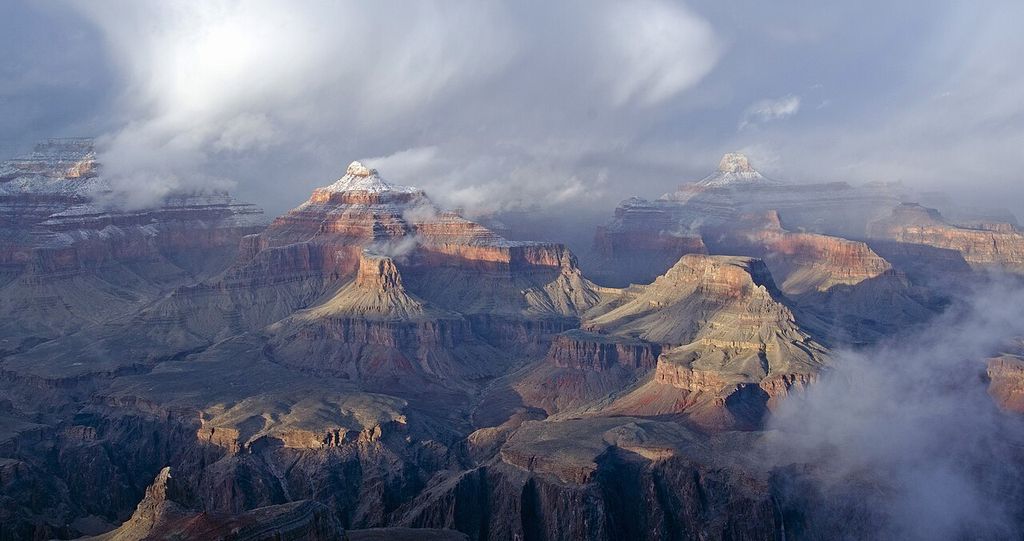
Geographic context: Grand Canyon from Powell Point just before sunset, 10 February 2013. Michael Quinn / National Park Service / Wikimedia Commons. Image source. Public domain. Resized and converted to JPEG; no crop or recolouring.
Drawing the parts of an enormous whole
The surviving study material brings the scale of the undertaking back to the hand. Lightroom’s gallery guide records a 1998 Composition Study for A Bigger Grand Canyon in charcoal, pencil, ink and tape on three sheets of paper. It also identifies Live Tree Detail for ‘A Bigger Grand Canyon’, a charcoal drawing, and Study of ‘A Bigger Grand Canyon’, VIII, made with crayon and ink on a colour laser copy. These are different forms of investigation, each with a specific material basis. [3]
Their variety suggests a flexible passage between planning, drawing and reproduction. A composition study can consider the distribution of a long image; a tree detail can concentrate on a local feature; marks added to a laser copy can test changes against an image already available. The scale of the final painting did not remove the need for close attention to individual things. It made the relationship between those things and the whole particularly demanding.
Hockney’s official public-collection list also records the National Gallery’s Island Detail, in charcoal, and Dead Tree Detail, in charcoal and ink. Such titles are useful reminders that the canyon picture contains differentiated incidents, with their own shapes and drawing problems. The immense space has to be articulated through particular forms. A tree, a ledge or an isolated mass can give the eye a foothold within a subject whose overall dimensions are otherwise difficult to comprehend. [14]
The National Gallery’s report for 1999–2000 records Hockney’s gift of three preliminary drawings for the painting. Their presence in the collection extends the acquisition beyond the spectacular finished object. Drawings concerned with separate features can be considered alongside the panorama that gathers those features into a continuous space. [15]
The related oil paintings also test different formats. The Metropolitan Museum’s 2017 checklist identifies 9 Canvas Study of the Grand Canyon as nine canvases, each about 33.4 by 56.3 centimetres. Sotheby’s 2017 record for 15 Canvas Study of the Grand Canyon gives overall measurements of 169 by 166.5 centimetres. That fifteen-part study is almost square, a striking difference from the finished panorama’s long rectangle. [4] [16]
The distinction matters when imagining what a study can do. A more compact field can concentrate the canyon’s forms; a long field must also sustain their lateral relationships. Adding canvases is therefore only one part of the problem. The shape made by the assembly changes how the subject meets the viewer. These are related experiments in pictorial space, with different proportions as well as different dimensions.
Powell Point and the experience of an edge
The National Gallery identifies the painting’s spatial setting with Powell Point on the South Rim, in northern Arizona. Its account emphasises the sensation of standing at a precipice. Geography helps explain the subject’s hold on Hockney: the observer occupies a definite edge while the land beyond drops, branches and extends across a vast field. The body has a position even when the eye finds it difficult to measure what lies ahead. [17]
Powell Point is a named South Rim viewpoint associated with a memorial to John Wesley Powell’s nineteenth-century Colorado River expeditions. The National Park Service identifies it as a place for both sunrise and sunset views. The changing light at a real viewpoint gives a useful comparison for Hockney’s decision to work from remembered colour. A photograph of the point records one set of conditions; the painting brings together a more extended experience. [18]
The useful comparison is between ways of encountering the place, without making a photograph stand in for a precise painted camera position. The canyon picture has already passed through photographic selection, recollection, studies and painting. Its broad image can carry several directions of looking. The named location anchors that investigation in a real landscape, while the constructed space explains why a single contemporary view will not account for every part of it.
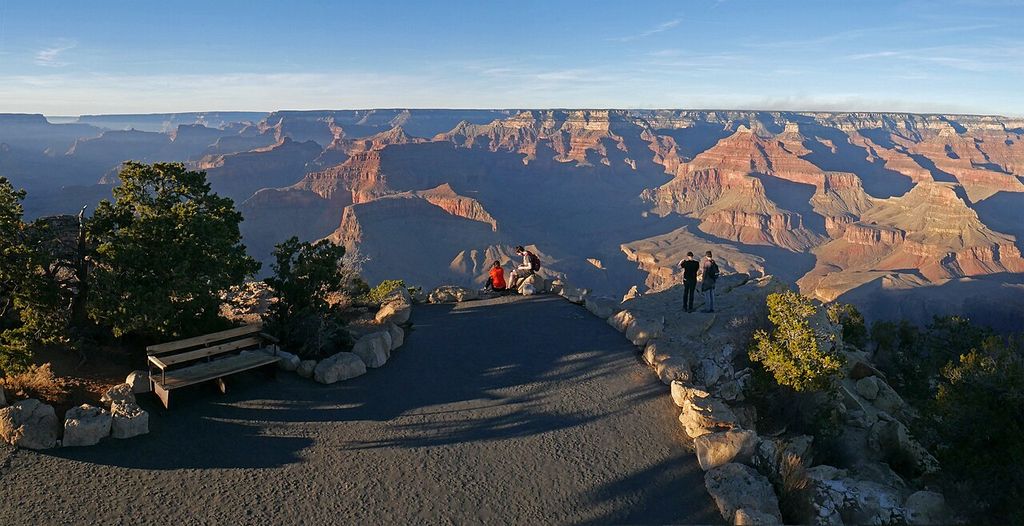
The viewing area at Powell Point on Grand Canyon’s South Rim. The bench and visitors give a sense of the physical encounter with the landscape. Grand Canyon NPS / Wikimedia Commons. Image source. CC BY 2.0. Resized and converted to JPEG; no crop or recolouring.
Thomas Moran and the challenge of a vast landscape
Hockney’s return to the canyon was encouraged by seeing Thomas Moran’s retrospective at the National Gallery of Art in Washington. The exhibition ran from 28 September 1997 to 11 January 1998. It brought together Moran’s major western landscapes, including Chasm of the Colorado, alongside paintings, watercolours and photographs. A painter working at the end of the twentieth century could examine how an earlier artist had made immense American spaces intelligible on a bounded surface. [10] [19]
Moran’s Grand Canyon of the Colorado River, dated 1892 and 1908 and now in the Philadelphia Museum of Art, provides a particularly useful historical comparison. The museum records its commission by the Atchison, Topeka and Santa Fe Railway to promote tourism. Its panorama therefore belongs to a history in which painted views helped distant audiences imagine the American West and encouraged them to travel there. It is a comparison with the earlier landscape tradition, without needing to identify it as the single canvas that prompted Hockney. [20]
The distinction between the two painters becomes more interesting once Moran’s own methods are considered. In his museum handbook entry, Darrel Sewell explained that Moran worked from sketches, photographs and direct experience, and could alter the terrain for pictorial effect. The two dates on the Philadelphia painting indicate later reworking. Hockney’s use of memory and construction thus belongs in a longer history of artists making a coherent picture from experiences gathered over time. [21]
Moran used dramatic weather and light to give the distant scene its emotional force. Hockney’s concentrated pigments and conspicuous grid offer another answer to the same problem of magnitude. The comparison directs attention to decisions: how much sky to allow, how to establish near and far, where to lead the eye, and how a painting’s physical size affects its claim on the viewer. Neither an accurate inventory nor scale alone explains the experience of the canyon. [21] [2]
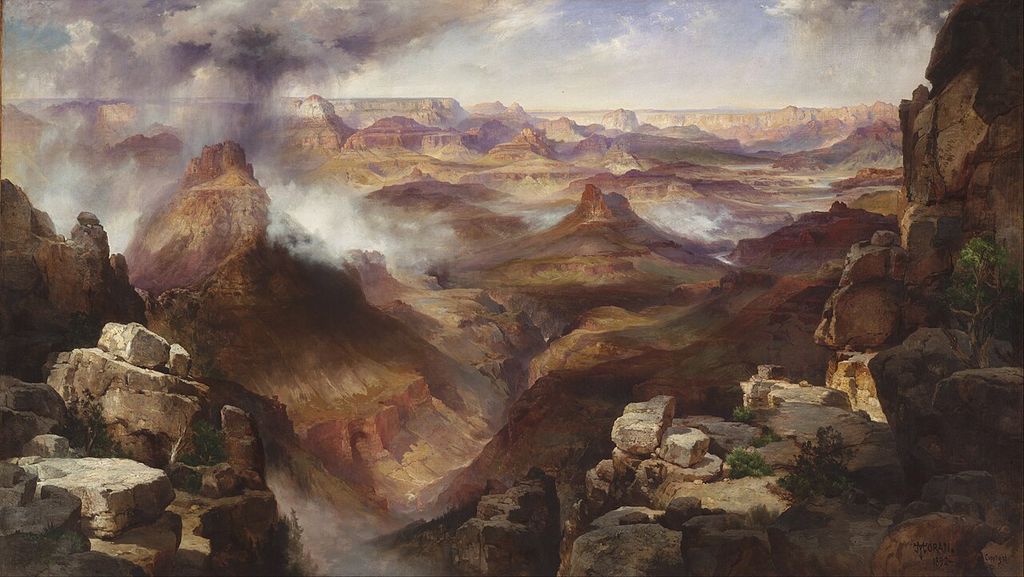
Historical comparison: Thomas Moran, Grand Canyon of the Colorado River, dated 1892 and 1908, Philadelphia Museum of Art. Thomas Moran / Philadelphia Museum of Art / Wikimedia Commons. Image source. Public domain. Resized and converted to JPEG; no crop or recolouring.
Cubism, scrolls and a moving viewer
The National Gallery’s account connects A Bigger Grand Canyon with Cubism and Chinese scroll painting. These references concern the organisation of experience within one image. Different views can be brought together, and a landscape can unfold through successive passages of attention. Hockney’s large rectangle accommodates such movement without requiring every part to agree with a single fixed viewpoint. [8]
Kunstmuseum Luzern’s account of his Moving Focus work explains how the artist questioned central perspective and explored reverse perspective, with the convergence imagined behind the spectator. Its discussion of scrolls emphasises the joining of different moments and viewpoints. Applied to the canyon, these ideas help explain the impression that the scene spreads around a viewer. They give several ways of thinking about space, rather than a formula to impose on every painted line. [22]
Anthi-Danaé Spathoni’s study of Hockney’s landscapes develops the role of an active, participating spectator. Her interpretation asks us to consider the time and bodily movement involved in looking across the large canvas. That is a useful account of the relationship between the work’s joined structure and its reception: understanding the picture happens through an encounter, with the viewer’s attention moving between parts. [7]
The analogy with a scroll has a practical limit that makes it more illuminating. A handscroll can reveal its landscape progressively as it is unrolled. Hockney’s painting hangs as a broad whole, already available to the room. The succession occurs in the viewer’s looking and movement. One may begin with the overall field and move towards a detail, or follow a succession of forms across the width. The painting offers routes without assigning a compulsory order. [22] [7]
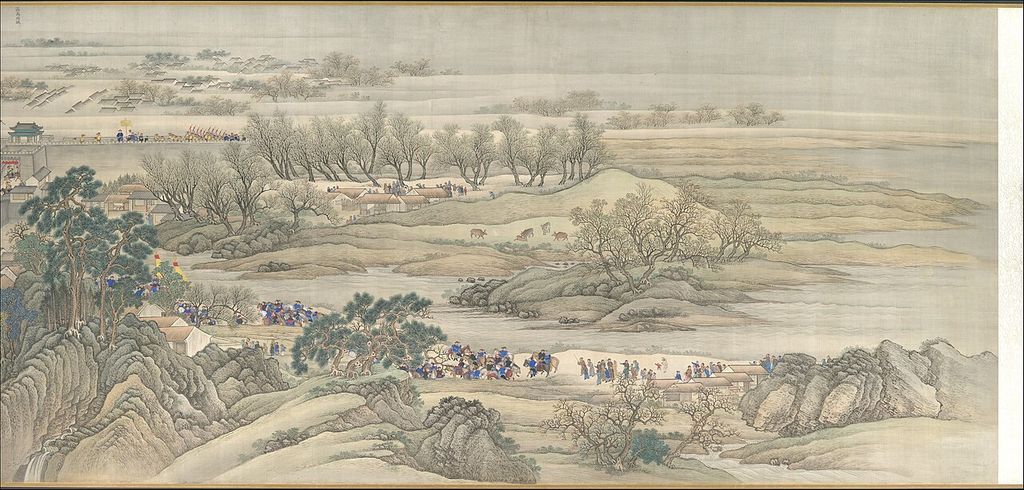
Handscroll comparison: Wang Hui and assistants, The Kangxi Emperor’s Southern Inspection Tour, Scroll Three: Ji’nan to Mount Tai, datable to 1698, Metropolitan Museum of Art. Wang Hui and assistants / The Metropolitan Museum of Art / Wikimedia Commons. Image source. CC0 / Public domain. Resized and converted to JPEG; no crop or recolouring.
A Bigger Grand Canyon and A Closer Grand Canyon
The two titles identify separate paintings of 1998. After completing A Bigger Grand Canyon, Hockney returned to the subject through renewed observation. In the autumn he spent a week drawing daily at Powell Point, making oil-pastel studies before developing A Closer Grand Canyon in his studio. The first panorama’s sustained engagement with memory and photographic construction was followed by another cycle of sitting, looking, drawing and remembering. [11] [10]
The change in method gives Closer a precise significance. Hockney wanted the viewer to feel more immediately involved with the space. His descriptions of sitting near the edge after sunrise place duration at the heart of the enterprise. The drawing sessions supplied knowledge acquired through remaining with the subject. [11]
Related works keep the distinction clear. The Royal Academy holds Double Study for ‘A Closer Grand Canyon’, an oil painting on two canvases. Louisiana Museum of Modern Art acquired A Closer Grand Canyon in 2007 with support from the A.P. Møller Foundation. The donor’s account draws attention to the varying languages within its separate fields: dots, hatching, strokes and contours. This later work continued Hockney’s investigation of how local marks could become an enveloping landscape. [23] [24]
Exhibitions, argument and Australian ownership
A Bigger Grand Canyon was exhibited at Washington’s National Museum of American Art from 19 June to 7 September 1998. The museum’s exhibition records preserve those dates, placing its public appearance soon after the months of painting. Its scale and colour made an immediate argument for the continuing possibilities of landscape, although critics differed sharply over the result. [25]
Hilton Kramer’s August 1998 Observer review treated it as an inflated postcard and compared its broad format and colour to Hollywood spectacle. His objection was directed at what he considered a failure of substance behind the visual display. This response is valuable because it names the very features other viewers found compelling. An emphatic panorama could be judged as an absorbing reconstruction of space or as an overbearing substitute for it. The work left little room for neutrality about its scale. [26]
The Royal Academy’s 1999 Summer Exhibition provided another kind of setting. Hockney’s canyon paintings occupied the restored Mori Lecture Room, and he won the Charles Wollaston Award. Beth Williamson’s history of that exhibition records his request for large mirrors in the room’s four corners. Reflections brought the visitors’ own bodies into relationship with the surrounding colour. Display became part of the experience: the landscape existed on the canvas, across reflections and within a room people were moving through. [27]
The National Gallery of Australia purchased A Bigger Grand Canyon in 1999 with the assistance of Kerry Stokes, Carol and Tony Berg, and the O’Reilly family. Its Canberra presentation formed part of Hockney & Stella: Masterworks in Paint and Print, held from 12 October 1999 to 26 January 2000. Preliminary drawings and photographic collages accompanied the painting, making its working history available alongside the finished work. [17] [28]
An ABC broadcast on 13 October 1999 reported the purchase at A$4.6 million. Interviewed after seeing the installation, the critic Sasha Grishin argued that the image came together particularly well from thirty or forty metres away; he found his preferred position beyond the room itself. His estimate records a specific response to that exhibition. It also shows how seriously this painting made a critic consider the room, the viewer’s distance and the relationship between enveloping space and visual coherence. [29]
Quilty’s later recollection gives the acquisition a more personal afterlife. He remembered travelling to see the painting with his parents around the time of its purchase. Decades later, its contentious colour was still the quality he especially valued. Set beside Kramer’s hostile response and Grishin’s concern with viewing distance, that memory shows the picture generating different kinds of attention: critical dispute, spatial experiment and a lasting attachment formed through seeing it. [13]
The painting has subsequently travelled beyond Canberra. In 2023 the National Gallery announced a loan to HOTA on the Gold Coast, scheduled from June 2024, and its 2026 memorial account records the work’s inclusion in the Fondation Louis Vuitton’s 2025 Hockney exhibition in Paris. Those dated appearances belong to its exhibition history. They demonstrate the continuing demand for the object, whose scale makes every new placement a consequential decision. [30] [17]
From the American canyon to Yorkshire
The canyon and Yorkshire paintings of 1998 illuminate one another. Garrowby Hill was also developed in Los Angeles from Hockney’s knowledge and memory of an English landscape. The two subjects have very different physical characters, but both raised questions about colour, remembered movement and how a painted surface can offer a journey. His earlier Mulholland Drive: The Road to the Studio belongs to the same sustained interest in space encountered through changing views. [10]
Writing in 2013, Lawrence Weschler distinguished the expanding spaces of Hockney’s canyon work from his later attention to the changing seasons around Bridlington. The multi-canvas Yorkshire paintings extended looking through time in another way: repeated sites revealed the differences between one season and the next. Weschler’s account also records Hockney’s insistence that the person looking could be the figure in a landscape apparently empty of people. [31]
A Bigger Grand Canyon gives that proposition an unusually forceful setting. The edge in the depicted landscape and the viewer’s position in the gallery make presence itself part of the subject. Its breadth allows attention to roam; its joined parts repeatedly bring attention back to the making of an image. Within Hockney’s landscape painting, it is an especially sustained attempt to give a place the time and space of being looked at.
Works directory
This source-bounded directory combines the works in the Metropolitan Museum’s 2017 retrospective checklist with reviewed museum object records and the additional works and series examined in this guide. It spans several media and is not a complete catalogue raisonné. Titles without an article link remain useful dated records. Metropolitan Museum final retrospective checklist (2017); additional object and series sources are given in the linked articles. [4]
| Name | Date | Medium |
|---|---|---|
| Love Painting | 1960 | Painting |
| Shame | 1960 | Painting |
| The Third Love Painting | 1960 | Painting |
| Tyger Painting No. 2 | 1960 | Painting |
| A Rake’s Progress | 1961–63 | Print series |
| Tea Painting in an Illusionistic Style | 1961 | Painting |
| The Cha-Cha That Was Danced in the Early Hours of 24th March | 1961 | Painting |
| Cleaning Teeth, Early Evening (10pm) W11 | 1962 | Painting |
| Flight into Italy - Swiss Landscape (Painting in a Scenic Style) | 1962 | Painting |
| Man in a Museum (or You're in the Wrong Movie) | 1962 | Painting |
| My Brother is Only Seventeen | 1962 | Painting |
| The First Marriage (A Marriage of Styles I) | 1962 | Painting |
| Domestic Scene, Los Angeles | 1963 | Painting |
| Play Within a Play | 1963 | Painting |
| The Hypnotist | 1963 | Painting |
| Arizona | 1964 | Painting |
| California Art Collector | 1964 | Painting |
| Man in Shower in Beverly Hills | 1964 | Painting |
| Portrait Surrounded by Artistic Devices | 1965 | Painting |
| Rocky Mountains and Tired Indians | 1965 | Painting |
| Beverly Hills Housewife | 1966–67 | Painting |
| Medical Building | 1966 | Painting |
| Peter | 1966 | Drawing |
| Peter Getting Out of Nick’s Pool | 1966 | Painting |
| A Bigger Splash | 1967 | Painting |
| A Lawn Being Sprinkled | 1967 | Painting |
| Kasmin in Bed in His Chateau in Carennac | 1967 | Drawing |
| Peter Feeling Not Too Good | 1967 | Drawing |
| Savings and Loan Building | 1967 | Painting |
| The Room, Tarzana | 1967 | Painting |
| American Collectors (Fred and Marcia Weisman) | 1968 | Painting |
| Christopher Isherwood and Don Bachardy | 1968 | Painting |
| Henry Geldzahler and Christopher Scott | 1968-1969 | Painting |
| W. H. Auden | 1968 | Drawing |
| Peter Langan in His Kitchen at Odins | 1969 | Drawing |
| Mark Glazebrook | 1970 | Drawing |
| Mr and Mrs Clark and Percy | 1970-1971 | Painting |
| Ossie Wearing a Fairisle Sweater | 1970 | Drawing |
| Pool and Steps, Le Nid du Duc | 1971 | Painting |
| Rubber Ring Floating in a Swimming Pool | 1971 | Painting |
| Celia in a Black Dress with White Flowers | 1972 | Drawing |
| Mount Fuji and Flowers | 1972 | Painting |
| Portrait of an Artist (Pool with Two Figures) | 1972 | Painting |
| Portrait of the Artist's Mother, Mrs Laura Hockney, Bradford | 1972 | Drawing |
| The Artist's Father | 1972 | Drawing |
| Dr Eugene Lamb, Lucca | 1973 | Drawing |
| Andy, Paris | 1974 | Drawing |
| Contre-jour in the French Style (Against the Day dans le Style-Français) | 1974 | Painting |
| Gregory Sitting on Base of Column | 1975 | Drawing |
| Kerby (after Hogarth) Useful Knowledge | 1975 | Painting |
| Ron Kitaj Outside Akademie der Kunste Vienna | 1975 | Drawing |
| Kasmin Reading the Udaipur Guide | 1977 | Drawing |
| Looking at Pictures on a Screen | 1977 | Painting |
| My Parents | 1977 | Painting |
| Canyon Painting | 1978 | Painting |
| Mother, Bradford, 19 Feb. 1979 (inscribed 1978) | 1979 | Drawing |
| Mulholland Drive: The Road to the Studio | 1980 | Painting |
| Nichols Canyon | 1980 | Painting |
| Outpost Drive, Hollywood | 1980 | Painting |
| Hollywood Hills House | 1981-1982 | Painting |
| Celia. Los Angeles. April 10th 1982 | 1982 | Polaroid composite |
| Don + Christopher, Los Angeles, 6th March 1982 | 1982 | Polaroid composite |
| Gregory Swimming Los Angeles March 31st 1982 | 1982 | Polaroid composite |
| My Mother, Bolton Abbey, Yorkshire, Nov. 1982 | 1982 | Photocollage |
| Self Portrait 30th Sept. 1983 | 1983 | Drawing |
| Pearblossom Hwy., 11-18th April 1986, #1 | 1986 | Photocollage |
| Pearblossom Hwy., 11–18th April 1986, #2 | 1986 | Photocollage |
| Large Interior, Los Angeles | 1988 | Painting |
| Breakfast at Malibu, Sunday, 1989 | 1989 | Painting |
| Pacific Coast Highway and Santa Monica | 1990 | Painting |
| The Other Side | 1991-1993 | Painting |
| The Eleventh V. N. Painting | 1992 | Painting |
| The Twenty Sixth V. N. Painting | 1992 | Painting |
| The Road Across the Wolds | 1997 | Painting |
| 9 Canvas Study of the Grand Canyon | 1998 | Painting |
| A Bigger Grand Canyon | 1998 | Painting |
| Colorado River | 1998 | Painting |
| Garrowby Hill | 1998 | Painting |
| Colin St. John Wilson. London. 3rd June 1999 | 1999 | Drawing |
| Gregory Evans. Los Angeles. 18th September 1999 | 1999 | Drawing |
| Laura Huston. London. 22nd June 1999 | 1999 | Drawing |
| Lindy. Marchioness of Dufferin and Ava. London. 17th June | 1999 | Painting |
| Going Up Garrowby Hill | 2000 | Painting |
| Red Pots in the Garden | 2000 | Painting |
| A Closer Winter Tunnel, February - March | 2006 | Painting |
| Elderflower Blossom, Kilham, July 2006 | 2006 | Painting |
| The Road to Thwing, July 2006 | 2006 | Painting |
| Bigger Trees near Warter | 2007 | Painting |
| Hawthorn Blossom near Rudston | 2008 | Painting |
| Views Through the Artist's Bedroom Window, Bridlington | 2010-2013 | Digital animation |
| The Arrival of Spring in Woldgate, East Yorkshire in 2011 (twenty eleven) | 2011 | Painting / digital series |
| 82 Portraits and 1 Still-life | 2013–16 | Portrait series |
| Garden | 2015 | Painting |
| Garden with Blue Terrace | 2015 | Painting |
| Garden #3 | 2016 | Painting |
| A Bigger Interior with Blue Terrace | 2017 | Painting |
| Interior with Blue Terrace and Garden | 2017 | Painting |
| A Year in Normandie | 2020–21 | Digital frieze |
Discussion
Look again at the images and ideas explored in A Bigger Grand Canyon. These editorial prompts invite your observations.
Reader Insights
How might the experience of sixty joined canvases differ when seen from across a room and close to the surface?
What does the comparison with Moran reveal about the choices involved in painting an immense landscape?
How do changing viewpoints and emphatic colour shape the painting’s account of the canyon?
Join the Conversation
Share a detail, comparison or question about A Bigger Grand Canyon below.
References
- The David Hockney Foundation. A Bigger Grand Canyon, 1998, artwork record. View source.
- National Gallery of Australia. Annual Report 1998–99, p. 14, acquisition discussion of A Bigger Grand Canyon. View source.
- Lightroom. David Hockney Gallery Guide, Grand Canyon and study entries. View source.
- The Metropolitan Museum of Art. David Hockney, final illustrated checklist, 15 November 2017, p. 15, 9 Canvas Study of the Grand Canyon. View source.
- The David Hockney Foundation, 2021 chronology. View source.
- Hank Burchard. “Hockney’s Grand Canyon: A Visionary View,” The Washington Post, 26 June 1998; grid arrangement. View source.
- Anthi-Danaé Spathoni. “David Hockney’s Moving Landscapes,” Revista de História da Arte, W, no. 11, pp. 95–103, especially pp. 99–100. View source.
- National Gallery of Australia Foundation. Annual Report 2024–25, p. 41, genesis and spatial construction of A Bigger Grand Canyon. View source.
- The David Hockney Foundation. “1982,” sections on composite Polaroids, the Pentax camera and Grand Canyon. View source.
- David Hockney. Illustrated Biography, entries for 1997–98. View source.
- The David Hockney Foundation. “1998,” sections on painting distant landscapes and A Closer Grand Canyon. View source.
- The David Hockney Foundation. “1997,” “Visiting Jonathan Silver” section. View source.
- Jennifer Higgie and Ben Quilty. Artists’ Artists, episode 5: Ben Quilty, National Gallery of Australia, transcript. View source.
- David Hockney. Selected Works in Public Collections, National Gallery of Australia entries. View source.
- National Gallery of Australia. Annual Report 1999–2000, p. 12, gift of three preliminary drawings. View source.
- Sotheby’s. 15 Canvas Study of the Grand Canyon, 1998, lot 6, Contemporary Art Evening Auction, London, 5 October 2017, object description and dimensions. View source.
- National Gallery of Australia. “David Hockney, 1937–2026,” 2026. View source.
- US National Park Service. “Powell Point,” updated 10 October 2024. View source.
- National Gallery of Art, Washington. Thomas Moran, exhibition record, 28 September 1997–11 January 1998. View source.
- Philadelphia Museum of Art. Thomas Moran, Grand Canyon of the Colorado River, 1892 and 1908, collection record. View source.
- Darrel Sewell. Entry on Thomas Moran’s Grand Canyon of the Colorado River, Philadelphia Museum of Art: Handbook of the Collections, 1995, p. 290, reproduced by the museum. View source.
- Kunstmuseum Luzern. “Moving Focus,” David Hockney: Moving Focus, 2022. View source.
- The David Hockney Foundation. Double Study for ‘A Closer Grand Canyon’, 1998, artwork record. View source.
- A.P. Møller Foundation. “A Closer Grand Canyon,” account of Louisiana’s 2007 acquisition. View source.
- Smithsonian Institution Archives. “David Hockney, A Bigger Grand Canyon, 6/19/1998–9/7/1998,” National Museum of American Art curatorial exhibition records. View source.
- Hilton Kramer. “David Hockney’s Canyon Is a 24-Foot Postcard,” Observer, 31 August 1998. View source.
- Beth Williamson. “1999: The Bigger Picture,” The Royal Academy of Arts Summer Exhibition: A Chronicle, 1769–2018, Paul Mellon Centre, 2018. View source.
- National Gallery of Australia. Hockney & Stella: Masterworks in Paint and Print, exhibition record, 12 October 1999–26 January 2000. View source.
- Alison Caldwell and Sasha Grishin. “A bigger Grand Canyon,” The World Today, ABC, 13 October 1999, broadcast transcript. View source.
- National Gallery of Australia. “Sharing the National Collection: Hockney for HOTA and Mueck for Maitland,” media statement, 23 September 2023. View source.
- Lawrence Weschler. “Why David Hockney Has a Love-Hate Relationship With Technology,” Smithsonian Magazine, September 2013. View source.
More HOCKNEY Works
A Bigger Splash
A momentary disturbance becomes the focus of a large acrylic painting, made through weeks of patient work.
Mr and Mrs Clark and Percy
The designers Celia Birtwell and Ossie Clark occupy a room shaped by light, repeated sittings and the demands of a double portrait.
A Bigger Grand Canyon
Sixty canvases gather memory, studies and changing viewpoints into an immense painting of 1998.
Garrowby Hill
The 1998 oil painting transforms a remembered Yorkshire journey into a road, fields and an expansive view.
Portrait of an Artist (Pool with Two Figures)
Photographic studies, two figures and a swimming pool become a carefully constructed painting of 1972.
My Parents
The 1977 oil painting sets Kenneth and Laura Hockney within a quietly organised interior.
Pearblossom Hwy., 11–18th April 1986, #2
Hundreds of separately made photographs construct a road scene that unfolds through movement and time.
Bigger Trees near Warter
Fifty canvases join into a large outdoor painting of Yorkshire trees, with photography helping the artist organise the whole.