


 by Tom Gurney
Tom Gurney BSc (Hons) is an art history expert with over 20 years experience
Email: tomgurney1@gmail.com / Phone: +44 7429 011000
David Hockney’s Dogs: Stanley and Boodgie: Introduction
Stanley and Boodgie gave David Hockney a subject that was always close at hand and never entirely under his control. His two dachshunds slept, shifted their weight and settled against one another while he watched. A comfortable cushion could become a field of colour; the bend of a back could organise a whole composition. Their small domestic world offered an exacting problem for an artist interested in how looking becomes a picture. The Wallace Collection, which included the dogs in its 2023 exhibition of canine portraiture, identified the resting bodies and brightly coloured cushions as the source of the paintings’ intimacy and immediacy. [1]
Hockney knew the animals well and had repeated opportunities to draw them. Familiarity did not make the subject fixed. In the artist’s introduction reproduced by the publisher of David Hockney’s Dog Days, he described the planning required to work with dogs who had little interest in remaining available as models. Affection supplied the reason to keep looking; observation supplied the pictures’ changing shapes. [2]
At a Glance
- ArtistDavid Hockney
- Born9 July 1937, Bradford, England
- Died11 June 2026
- FocusDogs: Stanley and Boodgie
Contents
- Two familiar companions
- Affection in a period of loss
- Resting bodies and the artist’s viewpoint
- Working quickly required preparation
- A small oil painting and a wall of etchings
- The 1995 exhibitions and Dog Days
- Portraiture close to home
Two familiar companions
Stanley and Boodgie belonged to the household life Hockney shared in California. He described their differences in his own terms: Stanley followed him about, with exceptions for rain or the prospect of food, while Boodgie was more independent. Such comments matter because they distinguish known companions from interchangeable examples of a breed. Hockney was observing particular animals whose behaviour he could anticipate, even when he could not direct it. Phaidon’s account preserves these recollections alongside his description of placing easels around the Montcalm Avenue house so that he could respond to different poses. [3]
The distinction between a pet’s appearance and its familiar presence also helps explain the repeated subject. A series can attend to the different ways a familiar body occupies a room: curled tightly, stretched along a support, alone or pressed against another animal. Recognition accumulates through variations. The artist’s repeated return makes the dogs familiar to a viewer.
Hockney’s own account, reproduced by Thames & Hudson, dated a sustained period of painting and drawing the dogs from September 1993. His emphasis fell on their companionship and on the shapes they formed together. This makes the series a study of proximity as much as individual appearance. When two bodies touch, one outline can disappear against another; when they separate, the intervening patch of cushion becomes part of the composition. The relationship is made legible through arrangements of form. [2]
Affection in a period of loss
The Foundation’s chronology places the concentrated dog paintings of 1995 against the deaths of Hockney’s friends, particularly the curator Henry Geldzahler, and describes his retreat to Malibu with Stanley and Boodgie. It also preserves his explanation: “I wanted desperately to paint something loving”. He spoke of recognising that he was painting his closest companions and of wanting to respond to a profound loss of love. These are the artist’s stated reasons for the work, giving the domestic subject a specific emotional context. [4]
That testimony brings the physical act of attention into focus. The animals were present, available to be watched and capable of surprising him. To draw the curve of a resting body was to spend time with a living companion. The pictures’ feeling can be understood through that sustained activity, without assigning a hidden message to every sleeping pose. A closed eye remains an observed feature; its significance develops within a practice of caring enough to look repeatedly.
Malibu belongs to the story of this concentrated period, while the working arrangements described at Montcalm Avenue show that the subject crossed the spaces of Hockney’s California life. The important continuity is domestic access. A house, studio or sleeping place could offer another occasion to see the same companions afresh. [3] [4]
Resting bodies and the artist’s viewpoint
Sleep makes a subject available for close study, but it does not remove the possibility of movement. A resting dog can raise an ear or alter the position of its head with little warning. In a series centred on repose, the balance between apparent stillness and potential change becomes a working condition. The artist has to decide which relationships of shape matter before the arrangement disappears.
Cushions are especially useful here. They support the animal, provide a boundary around it and introduce a second kind of softness. A curved back may echo the edge of a bed, while a head or paw interrupts that enclosing shape. The Wallace Collection’s account of the 1995 paintings emphasised dogs sleeping or resting on vibrant cushions. Its reading of intimacy begins with these visible relationships: the animal is shown within the small area it actually inhabits. [1]
Viewpoint changes that relationship. Looking down makes the bend of the body and the surrounding support easier to compare as shapes on a surface. A lower view gives greater importance to the animal’s profile and the level at which it meets the artist. Christie’s account of Hockney’s working method describes elevated platforms for the cushions, allowing him to study the dogs at eye level. The practical adjustment brought a very small sitter into a sustained face-to-face encounter. [5]
This offers a useful way to think about scale. Intimacy is partly a question of the distance implied between observer and subject. A dog seen near the artist’s eye level can hold the centre of attention as completely as a human sitter. The surrounding room need not be extensively described for the encounter to feel specific: the support, the body and the space immediately around them can carry the scene.
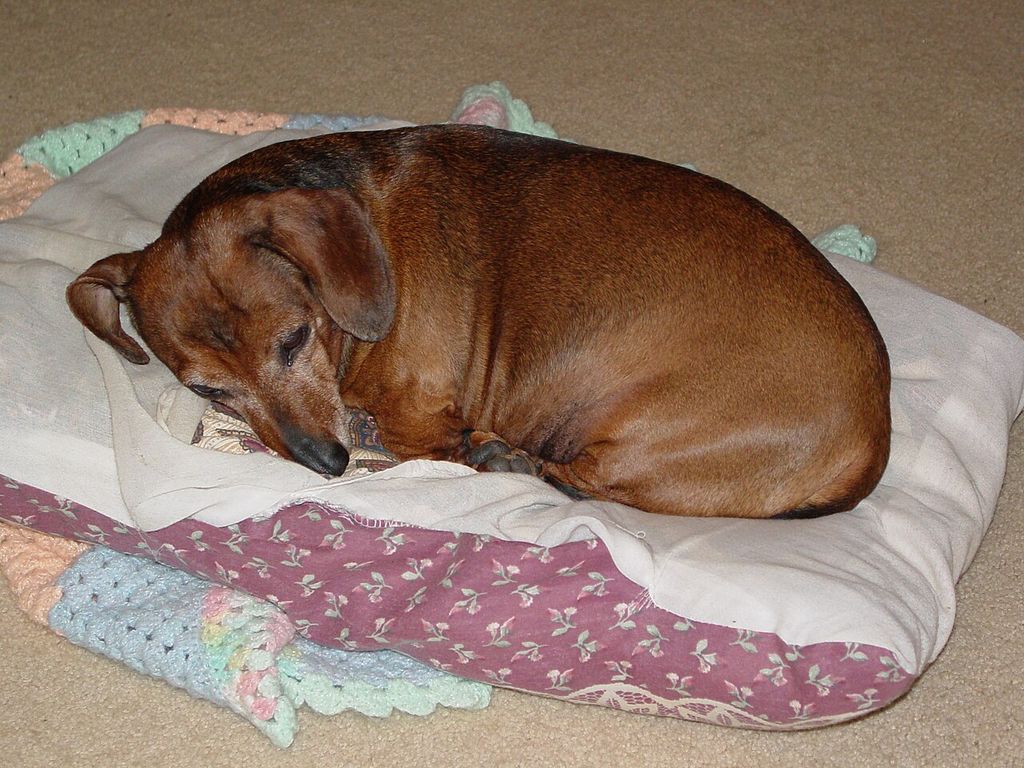
A posture comparison: Greta, a dachshund photographed at rest by Ben Schumin. Ben Schumin / Wikimedia Commons. Image source. CC BY-SA 3.0. Resized and converted to JPEG; no crop or recolouring. Image derivative retains CC BY-SA 3.0.
Working quickly required preparation
The speed of the dog pictures depended on preparation. In June 1995, Hockney described keeping a separate palette ready so he could paint the dogs from life. [6] Phaidon records his account of working in intervals of roughly twenty minutes to half an hour, according to the dogs’ position. The concentrated effort could be tiring. Their temporary stillness determined the opportunity. [3]
A prepared working space changes what speed means. It allows the artist to spend the available interval looking and making marks. The resulting directness can preserve a decisive bend or contact between forms, with fewer interruptions between seeing and recording. It also requires selection. A complete inventory of fur, furniture and anatomy would compete with the immediate task of securing the pose. The picture depends on which lines and colour relationships can do the most work.
The same practical principle reappeared in 1998 when Hockney and the printer Maurice Payne established a print studio at the Hollywood Hills house. According to the Foundation, Payne left prepared plates around so Hockney could draw the people and objects of his household during the day. Readiness turned ordinary moments into opportunities for making an etching. The dogs belonged to this wider domestic practice, alongside chairs, plants and familiar people. [7]
A small oil painting and a wall of etchings
Dog Painting 17 is a 1995 oil on canvas, approximately 33 centimetres high. Its inscription names Stanley. Christie’s describes him lying in the hollow of a cushion, with blue and green at the edges of the composition and yellow marking the light towards the left. The auction essay draws attention to the quick treatment of the ear. The visible economy is important: a few marks can keep a resting body from becoming a closed, immobile mass. [5]
The cushion and coloured surroundings allow the brown body to be understood through differences of hue as well as outline. A dark shape can sit inside a bright field without requiring a fully modelled room behind it. At this scale, the relation between a broad body and a small active detail becomes particularly concentrated. The eye moves between the animal’s overall shape and those brief changes that make the pose particular.
The later Dog Wall offers another set of material possibilities. Pace Prints identifies it as a suite of fifteen black-and-white etchings made in 1998, with individual prints differing in scale. Removing colour changes the terms of recognition. The boundary of a body, the amount of white paper around it and the density of marks have to establish relationships that paint can articulate through contrasting hues. Familiarity survives the change of medium. [8]
Each print can retain the concentration of a brief encounter; seen together, the prints invite comparison across different sizes and arrangements. Repetition becomes an active way of looking. A viewer begins to notice differences because the underlying subject is known. The series gives ordinary posture the attention that a single spectacular event might otherwise command.
The 1995 exhibitions and Dog Days
The dogs were shown within a broader field of work. L.A. Louver’s exhibition ran from 7 April to 6 May 1995 under the title Some Very Large New Paintings, with “Twenty-Five Dogs Upstairs and Some Drawings of Friends”. The conjunction matters: small animal studies, human likenesses and large paintings occupied the same moment of Hockney’s practice. [9] Hockney recalled painting large abstract pictures alongside the dogs. [3]
The dogs’ scale and familiar subject concentrate attention on a nearby external world, while other work could expand into larger invented spaces. These approaches could coexist. The dogs gave him another set of decisions about shape, colour and pictorial space, with the additional pressure of an independently moving sitter.
At the 1853 Gallery in Salts Mill, David Hockney Dog Paintings ran from 26 June to 1 October 1995, as recorded by the Foundation. The exhibition brought this closely observed household subject to the Yorkshire venue associated with his friend Jonathan Silver. [4] The public setting altered the scale of the encounter: pictures made through private familiarity could be compared as a sustained body of work.
David Hockney’s Dog Days followed as a publication in 1998, issued in London by Thames & Hudson. The Foundation describes it as bringing together paintings and drawings made over several years. [7] The publisher’s later paperback listing gives 26 September 2011 as that edition’s publication date, with 80 pages. Its reproduced introduction pairs the artist’s account of companionship with the practical difficulty of uncooperative models. The book’s subject therefore includes the conditions of making the pictures as well as the dogs themselves. [2]
Portraiture close to home
The dogs fit a longstanding habit in Hockney’s portraiture: returning to a small group of subjects he knew. The National Portrait Gallery describes his repeated studies of his mother, Celia Birtwell, Gregory Evans and Maurice Payne, observing changes across relationships and years. Stanley and Boodgie extend that pattern of sustained acquaintance. Their presence made possible many separate acts of looking, each with different materials and immediate circumstances. [10]
There is also a productive closeness to still life. A resting dog offers rounded volumes beside fabric and furniture, but those volumes can stir, look back or leave. The artist works at the point where a stable arrangement remains alive. This gives the pictures their distinctive balance: enough stillness to examine a shape, enough independence to keep the examination alert.
Pace’s account of the 1998 etchings places Dog Wall alongside images of plants, stools, books and chairs, all made during Hockney’s collaboration with Payne. [8] Such company draws attention to the household as a field of artistic investigation. A familiar cushion or chair does not diminish the subject. It supplies the concrete setting in which a line, a volume or a shift of position can become visible. Stanley and Boodgie brought that investigation into a relationship of daily companionship, making the repeated act of looking both a formal discipline and an expression of affection.
Works directory
This source-bounded directory combines the works in the Metropolitan Museum’s 2017 retrospective checklist with reviewed museum object records and the additional works and series examined in this guide. It spans several media and is not a complete catalogue raisonné. Titles without an article link remain useful dated records. Metropolitan Museum final retrospective checklist (2017); additional object and series sources are given in the linked articles. [11]
| Name | Date | Medium |
|---|---|---|
| Love Painting | 1960 | Painting |
| Shame | 1960 | Painting |
| The Third Love Painting | 1960 | Painting |
| Tyger Painting No. 2 | 1960 | Painting |
| A Rake’s Progress | 1961–63 | Print series |
| Tea Painting in an Illusionistic Style | 1961 | Painting |
| The Cha-Cha That Was Danced in the Early Hours of 24th March | 1961 | Painting |
| Cleaning Teeth, Early Evening (10pm) W11 | 1962 | Painting |
| Flight into Italy - Swiss Landscape (Painting in a Scenic Style) | 1962 | Painting |
| Man in a Museum (or You're in the Wrong Movie) | 1962 | Painting |
| My Brother is Only Seventeen | 1962 | Painting |
| The First Marriage (A Marriage of Styles I) | 1962 | Painting |
| Domestic Scene, Los Angeles | 1963 | Painting |
| Play Within a Play | 1963 | Painting |
| The Hypnotist | 1963 | Painting |
| Arizona | 1964 | Painting |
| California Art Collector | 1964 | Painting |
| Man in Shower in Beverly Hills | 1964 | Painting |
| Portrait Surrounded by Artistic Devices | 1965 | Painting |
| Rocky Mountains and Tired Indians | 1965 | Painting |
| Beverly Hills Housewife | 1966–67 | Painting |
| Medical Building | 1966 | Painting |
| Peter | 1966 | Drawing |
| Peter Getting Out of Nick’s Pool | 1966 | Painting |
| A Bigger Splash | 1967 | Painting |
| A Lawn Being Sprinkled | 1967 | Painting |
| Kasmin in Bed in His Chateau in Carennac | 1967 | Drawing |
| Peter Feeling Not Too Good | 1967 | Drawing |
| Savings and Loan Building | 1967 | Painting |
| The Room, Tarzana | 1967 | Painting |
| American Collectors (Fred and Marcia Weisman) | 1968 | Painting |
| Christopher Isherwood and Don Bachardy | 1968 | Painting |
| Henry Geldzahler and Christopher Scott | 1968-1969 | Painting |
| W. H. Auden | 1968 | Drawing |
| Peter Langan in His Kitchen at Odins | 1969 | Drawing |
| Mark Glazebrook | 1970 | Drawing |
| Mr and Mrs Clark and Percy | 1970-1971 | Painting |
| Ossie Wearing a Fairisle Sweater | 1970 | Drawing |
| Pool and Steps, Le Nid du Duc | 1971 | Painting |
| Rubber Ring Floating in a Swimming Pool | 1971 | Painting |
| Celia in a Black Dress with White Flowers | 1972 | Drawing |
| Mount Fuji and Flowers | 1972 | Painting |
| Portrait of an Artist (Pool with Two Figures) | 1972 | Painting |
| Portrait of the Artist's Mother, Mrs Laura Hockney, Bradford | 1972 | Drawing |
| The Artist's Father | 1972 | Drawing |
| Dr Eugene Lamb, Lucca | 1973 | Drawing |
| Andy, Paris | 1974 | Drawing |
| Contre-jour in the French Style (Against the Day dans le Style-Français) | 1974 | Painting |
| Gregory Sitting on Base of Column | 1975 | Drawing |
| Kerby (after Hogarth) Useful Knowledge | 1975 | Painting |
| Ron Kitaj Outside Akademie der Kunste Vienna | 1975 | Drawing |
| Kasmin Reading the Udaipur Guide | 1977 | Drawing |
| Looking at Pictures on a Screen | 1977 | Painting |
| My Parents | 1977 | Painting |
| Canyon Painting | 1978 | Painting |
| Mother, Bradford, 19 Feb. 1979 (inscribed 1978) | 1979 | Drawing |
| Mulholland Drive: The Road to the Studio | 1980 | Painting |
| Nichols Canyon | 1980 | Painting |
| Outpost Drive, Hollywood | 1980 | Painting |
| Hollywood Hills House | 1981-1982 | Painting |
| Celia. Los Angeles. April 10th 1982 | 1982 | Polaroid composite |
| Don + Christopher, Los Angeles, 6th March 1982 | 1982 | Polaroid composite |
| Gregory Swimming Los Angeles March 31st 1982 | 1982 | Polaroid composite |
| My Mother, Bolton Abbey, Yorkshire, Nov. 1982 | 1982 | Photocollage |
| Self Portrait 30th Sept. 1983 | 1983 | Drawing |
| Pearblossom Hwy., 11-18th April 1986, #1 | 1986 | Photocollage |
| Pearblossom Hwy., 11–18th April 1986, #2 | 1986 | Photocollage |
| Large Interior, Los Angeles | 1988 | Painting |
| Breakfast at Malibu, Sunday, 1989 | 1989 | Painting |
| Pacific Coast Highway and Santa Monica | 1990 | Painting |
| The Other Side | 1991-1993 | Painting |
| The Eleventh V. N. Painting | 1992 | Painting |
| The Twenty Sixth V. N. Painting | 1992 | Painting |
| The Road Across the Wolds | 1997 | Painting |
| 9 Canvas Study of the Grand Canyon | 1998 | Painting |
| A Bigger Grand Canyon | 1998 | Painting |
| Colorado River | 1998 | Painting |
| Garrowby Hill | 1998 | Painting |
| Colin St. John Wilson. London. 3rd June 1999 | 1999 | Drawing |
| Gregory Evans. Los Angeles. 18th September 1999 | 1999 | Drawing |
| Laura Huston. London. 22nd June 1999 | 1999 | Drawing |
| Lindy. Marchioness of Dufferin and Ava. London. 17th June | 1999 | Painting |
| Going Up Garrowby Hill | 2000 | Painting |
| Red Pots in the Garden | 2000 | Painting |
| A Closer Winter Tunnel, February - March | 2006 | Painting |
| Elderflower Blossom, Kilham, July 2006 | 2006 | Painting |
| The Road to Thwing, July 2006 | 2006 | Painting |
| Bigger Trees near Warter | 2007 | Painting |
| Hawthorn Blossom near Rudston | 2008 | Painting |
| Views Through the Artist's Bedroom Window, Bridlington | 2010-2013 | Digital animation |
| The Arrival of Spring in Woldgate, East Yorkshire in 2011 (twenty eleven) | 2011 | Painting / digital series |
| 82 Portraits and 1 Still-life | 2013–16 | Portrait series |
| Garden | 2015 | Painting |
| Garden with Blue Terrace | 2015 | Painting |
| Garden #3 | 2016 | Painting |
| A Bigger Interior with Blue Terrace | 2017 | Painting |
| Interior with Blue Terrace and Garden | 2017 | Painting |
| A Year in Normandie | 2020–21 | Digital frieze |
Discussion
Look again at the images and ideas explored in David Hockney’s Dogs: Stanley and Boodgie. These editorial prompts invite your observations.
Reader Insights
How does raising a dog’s cushion to the artist’s eye level change the kind of encounter a portrait can offer?
What can fifteen black-and-white etchings reveal through repetition that a single oil painting might leave unexplored?
In the discussion of Dog Painting 17, which seems more important to the sense of a living subject: the rounded body, its coloured surroundings or the quickly painted ear?
Join the Conversation
Share a detail, comparison or question about David Hockney’s Dogs: Stanley and Boodgie below.
References
- The Wallace Collection, Portraits of Dogs: From Gainsborough to Hockney, exhibition press release, 2023, pp. 1–2, especially p. 2. View source.
- Thames & Hudson, David Hockney’s Dog Days, publisher’s description, artist’s introductory extract and paperback edition details, publication date 26 September 2011. View source.
- Phaidon, “David Hockney – ‘I realized I was painting my best friends. The subject wasn’t dogs but my love of the little creatures.’”, 7 July 2023. View source.
- The David Hockney Foundation, “1995”, Dog Paintings section and exhibition listing. View source.
- Christie’s, Dog Painting 17, object record and lot essay, 20th/21st Century: London Evening Sale, 14 October 2026. View source.
- Jon Stock, “A Dog’s Life”, The Independent on Sunday, 25 June 1995. View source.
- The David Hockney Foundation, “1998”, Etchings, Dog Days and Publications sections. View source.
- Pace Prints, David Hockney: Etchings, exhibition account, 31 October–20 December 2018. View source.
- L.A. Louver, David Hockney: Some Very Large New Paintings, with Twenty-Five Dogs Upstairs and Some Drawings of Friends, exhibition record, 7 April–6 May 1995. View source.
- National Portrait Gallery, David Hockney: Drawing from Life, learning resource, biography and portraiture sections. View source.
- The Metropolitan Museum of Art, David Hockney, final exhibition checklist, 15 November 2017. View source.
More HOCKNEY Works
A Bigger Splash
A momentary disturbance becomes the focus of a large acrylic painting, made through weeks of patient work.
Mr and Mrs Clark and Percy
The designers Celia Birtwell and Ossie Clark occupy a room shaped by light, repeated sittings and the demands of a double portrait.
A Bigger Grand Canyon
Sixty canvases gather memory, studies and changing viewpoints into an immense painting of 1998.
Garrowby Hill
The 1998 oil painting transforms a remembered Yorkshire journey into a road, fields and an expansive view.
Portrait of an Artist (Pool with Two Figures)
Photographic studies, two figures and a swimming pool become a carefully constructed painting of 1972.
My Parents
The 1977 oil painting sets Kenneth and Laura Hockney within a quietly organised interior.
Pearblossom Hwy., 11–18th April 1986, #2
Hundreds of separately made photographs construct a road scene that unfolds through movement and time.
Bigger Trees near Warter
Fifty canvases join into a large outdoor painting of Yorkshire trees, with photography helping the artist organise the whole.