


 by Tom Gurney
Tom Gurney BSc (Hons) is an art history expert with over 20 years experience
Email: tomgurney1@gmail.com / Phone: +44 7429 011000
David Hockney’s iPad and iPhone Art: Introduction
A flower on a bedside table, daylight entering through shutters, a country lane acquiring its spring leaves: David Hockney found subjects for digital art among the things he had long enjoyed drawing. By 2009 he was making pictures on an iPhone and sending them to friends. The illuminated screen attracted him particularly to sunrise, which he could draw from bed with the whole apparatus already in his hand. [1] When he acquired an iPad in April 2010, its larger surface opened further possibilities for drawing outdoors, including in Yosemite National Park. [2]
These works belong to a sustained investigation of what different tools allow a picture to become. A mark could remain luminous on a handheld screen, arrive on somebody else’s device, expand into a large print or reappear in a replay of its making. Hockney’s digital practice joined the intimacy of a sketchbook to forms of display that could occupy an entire gallery. Understanding those changes of scale and material helps explain why his iPad art encompasses both quick observations and elaborate painted compositions.
At a Glance
- ArtistDavid Hockney
- Born9 July 1937, Bradford, England
- Died11 June 2026
- FocusiPad Art
Contents
- From the photocopier to pictures sent down a line
- iPhone mornings and the larger iPad
- A digital brush with its own character
- Colour made from light
- Yorkshire: following the arrival of spring
- Yosemite and the size of an image
- Normandy: a spring, then a whole year
- Replay, transmission and the printed object
From the photocopier to pictures sent down a line
Hockney had already tested machines associated with everyday communication before the smartphone arrived. In 1986 he made his Home Made Prints on an office photocopier. Changing coloured cartridges, enlarging or reducing images and repeating parts gave him a way of building pictures through successive operations. The scanning bed also allowed objects to enter the process directly. He could undertake the work in his own studio without the interruptions and assistance required by a conventional print workshop. [3]
The photocopier interested him as an image-making instrument with particular strengths. Enlargement could alter the relationship between a small drawn element and its setting; repetition could become part of a composition. Its practical availability also mattered. Hockney’s purchase of a colour laser copier in 1987 supported further reconfiguration of existing drawings, while newspapers and magazines offered another route by which his pictures could reach a public. Production and distribution were connected questions. [4]
Fax extended that connection across distance. In her account of his technological experiments, curator Ai Kusumoto described the 1990 presentation of faxed drawings sent from Los Angeles to Tokyo. Large images travelled as small sections and were assembled at their destination according to Hockney’s instructions. The picture’s physical size therefore exceeded the machine’s individual sheet. This was an important precedent for the later separation between a portable drawing surface and a much larger public display. [5]
Each device imposed conditions: a sheet size, a palette, a transmission method, a way of repeating or joining elements. Those conditions became things to work with. Hockney’s photography and joiners pursued related questions through assembled views; the phone and tablet added a surface on which he could make the marks himself and immediately send the resulting image elsewhere.
Explore the seasonal series
The Arrival of Spring in Woldgate
A thirty-two-canvas oil painting and an associated sequence of iPad drawings offer distinct ways of following spring in 2011.
A Year in Normandie
A long frieze developed from iPad paintings follows the changing seasons around Hockney’s Normandy home.
iPhone mornings and the larger iPad
The Foundation’s chronology places the sustained iPhone drawing activity in 2009. His sister Margaret introduced him to Brushes, and friends began receiving images made on the phone. Hockney recalled drawing with his thumb, whose movement could cover the small screen while he held the device in the same hand. The scale shaped the gesture. A telephone became a compact place to look, draw and transmit. [1]
In Martin Gayford’s 2010 interview, flowers and dawn light recur as subjects. Hockney discussed learning different line widths, transparency and soft edges, and described the flow of working on glass alongside the missing resistance of paper. Such testimony makes the change of medium tangible. The hand still had to learn how a particular surface responded, even though there was no wet pigment to handle. The convenience of the device made it possible to begin while an effect of light was still unfolding. [6]
The iPad increased the available working area. Hockney bought one soon after its April 2010 release and used Brushes to draw directly before the landscape. He explained that mastering it took months, and that transparent layers offered considerable subtlety. Speed was valuable because light changed quickly: the tool let him establish an image before the conditions disappeared. This was a developed working method, acquired through use, with its own demands on judgement and coordination. [2]
Fingers and a stylus offered different ways of addressing the screen. The Royal Ontario Museum’s 2011 account described the early finger and thumb drawings, adjustable width and opacity, and the greater complexity made possible by the tablet’s scale and a stylus. The subjects also extended beyond flowers to portraits, still lifes and landscapes. Portability joined a surprisingly broad set of pictorial decisions: how firmly to describe an edge, how much to obscure beneath another mark, and where colour alone could establish a form. [7]
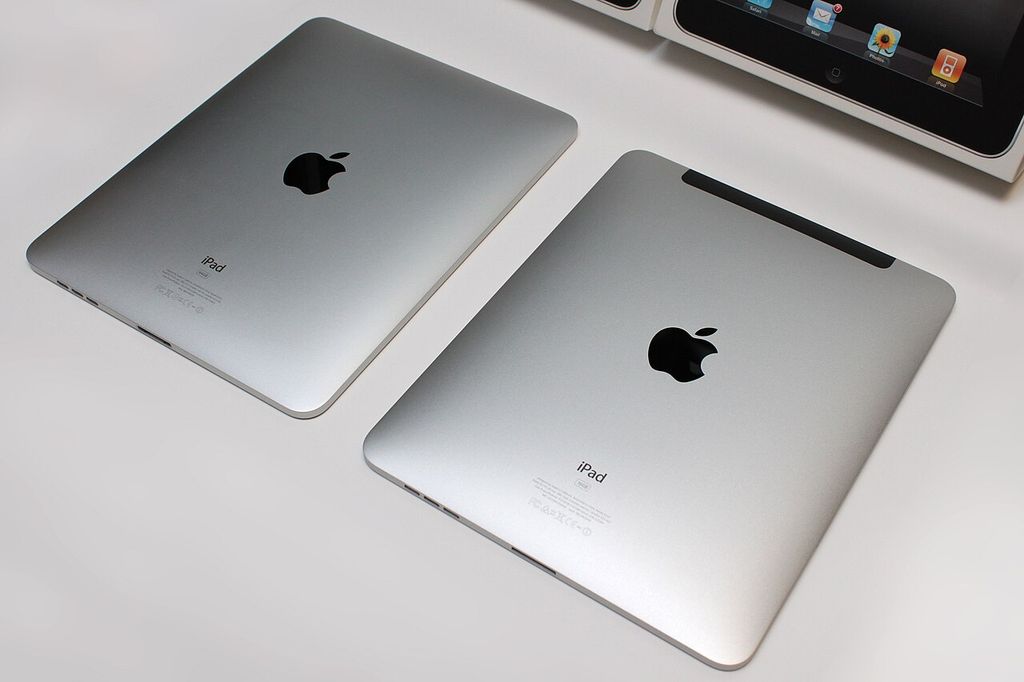
Drawing hardware: the backs of first-generation Wi-Fi and Wi-Fi + 3G iPads. Yutaka Tsutano / Wikimedia Commons. Image source. CC BY 2.0. Resized and converted to JPEG; no crop or recolouring.
A digital brush with its own character
The word brush can make a digital tool sound like a substitute for a familiar implement. Hockney’s interest went further. He wanted marks suited to the medium, and eventually took part in shaping the software itself. Reflex Arc, the Leeds developers who worked with his studio, distinguish Steve Sprang’s original Brushes from the bespoke Hockney Brushes they built mainly in early 2018. Their account describes an application adapted to his working habits, with his chosen brushes readily available in the palette. The later program was a separate development, created around a particular artist’s needs. [8]
Hockney’s own recollection, preserved by the Foundation, credited his technical assistant Jonathan Wilkinson with proposing a new application in 2018. He then had six or seven brushes made to his specifications. The same passage records his growing preference for calling the results paintings. That change of vocabulary points towards the increased complexity of the work and the way he developed it through successive interventions. [9]
Kusumoto explained the distinction through particular examples. She described the Woldgate spring works as iPad drawings that responded directly to the changing landscape. In the Normandy flower image No. 118, 16 March 2020, separate layers allowed colour and composition to be developed and finally brought together, producing what Hockney called an iPad painting. She also identified small leaves and dotted marks in the later Normandy frieze as products of the custom brushes; a similar mark could describe grass in one passage and a roof in another. [5]
A mark acquires meaning through its position, colour, repetition and relationship to neighbouring shapes. The digital brush supplies an available form, while the artist decides what it will describe. A repeated element can spread growth across a field or make a patterned surface hold together. The custom tools belong to the larger story of Hockney’s style and techniques: he kept testing how different kinds of marks could carry visual information.
The screen also supported work destined for canvas. In its 2016–17 exhibition David Hockney: Current, the National Gallery of Victoria included iPad studies in which he photographed unfinished paintings and tested possibilities for refining and completing them. Here the digital surface served a painting already under way in another material. An electronic alteration could make a possible development visible before he committed to it on the canvas. This studio use adds a further relationship between the media alongside the drawings and paintings created directly on the tablet. [10]
Colour made from light
An iPad image viewed on its screen emits light. A printed version is seen by light reflected from its material surface. The difference affects the experience of colour even when the composition remains recognisable. The Fitzwilliam Museum’s Hockney’s Eye labels drew particular attention to his Normandy greens: on the screen these colours came directly from emitted light, and their range and prominence gave the vegetation an assertive presence. The museum connected the digital landscapes with the older practice of returning to a motif under changing light and atmospheric conditions. [11]
Green has to do several jobs in these landscapes. It may describe the ground, separate areas of foliage or help distinguish one stage of the season from another. A bright green passage can come forward as a colour even when it represents something farther away. The image asks the viewer to hold together spatial description and the immediate pattern on the surface. The luminous device made those relationships available in a particular form; a print established them again in a different material situation.
Early exhibition decisions acknowledged the screen’s importance. Fleurs fraîches, presented at the Fondation Pierre Bergé–Yves Saint Laurent in Paris in 2010–11, brought together more than two hundred iPhone and iPad works. The institution’s account says that they were shown in their original format to preserve the luminous, colourful character Hockney wanted viewers to encounter. A small image could therefore retain the scale and lighting conditions of its initial electronic life even as it entered a public exhibition. [12]
This makes the viewing format part of the work’s history. The glow of a device, the reflected colour of paper and the bodily experience of a large installation offer different encounters with the image. Hockney used those possibilities selectively. His digital pictures did not all have to end in the same kind of object or be seen from the same distance.
Yorkshire: following the arrival of spring
In January 2011 Hockney began an outdoor iPad campaign in East Yorkshire that developed into a record of the passage from winter towards summer. He made more than one hundred drawings. For the Royal Academy’s 2012 exhibition, fifty-one were selected and printed on paper, accompanying an oil painting assembled from thirty-two canvases. The digital corpus, the exhibited selection and the multi-canvas oil are distinct parts of The Arrival of Spring in Woldgate. [13]
The dates matter because growth changes the structure of what can be seen. Kusumoto traced the sequence from branches retaining dead leaves and ground carrying thin ice through the emergence of young leaves and the dense greens of May. Returning to familiar places made small differences legible. Spring altered the intervals between branches, the amount of visible sky and the relationship between the road and the vegetation around it. The repeated visit gave the images their cumulative force. [14]
The iPad helped Hockney respond quickly, but his account also includes returning to the studio, where he could see the screen better and develop what he had established outdoors. Observation and later elaboration worked together. Speed allowed an initial palette and disposition of colour to be caught; it did not require every picture to be finished in one uninterrupted encounter. [13]
Printed display changed the drawings again. The Museum of Fine Arts, Houston, identified a selection of fourteen Woldgate images, running from January to May, as enlarged prints in an edition of twenty-five. Its labels also distinguished larger spring drawings printed across four sheets of paper. A single series could consequently be encountered through different selections and scales. The material description tells us how a particular exhibited version was made; it does not turn every spring drawing into an identically sized object. [15]
Digital drawing and painting on canvas supplied different ways of concentrating an experience of seasonal change. Their co-presence in the gallery makes visible the overlap between the new tool and an established practice. The dedicated account of The Arrival of Spring in Woldgate examines that relationship in greater detail.
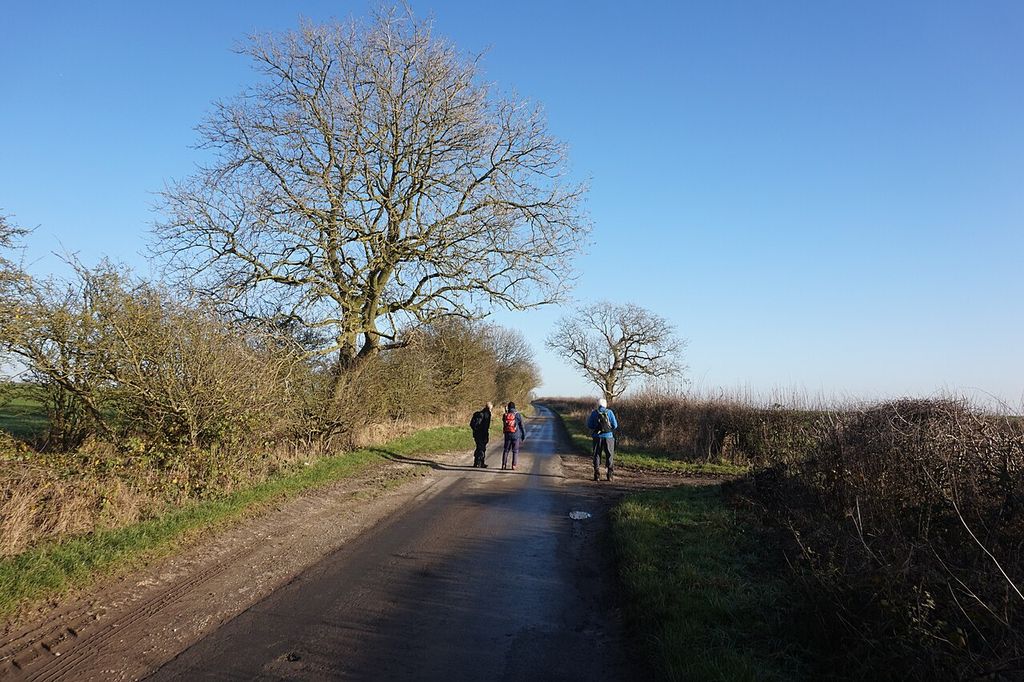
Geographic context: Woldgate towards Bridlington, photographed by Ian S. Ian S / Wikimedia Commons. Image source. CC BY-SA 2.0. Resized and converted to JPEG; no crop or recolouring. Image derivative retains CC BY-SA 2.0.
Yosemite and the size of an image
Hockney’s Yosemite drawings tested another relationship between the handheld screen and the landscape. He worked there with the iPad in 2010 and returned in 2011 intending to print the new drawings at a very large scale. He planned to show them alongside A Bigger Message, his multi-canvas painting after Claude Lorrain, in a Royal Academy gallery concerned with the experience of looking upwards. [2] [13]
The intention to enlarge was part of the project. The National Gallery of Victoria’s 2016–17 labels described the contrast between the harsher, more intense light of Yosemite and the Woldgate scenes. They identified large Yosemite drawings printed on six sheets mounted on Dibond, alongside an animated version of Yosemite I, October 16th 2011 presented on fifteen screens. The installation gave the images different physical forms while addressing the scale of the park’s trees and granite cliffs. [10]
A particular print has its own specifications. The NGV’s collection record for Yosemite I, October 16th 2011 identifies a version printed in 2015 on four sheets, measuring about two metres high overall. The distinction between the drawing’s date and the print’s date is useful: making the electronic image and producing a physical edition were separate events. Its four-sheet construction also differs from the six-sheet exhibition prints. [16]
Hockney could bring a compact tool before the motif and imagine an eventual encounter on a much larger surface. A viewer could stand back to grasp the composition or move towards an individual mark. Changing the scale altered the relation between the body and the depicted landscape: an image held in the hand could become something that required an upward glance.
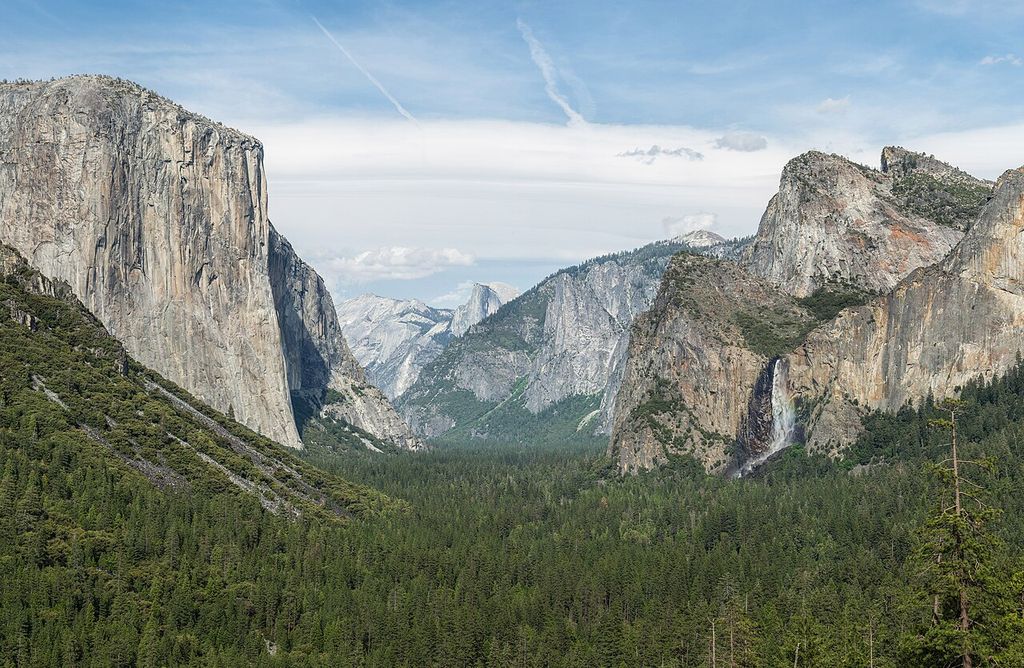
Geographic context: Yosemite Valley from Tunnel View. Diliff / Wikimedia Commons. Image source. CC BY-SA 3.0. Resized and converted to JPEG; no crop or recolouring. Image derivative retains CC BY-SA 3.0.
Normandy: a spring, then a whole year
Hockney’s 2020 Normandy spring works brought renewed attention to the iPad. The Royal Academy’s contemporary account described software tailored to his specifications and the ease with which he could begin without arranging a conventional painting kit. During lockdown he followed the fruit trees around the house from winter branches to buds, blossom, leaves and fruit, eventually taking up the pond’s water lilies. The changing subject and his developing command of screen marks progressed together. [17]
The 116 images exhibited as The Arrival of Spring, Normandy, 2020 were printed on paper for the 2021 presentation. [9] Their sequence gave the returning motif a temporal structure. A tree could be recognisable while its proportions of branch, flower and leaf altered markedly. What first appeared as a network of lines could become an area of denser colour. Looking across the series makes those changes appreciable in a way that a single picture cannot provide.
Normandy prompted several related projects in different media. La Grande Cour of 2019 is a panorama composed of twenty-four ink drawings, as the Fondation Louis Vuitton’s 2025 curatorial account specifies. That exhibition also presented 220 for 2020, an iPad corpus attending to changing light across the seasons, followed by acrylic paintings of Normandy. The landscape supported parallel work in different materials. [18] The long digital frieze A Year in Normandie, dated 2020–21, was a further project with its own arrangement and viewing experience. [14]
For the frieze, a succession of seasonal images became a continuous printed environment. [8] The Musée de l’Orangerie connected its conception with Hockney’s encounter with the Bayeux Tapestry and presented the work in dialogue with Monet’s Water Lilies. The subject expanded beyond one spring to the passage through summer, autumn and winter. Its great length allowed change to unfold as the visitor moved along it. [19]
Kusumoto placed that experience within Hockney’s longer engagement with Chinese and Japanese scroll painting. Her interpretation emphasised the viewer’s body and the possibility of experiencing space through time. These traditions offered different precedents for an image that could be explored successively. With the Normandy frieze, the movement of the spectator became integral to following the landscape’s seasonal rhythm. The full account of A Year in Normandie considers this unfolding structure, while Hockney in Normandy places it within his work in the region. [14]
Normandy context: timber framing in Beuvron-en-Auge. Renhour48 / Wikimedia Commons. Image source. CC0 / Public domain. Resized and converted to JPEG; no crop or recolouring.
Replay, transmission and the printed object
Digital work also made the order of mark-making available to viewers. Gayford described the early iPad replay in 2010: a cleared screen filled again as lines and washes returned in sequence. Hockney could watch a drawing develop after the fact, encountering a process he had previously experienced from inside the act of making. Replay turned the completed image into the end point of a visible sequence of decisions. [6]
The Royal Ontario Museum’s 2011 exhibition announcement included playback animations and large animated projections alongside images displayed on devices. Visitors could encounter both a finished composition and an account of how its elements accumulated. A replay differs from a film of the artist’s hand: it directs attention towards the evolving picture surface. A line establishes one possibility, a patch of colour alters it, and later marks change the importance of what appeared first. [7]
For the later bespoke software, Reflex Arc explain that the paintings were retained as stroke information, enabling both replay and rendering at enlarged output sizes. In their description, the system drew the recorded marks again for the required scale, using the corresponding brushes. This is a more specific process than enlarging a small, flattened image. It helps explain how a portable drawing practice could support prints and installations far beyond the tablet’s own dimensions. [8]
The printed object still requires a precise identity. L.A. Louver’s 2018 exhibition records, for example, describe White Rose of 2009 as an iPhone drawing printed on paper, and Sunflowers of 2010 as an iPad drawing printed on paper; both are listed in editions of twenty-five. The electronic image and a particular editioned print belong to the same creative history, but the print adds a specified sheet, size and edition. The description identifies both the image’s digital origins and the material form of the edition. [20]
Across these forms, Hockney continued to make decisions about looking and depiction. The device supplied a luminous surface, adaptable marks and unusual means of replay and circulation. The artist chose what to observe, what to retain, how to develop the composition and how it should meet a viewer. His iPad art extended the possibilities of drawing and painting through another set of tools, carrying the immediate encounter with a flower, a dawn or a changing tree into new material forms.
Works directory
This source-bounded directory combines the works in the Metropolitan Museum’s 2017 retrospective checklist with reviewed museum object records and the additional works and series examined in this guide. It spans several media and is not a complete catalogue raisonné. Titles without an article link remain useful dated records. Metropolitan Museum final retrospective checklist (2017); additional object and series sources are given in the linked articles. [21]
| Name | Date | Medium |
|---|---|---|
| Love Painting | 1960 | Painting |
| Shame | 1960 | Painting |
| The Third Love Painting | 1960 | Painting |
| Tyger Painting No. 2 | 1960 | Painting |
| A Rake’s Progress | 1961–63 | Print series |
| Tea Painting in an Illusionistic Style | 1961 | Painting |
| The Cha-Cha That Was Danced in the Early Hours of 24th March | 1961 | Painting |
| Cleaning Teeth, Early Evening (10pm) W11 | 1962 | Painting |
| Flight into Italy - Swiss Landscape (Painting in a Scenic Style) | 1962 | Painting |
| Man in a Museum (or You're in the Wrong Movie) | 1962 | Painting |
| My Brother is Only Seventeen | 1962 | Painting |
| The First Marriage (A Marriage of Styles I) | 1962 | Painting |
| Domestic Scene, Los Angeles | 1963 | Painting |
| Play Within a Play | 1963 | Painting |
| The Hypnotist | 1963 | Painting |
| Arizona | 1964 | Painting |
| California Art Collector | 1964 | Painting |
| Man in Shower in Beverly Hills | 1964 | Painting |
| Portrait Surrounded by Artistic Devices | 1965 | Painting |
| Rocky Mountains and Tired Indians | 1965 | Painting |
| Beverly Hills Housewife | 1966–67 | Painting |
| Medical Building | 1966 | Painting |
| Peter | 1966 | Drawing |
| Peter Getting Out of Nick’s Pool | 1966 | Painting |
| A Bigger Splash | 1967 | Painting |
| A Lawn Being Sprinkled | 1967 | Painting |
| Kasmin in Bed in His Chateau in Carennac | 1967 | Drawing |
| Peter Feeling Not Too Good | 1967 | Drawing |
| Savings and Loan Building | 1967 | Painting |
| The Room, Tarzana | 1967 | Painting |
| American Collectors (Fred and Marcia Weisman) | 1968 | Painting |
| Christopher Isherwood and Don Bachardy | 1968 | Painting |
| Henry Geldzahler and Christopher Scott | 1968-1969 | Painting |
| W. H. Auden | 1968 | Drawing |
| Peter Langan in His Kitchen at Odins | 1969 | Drawing |
| Mark Glazebrook | 1970 | Drawing |
| Mr and Mrs Clark and Percy | 1970-1971 | Painting |
| Ossie Wearing a Fairisle Sweater | 1970 | Drawing |
| Pool and Steps, Le Nid du Duc | 1971 | Painting |
| Rubber Ring Floating in a Swimming Pool | 1971 | Painting |
| Celia in a Black Dress with White Flowers | 1972 | Drawing |
| Mount Fuji and Flowers | 1972 | Painting |
| Portrait of an Artist (Pool with Two Figures) | 1972 | Painting |
| Portrait of the Artist's Mother, Mrs Laura Hockney, Bradford | 1972 | Drawing |
| The Artist's Father | 1972 | Drawing |
| Dr Eugene Lamb, Lucca | 1973 | Drawing |
| Andy, Paris | 1974 | Drawing |
| Contre-jour in the French Style (Against the Day dans le Style-Français) | 1974 | Painting |
| Gregory Sitting on Base of Column | 1975 | Drawing |
| Kerby (after Hogarth) Useful Knowledge | 1975 | Painting |
| Ron Kitaj Outside Akademie der Kunste Vienna | 1975 | Drawing |
| Kasmin Reading the Udaipur Guide | 1977 | Drawing |
| Looking at Pictures on a Screen | 1977 | Painting |
| My Parents | 1977 | Painting |
| Canyon Painting | 1978 | Painting |
| Mother, Bradford, 19 Feb. 1979 (inscribed 1978) | 1979 | Drawing |
| Mulholland Drive: The Road to the Studio | 1980 | Painting |
| Nichols Canyon | 1980 | Painting |
| Outpost Drive, Hollywood | 1980 | Painting |
| Hollywood Hills House | 1981-1982 | Painting |
| Celia. Los Angeles. April 10th 1982 | 1982 | Polaroid composite |
| Don + Christopher, Los Angeles, 6th March 1982 | 1982 | Polaroid composite |
| Gregory Swimming Los Angeles March 31st 1982 | 1982 | Polaroid composite |
| My Mother, Bolton Abbey, Yorkshire, Nov. 1982 | 1982 | Photocollage |
| Self Portrait 30th Sept. 1983 | 1983 | Drawing |
| Pearblossom Hwy., 11-18th April 1986, #1 | 1986 | Photocollage |
| Pearblossom Hwy., 11–18th April 1986, #2 | 1986 | Photocollage |
| Large Interior, Los Angeles | 1988 | Painting |
| Breakfast at Malibu, Sunday, 1989 | 1989 | Painting |
| Pacific Coast Highway and Santa Monica | 1990 | Painting |
| The Other Side | 1991-1993 | Painting |
| The Eleventh V. N. Painting | 1992 | Painting |
| The Twenty Sixth V. N. Painting | 1992 | Painting |
| The Road Across the Wolds | 1997 | Painting |
| 9 Canvas Study of the Grand Canyon | 1998 | Painting |
| A Bigger Grand Canyon | 1998 | Painting |
| Colorado River | 1998 | Painting |
| Garrowby Hill | 1998 | Painting |
| Colin St. John Wilson. London. 3rd June 1999 | 1999 | Drawing |
| Gregory Evans. Los Angeles. 18th September 1999 | 1999 | Drawing |
| Laura Huston. London. 22nd June 1999 | 1999 | Drawing |
| Lindy. Marchioness of Dufferin and Ava. London. 17th June | 1999 | Painting |
| Going Up Garrowby Hill | 2000 | Painting |
| Red Pots in the Garden | 2000 | Painting |
| A Closer Winter Tunnel, February - March | 2006 | Painting |
| Elderflower Blossom, Kilham, July 2006 | 2006 | Painting |
| The Road to Thwing, July 2006 | 2006 | Painting |
| Bigger Trees near Warter | 2007 | Painting |
| Hawthorn Blossom near Rudston | 2008 | Painting |
| Views Through the Artist's Bedroom Window, Bridlington | 2010-2013 | Digital animation |
| The Arrival of Spring in Woldgate, East Yorkshire in 2011 (twenty eleven) | 2011 | Painting / digital series |
| 82 Portraits and 1 Still-life | 2013–16 | Portrait series |
| Garden | 2015 | Painting |
| Garden with Blue Terrace | 2015 | Painting |
| Garden #3 | 2016 | Painting |
| A Bigger Interior with Blue Terrace | 2017 | Painting |
| Interior with Blue Terrace and Garden | 2017 | Painting |
| A Year in Normandie | 2020–21 | Digital frieze |
Discussion
Look again at the images and ideas explored in David Hockney’s iPad and iPhone Art. These editorial prompts invite your observations.
Reader Insights
How might a dawn drawn on an illuminated phone change when the image becomes a print viewed by reflected light?
What does following the dated Woldgate drawings reveal about spring that a single landscape image could leave unseen?
How do an iPad replay, a large Yosemite print and the long Normandy frieze ask you to spend time with a picture differently?
Join the Conversation
Share a detail, comparison or question about David Hockney’s iPad and iPhone Art below.
References
- The David Hockney Foundation, Chronology: 2009, “Brushes on the iPhone” section and artist testimony. View source.
- The David Hockney Foundation, Chronology: 2010, “Buys first iPad” section and artist testimony. View source.
- The David Hockney Foundation, Chronology: 1986, “Home Made Prints” section. View source.
- The David Hockney Foundation, Chronology: 1987, “Color photocopier” section. View source.
- Tamaki Sugihara interviewing Ai Kusumoto, Why has Hockney sustained acclaim and popularity for sixty years?, part one, Tokyo Art Beat, 25 August 2023, Japanese; fax, medium-specific marks and iPad drawing/painting sections. View source.
- Martin Gayford, David Hockney’s iPad art, The Telegraph, 20 October 2010, interview, PDF pp. 1–4, accessed through Richard Gray Gallery. View source.
- Royal Ontario Museum, North American Debut of David Hockney’s Fresh Flowers, 26 July 2011, exhibition announcement. View source.
- Reflex Arc, The iPad painting app we built for David Hockney, developer account, “Hockney Brushes, 2018” and “At scale, 2021” sections, accessed 5 November 2026. View source.
- The David Hockney Foundation, Chronology: 2021, “The Arrival of Spring, Normandy, 2020” section and artist testimony. View source.
- National Gallery of Victoria, David Hockney: Current, exhibition artwork labels, 2016–17, PDF pp. 7 and 28–35. View source.
- The Fitzwilliam Museum, Hockney’s Eye: The Art and Technology of Depiction, large-print exhibition labels, 2022, PDF pp. 128–130. View source.
- Musée Yves Saint Laurent Paris, David Hockney: Fleurs fraîches, Dessins sur iPhone et iPad, exhibition archive, 20 October 2010–30 January 2011. View source.
- The David Hockney Foundation, Chronology: 2011, “The Arrival of Spring in 2011”, “Drawing on the iPad” and “Bigger Yosemite” sections. View source.
- Tamaki Sugihara interviewing Ai Kusumoto, From difficulty to a new direction: David Hockney exhibition curator interview, part two, Tokyo Art Beat, 22 September 2023, Japanese; viewer, scroll and spring sections. View source.
- Museum of Fine Arts, Houston, Hockney–Van Gogh: The Joy of Nature, exhibition labels, 2021, PDF pp. 8–9, “Experimenting with the iPad” and “The Arrival of Spring”. View source.
- National Gallery of Victoria, Yosemite I, October 16th 2011, 2011, printed 2015, collection record, accession 2017.1213.a–d. View source.
- Royal Academy of Arts, David Hockney: The Arrival of Spring, Normandy, 2020, press release, 4 March 2021, PDF pp. 1–2. View source.
- Fondation Louis Vuitton, David Hockney 25, 2025 exhibition text, Normandy galleries. View source.
- Musée de l’Orangerie, David Hockney: A Year in Normandie, exhibition archive, 13 October 2021–14 February 2022. View source.
- L.A. Louver, David Hockney: iPhone and iPad Drawings, 2009–12, exhibition records, 28 March–25 May 2018, White Rose and Sunflowers. View source.
- The Metropolitan Museum of Art, David Hockney, final exhibition checklist, 15 November 2017. View source.
More HOCKNEY Works
A Bigger Splash
A momentary disturbance becomes the focus of a large acrylic painting, made through weeks of patient work.
Mr and Mrs Clark and Percy
The designers Celia Birtwell and Ossie Clark occupy a room shaped by light, repeated sittings and the demands of a double portrait.
A Bigger Grand Canyon
Sixty canvases gather memory, studies and changing viewpoints into an immense painting of 1998.
Garrowby Hill
The 1998 oil painting transforms a remembered Yorkshire journey into a road, fields and an expansive view.
Portrait of an Artist (Pool with Two Figures)
Photographic studies, two figures and a swimming pool become a carefully constructed painting of 1972.
My Parents
The 1977 oil painting sets Kenneth and Laura Hockney within a quietly organised interior.
Pearblossom Hwy., 11–18th April 1986, #2
Hundreds of separately made photographs construct a road scene that unfolds through movement and time.
Bigger Trees near Warter
Fifty canvases join into a large outdoor painting of Yorkshire trees, with photography helping the artist organise the whole.