


 by Tom Gurney
Tom Gurney BSc (Hons) is an art history expert with over 20 years experience
Email: tomgurney1@gmail.com / Phone: +44 7429 011000
Salts Mill: Introduction
Salts Mill brought David Hockney's art into a building that already belonged to the history of Bradford. Opened as a textile mill in 1853, it acquired a new purpose after the entrepreneur Jonathan Silver bought it in 1987. Paintings, drawings and prints became part of a setting shared with books, art materials, shops and working businesses. The connection depended on a friendship, but its consequences reached beyond the two friends: Hockney's work helped give a redundant industrial building a public cultural life. [1] [2]
The relationship also ran in the other direction. Salts Mill became a place where Hockney could send new work, test ways of reaching an audience and sustain a connection with Yorkshire while living elsewhere. Its story includes the collective assembly of a fax picture, exhibitions of changing landscapes and a long digital frieze made in France. Following those episodes reveals how a place of production became a place of looking without losing its association with work.
At a Glance
- ArtistDavid Hockney
- Born9 July 1937, Bradford, England
- Died11 June 2026
- FocusSalts Mill
Contents
- The mill before the gallery
- Jonathan Silver's opportunity in 1987
- A different setting for looking
- Tennis: a picture arriving by fax
- A place for new work
- Friendship and the Yorkshire return
- Landscapes, paper and changing displays
- A year in France, seen in Saltaire
- An industrial place with a cultural future
- Salts Mill within Hockney's Bradford
The mill before the gallery
Titus Salt built Salts Mill to bring textile manufacture together on a site beside the Leeds–Liverpool Canal and the railway. These connections allowed raw materials and finished cloth to move efficiently. Lockwood and Mawson designed the Italianate exterior; the engineer William Fairbairn was largely responsible for the interior. The mill opened on 20 September 1853, Salt's fiftieth birthday. Its integrated operation could take raw fibre through washing, combing, drawing, spinning, weaving and finishing. The spacious building later available to Silver was the physical result of this ambition to organise manufacture under one roof. [3]
The architecture combined display with practical construction. Local sandstone gave the exterior a substantial presence, while brick and cast iron formed the internal framework. The nomination dossier for Saltaire's World Heritage inscription describes machinery and drive shafts placed below the floor as part of the attempt to reduce industrial injury. Its account of the long, regularly windowed elevations helps explain the building's later possibilities: the mill offered extensive rooms and light, but turning those rooms into galleries required decisions about how pictures would occupy them. [2]
Around the mill, Salt developed Saltaire as a planned community of houses, shops and public institutions. The housing supplied drainage, water and private lavatories, while communal buildings supported education, worship and recreation. The Saltaire Collection records that the early Dining Hall also accommodated a school, religious services, a library, lectures and concerts. Production and social provision were interwoven from the beginning. [3]
That history carries the paternalism of a community shaped by its employer. UNESCO's recognition of Saltaire in 2001 concerned the unusually complete industrial settlement: mills, workers' housing, public buildings and their surviving plan. Hockney's gallery belongs within this larger setting. Looking at the mill only as a container for celebrated pictures would miss the relationship between the building and the streets around it, and the workers whose lives gave its scale a purpose. [4]
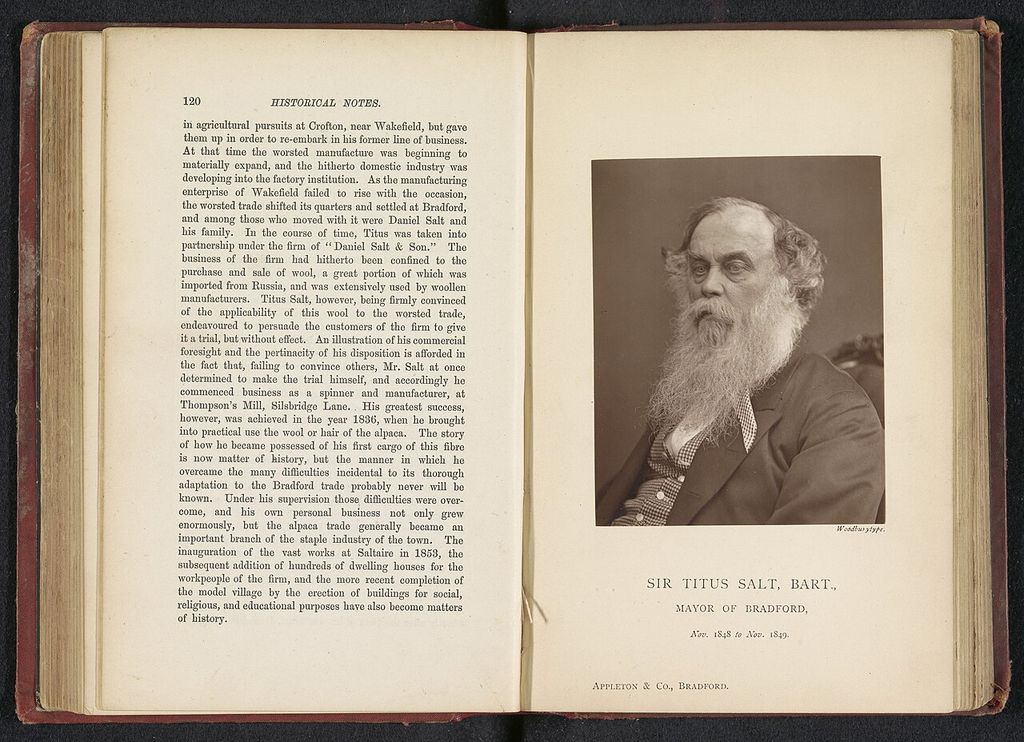
Historical context: Sir Titus Salt, a Woodburytype after a photograph by Appleton & Co., in a nineteenth-century book spread. Rijksmuseum, RP-F-2001-7-324-2, circa 1871–1881. The 1848–49 inscription records his term as Mayor of Bradford. Appleton & Co.(photograph); anonymous Woodburytype maker / Rijksmuseum / Wikimedia Commons. Image source. CC0 / Public domain. Resized and converted to JPEG; whole book spread retained, with no crop or recolouring.
Jonathan Silver's opportunity in 1987
The mill passed through several owners after the Salt family. Illingworth Morris acquired the business in 1958; its later reorganisation moved remaining productive processes to other sites. Cloth production at Salts Mill ended in 1986, following a period of industrial decline and deteriorating buildings. The Saltaire Village Society had formed in 1984 to help regenerate the area. Silver bought the mill in June 1987 and began making space for galleries, retail, restaurants and businesses. [5] [2]
The 1853 Gallery opened in November 1987, taking its name from the mill's original opening year. Local historian Roger Clarke's account describes Silver helping to remove flooring to expose the stone flags beneath, and records Maggie Silver's recollection that she was the first gallery assistant. The practical work and family participation give the project a human scale alongside the enormous building. A gallery could begin within the mill while the wider enterprise continued to develop. [6]
Hockney and Silver had known one another long before this purchase. In his tribute to Silver, written in 1997, Hockney recalled their first meeting in a Bradford Wimpy bar in the early 1960s. Silver, then a schoolboy, had asked him for a picture for an alternative school magazine. They stayed in touch through Silver's subsequent business career and Hockney's life in Los Angeles. When Silver telephoned in 1987 to announce the purchase, both men already knew Saltaire from growing up nearby. Hockney remembered family outings that passed the working mill on the way towards Shipley Glen. [7]
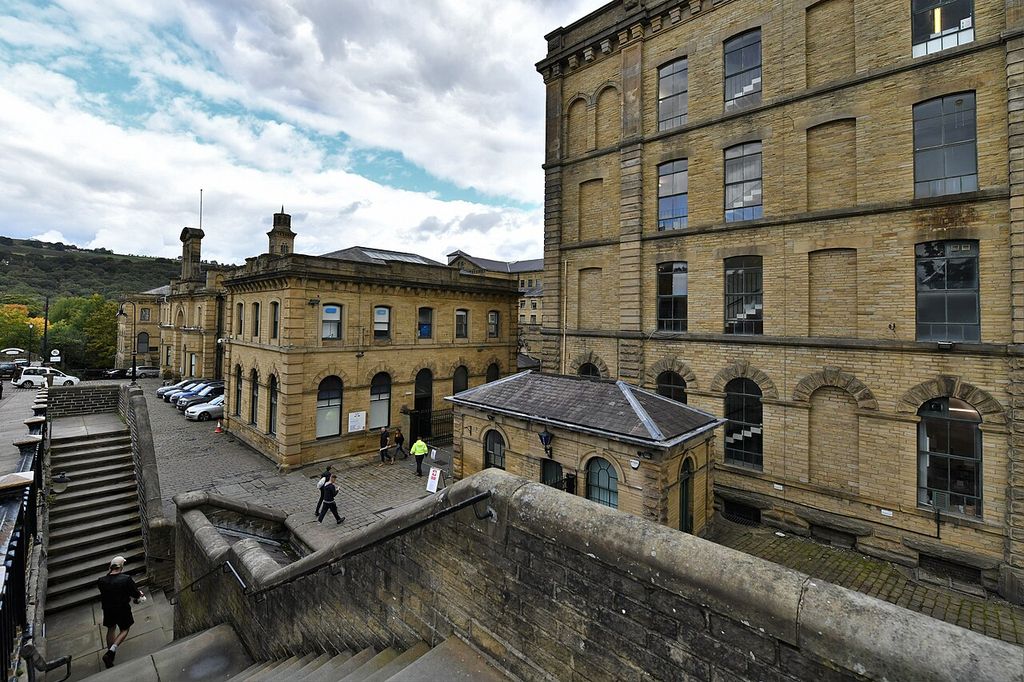
Salts Mill, Saltaire. Jonathan Silver’s redevelopment made the former textile mill an important setting for Hockney’s work. Michael Garlick / Wikimedia Commons. Image source. CC BY-SA 2.0. Resized and converted to JPEG; no crop or recolouring. Image derivative retains CC BY-SA 2.0.
A different setting for looking
Hockney's recollection of his first gallery visit centred on a display problem: Silver had hung pictures in an extremely long room with windows where conventional gallery walls might have been. He watched the spaces develop on subsequent visits and lent early work from his Bradford School of Art years. He also remembered theatre, poetry readings, shops and restaurants becoming part of the undertaking. His admiration concerned the atmosphere Silver created and shared, as well as the entrepreneurial skills needed to sustain it. [7]
The timing connected this new setting with Hockney's interest in circulation. In 1987 he bought a colour laser photocopier, expanding his experiments with reproducing paintings and rearranging drawings. That February, a colour design appeared in Bradford's Telegraph & Argus. His accompanying reflections, preserved by the Foundation, connected printing with the opportunity to reach a public. Showing work in Saltaire and distributing it through a local newspaper were different activities, but both brought pictures into contact with people beyond an established exhibition circuit. The wider history of his prints helps explain why reproduction technology mattered to him. [8]
Salts Mill developed its own institutional character. In its 2024 visitor guide, the 1853 Gallery described itself as a private enterprise devoted to Hockney's work, with free entry and no public-source funding. This arrangement placed access to art within an enterprise supported by other activities. Books and artists' materials could sit within the same encounter as displayed pictures. The resulting experience allowed looking, reading and the possibility of making something oneself to meet in one building. [9] [1]
Tennis: a picture arriving by fax
On 10 November 1989, Salts Mill became the receiving end of an unusually public experiment. Hockney sent Tennis from Los Angeles as 144 fax sheets. Four machines in the gallery received the pages, which were assembled into a grid according to instructions sent in advance. Jonathan Silver organised the evening, with Wagner's Ride of the Valkyries supplying a soundtrack. The audience could encounter a picture arriving in pieces and being given its full scale through work carried out at the destination. [2] [10]
The process made distance part of the event. Hockney's hand had made the image in California; a telephone connection transmitted it; people in Yorkshire handled and joined its paper components. A technology normally associated with office correspondence became a means of producing a large public picture. Silver's contribution involved staging the conditions in which that remote act could become a shared experience. [10]
The same year's São Paulo project showed the practical limits. When the connection failed to receive Hockney's faxes in Brazil, sheets were faxed between rooms in a Los Angeles hotel and carried to the exhibition. At Salts Mill, transmission and local assembly had worked together to make the picture. [10]
A place for new work
The early exhibitions also kept Saltaire connected with Hockney's current practice. Some Very New Paintings reached the 1853 Gallery in September 1993 after presentations in New York and Glasgow. The figureless studio paintings brought a different aspect of his work to the mill from familiar views of California or Bradford. Saltaire was participating in the circulation of a recent body of work between exhibition venues. [11]
In summer 1994, New Drawings: Some Drawings of Family, Friends and Best Friends presented large portrait drawings. The Foundation records that the catalogue reproduced video-camera stills of the drawings, connecting the direct marks on paper with Hockney's exploration of camera and printer technologies. In 1995 the gallery showed his dog paintings, with the Foundation listing the exhibition from 26 June to 1 October. These successive projects gave the mill's audience access to changing subjects and methods, from abstract space to familiar faces and the close observation of his dachshunds. Their range helps explain why Salts Mill mattered as a place to encounter an artist who continued experimenting. [12] [13]
Friendship and the Yorkshire return
The relationship acquired a different urgency in 1997, when Silver was seriously ill. Hockney returned from Los Angeles and spent an extended period in Yorkshire. His recollection describes driving from Bridlington to visit Silver in Wetherby every few days. Along the route he noticed fields changing through growth, harvest and ploughing. Familiar country began to offer a renewed subject, with broad views and roads leading across the Wolds. These journeys connected personal concern with an increasingly attentive experience of landscape. [14]
This was one important beginning within a much longer relationship with Yorkshire. It should retain the particular circumstances that made the journey necessary: Hockney was visiting a close friend with whom he had talked regularly about art and other matters. After Silver's death, the 1853 Gallery held a memorial exhibition from 14 December 1997 to 12 April 1998. The institution they had helped animate could also provide a public setting for remembrance. [14]
The landscape work continued across geographical distance. In 1998 Hockney painted Yorkshire from memory after returning to Los Angeles. The region could remain active in his pictures even when he was elsewhere. This movement between presence and recollection helps explain the mill's place in his career: it maintained a local point of encounter for work made within a life that continued to move between countries. [15]
Landscapes, paper and changing displays
The mill's exhibition history lets us follow the changing forms of that encounter. Midsummer: East Yorkshire was shown at the 1853 Gallery from 3 June to 6 November 2005, before travelling to Somerset House in London. The series consisted of thirty-six watercolours made in 2004. Its subjects included roads, cornfields, gardens, buildings and agricultural equipment: a landscape experienced through repeated excursions and attention to ordinary features. The exhibition gave Yorkshire viewers access to this recent work within a Yorkshire institution, while its subsequent journey connected Saltaire with a wider audience. [16]
The Arrival of Spring opened at the 1853 Gallery on 18 February 2015. The mill's historical exhibition description identifies its works as drawings made on an iPad in 2011 and then printed at enlarged scale. This distinction matters. The handheld device was the place of drawing, while paper gave the work another size and a shared physical setting. The exhibition extended the mill's earlier interest in making technologically produced images available for public viewing. [17] [18]
The broader 2011 project began with Hockney drawing the East Yorkshire landscape outdoors in January and recognising that he could follow the transition from winter towards summer. He made more than a hundred iPad drawings. For the Royal Academy's 2012 exhibition, fifty-one were selected to accompany a separate oil painting on thirty-two canvases. The Arrival of Spring in Woldgate brought several kinds of picture together; Saltaire's enlarged paper works offered a further exhibition form for the digital drawings. [19] [18]
A year in France, seen in Saltaire
The relationship eventually carried a French landscape into the mill. A Year in Normandie, dated 2020–21, developed from Hockney's iPad observations of the seasons around his home in Normandy. A Salts Mill exhibition began on 30 April 2022, with a further showing from 4 May to 3 November 2024. [20] [18]
The installation used the mill's roof space, with the paper frieze attached to a specially built wall beneath the timber beams. The Saltaire Festival's 2024 account explains that the continuous work joined selected images from the 220 iPad works made during 2020. Walking alongside it offered a way to experience the passage of seasons through changes in the garden and surrounding landscape. The building's long dimensions acquired a new use: viewers could move through pictorial time as they moved through space. [21]
The Foundation connects the frieze with Hockney's interest in the Bayeux Tapestry and Chinese scroll painting. At Saltaire, that interest became an encounter at the scale of the visitor's body. A sequence initially worked on a screen could extend along a wall, invite a walk, and allow a return to details already passed. This was another transformation of image into exhibition, following the fax sheets and enlarged spring drawings through quite different means. [20] [21]
An industrial place with a cultural future
The later programme continued to explore the meeting of images and their making. The mill's 20 Flowers for 2025 and Some Bigger Pictures presentation combined iPad flower pictures with larger landscape and abstract works. A six-screen installation showed recorded brushstrokes from the creation of 10th–22nd June 2021, Water Lilies in the Pond with Pots of Flowers. Here the developing picture itself became something an audience could follow. The emphasis on process sits naturally within a building whose previous purpose was manufacture. [1]
Industrial history also has its own place in the mill through People + Process, whose exhibits include machinery, clothing and objects connected with the original opening. Keeping that history visible matters to the cultural reuse of the site. The rooms have acquired other functions, yet their earlier working life remains available to understand. The gallery and the history exhibition offer different reasons to enter the same building. [1]
Historic England's 2016 case study considered Saltaire's heritage as an active resource for artists, artisans, businesses and festivals. It described the mill's façade and industrial references appearing in the village's public identity, including the alpaca used by the Saltaire Festival. This broader activity shows how Hockney's presence formed part of a local cultural network. The mill could draw visitors while other people made, traded and organised around it. [22]
UNESCO likewise identifies continued life as a community as part of Saltaire's authenticity. The survival of stone buildings alone does not explain the place's significance; their use and relationship to one another also matter. Silver's undertaking gave the mill new functions, and Hockney's art supplied an enduring reason for people to look, return and talk about what they had seen. Within that history, friendship had public consequences. [4]
Salts Mill within Hockney's Bradford
Salts Mill belongs alongside other local institutions in the story of Hockney's life. Cartwright Hall was somewhere he visited as a child and later as a student practising drawing. Bradford Museums' collection includes the four literary print series associated with Hogarth, Cavafy, the Brothers Grimm and The Blue Guitar. These civic holdings and the privately developed 1853 Gallery have different histories. Together they show several ways in which the region supported the experience of art: early learning, collecting, exhibition and the renewal of a working place. [23] [24]
Works directory
This source-bounded directory combines the works in the Metropolitan Museum’s 2017 retrospective checklist with reviewed museum object records and the additional works and series examined in this guide. It spans several media and is not a complete catalogue raisonné. Titles without an article link remain useful dated records. Metropolitan Museum final retrospective checklist (2017); additional object and series sources are given in the linked articles. [25]
| Name | Date | Medium |
|---|---|---|
| Love Painting | 1960 | Painting |
| Shame | 1960 | Painting |
| The Third Love Painting | 1960 | Painting |
| Tyger Painting No. 2 | 1960 | Painting |
| A Rake’s Progress | 1961–63 | Print series |
| Tea Painting in an Illusionistic Style | 1961 | Painting |
| The Cha-Cha That Was Danced in the Early Hours of 24th March | 1961 | Painting |
| Cleaning Teeth, Early Evening (10pm) W11 | 1962 | Painting |
| Flight into Italy - Swiss Landscape (Painting in a Scenic Style) | 1962 | Painting |
| Man in a Museum (or You're in the Wrong Movie) | 1962 | Painting |
| My Brother is Only Seventeen | 1962 | Painting |
| The First Marriage (A Marriage of Styles I) | 1962 | Painting |
| Domestic Scene, Los Angeles | 1963 | Painting |
| Play Within a Play | 1963 | Painting |
| The Hypnotist | 1963 | Painting |
| Arizona | 1964 | Painting |
| California Art Collector | 1964 | Painting |
| Man in Shower in Beverly Hills | 1964 | Painting |
| Portrait Surrounded by Artistic Devices | 1965 | Painting |
| Rocky Mountains and Tired Indians | 1965 | Painting |
| Beverly Hills Housewife | 1966–67 | Painting |
| Medical Building | 1966 | Painting |
| Peter | 1966 | Drawing |
| Peter Getting Out of Nick’s Pool | 1966 | Painting |
| A Bigger Splash | 1967 | Painting |
| A Lawn Being Sprinkled | 1967 | Painting |
| Kasmin in Bed in His Chateau in Carennac | 1967 | Drawing |
| Peter Feeling Not Too Good | 1967 | Drawing |
| Savings and Loan Building | 1967 | Painting |
| The Room, Tarzana | 1967 | Painting |
| American Collectors (Fred and Marcia Weisman) | 1968 | Painting |
| Christopher Isherwood and Don Bachardy | 1968 | Painting |
| Henry Geldzahler and Christopher Scott | 1968-1969 | Painting |
| W. H. Auden | 1968 | Drawing |
| Peter Langan in His Kitchen at Odins | 1969 | Drawing |
| Mark Glazebrook | 1970 | Drawing |
| Mr and Mrs Clark and Percy | 1970-1971 | Painting |
| Ossie Wearing a Fairisle Sweater | 1970 | Drawing |
| Pool and Steps, Le Nid du Duc | 1971 | Painting |
| Rubber Ring Floating in a Swimming Pool | 1971 | Painting |
| Celia in a Black Dress with White Flowers | 1972 | Drawing |
| Mount Fuji and Flowers | 1972 | Painting |
| Portrait of an Artist (Pool with Two Figures) | 1972 | Painting |
| Portrait of the Artist's Mother, Mrs Laura Hockney, Bradford | 1972 | Drawing |
| The Artist's Father | 1972 | Drawing |
| Dr Eugene Lamb, Lucca | 1973 | Drawing |
| Andy, Paris | 1974 | Drawing |
| Contre-jour in the French Style (Against the Day dans le Style-Français) | 1974 | Painting |
| Gregory Sitting on Base of Column | 1975 | Drawing |
| Kerby (after Hogarth) Useful Knowledge | 1975 | Painting |
| Ron Kitaj Outside Akademie der Kunste Vienna | 1975 | Drawing |
| Kasmin Reading the Udaipur Guide | 1977 | Drawing |
| Looking at Pictures on a Screen | 1977 | Painting |
| My Parents | 1977 | Painting |
| Canyon Painting | 1978 | Painting |
| Mother, Bradford, 19 Feb. 1979 (inscribed 1978) | 1979 | Drawing |
| Mulholland Drive: The Road to the Studio | 1980 | Painting |
| Nichols Canyon | 1980 | Painting |
| Outpost Drive, Hollywood | 1980 | Painting |
| Hollywood Hills House | 1981-1982 | Painting |
| Celia. Los Angeles. April 10th 1982 | 1982 | Polaroid composite |
| Don + Christopher, Los Angeles, 6th March 1982 | 1982 | Polaroid composite |
| Gregory Swimming Los Angeles March 31st 1982 | 1982 | Polaroid composite |
| My Mother, Bolton Abbey, Yorkshire, Nov. 1982 | 1982 | Photocollage |
| Self Portrait 30th Sept. 1983 | 1983 | Drawing |
| Pearblossom Hwy., 11-18th April 1986, #1 | 1986 | Photocollage |
| Pearblossom Hwy., 11–18th April 1986, #2 | 1986 | Photocollage |
| Large Interior, Los Angeles | 1988 | Painting |
| Breakfast at Malibu, Sunday, 1989 | 1989 | Painting |
| Pacific Coast Highway and Santa Monica | 1990 | Painting |
| The Other Side | 1991-1993 | Painting |
| The Eleventh V. N. Painting | 1992 | Painting |
| The Twenty Sixth V. N. Painting | 1992 | Painting |
| The Road Across the Wolds | 1997 | Painting |
| 9 Canvas Study of the Grand Canyon | 1998 | Painting |
| A Bigger Grand Canyon | 1998 | Painting |
| Colorado River | 1998 | Painting |
| Garrowby Hill | 1998 | Painting |
| Colin St. John Wilson. London. 3rd June 1999 | 1999 | Drawing |
| Gregory Evans. Los Angeles. 18th September 1999 | 1999 | Drawing |
| Laura Huston. London. 22nd June 1999 | 1999 | Drawing |
| Lindy. Marchioness of Dufferin and Ava. London. 17th June | 1999 | Painting |
| Going Up Garrowby Hill | 2000 | Painting |
| Red Pots in the Garden | 2000 | Painting |
| A Closer Winter Tunnel, February - March | 2006 | Painting |
| Elderflower Blossom, Kilham, July 2006 | 2006 | Painting |
| The Road to Thwing, July 2006 | 2006 | Painting |
| Bigger Trees near Warter | 2007 | Painting |
| Hawthorn Blossom near Rudston | 2008 | Painting |
| Views Through the Artist's Bedroom Window, Bridlington | 2010-2013 | Digital animation |
| The Arrival of Spring in Woldgate, East Yorkshire in 2011 (twenty eleven) | 2011 | Painting / digital series |
| 82 Portraits and 1 Still-life | 2013–16 | Portrait series |
| Garden | 2015 | Painting |
| Garden with Blue Terrace | 2015 | Painting |
| Garden #3 | 2016 | Painting |
| A Bigger Interior with Blue Terrace | 2017 | Painting |
| Interior with Blue Terrace and Garden | 2017 | Painting |
| A Year in Normandie | 2020–21 | Digital frieze |
Discussion
Look again at the images and ideas explored in Salts Mill. These editorial prompts invite your observations.
Reader Insights
How might knowing the rooms were designed for integrated textile production change your experience of seeing pictures inside Salts Mill?
Compare the assembly of the 144 fax sheets of Tennis with walking alongside A Year in Normandie: how did each installation make the audience aware of time and distance?
What does the relationship between the 1853 Gallery, shops, businesses and People + Process suggest about how an industrial building can acquire a new public life?
Join the Conversation
Share a detail, comparison or question about Salts Mill below.
References
- Salts Mill. “1853 Gallery and Art Materials,” “About Salts Mill,” “20 Flowers for 2025 and Some Bigger Pictures” and “People + Process,” official institutional website, accessed 5 November 2026. View source.
- City of Bradford Metropolitan District Council and English Heritage. Nomination of Saltaire Village for Inclusion in the World Heritage List, 2000, printed/PDF pp. 36–37, 62–63 and 95. View source.
- Saltaire Collection. “The Foundation of Saltaire,” especially “Salts Mill,” “Saltaire Houses” and “The earliest public amenity.” View source.
- UNESCO World Heritage Centre. “Saltaire,” statement of Outstanding Universal Value, integrity and authenticity; inscription 2001. View source.
- Saltaire Collection. “A timeline of mill owners and managers,” especially the Illingworth Morris and Jonathan Silver entries. View source.
- Roger Clarke. A Penny for Going: A History of Saltaire and Its Regeneration Told Through Its Shops, Nemine Juvante (Saltaire) Publications, 2011, printed pp. 43 and 49, PDF pp. 45 and 51. View source.
- David Hockney. “King of Salt's Mill,” 1997 tribute to Jonathan Silver, reproduced with the author's permission by the Saltaire Village website. View source.
- The David Hockney Foundation. “1987,” especially “Color photocopier” and “50th birthday.” View source.
- Salts Mill. School & Visitor Information Guide, 2024, PDF p. 1. View source.
- The David Hockney Foundation. “1989,” especially “XX Bienal de São Paulo” and “Tennis.” View source.
- The David Hockney Foundation. “1993,” opening account and the exhibition itinerary for Some Very New Paintings. View source.
- The David Hockney Foundation. “1994,” “Drawing portraits” and the 1853 Gallery exhibition listing. View source.
- The David Hockney Foundation. “1995,” exhibition listing for David Hockney Dog Paintings, 1853 Gallery, 26 June–1 October 1995. View source.
- The David Hockney Foundation. “1997,” especially “Visiting Jonathan Silver,” Hockney's accompanying recollection and the memorial exhibition entry. View source.
- The David Hockney Foundation. “1998,” “Painting distant landscapes.” View source.
- The David Hockney Foundation. “2005,” “East Yorkshire landscapes” and exhibition listings for Midsummer: East Yorkshire. View source.
- The David Hockney Foundation. “2015,” exhibition listing for The Arrival of Spring, 1853 Gallery, opening 18 February 2015. View source.
- Salts Mill. Retained 2024 institutional page, historical announcements for The Arrival of Spring and A Year in Normandie. View source.
- The David Hockney Foundation. “2011,” “The Arrival of Spring in 2011.” View source.
- The David Hockney Foundation. “2022,” “Salts Mill” and the exhibition listing for A Year in Normandie, 30 April–21 September 2022. View source.
- Saltaire Festival. “David Hockney – A Year in Normandie,” exhibition account and event listing, 24 July–3 November 2024. View source.
- Historic England. “Saltaire,” Heritage Counts 2016: Case Study, pp. 1–3. View source.
- Bradford District Museums & Galleries. “I draw, I do,” curatorial account, 15 August 2016. View source.
- Bradford District Museums & Galleries. “Plan a Visit to Cartwright Hall Art Gallery,” art collection section, accessed 5 November 2026. View source.
- The Metropolitan Museum of Art, David Hockney, final exhibition checklist, 15 November 2017. View source.
More HOCKNEY Works
A Bigger Splash
A momentary disturbance becomes the focus of a large acrylic painting, made through weeks of patient work.
Mr and Mrs Clark and Percy
The designers Celia Birtwell and Ossie Clark occupy a room shaped by light, repeated sittings and the demands of a double portrait.
A Bigger Grand Canyon
Sixty canvases gather memory, studies and changing viewpoints into an immense painting of 1998.
Garrowby Hill
The 1998 oil painting transforms a remembered Yorkshire journey into a road, fields and an expansive view.
Portrait of an Artist (Pool with Two Figures)
Photographic studies, two figures and a swimming pool become a carefully constructed painting of 1972.
My Parents
The 1977 oil painting sets Kenneth and Laura Hockney within a quietly organised interior.
Pearblossom Hwy., 11–18th April 1986, #2
Hundreds of separately made photographs construct a road scene that unfolds through movement and time.
Bigger Trees near Warter
Fifty canvases join into a large outdoor painting of Yorkshire trees, with photography helping the artist organise the whole.