


 by Tom Gurney
Tom Gurney BSc (Hons) is an art history expert with over 20 years experience
Email: tomgurney1@gmail.com / Phone: +44 7429 011000
Pearblossom Hwy., 11–18th April 1986, #2: Introduction
A road runs towards distant mountains, while signs, scrub and discarded containers insist on being noticed close at hand. David Hockney’s Pearblossom Hwy., 11–18th April 1986, #2 gives both kinds of looking room to develop. Its subject is a crossroads north of Los Angeles, but its space comes from hundreds of separate photographs. A glance can recognise the landscape; a longer look discovers that its apparently continuous view has been assembled from many different encounters with the place. The Getty records the work as a collage of chromogenic prints, with an image measuring 181.6 × 271.8 cm. [1]
The scale matters. Small, familiar colour prints become a picture large enough to confront the viewer bodily. In a September 2026 conversation with fellow Getty curator Julian Brooks, Virginia Heckert described its constituent Photomat-developed prints as numbering almost 800. The approximation conveys the extraordinary accumulation involved in the work. Each print remains a small view; their arrangement produces an experience larger than any one of them can contain. [2]
At a Glance
- ArtistDavid Hockney
- TitlePearblossom Hwy., 11–18th April 1986, #2
- Date1986
- Medium and formatChromogenic print collage; 181.6 × 271.8 cm
- CollectionJ. Paul Getty Museum, Los Angeles
This work across David Hockney’s career
A Rake’s Progress
1961–63 [3]A Bigger Splash
1967 [3]Mr and Mrs Clark and Percy
1970–71 [3]My Parents
1977 [3]Garrowby Hill
1998 [3]A Year in Normandie
2020–21 [4]Contents
- A crossroads, a commission and a dated title
- From instant grids to developed prints
- Where Hockney stood
- The driver’s signs and the passenger’s attention
- Making depth out of surfaces
- Time in the making and in the looking
- Cubist views and scroll-like journeys
- The first version and the second version
- Exhibitions and the Getty collection
- A road within Hockney’s landscapes
A crossroads, a commission and a dated title
The project began with an illustration commission for Vanity Fair, for a story by Gregor von Rezzori. According to the David Hockney Foundation’s chronology, the photographic undertaking outgrew that starting point and was never published in the magazine. Hockney made a first version and then a larger second version, using 4 × 6-inch prints for the latter in place of the smaller 3½ × 5-inch prints. The suffix “#2” therefore identifies a particular version, whose physical construction and scale need to remain attached to its title. [5]
The dates give the landscape a duration before we begin to examine its seams. They place the photographic encounter in April 1986 and direct attention to repeated work at the site. They do not, by themselves, establish how long every stage of arranging, printing and mounting the two versions took. A collage has a second kind of time after the shutter closes: the time in which photographs are compared, placed beside one another, shifted and made to operate as a larger picture.
That distinction helps explain the choice of an ordinary road junction. A crossroads already organises movement and decisions. It offers a route forward, alternatives to either side, instructions to read and a surrounding landscape that travellers can attend to or ignore. Hockney made this practical environment into a demanding pictorial one. The work invites us to experience how looking changes when we have somewhere to go, and how differently we see when we are free to let our attention wander.
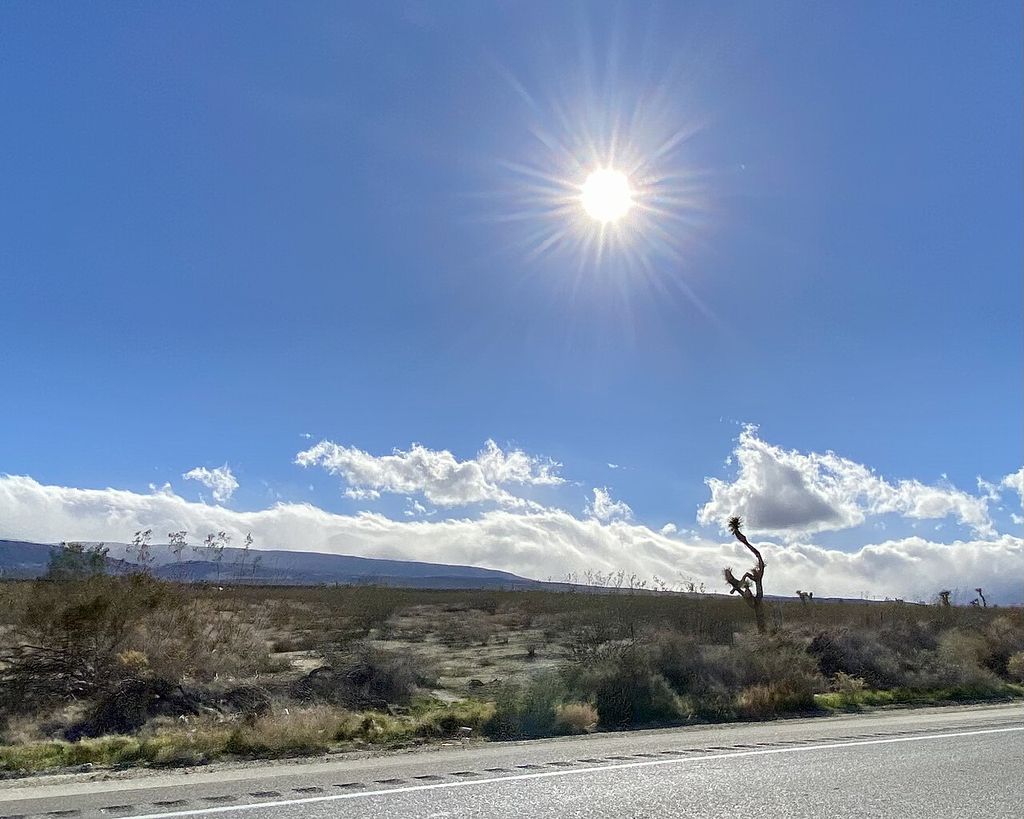
Geographic context: Pearblossom Highway and a Joshua tree, photographed in 2023. Jengod / Wikimedia Commons. Image source. CC BY-SA 4.0. Resized and converted to JPEG; no crop or recolouring. Image derivative retains CC BY-SA 4.0.
From instant grids to developed prints
Pearblossom Hwy. belongs within Hockney’s photography and joiners, but it should be distinguished from his earlier Polaroid composites. The Getty’s 2017 gallery text describes the Polaroid SX-70 as the camera that enabled him to assemble instantaneous prints into grids. It places those works within his dissatisfaction with the single moment and fixed viewpoint of conventional photography, and his effort to bring duration and his own presence into a photograph. [6]
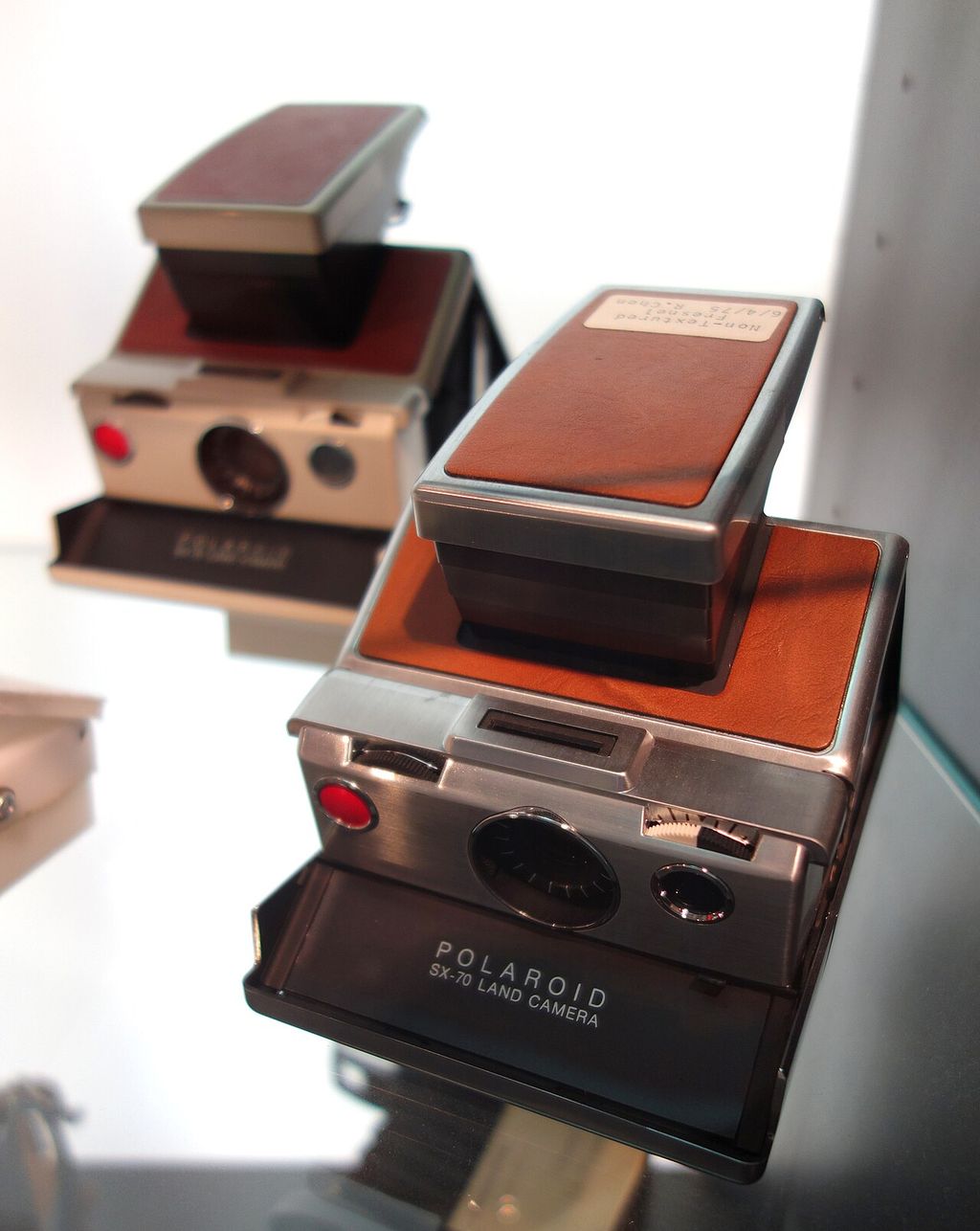
A Polaroid SX-70 Land Camera in the MIT Museum: an example of the model used in Hockney’s composite photography. Daderot / Wikimedia Commons. Image source. CC0 / Public domain. Resized and converted to JPEG; no crop or recolouring.
The Foundation traces the intense development of the composite Polaroids to 1982. During that year Hockney also turned to the miniature Pentax 110, whose developed photographs allowed him to escape the white borders of instant prints. Waiting for processing made notes, diagrams and visual memory useful parts of the work. The discovery was therefore more than a new arrangement on the wall: changing the camera changed the relationship between seeing a subject and seeing its printed image. [7]
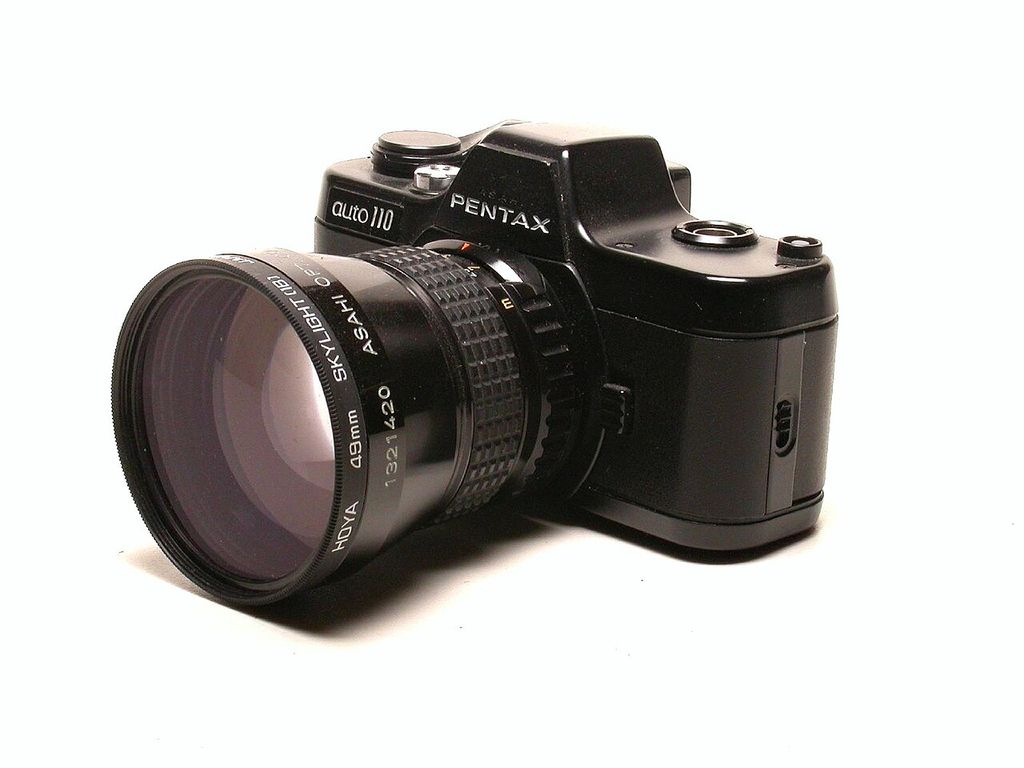
A Pentax Auto 110 camera. An example of the miniature camera model discussed in the transition from instant grids to developed photographs. John Nuttall from Hampshire, United Kingdom / Wikimedia Commons. Image source. CC BY 2.0. Image resized; framing and colours retained.
For Pearblossom, the later method used developed 35mm photographs, not SX-70 instant prints. The distinction belongs to the material history of the joiners: Juliane Wenzl’s study separates the composite Polaroids from the collages made with conventional small-format photographs, discussing the Nikon alongside the Pentax. In the finished road picture, overlapping rectangles can build continuous areas without the regular white lattice of a Polaroid grid. [8]
The visible edges still make the picture’s construction available to us. They ask the eye to work at two scales: the scale of each exposure and the scale of the road they collectively form. A print can be read as a self-contained rectangle and then absorbed into a larger object, patch of ground or expanse of sky. This alternation is part of the pleasure of the collage. Recognition does not remove the pieces; recognising the pieces does not destroy the landscape.
Where Hockney stood
Hockney’s lecture, published by Caltech in 1994, makes the unusual positions concrete. He explained that he moved around continually, photographed the lettering on the road from above, and used a ladder to face the stop sign directly. Standing at ground level would have shown that sign at an angle. The frontal sign and downward view of the lettering thus come from different bodily situations, even though the finished composition gathers them into what initially resembles a single view. [9]
This gives the word “viewpoint” a practical meaning. It concerns where a person’s feet are, how high the camera is held, and which surface faces the lens. Looking up from the road towards a sign, looking down onto painted letters and looking towards distant mountains cannot all be the same act. Hockney retained the useful result of each encounter. The viewer can approach the sign as though close to it and still experience the openness of the road beyond.
The Getty’s discussion of the first version explains that he varied his distance from subjects to choose their relative size within the assembled image. Scale was something he could construct locally. A particular sign did not have to accept the size assigned to it by a camera planted at one distant point. This method connects the collage to a painter’s decisions about emphasis, while preserving the photographic specificity of its individual parts. [10]
The viewer connects adjacent views and carries a sense of the whole through their changes. The seams make that activity apparent: we can recognise a continuous place while noticing the different positions needed to gather it.
The driver’s signs and the passenger’s attention
Hockney gave the Getty a particularly useful explanation of the picture’s two sides. On the right he associated the signs with a driver’s attention to instructions; on the left he associated the freer exploration of the roadside with a passenger’s looking. He understood the composition as a picture of driving even though it contains no car. The distinction describes modes of attention, rather than a literal diagram of seats in a vehicle. [1]
The driver must read selectively and act on what is read. A stop sign is a word, a shape and a command. The lettering painted on the road similarly turns the ground into information. In the collage, these devices do double work: they belong to the functioning junction, and they become forceful shapes on the picture’s surface. Reading them takes the eye across a plane before the road carries it onwards into depth.
The passenger’s freedom gives the small roadside objects a different importance. Cans, bottles and the irregular meeting of asphalt and sand are features that the Getty’s account explicitly draws out. They record human use of the landscape at a much smaller scale than the highway itself. [1] Their presence also changes the pace of looking. A distant road can offer a swift visual escape; an identifiable piece of litter makes us pause near the foreground and attend to something easily overlooked.
This contrast does not split the image into separate stories. The commands and incidental objects share one field, and the eye repeatedly crosses between them. A sign can attract attention by its recognisable purpose, while a small container can attract it through its particular shape and placement. The viewer experiences both directed reading and curiosity. The road’s strong movement into the distance remains available, but it competes with a landscape full of other reasons to look.
Making depth out of surfaces
Hockney’s explanation preserved in the Foundation chronology singles out an ordinary photograph near the centre: a road receding into the distance. He distinguished this from the surrounding photographs of surfaces, including signs, vegetation, road and rubbish. In his account, the larger space emerges in the viewer’s mind from their construction. [5]
This is a useful way to approach the picture without assuming that all its perspectives have been reversed. A familiar recession survives at its centre. Around it, other photographs present things insistently and locally. The road supplies a route into the distance, while the nearer surfaces keep returning us to the broad plane in front of us. The experience rests on their coexistence. We recognise depth and also recognise the material units through which it has been made.
The sky is especially revealing in this respect. Its expansiveness belongs to the landscape, yet its assembly subjects it to the same rectangular decisions as the ground. A supposedly empty area becomes a field of individual photographic acts. The collage does not reserve its labour for the objects we can name. It gives sustained attention to the intervals around them, so that apparent openness is built with the same patient accumulation as a roadside detail.
The comparison with Cubism follows from this treatment of viewpoint and construction. Virginia Heckert’s 2017 account links Hockney’s composites and collages to Cubism through their fragmentation and multiple aspects of a subject. [11] Hockney pursued a recognisable place through a photographic medium, using the freedom to put different views together to question what counts as a convincing account of seeing.
Time in the making and in the looking
Hockney recalled building the composition during the visits, sticking early photographs onto a board and using the developing arrangement to guide further photography. The process moved between place and picture. Looking at the board could reveal a need that sent him back to the world with the camera. His later description also distinguished the small version from the subsequent larger one. [9]
The work’s time is therefore present in several forms. There are the separate exposures, the repeated encounters with the junction, the decisions of assembly and the viewer’s own progress through the result. None requires the road to display a sequence of moving cars. Duration can be conveyed through the accumulation of stationary things, because the changing act of attention is itself part of the subject.
Anthi-Danaé Spathoni’s essay in RHA 11, published in April 2022, considers the joiners as part of a larger investigation of moving viewpoints and participatory landscape. Its named Pearblossom example is #1; its wider argument helps illuminate the relationship between the photographic experiment and the viewer’s activity. Spathoni connects the work across media through the time needed to apprehend a space. [12]
The distinction from cinema is useful. A film normally determines the order and duration in which its images arrive. Here many moments remain available together. We can return to the stop sign, drift towards the edge, or follow the road again. The picture contains the record of Hockney’s changing attention while giving us considerable freedom to organise our own. Its stillness is compatible with a restless, revisiting kind of looking.
Cubist views and scroll-like journeys
Chinese scroll painting offered another model for thinking about a view that unfolds through time. Kunstmuseum Luzern’s Moving Focus account relates Hockney’s interest in multiple perspectives to both Cubism and scrolls, whose landscapes and narratives can connect different moments and viewpoints. It also describes his Acatlán courtyard work through the artist’s changing positions around the space. [13]
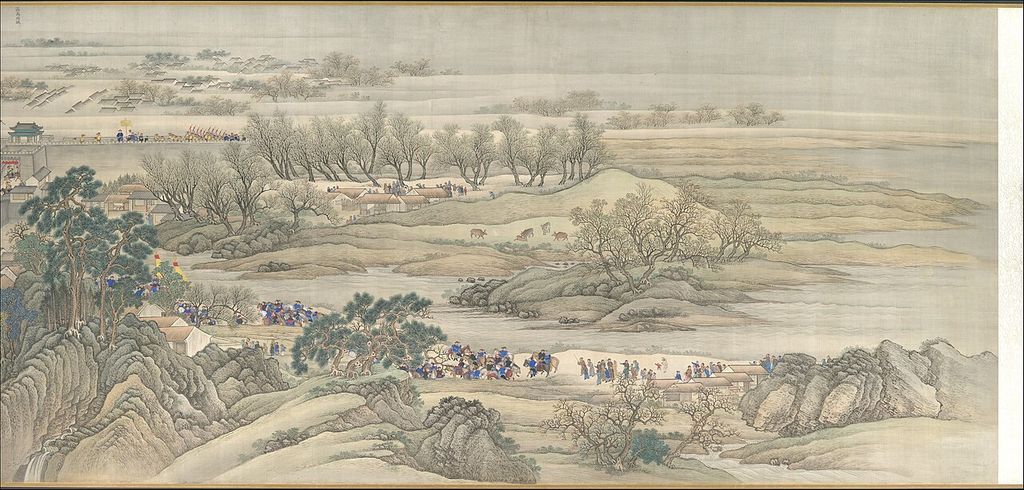
Handscroll comparison: Wang Hui and assistants, The Kangxi Emperor’s Southern Inspection Tour, Scroll Three: Ji’nan to Mount Tai, datable to 1698, Metropolitan Museum of Art. Wang Hui and assistants / The Metropolitan Museum of Art / Wikimedia Commons. Image source. CC0 / Public domain. Resized and converted to JPEG; no crop or recolouring.
The comparison is most helpful when kept specific. Pearblossom is a broad photographic collage intended to be seen as an assembled whole; it is not a handscroll unrolled section by section. What the comparison opens up is the possibility of encountering a landscape through a succession of attention, instead of making one fixed position the governing condition of the picture. One can move through a place in the mind as well as along its actual roads.
In Pearblossom, this journey repeatedly changes distance. The road draws us towards the horizon; a nearby sign brings us back; the ground lettering asks us to look down. The shifts keep the viewer’s position unsettled in a productive way. We are offered a landscape that can be explored, with the pieces serving as evidence of the different encounters from which that exploration has been constructed.
The first version and the second version
The Getty holds both versions. Its current record describes #1 as a preparatory collage of chromogenic prints, with an image measuring 119.1 × 162.9 cm, or approximately 119 × 163 cm. It was a gift from Hockney. The museum identifies changes in the foreground stop sign and at the left and right edges, as well as the difference in scale. Those differences mean that #2 cannot be understood simply as a larger reproduction of an unchanged first composition. [10]
The second version’s image is 181.6 × 271.8 cm; its outer framed dimensions are 198.1 × 281.9 cm. These are measurements of different parts of the object. [1] The image itself is already a substantial field of photographic decisions before the surrounding frame is included. The Getty bought #2 from Hockney in 1997. [14]
Version numbers should also be distinguished from edition sizes. Wenzl’s list of works records #2 as an edition of two. That bibliographic detail does not make “#2” an indication that the Getty owns the second numbered impression of a single composition: the title distinguishes this larger version from #1. [8] For understanding the work, the essential distinction is between the particular assembled collage and an image of that collage reproduced elsewhere. A reproduction can convey the arrangement, while reducing the scale at which its many individual photographs meet the viewer.
Exhibitions and the Getty collection
The second version made its public debut in New York in September 1986, according to the Foundation chronology. The International Center of Photography’s own archive dates David Hockney’s Photocollages: A Wider Perspective to 14 September–9 November 1986 and explains that Hockney selected the collages himself. The show brought together the experiments with instant and single-lens-reflex cameras. [5] [15]
The Getty’s 2017 presentation placed the picture among photographs from the 1980s that explored time, perspective and the artist’s presence. [11] An earlier Getty exhibition, Ten Years in Focus: The Artist and the Camera, ran from 25 March to 10 August 2008. Its framing connected Hockney’s landscape to the museum’s interest in artists working with photography and in photographers associated with California and the American West. [16]
The two versions have also supported different exhibition arguments. Guggenheim Bilbao included #1 in its 2012 landscape exhibition David Hockney: A Bigger Picture, held from 15 May to 30 September. That placement brought the photographic junction into a broader account of his changing approaches to landscape, alongside later Yorkshire works. [17] The version distinction is particularly useful here: the presence of Pearblossom in an exhibition history does not automatically establish that the larger Getty collage travelled.
In their September 2026 conversation, Brooks and Heckert returned to the 2017 birthday exhibitions. Heckert recalled #2’s popularity and named 1998, 2008 and 2017 as its Getty display years, explaining that conservation concerns had limited its appearances. Her account describes the considerable planning involved in presenting so large a photographic work. [2] The intervals between exhibitions make close attention to the object’s physical character especially valuable: the picture asks for time from its audience, while its care also determines when that encounter can take place.
A road within Hockney’s landscapes
Pearblossom brings together two continuing interests in Hockney’s California: the experience of travelling through a landscape and the problem of giving that experience a pictorial form. Its relationship to Mulholland Drive: The Road to the Studio is illuminating because a road can organise a picture through movement as well as through recession. Spathoni places the painted and photographic roads within this investigation of a landscape encountered by an active observer. [12]
The connection also leads towards A Bigger Grand Canyon, where an extensive landscape is gathered across a divided surface. These works reward comparison through the question they pose to viewers: how can a picture hold an experience that exceeds a single glance? Their different materials keep that question open. A painted panel and a photographic print each establish a local area, but the nature of the mark, the recorded detail and the relationship between neighbouring units remain different. [12]
Within Hockney’s landscapes, the roadside objects are what give Pearblossom its particular force. Its broad space never floats free of things found underfoot or instructions fixed beside the carriageway. The viewer must negotiate distant mountains, readable words, photographic edges and small traces of other travellers. The picture sustains that negotiation: a road to follow, a surface to examine and a place repeatedly discovered through acts of looking.
Works directory
This source-bounded directory combines the works in the Metropolitan Museum’s 2017 retrospective checklist with reviewed museum object records and the additional works and series examined in this guide. It spans several media and is not a complete catalogue raisonné. Titles without an article link remain useful dated records. Metropolitan Museum final retrospective checklist (2017); additional object and series sources are given in the linked articles. [3]
| Name | Date | Medium |
|---|---|---|
| Love Painting | 1960 | Painting |
| Shame | 1960 | Painting |
| The Third Love Painting | 1960 | Painting |
| Tyger Painting No. 2 | 1960 | Painting |
| A Rake’s Progress | 1961–63 | Print series |
| Tea Painting in an Illusionistic Style | 1961 | Painting |
| The Cha-Cha That Was Danced in the Early Hours of 24th March | 1961 | Painting |
| Cleaning Teeth, Early Evening (10pm) W11 | 1962 | Painting |
| Flight into Italy - Swiss Landscape (Painting in a Scenic Style) | 1962 | Painting |
| Man in a Museum (or You're in the Wrong Movie) | 1962 | Painting |
| My Brother is Only Seventeen | 1962 | Painting |
| The First Marriage (A Marriage of Styles I) | 1962 | Painting |
| Domestic Scene, Los Angeles | 1963 | Painting |
| Play Within a Play | 1963 | Painting |
| The Hypnotist | 1963 | Painting |
| Arizona | 1964 | Painting |
| California Art Collector | 1964 | Painting |
| Man in Shower in Beverly Hills | 1964 | Painting |
| Portrait Surrounded by Artistic Devices | 1965 | Painting |
| Rocky Mountains and Tired Indians | 1965 | Painting |
| Beverly Hills Housewife | 1966–67 | Painting |
| Medical Building | 1966 | Painting |
| Peter | 1966 | Drawing |
| Peter Getting Out of Nick’s Pool | 1966 | Painting |
| A Bigger Splash | 1967 | Painting |
| A Lawn Being Sprinkled | 1967 | Painting |
| Kasmin in Bed in His Chateau in Carennac | 1967 | Drawing |
| Peter Feeling Not Too Good | 1967 | Drawing |
| Savings and Loan Building | 1967 | Painting |
| The Room, Tarzana | 1967 | Painting |
| American Collectors (Fred and Marcia Weisman) | 1968 | Painting |
| Christopher Isherwood and Don Bachardy | 1968 | Painting |
| Henry Geldzahler and Christopher Scott | 1968-1969 | Painting |
| W. H. Auden | 1968 | Drawing |
| Peter Langan in His Kitchen at Odins | 1969 | Drawing |
| Mark Glazebrook | 1970 | Drawing |
| Mr and Mrs Clark and Percy | 1970-1971 | Painting |
| Ossie Wearing a Fairisle Sweater | 1970 | Drawing |
| Pool and Steps, Le Nid du Duc | 1971 | Painting |
| Rubber Ring Floating in a Swimming Pool | 1971 | Painting |
| Celia in a Black Dress with White Flowers | 1972 | Drawing |
| Mount Fuji and Flowers | 1972 | Painting |
| Portrait of an Artist (Pool with Two Figures) | 1972 | Painting |
| Portrait of the Artist's Mother, Mrs Laura Hockney, Bradford | 1972 | Drawing |
| The Artist's Father | 1972 | Drawing |
| Dr Eugene Lamb, Lucca | 1973 | Drawing |
| Andy, Paris | 1974 | Drawing |
| Contre-jour in the French Style (Against the Day dans le Style-Français) | 1974 | Painting |
| Gregory Sitting on Base of Column | 1975 | Drawing |
| Kerby (after Hogarth) Useful Knowledge | 1975 | Painting |
| Ron Kitaj Outside Akademie der Kunste Vienna | 1975 | Drawing |
| Kasmin Reading the Udaipur Guide | 1977 | Drawing |
| Looking at Pictures on a Screen | 1977 | Painting |
| My Parents | 1977 | Painting |
| Canyon Painting | 1978 | Painting |
| Mother, Bradford, 19 Feb. 1979 (inscribed 1978) | 1979 | Drawing |
| Mulholland Drive: The Road to the Studio | 1980 | Painting |
| Nichols Canyon | 1980 | Painting |
| Outpost Drive, Hollywood | 1980 | Painting |
| Hollywood Hills House | 1981-1982 | Painting |
| Celia. Los Angeles. April 10th 1982 | 1982 | Polaroid composite |
| Don + Christopher, Los Angeles, 6th March 1982 | 1982 | Polaroid composite |
| Gregory Swimming Los Angeles March 31st 1982 | 1982 | Polaroid composite |
| My Mother, Bolton Abbey, Yorkshire, Nov. 1982 | 1982 | Photocollage |
| Self Portrait 30th Sept. 1983 | 1983 | Drawing |
| Pearblossom Hwy., 11-18th April 1986, #1 | 1986 | Photocollage |
| Pearblossom Hwy., 11–18th April 1986, #2 | 1986 | Photocollage |
| Large Interior, Los Angeles | 1988 | Painting |
| Breakfast at Malibu, Sunday, 1989 | 1989 | Painting |
| Pacific Coast Highway and Santa Monica | 1990 | Painting |
| The Other Side | 1991-1993 | Painting |
| The Eleventh V. N. Painting | 1992 | Painting |
| The Twenty Sixth V. N. Painting | 1992 | Painting |
| The Road Across the Wolds | 1997 | Painting |
| 9 Canvas Study of the Grand Canyon | 1998 | Painting |
| A Bigger Grand Canyon | 1998 | Painting |
| Colorado River | 1998 | Painting |
| Garrowby Hill | 1998 | Painting |
| Colin St. John Wilson. London. 3rd June 1999 | 1999 | Drawing |
| Gregory Evans. Los Angeles. 18th September 1999 | 1999 | Drawing |
| Laura Huston. London. 22nd June 1999 | 1999 | Drawing |
| Lindy. Marchioness of Dufferin and Ava. London. 17th June | 1999 | Painting |
| Going Up Garrowby Hill | 2000 | Painting |
| Red Pots in the Garden | 2000 | Painting |
| A Closer Winter Tunnel, February - March | 2006 | Painting |
| Elderflower Blossom, Kilham, July 2006 | 2006 | Painting |
| The Road to Thwing, July 2006 | 2006 | Painting |
| Bigger Trees near Warter | 2007 | Painting |
| Hawthorn Blossom near Rudston | 2008 | Painting |
| Views Through the Artist's Bedroom Window, Bridlington | 2010-2013 | Digital animation |
| The Arrival of Spring in Woldgate, East Yorkshire in 2011 (twenty eleven) | 2011 | Painting / digital series |
| 82 Portraits and 1 Still-life | 2013–16 | Portrait series |
| Garden | 2015 | Painting |
| Garden with Blue Terrace | 2015 | Painting |
| Garden #3 | 2016 | Painting |
| A Bigger Interior with Blue Terrace | 2017 | Painting |
| Interior with Blue Terrace and Garden | 2017 | Painting |
| A Year in Normandie | 2020–21 | Digital frieze |
Discussion
Look again at the images and ideas explored in Pearblossom Hwy., 11–18th April 1986, #2. These editorial prompts invite your observations.
Reader Insights
How does the frontal stop sign change your sense of where you stand, especially when compared with the road lettering photographed from above?
Which holds your attention longer: the driver’s instructions on the right or the passenger’s roadside discoveries on the left, and how does that affect your route through the picture?
Compare the visible photographic units in Pearblossom with the divided painted surface of A Bigger Grand Canyon: what changes when each local view is a photograph?
Join the Conversation
Share a detail, comparison or question about Pearblossom Hwy., 11–18th April 1986, #2 below.
References
- J. Paul Getty Museum, Pearblossom Hwy., 11–18th April 1986, #2, collection record, 97.XM.39; description, medium and labelled image/framed dimensions. View source.
- Julian Brooks and Virginia Heckert, “Remembering the Creativity and Humor of David Hockney,” Getty, 3 September 2026. View source.
- The Metropolitan Museum of Art, David Hockney, final exhibition checklist, 15 November 2017. View source.
- The David Hockney Foundation, 2021 chronology. View source.
- The David Hockney Foundation, “1986,” especially “Pearblossom Highway” and the exhibition chronology. View source.
- J. Paul Getty Museum, Happy Birthday, Mr. Hockney, gallery text, 2017, PDF pp. 2–4, especially p. 3, “Photographs.” View source.
- The David Hockney Foundation, “1982,” especially “Composite Polaroids,” “Polaroid to Pentax” and “Grand Canyon.” View source.
- Juliane Wenzl, Facettierungen: Bewegung, Raum, Zeit und Erzählung in David Hockneys Joiner Photographs, Heidelberg: arthistoricum.net, 2022, selected passages pp. 17, 22 and works list p. 327. View source.
- David Hockney, “Which Way Is Reverse?”, Engineering & Science 57, no. 2, Winter 1994, especially pp. 26–28; Caltech repository. View source.
- J. Paul Getty Museum, Pearblossom Hwy., 11–18th April 1986, #1, collection record, 97.XM.44; description, medium, credit and labelled dimensions. View source.
- J. Paul Getty Museum, “Getty Museum Presents Happy Birthday, Mr. Hockney,” 13 June 2017; acquisition and Virginia Heckert’s account of Cubism and viewing. View source.
- Anthi-Danaé Spathoni, “David Hockney’s Moving Landscapes,” RHA 11, April 2022, pp. 95–103, especially pp. 97–100. View source.
- Kunstmuseum Luzern, “Moving Focus,” exhibition text, 2022, sections “Multiperspektive” and “Glücklicher Zufall.” View source.
- Suzanne Muchnic, “Hockney Makes an Inroad With ‘Pearblossom Hwy.’,” Los Angeles Times, 8 August 1997. View source.
- International Center of Photography, David Hockney’s Photocollages: A Wider Perspective, exhibition archive, 14 September–9 November 1986. View source.
- J. Paul Getty Museum, Ten Years in Focus: The Artist and the Camera, exhibition text, 25 March–10 August 2008. View source.
- Guggenheim Museum Bilbao, David Hockney: una visión más amplia, exhibition archive and #1 object entry, 15 May–30 September 2012. View source.
More HOCKNEY Works
A Bigger Splash
A momentary disturbance becomes the focus of a large acrylic painting, made through weeks of patient work.
Mr and Mrs Clark and Percy
The designers Celia Birtwell and Ossie Clark occupy a room shaped by light, repeated sittings and the demands of a double portrait.
A Bigger Grand Canyon
Sixty canvases gather memory, studies and changing viewpoints into an immense painting of 1998.
Garrowby Hill
The 1998 oil painting transforms a remembered Yorkshire journey into a road, fields and an expansive view.
Portrait of an Artist (Pool with Two Figures)
Photographic studies, two figures and a swimming pool become a carefully constructed painting of 1972.
My Parents
The 1977 oil painting sets Kenneth and Laura Hockney within a quietly organised interior.
Pearblossom Hwy., 11–18th April 1986, #2
Hundreds of separately made photographs construct a road scene that unfolds through movement and time.
Bigger Trees near Warter
Fifty canvases join into a large outdoor painting of Yorkshire trees, with photography helping the artist organise the whole.