


 by Tom Gurney
Tom Gurney BSc (Hons) is an art history expert with over 20 years experience
Email: tomgurney1@gmail.com / Phone: +44 7429 011000
Mulholland Drive: The Road to the Studio: Introduction
David Hockney’s Mulholland Drive: The Road to the Studio turns a familiar journey into an expansive field of colour, lines and changing distances. Painted in 1980, it stretches more than six metres across a single canvas. A road curls along its upper reaches while the landscape opens below it, offering the eye a succession of places to explore. LACMA’s account identifies the daily trip behind the picture: from Hockney’s home in the Hollywood Hills to his studio on Santa Monica Boulevard. [1]
The title names both a place and an activity. As Martin Gayford explained when discussing this painting alongside Nichols Canyon, Hockney intended “Drive” to evoke the act of driving. The journey becomes the picture’s organising experience: bends, changes of level and successive views are gathered into something we can follow with our eyes. Its breadth gives an ordinary commute the space of a panorama. [2]
At a Glance
- ArtistDavid Hockney
- TitleMulholland Drive: The Road to the Studio
- Date1980
- Medium and formatAcrylic on canvas; 218.44 × 617.22 cm
- CollectionLos Angeles County Museum of Art
This work across David Hockney’s career
A Rake’s Progress
1961–63 [3]A Bigger Splash
1967 [3]Mr and Mrs Clark and Percy
1970–71 [3]My Parents
1977 [3]Garrowby Hill
1998 [3]A Year in Normandie
2020–21 [4]Contents
- From the Hollywood Hills to the studio
- A painting wide enough for a journey
- Colour, pattern and changing distance
- Remembering a place, assembling a view
- Two routes through the same neighbourhood
- A picture that rewards changing position
- Beyond Mulholland Drive
From the Hollywood Hills to the studio
Hockney’s own account supplies a precise starting point. In the artist material included in LACMA’s audio-tour transcript, he recalled moving to a home just off Mulholland Drive in 1979 while continuing to work on Santa Monica Boulevard. The difference between those two settings entered his painting. On the flatlands, buildings, pavements and roads had supplied straight lines; the winding routes through the hills introduced a different rhythm. Repeating the drive made that rhythm familiar enough to become a subject. [5]
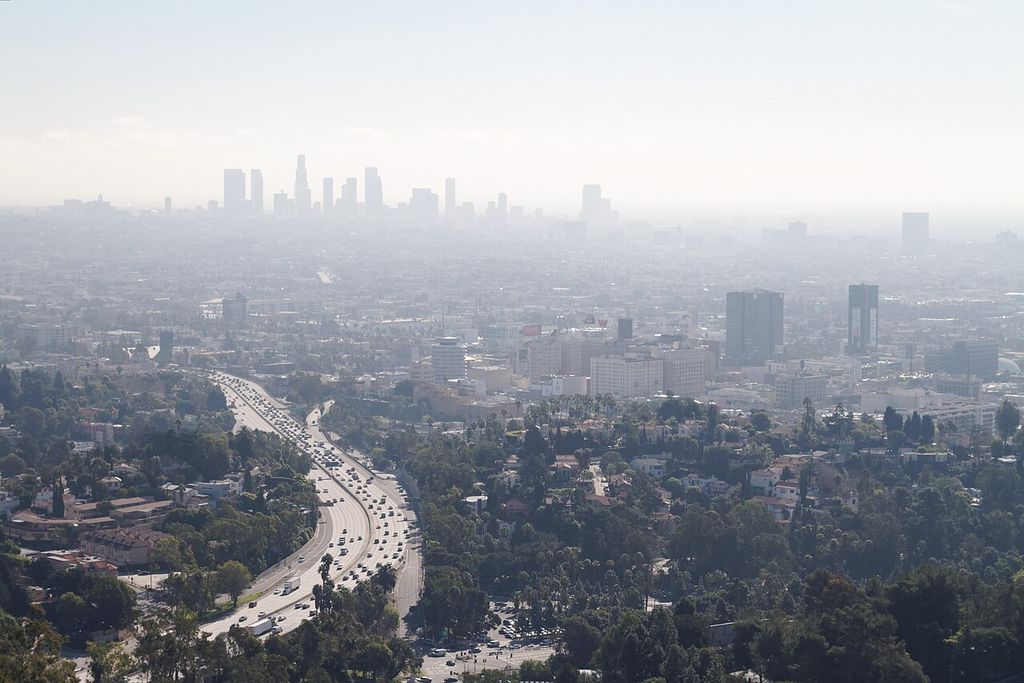
Los Angeles seen from the Mulholland Drive area in 2011. The city below the hills provides geographical context for the studio journey. KimonBerlin / Wikimedia Commons. Image source. CC BY-SA 2.0. Image resized; framing and colours retained. This derivative retains CC BY-SA 2.0.
Hockney noticed a change in the shape of his daily experience, then found a pictorial language for it. The hills supplied curves which also recorded the bodily sensation of travelling: turning, climbing, descending and anticipating another bend. A line could therefore carry information about the ground and about the person moving through it. His wider experience of California gave him several Los Angeleses to paint, from the geometry of the boulevards to the less predictable routes above them. [5]
The David Hockney Foundation places the making of Mulholland Drive and Nichols Canyon within his return to Los Angeles in the autumn of 1980. Its chronology describes a fresh approach to an environment where city and wild terrain met. Both paintings arose from the descent between the hills and the studio, giving a repeated practical journey the concentration of a sustained artistic investigation. The commute offered changing views that could be remembered, compared and reorganised over time. [6]
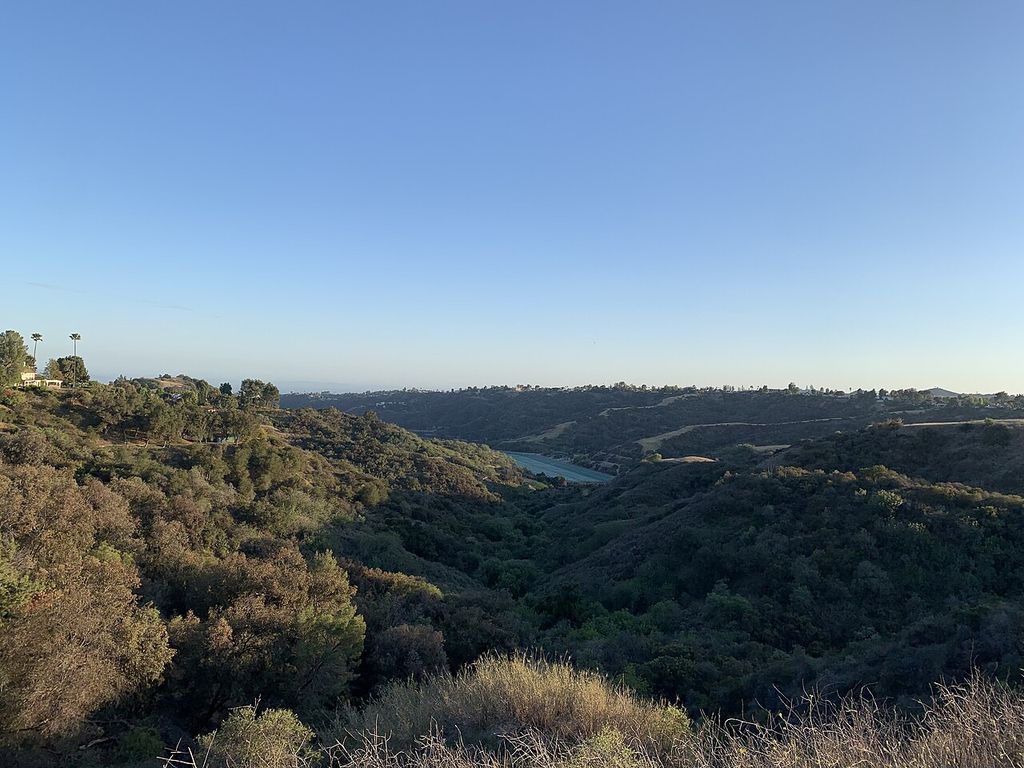
Los Angeles context: Stone Canyon Reservoir and the surrounding hills. DocFreeman24 / Wikimedia Commons. Image source. CC BY-SA 4.0. Resized and converted to JPEG; no crop or recolouring. Image derivative retains CC BY-SA 4.0.
A painting wide enough for a journey
The work is acrylic on canvas, measuring 86 × 243 inches, or 218.44 × 617.22 centimetres. Its height exceeds two metres and its width is almost three times its height. These proportions matter to the encounter. We can take in the long rectangle as a whole, but sustained attention moves between its parts. A road at this scale becomes an extended passage across the field of vision, with room for local incidents and broader changes of terrain. [1]
Scale alone had already proved insufficient for Hockney. The Foundation’s account of his earlier Santa Monica Blvd. project describes a long composition begun in 1978 which he struggled to resolve. He eventually identified an excessive dependence on photographs and a failure to keep the eye moving across the horizontal canvas. That difficulty gives Mulholland Drive a useful background: breadth had to be made active through the relationships within the painting. A wide surface could still produce a static picture. [7]
Hockney’s remarks about Los Angeles help explain the challenge. He observed that shops, signs and architecture in the city were often encountered at driving speed. A pedestrian and a motorist received different impressions of the same boulevard. For a painter, this raised a question about selection: which shapes register quickly, which features persist in memory, and how can a stationary canvas convey their succession? In Mulholland Drive, the subject gives the large format a purpose. Its spreading structure has to accommodate a journey’s changing attention. [7]
Colour, pattern and changing distance
LACMA’s catalogue account describes a deliberate alternation between recognisable features and more abstract areas. Trees, houses, tennis courts and power lines give particular sections of landscape a distinct character. Elsewhere, broad colour planes and simplified grids stand for the more distant districts of Studio City and Burbank. The road running across the upper part of the composition draws the eye laterally, carrying a sense of the height and motion experienced on the ridge. [1]
This change in descriptive density offers a way to understand the picture’s spaciousness. A small, legible feature gives the eye something to recognise; a larger pattern allows attention to travel over a wider area. Moving between the two changes our sense of distance. The landscape can spread out while keeping enough identifiable things to remain inhabited. Its houses and tennis courts belong to the same field as the hills and roads, allowing the urban and the natural to remain closely interwoven.
Hockney linked some of the patterns to maps of the San Fernando Valley. In the LACMA transcript, he also described pure colour as a means of drawing the viewer into space. Those two observations bring together information and sensation. A grid can suggest an organised district seen from above, while a strongly differentiated colour area establishes its own visual presence. The painting asks us to read relationships between areas as well as identify objects within them. Its style and techniques serve the task of making a large terrain available to a moving eye. [5]
Art historian Anthi-Danaé Spathoni connects the painting’s intense blues, reds and pinks with Californian light. She also reads its winding lines and changing viewpoints as a means of setting the composition in motion. Her discussion relates the road picture to Hockney’s interest in Cubism and to the spectator’s active role in reconstructing a view. The eye follows one line, encounters another area, then adjusts its understanding of how the parts belong together. Recognition happens through a sequence of discoveries across the canvas. [8]
Remembering a place, assembling a view
In its catalogue text, LACMA records that Hockney painted Mulholland Drive from memory over a few weeks. The compression of a repeated journey into one canvas is central to its character. Memories of a route accumulate: a bend becomes familiar, a distant district becomes recognisable, and separate views begin to form a connected understanding of the terrain. The picture’s map-like organisation accommodates that accumulated knowledge. It makes several kinds of encounter available together. [1]
A practical map usually lets us compare locations within a consistent system. Hockney’s painting has another set of priorities. The experience of going somewhere includes sudden changes in what matters: the next turn, the drop beyond the road, an identifiable building, a broad view of the valley. Bringing these together allows a remembered journey to have a structure of emphasis. An enlarged passage or a simplified district can be understood as a decision about attention, without requiring every feature to share one scale.
Hockney took the role of memory further. In the LACMA transcript, he argued that people’s differing memories affect what they see. The claim gives a personal dimension to the panorama: knowing a route changes the experience of looking at it. A resident may recognise a remembered journey; someone encountering the hills for the first time builds an understanding from the painting’s own connections. Both responses involve bringing previous experience to what is visible now. [5]
The Foundation preserves Hockney’s comparison between travelling around this picture with the eye and driving along the actual road. His analogy suggests a duration for looking. We connect one passage with another, carrying what we have just seen into the next stretch. Spathoni’s account of a participating spectator gives this activity a useful critical context: the viewer helps reconstruct the journey through the time spent following it. [6] [8]
The canvas remains available for pauses, reversals and detours. We can leave the road to inspect a patterned area, then return to its winding course. That freedom makes the analogy with driving suggestive without turning it into an instruction to read at a fixed speed. The painting arranges the possibilities; each encounter supplies a particular order of attention. A route known intimately by the artist becomes accessible to people who have never taken it.
Two routes through the same neighbourhood
Nichols Canyon offers the closest comparison. Also painted in 1980, it uses a tall canvas, 84 × 60 inches, to organise its winding route. Mulholland Drive extends the road experience across a much broader horizontal field. The formats give the related subjects different physical demands: the upright picture concentrates the ascent and descent within a tall rectangle, while the panorama allows attention to range widely across adjoining parts of the city and hills. [2] [1]
Gayford’s account stresses the personal nature of the commute. Hockney continued working in his studio below the hills after moving into his new home, and for a period made the journey several times a day. Familiarity supplied repeated opportunities to feel the roads’ turns. In the paired paintings, a line can hold together an experience gathered across many trips. Their shared subject also shows how much depended on pictorial organisation: one daily routine could become two substantially different constructions of space. [2]
The Foundation places these landscapes in a year when Hockney was also looking closely at Picasso and designing a triple bill for the Metropolitan Opera. Picasso’s work encouraged a renewed freedom in painting. Landscape, theatre and the study of earlier art overlapped in his working life; the drive provided a particular subject through which new decisions about line, colour and space could take shape. [6]
A picture that rewards changing position
LACMA purchased Mulholland Drive with funds from the F. Patrick Burns Bequest; its accession number is M.83.35. The museum’s stewardship has also generated a revealing account of how people look at it. In October 2015, education coordinator Holly Gillette chose the painting for a session intended to keep a group with one work for an hour. Some participants remembered driving the road themselves; others asked about colour or noticed passages which appeared unfinished to them. [1] [9]
Gillette moved the group closer to examine texture and paint quality, then farther away again. This change in distance made the surface and the panorama available in turn. The broad arrangement can absorb us from across a gallery, while proximity introduces the particular character of painted passages. The apparent lack of finish was an observation made by participants, whose questions helped sustain the discussion. [9]
About 45 minutes passed before the group reached a natural stopping point. Only afterwards did Gillette discover that Hockney had been present, quietly listening. She did not know what he had made of the conversation. The story leaves us with the visitors’ responses: remembered drives, questions about colour and observations gathered through looking together. Thirty-five years after the painting’s creation, its landscape was still capable of bringing different experiences into a shared discussion. [9]
Beyond Mulholland Drive
The problem explored here continued through other media. Kunstmuseum Luzern’s account of Hockney’s Moving Focus work describes pictures in which several viewpoints convey the experience of looking around an interior. It also explains his use of reverse perspective, with the imagined point of convergence placed behind the viewer. The space of the person looking becomes part of the pictorial argument. These devices gave him ways to involve a viewer in an image, an ambition he also voiced when discussing Mulholland Drive. [10] [5]
Luzern’s discussion of the Hotel Acatlán prints is especially concrete: Hockney moved through a courtyard, observed from different positions and brought those views together in one image. The Musée Granet’s exhibition guide connects the series with the passage of time as well as the viewer’s imagined movement through space. The outdoor route and the courtyard offered different settings for related questions. A change of position could supply new information, and the finished picture could hold several such discoveries together. [10] [11]
Chinese scroll painting became another important point of comparison in Hockney’s later thinking. The Foundation’s 1983 chronology records his sustained study of scrolls and his interest in how they could include a viewer moving through a landscape. His photographic experiments in Japan also encouraged him to think about successive positions and moments within one constructed picture. These later investigations developed the relationship between looking, movement and time already made vivid by the 1980 road paintings. [12]
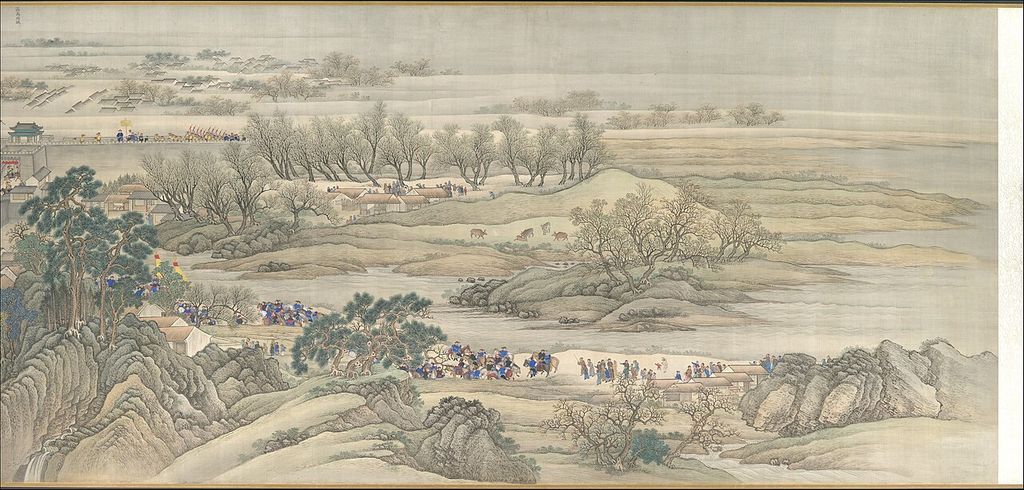
Handscroll comparison: Wang Hui and assistants, The Kangxi Emperor’s Southern Inspection Tour, Scroll Three: Ji’nan to Mount Tai, datable to 1698, Metropolitan Museum of Art. Wang Hui and assistants / The Metropolitan Museum of Art / Wikimedia Commons. Image source. CC0 / Public domain. Resized and converted to JPEG; no crop or recolouring.
Memory continued to play a substantial role. In 1998, Hockney painted Yorkshire landscapes after returning to Los Angeles and developed A Bigger Grand Canyon through a combination of remembered space and photographic documentation. That later painting’s sixty canvases provided another way to assemble an expansive landscape. Mulholland Drive had achieved its continuous panorama on one enormous surface. The comparison makes the differences in construction clear while showing the persistence of a question across his landscapes: how can a picture bring us closer to the experience of being somewhere? [13]
Works directory
This source-bounded directory combines the works in the Metropolitan Museum’s 2017 retrospective checklist with reviewed museum object records and the additional works and series examined in this guide. It spans several media and is not a complete catalogue raisonné. Titles without an article link remain useful dated records. Metropolitan Museum final retrospective checklist (2017); additional object and series sources are given in the linked articles. [3]
| Name | Date | Medium |
|---|---|---|
| Love Painting | 1960 | Painting |
| Shame | 1960 | Painting |
| The Third Love Painting | 1960 | Painting |
| Tyger Painting No. 2 | 1960 | Painting |
| A Rake’s Progress | 1961–63 | Print series |
| Tea Painting in an Illusionistic Style | 1961 | Painting |
| The Cha-Cha That Was Danced in the Early Hours of 24th March | 1961 | Painting |
| Cleaning Teeth, Early Evening (10pm) W11 | 1962 | Painting |
| Flight into Italy - Swiss Landscape (Painting in a Scenic Style) | 1962 | Painting |
| Man in a Museum (or You're in the Wrong Movie) | 1962 | Painting |
| My Brother is Only Seventeen | 1962 | Painting |
| The First Marriage (A Marriage of Styles I) | 1962 | Painting |
| Domestic Scene, Los Angeles | 1963 | Painting |
| Play Within a Play | 1963 | Painting |
| The Hypnotist | 1963 | Painting |
| Arizona | 1964 | Painting |
| California Art Collector | 1964 | Painting |
| Man in Shower in Beverly Hills | 1964 | Painting |
| Portrait Surrounded by Artistic Devices | 1965 | Painting |
| Rocky Mountains and Tired Indians | 1965 | Painting |
| Beverly Hills Housewife | 1966–67 | Painting |
| Medical Building | 1966 | Painting |
| Peter | 1966 | Drawing |
| Peter Getting Out of Nick’s Pool | 1966 | Painting |
| A Bigger Splash | 1967 | Painting |
| A Lawn Being Sprinkled | 1967 | Painting |
| Kasmin in Bed in His Chateau in Carennac | 1967 | Drawing |
| Peter Feeling Not Too Good | 1967 | Drawing |
| Savings and Loan Building | 1967 | Painting |
| The Room, Tarzana | 1967 | Painting |
| American Collectors (Fred and Marcia Weisman) | 1968 | Painting |
| Christopher Isherwood and Don Bachardy | 1968 | Painting |
| Henry Geldzahler and Christopher Scott | 1968-1969 | Painting |
| W. H. Auden | 1968 | Drawing |
| Peter Langan in His Kitchen at Odins | 1969 | Drawing |
| Mark Glazebrook | 1970 | Drawing |
| Mr and Mrs Clark and Percy | 1970-1971 | Painting |
| Ossie Wearing a Fairisle Sweater | 1970 | Drawing |
| Pool and Steps, Le Nid du Duc | 1971 | Painting |
| Rubber Ring Floating in a Swimming Pool | 1971 | Painting |
| Celia in a Black Dress with White Flowers | 1972 | Drawing |
| Mount Fuji and Flowers | 1972 | Painting |
| Portrait of an Artist (Pool with Two Figures) | 1972 | Painting |
| Portrait of the Artist's Mother, Mrs Laura Hockney, Bradford | 1972 | Drawing |
| The Artist's Father | 1972 | Drawing |
| Dr Eugene Lamb, Lucca | 1973 | Drawing |
| Andy, Paris | 1974 | Drawing |
| Contre-jour in the French Style (Against the Day dans le Style-Français) | 1974 | Painting |
| Gregory Sitting on Base of Column | 1975 | Drawing |
| Kerby (after Hogarth) Useful Knowledge | 1975 | Painting |
| Ron Kitaj Outside Akademie der Kunste Vienna | 1975 | Drawing |
| Kasmin Reading the Udaipur Guide | 1977 | Drawing |
| Looking at Pictures on a Screen | 1977 | Painting |
| My Parents | 1977 | Painting |
| Canyon Painting | 1978 | Painting |
| Mother, Bradford, 19 Feb. 1979 (inscribed 1978) | 1979 | Drawing |
| Mulholland Drive: The Road to the Studio | 1980 | Painting |
| Nichols Canyon | 1980 | Painting |
| Outpost Drive, Hollywood | 1980 | Painting |
| Hollywood Hills House | 1981-1982 | Painting |
| Celia. Los Angeles. April 10th 1982 | 1982 | Polaroid composite |
| Don + Christopher, Los Angeles, 6th March 1982 | 1982 | Polaroid composite |
| Gregory Swimming Los Angeles March 31st 1982 | 1982 | Polaroid composite |
| My Mother, Bolton Abbey, Yorkshire, Nov. 1982 | 1982 | Photocollage |
| Self Portrait 30th Sept. 1983 | 1983 | Drawing |
| Pearblossom Hwy., 11-18th April 1986, #1 | 1986 | Photocollage |
| Pearblossom Hwy., 11–18th April 1986, #2 | 1986 | Photocollage |
| Large Interior, Los Angeles | 1988 | Painting |
| Breakfast at Malibu, Sunday, 1989 | 1989 | Painting |
| Pacific Coast Highway and Santa Monica | 1990 | Painting |
| The Other Side | 1991-1993 | Painting |
| The Eleventh V. N. Painting | 1992 | Painting |
| The Twenty Sixth V. N. Painting | 1992 | Painting |
| The Road Across the Wolds | 1997 | Painting |
| 9 Canvas Study of the Grand Canyon | 1998 | Painting |
| A Bigger Grand Canyon | 1998 | Painting |
| Colorado River | 1998 | Painting |
| Garrowby Hill | 1998 | Painting |
| Colin St. John Wilson. London. 3rd June 1999 | 1999 | Drawing |
| Gregory Evans. Los Angeles. 18th September 1999 | 1999 | Drawing |
| Laura Huston. London. 22nd June 1999 | 1999 | Drawing |
| Lindy. Marchioness of Dufferin and Ava. London. 17th June | 1999 | Painting |
| Going Up Garrowby Hill | 2000 | Painting |
| Red Pots in the Garden | 2000 | Painting |
| A Closer Winter Tunnel, February - March | 2006 | Painting |
| Elderflower Blossom, Kilham, July 2006 | 2006 | Painting |
| The Road to Thwing, July 2006 | 2006 | Painting |
| Bigger Trees near Warter | 2007 | Painting |
| Hawthorn Blossom near Rudston | 2008 | Painting |
| Views Through the Artist's Bedroom Window, Bridlington | 2010-2013 | Digital animation |
| The Arrival of Spring in Woldgate, East Yorkshire in 2011 (twenty eleven) | 2011 | Painting / digital series |
| 82 Portraits and 1 Still-life | 2013–16 | Portrait series |
| Garden | 2015 | Painting |
| Garden with Blue Terrace | 2015 | Painting |
| Garden #3 | 2016 | Painting |
| A Bigger Interior with Blue Terrace | 2017 | Painting |
| Interior with Blue Terrace and Garden | 2017 | Painting |
| A Year in Normandie | 2020–21 | Digital frieze |
Discussion
Look again at the images and ideas explored in Mulholland Drive: The Road to the Studio. These editorial prompts invite your observations.
Reader Insights
How does following the road across Mulholland Drive differ from attending to the houses, courts and patterned districts below it?
What changes when a daily route is organised in the broad format of Mulholland Drive and the upright format of Nichols Canyon?
Gillette’s group moved close to the painted surface and then farther away. Which questions about texture, finish and distance would you bring to that change of position?
Join the Conversation
Share a detail, comparison or question about Mulholland Drive: The Road to the Studio below.
References
- Los Angeles County Museum of Art. “David Hockney, Mulholland Drive: The Road to the Studio, 1980”, collection record M.83.35, object fields and curatorial notes; notes excerpted from J. Patrice Marandel and Claudia Einecke, eds., Los Angeles County Museum of Art: European Art (2006). View source.
- Martin Gayford / Phillips. “Martin Gayford on Nichols Canyon”, in Nichols Canyon, lot 10, 20th Century & Contemporary Art Evening Sale, 7 December 2020; Gayford essay and separate lot fields for medium, date and dimensions. View source.
- The Metropolitan Museum of Art, David Hockney, final exhibition checklist, 15 November 2017. View source.
- The David Hockney Foundation, 2021 chronology. View source.
- David Hockney / Los Angeles County Museum of Art. “Artists on Art Audio Transcript”, Hockney section on Mulholland Drive, including artist excerpts credited to the Metropolitan Museum of Art’s 2017 audio guide and a separate filmed interview. Transcript consulted. View source.
- The David Hockney Foundation. “1980”, chronology, “Picasso, music, and dance” and “Different views of L.A.” View source.
- The David Hockney Foundation. “1978”, chronology, “Painting L.A.” View source.
- Anthi-Danaé Spathoni. “David Hockney’s Moving Landscapes”, Revista de História da Arte, W series, no. 11, pp. 95–103, especially pp. 97 and 100–101. View source.
- Holly Gillette. “The Art of Looking: David Hockney at LACMA”, LACMA Unframed, 23 November 2015, account of the October 2015 session. View source.
- Kunstmuseum Luzern. “Moving Focus”, 2022 exhibition microsite, “Viele Perspektiven!”, “Multiperspektive” and “Glücklicher Zufall”. German text. View source.
- Musée Granet. David Hockney: Works from the Tate Collection, English press dossier for the exhibition of 28 January–28 May 2023, p. 16, “Moving Focus”. View source.
- The David Hockney Foundation. “1983”, chronology, “Walking in the Zen Garden”, “Studying Chinese scrolls” and “A lecture, ‘On Photography’”. View source.
- The David Hockney Foundation. “1998”, chronology, “Painting distant landscapes”. View source.
More HOCKNEY Works
A Bigger Splash
A momentary disturbance becomes the focus of a large acrylic painting, made through weeks of patient work.
Mr and Mrs Clark and Percy
The designers Celia Birtwell and Ossie Clark occupy a room shaped by light, repeated sittings and the demands of a double portrait.
A Bigger Grand Canyon
Sixty canvases gather memory, studies and changing viewpoints into an immense painting of 1998.
Garrowby Hill
The 1998 oil painting transforms a remembered Yorkshire journey into a road, fields and an expansive view.
Portrait of an Artist (Pool with Two Figures)
Photographic studies, two figures and a swimming pool become a carefully constructed painting of 1972.
My Parents
The 1977 oil painting sets Kenneth and Laura Hockney within a quietly organised interior.
Pearblossom Hwy., 11–18th April 1986, #2
Hundreds of separately made photographs construct a road scene that unfolds through movement and time.
Bigger Trees near Warter
Fifty canvases join into a large outdoor painting of Yorkshire trees, with photography helping the artist organise the whole.