


 by Tom Gurney
Tom Gurney BSc (Hons) is an art history expert with over 20 years experience
Email: tomgurney1@gmail.com / Phone: +44 7429 011000
Pop Art: Introduction
David Hockney belonged to the moment when British Pop Art came into public view, and several of his early pictures help explain what made it exciting. They admitted pop singers, packaging, magazine photographs and handwritten messages into painting. His work appeared alongside that of the young Royal College of Art artists whose contribution to the 1961 Young Contemporaries exhibition became a landmark in accounts of British Pop. The association has a firm historical basis. [1]
Yet Pop describes one part of Hockney’s artistic formation better than it describes his whole practice. Even at college, he pursued a personal mixture of desire, literary quotation, drawing and experiments with pictorial space. Zorian Clayton, curator of prints at the V&A, places his emergence amid the shift from Abstract Expressionism towards Pop and Minimalism, while stressing his independence from fixed movements. Following the uses Hockney made of contemporary imagery reveals both his participation in Pop and the interests that carried him beyond it. [2]
At a Glance
- ArtistDavid Hockney
- Born9 July 1937, Bradford, England
- Died11 June 2026
- FocusPop Art
Contents
- British Pop before Hockney
- The Royal College and Young Contemporaries
- Words, codes and the expression of desire
- A packet of tea and a choice of styles
- America imagined through pictures
- California: popular imagery and the work of looking
- Hockney and Warhol: portraits and photographs
- Older art was present from the beginning
- Abstraction and the freedom to depict
- What the Pop Art label explains
British Pop before Hockney
British Pop had a history before Hockney entered the Royal College. The Independent Group, active at London’s Institute of Contemporary Arts between 1952 and 1955, brought artists, architects and critics together to discuss advertising, technology, consumer goods and mass culture. Eduardo Paolozzi’s presentation of magazine imagery at its first meeting exemplified a change of attention: material encountered outside galleries could become a serious subject for artistic thought. The 1956 exhibition This Is Tomorrow brought this questioning culture to a wider public. [3]
This background matters because Pop was more varied than a recognisable combination of bright colour and famous faces. As Pallant House Gallery’s account explains, its British sources included car design, comics, cinema, advertising and scientific publications. Richard Hamilton’s analytical engagement with commercial culture differed from Peter Blake’s affection for aspects of popular entertainment and youth culture. British and American Pop developed in overlapping periods, with different artists making different uses of the imagery surrounding them. Hockney entered an existing conversation; he did not have to follow a single recipe to participate in it. [4]
Colour alone is consequently a poor guide to the connection. A vivid landscape may have little to do with mass communication, while an awkwardly painted figure accompanied by a borrowed phrase can disclose a close relationship with contemporary visual life. To understand Hockney’s place in Pop, it helps to follow what he selected, how he changed it and the purpose it served in a particular picture.
The Royal College and Young Contemporaries
Hockney arrived at the Royal College of Art in autumn 1959. His surroundings combined established observational teaching with contact with visiting artists including Peter Blake, Richard Smith and Joe Tilson. He continued to draw with considerable concentration: his early skeleton studies were demanding exercises in anatomy and observation. R. B. Kitaj, an older fellow student, encouraged him to paint the subjects he cared about. In Hockney’s later account, that advice helped him move from dissatisfaction towards work grounded in his own interests. His independence grew through exchanges with other artists, alongside the disciplined drawing that had already occupied him. [5]
Hamilton’s encouragement also mattered. The Foundation records his support for Hockney and Kitaj through awards of merit, offering recognition from the earlier British Pop generation when tutors were less sympathetic. [6]
The 1961 Young Contemporaries exhibition made the younger RCA artists conspicuous. Peter Phillips organised that year’s exhibition, bringing his fellow students’ work to the fore; contemporary criticism linked Hockney with artists including Phillips and Allen Jones. The National Portrait Gallery identifies it as a decisive moment in British Pop’s emergence. Its significance lies in the public visibility of a group whose figurative inventions challenged the dominance of recent abstraction; the artists retained different subjects and methods. The Foundation also records a practical consequence for Hockney: visitors began coming to see his paintings in progress at the college. Classification and opportunity arrived together, bringing his developing work into contact with a larger audience. [1] [7]
Words, codes and the expression of desire
Hockney’s use of writing gives the early paintings a different register from the language of a straightforward advertisement. A word can identify a desire, address another person or tempt the viewer to come closer. It also remains a mark on the surface. Reading and looking interrupt one another: the eye moves between a patch of paint, a suggestion of a body and something that can be said aloud. The paintings ask the viewer to negotiate these forms of meaning together.
Walt Whitman supplied an important language for male affection. In Adhesiveness (1960), the title draws on the poet’s term for comradeship, while the numbers 4.8 and 23.23 identify D.H. and W.W. through the positions of their initials in the alphabet. Hockney could place himself and Whitman in a shared pictorial encounter through a code that remained readable. The combination of declaration and indirection gave the imagery its particular intimacy. [6]
Whitman also supplied the title We Two Boys Together Clinging for Hockney’s 1961 painting. Clayton’s V&A essay connects this literary interest with the early exploration of male looking and desire. The poems offered an imaginative company extending beyond Hockney’s immediate surroundings. Their presence distinguishes his words from slogans selected merely for their visual punch: a borrowed text could help him articulate a life and an attachment. [2]
These works were made while sexual acts between men remained criminal offences in England. The Sexual Offences Act 1967 later introduced a limited reform for consensual acts in private between two men over 21 in England and Wales. It did not establish general equality or change the law throughout the United Kingdom. That precise context helps explain the stakes of making male desire visible without treating every inscription as a secret forced into being by the law. The paintings could be playful, affectionate and assertive as well as indirect. [8]
Popular music entered this personal language too. Hockney collected newspaper and magazine photographs of Cliff Richard, displaying male pin-ups where other students displayed women. Doll Boy changed the gender of the living-doll idea associated with Richard’s song. A celebrity image became material for an admirer’s desire, turning a widely circulated figure towards an experience the publicity itself did not describe. [6]
Art historian Raymond Carlson connects personal attraction and historical reference in this early body of work. In his account, Hockney’s engagement with Whitman, Cavafy and Michelangelo belongs to the search for means of representing same-sex desire. Pop culture was one available resource within a much larger field of pictures and writing. [9]
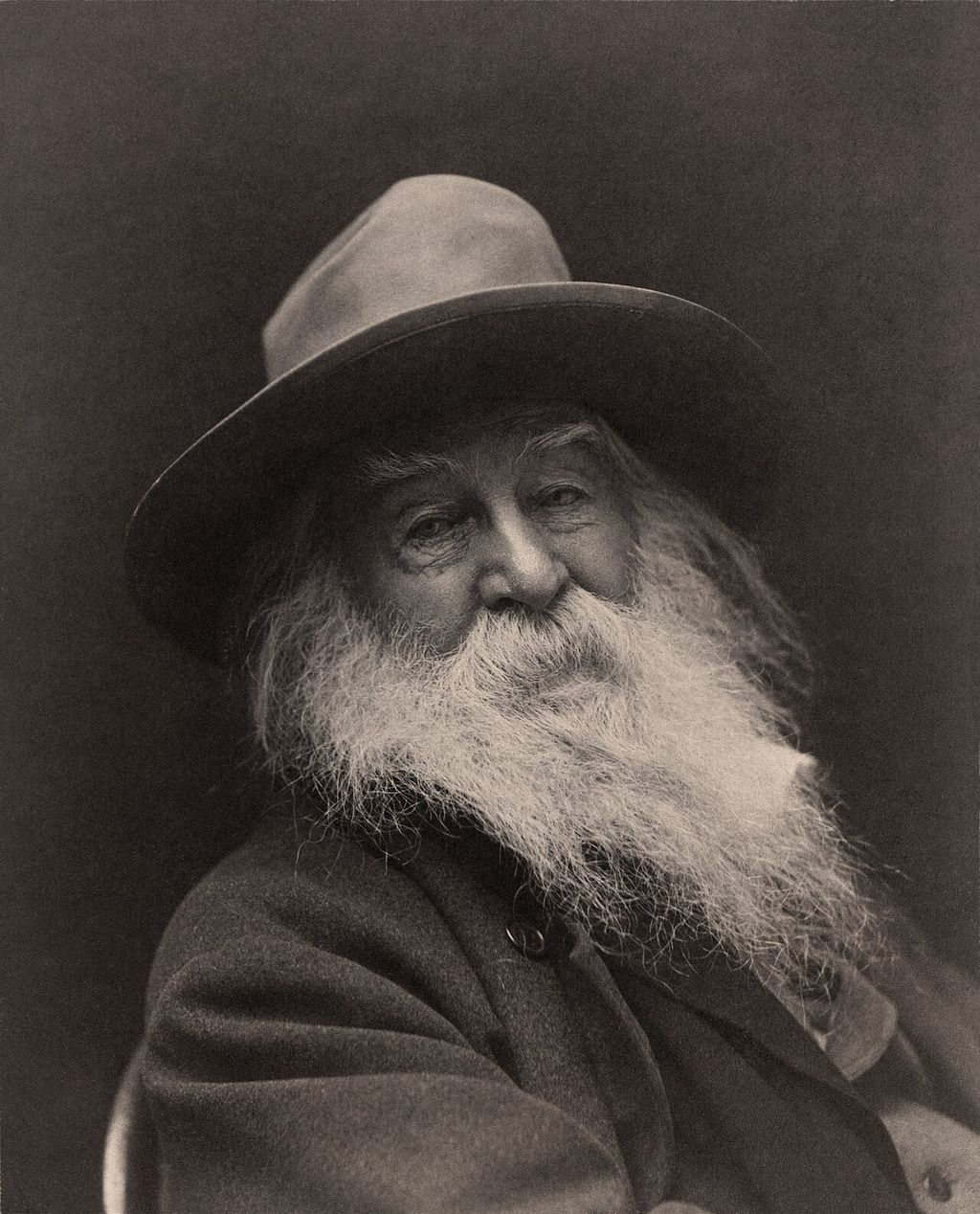
Walt Whitman, photographed by George Collins Cox. His poetry informed Hockney’s early paintings of love and identity. George Collins Cox; restored by Adam Cuerden / Wikimedia Commons. Image source. Public domain. Resized and converted to JPEG; no crop or recolouring.
A packet of tea and a choice of styles
Tea Painting in an Illusionistic Style (1961) brings Hockney especially close to a familiar Pop subject: commercial packaging. The work is oil on canvas, but the canvas itself participates in the description of the packet. Its irregular construction makes the painted object’s apparent shape part of the painting’s physical outline. The Met’s checklist records it as a canvas more than two metres high, giving an ordinary purchase an unexpectedly bodily scale. [10]
Hockney later described it as “as close to Pop art as I ever came”. His account dwells on making the stretcher and stretching its separate sections, and on the difficulty of spelling a small word while concentrating on perspective. The anecdote directs attention to a productive complication. Packaging gives him an accessible subject, yet the work is also about drawing a solid thing, arranging lettering and determining where an image ends. A familiar commodity becomes a means of testing the relation between a flat support and an illusion. [7]
At the 1962 Young Contemporaries, Hockney grouped four pictures as Demonstrations of Versatility. Their titles advertised different pictorial manners: semi-Egyptian, scenic, illusionistic and flat. The Foundation records his interest in bringing different styles together as a kind of collage without changing materials. Style itself could become a subject of painting, something available for selection and combination. [11]
Helen Little’s room guide for the Tate collection exhibition relates this freedom to Picasso’s example. Hockney’s early experiments could engage both old and new art while asserting his ability to choose the language a picture needed. The grouping is a strong warning against imagining his student years as the discovery of one permanent Pop style. His later changes of style and technique developed an openness already announced in these college paintings. [12]
America imagined through pictures
Hockney’s early America was partly a place encountered through existing images and stories. This makes his work relevant to Pop’s interest in mediated experience, while preserving its autobiographical character. His first visit to New York in 1961 supplied material for A Rake’s Progress, the sixteen etchings with aquatint made in 1961–63. Mary Weaver Chapin’s Portland Art Museum essay explains how he adapted William Hogarth’s eighteenth-century narrative to a young gay man’s arrival in modern New York. Personal experience, invention and an older printed story meet within the same sequence. [13]
The substitution of one kind of inheritance for another is especially telling. Where Hogarth’s fictional rake receives a family fortune, Hockney’s protagonist receives money through the purchase of his prints by MoMA curator William S. Lieberman. Other episodes transform adventures into comic narrative. The series can therefore engage money, consumption and the metropolitan world without being reducible to a celebration of American abundance. Its economy of line and invented incidents give the reader a particular traveller’s account. The wider development of his printmaking shows how important this literary and graphic resource remained. [13]
California, too, existed in Hockney’s paintings before he arrived there. Domestic Scene, Los Angeles (1963) drew on a photograph in Physique Pictorial. The Foundation explicitly dates it before his first visit to the city. The imagined domestic setting was built from circulated material, so the painting should not be read as a direct record of a Californian encounter. [14]
Matthew Sperling’s Apollo essay links Hockney’s anticipation of California to both male physique photography and the architectural photographs of Julius Shulman. These were distinct kinds of persuasion: bodies and buildings together helped give a distant place its attraction. Sperling also traces how the pool developed from an erotic and domestic setting into a sustained formal problem. An image could arouse Hockney’s interest in a destination; working there could then give that interest new visual tasks. [15]
California: popular imagery and the work of looking
Hockney first arrived in Los Angeles in 1964, establishing a home and studio in Santa Monica. The Foundation records his encounters with Christopher Isherwood, Don Bachardy and other figures who became part of his surroundings, along with his early experiments in acrylic and the first swimming-pool paintings. The distinction between an imagined city and a lived environment now became more complicated. He had people, light, buildings and water before him as well as photographs through which he had anticipated them. [16]
Little’s account of the Californian pictures brings these interests together. A shower offered the sight of a moving body and the problem of transparent water; it also belonged to the long history of bathers in painting. Such pictures could draw on erotic magazines while engaging a traditional subject. Their clear planes and striking surfaces are therefore only part of their meaning. They stage an encounter between contemporary experience and the painter’s decisions about how a body, light or liquid might be represented. [12]
Even a borrowed advertisement could lead towards close attention to a particular person and place. For The Room, Tarzana (1967), Hockney adapted a department-store bedroom advertisement, placing Peter Schlesinger in the sunlit scene. His account identifies the illumination itself as a growing subject of interest. Commercial imagery supplied a starting arrangement; the painting developed through questions about a body and the direction of light. [17]
A Bigger Splash (1967) makes a related difficulty immediately legible. An apparently brief event occupies a picture made slowly. The Foundation preserves Hockney’s explanation of the difference between a splash’s short duration and the extended labour of painting it. Sperling describes the contrast between the architectural planes and the erupting water. The picture’s immediate recognisability coexists with a concentrated problem of representation: how can paint hold an event that the eye cannot keep still? Pop helps explain its cultural setting, but offers only part of an answer to that question. [17] [15]
Hockney and Warhol: portraits and photographs
Andy Warhol offers a useful comparison when it begins with particular works and methods. In Gold Marilyn Monroe (1962), he used a publicity photograph from Niagara, bringing an already public face into a new arrangement through silkscreen ink and acrylic. MoMA’s account explains the significance of the gold field and relates the work to the construction of Monroe’s celebrity image. Her recognisable face is an image shared by a mass audience before it enters the painting. The religious resonance of gold complicates that public familiarity with an atmosphere of veneration and loss. [18]
Warhol’s portraiture also included direct encounters. The Andy Warhol Museum describes his commissioned portraits as beginning with Polaroid sessions, followed by enlargement, transfer to a screen and the combination of painted colour with a printed photographic image. Those works became a major source of income during the 1970s. Their commercial organisation is relevant to Pop, but their production involved decisions about the sitter’s appearance, colour and handling. [19]
Nor should Warhol’s sitters be imagined as uniformly distant strangers. The museum’s account of his photography includes celebrities and friends in the art, fashion and entertainment worlds. A contrast between an intimate Hockney and an entirely impersonal Warhol would conceal this overlap. Both used photography and moved through social networks that could become artistic material. Their differences become clearer when we ask what each work does with those encounters and images. [20]
In Hockney’s Mr and Mrs Clark and Percy (1970–71), the encounter extends into a room and the relation between two nearly life-size figures. His account describes substantial work from life, repeated painting and removal of Ossie Clark’s head, and the difficulties created by a central light source. He identified the relationship of the two people as the painting’s main aim. The portrait emerged through prolonged adjustment of a shared setting, giving bodily presence and spatial arrangement a different role from the transferred publicity image in Gold Marilyn Monroe. [21]
Hockney’s later 82 Portraits and 1 Still-life makes another useful distinction. LACMA records that none of its portraits was commissioned: he invited people from his circle, including employees, acquaintances, artists and family members. Most were painted in 2013–16, under repeated conditions involving the same yellow chair and blue background. Repetition here created a framework within which different sitters and successive sessions could be observed. A series, a standard format and strong colour can serve an inquiry into individual presence without depending on the reuse of a circulating celebrity image. [22]
Older art was present from the beginning
Historical painting was integral to Hockney’s early experiments. Carlson’s study of In Memoriam of Cecchino Bracci (1962) connects its shaped, joined canvases with Hockney’s interest in Italian art and its text with a poem by Michelangelo. The unusual support and the literary subject belong together in his account: Hockney explored the construction of a painting while finding historical language for male desire. This was an active use of the past within an inventive contemporary practice. It also places the tea packet and Renaissance poetry within the same broad field of available resources. [9]
In Play within a Play (1963), the Foundation identifies another older model: Domenichino’s painted illusion of a tapestry. Hockney placed his dealer John Kasmin before a tapestry and behind a glass surface, making the figure appear separated from the viewer within the picture. The Met checklist records oil and Plexiglas on canvas, underlining the meeting of painted illusion and a physical material. This interest in pictorial boundaries developed alongside his magazine-derived domestic scenes. [14] [10]
His literary print suites extend the evidence beyond the first Pop moment. The British Council’s Words & Pictures exhibition brought together A Rake’s Progress, the Cavafy illustrations, the Grimm fairy tales and The Blue Guitar. The last of these, published in 1977, responded to Wallace Stevens’s poem and its dialogue with Picasso. These projects involved different forms of storytelling, erotic intimacy and pictorial invention. They show why a public reputation established during Pop’s rise could coexist with sustained work across older literature and art. [23]
Abstraction and the freedom to depict
Hockney’s own recollections resist a clean progression from abstraction to Pop. In an interview published by the RCA in 2012, he recalled the excitement of American abstraction among students who had received traditional training. His sense that artistic activity had shifted from Paris towards New York coexisted with an interest in French artists such as Jean Dubuffet and Yves Klein. He described his central interest as depicting the world and said that Pop itself had not greatly interested him. This later testimony helps distinguish the movement’s importance to his public emergence from his account of what motivated him. [24]
Abstraction also remained available within his figurative pictures. In a 2023 interview with Tamaki Sugihara, Museum of Contemporary Art Tokyo curator Ai Kusumoto pointed to the concentric forms in The First Marriage as recalling Kenneth Noland’s colour-field painting, and to Hockney’s stated engagement with Robyn Denny’s symmetry in a 1967 sprinkler painting shown in Tokyo. These connections complicate the idea of a final choice between depicting things and engaging with abstract art. Hockney could use a contemporary formal language while giving it a different task within an image. His exchanges with abstraction continued after the early Pop association had been established. [25]
What the Pop Art label explains
Pop remains valuable as an account of Hockney’s emergence: his RCA context, the reception of Young Contemporaries and his willingness to use images and language from contemporary life. Its limits become clear when it is asked to explain every later choice. A magazine photograph, a poem, a sitter in a studio and an observed landscape make different demands on the artist. Hockney kept changing his means in response to them.
Kusumoto also emphasised the continuity beneath this variety: the exploration of how things are seen and translated into images, including the marks particular tools can make. That perspective connects the early freedom to combine styles with later changes of medium, giving those changes a purpose beyond the adoption of new technology or fashion. [25]
The Met’s 2017 retrospective similarly organised its account around perception, representation, movement, space and time across painting, drawing, photography and video. Read in that light, Hockney’s relationship with Pop is a productive starting point within a longer artistic life. It identifies a moment when he helped enlarge what a painting could contain. His subsequent work continued to ask how those contents could become a picture. [26]
Works directory
This source-bounded directory combines the works in the Metropolitan Museum’s 2017 retrospective checklist with reviewed museum object records and the additional works and series examined in this guide. It spans several media and is not a complete catalogue raisonné. Titles without an article link remain useful dated records. Metropolitan Museum final retrospective checklist (2017); additional object and series sources are given in the linked articles. [10]
| Name | Date | Medium |
|---|---|---|
| Love Painting | 1960 | Painting |
| Shame | 1960 | Painting |
| The Third Love Painting | 1960 | Painting |
| Tyger Painting No. 2 | 1960 | Painting |
| A Rake’s Progress | 1961–63 | Print series |
| Tea Painting in an Illusionistic Style | 1961 | Painting |
| The Cha-Cha That Was Danced in the Early Hours of 24th March | 1961 | Painting |
| Cleaning Teeth, Early Evening (10pm) W11 | 1962 | Painting |
| Flight into Italy - Swiss Landscape (Painting in a Scenic Style) | 1962 | Painting |
| Man in a Museum (or You're in the Wrong Movie) | 1962 | Painting |
| My Brother is Only Seventeen | 1962 | Painting |
| The First Marriage (A Marriage of Styles I) | 1962 | Painting |
| Domestic Scene, Los Angeles | 1963 | Painting |
| Play Within a Play | 1963 | Painting |
| The Hypnotist | 1963 | Painting |
| Arizona | 1964 | Painting |
| California Art Collector | 1964 | Painting |
| Man in Shower in Beverly Hills | 1964 | Painting |
| Portrait Surrounded by Artistic Devices | 1965 | Painting |
| Rocky Mountains and Tired Indians | 1965 | Painting |
| Beverly Hills Housewife | 1966–67 | Painting |
| Medical Building | 1966 | Painting |
| Peter | 1966 | Drawing |
| Peter Getting Out of Nick’s Pool | 1966 | Painting |
| A Bigger Splash | 1967 | Painting |
| A Lawn Being Sprinkled | 1967 | Painting |
| Kasmin in Bed in His Chateau in Carennac | 1967 | Drawing |
| Peter Feeling Not Too Good | 1967 | Drawing |
| Savings and Loan Building | 1967 | Painting |
| The Room, Tarzana | 1967 | Painting |
| American Collectors (Fred and Marcia Weisman) | 1968 | Painting |
| Christopher Isherwood and Don Bachardy | 1968 | Painting |
| Henry Geldzahler and Christopher Scott | 1968-1969 | Painting |
| W. H. Auden | 1968 | Drawing |
| Peter Langan in His Kitchen at Odins | 1969 | Drawing |
| Mark Glazebrook | 1970 | Drawing |
| Mr and Mrs Clark and Percy | 1970-1971 | Painting |
| Ossie Wearing a Fairisle Sweater | 1970 | Drawing |
| Pool and Steps, Le Nid du Duc | 1971 | Painting |
| Rubber Ring Floating in a Swimming Pool | 1971 | Painting |
| Celia in a Black Dress with White Flowers | 1972 | Drawing |
| Mount Fuji and Flowers | 1972 | Painting |
| Portrait of an Artist (Pool with Two Figures) | 1972 | Painting |
| Portrait of the Artist's Mother, Mrs Laura Hockney, Bradford | 1972 | Drawing |
| The Artist's Father | 1972 | Drawing |
| Dr Eugene Lamb, Lucca | 1973 | Drawing |
| Andy, Paris | 1974 | Drawing |
| Contre-jour in the French Style (Against the Day dans le Style-Français) | 1974 | Painting |
| Gregory Sitting on Base of Column | 1975 | Drawing |
| Kerby (after Hogarth) Useful Knowledge | 1975 | Painting |
| Ron Kitaj Outside Akademie der Kunste Vienna | 1975 | Drawing |
| Kasmin Reading the Udaipur Guide | 1977 | Drawing |
| Looking at Pictures on a Screen | 1977 | Painting |
| My Parents | 1977 | Painting |
| Canyon Painting | 1978 | Painting |
| Mother, Bradford, 19 Feb. 1979 (inscribed 1978) | 1979 | Drawing |
| Mulholland Drive: The Road to the Studio | 1980 | Painting |
| Nichols Canyon | 1980 | Painting |
| Outpost Drive, Hollywood | 1980 | Painting |
| Hollywood Hills House | 1981-1982 | Painting |
| Celia. Los Angeles. April 10th 1982 | 1982 | Polaroid composite |
| Don + Christopher, Los Angeles, 6th March 1982 | 1982 | Polaroid composite |
| Gregory Swimming Los Angeles March 31st 1982 | 1982 | Polaroid composite |
| My Mother, Bolton Abbey, Yorkshire, Nov. 1982 | 1982 | Photocollage |
| Self Portrait 30th Sept. 1983 | 1983 | Drawing |
| Pearblossom Hwy., 11-18th April 1986, #1 | 1986 | Photocollage |
| Pearblossom Hwy., 11–18th April 1986, #2 | 1986 | Photocollage |
| Large Interior, Los Angeles | 1988 | Painting |
| Breakfast at Malibu, Sunday, 1989 | 1989 | Painting |
| Pacific Coast Highway and Santa Monica | 1990 | Painting |
| The Other Side | 1991-1993 | Painting |
| The Eleventh V. N. Painting | 1992 | Painting |
| The Twenty Sixth V. N. Painting | 1992 | Painting |
| The Road Across the Wolds | 1997 | Painting |
| 9 Canvas Study of the Grand Canyon | 1998 | Painting |
| A Bigger Grand Canyon | 1998 | Painting |
| Colorado River | 1998 | Painting |
| Garrowby Hill | 1998 | Painting |
| Colin St. John Wilson. London. 3rd June 1999 | 1999 | Drawing |
| Gregory Evans. Los Angeles. 18th September 1999 | 1999 | Drawing |
| Laura Huston. London. 22nd June 1999 | 1999 | Drawing |
| Lindy. Marchioness of Dufferin and Ava. London. 17th June | 1999 | Painting |
| Going Up Garrowby Hill | 2000 | Painting |
| Red Pots in the Garden | 2000 | Painting |
| A Closer Winter Tunnel, February - March | 2006 | Painting |
| Elderflower Blossom, Kilham, July 2006 | 2006 | Painting |
| The Road to Thwing, July 2006 | 2006 | Painting |
| Bigger Trees near Warter | 2007 | Painting |
| Hawthorn Blossom near Rudston | 2008 | Painting |
| Views Through the Artist's Bedroom Window, Bridlington | 2010-2013 | Digital animation |
| The Arrival of Spring in Woldgate, East Yorkshire in 2011 (twenty eleven) | 2011 | Painting / digital series |
| 82 Portraits and 1 Still-life | 2013–16 | Portrait series |
| Garden | 2015 | Painting |
| Garden with Blue Terrace | 2015 | Painting |
| Garden #3 | 2016 | Painting |
| A Bigger Interior with Blue Terrace | 2017 | Painting |
| Interior with Blue Terrace and Garden | 2017 | Painting |
| A Year in Normandie | 2020–21 | Digital frieze |
Discussion
Look again at the images and ideas explored in Pop Art. These editorial prompts invite your observations.
Reader Insights
How does changing a familiar pop-song idea in Doll Boy turn a public celebrity image into something personal?
Compare the role of photography in Gold Marilyn Monroe with the sittings and revisions described for Mr and Mrs Clark and Percy. What different kinds of presence do these methods create?
Does the shaped support of Tea Painting in an Illusionistic Style make the packet more convincing as an object, or draw your attention to the painting’s construction?
Join the Conversation
Share a detail, comparison or question about Pop Art below.
References
- National Portrait Gallery. Pop Art Portraits, exhibition archive, 11 October 2007–20 January 2008, especially “Portraits and Style”. View source.
- Zorian Clayton, Victoria and Albert Museum. “David Hockney in the V&A: printmaker, painter, pioneer”, 9 July 2026. View source.
- National Portrait Gallery. “Independent Group”, collection group history. View source.
- Pallant House Gallery. “British Pop art”, overview. View source.
- The David Hockney Foundation. Chronology: “1959”, “Royal College of Art”, “Early friendship with Kitaj” and “Skeleton drawings”. View source.
- The David Hockney Foundation. Chronology: “1960”, “Walt Whitman and the ‘love’ paintings”, “Doll Boy” and “Pop Art”. View source.
- The David Hockney Foundation. Chronology: “1961”, “Young Contemporaries”, “Working in the public eye at the RCA” and “Tea Painting in an Illusionistic Style”. View source.
- Amritpal Bachu, House of Lords Library. Sexual Offences Act 1967: 50th Anniversary, 19 July 2017, p. 1, summary. View source.
- Raymond Carlson, Museo Nacional Thyssen-Bornemisza. “David Hockney and the Memory of Michelangelo”, Open Windows 9, especially pp. 3–10 and 16–17. View source.
- The Metropolitan Museum of Art. David Hockney: Final Checklist, 15 November 2017, printed checklist pp. 2–3, entries for Tea Painting in an Illusionistic Style and Play Within a Play. View source.
- The David Hockney Foundation. Chronology: “1962”, “Demonstrations of Versatility”. View source.
- Helen Little, Tate and Musée Granet. David Hockney: Works from the Tate Collection, press pack and room guide, 2023, pp. 9 and 11–14. View source.
- Mary Weaver Chapin, Portland Art Museum. David Hockney: A Rake’s Progress, exhibition brochure, 2015, pp. 3–4. View source.
- The David Hockney Foundation. Chronology: “1963”, “Paintings of couples” and “Play within a Play”. View source.
- Matthew Sperling. “Water Marks: The Pull of Hockney’s Pool Paintings”, Apollo, February 2017, pp. 52–58; repository proof, especially PDF pp. 1–2. View source.
- The David Hockney Foundation. Chronology: “1964”, “Move to L.A.” and “Landscapes and swimming pools”. View source.
- The David Hockney Foundation. Chronology: “1967”, “A Bigger Splash” and “The Room, Tarzana”. View source.
- The Museum of Modern Art. “Andy Warhol. Gold Marilyn Monroe. 1962”, collection record and commentary. View source.
- The Andy Warhol Museum. “Commissioned Portraits”, “About the Art”. View source.
- The Andy Warhol Museum. “Time Capsule 21: Photography”. View source.
- The David Hockney Foundation. Chronology: “1971”, “Mr. and Mrs. Clark and Percy”. View source.
- Los Angeles County Museum of Art. “Opening This Week! David Hockney: 82 Portraits and 1 Still-life”, Unframed, 9 April 2018. View source.
- British Council. “David Hockney: Words & Pictures”, exhibition account. View source.
- David Hockney, Royal College of Art. “David Hockney”, interview originally commissioned for The Perfect Place to Grow: 175 Years of the Royal College of Art, published online 1 November 2012. View source.
- Tamaki Sugihara, interviewing Ai Kusumoto. “Why has Hockney continued to win acclaim and popularity for 60 years? A curator explains the David Hockney exhibition, Part I” [Japanese title translated], Tokyo Art Beat, 25 August 2023. View source.
- The Metropolitan Museum of Art. David Hockney, retrospective exhibition overview, 27 November 2017–25 February 2018. View source.
More HOCKNEY Works
A Bigger Splash
A momentary disturbance becomes the focus of a large acrylic painting, made through weeks of patient work.
Mr and Mrs Clark and Percy
The designers Celia Birtwell and Ossie Clark occupy a room shaped by light, repeated sittings and the demands of a double portrait.
A Bigger Grand Canyon
Sixty canvases gather memory, studies and changing viewpoints into an immense painting of 1998.
Garrowby Hill
The 1998 oil painting transforms a remembered Yorkshire journey into a road, fields and an expansive view.
Portrait of an Artist (Pool with Two Figures)
Photographic studies, two figures and a swimming pool become a carefully constructed painting of 1972.
My Parents
The 1977 oil painting sets Kenneth and Laura Hockney within a quietly organised interior.
Pearblossom Hwy., 11–18th April 1986, #2
Hundreds of separately made photographs construct a road scene that unfolds through movement and time.
Bigger Trees near Warter
Fifty canvases join into a large outdoor painting of Yorkshire trees, with photography helping the artist organise the whole.