


 by Tom Gurney
Tom Gurney BSc (Hons) is an art history expert with over 20 years experience
Email: tomgurney1@gmail.com / Phone: +44 7429 011000
David Hockney Landscapes: Introduction
A road climbs through fields, a canyon opens beneath the eye, and bare trees slowly acquire their leaves. David Hockney’s landscapes repeatedly turn recognisable places into questions about seeing. Where are we standing? How far can we look? What happens when we remember a journey, return to a familiar wood, or watch the same garden change over a year? The answers involve colour and perspective, but also the time that a picture asks us to give it.
Across paintings, photographic collages, drawings and films, Hockney developed several ways of bringing a place into view. Sometimes he worked outdoors; sometimes he painted a distant landscape from memory. A single canvas could become a road to follow, while dozens of canvases could spread a network of branches across a gallery wall. His landscape work becomes especially revealing when these decisions are compared: the choice of medium changes what can be recorded, assembled and experienced.
At a Glance
- ArtistDavid Hockney
- Born9 July 1937, Bradford, England
- Died11 June 2026
- FocusLandscapes
Contents
- Painting a place through the act of looking
- California roads and remembered journeys
- A photographic landscape can contain many moments
- The Grand Canyon and the problem of scale
- Yorkshire: memory within a familiar landscape
- Colour, repeated observation and the seasons
- Why build a landscape from many canvases?
- Spring in oil and on a screen
- Learning from other landscapes
- When the landscape itself moves
Painting a place through the act of looking
The expansive landscapes grew from a wider investigation of how pictures represent space. In her account of Hockney’s development, Museum of Contemporary Art Tokyo curator Ai Kusumoto links his questioning of naturalism in the 1970s with several experiences: prolonged drawing from people in Paris, renewed engagement with Picasso, work for the stage, and encounters with Japanese and Chinese art. Her explanation makes the later landscapes part of a sustained enquiry. The problem was how to give a convincing account of a world encountered through attention, movement and duration. [1]
The familiar convention of lines converging towards a distant vanishing point is useful, but it assumes a stable viewing position. Hockney explored what happened when that position changed. Kunstmuseum Luzern’s account of his Moving Focus works explains reverse perspective as a reversal of the usual arrangement: the implied convergence moves behind the viewer. Other pictures combine several viewpoints. A table, courtyard or landscape can consequently appear to open towards us, with its different parts inviting attention in turn. These were artistic propositions about perception, rather than demonstrations that one system could reproduce every aspect of sight. [2]
Chinese scroll painting offered another example of a picture unfolding through space and time. The viewer encounters successive passages, and a landscape need not submit to one stationary viewpoint. Luzern also describes Hockney sketching the courtyard of a hotel in Acatlán, Mexico, before returning with the printmaker Kenneth Tyler to develop prints. A courtyard might seem a different subject from a canyon, yet both raise the question of how the eye travels around a place. The frame encloses the image; the activity represented can range much further. [2]
This gives a useful starting point for his landscapes. Their roads, branches and changes of colour often organise a journey for the eye. A viewer may look across the whole surface, then concentrate on a smaller passage, then return to the broader arrangement. Size can encourage that activity, but a large format alone cannot produce it. The connections between the picture’s parts have to keep the act of looking alive.
Explore the landscape studies
Garrowby Hill
The 1998 oil painting transforms a remembered Yorkshire journey into a road, fields and an expansive view.
A Bigger Grand Canyon
Sixty canvases gather memory, studies and changing viewpoints into an immense painting of 1998.
Mulholland Drive: The Road to the Studio
The large 1980 panorama brings the experience of travelling through Los Angeles into an arrangement of vivid colour and changing viewpoints.
Nichols Canyon
A winding Los Angeles route becomes a network of road, vegetation and emphatic colour in 1980.
Bigger Trees near Warter
Fifty canvases join into a large outdoor painting of Yorkshire trees, with photography helping the artist organise the whole.
The Arrival of Spring in Woldgate
A thirty-two-canvas oil painting and an associated sequence of iPad drawings offer distinct ways of following spring in 2011.
A Year in Normandie
A long frieze developed from iPad paintings follows the changing seasons around Hockney’s Normandy home.
California roads and remembered journeys
In Mulholland Drive: The Road to the Studio, 1980, the subject is a familiar journey through Los Angeles. The acrylic painting measures more than six metres across. LACMA describes it as a personal panoramic map based on Hockney’s daily route from his Hollywood Hills home to his studio on Santa Monica Boulevard. He painted it from memory over a few weeks. The road therefore gathers an experience of travelling into a composition that can be surveyed at once. [3]
The museum identifies a deliberate alternation between detailed trees, houses, tennis courts and power lines, and more abstract fields of colour or grids. These different kinds of description make the city feel both inhabited and extensive. The road’s sweep across the upper part of the canvas carries the eye laterally, while the smaller features invite closer inspection. Driving supplies a sequence of encounters; painting allows those encounters to coexist. The result combines the intimacy of a commute with the breadth of an urban panorama. [3]
Memory is important here because it involves selection. A remembered route includes turns, changes of height and the relationship between one stretch and the next. Its usefulness to a painter differs from that of a single view taken at a roadside stopping place. The long format gives these connected impressions room to develop. Hockney’s California landscapes are consequently relevant to the later Yorkshire roads: both turn a journey through a known environment into a structure for looking.
Photography subsequently expanded this enquiry. The David Hockney Foundation traces his composite Polaroids of 1982 to preparations for a photography exhibition with curator Alain Sayag. The instant camera became a means of making new pictures from multiple viewpoints. Later that year, changing to a Pentax camera removed the Polaroids’ white borders but introduced a delay while film was processed. Hockney planned arrangements through notes and diagrams. In the Grand Canyon collages, remembering what he had photographed became part of constructing the picture. [4]
The change of camera therefore altered the work’s rhythm. An instant print could be examined immediately; a processed photograph had to be anticipated and subsequently fitted into a larger design. Both processes required decisions about relationships between fragments. Hockney was using a camera to build a picture over time, and the assembled result preserved traces of that making.
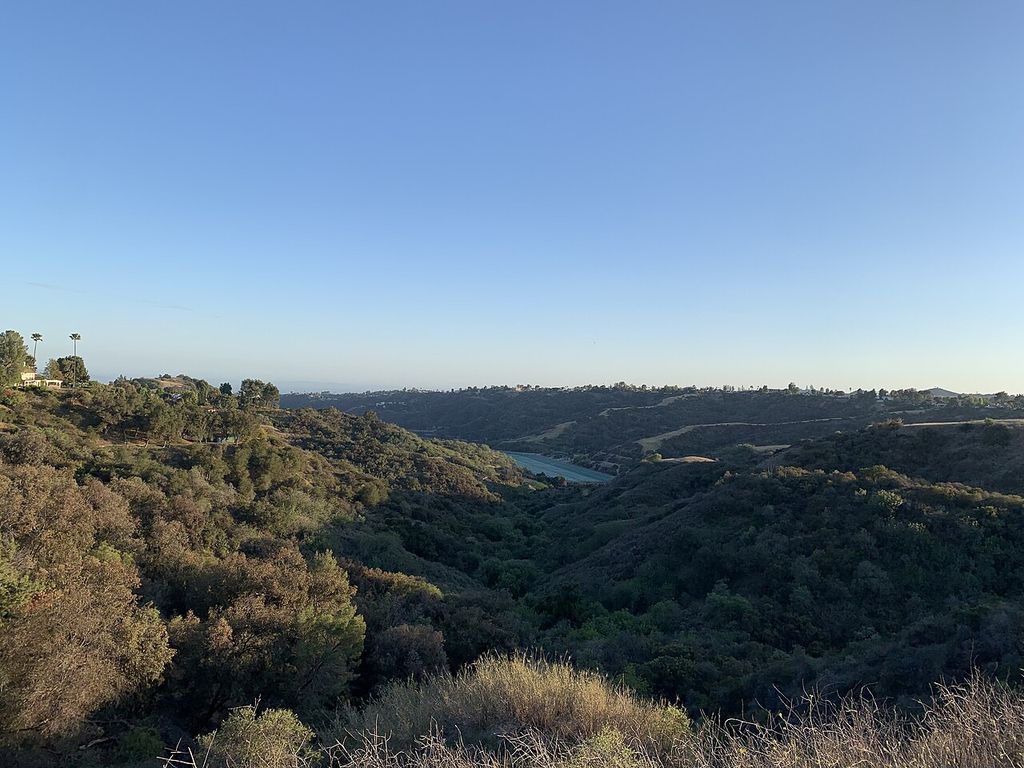
Los Angeles context: Stone Canyon Reservoir and the surrounding hills. DocFreeman24 / Wikimedia Commons. Image source. CC BY-SA 4.0. Resized and converted to JPEG; no crop or recolouring. Image derivative retains CC BY-SA 4.0.
A photographic landscape can contain many moments
The Getty’s 2017 exhibition text explains how Hockney used Polaroid grids and later photographic collages to challenge the idea of a photograph as one decisive instant. Multiple views introduced elapsed time and the photographer’s presence into the image. This is essential to understanding Pearblossom Hwy., 11–18th April 1986, #2: although it is often discussed beside the paintings, its medium is photographic collage. The separate prints are the material from which the landscape is constructed. [5]
In their 2026 recollections, Getty curators Julian Brooks and Virginia Heckert identify Pearblossom as a collage of chromogenic prints and describe the considerable practical demands of exhibiting a photographic work on the scale of a large painting. Its hundreds of constituent photographs make a productive comparison with Hockney’s later multi-canvas landscapes. In each, the larger image remains an assembly of smaller surfaces, although the materials and the process of joining them differ. [6]
A photographic fragment can preserve a view made at a particular moment, while its place in the finished collage establishes a new relationship with neighbouring fragments. Painting permits a different kind of adjustment: a line or colour can be carried across adjoining supports as the composition develops. These are related ways of constructing continuity. Their visible divisions need not prevent a landscape from holding together; they can help us notice how much work is involved in bringing it together.
The Grand Canyon and the problem of scale
A Bigger Grand Canyon, 1998, is oil on sixty canvases, with an overall width of roughly seven and a half metres. It belongs to the National Gallery of Australia. The material facts matter: the picture is a substantial painted object built from a grid of supports, each contributing to an enormous expanse of represented terrain. Its size makes the relationship between a small human observer and a vast landscape physically present in the gallery. [7]
The owning museum associates the painting with Powell Point on the canyon’s southern rim and emphasises the sensation of standing at an edge. That is a different spatial challenge from following a road. A road establishes a route onwards; the canyon demands that the eye range across and down through a depth that cannot be comfortably grasped in one inspection. The problem is as much the disposition of the terrain as its sheer extent. [8]
For A Bigger Grand Canyon, Hockney combined recollection with an earlier photographic collage. The Foundation also identifies Thomas Moran’s landscape painting as an inspiration. A separate painting, A Closer Grand Canyon, followed a later visit in 1998, when Hockney made oil-pastel studies from observation before returning to the studio. The two works demonstrate different balances between direct study, memory and earlier images. Painting a landscape on an ambitious scale did not prescribe a single method of gathering its information. [9]
Moran offers a historical comparison without explaining away Hockney’s choices. The National Gallery of Art’s 1997–98 Moran retrospective brought together his monumental Grand Canyon of the Yellowstone, Chasm of the Colorado and Mountain of the Holy Cross. Large landscape painting already had a history of translating an encounter with terrain into an exhibition experience. Hockney’s conspicuous grid and intensely varied colour belong to his own means of undertaking that task. [10]
Colour has remained central to the canyon painting’s reception. In conversation with Jennifer Higgie for the National Gallery of Australia, painter Ben Quilty singled out its relationships between orange, purple and a forceful foreground green. He treated the colour’s daring as a strength, while acknowledging how close the painting could come to kitsch. His response helps to identify a real tension: recognisable geology is presented through a palette that asserts the painter’s freedom at every turn. It can persuade a viewer through relationships between colours, without pretending to be a neutral record. [11]
The canyon thus gives scale two meanings. There is the measurable width of the painting and the apparently immeasurable space it depicts. The first can be walked along; the second must be imagined through the picture’s arrangement. Hockney makes the encounter depend on movement between those two kinds of space, with the painted divisions continually available to remind us of the object before us.
Yorkshire: memory within a familiar landscape
The Yorkshire paintings of the late 1990s developed alongside this American work. In 1997, Hockney spent late summer in Yorkshire while his friend Jonathan Silver was seriously ill. The Foundation connects his repeated journeys between Bridlington and Saltaire with the beginning of a new body of landscape painting. A route travelled for a personal reason became an occasion for looking again at the countryside of his earlier life. [12]
After returning to Los Angeles, Hockney continued painting Yorkshire from memory. This distance is crucial to Garrowby Hill, 1998. A known journey could be re-formed in the studio, with memory supplying an active resource. The same year’s canyon work shows how a distant place could remain available to him through recollection and earlier study. [9]
The Boston Garrowby Hill is a horizontal oil painting, sixty by seventy-six inches. Its road leads into a broad field of patterned countryside. The format allows the route and the surrounding land to compete for attention: following a bend brings us into the picture, while neighbouring fields draw us sideways. [13] [14] Going Up Garrowby Hill, painted in 2000, is a separate oil with an upright format. The different proportions change the space through which Hockney organised these encounters with the hill. [15]
Filmmaker Bruno Wollheim, who knew Hockney over many years, described the Yorkshire road paintings as imaginative syntheses of a car journey. He also recalled Hockney questioning an ordinary assumption: what colour is a road? Tarmac has a conventional colour in our minds, but weather, light and surroundings complicate its appearance. That question helps explain why an unusual colour can sharpen our interest in a real place. It asks us to reconsider a familiar visual category. [16]
The relationship between place and memory is therefore more complicated than nostalgia. A familiar landscape supplies habits of recognition, but those habits can also conceal it. Hockney’s roads make the viewer work through direction, colour and changing emphasis. The picture offers the pleasure of following a route while disturbing the expectation that a known countryside must appear in subdued or predictable terms. The fuller geography of these returns belongs to Hockney’s Yorkshire; across the landscapes, the larger issue is how familiarity can be made newly visible.
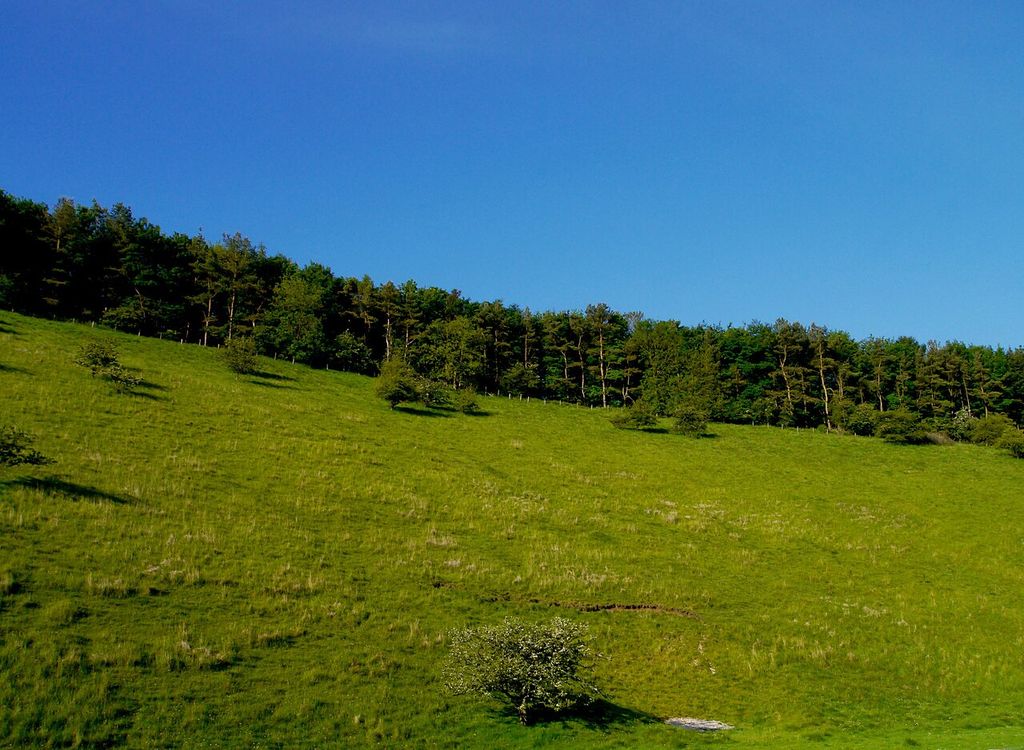
Regional context: the dry chalk valley of Water Dale, near Thixendale in the Yorkshire Wolds. Andy Beecroft / Wikimedia Commons. Image source. CC BY-SA 2.0. Resized and converted to JPEG; no crop or recolouring. Image derivative retains CC BY-SA 2.0.
Colour, repeated observation and the seasons
Reviewing the 1998 landscape exhibition at L.A. Louver, William Wilson noticed that Hockney did not consistently weaken colour in the distance. Bright remote areas could seem to move towards the picture’s surface. Wilson’s response identifies a useful tension between spatial depth and the flat, coloured object. A distant field can belong to the depicted countryside while remaining a strong shape close to the eye. Perspective is being adjusted through colour as well as through the direction of lines. [17]
Repeated observation brought a different discipline to the later Yorkshire work. The Guggenheim Bilbao’s 2012 exhibition centred on landscapes made from 2004 onwards and brought together oils, charcoal, sketchbooks, iPad drawings and digital video. The range of materials reflects several ways of returning to a subject. A scene might be observed through a drawing’s immediate decisions, a sustained painting, or a sequence of visits that makes changes between images important. [18]
Titles can register this accumulation of time with unusual precision. Woldgate Woods, 21, 23 and 29 November 2006 is an oil painting on six canvases. Its title gives three dates, connecting one assembled work with more than one day. Other works isolate conditions such as a winter tunnel or snow. Their specificity helps resist the idea of a generic green countryside. A particular place offers different structures when branches are exposed, leaves gather, or the ground changes colour. [18]
Lawrence Weschler’s 2013 account describes Hockney’s Yorkshire watercolour studies in 2004 and the following year’s return to some of those locations in paint. The sequence gives close observation a practical role: time spent attending to hedges, plants and the character of a site could feed later work. Moving between materials did not erase what the earlier medium had taught him. [19]
The Musée Granet’s Tate-based guide places the landscape work within Hockney’s continuing investigation of memory and spatial experience. It also follows his expansion from composite paintings into multi-screen video. Such movement between media is especially productive for a seasonal subject, because no single view can show every stage. A painting can concentrate an encounter into a surface; a group of drawings can preserve successive states; moving images can make duration part of the event. [20]
Why build a landscape from many canvases?
The construction of Bigger Trees near Warter, 2007, joins outdoor observation to an ambitious plan for exhibition. Its fifty oil-painted canvases form a picture approximately fifteen feet high and forty feet wide. The Foundation records that the canvases were painted outdoors and the overall composition planned with digital photography. Hockney could work on separate portions of the landscape while using photographs and a computer to assess how the larger image was developing. The camera became an aid to a painting whose scale exceeded a conventional easel view. [21]
His account of the project gives the practical idea a revealing origin. Reproductions of earlier six-canvas works, hung together in Los Angeles, suggested that a much larger composition could be made by extending a method already in use. The prospective wall at the Royal Academy then became part of his planning. The size of the final work emerged from a relationship between observation, manageable sections and the space in which the painting would meet its viewers. [21]
Luzern’s exhibition text explains the seasonal urgency. Hockney wanted to complete the work before leaves concealed the branching structure. Branches pass between the canvases, connecting the separate supports, while small shifts remain perceptible at their boundaries. The grid is a means of enlarging a picture and a means of accommodating local differences within it. A viewer can attend to the branching network as a whole, then notice the decisions through which one section meets another. [22]
This differs from enlarging a finished small picture. The work’s parts were themselves occasions for looking and painting. Its monumental size does not abandon the particular: it gives an ordinary group of Yorkshire trees the space usually associated with a commanding spectacle. Compared with the Grand Canyon, the change is striking. The land need not be extraordinary in extent for the sustained effort of representing it to become extensive.
Spring in oil and on a screen
The Arrival of Spring in Woldgate, East Yorkshire in 2011 (twenty eleven) brought oil painting and digital drawing into a shared seasonal project. The Foundation distinguishes the enormous painting on thirty-two canvases from the related iPad drawings. Hockney made more than a hundred digital drawings; fifty-one were selected for presentation with the oil at the Royal Academy. The room brought a single expansive painted image into conversation with many smaller records of change. [23]
Hockney explained that the oil painting sought an early stage of spring, when new leaves begin to appear but do not yet obscure everything. This choice fixes a particular balance between growth and visibility. The accompanying drawings could follow change over a longer interval. Together, the large painting and successive printed digital images offered two experiences of a season: concentration in one extensive composition, and comparison between distinct moments. [23]
Luzern points to the oil painting’s simplified forms, firm outlines and patterned marks, as well as differences between its more articulated foreground and simplified background. Such devices allow observed growth to become an emphatic painted arrangement. Small marks can accumulate into vegetation, while large divisions keep the whole composition legible. The medium provides ways of making nature intelligible without requiring every leaf to be individually described. [22]
In 2019 the Van Gogh Museum included the thirty-two-canvas painting in Hockney–Van Gogh: The Joy of Nature. The exhibition framed the Yorkshire landscapes through a dialogue with Van Gogh. This is one reason Hockney’s digital work belongs within the history of landscape painting: technological tools coexisted with a close interest in what earlier painters had achieved through colour, drawing and attention to the natural world. Hockney and Van Gogh form a distinct chapter of that relationship. [24]
Learning from other landscapes
Hockney also explored landscape through existing paintings. The Guggenheim Bilbao’s 2012 exhibition account describes his encounter with Claude Lorrain’s The Sermon on the Mount at the Frick Collection in December 2009. He made a full-size transcription and further studies, leading to A Bigger Message, 2010, an oil painting on thirty canvases. The museum presents the spatial effect of Claude’s composition as the focus of his fascination. A work from another century offered a problem that he could investigate through his own materials and scale. [25]
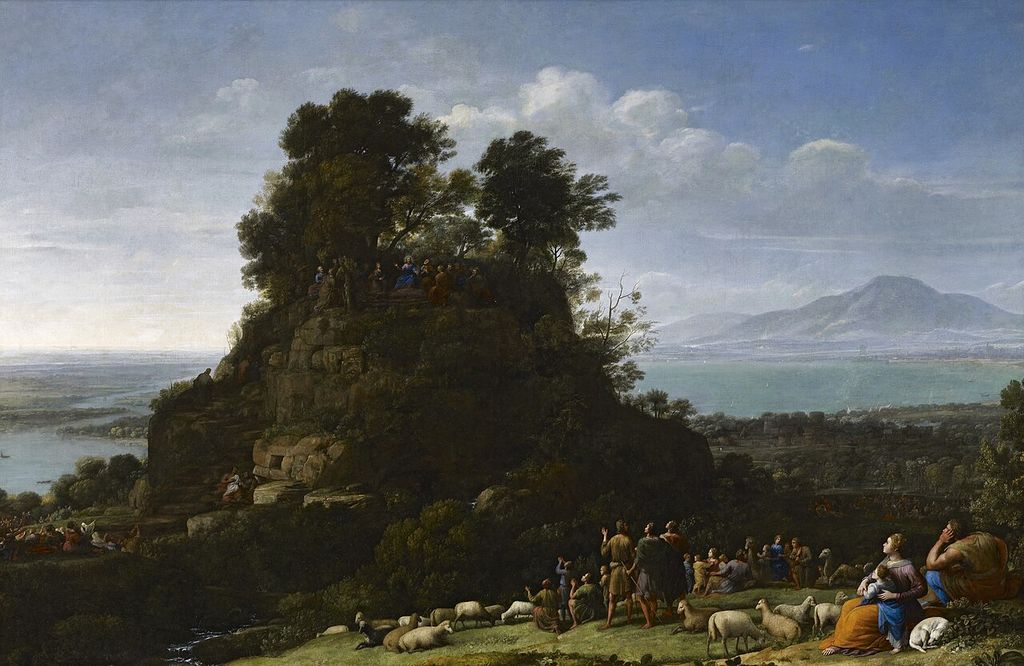
Historical comparison: Claude Lorrain, The Sermon on the Mount, circa 1656, Frick Collection. Claude Lorrain (c. 1600 - 1682) / Wikimedia Commons. Image source. Public domain. Resized and converted to JPEG; no crop or recolouring.
The same account connects this interest in expansive landscape with Hockney’s iPad images of Yosemite. There, the tablet allowed him to respond quickly to dramatic light and weather, while the eventual prints extended the drawings to a much larger scale. Familiarity with Yorkshire had helped prepare his interest in a different terrain. Read alongside Wilson’s account of the American West’s significance for the 1998 paintings, this suggests an exchange: sustained attention to one place could renew Hockney’s approach to another. [25] [17]
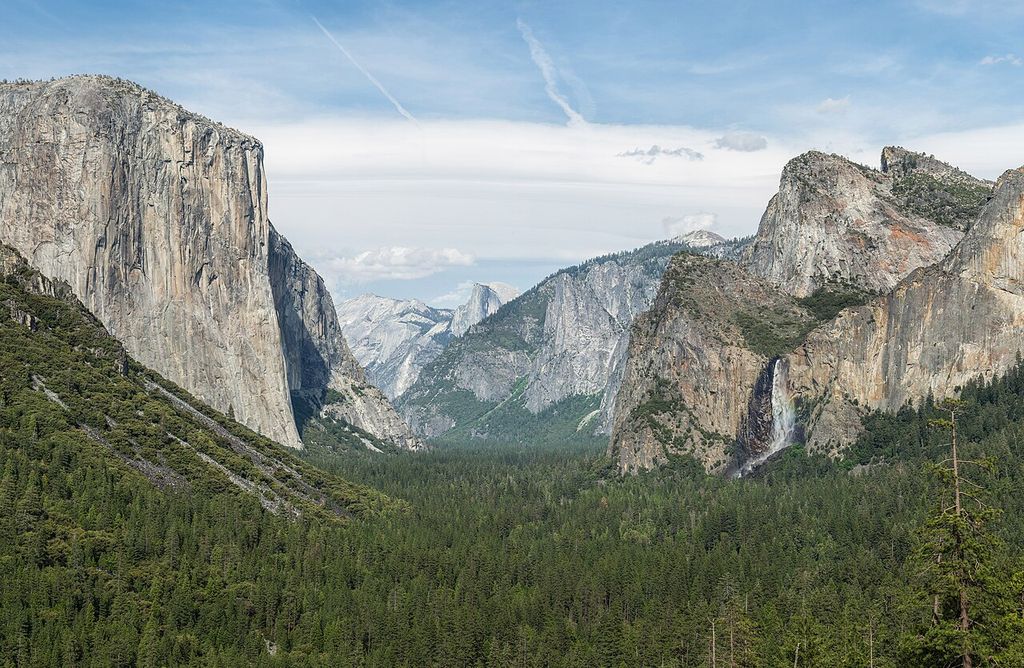
Geographic context: Yosemite Valley from Tunnel View. Diliff / Wikimedia Commons. Image source. CC BY-SA 3.0. Resized and converted to JPEG; no crop or recolouring. Image derivative retains CC BY-SA 3.0.
These works add another possibility to the relationship between memory and observation. A painter can study the solutions embodied in another picture, test them, and carry the resulting questions back to the world outside. Hockney’s landscape practice involved repeated exchanges between the place encountered, the image remembered and the picture being made.
When the landscape itself moves
For the multi-screen films, movement became part of the recording apparatus. Weschler describes arrays of small cameras attached to Hockney’s vehicle, with the resulting views presented across adjoining screens. Seasonal journeys could be compared as branches, road surfaces and light changed. The viewer was offered several moving views simultaneously, with room for attention to shift between them. [19]
The Granet guide relates these moving images to the grid of the composite paintings and records Hockney’s description of them as Cubist movies. The comparison makes sense at the level of construction: several partial views contribute to a larger experience, while the spectator’s gaze remains active. Yet film introduces a different condition. A painting remains available for indefinite inspection; a filmed passage advances while we look. Attention has to negotiate the movement supplied by the work as well as the movement of our own eyes. [20]
Across these media, a road supplies a particularly effective recurring structure. In an oil painting it may guide an imagined journey. In a photographic collage it is rebuilt from separately recorded views. In the films it becomes a route through which the cameras actually travel. The subject remains recognisable, while each process gives the relationship between looking and travelling a different form.
Normandy: a garden, a spring and a year
The later Normandy landscapes concentrated this attention on the surroundings of a home. Different media gave this familiar setting several distinct forms. La Grande Cour, 2019, is a panorama composed of twenty-four ink drawings. The Fondation Louis Vuitton’s 2025 curatorial text identifies it separately from the iPad work, including 220 for 2020. The earlier ink panorama demonstrates that Hockney’s interest in extending a view around his surroundings was not dependent on a single digital technique. [26]
During the spring of 2020, the changing garden became a sustained subject on the iPad. The Foundation records Hockney’s account of following winter trees through buds, blossom, leaves and developing fruit. The Royal Academy exhibited 116 of these images in 2021 as The Arrival of Spring, Normandy, 2020, printed on paper. The tablet allowed him to develop marks while following changes close at hand; printing gave those screen-made images another physical scale and setting. [27]
The movement from blossom to fruit supplies a precise form of continuity. These are successive conditions of the same living subjects, and the interval between pictures is part of what a viewer understands. A garden can thus sustain an extensive series without a search for new destinations. The interest lies in the differences that appear when an artist gives an apparently settled place sustained attention.
A Year in Normandie, 2020–21, extends the seasonal subject into a long frieze developed from iPad paintings. The Musée de l’Orangerie’s historical exhibition account connects the project to Hockney’s encounter with the Bayeux Tapestry, an embroidery whose narrative develops across a considerable horizontal extent. It also presents the frieze in relation to Monet’s Water Lilies. These comparisons concern how an extended image can organise experience around a viewer. Hockney’s sequence follows the natural year through the familiar surroundings of his house and garden. [28] [29]
The Serpentine’s 2026 guide explains that Hockney made more than two hundred iPad paintings of the Normandy landscape and selected around half for the frieze. That selection matters. A daily practice of looking became a constructed sequence, with a continuous presentation assembled from separate images. The guide also connects its format with Chinese scroll painting’s ability to mobilise the viewer’s gaze. The different historical examples were resources for Hockney’s own investigation, each offering ways to think about duration across a surface. [29]
In the Normandy work, a local setting becomes extensive through time. The canyon opens through a vast depth; the frieze opens through a year. Neither experience can be reduced to a single glance. One asks the viewer to range across terrain, the other to recognise change and continuity as the seasons unfold. Their different subjects and materials bring us back to the same practical question: how much of an encounter with a place can a picture hold?
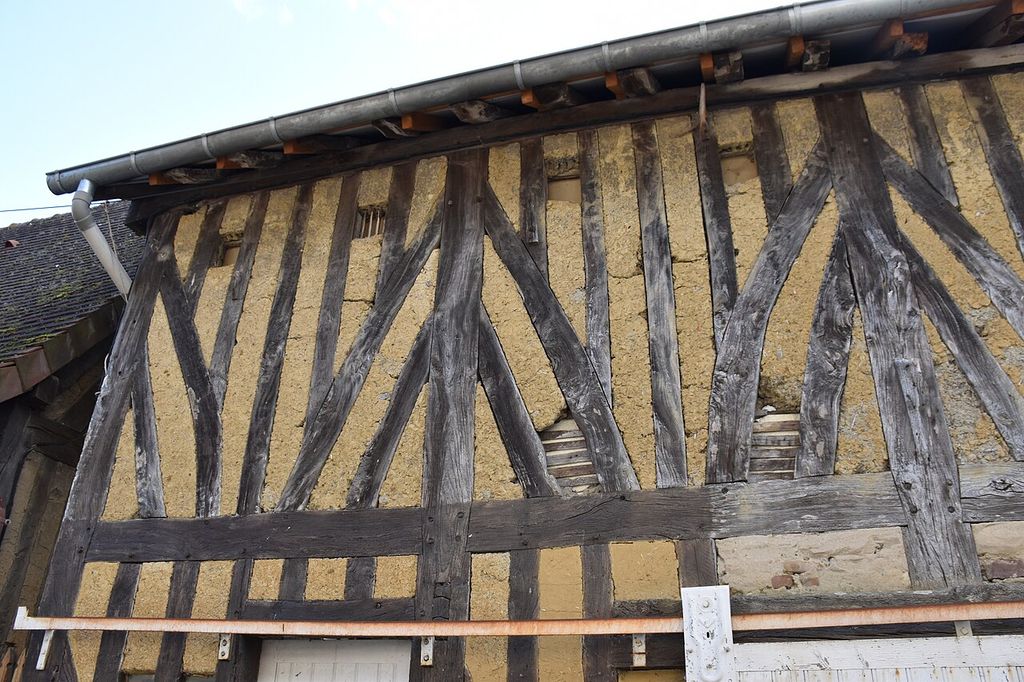
Normandy context: timber framing in Beuvron-en-Auge. Renhour48 / Wikimedia Commons. Image source. CC0 / Public domain. Resized and converted to JPEG; no crop or recolouring.
Comparing movement, colour and duration
Art historian Anthi-Danaé Spathoni interprets Hockney’s landscapes through the participation of a moving viewer. Her account connects photographic experiments, painted roads and large assembled landscapes through the ways they direct attention and invite us to imagine ourselves within their space. This is a useful reading of their shared ambition, provided the differences between media remain visible. Walking along a painted panorama, inspecting a collage and watching adjoining film screens are related activities with different demands. [14]
The same landscape can also acquire new meanings in different settings. In 2014, Boston’s Museum of Fine Arts included Garrowby Hill in Landscape, abstracted, a cross-medium installation that explored contemporary approaches to the genre. In its 2024 Our Family Portrait exhibition, the museum used the painting to represent home as both landscape and community, alongside portraits by Charles Allston and Alice Neel. A work born from a particular journey could support thinking about pictorial invention in one display and belonging in another. [30] [31]
Looking across Hockney’s landscapes, useful comparisons begin with decisions. A remembered route permits one kind of organisation; repeated visits reveal another. Strong colour can pull a distant field towards the surface, while a network of branches can bind fifty canvases together. A sequence can describe a season through separate encounters or gather a year into a frieze. These choices give each landscape its particular character. They also make the works generous subjects for returning viewers: the place may already be familiar, but the means of seeing it remain open to discovery.
Works directory
This source-bounded directory combines the works in the Metropolitan Museum’s 2017 retrospective checklist with reviewed museum object records and the additional works and series examined in this guide. It spans several media and is not a complete catalogue raisonné. Titles without an article link remain useful dated records. Metropolitan Museum final retrospective checklist (2017); additional object and series sources are given in the linked articles. [15]
| Name | Date | Medium |
|---|---|---|
| Love Painting | 1960 | Painting |
| Shame | 1960 | Painting |
| The Third Love Painting | 1960 | Painting |
| Tyger Painting No. 2 | 1960 | Painting |
| A Rake’s Progress | 1961–63 | Print series |
| Tea Painting in an Illusionistic Style | 1961 | Painting |
| The Cha-Cha That Was Danced in the Early Hours of 24th March | 1961 | Painting |
| Cleaning Teeth, Early Evening (10pm) W11 | 1962 | Painting |
| Flight into Italy - Swiss Landscape (Painting in a Scenic Style) | 1962 | Painting |
| Man in a Museum (or You're in the Wrong Movie) | 1962 | Painting |
| My Brother is Only Seventeen | 1962 | Painting |
| The First Marriage (A Marriage of Styles I) | 1962 | Painting |
| Domestic Scene, Los Angeles | 1963 | Painting |
| Play Within a Play | 1963 | Painting |
| The Hypnotist | 1963 | Painting |
| Arizona | 1964 | Painting |
| California Art Collector | 1964 | Painting |
| Man in Shower in Beverly Hills | 1964 | Painting |
| Portrait Surrounded by Artistic Devices | 1965 | Painting |
| Rocky Mountains and Tired Indians | 1965 | Painting |
| Beverly Hills Housewife | 1966–67 | Painting |
| Medical Building | 1966 | Painting |
| Peter | 1966 | Drawing |
| Peter Getting Out of Nick’s Pool | 1966 | Painting |
| A Bigger Splash | 1967 | Painting |
| A Lawn Being Sprinkled | 1967 | Painting |
| Kasmin in Bed in His Chateau in Carennac | 1967 | Drawing |
| Peter Feeling Not Too Good | 1967 | Drawing |
| Savings and Loan Building | 1967 | Painting |
| The Room, Tarzana | 1967 | Painting |
| American Collectors (Fred and Marcia Weisman) | 1968 | Painting |
| Christopher Isherwood and Don Bachardy | 1968 | Painting |
| Henry Geldzahler and Christopher Scott | 1968-1969 | Painting |
| W. H. Auden | 1968 | Drawing |
| Peter Langan in His Kitchen at Odins | 1969 | Drawing |
| Mark Glazebrook | 1970 | Drawing |
| Mr and Mrs Clark and Percy | 1970-1971 | Painting |
| Ossie Wearing a Fairisle Sweater | 1970 | Drawing |
| Pool and Steps, Le Nid du Duc | 1971 | Painting |
| Rubber Ring Floating in a Swimming Pool | 1971 | Painting |
| Celia in a Black Dress with White Flowers | 1972 | Drawing |
| Mount Fuji and Flowers | 1972 | Painting |
| Portrait of an Artist (Pool with Two Figures) | 1972 | Painting |
| Portrait of the Artist's Mother, Mrs Laura Hockney, Bradford | 1972 | Drawing |
| The Artist's Father | 1972 | Drawing |
| Dr Eugene Lamb, Lucca | 1973 | Drawing |
| Andy, Paris | 1974 | Drawing |
| Contre-jour in the French Style (Against the Day dans le Style-Français) | 1974 | Painting |
| Gregory Sitting on Base of Column | 1975 | Drawing |
| Kerby (after Hogarth) Useful Knowledge | 1975 | Painting |
| Ron Kitaj Outside Akademie der Kunste Vienna | 1975 | Drawing |
| Kasmin Reading the Udaipur Guide | 1977 | Drawing |
| Looking at Pictures on a Screen | 1977 | Painting |
| My Parents | 1977 | Painting |
| Canyon Painting | 1978 | Painting |
| Mother, Bradford, 19 Feb. 1979 (inscribed 1978) | 1979 | Drawing |
| Mulholland Drive: The Road to the Studio | 1980 | Painting |
| Nichols Canyon | 1980 | Painting |
| Outpost Drive, Hollywood | 1980 | Painting |
| Hollywood Hills House | 1981-1982 | Painting |
| Celia. Los Angeles. April 10th 1982 | 1982 | Polaroid composite |
| Don + Christopher, Los Angeles, 6th March 1982 | 1982 | Polaroid composite |
| Gregory Swimming Los Angeles March 31st 1982 | 1982 | Polaroid composite |
| My Mother, Bolton Abbey, Yorkshire, Nov. 1982 | 1982 | Photocollage |
| Self Portrait 30th Sept. 1983 | 1983 | Drawing |
| Pearblossom Hwy., 11-18th April 1986, #1 | 1986 | Photocollage |
| Pearblossom Hwy., 11–18th April 1986, #2 | 1986 | Photocollage |
| Large Interior, Los Angeles | 1988 | Painting |
| Breakfast at Malibu, Sunday, 1989 | 1989 | Painting |
| Pacific Coast Highway and Santa Monica | 1990 | Painting |
| The Other Side | 1991-1993 | Painting |
| The Eleventh V. N. Painting | 1992 | Painting |
| The Twenty Sixth V. N. Painting | 1992 | Painting |
| The Road Across the Wolds | 1997 | Painting |
| 9 Canvas Study of the Grand Canyon | 1998 | Painting |
| A Bigger Grand Canyon | 1998 | Painting |
| Colorado River | 1998 | Painting |
| Garrowby Hill | 1998 | Painting |
| Colin St. John Wilson. London. 3rd June 1999 | 1999 | Drawing |
| Gregory Evans. Los Angeles. 18th September 1999 | 1999 | Drawing |
| Laura Huston. London. 22nd June 1999 | 1999 | Drawing |
| Lindy. Marchioness of Dufferin and Ava. London. 17th June | 1999 | Painting |
| Going Up Garrowby Hill | 2000 | Painting |
| Red Pots in the Garden | 2000 | Painting |
| A Closer Winter Tunnel, February - March | 2006 | Painting |
| Elderflower Blossom, Kilham, July 2006 | 2006 | Painting |
| The Road to Thwing, July 2006 | 2006 | Painting |
| Bigger Trees near Warter | 2007 | Painting |
| Hawthorn Blossom near Rudston | 2008 | Painting |
| Views Through the Artist's Bedroom Window, Bridlington | 2010-2013 | Digital animation |
| The Arrival of Spring in Woldgate, East Yorkshire in 2011 (twenty eleven) | 2011 | Painting / digital series |
| 82 Portraits and 1 Still-life | 2013–16 | Portrait series |
| Garden | 2015 | Painting |
| Garden with Blue Terrace | 2015 | Painting |
| Garden #3 | 2016 | Painting |
| A Bigger Interior with Blue Terrace | 2017 | Painting |
| Interior with Blue Terrace and Garden | 2017 | Painting |
| A Year in Normandie | 2020–21 | Digital frieze |
Discussion
Look again at the images and ideas explored in David Hockney Landscapes. These editorial prompts invite your observations.
Reader Insights
How does a remembered journey produce a different kind of landscape from repeated visits through a season?
Which comparison best explains why Hockney joined several canvases or views into one work?
What changes when a landscape unfolds through pictorial depth, a moving film or a year-long sequence?
Join the Conversation
Share a detail, comparison or question about David Hockney Landscapes below.
References
- Tamaki Sugihara / Ai Kusumoto, Tokyo Art Beat. Curatorial interview, part two, “混迷から新境地へ。巨匠ホックニーが喜びに満ちた作品に辿り着くまで”, 22 September 2023. View source.
- Kunstmuseum Luzern. “Moving Focus”, 2022, German exhibition text. View source.
- Los Angeles County Museum of Art. Mulholland Drive: The Road to the Studio, 1980, collection record and curatorial notes, accession M.83.35; notes excerpted from the museum’s 2006 collection publication. View source.
- The David Hockney Foundation. “1982”, especially “Composite Polaroids”, “Polaroid to Pentax” and “Grand Canyon”. View source.
- J. Paul Getty Museum. Happy Birthday, Mr. Hockney, 2017, exhibition text, PDF p. 3, “Photographs”. View source.
- Julian Brooks and Virginia Heckert, Getty. “Remembering the Creativity and Humor of David Hockney”, 3 September 2026. View source.
- The David Hockney Foundation. A Bigger Grand Canyon, 1998, artwork record. View source.
- National Gallery of Australia. “David Hockney, 1937–2026”, memorial account, 2026, relevant canyon passage. View source.
- The David Hockney Foundation. “1998”, “Painting distant landscapes” and “A Closer Grand Canyon”. View source.
- National Gallery of Art, Washington. Thomas Moran, exhibition record, 28 September 1997–11 January 1998. View source.
- Jennifer Higgie and Ben Quilty, National Gallery of Australia. Artists’ Artists, episode 5, discussion of A Bigger Grand Canyon, transcript. View source.
- The David Hockney Foundation. “1997”, “Visiting Jonathan Silver”. View source.
- The David Hockney Foundation. Garrowby Hill, 1998, artwork record. View source.
- Anthi-Danaé Spathoni. “David Hockney’s Moving Landscapes”, RHA 11, 2022, pp. 95–103, especially pp. 98–101. View source.
- The Metropolitan Museum of Art. David Hockney: Final Checklist, 15 November 2017, printed p. 16 / PDF p. 17, Going Up Garrowby Hill. View source.
- Bruno Wollheim, The Art Newspaper. “What colour is the road? David Hockney tells us to take a closer look”, 9 October 2020, written commentary. View source.
- William Wilson, Los Angeles Times. “‘landscape’ a Panoramic Look at Hockney’s Use of Space”, 1998, three-page review preserved by L.A. Louver, especially PDF pp. 2–3. View source.
- Guggenheim Bilbao. David Hockney: una visión más amplia, 15 May–30 September 2012, Spanish exhibition introduction and selected object records. View source.
- Lawrence Weschler, Smithsonian Magazine. “Why David Hockney Has a Love-Hate Relationship With Technology”, 2013, “Looking Deeper, Seeing More” and “More Real Than Real”. View source.
- Musée Granet / Tate. David Hockney: Collection de la Tate, English press guide, 2023, printed pp. 16–18, “Moving Focus”, “Spatial Experiences” and “Landscape”. View source.
- The David Hockney Foundation. “2007”, “Making Bigger Trees” and the opening of “The largest en plein air painting”. View source.
- Kunstmuseum Luzern. “Landscape”, 2022, “A Bigger Landscape” and “Spring Feelings”. View source.
- The David Hockney Foundation. “2011”, “The Arrival of Spring in 2011”. View source.
- Van Gogh Museum. Annual Report 2019, “Hockney–Van Gogh: The Joy of Nature”, pp. 8–9. View source.
- Guggenheim Bilbao. David Hockney: A Bigger Picture, English press dossier, 2012, “The Sermon on the Mount” and related Yosemite passage. View source.
- Fondation Louis Vuitton. David Hockney 25, 2025, French curatorial text, especially Normandy and La Grande Cour. View source.
- The David Hockney Foundation. “2021”, “The Arrival of Spring, Normandy, 2020”. View source.
- Musée de l’Orangerie. David Hockney. A Year in Normandie, historical exhibition account, 2021–22. View source.
- Serpentine. A Year in Normandie and Some Other Thoughts about Painting, exhibition guide, 2026, PDF pp. 1–2, especially “A Year in Normandie” and the work credit. View source.
- Museum of Fine Arts, Boston. “‘Landscape, abstracted’ Debuts New Works in the Linde Family Wing for Contemporary Art”, 31 July 2014. View source.
- Museum of Fine Arts, Boston. Community Arts Initiative: Our Family Portrait, 18 May–27 October 2024. View source.
More HOCKNEY Works
A Bigger Splash
A momentary disturbance becomes the focus of a large acrylic painting, made through weeks of patient work.
Mr and Mrs Clark and Percy
The designers Celia Birtwell and Ossie Clark occupy a room shaped by light, repeated sittings and the demands of a double portrait.
A Bigger Grand Canyon
Sixty canvases gather memory, studies and changing viewpoints into an immense painting of 1998.
Garrowby Hill
The 1998 oil painting transforms a remembered Yorkshire journey into a road, fields and an expansive view.
Portrait of an Artist (Pool with Two Figures)
Photographic studies, two figures and a swimming pool become a carefully constructed painting of 1972.
My Parents
The 1977 oil painting sets Kenneth and Laura Hockney within a quietly organised interior.
Pearblossom Hwy., 11–18th April 1986, #2
Hundreds of separately made photographs construct a road scene that unfolds through movement and time.
Bigger Trees near Warter
Fifty canvases join into a large outdoor painting of Yorkshire trees, with photography helping the artist organise the whole.