


 by Tom Gurney
Tom Gurney BSc (Hons) is an art history expert with over 20 years experience
Email: tomgurney1@gmail.com / Phone: +44 7429 011000
David Hockney Biography: Introduction
David Hockney’s life took him from Bradford to London, New York, Los Angeles, Paris and Normandy, but the people and places he left behind repeatedly returned in his work. Born in Yorkshire on 9 July 1937, he became a painter of Californian pools, a portraitist of friends, a designer for opera and an unusually adventurous user of cameras and digital screens. He died on 11 June 2026, aged eighty-eight, after a career in which drawing remained a means of understanding the world. [1] [2] [3]
The familiar public image—the pale hair, conspicuous spectacles and cigarette—can make that career seem effortless. Its chronology tells a more demanding story. Hockney repeatedly became dissatisfied with ways of making pictures that had already brought him success. A new relationship, an encounter with another artist’s work or a change of home could reopen questions about how a person or a landscape might be represented. His biography therefore involves both an expanding circle of experience and the patient return to a small number of subjects. The same mother, friend, road or tree could reward another look, with another material, years later. [4]
At a Glance
- ArtistDavid Hockney
- Born9 July 1937, Bradford, England
- Died11 June 2026
- FocusBiography
David Hockney in context
A Rake’s Progress
1961–63 [12]A Bigger Splash
1967 [12]Mr and Mrs Clark and Percy
1970–71 [12]My Parents
1977 [12]Garrowby Hill
1998 [12]A Year in Normandie
2020–21 [13]Contents
- Bradford: family, independence and the wish to draw
- Art school, hospital work and the journey to London
- The Royal College: finding a personal language
- New York, the first exhibitions and an imagined America
- Los Angeles and Peter Schlesinger
- London, friendship and the double portraits
- Paris and a change of direction
- Theatre, print workshops and the return to California
- Photography and the experience of time
- Copiers, fax machines and a public beyond the gallery
Bradford: family, independence and the wish to draw
Hockney grew up in Bradford in a family whose strong convictions offered an early example of thinking independently. His father, Kenneth, worked as an accountant’s clerk and was a pacifist; his mother, Laura, was a vegetarian and a committed Methodist. Their circumstances were modest, but they recognised their son’s interest in art. When his wish to enter an art school conflicted with the educational route laid out for him, they arranged private calligraphy lessons with a tutor from Bradford School of Art. Making things with a brush was treated as a serious interest worth encouraging. [1]
His childhood understanding of an artist was practical. He knew about people who painted signs, designed posters and made cards before he understood that someone might spend a working life making pictures for their own sake. He remembered watching his father refurbish old bicycles, absorbed by the paint moving from brush to surface. That recollection belongs beside the more familiar account of his later love of new machines: the pleasure of a material doing something remained fundamental to him. A screen, camera or copier became interesting when it offered a different way to make a visible mark. [1] [14]
A scholarship took him to Bradford Grammar School in 1948. The academic curriculum allowed little space for the subject he most wanted to pursue. His later recollections of manoeuvring towards a course that retained art reveal how early he had made his choice. [1]
In 1953 he entered Bradford School of Art, where teaching centred on observation: drawing the figure, studying anatomy, learning perspective and judging tonal relationships. He initially welcomed its discipline. His later arguments with established rules of depiction grew from substantial experience of using them. [15] [16]
Four stages of David Hockney’s career
These four phases group related developments. Painting, drawing, travel and experiments with new tools continued to overlap.
Art school, hospital work and the journey to London
Bradford itself supplied subjects. Hockney took his equipment outdoors on a cart adapted from a pram and painted suburban houses and streets. His early portrait of Kenneth involved a father who had helped provide the canvas and who watched the painting develop through strategically placed mirrors. These were local, domestic circumstances, far removed from his eventual international celebrity. They established two habits that would endure: treating familiar surroundings as sufficient material and allowing the sitter to be an active presence in the process. The portrait became his first sale when it was exhibited in Leeds in 1957. [15]
Looking back, Hockney described an education in which colour had received less attention than the correct relation of light and dark. By his final year he wanted to know more about modern art beyond the models favoured by his teachers. The bright surfaces associated with California developed after this grounding in a different set of visual priorities. [15]
He graduated in 1957 with a first-class diploma with honours. Before continuing his education in London, he completed National Service as a conscientious objector, working as a hospital orderly in Bradford and Hastings. The decision was consistent with the pacifist example at home. This interval interrupted his usual production of paintings, but it also brought encounters with exhibitions by Alan Davie and Jackson Pollock. The range of possible painting was opening beyond the observational practice he already knew. [15] [16]
Hockney arrived at the Royal College of Art in the autumn of 1959. He carried considerable drawing ability into an institution where academic teaching coexisted with visiting artists and students searching for a new visual language. Tutors included Carel Weight and Ceri Richards; visiting figures included Francis Bacon and Peter Blake. The move therefore involved more than exchanging Bradford for the capital. It placed different claims about what painting should be within the same working environment. [25]
An especially important friendship began with the American student R. B. Kitaj. Older than Hockney and more experienced, Kitaj admired his drawing and encouraged him to use his own interests as subjects. Hockney had been able to make an accomplished academic study while feeling uncertain about its purpose. Kitaj’s advice connected skill to something personal: convictions, enthusiasms and the life he actually wanted to express. This did not dictate a style. It gave him a reason to make decisions that the exercise of competence alone could not supply. [25]
The Royal College: finding a personal language
For a time Hockney tried the abstract painting that attracted some of the most adventurous students around him. He found that it could not sustain what he wanted to say. The problem was particularly acute because he wanted to bring the human figure back into his work while feeling the pressure of arguments against it. Words, symbols and deliberately awkward figures offered ways forward. A phrase could direct a viewer towards love or desire without requiring a fully naturalistic scene. [17]
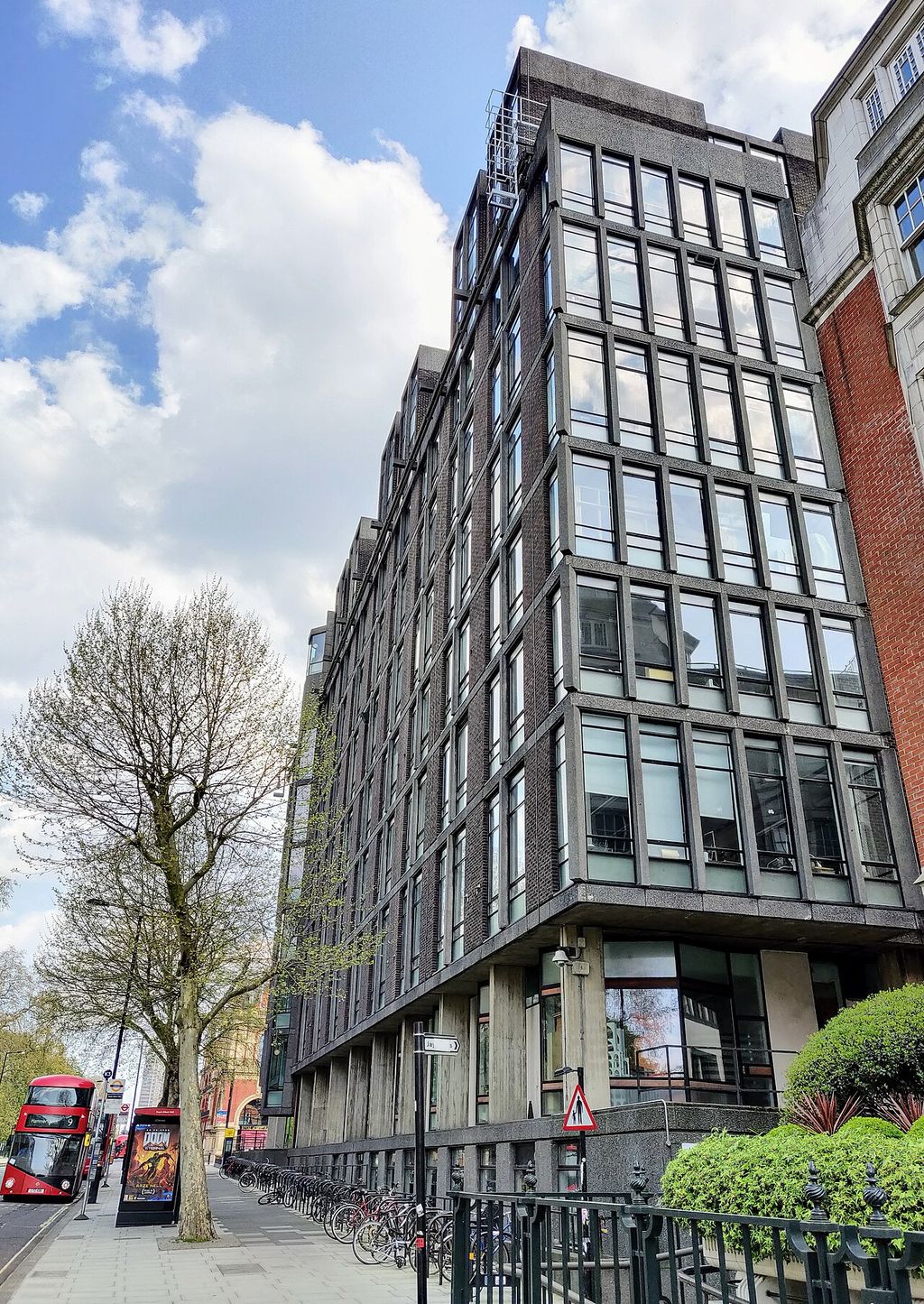
The Royal College of Art’s Darwin Building in South Kensington, photographed in April 2020. A later view of the college’s London setting. Shadowssettle / Wikimedia Commons. Image source. CC BY-SA 4.0. Image resized; framing and colours retained. This derivative retains CC BY-SA 4.0.
The major Picasso exhibition at Tate in 1960 was another opening. Picasso’s changes of style suggested that an artist could choose among different ways of representing things, even combine them, without treating consistency as a duty. Hockney’s early paintings consequently moved between flatness, shallow illusion, writing and fragments of the figure. Their apparent freedom rested on decisions about what each device could communicate. His subsequent career across many media had an early equivalent in this willingness to let different pictorial languages coexist. [17] [4]
Reading Walt Whitman helped him give male love a place in that language. The early love paintings incorporated words and numerical codes connected with the poet. Personal feeling, literary reference and the visual appearance of writing became parts of the same image. These pictures emerged while sexual acts between men remained criminalised, giving their declarations a historical weight that should not be lost beneath a general description of youthful rebellion. Hockney’s sexuality was involved in the choice of subject and the construction of the picture. [17]
The legal change came later and was limited. The Sexual Offences Act 1967 partly decriminalised private homosexual acts between men over twenty-one in England and Wales. It did not establish equal treatment or change the law throughout the United Kingdom. Hockney’s early pictures and his later Cavafy etchings belong within that specific history. Their openness could arise from a supportive artistic circle while the wider legal restrictions remained. [26] [27]
Recognition arrived before he finished his course. The Young Contemporaries exhibitions brought attention to the new work emerging from the RCA, and Hockney met the dealer John Kasmin and the textile-design student Mo McDermott, who became a recurring model. Financial circumstances also affected his choice of medium. When he could not keep buying painting materials, the college’s provision of etching materials allowed him to continue making work. Printmaking entered his career as an immediate practical opportunity, then developed into a sustained interest. [6]
Graduation in 1962 brought another assertion of independence. Hockney challenged assignments by using a male physique-magazine image for Life Painting for a Diploma and securing McDermott as the model for Life Painting for Myself. He received the college’s gold medal wearing a gold lamé jacket. Kasmin agreed to represent him, and a home and studio at Powis Terrace provided a base for work beyond the college. The move into professional life combined institutional recognition with the same insistence on choosing his subjects that had shaped the student paintings. [28]
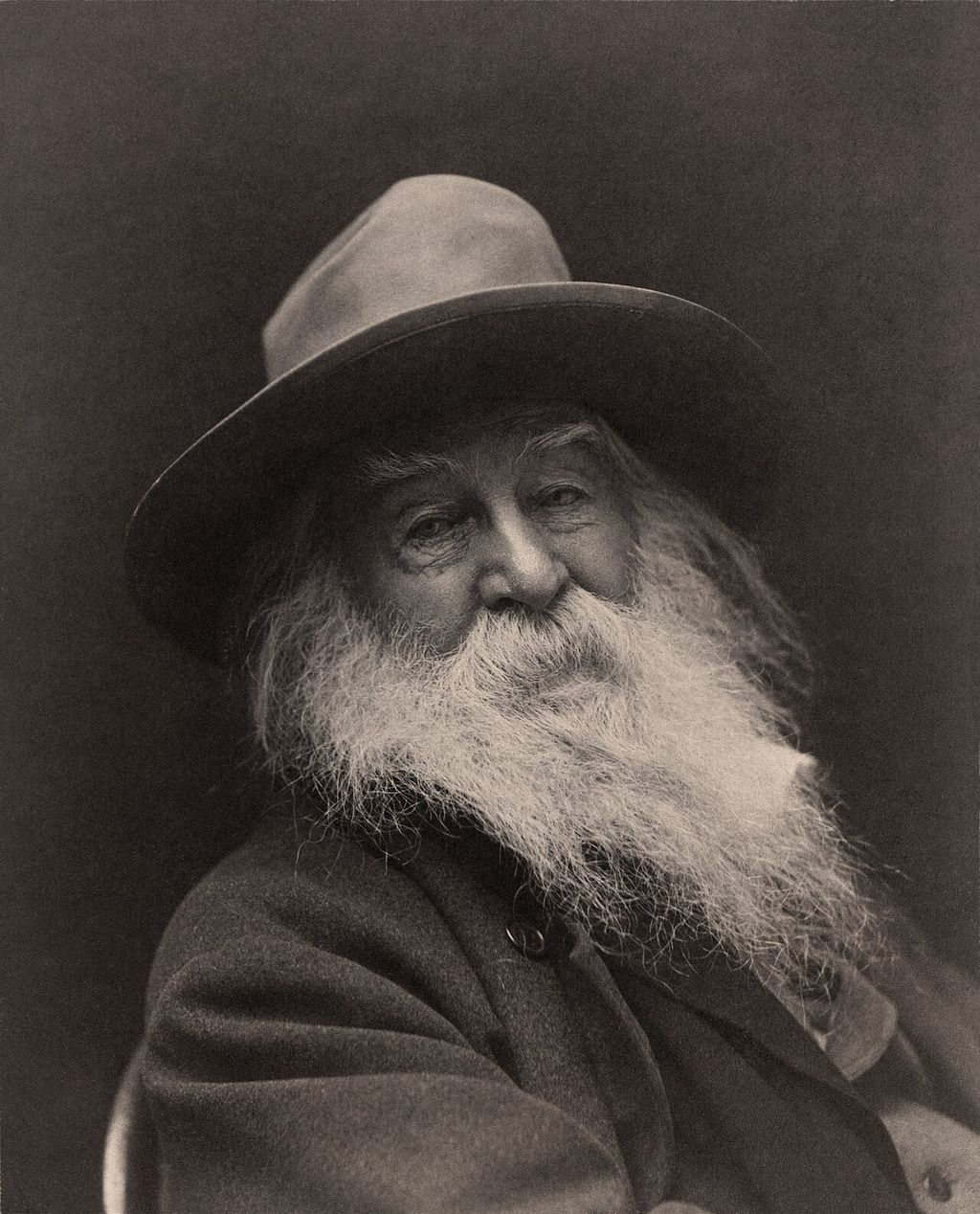
Walt Whitman, photographed by George Collins Cox. His poetry informed Hockney’s early paintings of love and identity. George Collins Cox; restored by Adam Cuerden / Wikimedia Commons. Image source. Public domain. Resized and converted to JPEG; no crop or recolouring.
New York, the first exhibitions and an imagined America
Hockney first visited New York in 1961. Prizes, commissions and the sale of prints helped make travel possible. At the Museum of Modern Art he showed work to the curator William S. Lieberman, who bought examples and helped sell more. The encounter gave the young artist both money and a striking demonstration that his work could find an audience outside Britain. Away from museums, the late-night life of the city was equally exciting. He also bleached his hair after seeing a television advertisement, beginning the appearance that would become inseparable from his public identity. [6]
The experience fed into A Rake’s Progress, the sixteen etchings with aquatint made between 1961 and 1963. Hockney adapted William Hogarth’s narrative structure to the adventures of a young gay man in New York. The protagonist resembles him, but the series mixes observed incidents with invention. It should not be read as an illustrated record in which every event happened to the artist. Its humour depends partly on the distance between a life being lived and a cautionary tale being performed. [29]
Hockney was already making stories out of his experience, choosing details to exaggerate or place beside one another. The prints turn self-presentation into an artistic subject: arrival, money, spending, appearance and belonging become scenes that a viewer can follow. The blond hair could be both a personal transformation and material for a picture. [29]
His first solo painting exhibition at Kasmin’s London gallery, Pictures with People In, opened in December 1963 and sold out. Its title announced a commitment to the figure in a gallery whose other artists often pursued abstraction. The same year, the completed Rake prints contributed to the financial independence that made a longer stay in California possible. A second New York visit brought meetings with Andy Warhol and Dennis Hopper, and the beginning of his close friendship with the curator Henry Geldzahler. Music, particularly opera, was one of the interests Hockney and Geldzahler shared. [30]
California had already entered his paintings before he reached it. Domestic Scene, Los Angeles drew on a magazine image of two men, combining desire with a place imagined at a distance. His later attachment to the region therefore involved recognition as well as discovery. He arrived with pictures in mind, then had to respond to the scale, light and daily arrangements of the actual city. The distinction between an imagined America and a lived one would continue to enrich his work. [30]
Los Angeles and Peter Schlesinger
Hockney arrived in Los Angeles in 1964 and established a home and studio in Santa Monica. He quickly met people who became central to his Californian life: Christopher Isherwood and Don Bachardy, the dealer Nicholas Wilder, the writer and director Jim Bridges and the master printer Ken Tyler. Their importance extended beyond introductions or professional opportunity. They provided a social world that could be drawn and painted from within, giving his work the familiarity of people known across visits, conversations and shared routines. [18]
The city also demanded a new way of moving. His account of attempting to cycle along Wilshire Boulevard towards downtown Los Angeles ends with the realisation that he needed a car. Distances that appeared manageable on a map were something else on the ground. Roads, moving viewpoints and the organisation of buildings for drivers later became major pictorial concerns. The early encounter was practical: to inhabit this place and reach its people, he had to learn its scale. [18]
His painting changed with the setting. Acrylic paint, palm trees, modern houses and swimming pools became part of the work. The pools offered intertwined attractions: the visibility of the male body, the pleasure of outdoor life and the difficulty of representing transparent water in motion. Bright sunlight made shadows and edges conspicuous. The California years involved a particular human and visual environment, not a ready-made style that he could simply import. [18] [4]
In 1966 he met the art student Peter Schlesinger while teaching in California. They became lovers, and Schlesinger became one of his most frequent subjects. The relationship brought another degree of intimacy to pictures of beds, pools and private interiors. Their shared existence gave Hockney repeated access to the same person across different moods and circumstances, while Schlesinger continued his own development as an artist. [31]
By the beginning of 1967 they were living together in Los Angeles. Later that year they travelled in Europe, and Hockney acquired a 35mm camera. Photographs increasingly joined drawings and memory among his resources. A domestic scene could be assembled from different kinds of attention: something witnessed in a room, an image retained by the camera and a shape selected for its place on the canvas. His expanding use of photography grew alongside an intensely personal subject matter. [32]
The same years included work beyond California. In Beirut in 1966 he made drawings towards the etchings accompanying poems by C. P. Cavafy, printed with Maurice Payne in London. These quiet scenes of male intimacy carried forward the literary interests of the RCA period in a different visual language. The contrast between their economical lines and the larger Californian paintings shows why travel or a change of material should not be treated as the end of an earlier concern. Male love, domestic presence and the expressive possibilities of drawing continued across them. [27]
London, friendship and the double portraits
Hockney returned to Britain in 1968. Schlesinger enrolled at the Slade and joined him at Powis Terrace in London, while travel to France and elsewhere continued. The return did not sever California from the work. Hockney had spent the first part of the year painting large double portraits in Santa Monica, including Christopher Isherwood and Don Bachardy and American Collectors (Fred and Marcia Weisman). These works enlarged the scale at which a relationship and its setting could be considered together. [33]
His recollections of painting Isherwood and Bachardy reveal the practical attention behind that ambition. Isherwood characteristically looked towards Bachardy, while Bachardy looked at Hockney. Their different directions of attention helped determine the composition. A social fact observed during sittings became part of the picture’s organisation. In the portrait of the Weismans, the objects around the couple also belonged to the representation of their lives. Hockney’s portraiture was expanding beyond the likeness of a face towards the arrangement of people within an environment. [33]
The first Whitechapel retrospective in 1970 made clear how much he had achieved while still in his early thirties. At the same time, the highly naturalistic paintings were becoming increasingly difficult to resolve. Mr and Mrs Clark and Percy, made in 1970–71, brought his friends Ossie Clark and Celia Birtwell into a large domestic setting. He wanted the near life-size figures to establish the presence of two people in a room and the relation between them. That ambition created technical problems involving backlighting, tone and the repeated alteration of the figures. [34] [19]
Clark and Birtwell posed for him extensively, with much of the figure painting done from life in the studio. Photographs and drawings also contributed to a composition developed through repeated decisions and revisions. Their subsequent marital history can tempt a viewer to make every gesture predictive; Hockney’s account concentrates instead on the difficulty of establishing their presence together in paint. [19]
Birtwell remained a close friend and repeated sitter for decades. The relationship connected two people who both worked with visual invention and enjoyed a shared northern background and humour. Her patterned clothes could offer Hockney material as compelling as her changing appearance. The long sequence of portraits records accumulated familiarity without freezing either artist in the early London years. [35]
His relationship with Schlesinger ended in 1971. Hockney worked intensely during the painful period that followed, and the making of Portrait of an Artist (Pool with Two Figures) in 1972 became exceptionally prolonged. He abandoned an earlier arrangement and rebuilt the painting, returning to a pool in southern France for further studies. Its history involves a personal separation and a difficult pictorial construction. Neither alone explains the resulting image. The pool, the standing figure and the landscape had to be made to relate within a convincing composition. [19] [36]
Paris and a change of direction
In autumn 1973 Hockney moved to Paris. Drawing and printmaking occupied much of his attention, and a quieter studio routine offered relief from interruption. Celia Birtwell, Henry Geldzahler and Mo McDermott remained part of his circle, alongside newer acquaintances. Moving country did not mean beginning with a blank social world. Friendships travelled, and the drawings made across these journeys gave continuity to a life divided between places. [37]
Picasso died that year without Hockney having met him. A different kind of contact became possible through the master printer Aldo Crommelynck, who had worked closely with Picasso. Hockney made prints in homage to the artist and learned techniques including coloured etching and sugar-lift. The encounter joined admiration for an earlier artist to the immediate experience of a workshop. It also supplied technical resources that could be carried into subsequent projects, including The Blue Guitar. [37] [38]
The Tokyo curator Ai Kusumoto interprets the mid-1970s as a period when Hockney was trying to escape the restrictions he felt in naturalism. More accurate description had not necessarily brought a picture closer to the experience of living and looking. Slow portrait drawing, renewed attention to Picasso, theatre and encounters with Japanese and Chinese art offered different routes through the problem. Kusumoto also relates the period to Hockney’s developing hearing difficulties and his own reflections on spatial perception. This is a connected interpretation of several changes, rather than a medical explanation for his style. [39]
Gregory Evans became an intimate companion during the Paris years and subsequently worked as Hockney’s assistant, studio manager and curator. Their relationship extended far beyond its romantic beginning. Evans repeatedly sat for him and helped sustain the practical life around the work. By late 1975 Hockney was back in London, where a period of relative quiet once again allowed him to concentrate. The pattern is revealing: he valued company intensely, while also moving or rearranging his life to protect the time that making pictures required. [40] [41]
Theatre, print workshops and the return to California
Designing Stravinsky’s The Rake’s Progress for Glyndebourne, first performed in 1975, provided a new working arena. Hockney had already designed for Ubu Roi in 1966, so this was the beginning of his opera career rather than his first involvement with the stage. The Hogarth subject returned in a form distinct from the earlier etching series. Working with director John Cox, he enlarged the visual language of engraved crosshatching into scenery and costumes that had to function across a theatre. [41] [27]
The change of scale required experiments. Hatching that worked on a small sheet might merge or become an obtrusive pattern when enlarged. Hockney tested samples and judged them from the back of the auditorium. The audience’s position became an immediate practical consideration. Space could be constructed for moving performers and changing light, with an image experienced over the duration of music. His later accounts described this work as a release from pictorial habits that had begun to constrain him. [41]
Theatre absorbed a substantial part of his time. Mozart’s The Magic Flute followed at Glyndebourne in 1978, with thirty-five backdrops and a journey to Egypt among its preparations. Further work for the Metropolitan Opera brought him into collaboration with John Dexter and the young designer Ian Falconer. Sets, costumes, lighting, workshop production and performance involved kinds of cooperation different from painting alone. The friendships and skills developed through these projects remained part of his career for many years. [42] [43]
In 1978 Los Angeles again became his principal base. That year also brought the Paper Pools, made with Ken Tyler from coloured paper pulp. Their making required a bold response to colour and mass, quite different from the fine line of an etching needle. These unique works used coloured pulp as the material of the picture itself. Returning to a familiar subject through an unfamiliar substance opened another avenue of work. [42]
The Blue Guitar, published in 1977 with Maurice Payne, grew from Wallace Stevens’s poem and Hockney’s interest in Picasso. Poems, people and working partnerships repeatedly crossed the boundaries between projects, with coloured etchings supplying another scale and pace of invention. [38]
Kenneth Hockney died in February 1979. David returned to Bradford for the funeral and to be with Laura. Later that year he took up residence in a house in the Hollywood Hills and continued portrait work in painting and lithography. The journeys home and the continuing pictures of his parents kept Yorkshire present within his Californian life. [44]
Photography and the experience of time
In 1982 Hockney began making composite Polaroid pictures. He had long used photographs but questioned what a single camera image could convey about seeing. Curator Alain Sayag’s plans for a photographic exhibition at the Centre Pompidou helped prompt the new work. Hockney discovered that instant prints could be assembled into views containing changes of angle and moments. Matching everything into a seamless illusion was unnecessary. The differences between frames could become part of the account of looking. [20]
Getty curator Virginia Heckert later used Jerry Diving, Sunday Feb. 28th 1982 to explain the effect. A dive extends across seven frames within a grid of twenty-one prints. The viewer follows movement through the separate photographs while also noticing the poolside setting. Heckert recalled learning that Jerry Sohn had repeated the dive several times. The image’s unfolding time is therefore constructed through selection and assembly, not simply extracted whole from one continuous action. [3]
For Hockney, the attraction lay in the possibility of giving a picture some of the duration involved in perception. A person looks from one feature to another, shifts position and remembers what has just been seen. His collages made those acts conspicuous. Their importance in his life was also social: friends, assistants and his mother remained available subjects for experiments that challenged how a portrait or domestic scene might be organised. Technological invention did not require him to leave his established circle behind. [20]
Travel to Japan in 1983 supplied material for Walking in the Zen Garden at the Ryoanji Temple, Kyoto. Hockney moved around the garden to make its component photographs, and his feet enter the lower part of the collage. His account emphasised how changing positions allowed him to rearrange the geometry a single viewpoint imposed. Study of Chinese scrolls deepened his interest in pictures that lead the viewer through space over time. These encounters became part of a long investigation, returning decades later in Normandy. [45]
The large Pearblossom Hwy. collage of 1986 developed related ideas through hundreds of photographs of a Californian road. The patient construction of an everyday scene had become as significant as the immediate availability of the camera. His criticism of conventional photography therefore needs to be understood alongside his prolific use of it. He could challenge the lens’s apparent authority while finding new ways to work with its products. Paintings, collages and prints continued to inform one another. [3] [46]
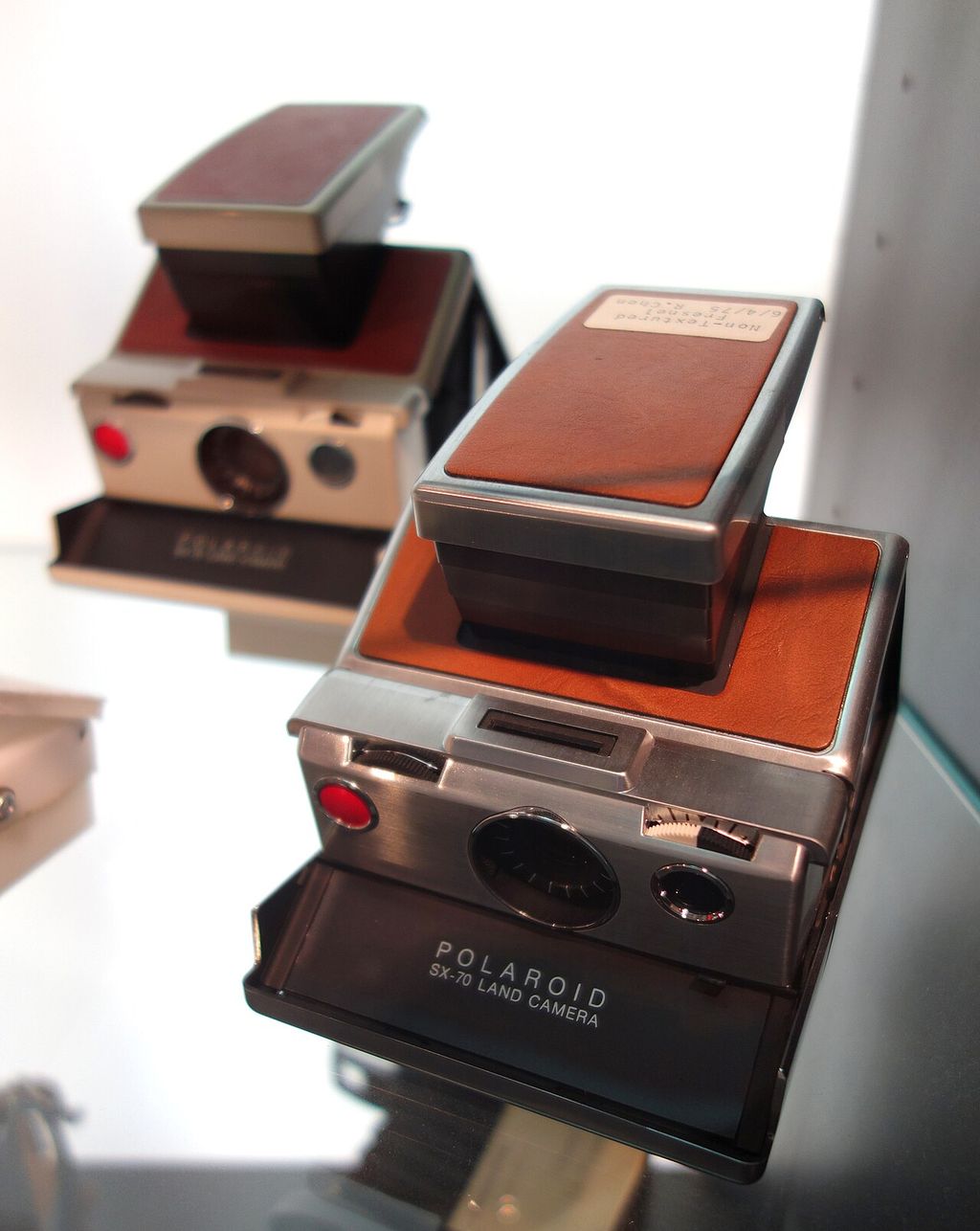
A Polaroid SX-70 Land Camera in the MIT Museum: an example of the model used in Hockney’s composite photography. Daderot / Wikimedia Commons. Image source. CC0 / Public domain. Resized and converted to JPEG; no crop or recolouring.
Copiers, fax machines and a public beyond the gallery
The office photocopier became another studio instrument in 1986. Hockney could change coloured cartridges, enlarge or reduce elements, repeat forms and place objects on the scanning bed. The attraction included being able to complete a print himself without the delays of a complex workshop process. The resulting Home Made Prints were experiments in image-making, with the machine’s particular capacities helping determine their appearance. They followed years of collaborative printmaking without erasing the value of those collaborations. [46]
He also cared about where an image could go. In 1987 a work appeared in Bradford’s Telegraph & Argus, bringing it to newspaper readers in the city where he had grown up. The subsequent use of fax opened another possibility: a picture could be transmitted across a distance and assembled elsewhere. His curiosity concerned reproduction and distribution as well as the making of a single precious object. [47]
Kusumoto describes a 1990 project in which drawings sent from Los Angeles by fax were pieced together for display in Tokyo. A large image travelled as many small fragments. That history helps explain the later enthusiasm for sending digital drawings directly to friends. A new device could allow speed, independence and intimacy, or a different relation to a distant audience. His interest lay in what the device made possible for pictures, rather than in maintaining an allegiance to the newest equipment. [14]
Loss, self-portraits and Stanley and Boodgie
Public success did not eliminate periods of loneliness or loss. In 1983 Hockney undertook a sustained series of charcoal self-portraits. The National Portrait Gallery connects this self-examination with approaching middle age, hearing loss and the deaths of friends, including deaths associated with AIDS. The repeated task placed a familiar face under daily scrutiny. The Morgan Library describes the resulting drawings as records of changing moods and vulnerability: a quieter account of the self than the conspicuous public image of his youth. [40] [48]
During the following decade, bereavement became an especially pressing part of his experience. The death of Henry Geldzahler, a close friend since the early 1960s, affected him deeply. At Malibu he turned with renewed intensity towards his dachshunds, Stanley and Boodgie. The dogs had already appeared in his work; the concentrated paintings and drawings of the mid-1990s grew from a need to make something loving in a period when love had been lost. This connection is documented in Hockney’s own account. [49]
The pictures of Stanley and Boodgie drew on constant proximity. They slept, rested and remained near him as he worked. Knowing their bodies and habits gave him opportunities to notice small differences without having to turn the subject into an elaborate event. As with his repeated human sitters, affection sustained observation and familiarity supplied a continuing subject. Their scale and domestic setting offer a different register from the large, publicly ambitious works of the same broad career. [49]
There was no permanent withdrawal from people or experimentation. Flowers, portraits, prints and large constructed spaces continued alongside the dogs. In 1997 his Flowers, Faces and Spaces exhibition included a wall of portraits of friends and relatives. The group brought many of the connections sustaining his life into one installation. Its sitters included members of his family, Gregory Evans, Maurice Payne and Jonathan Silver. The work’s variety also showed that grief and curiosity could occupy the same period. [50]
Jonathan Silver and the road back to Yorkshire
Silver’s friendship helped give Hockney’s work a substantial public presence near Bradford. In 1987 the entrepreneur bought Salts Mill in Saltaire and developed its reuse for galleries, shops, restaurants and other activities. The conversion linked a building from the region’s industrial history to a new cultural life. Hockney’s work formed an important part of that enterprise, allowing a continuing connection with Yorkshire through a place created by someone he knew. [51] [47]
Ten years later, Silver was gravely ill with cancer. Hockney’s journeys to visit him from Bridlington took him repeatedly through the Yorkshire countryside. The road became familiar through urgency and repetition, and he began to consider more closely how its landscapes could be painted. A change in artistic attention emerged within the circumstances of a friendship. It would be misleading to describe the ensuing landscapes only as a nostalgic decision to rediscover his roots. The return involved particular journeys and a person whose remaining time mattered to him. [50]
After returning to Los Angeles, Hockney continued to paint Yorkshire from memory. The distance allowed recollection to work alongside colour and composition. At roughly the same time, the Grand Canyon occupied him on an enormous scale. A Bigger Grand Canyon brought sixty canvases together; a subsequent return to the site for drawing helped develop the distinct A Closer Grand Canyon. The Yorkshire and American landscapes were being reconsidered together, through different mixtures of remembered space, direct study and photographic material. [21]
This was a return to landscape after decades in which places had never really disappeared. Bradford streets, Californian houses, pools, roads and theatrical settings had all involved the organisation of space. What changed was the sustained attention now given to particular stretches of countryside and the possibilities of describing them across a large surface. The later Yorkshire work developed from that renewed commitment, while retaining the accumulated experience of California, photography and the stage. [21] [52]
His mother died in 1999. Laura had remained a sitter through drawing, painting and photographic collage, giving the work one of its longest human continuities. Her death belongs to the same period in which Hockney’s investigation of earlier painting became especially intense. Bereavement, returning to family places and renewed intellectual work overlapped within a life still moving between Britain and California. [34] [53]
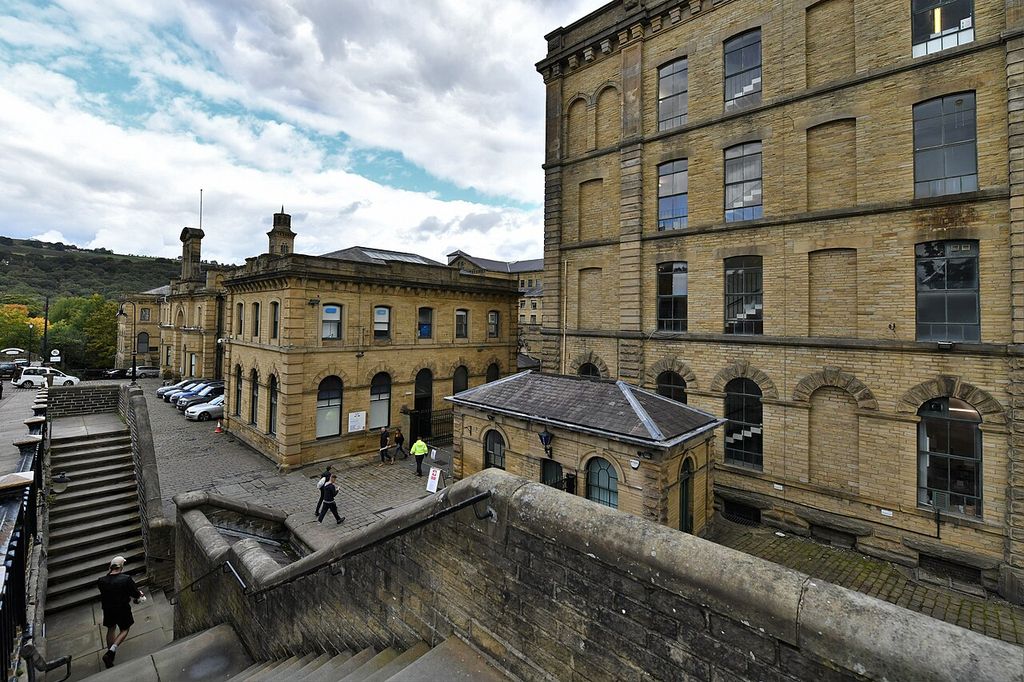
Salts Mill, Saltaire. Jonathan Silver’s redevelopment made the former textile mill an important setting for Hockney’s work. Michael Garlick / Wikimedia Commons. Image source. CC BY-SA 2.0. Resized and converted to JPEG; no crop or recolouring. Image derivative retains CC BY-SA 2.0.
Old masters and the arguments around Secret Knowledge
Published in 2001, Secret Knowledge: Rediscovering the Lost Techniques of the Old Masters took Hockney’s scrutiny of pictures into a contentious historical field. He argued that optical devices had played a much greater role in earlier European painting than was generally recognised. The project involved lectures, a BBC film and exchanges with scholars and artists. His studio work with pictures expanded into a public argument about how pictures from the past had been made. [54]
The argument remained contested. Hockney’s demonstrations and comparisons did not settle every historical claim about the artists concerned. Teylers Museum later presented this optical research as an important and disputed part of his practice, setting his work beside earlier art and instruments. The project also reveals his practical approach to art history: he studied earlier images through the questions of someone who made them, then tested what particular tools might help a hand and eye accomplish. [55]
The episode also complicates a simple story of an artist opposed to cameras. His concern was with habits of seeing and the authority given to certain appearances, while his curiosity about equipment remained considerable. After the concentrated debates surrounding the book, he wanted more time for his own pictures. Watercolour, followed by renewed oil painting outdoors, offered fresh material problems at the beginning of the new century. [54] [52]
Bridlington and the discipline of returning to a place
By 2004 Hockney was spending extended periods working from Bridlington, with the countryside of East Yorkshire increasingly central to his days. Lawrence Weschler’s account describes the importance of watercolour during this return. The medium’s speed and limited possibilities for covering a mistake encouraged careful decisions at the moment of looking. Familiarity grew through repeated excursions and the attempt to distinguish the particular forms making up an apparently ordinary bank or hedge. [56] [57]
Oil paint offered different freedoms. In 2005 Hockney continued to work outdoors but could now revise, build and alter with the greater flexibility the material allowed. He described the return to it after watercolour as a thrilling luxury. Landscape painting also required practical knowledge: the direction of light, the best time to arrive and adequate clothing for winter. The work was rooted in routines of going out, remaining there and coming back when conditions had changed. [52]
The countryside rewarded that repetition. A tree seen bare could be understood differently when it filled with leaves; a road followed in one season could become the structure for another encounter months later. Such changes offered time as a subject without requiring an exceptional event. The ordinary scene became more particular as he learned it. His years away also helped him recognise seasonal differences with an intensity that long familiarity alone might not have produced. [56]
In 2007 Bigger Trees near Warter brought this work to an extraordinary public scale through fifty canvases. Digital photographs helped him keep track of a composition that could not be seen whole while each part was being painted outdoors. Looking up into the branches remained the starting activity, while computers and planning helped solve the problem of assembly. The painting united direct study with methods developed through the experience of composite images. [22]
A large warehouse studio in Bridlington, occupied in 2008, increased the possibilities. Hockney no longer needed to confine all landscape painting to the site. Having accumulated observations and studies, he could work from memory with a vocabulary of forms he knew. His remarks about the new space convey renewed physical and imaginative energy. The studio, like the outdoor routine, shaped what became possible; the biography of a landscape painter includes leases, working room and the organisation of materials alongside encounters with trees. [58]
iPhones, iPads and another arrival of spring
Hockney began drawing on an iPhone in 2009 and adopted the iPad in 2010. The small illuminated screen was useful in circumstances where conventional tools were awkward. Weschler describes his fascination with recording dawn without turning on a light to identify coloured pencils or paint. The device could go in a pocket like a sketchbook and send the resulting image directly to another person. Such uses gave the technology a place within established habits of drawing and communication. [14] [56]
In 2011 he followed the passage from winter towards summer in East Yorkshire through more than a hundred iPad drawings. Fifty-one were selected for the Royal Academy display alongside the thirty-two-canvas oil painting The Arrival of Spring in Woldgate, East Yorkshire in 2011. Those are distinct parts of the project. Its scale depended on many individual acts of noticing, while its larger subject emerged between the images as branches, leaves and ground altered over time. [23]
Oil paint, paper and charcoal remained active materials alongside the iPad. The Yorkshire period included multi-camera moving images as well as large oils and digital drawings. Different tools made different aspects of the subject available. Even when the newest technology was involved, the underlying task could be as familiar as returning to a road to see what had changed since the previous visit. [34]
A Bigger Picture opened at the Royal Academy in January 2012. Hockney chose a concentrated presentation of the Yorkshire landscapes instead of a career retrospective. At seventy-four, he was placing the work of these recent years before a large audience while continuing to think about what to make next. He returned to charcoal for portraits and landscape drawings, including another account of spring in 2013. [59] [60]
Familiar faces in the later Los Angeles studio
His assistant Dominic Elliott died in 2013; Hockney later recalled struggling to resume work in Bridlington. [61] Early that year, during a period of recovery in his own health, he had invited friends and relatives to sit for charcoal portraits in his bedroom. The return to Los Angeles brought another sustained encounter with familiar people. [60]
He undertook the group eventually exhibited as 82 Portraits and 1 Still-life, most of which was painted between 2013 and 2016 in his Hollywood Hills studio. The sitters included family, friends, artists, employees, dealers and acquaintances, invited by him rather than commissioning their pictures. The series records the world around an older artist, with professional and personal connections sharing the same pictorial conditions. [62]
Acrylic canvases of the same size, a yellow chair and a blue ground provided a framework. Each sitter spent two or three days with him, and the background could be adjusted to the clothing. Within that continuity, changes of posture, dress and scale of bodily presence become conspicuous. The still life followed a postponed sitting. The project’s regularity therefore grew from an actual schedule of encounters, with a modest interruption absorbed into the group rather than concealed. [62]
His eightieth birthday in 2017 brought exhibitions on several scales. The career retrospective at Tate Britain travelled to the Centre Pompidou and the Metropolitan Museum of Art. At Getty, separate focused displays examined self-portraits and photographic collages. Together these different approaches made the range of the career visible while allowing its recurring questions to be followed through particular groups of work. [63] [3]
Portraiture and spatial experiment continued to overlap. The later photographic drawings assembled people and studio objects photographed separately into shared scenes. In the works exhibited at L.A. Louver in 2019, sitters could appear together even though they had been recorded at different times. The studio became a subject as well as a workplace: a constructed gathering of pictures, chairs and people through which Hockney could test how an image might hold more than one moment. [24]
Normandy: a new home and the pandemic year
Hockney began a new working life in Normandy in 2019. The half-timbered house, its grounds and the surrounding northern French landscape supplied another environment to learn through repeated looking. The early work shown as La Grande Cour already included expansive treatment of the setting. His renewed interest in the Bayeux Tapestry offered a nearby example of how an extended image could carry successive events within one continuous field. [24] [63]
The timing gave the project an unexpected setting. During the restrictions of 2020, the house, studio and garden became the territory for another close examination of spring. An iPad allowed him to register its changing colours and forms as they emerged. The resulting works were part of a practice he had already developed in Yorkshire, but this was a different place and a different year. Their brightness arose from particular observations and choices within a period of widespread confinement. [64]
The larger A Year in Normandie, made in 2020–21, carried observation through the seasons as a long frieze. Kusumoto connects its extended viewing to Hockney’s interest in Chinese and Japanese scrolls as well as his encounter with Bayeux. The viewer has to move and spend time with a work that cannot be taken in from one position. A question pursued through photographic collages and stage space acquired another form in the landscape around his later home. [39] [65]
The Normandy years also retained an intimate network. Jean-Pierre Gonçalves de Lima, his partner, and studio collaborators including Jonathan Wilkinson were closely involved in the working life around him. As sittings resumed after the pandemic restrictions, familiar people and new visitors entered the paintings, renewing the balance between landscape and portraiture. [40] [24]
Hockney’s conversations and correspondence with Martin Gayford became the basis of Spring Cannot Be Cancelled, published in 2021. The book placed his continuing work and discussion before a wider audience. That year an animated sunrise also appeared on public screens in several cities. The means of reaching viewers had changed considerably since the newspaper print and fax projects, while the interest in carrying an image beyond the studio remained. [13]
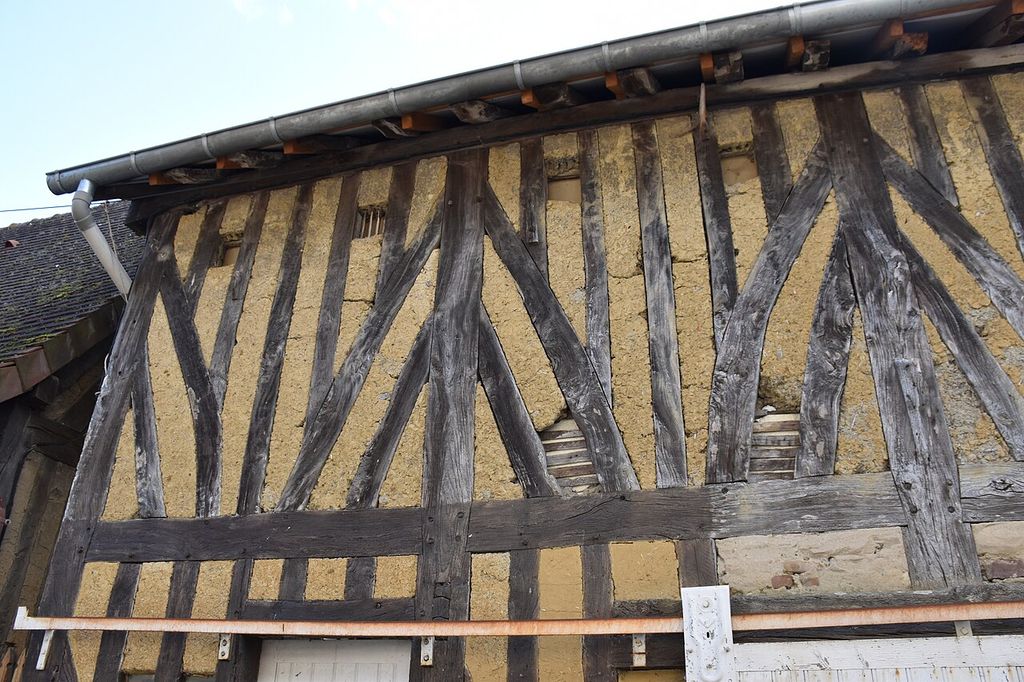
Normandy context: timber framing in Beuvron-en-Auge. Renhour48 / Wikimedia Commons. Image source. CC0 / Public domain. Resized and converted to JPEG; no crop or recolouring.
London, the last paintings and death in 2026
Large exhibitions continued to reinterpret the career during Hockney’s final years. In 2023 Bigger & Closer opened at Lightroom in London, while the National Portrait Gallery returned to Drawing from Life with additional Normandy portraits. In 2024 Rouen presented the Moon Room, based on iPad paintings made in 2020. These projects brought works from different periods into new forms of viewing rather than describing a single final manner. [66] [67]
Hockney continued painting in London. Works made in his studio during 2025 were shown that November at Annely Juda Fine Art, alongside the Moon Room. The persistence of reverse perspective in these late canvases connected them with questions he had explored for decades. That year also brought the large David Hockney 25 survey at the Fondation Louis Vuitton in Paris and a Bradford exhibition devoted to film and photography. Public attention extended across the career while new work was still being made. [68]
In 2026 the Serpentine North presentation joined recent paintings with A Year in Normandie. Hockney died at home on 11 June, one month before his eighty-ninth birthday. The David Hockney Foundation announced the date, and Getty curators Julian Brooks and Virginia Heckert confirmed it in their September remembrance. Their recollections of working with him described humour, curiosity about scale and a readiness to reconsider the display of his own pictures. [2] [3]
Honours and a life of looking
Hockney received the Order of the Companions of Honour in 1997 and the Order of Merit in 2012, having declined a knighthood in 1990. France appointed him an Officier of the Légion d’Honneur in 2026. These honours mark the public standing he achieved, but they offer only one measure of a career that repeatedly crossed national and institutional boundaries. Bradford and Los Angeles, a print workshop and an opera house, the private garden and the large exhibition all formed parts of his working world. [50] [59] [2]
The work also leaves room for argument. His claims about optics and his judgments about photography should be read as the proposals of an intensely committed artist, open to examination. His own practice was broader than any slogan: he criticised the camera while using it inventively, sought independence at a copier while valuing master printers, and took up digital drawing while continuing to paint. The productive tension between those activities helped keep familiar subjects available for change. [55] [20] [46]
Across the long career of David Hockney, relationships supplied continuity as methods changed. Parents, partners, friends, assistants and dogs appear because they occupied his life, while the roads between homes became occasions for seeing again. The repeated return matters as much as the celebrated innovation. A new tool might disclose something in a known subject; years of familiarity might make a new picture possible. His biography gives particular human circumstances to that continuing exchange between looking, remembering and making. [49] [50]
Works directory
This source-bounded directory combines the works in the Metropolitan Museum’s 2017 retrospective checklist with reviewed museum object records and the additional works and series examined in this guide. It spans several media and is not a complete catalogue raisonné. Titles without an article link remain useful dated records. Metropolitan Museum final retrospective checklist (2017); additional object and series sources are given in the linked articles. [12]
| Name | Date | Medium |
|---|---|---|
| Love Painting | 1960 | Painting |
| Shame | 1960 | Painting |
| The Third Love Painting | 1960 | Painting |
| Tyger Painting No. 2 | 1960 | Painting |
| A Rake’s Progress | 1961–63 | Print series |
| Tea Painting in an Illusionistic Style | 1961 | Painting |
| The Cha-Cha That Was Danced in the Early Hours of 24th March | 1961 | Painting |
| Cleaning Teeth, Early Evening (10pm) W11 | 1962 | Painting |
| Flight into Italy - Swiss Landscape (Painting in a Scenic Style) | 1962 | Painting |
| Man in a Museum (or You're in the Wrong Movie) | 1962 | Painting |
| My Brother is Only Seventeen | 1962 | Painting |
| The First Marriage (A Marriage of Styles I) | 1962 | Painting |
| Domestic Scene, Los Angeles | 1963 | Painting |
| Play Within a Play | 1963 | Painting |
| The Hypnotist | 1963 | Painting |
| Arizona | 1964 | Painting |
| California Art Collector | 1964 | Painting |
| Man in Shower in Beverly Hills | 1964 | Painting |
| Portrait Surrounded by Artistic Devices | 1965 | Painting |
| Rocky Mountains and Tired Indians | 1965 | Painting |
| Beverly Hills Housewife | 1966–67 | Painting |
| Medical Building | 1966 | Painting |
| Peter | 1966 | Drawing |
| Peter Getting Out of Nick’s Pool | 1966 | Painting |
| A Bigger Splash | 1967 | Painting |
| A Lawn Being Sprinkled | 1967 | Painting |
| Kasmin in Bed in His Chateau in Carennac | 1967 | Drawing |
| Peter Feeling Not Too Good | 1967 | Drawing |
| Savings and Loan Building | 1967 | Painting |
| The Room, Tarzana | 1967 | Painting |
| American Collectors (Fred and Marcia Weisman) | 1968 | Painting |
| Christopher Isherwood and Don Bachardy | 1968 | Painting |
| Henry Geldzahler and Christopher Scott | 1968-1969 | Painting |
| W. H. Auden | 1968 | Drawing |
| Peter Langan in His Kitchen at Odins | 1969 | Drawing |
| Mark Glazebrook | 1970 | Drawing |
| Mr and Mrs Clark and Percy | 1970-1971 | Painting |
| Ossie Wearing a Fairisle Sweater | 1970 | Drawing |
| Pool and Steps, Le Nid du Duc | 1971 | Painting |
| Rubber Ring Floating in a Swimming Pool | 1971 | Painting |
| Celia in a Black Dress with White Flowers | 1972 | Drawing |
| Mount Fuji and Flowers | 1972 | Painting |
| Portrait of an Artist (Pool with Two Figures) | 1972 | Painting |
| Portrait of the Artist's Mother, Mrs Laura Hockney, Bradford | 1972 | Drawing |
| The Artist's Father | 1972 | Drawing |
| Dr Eugene Lamb, Lucca | 1973 | Drawing |
| Andy, Paris | 1974 | Drawing |
| Contre-jour in the French Style (Against the Day dans le Style-Français) | 1974 | Painting |
| Gregory Sitting on Base of Column | 1975 | Drawing |
| Kerby (after Hogarth) Useful Knowledge | 1975 | Painting |
| Ron Kitaj Outside Akademie der Kunste Vienna | 1975 | Drawing |
| Kasmin Reading the Udaipur Guide | 1977 | Drawing |
| Looking at Pictures on a Screen | 1977 | Painting |
| My Parents | 1977 | Painting |
| Canyon Painting | 1978 | Painting |
| Mother, Bradford, 19 Feb. 1979 (inscribed 1978) | 1979 | Drawing |
| Mulholland Drive: The Road to the Studio | 1980 | Painting |
| Nichols Canyon | 1980 | Painting |
| Outpost Drive, Hollywood | 1980 | Painting |
| Hollywood Hills House | 1981-1982 | Painting |
| Celia. Los Angeles. April 10th 1982 | 1982 | Polaroid composite |
| Don + Christopher, Los Angeles, 6th March 1982 | 1982 | Polaroid composite |
| Gregory Swimming Los Angeles March 31st 1982 | 1982 | Polaroid composite |
| My Mother, Bolton Abbey, Yorkshire, Nov. 1982 | 1982 | Photocollage |
| Self Portrait 30th Sept. 1983 | 1983 | Drawing |
| Pearblossom Hwy., 11-18th April 1986, #1 | 1986 | Photocollage |
| Pearblossom Hwy., 11–18th April 1986, #2 | 1986 | Photocollage |
| Large Interior, Los Angeles | 1988 | Painting |
| Breakfast at Malibu, Sunday, 1989 | 1989 | Painting |
| Pacific Coast Highway and Santa Monica | 1990 | Painting |
| The Other Side | 1991-1993 | Painting |
| The Eleventh V. N. Painting | 1992 | Painting |
| The Twenty Sixth V. N. Painting | 1992 | Painting |
| The Road Across the Wolds | 1997 | Painting |
| 9 Canvas Study of the Grand Canyon | 1998 | Painting |
| A Bigger Grand Canyon | 1998 | Painting |
| Colorado River | 1998 | Painting |
| Garrowby Hill | 1998 | Painting |
| Colin St. John Wilson. London. 3rd June 1999 | 1999 | Drawing |
| Gregory Evans. Los Angeles. 18th September 1999 | 1999 | Drawing |
| Laura Huston. London. 22nd June 1999 | 1999 | Drawing |
| Lindy. Marchioness of Dufferin and Ava. London. 17th June | 1999 | Painting |
| Going Up Garrowby Hill | 2000 | Painting |
| Red Pots in the Garden | 2000 | Painting |
| A Closer Winter Tunnel, February - March | 2006 | Painting |
| Elderflower Blossom, Kilham, July 2006 | 2006 | Painting |
| The Road to Thwing, July 2006 | 2006 | Painting |
| Bigger Trees near Warter | 2007 | Painting |
| Hawthorn Blossom near Rudston | 2008 | Painting |
| Views Through the Artist's Bedroom Window, Bridlington | 2010-2013 | Digital animation |
| The Arrival of Spring in Woldgate, East Yorkshire in 2011 (twenty eleven) | 2011 | Painting / digital series |
| 82 Portraits and 1 Still-life | 2013–16 | Portrait series |
| Garden | 2015 | Painting |
| Garden with Blue Terrace | 2015 | Painting |
| Garden #3 | 2016 | Painting |
| A Bigger Interior with Blue Terrace | 2017 | Painting |
| Interior with Blue Terrace and Garden | 2017 | Painting |
| A Year in Normandie | 2020–21 | Digital frieze |
Discussion
Look again at the images and ideas explored in David Hockney Biography. These editorial prompts invite your observations.
Reader Insights
Which friendship or collaboration seems most important to a particular change in Hockney’s practice?
How does his repeated return to familiar people and places complicate a story told through successive cities?
Which episode most clearly shows a new tool changing the possibilities of a picture?
Join the Conversation
Share a detail, comparison or question about David Hockney Biography below.
References
- The David Hockney Foundation. Chronology: 1937–52. View source.
- The David Hockney Foundation. Chronology: 2026. View source.
- Julian Brooks and Virginia Heckert. Remembering the Creativity and Humor of David Hockney, Getty, 3 September 2026. View source.
- Musée Granet and Tate; curatorial texts by Helen Little and colleagues. David Hockney: Works from the Tate Collection, press pack, 2023, pp. 3, 8–21. View source.
- The Museum of Modern Art, Pop art. View source.
- The David Hockney Foundation. Chronology: 1961. View source.
- The Museum of Modern Art, Cubism. View source.
- The Museum of Modern Art, Abstract Expressionism. View source.
- The Museum of Modern Art, Richard Hamilton. View source.
- The Museum of Modern Art, Andy Warhol. View source.
- The Museum of Modern Art, Roy Lichtenstein. View source.
- The Metropolitan Museum of Art, David Hockney, final exhibition checklist, 15 November 2017. View source.
- The David Hockney Foundation. Chronology: 2021. View source.
- Tamaki Sugihara interviewing curator Ai Kusumoto. Why Hockney maintained acclaim and popularity for sixty years, interview part one, Tokyo Art Beat, 25 August 2023 [Japanese]. View source.
- The David Hockney Foundation. Chronology: 1953–58. View source.
- The David Hockney Foundation. Education & Awards. View source.
- The David Hockney Foundation. Chronology: 1960. View source.
- The David Hockney Foundation. Chronology: 1964. View source.
- The David Hockney Foundation. Chronology: 1971. View source.
- The David Hockney Foundation. Chronology: 1982. View source.
- The David Hockney Foundation. Chronology: 1998. View source.
- The David Hockney Foundation. Chronology: 2007. View source.
- The David Hockney Foundation. Chronology: 2011. View source.
- The David Hockney Foundation. Chronology: 2019. View source.
- The David Hockney Foundation. Chronology: 1959. View source.
- UK Parliament. Regulating sex and sexuality: the 20th century. View source.
- The David Hockney Foundation. Chronology: 1966. View source.
- The David Hockney Foundation. Chronology: 1962. View source.
- Mary Weaver Chapin, Portland Art Museum. David Hockney: A Rake’s Progress, exhibition brochure, 18 April–2 August 2015, pp. 2–5; checklist pp. 6–8. View source.
- The David Hockney Foundation. Chronology: 1963. View source.
- David Hockney Studio. Illustrated Biography. View source.
- The David Hockney Foundation. Chronology: 1967. View source.
- The David Hockney Foundation. Chronology: 1968. View source.
- The David Hockney Foundation. Chronology: overview, 1937–2026. View source.
- Celia Birtwell. About: A lifelong friendship in portraits. View source.
- The David Hockney Foundation. Chronology: 1972. View source.
- The David Hockney Foundation. Chronology: 1973. View source.
- The David Hockney Foundation. Chronology: 1977. View source.
- Tamaki Sugihara interviewing curator Ai Kusumoto. From uncertainty to new territory, interview part two, Tokyo Art Beat, 22 September 2023 [Japanese]. View source.
- National Portrait Gallery. David Hockney: Drawing from Life, learning resource. View source.
- The David Hockney Foundation. Chronology: 1975. View source.
- The David Hockney Foundation. Chronology: 1978. View source.
- The David Hockney Foundation. Chronology: 1980. View source.
- The David Hockney Foundation. Chronology: 1979. View source.
- The David Hockney Foundation. Chronology: 1983. View source.
- The David Hockney Foundation. Chronology: 1986. View source.
- The David Hockney Foundation. Chronology: 1987. View source.
- The Morgan Library & Museum. 048. Self-Portrait, 30 Sept 1983, online exhibition. View source.
- The David Hockney Foundation. Chronology: 1995. View source.
- The David Hockney Foundation. Chronology: 1997. View source.
- Saltaire Collection. A timeline of mill owners and managers. View source.
- The David Hockney Foundation. Chronology: 2005. View source.
- The David Hockney Foundation. Chronology: 2020. View source.
- The David Hockney Foundation. Chronology: 2001. View source.
- Teylers Museum. Hockney’s Eye, exhibition archive [Dutch]. View source.
- Lawrence Weschler. Why David Hockney Has a Love-Hate Relationship With Technology, Smithsonian Magazine, September 2013. View source.
- The David Hockney Foundation. Chronology: 2004. View source.
- The David Hockney Foundation. Chronology: 2008. View source.
- The David Hockney Foundation. Chronology: 2012. View source.
- The David Hockney Foundation. Chronology: 2013. View source.
- Simon Hattenstone. David Hockney: “Just because I’m cheeky, doesn’t mean I’m not serious”, The Guardian, 9 May 2015. View source.
- Los Angeles County Museum of Art. Opening This Week! David Hockney: 82 Portraits and 1 Still-life, 9 April 2018. View source.
- L.A. Louver. David Hockney: My Normandy, press release, January 2021, pp. 1–2. View source.
- Royal Academy of Arts; David Hockney, William Boyd and Edith Devaney. The Arrival of Spring, Normandy, 2020, official publisher description. View source.
- Bayeux Museums. Artist David Hockney Presents “His” Normandy at the Bayeux Tapestry Museum: A Year in Normandie, press release, 13 June 2022, pp. 1–3. View source.
- The David Hockney Foundation. Chronology: 2023. View source.
- The David Hockney Foundation. Chronology: 2024. View source.
- The David Hockney Foundation. Chronology: 2025. View source.
More HOCKNEY Works
A Bigger Splash
A momentary disturbance becomes the focus of a large acrylic painting, made through weeks of patient work.
Mr and Mrs Clark and Percy
The designers Celia Birtwell and Ossie Clark occupy a room shaped by light, repeated sittings and the demands of a double portrait.
A Bigger Grand Canyon
Sixty canvases gather memory, studies and changing viewpoints into an immense painting of 1998.
Garrowby Hill
The 1998 oil painting transforms a remembered Yorkshire journey into a road, fields and an expansive view.
Portrait of an Artist (Pool with Two Figures)
Photographic studies, two figures and a swimming pool become a carefully constructed painting of 1972.
My Parents
The 1977 oil painting sets Kenneth and Laura Hockney within a quietly organised interior.
Pearblossom Hwy., 11–18th April 1986, #2
Hundreds of separately made photographs construct a road scene that unfolds through movement and time.
Bigger Trees near Warter
Fifty canvases join into a large outdoor painting of Yorkshire trees, with photography helping the artist organise the whole.