


 by Tom Gurney
Tom Gurney BSc (Hons) is an art history expert with over 20 years experience
Email: tomgurney1@gmail.com / Phone: +44 7429 011000
Bigger Trees near Warter: Introduction
A tree can be familiar without being easy to see. Its trunk gives the eye something solid to grasp; higher up, the branches divide, overlap and escape any quick inventory. In Bigger Trees near Warter, David Hockney made that difficulty the substance of an enormous painting. Completed in 2007 in oil on fifty canvases, it turns a particular piece of East Yorkshire countryside into a field of sustained attention. The flowers, roadside and buildings remain recognisable, while the branching trees spread across a surface much larger than the viewer. [1]
The painting measures approximately 4.6 metres high by 12.2 metres wide, or fifteen by forty feet. Its size grew from practical experiments with smaller, joined canvases and a very particular destination: a whole wall at the Royal Academy. Yet the subject imposed its own conditions. Hockney needed to paint the trees before their leaves concealed the structure that interested him. Computer technology helped him keep track of the whole; direct observation supplied the changing world to which the picture had to answer. [2]
At a Glance
- ArtistDavid Hockney
- TitleBigger Trees near Warter
- Date2007
- Medium and formatOil on 50 canvases; 457.2 × 1219.2 cm
- CollectionTate, London
This work across David Hockney’s career
A Rake’s Progress
1961–63 [3]A Bigger Splash
1967 [3]Mr and Mrs Clark and Percy
1970–71 [3]My Parents
1977 [3]Garrowby Hill
1998 [3]A Year in Normandie
2020–21 [4]Contents
- A landscape at the edge of spring
- How six-canvas pictures suggested fifty
- Making the painting outdoors
- Branches, seams and brushwork
- Scale and the moving viewer
- What the post-photographic title means
- The Royal Academy wall
- The gift to Tate and later encounters
- Beyond the fifty canvases
A landscape at the edge of spring
The scene lies near Warter, west of Bridlington. Tall trees occupy the foreground, with a second, pinkish stand beyond them. A road bends away at the left, buildings stand towards the right, and daffodils punctuate the ground below the trees. Above this relatively narrow strip of habitation and growth, an intricate system of trunks, boughs and fine twigs spreads against the sky. [5]
That division of the surface matters. The lower details offer familiar measures: the width of a road, the size of a house, a flower close to the ground. The upper branches draw attention into a structure that those everyday measures cannot quickly contain. Looking travels from something small and graspable towards a much more extensive web. The countryside becomes monumental through this change of attention, without needing a mountain, a cliff or a panoramic prospect.
The painting's bare branches also make depth unusually available. A mass of summer leaves would establish an outer canopy; here the eye can follow successive crossings and openings. Near and far coexist within the same tangled passage. A branch can be read as a line on the surface and as part of a tree standing in front of another tree. Hockney's subject offers repeated opportunities for the eye to switch between those two readings.
The daffodils place this largely leafless scene at a seasonal threshold. Hockney identified spring's arrival as his deadline: foliage would transform the motif. The picture preserves an arrangement available for only a limited period. [6]
The road and buildings keep this from becoming an uninhabited wilderness. They establish a landscape lived in, travelled through and repeatedly encountered. Their modest place within the composition allows the trees to dominate without detaching them from ordinary surroundings. This balance is central to the picture's effect: it makes a familiar place worth prolonged looking. The broader history of that attention belongs to Hockney's work in Yorkshire; here it is concentrated on the demands of one site and one seasonal interval.
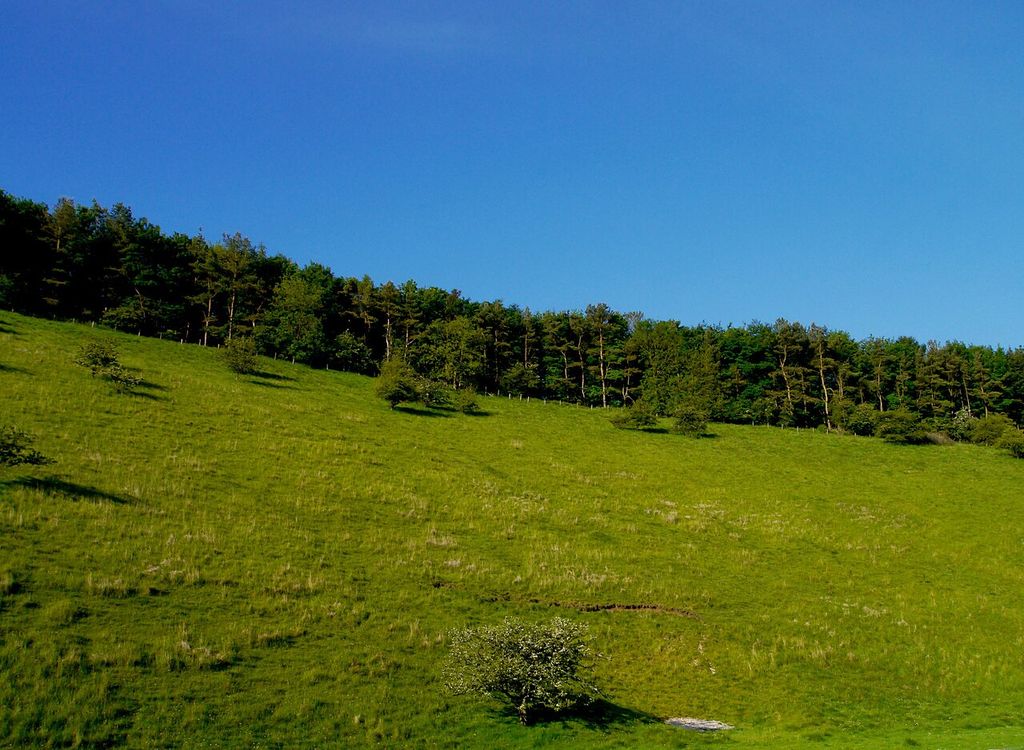
Regional context: the dry chalk valley of Water Dale, near Thixendale in the Yorkshire Wolds. Andy Beecroft / Wikimedia Commons. Image source. CC BY-SA 2.0. Resized and converted to JPEG; no crop or recolouring. Image derivative retains CC BY-SA 2.0.
How six-canvas pictures suggested fifty
The fifty-part construction developed from an existing practice. Hockney had been making Yorkshire landscapes across several canvases, including the six-part Woldgate Woods, 21, 23 and 29 November 2006. The Guggenheim Bilbao's exhibition record identifies its individual supports as approximately 91.4 by 121.9 centimetres, the same familiar three-by-four-foot module used in Bigger Trees. A large image could therefore grow from units already tested in the field. [7]
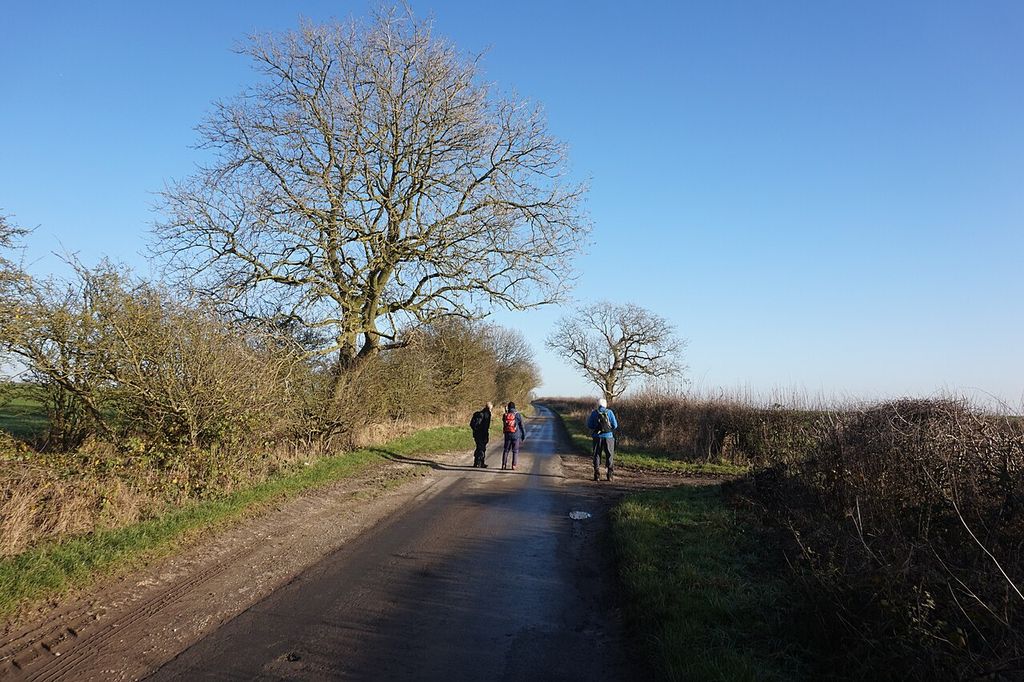
Geographic context: Woldgate towards Bridlington, photographed by Ian S. Ian S / Wikimedia Commons. Image source. CC BY-SA 2.0. Resized and converted to JPEG; no crop or recolouring. Image derivative retains CC BY-SA 2.0.
The decisive enlargement occurred through reproductions. Hockney recalled hanging images of nine six-canvas landscapes near his bed in Los Angeles. Together they represented fifty-four canvases. Their arrangement suggested that one composition could occupy a comparable area, with digital photography helping him oversee it. [6]
There are two scales of thought in that episode. A reproduction made the previous paintings small enough to survey together; what Hockney imagined from it was a painting large enough to exceed his own working space. The small image became a means of thinking about an enormous physical object. This movement between manageable model and overwhelming result would also become essential during production.
The title identifies the locality and the ambition with unusual directness. The complete title is Bigger Trees near Warter or/ou Peinture sur le Motif pour le Nouvel Age Post-Photographique. The French phrase places painting before the subject alongside a claim about a new post-photographic age. The work remains a single oil painting made from fifty supports, each measuring thirty-six by forty-eight inches. Its divisions belong to its physical construction and its visual organisation. [1]
A standard-sized support provides a useful bridge between a painter's reach and a wall-sized composition. Each piece can be handled separately, but its marks must carry relationships beyond its edges. A branch arriving at one boundary has to find its continuation in the next part. The painter must therefore think locally and across the whole at the same time. The size of Bigger Trees is inseparable from that repeated negotiation.
Making the painting outdoors
Martin Gayford visited the assembled work in a Bridlington warehouse on Good Friday 2007. He identified the prominent foreground tree as a sycamore. His contemporary account separates roughly six weeks of work into three weeks of preparation and an intense three-week painting period. A special rack was among the necessary preparations: fifty wet oil paintings required somewhere to go as the composition developed. [8]
Before starting, Hockney could spend three hours looking upwards into the branches, almost lying back to see their network. His preliminary drawings located the individual canvases within the composition. They were guides to its organisation, leaving the detailed painting to develop before the trees. [6]
This distinction between planning and execution helps explain the picture's energy. Knowing where a tree belongs does not settle every turn of a branch, every interval of sky or every change of colour. The plan gives those decisions a shared framework. Within it, looking and painting can continue to respond to one another. The preparations make rapid execution possible without reducing the subject to a predetermined diagram.
Edith Devaney, the Royal Academy curator involved in the project, recalled the cold, sometimes inhospitable working conditions. Canvases were painted in rotation, transported flat in an adapted van, then adjusted in the small top-floor studio at Hockney's Bridlington home. Photographs of the developing panels provided a computer overview. [9]
The daily movement between site and studio is important to the meaning of an outdoor painting. Observation anchored the project in the actual place; the return indoors allowed comparison, adjustment and preparation. These were complementary stages in making a coherent work. The picture's unity depended on connecting decisions made before nature with decisions about how fifty separate surfaces would finally act together.
Physical space remained a problem. The Korean museum's account explains that the Bridlington studio could accommodate only a portion of the work at once, up to ten canvases. Photographs of the parts could nevertheless be arranged as a digital mosaic. That smaller composite allowed Hockney to check relationships across an image that he could not yet hang in full. [5]
Hockney's assistant Jean-Pierre Gonçalves de Lima photographed the work as it developed. [8] [6] The computer supplied a view of the painting in progress. A photograph of a panel records decisions already made in paint; placing such records together reveals how those decisions relate. This made an otherwise awkward scale available to thought and revision.
Foliage would soon close the gaps that held Hockney's attention. [2] That urgency connects the separate acts of looking within the painting, while its organisation reflects the preparations that made the concentrated work possible.
Branches, seams and brushwork
Across the completed work, the regular canvas grid encounters the irregular branching of the trees. Kunstmuseum Luzern's account draws attention to the way branches connect different panels while also making slight shifts and colour changes between them noticeable. The joins do two things at once: they carry the image onward and register its assembly. The eye can recognise a continuous tree without forgetting the separate surfaces that support it. [2]
This gives the repeated rectangle a productive role. It establishes a steady measure against which the trees vary. A long bough crosses several units; smaller twigs multiply within one of them. Some passages invite a broad sweep of attention, others a more concentrated examination. The grid cannot make every part of nature equivalent, because the differences in density and direction remain active across it.
The brushwork contributes another scale. Gayford described quick, free, calligraphic marks, while Hockney connected the painting he had in mind with Chinese scrolls and late Picasso. His emphasis fell on visible marks made through the movement of an arm, shoulder or body. These comparisons place the painter's physical activity at the centre of the spatial experience he wanted to create. [8]
At a distance, those marks participate in a landscape. Closer to the surface, a painted branch also becomes a record of movement across canvas. The viewer changes the scale of attention by approaching or withdrawing. Large size therefore gives access to both the image and its making: the encompassing scene can resolve into gestures, while a single gesture can be understood as part of an extensive tree.
The picture does not require every twig to become a separately catalogued botanical detail. Its structure gives the eye enough information to continue exploring. The dense and open passages sustain one another, and the interruptions at panel boundaries keep the surface from becoming visually seamless. A reader interested in the wider relationship between Hockney's marks, supports and tools can follow these questions through his style and techniques.
Scale and the moving viewer
A painting more than twelve metres wide changes the act of viewing. Standing back makes the composition easier to survey; approaching makes its lateral extent more demanding. The viewer can look towards the road, return to the central branching or move along the surface to study a different group of marks. There is no requirement to consume the entire painting in a single, fixed glance.
The art historian Anthi-Danaé Spathoni reads Hockney's large landscapes as experiences involving the spectator's body and time. In her discussion of Bigger Trees, she compares movement along the painting with the unfolding attention of a Chinese scroll. This is an interpretation of how viewing develops: the spectator contributes the time needed to connect successive passages. [10]
The comparison is useful when kept close to what a viewer can do. A broad field of branches invites scanning; a particular junction can arrest that movement. Looking may then turn back along a bough already followed from another direction. Such returns differ from merely reading a picture from left to right. The subject allows a route through it to be revised, just as a person looking at real trees can attend to a trunk, a gap or a distant patch of colour in no compulsory order.
There is also a difference between immersion and illusion. The picture can occupy a substantial part of the field of vision while remaining visibly painted and visibly joined. Its effect does not depend on hiding every seam. Awareness of canvas, paint and scale can coexist with absorption in the trees. That double attention is one of the pleasures of the work: the object is materially assertive, while the scene continues to open beyond its component rectangles.
What the post-photographic title means
The important question is what each tool enabled. Separate canvases made a monumental object workable in parts. Drawings located those parts. Photographs made their painted states portable and comparable. The computer gathered the records into an overview. None of those functions alone describes the completed experience. The system supported Hockney's decisions about colour, line and spatial relationships across a surface of exceptional size.
The conjunction also resists an easy division between traditional and contemporary methods. Oil paint and work before the motif could accommodate a digital aid. The new tool increased the possible scale of an old activity: looking carefully at a place and making marks in response. The painting's argument about technology is therefore embodied in its construction. It demonstrates how an image-making device can extend another medium's possibilities.
The Royal Academy wall
The Royal Academy setting was part of the conception. Hockney secured the end wall of Gallery III before making the work. A warehouse was later hired for its first full assembly before the journey to London. [9] The grand exhibition wall and the modest industrial space offered very different settings for the same fifty-part object.
The 2007 Summer Exhibition ran from 11 June to 19 August. [6] Its crowded, varied character made possession of an entire wall significant. Bigger Trees could gather its parts into one extensive field, while other works occupied the surrounding gallery. It had been conceived with the architecture in mind, and the public encounter depended on that relationship between the painted rectangle and the room.
In her contemporary review, Janet McKenzie praised the relationship between painting and gallery, including the view towards it from another room. She also observed that the enormous Hockney and Anselm Kiefer works did not overwhelm all their neighbours: Adrian Berg's paintings retained their presence nearby. Her response places the work within the exhibition's complicated act of hanging, where size could be commanding without being the only source of visual force. [11]
At the exhibition's close, the other works were removed and two full-scale photographic reproductions of Bigger Trees were hung on the side walls. [9] [10] This extended the landscape around the spectator. The original remained the fifty-canvas oil painting; the flanking versions multiplied its presence within the room.
Those two forms of display create different relationships. On one wall, the landscape is an object towards which attention travels. Repeated around adjoining walls, it becomes a setting within which the viewer stands. The latter arrangement amplifies the work's scale through placement and repetition, pairing one original painting with two reproductions.
The experiment also helped shape Hockney's next undertaking at the Academy. Devaney proposed a Main Gallery exhibition devoted to his Yorkshire landscapes, and he accepted. That invitation led to the extensive new work shown in A Bigger Picture in 2012. [9] The fifty-canvas painting had opened a conversation about how landscape could fill and animate the galleries; the later exhibition expanded that conversation across paintings, drawings and screens.
The gift to Tate and later encounters
Hockney gave Bigger Trees near Warter to Tate in 2008. The donation placed a major example of the Yorkshire landscapes in a public collection that already held important paintings and works on paper from earlier periods of his career. His gifts over several decades helped extend that representation across media and periods. [12]
Tate's annual accounts record that the painting went on display during 2009–10. [13] At Tate Britain in November 2009, it was shown with two photographic companions. [14] These dated displays belong to its exhibition history; the work's dimensions make the conditions of each installation an important part of the encounter.
The painting subsequently travelled beyond Britain. The National Museum of Modern and Contemporary Art, Korea, presented it at Gwacheon from September 2013 to February 2014. [5] In 2025, the Fondation Louis Vuitton included the Tate loan in David Hockney 25, placing the monumental winter landscape within its account of his sustained observation of the seasons. [15]
This later history underlines the difference between a local subject and a local audience. The road, buildings and trees remain anchored near Warter, but their painted relationships can be experienced elsewhere. Every new room provides another setting in which the width, height, grid and brushwork meet the viewer. The work carries the specificity of its place through a carefully organised, portable construction.
Beyond the fifty canvases
Bigger Trees belongs within an extended investigation of landscape at different scales. The later Yorkshire work includes The Big Hawthorn of 2008, on nine canvases, Winter Timber of 2009, on fifteen, and Under the Trees, Bigger of 2010–11, on twenty. These varying formats show that a joined support was a flexible means of organising a subject. Fifty canvases were one solution within a continuing practice. [7]
The distinction becomes especially useful with The Arrival of Spring in Woldgate. That 2011 project brought together a thirty-two-canvas oil painting and an associated body of iPad drawings; fifty-one drawings were selected for its Royal Academy installation from more than a hundred made. Its combination of painted and digital components gave a new form to Hockney's observation of the season. [16]
The relationship between the works is more interesting than a simple sequence of increasing size. In Bigger Trees, the approach of leaves imposes a limit on a concentrated undertaking. In the 2011 project, seasonal change itself becomes a subject followed through many drawings. One painting gathers a branching structure before it disappears into foliage; the other project gives change a more extended form. Together they reveal how closely the shape of Hockney's work could respond to the conditions of looking. That continuity runs through his landscape painting, even as the tools and formats vary.
Works directory
This source-bounded directory combines the works in the Metropolitan Museum’s 2017 retrospective checklist with reviewed museum object records and the additional works and series examined in this guide. It spans several media and is not a complete catalogue raisonné. Titles without an article link remain useful dated records. Metropolitan Museum final retrospective checklist (2017); additional object and series sources are given in the linked articles. [3]
| Name | Date | Medium |
|---|---|---|
| Love Painting | 1960 | Painting |
| Shame | 1960 | Painting |
| The Third Love Painting | 1960 | Painting |
| Tyger Painting No. 2 | 1960 | Painting |
| A Rake’s Progress | 1961–63 | Print series |
| Tea Painting in an Illusionistic Style | 1961 | Painting |
| The Cha-Cha That Was Danced in the Early Hours of 24th March | 1961 | Painting |
| Cleaning Teeth, Early Evening (10pm) W11 | 1962 | Painting |
| Flight into Italy - Swiss Landscape (Painting in a Scenic Style) | 1962 | Painting |
| Man in a Museum (or You're in the Wrong Movie) | 1962 | Painting |
| My Brother is Only Seventeen | 1962 | Painting |
| The First Marriage (A Marriage of Styles I) | 1962 | Painting |
| Domestic Scene, Los Angeles | 1963 | Painting |
| Play Within a Play | 1963 | Painting |
| The Hypnotist | 1963 | Painting |
| Arizona | 1964 | Painting |
| California Art Collector | 1964 | Painting |
| Man in Shower in Beverly Hills | 1964 | Painting |
| Portrait Surrounded by Artistic Devices | 1965 | Painting |
| Rocky Mountains and Tired Indians | 1965 | Painting |
| Beverly Hills Housewife | 1966–67 | Painting |
| Medical Building | 1966 | Painting |
| Peter | 1966 | Drawing |
| Peter Getting Out of Nick’s Pool | 1966 | Painting |
| A Bigger Splash | 1967 | Painting |
| A Lawn Being Sprinkled | 1967 | Painting |
| Kasmin in Bed in His Chateau in Carennac | 1967 | Drawing |
| Peter Feeling Not Too Good | 1967 | Drawing |
| Savings and Loan Building | 1967 | Painting |
| The Room, Tarzana | 1967 | Painting |
| American Collectors (Fred and Marcia Weisman) | 1968 | Painting |
| Christopher Isherwood and Don Bachardy | 1968 | Painting |
| Henry Geldzahler and Christopher Scott | 1968-1969 | Painting |
| W. H. Auden | 1968 | Drawing |
| Peter Langan in His Kitchen at Odins | 1969 | Drawing |
| Mark Glazebrook | 1970 | Drawing |
| Mr and Mrs Clark and Percy | 1970-1971 | Painting |
| Ossie Wearing a Fairisle Sweater | 1970 | Drawing |
| Pool and Steps, Le Nid du Duc | 1971 | Painting |
| Rubber Ring Floating in a Swimming Pool | 1971 | Painting |
| Celia in a Black Dress with White Flowers | 1972 | Drawing |
| Mount Fuji and Flowers | 1972 | Painting |
| Portrait of an Artist (Pool with Two Figures) | 1972 | Painting |
| Portrait of the Artist's Mother, Mrs Laura Hockney, Bradford | 1972 | Drawing |
| The Artist's Father | 1972 | Drawing |
| Dr Eugene Lamb, Lucca | 1973 | Drawing |
| Andy, Paris | 1974 | Drawing |
| Contre-jour in the French Style (Against the Day dans le Style-Français) | 1974 | Painting |
| Gregory Sitting on Base of Column | 1975 | Drawing |
| Kerby (after Hogarth) Useful Knowledge | 1975 | Painting |
| Ron Kitaj Outside Akademie der Kunste Vienna | 1975 | Drawing |
| Kasmin Reading the Udaipur Guide | 1977 | Drawing |
| Looking at Pictures on a Screen | 1977 | Painting |
| My Parents | 1977 | Painting |
| Canyon Painting | 1978 | Painting |
| Mother, Bradford, 19 Feb. 1979 (inscribed 1978) | 1979 | Drawing |
| Mulholland Drive: The Road to the Studio | 1980 | Painting |
| Nichols Canyon | 1980 | Painting |
| Outpost Drive, Hollywood | 1980 | Painting |
| Hollywood Hills House | 1981-1982 | Painting |
| Celia. Los Angeles. April 10th 1982 | 1982 | Polaroid composite |
| Don + Christopher, Los Angeles, 6th March 1982 | 1982 | Polaroid composite |
| Gregory Swimming Los Angeles March 31st 1982 | 1982 | Polaroid composite |
| My Mother, Bolton Abbey, Yorkshire, Nov. 1982 | 1982 | Photocollage |
| Self Portrait 30th Sept. 1983 | 1983 | Drawing |
| Pearblossom Hwy., 11-18th April 1986, #1 | 1986 | Photocollage |
| Pearblossom Hwy., 11–18th April 1986, #2 | 1986 | Photocollage |
| Large Interior, Los Angeles | 1988 | Painting |
| Breakfast at Malibu, Sunday, 1989 | 1989 | Painting |
| Pacific Coast Highway and Santa Monica | 1990 | Painting |
| The Other Side | 1991-1993 | Painting |
| The Eleventh V. N. Painting | 1992 | Painting |
| The Twenty Sixth V. N. Painting | 1992 | Painting |
| The Road Across the Wolds | 1997 | Painting |
| 9 Canvas Study of the Grand Canyon | 1998 | Painting |
| A Bigger Grand Canyon | 1998 | Painting |
| Colorado River | 1998 | Painting |
| Garrowby Hill | 1998 | Painting |
| Colin St. John Wilson. London. 3rd June 1999 | 1999 | Drawing |
| Gregory Evans. Los Angeles. 18th September 1999 | 1999 | Drawing |
| Laura Huston. London. 22nd June 1999 | 1999 | Drawing |
| Lindy. Marchioness of Dufferin and Ava. London. 17th June | 1999 | Painting |
| Going Up Garrowby Hill | 2000 | Painting |
| Red Pots in the Garden | 2000 | Painting |
| A Closer Winter Tunnel, February - March | 2006 | Painting |
| Elderflower Blossom, Kilham, July 2006 | 2006 | Painting |
| The Road to Thwing, July 2006 | 2006 | Painting |
| Bigger Trees near Warter | 2007 | Painting |
| Hawthorn Blossom near Rudston | 2008 | Painting |
| Views Through the Artist's Bedroom Window, Bridlington | 2010-2013 | Digital animation |
| The Arrival of Spring in Woldgate, East Yorkshire in 2011 (twenty eleven) | 2011 | Painting / digital series |
| 82 Portraits and 1 Still-life | 2013–16 | Portrait series |
| Garden | 2015 | Painting |
| Garden with Blue Terrace | 2015 | Painting |
| Garden #3 | 2016 | Painting |
| A Bigger Interior with Blue Terrace | 2017 | Painting |
| Interior with Blue Terrace and Garden | 2017 | Painting |
| A Year in Normandie | 2020–21 | Digital frieze |
Discussion
Look again at the images and ideas explored in Bigger Trees near Warter. These editorial prompts invite your observations.
Reader Insights
How do the daffodils, curving road and buildings affect your sense of the enormous branching trees above them?
When a branch crosses a canvas join, do you follow the tree or become more aware of the painting's construction?
How might your experience change between facing the original on one wall and standing between it and two photographic companions?
Join the Conversation
Share a detail, comparison or question about Bigger Trees near Warter below.
References
- The David Hockney Foundation. Bigger Trees near Warter or/ou Peinture sur le Motif pour le Nouvel Age Post-Photographique, 2007, artwork record. View source.
- Kunstmuseum Luzern. “Landscape: A Bigger Landscape,” David Hockney: Moving Focus, 2022 exhibition resource, relevant work entry. View source.
- The Metropolitan Museum of Art, David Hockney, final exhibition checklist, 15 November 2017. View source.
- The David Hockney Foundation, 2021 chronology. View source.
- National Museum of Modern and Contemporary Art, Korea. David Hockney: Bigger Trees Near Warter, exhibition overview, 3 September 2013–28 February 2014. View source.
- The David Hockney Foundation. “2007,” chronology: “Making Bigger Trees,” “The largest en plein air painting” and exhibition dates, including Hockney's recollections. View source.
- Guggenheim Bilbao. David Hockney: una visión más amplia, 15 May–30 September 2012, introduction and selected object records. View source.
- Martin Gayford. “A Bigger Picture,” RA Magazine, Summer 2007, pp. 48–51; accessible text proof hosted by L.A. Louver, PDF pp. 1–2. View source.
- Edith Devaney. “2007: The Hockney Wall,” in The Royal Academy of Arts Summer Exhibition: A Chronicle, 1769–2018, edited by Mark Hallett, Sarah Victoria Turner and Jessica Feather, Paul Mellon Centre, 2018. View source.
- Anthi-Danaé Spathoni. “David Hockney's Moving Landscapes,” Revista de História da Arte — Série W, no. 11, April 2022, relevant discussion pp. 100–101. View source.
- Janet McKenzie. “The Royal Academy Summer Exhibition 2007,” Studio International, 3 September 2007, Summer Exhibition discussion. View source.
- Maria Balshaw / Tate and Musée Granet. Director's foreword, David Hockney: Works from the Tate Collection, 2023 press dossier, printed and PDF p. 3. View source.
- The Board of Trustees of the Tate Gallery. Annual Accounts 2009–2010, HC 376, 2010, “Programme,” printed p. 4, PDF p. 7. View source.
- Mark Brown. “David Hockney's Bigger Trees Near Warter given a big space at Tate Britain,” The Guardian, 23 November 2009; contemporary report of the photographic companions. View source.
- Fondation Louis Vuitton. David Hockney 25, 9 April–1 September 2025, Yorkshire landscape passage and work entry. View source.
- The David Hockney Foundation. “2011,” chronology: “The Arrival of Spring in 2011.” View source.
More HOCKNEY Works
A Bigger Splash
A momentary disturbance becomes the focus of a large acrylic painting, made through weeks of patient work.
Mr and Mrs Clark and Percy
The designers Celia Birtwell and Ossie Clark occupy a room shaped by light, repeated sittings and the demands of a double portrait.
A Bigger Grand Canyon
Sixty canvases gather memory, studies and changing viewpoints into an immense painting of 1998.
Garrowby Hill
The 1998 oil painting transforms a remembered Yorkshire journey into a road, fields and an expansive view.
Portrait of an Artist (Pool with Two Figures)
Photographic studies, two figures and a swimming pool become a carefully constructed painting of 1972.
My Parents
The 1977 oil painting sets Kenneth and Laura Hockney within a quietly organised interior.
Pearblossom Hwy., 11–18th April 1986, #2
Hundreds of separately made photographs construct a road scene that unfolds through movement and time.
Bigger Trees near Warter
Fifty canvases join into a large outdoor painting of Yorkshire trees, with photography helping the artist organise the whole.