


 by Tom Gurney
Tom Gurney BSc (Hons) is an art history expert with over 20 years experience
Email: tomgurney1@gmail.com / Phone: +44 7429 011000
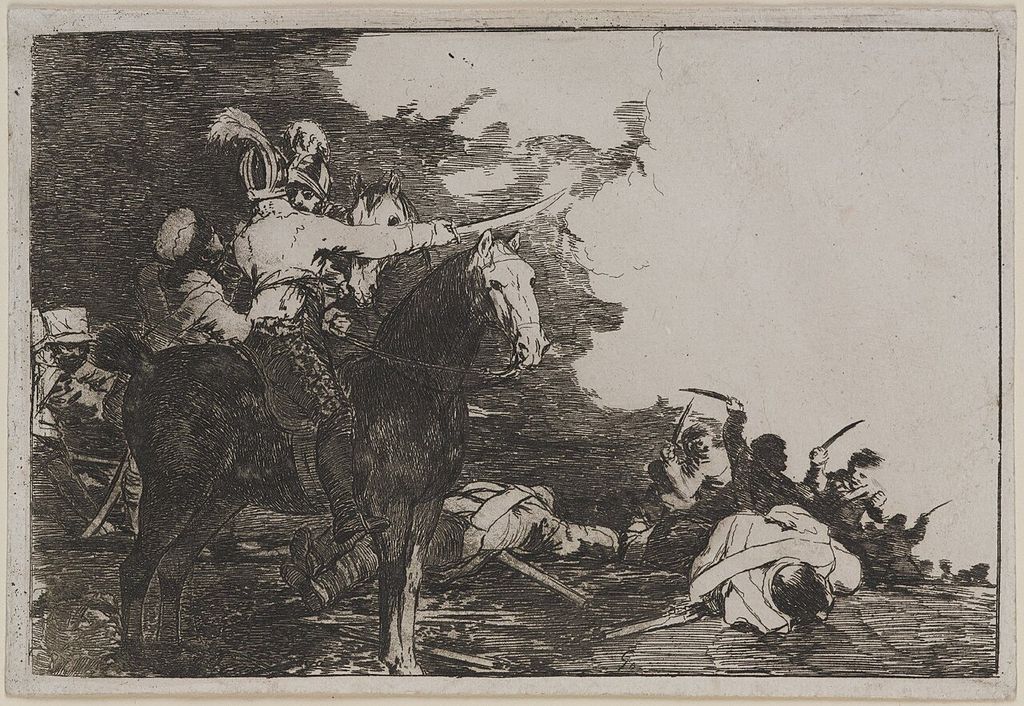
Illustrated comparison: Francisco Goya’s The Disasters of War.
Introduction
In The Dream and Lie of Franco, Pablo Picasso gave Spain's future dictator the shape of a ridiculous, threatening monster. The figure travels through scenes of mock triumph, destruction and defeat. Then the mood changes: the later images dwell on bodies hurt by war and on women in anguish. Eighteen small scenes, arranged nine to a sheet, make this 1937 print series both a political attack and an account of the human cost behind the caricature.[1][2][3]
Picasso called the work Sueño y mentira de Franco in Spanish. It consists of two etched and aquatinted plates, commonly identified as I and II, printed in Paris by Roger Lacourière. The completed edition was sold as a portfolio with a poem by Picasso to support the Spanish Republic during the Civil War. The first images preceded the bombing of Gernika and the making of Guernica; four final scenes were added after the painting was completed. That interrupted chronology explains why the work begins with savage comedy and ends nearer the visual world of Guernica.[1][3][4][5]
At a Glance
- Spanish title: Sueño y mentira de Franco
- Made: Paris, January–June 1937
- Form: Two etched and aquatinted plates; nine scenes each
- Printer: Roger Lacourière
- First issued: A two-print portfolio with Picasso’s poem, sold for the Spanish Republic
The Dream and Lie of Franco in Picasso's career
First Communion
1896Three Musicians
1921The Dream and Lie of Franco
1937 print seriesGuernica
1937Las Meninas series
1957The highlighted print series is dated with the qualifications explained in the sources on this page. The other works are selective points of comparison, not the start or end of a style.
Contents
- Two sheets, eighteen scenes
- Why Picasso made it in 1937
- Plate I: Franco as grotesque hero
- Plate II: from mockery to suffering
- The print process and the portfolio
- Were the scenes postcards?
- Beside Guernica, not beneath it
Two sheets, eighteen scenes
Each sheet has a three-by-three grid. Seen together, they contain eighteen scenes, not eighteen separate paintings and not nineteen images. A sheet can be encountered alone in a museum collection, but the two were conceived as parts of one work. The Metropolitan Museum of Art holds separate impressions catalogued as The Dream and Lie of Franco I and II; the Museu Picasso Barcelona holds a portfolio as well as individual prints. These records make it possible to discuss each sheet without mistaking the division into I and II for two unrelated projects.[1][2][3]
The order takes a little adjustment. In the printed impressions, the pictures are read from the upper right toward the lower left. Picasso worked across his plate in the opposite direction; printing reversed the image. The result looks like a familiar picture story whose route runs against the usual left-to-right movement of English reading. That reversal is not a mistake in a reproduction or a reason to flip an image file digitally. It is a consequence of the printmaking process and part of the experience of the final sheets.[2][3][6]
The images are related, but they are not a comic strip with a single unbroken plot. Barcelona's museum describes the copper plates as conceived in the spirit of an aleluya, a Spanish sequence of small pictures, yet notes that the eighteen final scenes lack an explicit continuous narrative. The recurring Franco caricature, the repeated horse and bull, and the later victims hold them together. A viewer can follow transformations and collisions rather than search for speech balloons or a definitive event in every square.[1][6][7]
The title likewise has more bite than a neutral description. “Dream” suggests the general's self-aggrandising fantasy; “lie” exposes the falsehood Picasso saw in it. This is an interpretive way of hearing the words, not a complete translation of each scene. The Spanish Sueño y mentira de Franco is best retained alongside the familiar English title, both to identify the original portfolio and to avoid treating “dream” as a serene vision. The images are deliberately ugly, comic and violent.[1][7]
Why Picasso made it in 1937
In July 1936, a military uprising against Spain's elected Republican government began the Civil War. Francisco Franco became the most recognisable leader of the rebel forces. Picasso lived in Paris, but the conflict in his home country demanded a public response. The Musée national Picasso-Paris records that the Republican government named him director of the Prado in September 1936. The appointment was politically meaningful; it should not be mistaken for evidence that Picasso was running the Madrid museum's daily work from his Paris studio.[5]
The Republican government also sought an artistic contribution from him for its pavilion at the 1937 international exposition in Paris. The pavilion would present Spain's crisis to an international audience. Picasso began The Dream and Lie of Franco on 8 January, months before he started the painted canvas Guernica. This order matters. The print series was not originally a set of illustrations made after the bombing of Gernika. Its first fourteen scenes were already under way when that attack occurred.[1][3][5]
Museum accounts sometimes call these among Picasso's first overtly political works. That is a useful description of their explicit attack on a named military leader, not a claim that Picasso had never made art with social or political implications. Here the politics cannot be missed: the grotesque figure is Franco, and the portfolio was offered in support of the Republic. At the same time, the satire's exact combination of costumes, beasts and actions is less straightforward than a single slogan. Picasso made an image sequence that could unsettle viewers while still taking a clear side.[1][3][6]
The work's production and sale were part of that public role. The plates were printed in June 1937; the portfolio, including Picasso's poem, was sold at the Spanish Republic's pavilion later that year. It belonged to a wider culture of exhibitions, posters, graphic art and publications defending the Republic. The work could circulate in multiples, unlike a single monumental canvas, while carrying a visual argument more complex than a standard political poster.[1][5][7]
Watch: Pablo Picasso
Explore Picasso through five videos from museums, broadcasters and art educators.
Picasso’s Guernica: Great Art Explained
Explore the composition and historical setting of Picasso’s best-known response to war.
Watch on YouTubePlate I: Franco as grotesque hero
Plate I, made on 8 January, gives Franco the recurring appearance of a distorted knight or ruler. His moustache helps identify him, but his body refuses stable human proportions. A crown or elaborate headgear appears in several scenes. He waves arms and weapons, rides or confronts animals, and repeatedly turns the posture of victory into something foolish or repulsive. The result attacks the heroic image that a military leader might wish to project.[2][8]
The Museu Picasso Barcelona identifies the sheet's central target as the insurgents' claims to martial glory and religiosity. In its reading, Franco can appear riding a pig, dressed as a maja, or praying before a shrine associated with money. Cleveland's description likewise notes a ship, the destruction of art, disguise, prayer and killing. These are museum descriptions of changing episodes, not a literal report of what Franco did on one day. Picasso's exaggeration makes his moral accusation visible through absurd action.[1][8]
Some details are bawdy and deliberately offensive. Barcelona describes an outsized phallic form among the ways the caricature humiliates Franco. Such imagery is not incidental decoration: it punctures the dignity of the self-styled crusader and makes claims of noble authority look obscene. But ridicule does not make the series light-hearted. The figure's weapons and the devastation around him keep the laughter close to alarm.[1]
The bull is one of the caricature's most important antagonists. The Met and Städel read it in these prints as a figure for Spain resisting or confronting Franco. In several scenes the general's supposed mastery collapses when an animal he cannot control pushes back. That reading is useful for this print sequence. It should not be exported mechanically to every bull Picasso painted, especially to Guernica, whose animal imagery has attracted different and often contested interpretations.[3][6]
Barcelona also sees something of Alfred Jarry's grotesque king Ubu in the Franco figure. The comparison points to a theatrical, inflated ruler made laughable by his own appetite for power. The Städel places the grid in the Spanish tradition of political aleluyas and discusses Goya's antiwar printmaking as a model. These contexts help explain why a modern artist working in Paris chose a serial graphic form for a Spanish political crisis. They do not imply that each of Picasso's nine scenes copies a known picture by Jarry or Goya.[1][6][7]
The close of plate I does not offer an easy moral victory. Its recurrent figure keeps mutating and returning. The viewer sees an absurd ruler who is also capable of causing harm. The sheet's harsh pleasure comes from exposing the general as contemptible while refusing to let him become harmless. It prepared a visual language of bodies, beasts and violence that the second plate would change in emphasis.[2][6]
Plate II: from mockery to suffering
Picasso began the second plate on 8–9 January. Its first five scenes continue the earlier satirical sequence. The Met describes Franco in one scene as a monstrous figure beside the horse he has killed, then identifies battle's effects and a confrontation with an angry bull. The print's reading direction is again from the upper right. Although the horse and bull are legible recurring forms, the exact action of every crowded frame may remain hard to separate at first glance. The pressure of line and the proximity of bodies are part of the experience.[1][3]
He did not finish plate II then. Four scenes remained unmade until 7 June. Between those dates, war and Picasso's own work changed the series. The German Städel Museum describes the first phase as a parody of Franco and the late images as a turn toward victims. The Met identifies three of the final four scenes as related to studies for Guernica. These statements allow a specific historical comparison: the later sections of the print series were made after the mural's visual language had developed, not that the entire two-sheet work was a by-product of the mural.[3][6]
The final figures no longer depend on Franco's cartoon face to deliver their force. Women cry out, children and broken bodies come into view, and the drawings seem to compress anguish into abrupt contours. A grieving woman holding a child recalls the mother-and-child figure in Guernica. Barcelona's museum treats the second plate as an early appearance of the crying-woman motif that Picasso would continue to work through in 1937. The plate's victims shift our attention from the tyrant's absurdity to the people his war endangers.[1][6]
This does not make the two sheets stylistically inconsistent. The sharp changes of scale, unstable bodies and collision of animal and human forms had been present from the start. What changes is their target and emotional direction. In the January scenes, Franco's distorted body is the focus of ridicule; in the June scenes, expressive distortion registers injury and grief. The same graphic freedom can serve satire and lament. The gap between the two phases gives the series its unusual shape.[1][3][6]
It is also why the work should not be described simply as “nine caricatures of Franco” on each sheet. That wording erases the late scenes and the reason they matter. The second plate is not a repeat of the first with different jokes. It records the expansion of a political indictment: an attack on a leader becomes an image of suffering people. The two together make more sense than either sheet isolated from the other.[1][3]
The print process and the portfolio
Picasso etched the designs into two copper plates and used sugar-lift aquatint to create areas of varied tone. The Met identifies Roger Lacourière as printer and Picasso as publisher. These are prints made from worked plates, not small oil paintings or drawings assembled into a sheet after the fact. An impression of either plate is one material instance of a design printed in an edition. Different museums hold different impressions, which is why their paper types, dimensions, edition numbers and accession numbers can differ.[2][3][8]
Barcelona's portfolio record supplies the edition's important distinction. One run comprised 150 signed and numbered copies on China paper mounted to Japan paper. Another comprised 850 copies on Montval laid paper, numbered and signed with a stamp. The combined figure is 1,000 portfolios. MoMA's illustrated-book record describes its own copy as from an edition of 150; Cleveland's plate I is numbered 142/150. Neither record contradicts the larger 150-plus-850 production described by Barcelona. They identify impressions of the smaller signed group.[1][4][8]
The portfolio was not only two prints. Picasso designed a wrapper and included a sheet carrying a facsimile of his handwritten poem, composed in mid-June, with typeset Spanish and French versions on the reverse. The poem's language is more accumulative and assaultive than explanatory; it does not provide a caption for every panel. Read with the plates, it extends the work into writing without turning the images into literal illustrations of lines of verse. The surviving poem and facsimile are protected works; readers need not see its full text to understand the portfolio's structure.[1][6][7]
Those details show why an individual sheet in a museum drawer is both complete as a print and incomplete as an account of the original offering. The portfolio joined two temporal phases, two printed surfaces and writing into an object meant to be bought in a charged public setting. It was a means of raising support as well as a work of art. Its editions made distribution possible, but we should not pretend that a count of impressions is a record of how many people saw it, how much money it raised, or what each viewer thought.[1][4][5]
Were the scenes postcards?
The postcard story requires a careful timeline. Barcelona and the Städel say the nine-panel sheets were first conceived so that scenes could be separated and sold individually as postcards. For the 1937 pavilion sale, however, Picasso issued the intact plates together in a portfolio. Barcelona's collection record then documents his permission in June 1939 to divide the images into individual postcard formats for Republican aid. Thus “planned as postcards” and “sold as portfolios in 1937” are not competing descriptions of the same physical issue; they name different stages of the project.[1][6]
Some museum summaries compress that history and say the scenes were produced on postcards and sold. The evidence reviewed here does not establish a reliable count of postcards printed or sold in 1939. The more precise statement is that the postcard idea shaped the initial design and later received Picasso's permission, while the well-documented 1937 object was the uncut two-plate portfolio with poem. Keeping that distinction prevents a reader from imagining that the small online pictures are photographs of eighteen original hand-painted postcards.[1][3][6]
The distinction also changes how we understand the grid. It was designed with potential separation in mind, but the uncut sheets create relationships across their borders. A viewer can move from panel to panel, then step back and see all nine at once. After the second plate's delayed completion, that format makes the change from grotesque ruler to suffering victim especially clear. The portfolio's meaning depends on both the possibility of circulation and the visual force of the sheets kept together.[1][6]
Beside Guernica, not beneath it
The Dream and Lie plates and Guernica share a year, a political crisis and recurring visual forms. They do not share a single creation date or medium. The first fourteen etched scenes were made in January 1937. Gernika was bombed on 26 April; Picasso's first dated studies for the mural followed in May, and he finished the canvas in early June. On 7 June he returned to the print series for its final four scenes. The dates let us see a movement back and forth between graphic and painted responses to war.[1][3][5]
The comparison is strongest in those last four frames. The anguished woman and child, the struck bodies and the expressive treatment of grief belong near the studies and figures of Guernica. But the print sequence addresses Franco explicitly and derisively; the mural does not label its figures with the general's face. The prints were offered as a fundraising edition, whereas the huge canvas occupied a prominent position at the Republic's pavilion. They worked together in that setting without becoming interchangeable versions of one picture.[1][3][5]
The French Musée national Picasso-Paris distinguishes the mural's more open iconography from straightforward partisan imagery. That contrast helps explain why The Dream and Lie of Franco matters independently. Its named target, deliberately ugly ruler and sale for Republican benefit make its political function unusually direct. Its later scenes, however, also ask viewers to contemplate civilians rather than merely laugh at a villain. It occupies a space between satire, antiwar testimony and fundraising print, and that mixture cannot be reduced to “Picasso's comic-strip version of Guernica.”[5][7]
The series' title, two plates and poem together complete the argument. Franco's dreamed authority is made monstrous and laughable; the lie is exposed through the destruction his cause brings; the victims prevent ridicule from becoming the last word. That is a reading of the work's structure, not a panel-by-panel code Picasso handed down. What can be verified is the sequence of making, the edition's physical form and the causes it was meant to support. The Museu Picasso Barcelona's portfolio record[1] and the Met's records for plate I[2] and plate II[3] allow readers to identify the original designs and their separate impressions.[1][2][3]
Discussion
Use the evidence and your own close looking to explain your view. These are editorial prompts, not reader comments.
Reader Insights
How does the monster’s caricature change across the eighteen scenes?
Where does the sequence turn from satire to the cost of war?
Why does the arrangement of nine scenes per sheet matter?
Join the Conversation
Which reading best fits the evidence?
References
- Museu Picasso Barcelona, Sueño y mentira de Franco portfolio record.
- The Metropolitan Museum of Art, The Dream and Lie of Franco I, 1986.1224.1(1).
- The Metropolitan Museum of Art, The Dream and Lie of Franco II, 1986.1224.1(2).
- The Museum of Modern Art, Sueño y mentira de Franco, 973.1964.1–2.
- Musée national Picasso-Paris, Guernica gallery text, French.
- Städel Museum, Theresa Nisters, “Picasso wird politisch,” German.
- Musée national Picasso-Paris, Picasso BD dossier, French.
- Cleveland Museum of Art, Dream and Lie of Franco I, 1973.137.5.
Image Credits
- Francisco Goya. Public domain. Source: Wikimedia Commons. Resized proportionally to 1024px wide; no crop. Source record. Licence.
