 by Tom Gurney
Tom Gurney BSc (Hons) is an art history expert with over 20 years experience
Published on June 19, 2020 / Updated on September 28, 2026
Email: tomgurney1@gmail.com / Phone: +44 7429 011000
About the painting
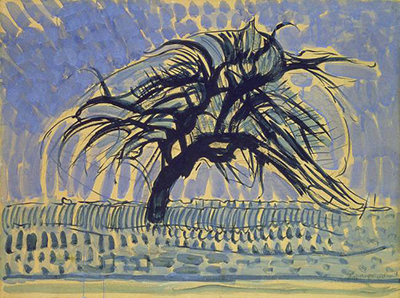
A dark trunk bends upward and to the right, then spreads into an elaborate fan of curling branches. Behind and between them, blue and yellow strokes make the space around the tree as lively as the tree itself. Piet Mondrian's Apple Tree in Blue invites a viewer to recognize an apple tree and then to keep looking at the repeated lines, colour contrasts and bands of short marks that organise the whole picture. It belongs to the years when he was working with trees as subjects for unusually bold experiments in colour.
RKD catalogues the work as A672, Apple tree in blue (1908–1909). Kunstmuseum Den Haag gives the same object number, 0320911, but calls it The Blue Tree. These are alternative titles for one artwork. The museum records tempera on cardboard, measuring 75.5 × 99.5 cm, and holds it in its collection. The existing site title and route can therefore remain while the museum's title is made clear to readers.[1][2]
At a glance
- ArtistPiet Mondrian (Piet Mondriaan, 1872–1944)
- TitleApple Tree in Blue; The Blue Tree in Kunstmuseum Den Haag's record
- Date1908–1909
- MediumTempera on cardboard
- Dimensions75.5 × 99.5 cm (height × width)
- CollectionKunstmuseum Den Haag, The Hague
- Museum object number0320911; inventory T99-1934
- Catalogue raisonnéJoosten A672; separate from the A666–A668 blue-tree works[1][2]
Where this painting sits in Mondrian's career
Contents
- What do you see in Apple Tree in Blue?
- Why did Mondrian use blue and tempera?
- Is it the same as the other blue apple-tree works?
- How does this tree relate to The Red Tree?
- Where is the original painting?
What do you see in Apple Tree in Blue?
The tree does not stand upright as a simple vertical silhouette. Its trunk begins near the lower centre, leans right and divides into dark limbs that bend back, arc over the middle and sweep toward the edges. The longest branches reach almost to the right side of the wide support. Others loop left and down. This unequal spread gives the tree an energetic shape, as though its growth or movement has been caught in a single concentrated image.
 The Red Tree Piet Mondrian.jpg)
The blue field behind it varies in tone. Some patches are cool and dense; others are broken by pale or warm yellow strokes. Thin lines cross the colour, and small yellow marks appear near the upper edge. The contrast makes the blackish branches legible, but they are not isolated from their surroundings. Blue shows through the gaps. Yellow accents seem to answer the curving limbs and help the eye move across the picture.
Below the tree, bands of short dark and blue strokes run across the lower portion. They do not give a detailed account of grass or earth. Their repeated marks can suggest ground while also setting a rhythmic base for the branching mass above. Looking from a normal viewing distance, a viewer sees the whole broad sweep; close up in the reproduction, many small strokes retain their separate directions. That shift in attention is visible without claiming that Mondrian followed a fixed optical recipe for every mark.
The structure is more specific than a general idea of a “blue tree.” The trunk's bend, the crowded loops around its upper part and the heavy rightward spread distinguish this painting from other blue apple-tree pictures. The museum's image and the local reproduction show the same arrangement. A title match alone would not establish that identity, because Mondrian painted and studied multiple tree motifs in these years.[1][2]
Why did Mondrian use blue and tempera?
The museum's record gives the material as tempera on cardboard, a combination that should be stated before interpreting its visual effect. This is not an oil painting on canvas, even though many related Mondrian works are. The record does not explain why he chose tempera for this particular object, so the medium should not be turned into a claim about a documented private intention.[1]
What we can see is how colour operates. The tree is dark, yet the eye repeatedly leaves its trunk for the blue around it. Yellow strokes warm selected parts of that blue, creating a strong contrast without turning the image into an ordinary record of a particular sky. The lower patterned band echoes small touches higher up. Mondrian makes colour an active part of the composition rather than a transparent description of natural light.
The title The Blue Tree can mislead if it makes us imagine a trunk painted solid blue. In the reproduction, the branches are predominantly dark. Blue dominates the surrounding field and appears among the marks at the base; its relation to the tree gives the work its distinctive atmosphere. RKD's longer title, Apple tree in blue, is perhaps more helpful for a first look because it leaves room for the tree and its setting to work together.[1][2]
We should also avoid assigning a single symbolic meaning to the blue. It may feel dreamlike or cool to a viewer, and the bright yellow can heighten that impression. Such responses belong to looking at the painting. Neither the museum's object record nor RKD's catalogue entry proves a specific spiritual code for these colours in A672. The visual account is already rich: blue space, dark looping lines and dispersed yellow touches keep changing one another as the eye moves.
Watch: Piet Mondrian
See his studio, the move toward geometric abstraction and the rhythms of his New York paintings.
Piet Mondrian: Abstract Painting as We Know It
Curator Michael White explores the paintings and Mondrian’s studio as an abstract space.
Watch on YouTubeIs it the same as the other blue apple-tree works?
No. RKD's nearby catalogue entries include A666, Apple tree in blue with wavy lines I in the Zeeuws Museum, A667, Apple tree in blue with wavy lines II in a private collection, and A668, an oil sketch for the blue apple-tree series. A672 is a separate work in Kunstmuseum Den Haag with its own object number. Their titles reveal a shared motif, but their collection lines and catalogue numbers prevent one image from being substituted for another.[2]
Kunstmuseum Den Haag also records a Sketch for the series of the blue apple tree, object 1064038, dated around 1909. That smaller work is oil on board, 32 × 37.5 cm, on long-term loan from a private collection. It is useful evidence that the blue-tree theme could be investigated in a separate sketch, but its size and medium do not belong to the large A672 tempera. The museum title says “for the series,” rather than naming this one painting as its proven sole destination.[3]
The site's Apple Tree, Pointillist Version is distinct again. The Dallas Museum of Art's museum-supplied Google Arts & Culture record gives that work a 1908–1909 date, oil on composition board medium and Dallas collection. It too uses radiating branches and strong colour. These similarities make comparison worthwhile; they do not make the paintings the same canvas or justify transferring Dallas's details to the Kunstmuseum object.[4]
How does this tree relate to The Red Tree?
Avond (Evening): The Red Tree was begun in 1908 and worked on until 1910, according to Kunstmuseum Den Haag. Its branches glow red against a cobalt-blue field. In Apple Tree in Blue, blue is more pervasive and yellow strokes take a larger role, while the dark tree leans and spreads across the support. Comparing the two can make the different uses of contrast easier to see. They are separate objects, 0332041 and 0320911, not two names for the same tree painting.[1][5]
The paintings overlap in date. It would be too simple to place one as a completed step after the other in an inevitable march toward abstraction. Mondrian could return to a motif, alter his colour and line, and work on a picture for an extended period. The A672 tree is still strongly recognizable. Its expressive colour and emphatic rhythm already ask us to attend to pictorial structure as much as the represented subject.
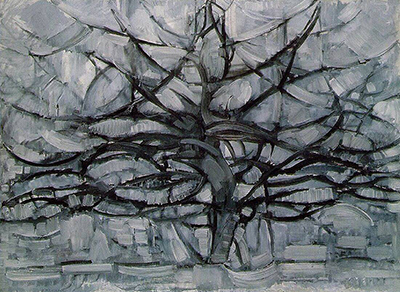
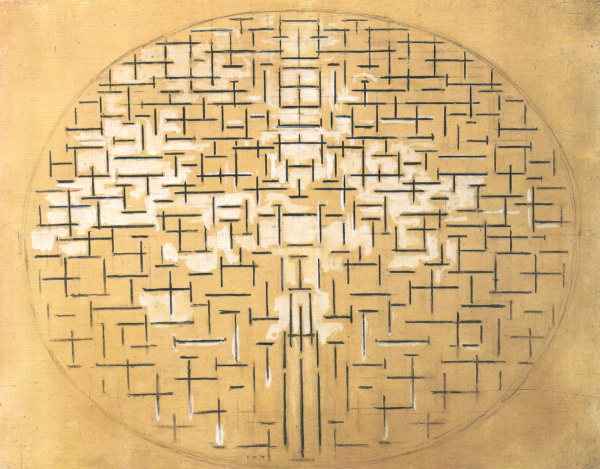
Looking later to Gray Tree can reveal a very different palette and a closer merging of branch and background. But the blue painting does not need the later work to justify its own choices. Its wide, left-leaning trunk, loops and low pattern of short strokes form a complete composition, not merely a note on the way to a gray or gridded picture.
Where is the original painting?
Apple Tree in Blue, titled The Blue Tree by the museum, belongs to Kunstmuseum Den Haag, object 0320911. RKD records it as A672 with inventory T99-1934. The museum's direct collection record is the best starting point for current information. Collection ownership does not prove that the work is on view on a particular day; check current display details before travelling specifically to see it.[1][2]
The painting matters because it makes an observed natural form into a vigorous arrangement without erasing the tree. Dark branches anchor the image. Blue and yellow marks give the surrounding field equal energy. The viewer can enjoy the tree's dramatic outline and the separate, almost musical cadence of its short strokes at the same time.
Mondrian artworks directory
Frequently asked questions
Is The Blue Tree another painting?
Is it oil on canvas?
Is it the Dallas pointillist apple tree?
Where can I find the original?
It belongs to Kunstmuseum Den Haag as object 0320911. Check the museum's current display information before visiting.[1]
Discussion
Where does the bending trunk first draw your eye, and where do the colours take over?
Reader Insights
Follow a looping branch toward the right edge. Which blue or yellow marks answer it?
Which short strokes in the lower band seem to echo marks above the tree?
How does this blue tree differ from The Red Tree or the Dallas pointillist apple tree?
Join the Conversation
Share what you notice in this painting below.
References
- Kunstmuseum Den Haag, collection record for Piet Mondrian, The Blue Tree, object 0320911. View source.
- RKD – Netherlands Institute for Art History, Mondrian catalogue raisonné, Amsterdam 1908–11 landscapes, A672 and neighbouring blue-tree entries. View source.
- Kunstmuseum Den Haag, collection record for Sketch for the series of the blue apple tree, object 1064038. View source.
- Dallas Museum of Art via Google Arts & Culture, Apple Tree, Pointillist Version, 1908–09. View source.
- Kunstmuseum Den Haag, collection record for Avond (Evening): The Red Tree, object 0332041. View source.
- Lead image credit. Piet Mondrian, Apple Tree in Blue (also The Blue Tree), 1908–09. Kunstmuseum Den Haag, object 0320911.