 by Tom Gurney
Tom Gurney BSc (Hons) is an art history expert with over 20 years experience
Published on June 19, 2020 / Updated on September 28, 2026
Email: tomgurney1@gmail.com / Phone: +44 7429 011000
About the painting
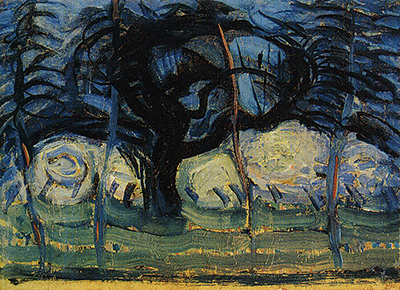
A dark apple tree fills a small, wide picture. Its branches twist through a blue field, while thin upright supports and pale rounded marks appear beneath them. Along the bottom, narrow bands of green and yellow steady the restless movement above. In Apple Tree in Blue with Wavy Lines I, Piet Mondrian gives a recognisable tree an unusually forceful design, built from curving lines and colour that does more than describe ordinary daylight.
RKD catalogues this work as A666, Apple tree in blue with wavy lines I, dated around 1908. It belongs to the Zeeuws Museum in Middelburg, inventory M94-008. The Vereniging Rembrandt, which helped the museum acquire it, records oil on paper mounted on canvas, measuring 27.2 × 38.4 cm. The museum's Dutch title is Blauwe appelboom met golvende lijnen I. The singular title and image refer to one main tree.[1][2][3]
At a glance
- ArtistPiet Mondrian (Piet Mondriaan, 1872–1944)
- TitleApple Tree in Blue with Wavy Lines I
- Dutch titleBlauwe appelboom met golvende lijnen I
- Datec. 1908
- MediumOil on paper mounted on canvas
- Dimensions27.2 × 38.4 cm (height × width)
- CollectionZeeuws Museum, Middelburg, Netherlands
- Museum inventoryM94-008
- Catalogue raisonnéJoosten A666[1][2]
Where the Zeeuws Museum apple tree sits in Mondrian's career
Contents
- What can you see in the blue apple tree?
- Why did Mondrian paint the tree blue?
- Is this a painting on canvas or paper?
- How is it different from Mondrian's other blue trees?
- Where is the original artwork?
What can you see in the blue apple tree?
The trunk stands near the centre and darkens as it rises into a dense mass of branches. Limbs bend toward both sides of the frame, crossing the blue background in long arcs. Some turn back on themselves, creating the “wavy lines” named in the title. Mondrian does not outline a neat, symmetrical crown. The branches cluster, separate and overlap, so the eye has to follow one curve at a time to understand the tree's shape.
 The Red Tree Piet Mondrian.jpg)
Several slender, straighter lines interrupt this tangle. They extend upward from the lower part of the picture and look different from the heavy trunk. The Vereniging Rembrandt identifies them as stakes supporting the branches. That observation makes sense of their position: the supports stand among the tree's limbs but do not share their twisting growth. The contrast between the upright stakes and curling branches gives the painting two related kinds of line.[2]
Pale rounded forms show through the lower branches. In the acquisition record, the association describes Mondrian's circular touches between the stakes as diffuse evening light. This is a more grounded reading than guessing that the circles must be flowers, clouds or plants. Even with that interpretation, their exact boundaries remain loose. They brighten the spaces between the trunk and supports and keep the dark tree from closing off the entire image.[2]
The bottom strip is comparatively calm. Thin horizontal passages of green, yellow and darker colour run across it, interrupted by the bases of the upright lines. These bands suggest ground without giving a detailed account of individual grasses. Their horizontals also answer the vertical stakes and the tree's wavering branches. The scene is still legible, but its shapes work together as a deliberately organised surface.
Blue extends through much of the upper field. It is not a perfectly flat sky: different dark and bright strokes are visible around the branches. The tree's broad, dark crown nearly presses against the top edge, making the blue feel threaded through it rather than laid behind it. This close relationship between branch and surrounding colour helps explain why the work looks intense despite its modest size.
Why did Mondrian paint the tree blue?
The painting's blue is an expressive choice visible in the work, but the available object records do not give a personal explanation from Mondrian for each stroke. The Vereniging Rembrandt places the work within a period when he increasingly used landscape colour as he experienced it, rather than simply repeating the colours he saw. Its text points to the tree as an example of that change. The Zeeuws Museum likewise describes a move away from naturalistic landscape colour in the years around Mondrian's visits to Zeeland.[2][3]
Here blue creates a strong atmosphere around the branches. Dark limbs remain recognisable as wood, while the cool field and pale circular touches make the spaces between them visually active. The painting does not need a precise symbolic translation to be understood. Its title draws attention to colour and line, and the image allows viewers to test how those two elements shape their experience of the tree.
The acquisition record connects this colour experiment with Mondrian's first visit to Domburg in 1908. The Zeeuws Museum's gallery text discusses the local artists' circle and the distinctive Zeeland light, and treats the blue apple tree as part of a larger group of tree pictures. Those sources provide regional context. They do not establish the exact orchard or moment at which A666 was painted, so its landscape setting should not be presented as a documented address.[2][3]
The museum text also describes Mondrian's tree motif in terms of repeated horizontal and vertical lines. In this small work, the distinction is already visible: the supports and trunk rise, low colour bands run across, and branches repeatedly challenge both directions with curves. The tree still dominates the image, yet looking at it soon becomes an exercise in following lines across a surface. This is a useful way to understand the work on its own terms, without treating it merely as a rough draft for the grids Mondrian painted much later.[3]
Watch: Piet Mondrian
See his studio, the move toward geometric abstraction and the rhythms of his New York paintings.
Piet Mondrian: Abstract Painting as We Know It
Curator Michael White explores the paintings and Mondrian’s studio as an abstract space.
Watch on YouTubeIs this a painting on canvas or paper?
The fullest material description in the acquisition record is oil on paper mounted on canvas. The Zeeuws Museum's gallery text shortens that to oil on paper. These accounts are compatible: one names the painted surface, while the other also identifies the canvas mounting. Describing the work simply as oil on canvas would hide the paper on which Mondrian painted.[2][3]
At 27.2 × 38.4 cm, A666 is a compact work. Its wide format gives the branching tree room to spread even though the object itself is relatively small. The high contrast between the dark limbs and pale openings helps the complicated structure remain readable in a reproduction. Exact dimensions also prevent confusion with the larger, differently made blue tree held in The Hague.
The museum acquired A666 in 1994 from Borzo art dealers in 's-Hertogenbosch, according to the Vereniging Rembrandt record. That association helped fund the purchase; the Zeeuws Museum says the Province of Zeeland contributed too. The acquisition gave the museum a Mondrian work through which to discuss the Domburg artists and their response to the Zeeland landscape. These collection facts are part of the painting's history, separate from the question of whether it is on view today.[2][3]
How is it different from Mondrian's other blue trees?
RKD places A667, Apple tree in blue with wavy lines II, immediately after A666 in its catalogue. It dates both to around 1908, but lists A667 in a New York private collection rather than the Zeeuws Museum. The shared title marks a related experiment, not two names for the same object. RKD also lists A668, an oil sketch for a blue apple-tree series. Their separate entries are a reminder that material, collection and image need to be checked before assigning a fact from one work to another.[1]
The site's Apple Tree in Blue is A672, called The Blue Tree by Kunstmuseum Den Haag. That painting is also dated 1908–1909, but the museum records tempera on cardboard, 75.5 × 99.5 cm, object 0320911. A666's paper support, smaller size and Zeeuws Museum inventory identify it as a distinct painting. Its dark central tree, straight supports and luminous rounded openings also create a different arrangement from the broad, leaning A672 tree.[1][4]
Apple Tree, Pointillist Version belongs to the Dallas Museum of Art and is RKD A673. Dallas records oil on composition board, 56.833 × 74.93 cm, with numerous blue and orange short strokes around a spreading tree. Comparing the three works shows how Mondrian could vary support, scale, colour and the paths made by branches while returning to an apple-tree subject. Their dates overlap; the catalogue does not turn them into an inevitable three-step sequence.[1][5]
Where is the original artwork?
Apple Tree in Blue with Wavy Lines I belongs to the Zeeuws Museum in Middelburg, inventory M94-008. The Vereniging Rembrandt acquisition page provides its full material, size and purchase history, while the museum's gallery text gives local context. Check current museum information if you plan a visit specifically to see it; a collection record and a past gallery text do not guarantee that a work is hanging on a particular day.[2][3]
The painting offers an unusually direct way to watch Mondrian vary his treatment of a tree. The trunk and stakes remain readable. Blue and pale light give the gaps between them equal importance. Across a small sheet, curving branches, upright supports and low horizontal bands produce an image that is both an apple tree and a lively pattern of lines.
Mondrian artworks directory
Frequently asked questions
When was Apple Tree in Blue with Wavy Lines I painted?
Is it one tree or several?
The catalogue title uses singular Apple tree, and one main dark tree dominates the image.[1]
What is its medium?
Are the pale circles flowers?
The Vereniging Rembrandt reads the circular touches between the support stakes as diffuse evening light. The record does not identify them as flowers.[2]
Is this The Blue Tree in The Hague?
Discussion
Where does the dark trunk first draw your eye, and where do the pale openings take over?
Reader Insights
Follow a curved branch toward the right edge. Which straight stakes cross it?
How do the narrow horizontal bands below the trunk change the rhythm above?
How does this Zeeuws Museum tree differ from The Blue Tree in The Hague?
Join the Conversation
Share what you notice in this painting below.
References
- RKD – Netherlands Institute for Art History, Mondrian catalogue raisonné, Amsterdam 1908–11 landscapes, A666 and neighbouring blue-tree entries. View source.
- Vereniging Rembrandt, acquisition record for Blauwe appelboom met golvende lijnen I, c. 1908, Zeeuws Museum M94-008. View source.
- Zeeuws Museum, Dit is Zeeland gallery text, 2024, section on Mondrian's blue apple tree. View source.
- Kunstmuseum Den Haag, collection record for The Blue Tree, object 0320911. View source.
- Dallas Museum of Art via Google Arts & Culture, Apple Tree, Pointillist Version, 1908–09. View source.
- Lead image credit. Piet Mondrian, Apple Tree in Blue with Wavy Lines I, c. 1908. Zeeuws Museum, inventory M94-008.