 by Tom Gurney
Tom Gurney BSc (Hons) is an art history expert with over 20 years experience
Published on June 19, 2020 / Updated on September 29, 2026
Email: tomgurney1@gmail.com / Phone: +44 7429 011000
About the painting
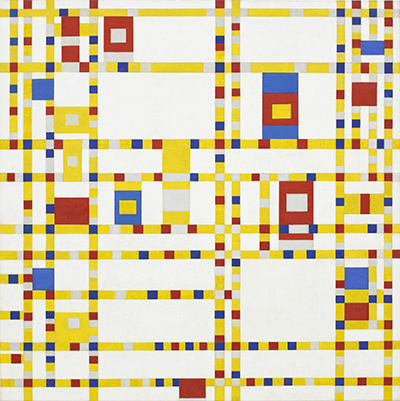
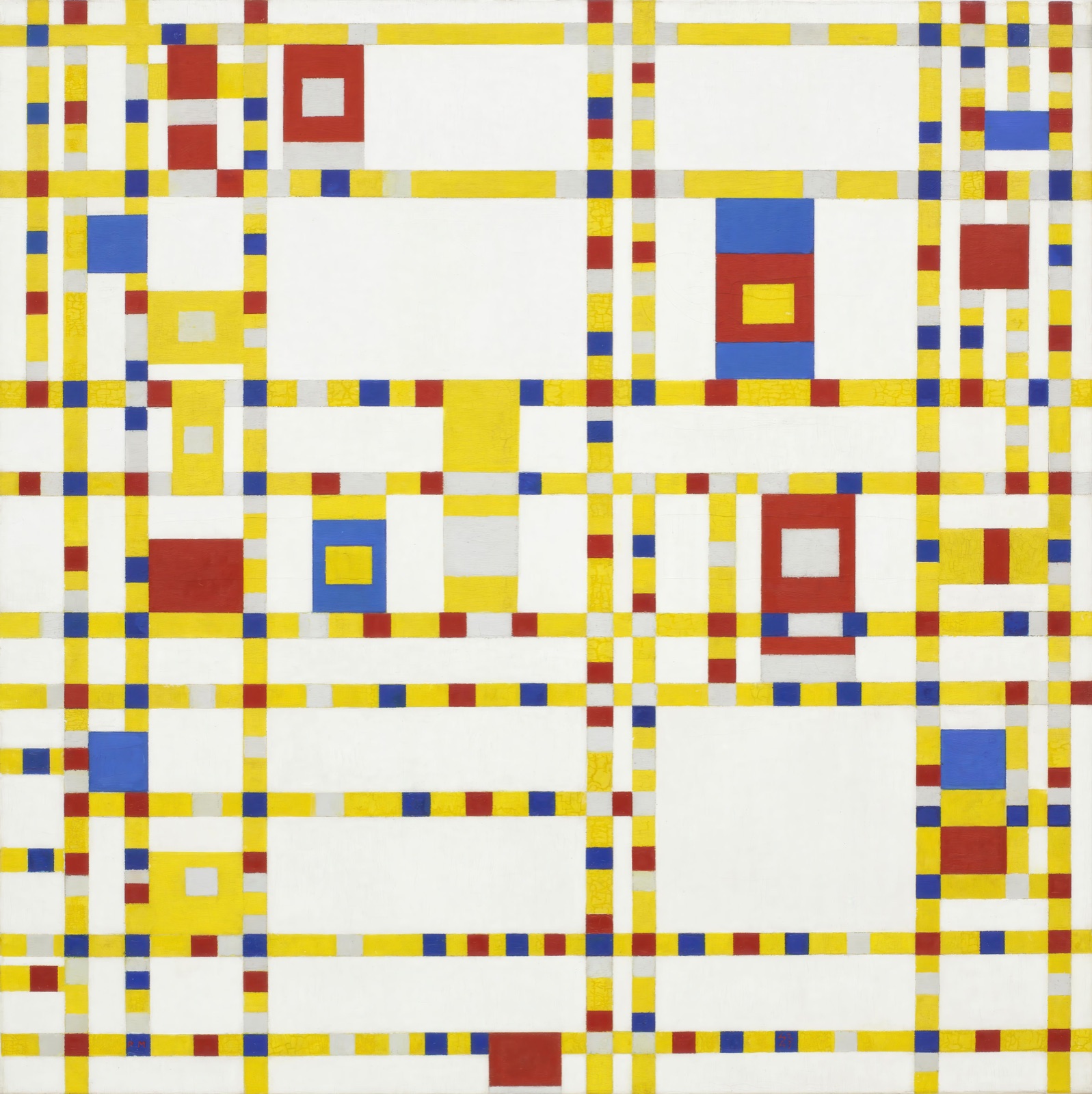
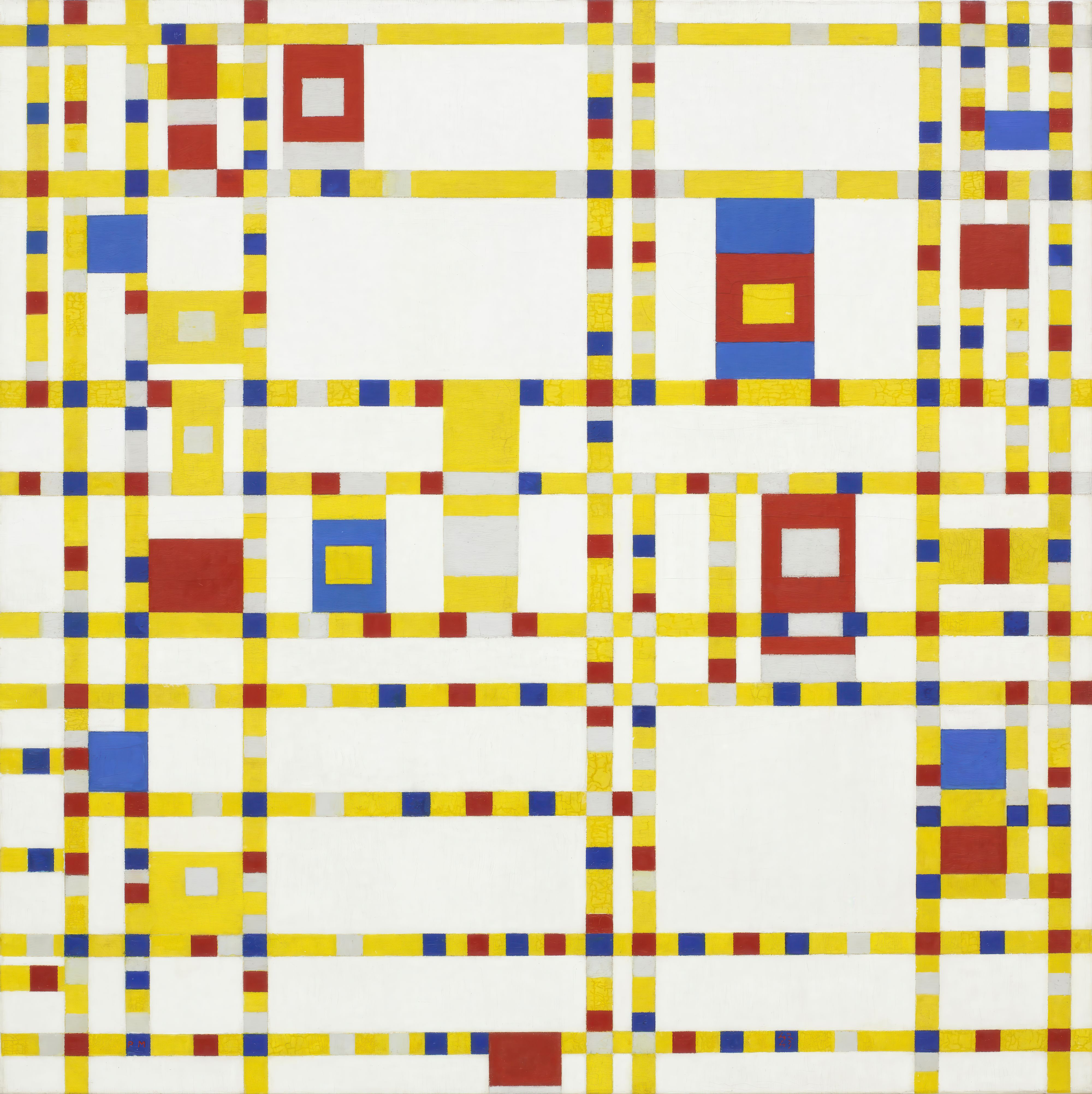
Piet Mondrian's Broadway Boogie Woogie looks like a lively network of short yellow bars interrupted by red, blue, gray and white squares. The whole canvas seems to move, yet its balance is carefully worked out. Painted in New York in 1942–43, it was the last painting Mondrian finished. The original belongs to The Museum of Modern Art, where it is recorded as oil on canvas, 127 × 127 cm, object number 73.1943. In the catalogue raisonné it is B323, immediately before the separate, unfinished Victory Boogie Woogie.[1][2][3]
The title joins two enthusiasms of Mondrian's final years: New York's Broadway and boogie-woogie music. The painting does not illustrate a particular street, tune or traffic scene. Its broken bands and changing intervals offer a visual rhythm that can suggest movement through a city or across a dance floor. Technical examination has also shown that this apparently immediate pattern took extensive revision. Looking closely at the visible work and its underlying changes makes the painting far richer than a simple coloured grid.[1][3][4]
At a glance
- ArtistPiet Mondrian (1872–1944)
- TitleBroadway Boogie Woogie
- Date1942–43
- MediumOil on canvas
- Dimensions127 × 127 cm (50 × 50 in)
- CollectionThe Museum of Modern Art, New York; object 73.1943
- Catalogue raisonnéJoosten B323
- Place in careerMondrian's last finished painting; the subsequent Victory Boogie Woogie remained unfinished[1][2][3]
Where this painting sits in Mondrian's career
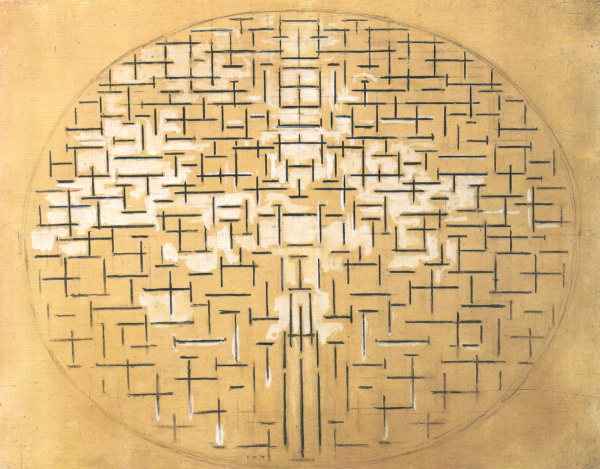
Evening: The Red Tree
1908–10Broadway Boogie Woogie
1942–43Victory Boogie Woogie
1942–44Contents
- What do you see in the painting?
- Annotated details in Broadway Boogie Woogie
- Why did Mondrian change his familiar black lines?
- What do Broadway and boogie-woogie have to do with it?
- How was the painting made?
- What does its surface reveal?
- Where did the painting go after Mondrian finished it?
- Why does it still feel new?
- How did contemporaries understand the final change?
What do you see in the painting?
The square canvas is crossed by horizontal and vertical routes, but the routes do not read as continuous black bars. Yellow predominates, repeatedly broken by smaller red, blue, gray and white blocks. Some interruptions are tiny; others expand into larger coloured rectangles or white openings. The eye can move along a line, be delayed by a change of colour, and then pick it up again farther across the canvas. There are crossings, pauses and departures rather than one place where the entire painting comes to rest.
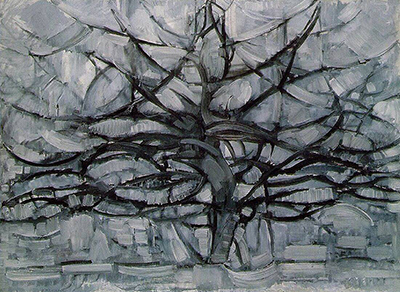
 The Red Tree Piet Mondrian.jpg)
At first glance the picture may seem evenly busy. It is not. Large white intervals open between the coloured paths, while denser clusters gather around their edges. The coloured squares do not sit at identical distances. Red appears in several sizes, blue often provides a cooler interruption, and small gray or white passages modulate the bright yellow. MoMA describes the shifting points where the short blocks meet as producing a pulse; curator Ann Temkin likens the paths to city streets or dancers moving across a floor. Both comparisons begin with the structure the painting actually presents.[1][4]
The picture is easier to read if one follows a single yellow band from an edge. It rarely remains the same colour and width for long. A red or blue unit enters, a white gap opens, or a broader coloured plane interrupts the route. Following another band produces a different experience. The square shape and upright divisions provide order, while the continually changing accents disturb a predictable beat. The work can feel energetic without surrendering to chaos.
There is no reason to assign each yellow square to a taxi or every gray passage to a road. The museum's account uses traffic as an analogy for optical movement; it does not identify individual marks as vehicles. The painting is an abstraction, and treating it as a coded overhead map would lose the very variations that make it interesting. Its relation to New York is carried by the title, its moment of making and the viewer's experience of movement, not by a one-to-one street plan.[1][4]
Annotated details in Broadway Boogie Woogie
Trace the interrupted yellow routes and unequal colour clusters in five close views of the 1942–43 painting. Select a number to jump to a detail.
 1
2
3
4
5
1
2
3
4
5
Choose a number to reach its detail, then select a detail image to open the gallery. Open the full-resolution image.
Details from BROADWAY BOOGIE WOOGIE
Five close views of the painting.
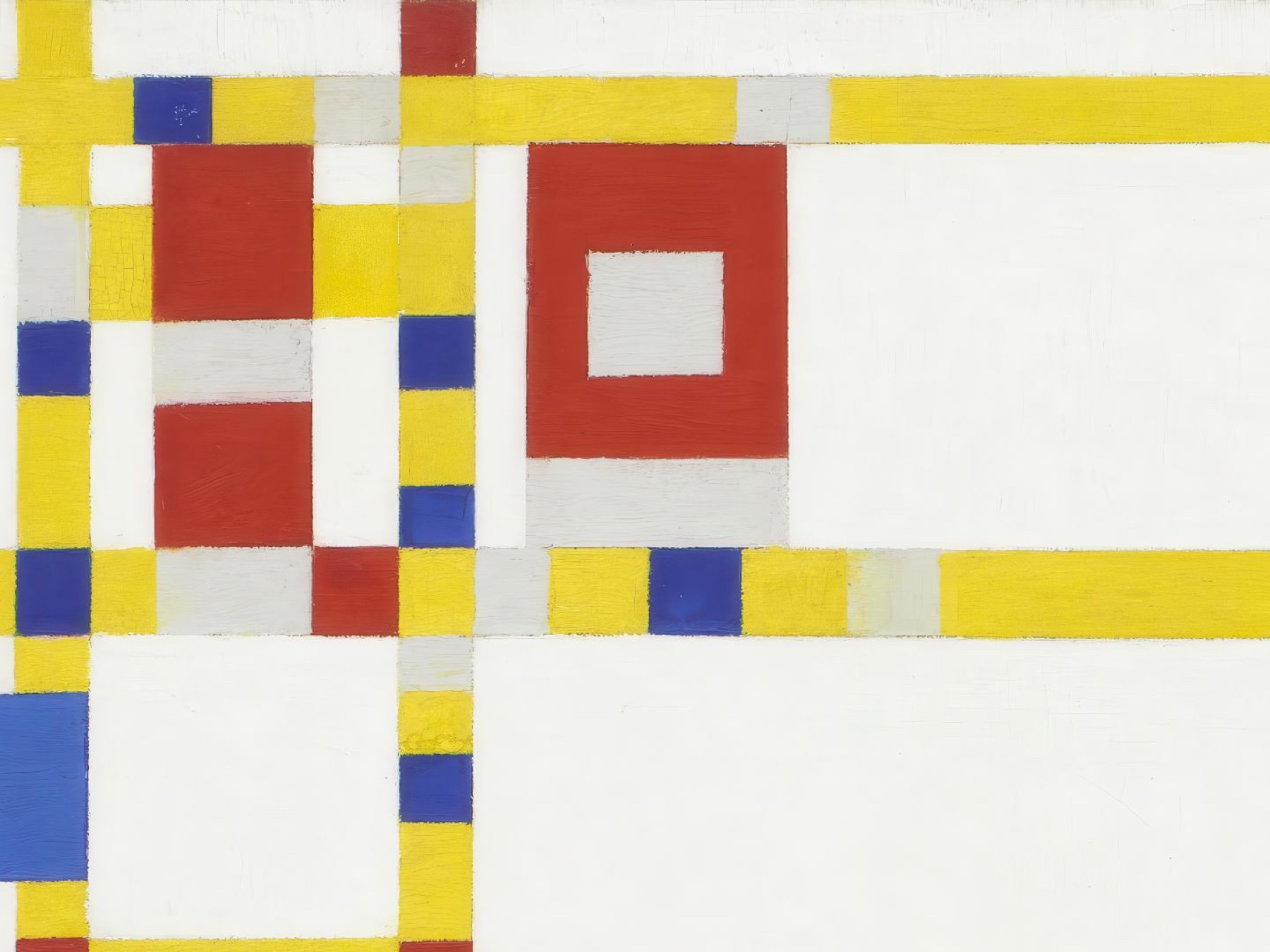
A red square interrupts the route
Near the upper left, a broad red enclosure and small white centre break the yellow network. Their scale differs from the small colour units around them.
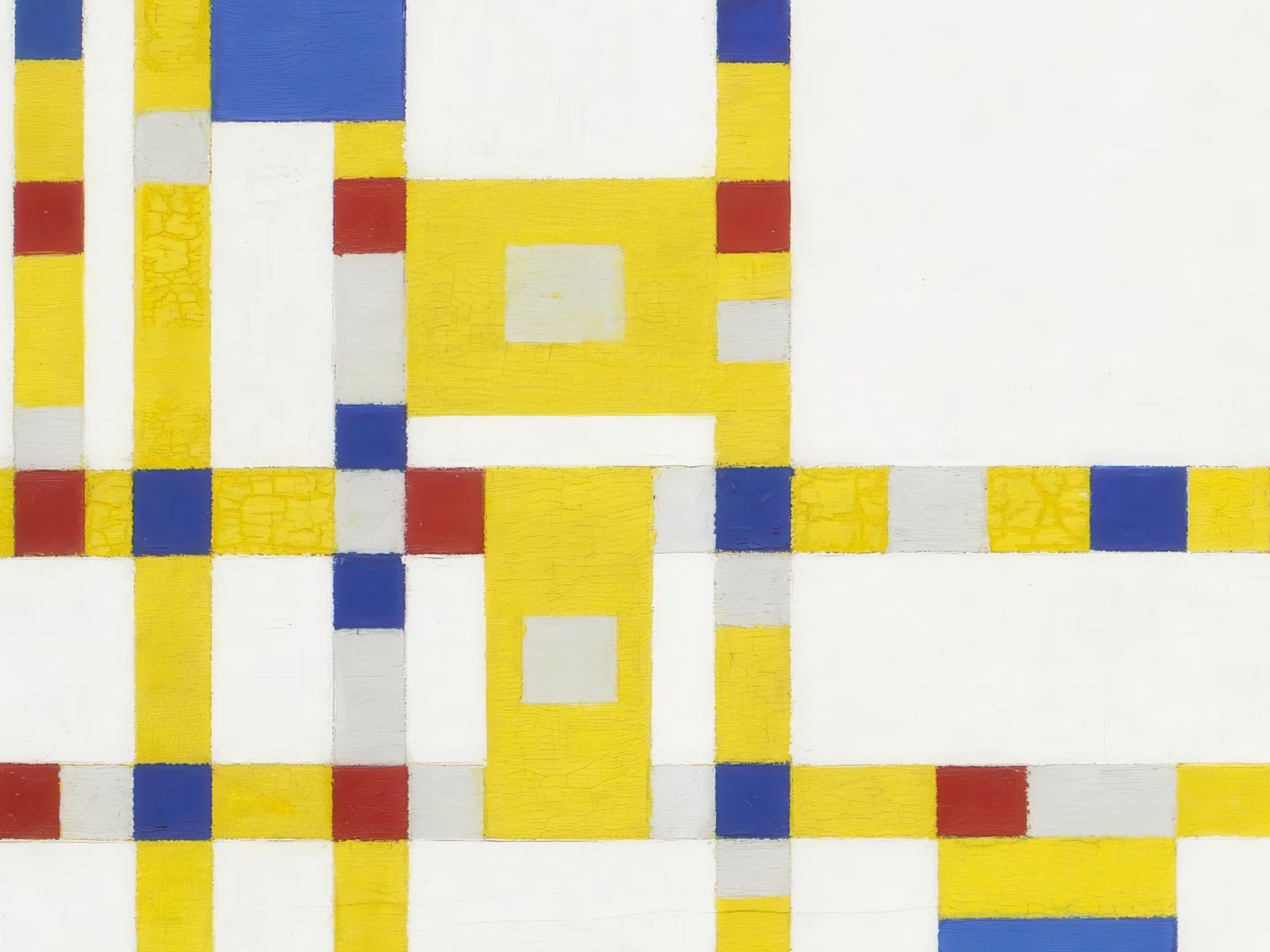
Blue and yellow change the pace
A blue block sits near a larger yellow enclosure. Following the adjacent lines reveals short changes of colour and width.
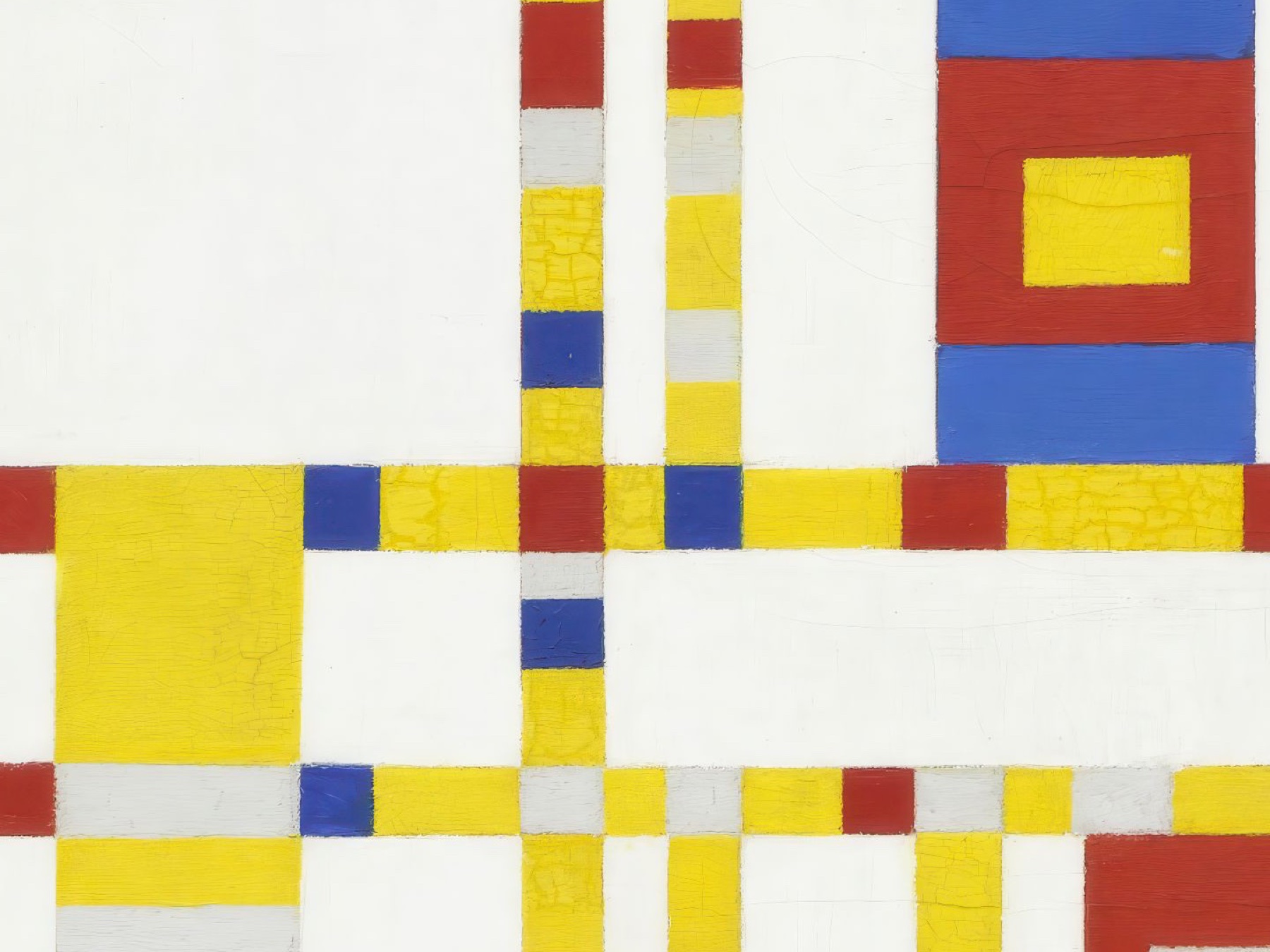
Crossings do not repeat evenly
Yellow lines meet red, blue, gray and white units around the centre. The neighbouring white intervals vary markedly in size.
Colour gathers at the right
A red square with a pale centre gathers attention among yellow routes and blue units. The surrounding paths remain visibly broken into smaller parts.
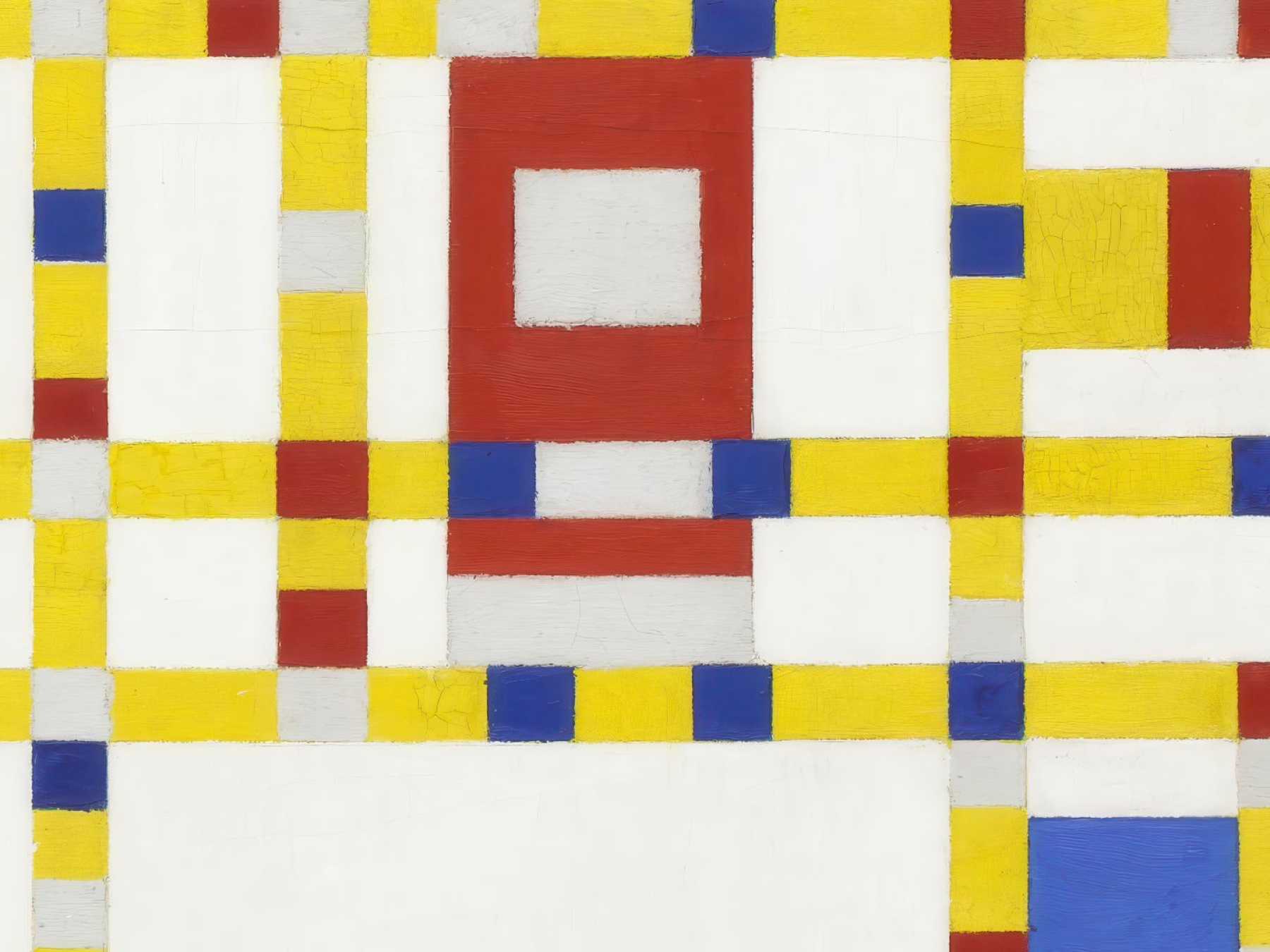
The lower bands stay active
Toward the bottom, broad white spaces alternate with dense coloured crossings. No single band keeps exactly the same rhythm all the way across.
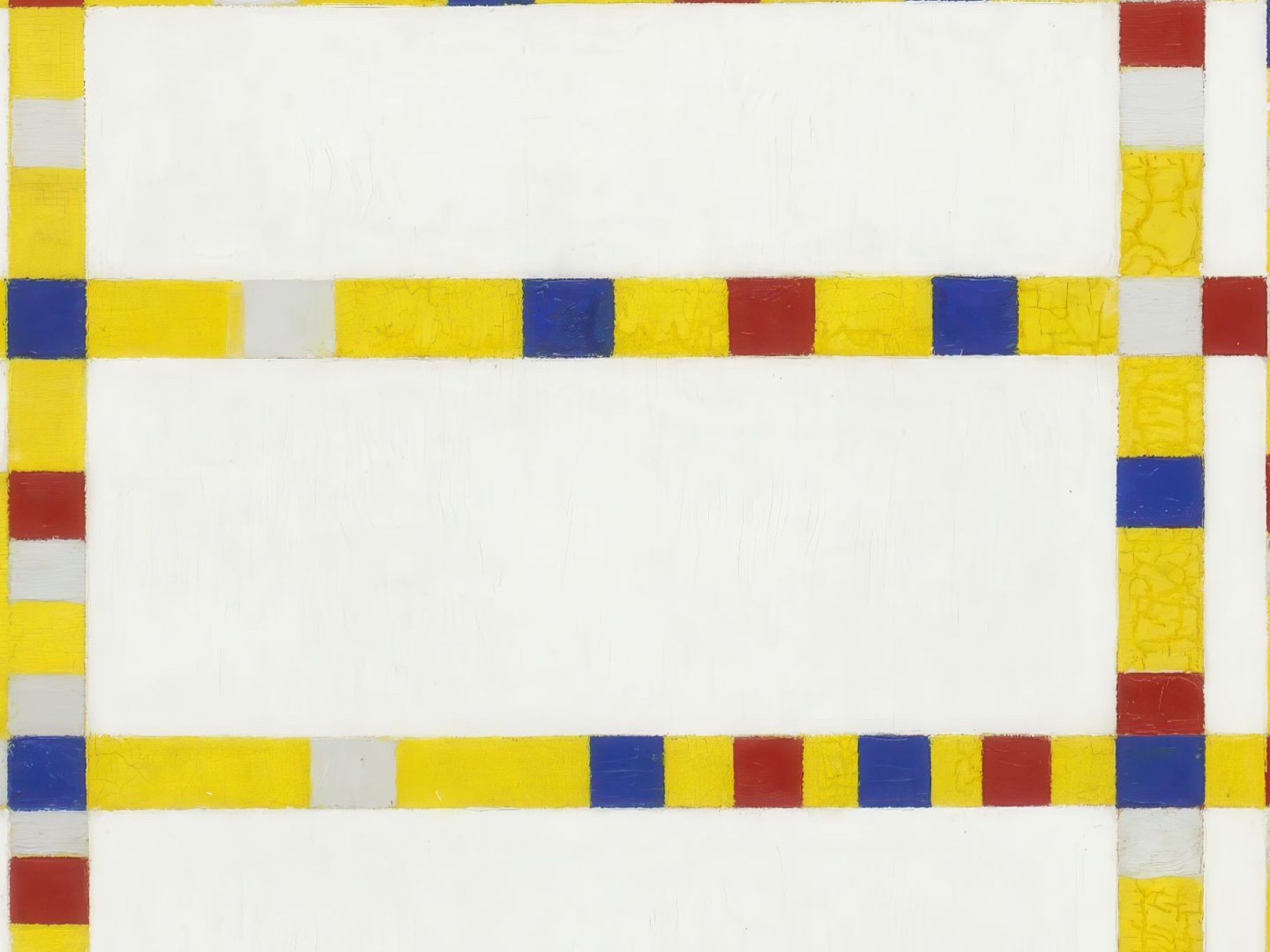
Why did Mondrian change his familiar black lines?
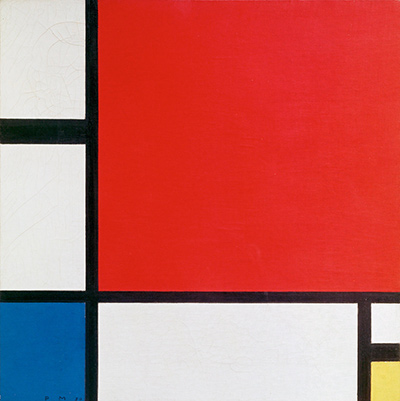
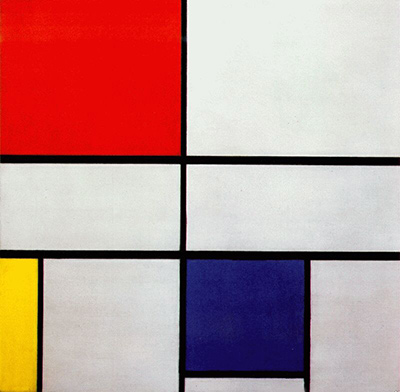
For years Mondrian had explored straight horizontal and vertical divisions with a restricted palette. In many earlier paintings, broad black bars frame coloured and white areas. The 1930 Composition with Red, Blue and Yellow in Zürich is a useful comparison: its great red field and relatively few black divisions create a very different visual tempo. Broadway Boogie Woogie keeps the perpendicular directions, yet breaks the bars into coloured segments. MoMA notes that the black of the earlier format disappears from the final picture.[1][6]
This change was part of a longer development, not a complete break made in one evening. MoMA's retrospective account traces Mondrian's mature Neo-Plastic language through the 1920s, a particularly austere group around 1929–32, and the growing role of doubled lines later in the 1930s. In New York, he revised earlier works as well as making new ones. The coloured paths of Broadway Boogie Woogie transform problems he had pursued for decades: how lines divide a surface, how unequal parts can hold together, and how a painting can achieve balance without symmetry.[6]
The absence of black does not mean the painting has abandoned structure. Instead, boundaries are established by the relationships between neighbouring colours, gaps and changing lengths. The work is still visibly Mondrian's, even as its pulse differs from the quiet concentration of many Paris paintings. The comparison also guards against a neat but false story in which an artist simply exchanged a rigid European style for carefree American improvisation. The finished canvas is lively and painstakingly calibrated.[1][3]
What do Broadway and boogie-woogie have to do with it?
Mondrian arrived in New York in 1940 after leaving Europe during the Second World War. MoMA says he encountered boogie-woogie music on his first evening in the city and became strongly attracted to it. The genre, developed by Black musicians and carried north through migration, was already part of New York's musical life. Its rolling piano patterns and offbeat accents help explain why a painting with interrupted, crossing paths acquired such a title. The historical music has its own makers and history; it should not be reduced to a fashionable label attached to a European painter.[1][4][5]
Broadway adds another point of reference. Temkin describes it as a busy thoroughfare and a centre of theatres and musical culture. The title connects the city's streets and its sounds, yet it remains a title for an abstract composition. A viewer may imagine lights, routes or a dance, but none of these is a literal image painted into the canvas. The work invites such associations because the spacing and colour actually feel quick and changing.[4]
MoMA's collection interpretation links the small blocks' visual pulse with the syncopation of boogie-woogie. Jazz musician Jason Moran offered a later, explicitly personal response when he treated the image as a possible musical score in a MoMA feature. His performance shows one way a musician could engage with Mondrian's structure. It is valuable as reception, though it cannot tell us precisely how Mondrian heard each painted square or whether a given rectangle represents a particular note.[1][7]
How was the painting made?
A close study of the actual canvas changes the story that a clean reproduction can tell. Conservators and researchers Ana Martins, Cynthia Albertson, Chris McGlinchey and Joris Dik examined the work with X-ray fluorescence mapping, ultraviolet light, radiography and other methods. Their published findings suggest that Mondrian began with an asymmetric network of interlacing red and yellow bars, then extensively reworked it. He divided continuous bars with small squares, altered the size or shade of many areas, and changed larger coloured shapes. The visible arrangement is the result of decisions made over time.[3]
The team found evidence of paint beneath the current surface, including red that once occupied more space. In some areas Mondrian scraped paint away before changing a passage; elsewhere he painted over it. Microscopic examination found successive campaigns of adjustment in both large and small shapes. The study also records pencil marks used in places to set a boundary. These traces make it difficult to speak of the work as though Mondrian merely laid down a predetermined pattern of squares.[3]
The research dates the painting's development between June 1942 and March 1943. It relates the early red-and-yellow framework to other New York compositions made with intersecting coloured bars. A recollection by Charmion von Wiegand, cited in the technical article, also describes the two Boogie Woogie pictures beginning with lines of primary colour. By autumn 1942, the bars of Broadway Boogie Woogie had given way to bands made of smaller blocks. The exact sequence of every individual alteration remains a research question; the well-supported conclusion is that the form evolved substantially.[3]
This matters to a viewer standing before the painting or studying a reproduction. Its liveliness does not depend on careless execution. Mondrian kept testing how a small change affected the whole. A red block painted over by yellow, or a line divided by gray, could shift the rhythm across a wide area. Technical evidence gives material form to what close looking already suggests: the work's apparent simplicity conceals a dense process of revision.
Watch: Piet Mondrian
See his studio, the move toward geometric abstraction and the rhythms of his New York paintings.
Piet Mondrian: Abstract Painting as We Know It
Curator Michael White explores the paintings and Mondrian’s studio as an abstract space.
Watch on YouTubeWhat does its surface reveal?
The painting is often reduced in reproduction to five crisp colours. The technical team found more subtle differences. White areas that look uniform under normal light responded differently under ultraviolet light; some blue and red passages show evidence of adjustment; and yellow areas vary in composition and tone. Chemical analysis pointed to several pigments and mixtures, including cadmium-based yellows and reds, ultramarine blue and different whites. These findings are about the material canvas, not a claim that every variation visible in a digital image faithfully reproduces its current surface.[3]
The researchers also documented condition problems, especially cracking in yellow paint and underlying red appearing through some cracks. They considered several possible contributing factors, including the materials, Mondrian's layering and later conservation treatments. Their paper did not settle on one cause. It also distinguishes the artist's revisions from later inpainting and other treatment. That caution is important: visible changes in an ageing painting cannot automatically be assigned to its maker, even when the artist himself was unusually willing to alter the work.[3]
For most readers, the useful lesson is not a list of chemical elements. It is that a painting which looks like a pristine diagram is a worked physical object. Mondrian's colours were applied in layers, some passages were scraped or repainted, and later conservators have had to care for an unstable surface. The picture's visual rhythm and its material history are connected, but neither can be reduced to the other.
Where did the painting go after Mondrian finished it?
The technical study says Broadway Boogie Woogie was first shown at the Valentine Dudensing Gallery in March 1943. MoMA's provenance record then places it with the museum later in 1943: MoMA purchased it from or through Valentine Gallery using funds provided by an anonymous donor. Its credit line reads “Given anonymously,” but the provenance gives the more precise account of the transaction. The painting remains in MoMA's collection as object 73.1943.[1][3]
It has been included in numerous later exhibitions and collection installations, as MoMA's object page records. That history demonstrates continuing interest in Mondrian's late work, but a list of installation images is not a promise that the canvas will always be hanging in a gallery. Visitors should check the museum's current record before planning a trip around a particular painting.[1]
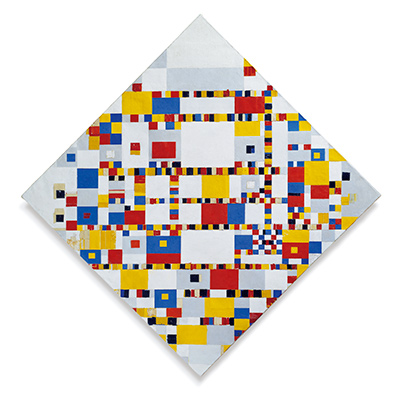
The work occupies a special position in Mondrian's final years because it was the last painting he completed. Victory Boogie Woogie followed but remained unfinished when he died in 1944. They share a title family and a restless visual energy, yet they are not interchangeable objects. Broadway is the square MoMA canvas B323; Victory is a separate work B324, with its own materials, form and later history.[2][3]
Why does it still feel new?
Broadway Boogie Woogie can be recognised immediately, even by someone who knows few Mondrian paintings. Its yellow crossings and scattered coloured interruptions give the eye many possible routes. Yet the canvas resists a quick summary. Follow one line and a small change holds you back; step away and the larger white spaces become clearer; return to the surface and the repeated reworking behind its final state becomes part of what you see.
The painting joins Mondrian's long pursuit of ordered relations to a new visual pulse. It does so without painting a specific street or transcribing a score. New York and boogie-woogie are real parts of its context, while the canvas remains a constructed arrangement of colour, space and rhythm. Its achievement lies in making those elements feel continually in motion inside a precisely bounded square.[1][3][4]
How did contemporaries understand the final change?
A memorial account issued by MoMA in 1945, close to Mondrian's death, already treated Broadway Boogie Woogie and unfinished Victory Boogie Woogie as a culmination of his earlier experiments. It described the previous black lines as feeling increasingly oppressive to him and the first New York paintings as replacing them with coloured bands. The account likened the persistence of right angles beneath many small colour changes to a musical bass pattern. This is a historically valuable early reading, though its musical analogy should not be mistaken for a score left by the artist.[8]
MoMA's object record gives another way to separate the historical canvas from its fame. The painting was acquired in 1943, through the Valentine Gallery with funds supplied by an anonymous donor, and entered the collection as 73.1943. The museum's current description calls it oil on canvas. This differs from the visible tape and paper recorded on the unfinished Victory; techniques used during planning should not be confused with a final medium entry for Broadway.[1]
Modern technical work adds a further correction to the idea of instant musical improvisation. MoMA's conservation team reports revisions hidden beneath the surface, and the published cross-institutional study maps changes to both large bars and tiny blocks. Mondrian could respond to music and city movement while testing his painted decisions slowly. In the finished picture, speed is an effect achieved through repeated revision, not proof that the artist worked quickly.[3][9]
Mondrian artworks directory
Frequently asked questions
When was Broadway Boogie Woogie painted?
Where is the original painting?
It belongs to The Museum of Modern Art in New York, object 73.1943. MoMA's object page should be checked for its current display status before visiting.[1]
What do the coloured squares represent?
Is Victory Boogie Woogie the same painting?
No. RKD lists Broadway Boogie Woogie as B323 and the unfinished Victory Boogie Woogie as B324. They are distinct works from Mondrian's final years.[2]
Was the pattern planned from the start?
Technical examination shows substantial revision. Researchers found an earlier red-and-yellow bar structure beneath the current surface, along with overpainting, changes to individual blocks and some scraping.[3]
Discussion
Where does your eye pause as it follows one of the yellow paths across the canvas?
Reader Insights
Follow the black bars from the upper left to the blue and yellow corners. Where does your eye stop?
Which smaller field seems to answer the red most strongly, and does that change after a second look?
How does this 1942–43 painting differ from Mondrian’s 1930 Zürich composition and his unfinished Victory Boogie Woogie?
Join the Conversation
Share what you notice in this painting below.
References
- The Museum of Modern Art, collection record for Piet Mondrian, Broadway Boogie Woogie, object 73.1943. View source.
- RKD – Netherlands Institute for Art History, Mondrian catalogue raisonné, New York sequence B296.318–B324, entries B323 and B324. View source.
- Ana Martins, Cynthia Albertson, Chris McGlinchey and Joris Dik, “Piet Mondrian's Broadway Boogie Woogie: non invasive analysis,” npj Heritage Science 4 (2016), article 22. View source.
- The Museum of Modern Art, Ann Temkin, audio guide for Broadway Boogie Woogie. View source.
- The Museum of Modern Art, “Mondrian Boogie Woogie,” exhibition introduction. View source.
- The Museum of Modern Art, “Major Mondrian Retrospective Opens at the Museum of Modern Art,” 1995, pp. 2–4. View source.
- The Museum of Modern Art, “Jason Moran plays Piet Mondrian's Broadway Boogie Woogie,” MoMA Magazine. View source.
- The Museum of Modern Art, 1945 memorial exhibition release, on the late paintings and coloured bars. View source.
- The Museum of Modern Art, “New Conservation Research on Piet Mondrian,” describing imaging evidence of revisions to Broadway Boogie Woogie. View source.
- Lead and annotated image credit. Piet Mondrian, Broadway Boogie Woogie, 1942–43. Oil on canvas, 127 × 127 cm. The Museum of Modern Art, New York, 73.1943. High-resolution reproduction supplied by the site owner as public domain.